• 검색 결과가 없습니다.

Learning Curve of a Young Surgeon’s Video-assisted Thoracic Surgery Lobectomy during His First Year Experience in Newly Established Institution

N/A
N/A
Protected

Academic year: 2021

Share "Learning Curve of a Young Surgeon’s Video-assisted Thoracic Surgery Lobectomy during His First Year Experience in Newly Established Institution"

Copied!
5
0
0

로드 중.... (전체 텍스트 보기)

전체 글

(1)

http://dx.doi.org/10.5090/kjtcs.2012.45.3.166 ISSN: 2233-601X (Print) ISSN: 2093-6516 (Online)

1

Department of Thoracic and Cardiovascular Surgery, Pusan National University Yangsan Hospital, Pusan National University School of Medicine,

2

Department of Thoracic and Cardiovascular Surgery, Pusan National University Hospital, Pusan National University School of Medicine

Received: March 9, 2011, Revised: December 19, 2011, Accepted: January 25, 2012

Corresponding author: Yong Joon Ra, Department of Thoracic and Cardiovascular Surgery, Pusan National University Yangsan Hospital, Pusan National University School of Medicine, 20 Geumo-ro, Yangsan 626-787, Korea

(Tel) 82-55-360-2127 (Fax) 82-55-360-2157 (E-mail) [email protected]

C

The Korean Society for Thoracic and Cardiovascular Surgery. 2012. All right reserved.

CC

This is an open access article distributed under the terms of the Creative Commons Attribution Non-Commercial License (http://creative- commons.org/licenses/by-nc/3.0) which permits unrestricted non-commercial use, distribution, and reproduction in any medium, provided the original work is properly cited.

Learning Curve of a Young Surgeon’s Video-assisted Thoracic Surgery Lobectomy during His First Year Experience in

Newly Established Institution

Yong Joon Ra, M.D.

1

, Hyo Yeong Ahn, M.D.

2

, Min Su Kim, M.D.

2

Background: The purpose of this paper is to present a guideline for beginning video-assisted thoracic surgery (VATS) lobectomy to junior surgeons, and to review the first year experience of a new surgeon performing VATS lobectomies who had not performed a VATS lobectomy unassisted during his training period. Materials and Methods: A young surgeon opened a division of general thoracic surgery at a medical institution. The surgeon had performed about 100 lobectomies via conventional thoracotomy during his training period, but had never per- formed a VATS lobectomy unassisted while under the supervision of an expert. After opening the division of gen- eral thoracic surgery, the surgeon performed a total of 38 pulmonary lobectomies for various pulmonary diseases from March 2009 to February 2010. All data were collected retrospectively. Results: There were 14 lobectomies via thoracotomy, 14 VATS lobectomies, and 10 cases of attempted VATS lobectomies that were converted to open thoracotomies. The number of VATS lobectomies increased from the second quarter (n=0) to the third quarter (n=5). The lobectomies that were converted from VATS into thoracotomies decreased from the second quarter (n=5) to the third quarter (n=1) (p=0.002). Conclusion: It can take 6 months for young surgeons without experi- ence in VATS lobectomy in their training period to be able to reliably perform a VATS lobectomy.

Key words: 1. Thoracoscopy 2. Lobectomy 3. Learning curve

INTRODUCTION

Pulmonary lobectomy is the elementary surgical technique for lung diseases such as lung cancer and inflammatory lung disease. A pulmonary lobectomy can be performed using tra- ditional thoracotomy or by video-assisted thoracoscopic sur- gery (VATS). The first report of a VATS lobectomy was in 1992 [1], and since then it has been replacing conventional

lobectomy via thoracotomy because there is less pain, faster recovery, and other advantages over thoracotomy [2,3].

However, it is difficult for a trainee such as a thoracic surgi-

cal resident or fellow to perform a VATS lobectomy because

of technical challenges such as the management of surgical

instruments and disastrous complications such as pulmonary

artery injury. Therefore, it is very difficult for a thoracic

trainee or thoracic surgeon who has never singlehandedly per-

(2)

Table 1. Characteristics of the patients

Variable Value

Sex (n=38)

Age (yr)

Diagnosis

Operation

Male Female Mean Range Inflammation Lung cancer Others

Open lobectomy Conversion lobectomy VATS lobectomy

21 17 54.8 10−81

6 29 3 14 10 14 VATS, video-assisted thoracic surgery.

formed a VATS lobectomy to perform one. This paper illus- trates the progress in the performance of VATS lobectomy of a young surgeon who had never performed one in his train- ing period and how he developed his skill in independently performing VATS lobectomy.

MATERIALS AND METHODS

This study examines the procedures used for 38 pulmonary lobectomy cases performed by a single surgeon from March 2009 to February 2010 (Table 1). All data were reviewed ret- rospectively from the medical records. The data were grouped into the three groups: conventional lobectomy through thor- acotomy, VATS lobectomy, and lobectomy via converted thoracotomy after a VATS attempt. We compared the in- crease or decrease in the frequency of use of each of the three approaches to lobectomy over time. We also compared parameters such as length of hospital stay, chest tube dura- tion, and surgical time. The protocol for this retrospective study was approved by our institutional review board.

1) Our center

Our institute has been open since November 2008, but the general thoracic surgery service was not available until a thoracic surgeon joined the center in March of 2009 and opened the Division of the General Thoracic Surgery. This thoracic surgeon had performed more than 100 lobectomies via thoracotomy and was competent in minor VATS proce- dures, such as wedge resection, through the experience of his fellowship period. He had also assisted in approximately 100 VATS lobectomy procedures and observed many VATS lo- bectomies; however, he had never performed a VATS lobec- tomy by himself during his training period.

2) Surgical technique of video-assisted thoracoscopic surgery lobectomy

The patients were placed in the lateral decubitus position.

After inserting a thoracoscopy at the junction of the 8th inter- costal space and posterior axillary line, we then made three 5 cm working ports: one at the crossing point of the 5th inter- costal space, another at the anterior axillary line, and a third port at the subscapular point of the 6th or 7th intercostal

space. We divided the connective tissue, specifically the ad- hesion bands and the inferior pulmonary ligament with a Bovie electrocautery unit, lung parenchyme such as fissure were seprated with an Endo-GIA green stapler (Covidien, Norwalk, CT, USA). The large were ligated using an Endo-GIA white stapler, and small branches of the pulmonary artery were ligated using a Weck clip (Teleflex, Research Triangle Park, NC, USA). All the surgical procedures were performed by viewing the surgical field through the monitor.

When the patients were diagnosed with lung cancer, media- stinal lymph nodes were dissected completely. To treat the cancer on the right side, the right inferior pulmonary liga- ment, subcarinal lymph nodes, right lower paratracheal nodes, and upper paratracheal nodes were dissected. To treat cancer on the left side, the left inferior pulmonary ligament, sub- carinal lymph nodes, left lower paratracheal subaortic nodes, and para-aortic nodes. A 28 Fr sized chest tube was inserted and then the operation was finished. This process was estab- lished on the basis of the visual observation of the senior surgeon during the junior surgeon’s fellowship.

3) Statistical analysis

The data were processed by SPSS ver. 12.0 (SPSS Inc.,

Chicago, IL, USA) and the chi-squared test. Analysis of var-

iance and logistic regression analysis were used for interpret-

ing the data. A p-value less than 0.05 was considered statisti-

cally significant.

(3)

Table 2. Disease category for surgical procedures

Operation Disease N (%) p-value

VATS lobectomy

Open lobectomy

Thoracotomy conversion

Inflammatory disease Lung cancer Benign mass Inflammatory disease Lung cancer Benign mass Inflammatory disease Lung cancer Benign mass

2 (14.3) 9 (64.3) 3 (21.4) 1 (7.1) 13 (92.9)

0 (0) 3 (30) 7 (70) 0 (0)

0.189

VATS, video-assisted thoracic surgery.

Table 3. Surgical pattern according to the time period

Case 2009.03−2009.05 2009.06−2009.08 2009.09−2009.11 2009.12−2010.02 p-value

Thoracotomy lobectomy Thoracotomy conversion VATS lobectomy Total

5 (62.5) 2 (25.0) 1 (12.5) 8 (100.0)

3 (37.5) 5 (62.5)

0 (0) 8 (100.0)

6 (50.0) 1 (8.3) 5 (41.7) 12 (100)

0 (0) 2 (20) 8 (80) 10 (100)

0.002

Values are presented as number (%).

VATS, video-assisted thoracic surgery.

RESULTS

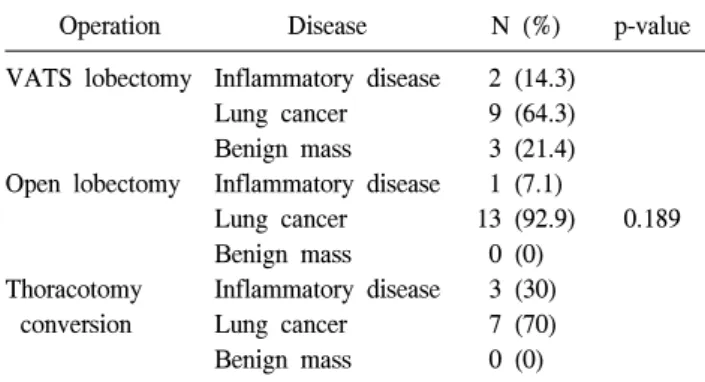
In our institute, the thoracic surgical team performed a to- tal of 38 cases of lobectomy during the first year. Detailed characteristics of the patients are shown in Table 1. Of those patients, 14 lobectomies were performed using open thor- acotomy, and the other 14 lobectomies were performed using VATS. In 10 patients, VATS lobectomy was initially at- tempted but the surgical procedure was converted into an open thoracotomy (Table 2).

There was no operative mortality. The number of VATS lobectomy procedures increased from the second quarter of the year to the third quarter, while conventional lobectomy via thoracotomy decreased from the third to the forth quarter.

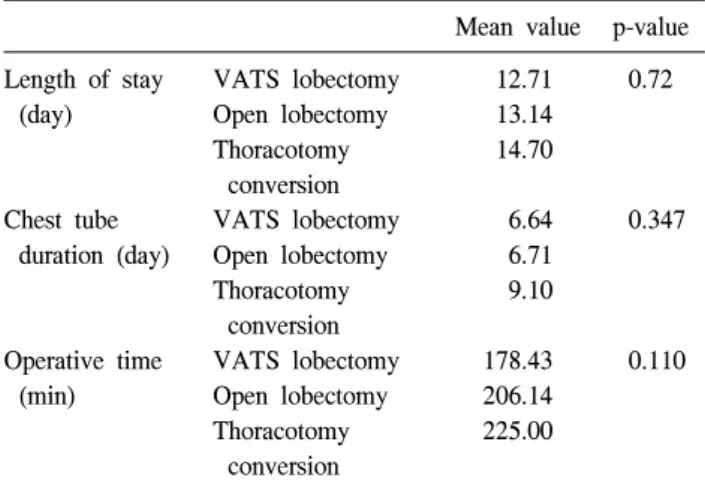
The number of conversions of VATS to thoracotomy de- creased from the second to the third quarter. These results show statistical significance (p=0.002). We concluded, there- fore, that the third quarter was the turning point, in which VATS lobectomies increased and conversions from VATS to thoracotomy decreased (Table 3). Although there was no stat- istical difference in the operative time, days of hospital-

ization, and chest tube removal time were generally the short- est in VATS lobectomy group (Table 4). In the VATS to thoracotomy conversions, the most common cause of the con- version was fibrous adhesion, which occurred in 5 cases, fol- lowed by bleeding in 3 cases, and oncology considerations in 2 cases.

DISCUSSION

Since the first series of lobectomies using VATS were re- ported in 1992 [1], several authors have reported on the fea- sibility and safety of this procedure [2,3]. Many reports have shown that the long term result of VATS major pulmonary resection and mediastinal lymph node dissection are equiv- alent to conventional thoracotomy in non-small cell lung can- cer [2,4-6]. Therefore, VATS lobectomy has been substituted for conventional thoracotomy with the improvement of video equipment and auto-stapler devices for treating diverse pul- monary diseases. VATS lobectomy is also superior in the management of post-operative pain and decompression of res- piratory function, and is outstanding in the reduction of health care costs.

However, even with these advantages, VATS lobectomy is a challenging procedure for beginner thoracic surgeons due to their inexperience in handling the instruments, obstacles cre- ated by the instruments that are caused by inappropriate port incisions, and most of all, catastrophic events resulting from pulmonary artery injury. When a general thoracic surgical di- vision is opened in a center without a history of performing VATS lobectomy, it is especially challenging to perform VATS lobectomies due to inexperienced assistants and an un- established protocol for pulmonary artery injury.

VATS lobectomy procedures can definitely be taught to

(4)

Table 4. The differences between the various parameters of the procedures

Mean value p-value Length of stay

(day)

Chest tube duration (day)

Operative time (min)

VATS lobectomy Open lobectomy Thoracotomy

conversion VATS lobectomy Open lobectomy Thoracotomy

conversion VATS lobectomy Open lobectomy Thoracotomy

conversion

12.71 13.14 14.70

6.64 6.71 9.10

178.43 206.14 225.00

0.72

0.347

0.110

VATS, video-assisted thoracic surgery.

thoracic trainees during their training program under super- vision of a thoracic expert [7,8]. However, it is unclear whether it is advisable for thoracic surgeons who have opened a new division of thoracic surgery and have received training in an institute in which they could not perform VATS lobectomy unassisted while under the supervision of an expert, to start performing VATS lobectomies. This ques- tion could be answered with the data that few centers per- form this type of surgery, and 45% of VATS lobectomies worldwide are performed in the UK [7].

This paper contributes to answering the question of wheth- er junior surgeons who spent their training period in a center where they could not perform a VATS lobectomy unassisted while under the supervision of an expert could go on to per- form VATS lobectomies independently. Even though a center may not provide such training, the competency of assistants for handling thoracoscopy and having a well-prepared proto- col for complications such as pulmonary artery injury are def- initely important. However, a surgeon must have a precise understanding of the anatomy of lung because this is the most important part of performing a VATS lobectomy.

Therefore, if junior thoracic surgeons had a precise under- standing of the anatomy of the pulmonary artery and lung pa- renchyme, learning to perform a VATS lobectomy would be a normal process. Acquiring this understanding, as well as training in the operating room, can be established at a VATS conference.

When the new division of thoracic surgery opened, I per- formed all the lobectomies only by open thoracotomy during the initial 2 months. This plan was intended to make the lo- bectomy procedure familiar to the surgical nurses and residents. After this period, VATS lobectomy was performed for benign diseases such as lobar bronchiectasis and was per- formed successfully. The surgical team then tried to perform a VATS lobectomy in a case of early stage lung cancer. The team became proficient in VATS lobectomy after a few con- versions to open thoracotomy. Among the reasons for the conversions, except in inevitable case such as pulmonary ar- tery injury, the most common cause for converting to thor- acotomy was minor bleeding from the lung parenchyme. The minor bleeding made it difficult to distinguish the precise anatomy of the pulmonary artery and lung parenchyme, which necessitated a conversion to open thoracotomy.

However, this problem can be solved after 6 months of expe- rience (Table 3).

Although there was no statistical significance due to the small number of cases, the duration of hospital stay, tube re- moval time, and operation time were the shortest in the VATS lobectomy group, and the longest in the conversion group (Table 4). These results coincide with the results of previous reports [9]. Obviously, operating time is prolonged in conversion cases because of the additional time needed to control bleeding and repairing lung parenchymal or arterial injuries (Table 4). Over time, the time to perform VATS lo- bectomies was clearly reduced, but the wedge resection time and waiting time for frozen examination were included in op- eration time; we regret that we could not measure the precise operation time without those procedures.

Although there was no statistical significance due to the small number of cases, it became apparent that effort should be directed toward decreasing the conversion rate from VATS lobectomy to open thoracotomy for patients with inflam- matory lung disease complicated by a distorted anatomy of the lung with severe fibrous adhesion (Table 2). Long-term follow up is mandatory for patients with lung cancer who have undergone VATS lobectomy.

This study supports the concept that junior thoracic sur-

geons, even if they have not performed a VATS lobectomy

during their training period, can become competent in per-

(5)

forming a VATS lobectomy after six months of experience in performing VATS lobectomies while concentrating entirely on open thoracotomy during the first two months as preparation for VATS lobectomy.

CONCLUSION

It took 6 months of the prescribed training for a young surgeon without experience in VATS lobectomy in his train- ing period to be able to reliably perform VATS lobectomy.

REFERENCES

1. Roviaro G, Rebuffat C, Varoli F, Vergani C, Mariani C, Maciocco M. Videoendoscopic pulmonary lobectomy for cancer. Surg Laparosc Endosc 1992;2:244-7.

2. McKenna RJ Jr, Wolf RK, Brenner M, Fischel RJ, Wurnig P. Is lobectomy by video-assisted thoracic surgery an ad- equate cancer operation? Ann Thorac Surg 1998;66:1903-8.

3. Kim HR, Cho JS, Jang HJ, et al. Video-assisted thoracic surgery lobectomy for non-small cell lung cancer: experi- ence of 133 cases. Korean J Thorac Cardiovasc Surg 2009;

42:615-23.

4. Iwasaki A, Shirakusa T, Shiraishi T, Yamamoto S. Results of video-assisted thoracic surgery for stage I/II non-small cell lung cancer. Eur J Cardiothorac Surg 2004;26:158-64.

5. Roviaro G, Varoli F, Vergani C, Nucca O, Maciocco M, Grignani F. Long-term survival after videothoracoscopic lo- bectomy for stage I lung cancer. Chest 2004;126:725-32.

6. Yamamoto K, Ohsumi A, Kojima F, et al. Long-term surviv- al after video-assisted thoracic surgery lobectomy for pri- mary lung cancer. Ann Thorac Surg 2010;89:353-9.

7. Ferguson J, Walker W. Developing a VATS lobectomy pro- gramme: can VATS lobectomy be taught? Eur J Cardiothor- ac Surg 2006;29:806-9.

8. Petersen RH, Hansen HJ. Learning thoracoscopic lobectomy.

Eur J Cardiothorac Surg 2010;37:516-20.

9. Casali G, Walker WS. Video-assisted thoracic surgery lo- bectomy: can we afford it? Eur J Cardiothorac Surg 2009;

35:423-8.

수치

Table 1. Characteristics of the patients Variable Value Sex  (n=38) Age  (yr) Diagnosis Operation Male FemaleMeanRange InflammationLung  cancerOthers Open  lobectomy Conversion  lobectomy VATS  lobectomy 2117 54.8 10−81  629  3141014 VATS,  video-assisted
Table 2. Disease category for surgical procedures
Table 4. The differences between the various parameters of the  procedures

참조

관련 문서

- Zero was not used until Middle age in western Europe, which partially explains why we do not have a year 0 in

The index is calculated with the latest 5-year auction data of 400 selected Classic, Modern, and Contemporary Chinese painting artists from major auction houses..

management of community-acquired pneumonia: an evidence- based update by the Canadian Infectious Diseases Society and the Canadian Thoracic Society. The

Its reputation as the priciest real estate market in the world has guaranteed Hong Kong a place in the lower half of our investment rankings survey almost every year since

Pathology, Internal Medicine, Neuroscience, Psychiatry, Pediatrics, Dermatology, Surgery, Thoracic and Cardiovascular Surgery, Neurosurgery, Orthopedic Surgery,

§ Due to the late start of construction and frequent design changes during construction, the completion of the project has been one year delayed. of the project has been

In this study, using concept mapping of a variety of learning techniques in the area of science, especially biology, has a positive effect on learning

Since the two countries have established diplomatic relations in 1992, the trade between Korea and China has been developing rapidly, By the end of 2006, Korea