• 검색 결과가 없습니다.

Video-Assisted Thoracic Surgery Thymectomy: Subxiphoid Approach

N/A
N/A
Protected

Academic year: 2021

Share "Video-Assisted Thoracic Surgery Thymectomy: Subxiphoid Approach"

Copied!
5
0
0

로드 중.... (전체 텍스트 보기)

전체 글

(1)

JCS

Journal of Chest Surgery

Video-Assisted Thoracic Surgery Thymectomy: Subxiphoid Approach

Sukki Cho

Department of Thoracic and Cardiovascular Surgery, Seoul National University Bundang Hospital, Seongnam, Korea

ARTICLE INFO Received June 1, 2021 Accepted July 16, 2021 Corresponding author SukKi Cho

Tel 82-31-787-7132 Fax 82-31-787-4050 E-mail [email protected] ORCID

https://orcid.org/0000-0002-9309-8865

In this paper, I present the technique of subxiphoid single-port video-assisted thoracic surgery (VATS) thymectomy for thoracic surgeons to perform this procedure safely. This procedure is indicated for all anterior mediastinal masses and may be extended to lung cancer. The patient is placed in the lithotomy position, and the operator should be on the midline. Below the xiphoid process, a skin incision is made 4–5 cm horizontally at a single thumb’s width down. Under two-lung ventilation, CO

2

is insufflated, maintaining 10 mm Hg. The fat tissue and thymic tissue are all resected from the sternum and pericardium between both phrenic nerves using an articulated grasper and an energy device. After re- trieval of the mass with a wrap bag, a Jackson-Pratt drain is inserted instead of a chest tube.

One of the advantages of this procedure is less postoperative pain than intercostal VATS.

The subxiphoid approach can be used for bilateral pneumothorax, bilateral pulmonary metastasectomy, and simple lobectomy for both upper lobes and the right middle lobe.

Keywords: Thymectomy, Subxiphoid, Video-assisted thoracic surgery, Single port

Copyright © 2021, The Korean Society for Thoracic and Cardiovascular Surgery

This is an Open Access article distributed under the terms of the Creative Commons Attribution Non-Commercial License (http://creativecommons.org/licenses/

Introduction

Minimally invasive surgery for anterior mediastinal tu- mors includes the bilateral intercostal, cervical, and subx- iphoid approaches. The intercostal approach was first per- formed by Landreneau et al. [1] in 1992, and is now the most popular approach. The cervical approach was initially performed by Cooper et al. [2] in 1988, but further use of this approach has not been reported in Korea. The subx- iphoid approach was first performed by Kido et al. [3] in 1999 and was further advanced by Suda et al. [4]. In this paper, I would like to elaborate on single-port video-assist- ed thoracic surgery (VATS) thymectomy through the subx- iphoid approach for anterior mediastinal tumors, with the goal of enabling beginners to perform this procedure safely.

Indications

This method is indicated for almost all anterior medias- tinal masses, except masses with vascular invasion (espe- cially invasive thymomas). Funnel chest, cardiomegaly, and a large tumor (>5 cm) are relative contraindications. In ad-

dition to anterior mediastinal masses, this approach is also highly suitable for lymph node metastasis to the internal mammary chain or cardiophrenic angle. Some surgeons have used this technique for lung cancer surgery, but in my opinion, doing so is premature because of the great diffi- culty of performing both lower lobectomy and subcarinal lymph node dissection, similar to the conventional VATS procedure.

Anatomy of the subxiphoid area

The anterior mediastinum is located between the body of the sternum in the front and the anterior pericardium posteriorly (Fig. 1). It contains loose connective tissue, me- diastinal fat, and the body of the thymus.

Procedure

Anesthesia

In principle, a single-lumen endotracheal tube can be used because one-lung ventilation is not necessary. Howev-

https://doi.org/10.5090/jcs.21.052 pISSN: 2765-1606 eISSN: 2765-1614 J Chest Surg. 2021;54(4):314-318

Collective

of Current

Reviews,

Lectures

(2)

Sukki Cho. Video-Assisted Thoracic Surgery Thymectomy: Subxiphoid Approach JCS

er, it is convenient to use a double-lumen endotracheal tube if the tumor is large or lung invasion is suspected. In- tensive arterial monitoring is required because of the pos- sibility of CO

2

retention with CO

2

insufflation and cardiac compromise during surgery or when the tumor is removed.

Because the operation time is not long, it is not necessary to insert a Foley catheter or to catheterize the femoral, jug- ular, or subclavian vein in the absence of vascular invasion.

Position

The lithotomy position is preferable because the operator should be on the midline (Fig. 2). Both arms should be at attention because sternotomy may be required in some sit- uations. The drape can expose the upper abdomen, sternal notch, and mid-axillary line on both sides.

Surgical instruments

(1) Wound retractor

(2) Multiport (Lapsingle version) (3) 30° thoracoscope (5 mm or 10 mm)

(4) Grasper (5 mm), as long as possible (>30 cm): An ar- ticulating grasper is the best, such as the Artisential grasper.

(5) Energy device: Ligasure, a Harmonic scalpel, or Thunderbeat are options, but if possible, the Mary- land tip shape is preferable and it should be as long as possible (>35 cm).

(6) Vinyl bag, medium or large size

Incision and port placement

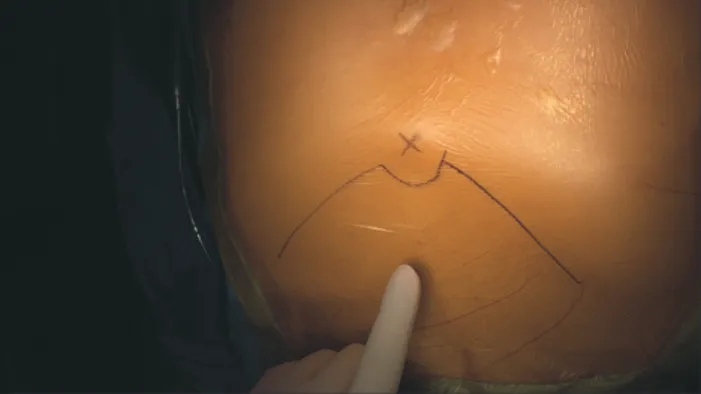
Incision (Fig. 3)

A skin incision is made 4–5 cm horizontally at a single thumb’s width down from the xiphoid process. At first, it is better to be sure to make a long enough incision, and the incision size can then be gradually reduced with practice.

There are 2 methods of skin incision: vertical and horizon- tal. The advantages of a vertical incision are that it is possi- ble not to transect the rectus muscle, and if sternotomy is also performed, the skin incision is connected. The advan- tage of a horizontal incision is that it spreads slightly better on the lateral side, thus reducing collisions between instru- ments within a single port. Therefore, the choice between a vertical and horizontal incision should be made according to the situation.

Fig. 1. Mediastinum. The anterior mediastinum is located between the body of the sternum in the front and the anterior pericardium posteriorly.

Fig. 2. Patient position. The lithotomy position is preferable, and the operator stands between the patient’s legs.

Fig. 3. Skin incision. A 5-cm horizontal incision is made below

the xiphoid process.

(3)

https://doi.org/10.5090/jcs.21.052

JCS

Port placement

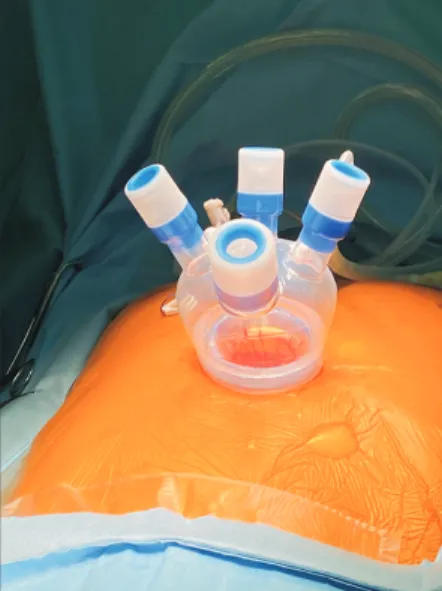
After finding the xiphoid process, the rectus muscle is transected about 1 cm to both sides and further dissection is performed 360° under the xiphoid process (Fig. 4). Using the index finger as in sternotomy, sufficient additional dis- section is performed under the sternum. Adding a wound protector, the subxiphoid area is further dissected using a monopolar Bovie under thoracoscopic guidance. The Laps- ingle is added and CO

2

insufflation is started, maintaining 10 mm Hg (Fig. 5). The position of the multiport and the location of the port for instruments are very important.

The bilateral pleurae are opened and both lungs continue to be ventilated while maintaining the pressure of CO

2

at around 10 mm Hg (Fig. 6).

Thymectomy

When sufficient space is available for the subxiphoid ap-

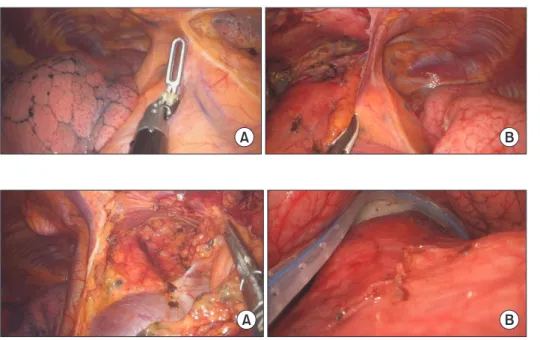
proach, the next step is to drop the thymic tissue from the sternum. The boundary between the 2 sides is formed by the mammary vein, and dissection proceeds upward, close- ly adhering to the sternum. The mediastinal pleura is opened by reaching as far as possible where the mammary vein on both sides inserts into the innominate veins. After con- firming that there is no bleeding, the thymic and pericar- dial fat is again dissected, as well as pleural fat from the in- let of the incision. If myasthenia gravis (MG) is present, more complete dissection will be necessary. During dissec- tion, it is necessary to check the course of both phrenic nerves (Fig. 7). In particular, if there is a suspicion that the thymic tumor invades the surrounding organs, they should

Fig. 6. Open pleura. Dissection of the substernal tissue using an ener- gy device (A), opening of the right pleura (B), opening of the left pleu- ra (C), and dissection of the subster- nal thymic tissue (D).

A B

C D

Fig. 4. Before port placement. The rectus muscle is transected about 1 cm horizontally and further dissection is performed 360°

under the xiphoid process. Fig. 5. After port placement. The multiport is added and CO

2

insuf-

flation is started, maintaining 10 mm Hg.

(4)

Sukki Cho. Video-Assisted Thoracic Surgery Thymectomy: Subxiphoid Approach JCS

be resected together to the greatest extent possible. Since it is quite possible for both lungs to have adhesions or inva- sions, an endostapler is used to resect them en bloc instead of being forced to dissect them from the mass. When en- countering the innominate vein, the thymic tissue is lifted and one proceeds upward while dissecting the front of the vein. There is no branch in this area, so there is no major problem with dissecting the vessel. Next, the left upper pole is dissected. The reason for this is that if the operator is right-handed, it seems safer empirically. Furthermore, since the left pole is larger than the right, one can think of the point of removing the left pole as the farthest place during surgery. Small branches can be clipped, but this step may vary depending on the energy device used. CO

2

insufflation is usually used, so it may seem that there are no areas of small bleeding, but when CO

2

is cut off at the end of surgery, bleeding may occur; therefore, I recom- mend using a clip if possible. The left pole is removed from the top of the innominate vein, one proceeds to the right, the tissue is dissected in front of the trachea, and the right pole is removed from the front of the left innominate ar- tery.

After total thymectomy, a wrap bag is inserted through one of the multiports, and the thymus, including the mass and adjacent fat tissue, is retrieved from the chest. It is im- portant to note that if the tumor is large and hard, it will press upon the heart as it is removed through a narrow space; therefore, the patient’s blood pressure and heart rhythm should be carefully observed.

When observing the surgical field after removing the tu-

mor, there is no temporary CO

2

in the thoracic cavity, so if there is a blood vessel for which proper hemostasis was not achieved, bleeding is visible. In the absence of bleeding, depending on the intraoperative findings of thymic dis- ease, it is recommended to check for pleural metastasis un- der one-lung ventilation. There is no need to insert a chest tube; at this point, I insert a Jackson-Pratt (J-P) drain and close the surgical field layer by layer (Fig. 8).

Postoperative management

Immediately after the operation, a chest posteroanterior radiograph should be checked in the operating room to de- termine whether there is pneumothorax. If pneumothorax is present, temporary suction can be applied to the J-P drain until the air leak is stopped. On postoperative day 1, the amount and color of the drainage are checked. If there is no evidence of chyle and the amount is less than 200 mL, the J-P drain is removed. Special medications, includ- ing painkillers, are not necessary unless the patient has MG.

Advantages

One of the advantages of this approach is that it can re- duce the frequency of bleeding caused by damage to the innominate vein, and the probability of successful hemo- stasis is very high without an open procedure because of the good visibility. In addition, it is very easy to perform median sternotomy without changing the patient’s position

A B Fig. 7. Phrenic nerve. Right phrenic

nerve (A) and left phrenic nerve (B).

A B

Fig. 8. Thymectomy. (A) Both upper

poles are removed and (B) a Jack-

son-Pratt drain is positioned after

retrieval of the mass.

(5)

https://doi.org/10.5090/jcs.21.052

JCS

when it is difficult to proceed with the subxiphoid ap- proach.

In the 1-sided VATS approach, if there are pleural adhe- sions, almost all adhesions must be released, and the air leakage is often severe due to lung damage caused by adhe- siolysis. However, the subxiphoid approach does not cause lung damage because only a small amount of adhesiolysis gives enough vision of the area to be operated on; there- fore, chest tube insertion is not required.

Postoperative pain is also an inevitable complication even after 1-sided VATS. However, the subxiphoid ap- proach causes significantly less postoperative pain than 1-sided VATS, because the intercostal nerve is not damaged by the surgical instruments during surgery, and the inter- costal or other thoracic muscles are not incised.

Disadvantages

A special instrument is required to operate in a narrow space. Most of the instruments used in VATS procedures are straight, so surgery is very difficult for patients with an exceptionally depressed sternum. Thus, it can be very use- ful to have instruments with multiple types of articula- tions. Although energy devices have a straight body, there is no particular inconvenience because the tip is curved.

Suction cannot be used freely because CO

2

insufflation is required. There is a risk of cardiac and pulmonary com- promise depending on the pressure and flow of CO

2

.

Conclusion

In the near future, the subxiphoid approach can be ap- plied to bilateral pneumothorax, bilateral pulmonary me- tastasectomy (especially for metastases on both upper lobes), and simple lobectomy for both upper lobes and the right middle lobe.

Conflict of interest

No potential conflict of interest relevant to this article

was reported.

Acknowledgments

I would like to thank Nayun Lee for drawing the figures (Figs. 1, 2) in this manuscript.

ORCID

Sukki Cho: https://orcid.org/0000-0002-9309-8865

Supplementary materials

Supplementary materials can be found via https://doi.

org/10.5090/jcs.21.052. Supplementary Video 1. A 44-year- old male patient had an anterior mediastinal tumor. The tumor size was 40 mm and no invasion of the vessel was found on a contrast computed tomography scan. The clini- cal diagnosis was a thymoma without myasthenia gravis.

This video shows total thoracotomy performed by subx- iphoid single-port video-assisted thoracic surgery. The pathological examination showed World Health Organiza- tion type AB thymoma (Masaoka-Koga stage IIA). The pa- tient was discharged a day after surgery.

References

1. Landreneau RJ, Dowling RD, Castillo WM, Ferson PF. Thoraco- scopic resection of an anterior mediastinal tumor. Ann Thorac Surg 1992;54:142-4.

2. Cooper JD, Al-Jilaihawa AN, Pearson FG, Humphrey JG, Humphrey HE. An improved technique to facilitate transcervical thymectomy for myasthenia gravis. Ann Thorac Surg 1988;45:242-7.

3. Kido T, Hazama K, Inoue Y, Tanaka Y, Takao T. Resection of anteri- or mediastinal masses through an infrasternal approach. Ann Thorac Surg 1999;67:263-5.

4. Suda T, Sugimura H, Tochii D, Kihara M, Hattori Y. Single-port

thymectomy through an infrasternal approach. Ann Thorac Surg

2012;93:334-6.

수치

Fig. 3. Skin incision. A 5-cm horizontal incision is made below  the xiphoid process.
Fig. 6. Open pleura. Dissection of  the substernal tissue using an  ener-gy device (A), opening of the right  pleura (B), opening of the left  pleu-ra (C), and dissection of the  subster-nal thymic tissue (D).
Fig. 8. Thymectomy. (A) Both upper  poles are removed and (B) a  Jack-son-Pratt drain is positioned after  retrieval of the mass.

참조

관련 문서

In this paper, we investigate the differential game theoretic approach for distributed dynamic cooperative power control in cognitive radio ad hoc networks (CRANETs).. First,

In this regard, I would like to request your full cooperation to Kangnam University when they contact you regarding the verification of enrollment

In this regard, I would like to request your full cooperation to Kangnam University when they contact you regarding the verification of enrollment

It considers the energy use of the different components that are involved in the distribution and viewing of video content: data centres and content delivery networks

Pathology, Internal Medicine, Neuroscience, Psychiatry, Pediatrics, Dermatology, Surgery, Thoracic and Cardiovascular Surgery, Neurosurgery, Orthopedic Surgery,

The purpose of this study is to investigate the effect of video- conferencing(VC) English class on affective domains of elementary school students.. They

This paper is written to find answers of the research question that the 'Meeting First, Key-issue Agreement Later" approach of the US and South Korea

Patient had laparoscopic surgery on the adnexal tumor and excised tissue was removed through Douglas pouch incision by single surgeon.. Results: The mean age