• 검색 결과가 없습니다.

Video-Assisted Thoracic Surgery (VATS) Lobectomy for Pathologic Stage I Non-Small Cell Lung Cancer: A Comparative Study with Thoracotomy Lobectomy

N/A
N/A
Protected

Academic year: 2021

Share "Video-Assisted Thoracic Surgery (VATS) Lobectomy for Pathologic Stage I Non-Small Cell Lung Cancer: A Comparative Study with Thoracotomy Lobectomy"

Copied!
7
0
0

로드 중.... (전체 텍스트 보기)

전체 글

(1)

DOI:10.5090/kjtcs.2011.44.1.32 ISSN: 2233-601X (Print) ISSN: 2093-6516 (Online)

*Department of Thoracic and Cardiovascular Surgery, Samsung Medical Center, Sungkyunkwan University School of Medicine Received: July 8, 2010, Revised: September 30, 2010, Accepted: October 7, 2010

Corresponding author: Kwhanmien Kim, Department of Thoracic and Cardiovascular Surgery, Samsung Medical Center, Sungkyunkwan University School of Medicine, 50, Irwon-dong, Gangnam-gu, Seoul 135-710, Korea

(Tel) 82-2-3410-3485 (Fax) 82-2-3410-6986 (E-mail) [email protected]

C

The Korean Society for Thoracic and Cardiovascular Surgery. 2011. All right reserved.

CC
This is an open access article distributed under the terms of the Creative Commons Attribution Non-Commercial License (http://creative- commons.org/licenses/by-nc/3.0) which permits unrestricted non-commercial use, distribution, and reproduction in any medium, provided the original work is properly cited.

Video-Assisted Thoracic Surgery (VATS) Lobectomy for Pathologic Stage I Non-Small Cell Lung Cancer:

A Comparative Study with Thoracotomy Lobectomy

Joon Suk Park, M.D.*, Kwhanmien Kim, M.D.*, Min Suk Choi, M.D.*, Sung Wook Chang, M.D.*, Woo-sik Han, M.D.*

Background: Surgical treatment of stage I non-small cell lung cancer (NSCLC) can be performed either by thor- acotomy or by employing video-assisted thoracic surgery (VATS). The aim of this study was to evaluate the feasi- bility of VATS lobectomy for pathologic stage I NSCLC. Material and Methods: Between December 2003 and December 2007, 529 patients with pathologic stage I NSCLC underwent lobectomies (373 thoracotomy, 156 VATS).

Patients in both groups were selected after being matched by age, gender and pathologic stage using propensity score method, to create two comparable groups: thoracotomy and VATS groups, and the overall survival, re- currence-free survival, complication and length of hospitalization were compared between these two groups.

Results: After the patients were matched by age, gender and pathologic stage, 272 patients remained eligible for analysis, 136 in each group (mean age of 59.5 years; 70 men, 66 women; 80 stage IA, 56 stage IB). There was no statistical difference in other preoperative clinical characteristics between the two groups. No hospital mortality was observed in both groups. Overall 3-year survival rate was 97.4% in thoracotomy group and 96.6% in VATS groups (p=0.76). During the follow-up, 20 patients (14.7%) developed recurrence in thoracotomy group, including lo- co-regional recurrence in 7, distant metastasis in 13. In VATS group, 13 patients (9.6%) developed recurrence, in- cluding loco-regional recurrence in 4, distant metastasis in 9. Three-year recurrence-free survival rate was 81.8% in thoracotomy group and 85.3% in VATS groups (p=0.43). There was no significant difference in postoperative com- plications between thoracotomy and VATS groups (30 cases in 22 patients vs. 19 cases in 17 patients, p=0.65, odds ratio=1.19). The mean hospital stay of VATS group was 2 days shorter than that of thoracotomy group (8.8±6.5 days vs. 6.3±3.3 days, p<0.05). Conclusion: VATS lobectomy for pathologic stage I lung cancer is a feasible operation with shorter hospitalization, while surgical outcome is comparable to thoracotomy lobectomy.

Key words: 1. Video-assisted thoracic surgery 2. Lobectomy

3. Lung neoplasms 4. Neoplasm staging

INTRODUCTION

Since video-assisted thoracoscopic surgery (VATS) lobec-

tomy was introduced in the early 1990s, its use in the treat-

ment of non-small cell lung cancer (NSCLC) has been gradu-

ally increased. Many surgeons demonstrated the technical fea-

(2)

Table 1. Patients’ characteristics of each group

VATS (n=136) Open-thoracotomy (n=136) Median follow-up (months)

Age (years)

Sex (M : F)

Pathologic stage (IA : IB)

Comorbidity Hypertension DM CAD

Pulmonary disease (IPF, Tbc, etc) Previous pulmonary procedure

Others (trauma, minor surgery, etc) Pathology

Adenocarcinoma Squamous cell carcinoma Bronchioalveolar carcinoma

Other non-small cell lung cancer Adjuvant treatment

Chemotherapy Radiotherapy Chemoradiation No adjuvant treatment

24.6±12.1 (2.0∼58.2) 59.5±8.6 (40∼79) 70 : 66 80 : 56

6 5 1 4

2

4

92 18 20

6

23 0 0 113

30.9±13.4 (2.6∼57.8) 59.5±9.3 (40∼79)

70 : 66 80 : 56

10 1 2 3

1

12

88 27 20

1

21 1 1 113 VATS=Video-assisted thoracic surgery; DM=Diabetes mellitus;

CAD=Coronary artery disease; IPF=Interstitial pulmonary fib- rosis; Tbc=Tuberculosis.

sibility and safety of VATS lobectomy. The ‘Cancer and Leukemia Group B (CALGB) 39802 prospective multi-institu- tional feasibility study’ revealed that VATS lobectomy could be performed with low morbidity and mortality, and a recent meta-analysis of various trials on safety and efficacy of VATS lobectomy demonstrated that VATS lobectomy is an appropriate procedure for selected patients with early-stage NSCLC when compared with open surgery. However, some surgeons have been concerned about whether VATS lobec- tomy really can achieve equal, or even superior, surgical and oncological results compared with those of conventional open-thoracotomy lobectomy. This might well be why VATS lobectomy is applied only in less than 20% of lobectomies performed in the United States, even though the detection of early lung cancer has been gradually increasing [1]. There- fore, evidence-based information on VATS lobectomy, regard- ing not only the safety and technical feasibility but also the oncological outcome, should be accumulated more for this novel approach widely accepted as a standard procedure for early-stage NSCLC.

In our institution, VATS lobectomy was adopted in the early 2000s, and has been performed with a gradual increase, for the treatment of both benign lung disease and early-stage non-small cell lung cancer. The aim of this study is to eval- uate the feasibility and surgical outcome of VATS lobectomy compared to conventional open-thoracotomy, based on our experience of pathologic stage I NSCLC.

MATERIAL AND METHODS

Between December 2003 and December 2007, medical re- cords of patients, who underwent surgery for pathologic stage I NSCLC in our institute, were retrospectively reviewed. We determined the cancer stage according to the ‘6

th

Edition of TNM staging system of lung cancer’, which was suggested by the International Staging Committee (ISC) in the Interna- tional Association for the Study of Lung Cancer (IASLC).

This study was reviewed and approved by the Institutional Review Board of our institute.

To create two comparable groups, we conducted propensity score analysis using nearest neighbor matching method of co- variates without replacement. Verified independent variables

are age, gender, and pathologic stage. Preoperative pulmonary

function, postoperative adjuvant therapy and pre-existing

co-morbidities of patients were compared to confirm that

these two groups are nearly identical except for the surgical

approaches (i.e. VATS or open-thoracotomy). However, be-

cause adenocarcinoma tends to be indicated more frequently

for VATS lobectomy, patients could not be exactly matched

by tumor pathology. The early postoperative results, such as

postoperative complications, hospital stay, recurrence pattern,

and overall and recurrence-free survival, were compared be-

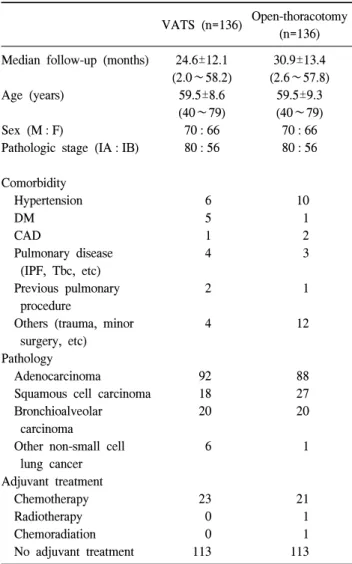
tween these two groups. Table 1 shows patient characteristics

of each group.

(3)

The decision to perform either VATS or open-thoracotomy was made by the individual four thoracic surgeons in our institution. Candidates for VATS lobectomy were patients with clinical stage I, peripheral, small-sized (≤5 cm) tumor without endobronchial lesion. The preoperative workup in- cluded pulmonary function tests, CT scan, integrated positron emission tomography (PET), and computerized tomography (CT) scan. For patients with preoperatively proven NSCLC, mediastinoscopic lymph node biopsy was routinely performed regardless of CT or PET scan findings.

All patients received operation under a standard general an- esthesia protocol, with single lung ventilation by a double-lu- men endotracheal tube. VATS lobectomy was performed after making two ports and a utility incision without rib spreading.

A 15-mm trocar was introduced through the seventh or eighth intercostal space for the 10-mm, 30-degree thoracoscope. A utility incision of four to five centimeters, which was cen- tered on the anterior axillary line, was made through the fourth or fifth intercostal space. A 5∼10 mm additional tro- car was placed through the sixth or seventh intercostal space on the posterior scapular line. The target vessels were in- dividually dissected, and divided using endoscopic staplers or surgical clips. The bronchi of target lobes were dissected, and divided using endoscopic staplers. All specimens were put in an impermeable bag and removed through the utility incision.

Open-thoracotomy lobectomy was performed via standard posterolateral thoracotomy through the fourth or fifth inter- costal space. Bronchial division was carried out using staplers. Mediastinal lymph node dissection was performed in all patients regardless of the surgical approaches, and it con- sisted of en bloc resection of all nodes at stations of 2R, 4R, 7, 8, 9, 10, and 11R for right-sided tumor, and nodes at sta- tions of 4L, 5, 6, 7, 8, 9, 10 and 11L for left-sided tumor.

Descriptive statistics were used to describe the patients’

characteristics and outcomes. The normally distributed con- tinuous data were expressed as means±standard deviations.

Categorical data were expressed as counts and proportions.

The student t tests and the ×2 test or Fisher exact test were used to compare the continuous and categorical variables, re- spectively. Overall survival (OS) was defined as the time from the date of surgery to the last date of follow-up for pa- tients who remained alive, or to the date of death. Disease-

free survival (DFS) was defined as the time from the date of surgery to the date of recurrence recognition, death, or to the end of observation. Survival curves were plotted using the Kaplan- Meier method and compared univariately using the log-rank test. All statistical testing was done at the two-sided 0.05 level of p-value using SAS

9.1 (SAS Institute Inc., Cary, NC, USA).

RESULTS

From December 2003 and December 2007, 1,469 patients underwent curative resection for NSCLC in our institution, and among them, 878 were found to have pathologic stage I lung cancer. VATS lobectomy was performed in 268 cases, and 216 of them had pathologic stage I lung cancer. Among the 878 patients, 529 patients were included for analysis, which consisted of 373 open-thoracotomy patients and 156 VATS patients. Patients with co-morbidity which could affect the survival or postoperative courses, such as history of ma- lignancy or co-existing malignancy of other organs, end stage renal disease, heart failure, liver cirrhosis, and pulmonary dis- ease with moderate to severe dysfunction, were excluded from patient enrollment. Among the patients with VATS lo- bectomy, 17 patients, who underwent surgery with rib spread- ing in our early experience of VATS practice, were also excluded. There were 3 cases of open-thoracotomy conversion from VATS procedures during the same period. In two of them, the operator decided to open the chest because the in- traoperative frozen biopsy of lymph node revealed tumor metastasis. In one patient, there happened the segmental arte- rial injury during VATS procedure, which forced conversion to thoracotomy. These patients were excluded from analysis.

After the patients were matched by age, gender and patho-

logic stage, there remained 272 patients eligible for analysis,

136 in each group. The mean age of patients in both groups

was 59.5 years, and each groups consisted of 70 men and 66

women, and 80 pathologic stage IA and 56 pathologic stage

IB. There was no statistical difference in preoperative clinical

characteristics between the two groups. Distribution of tumor

pathology, preoperative pulmonary function, postoperative ad-

juvant therapy and pre-existing co-morbidities of the patients

were compared, and there was no significant difference in

(4)

Table 2. Postoperative complications Thoracotomy (30 cases/22 pts)

VATS (19 cases/17 pts) Prolonged air leakage

Pneumonia ALI/ARDS Vocal cord palsy Chylothorax Atrial fibrillation Delirium AMI ARF

Postoperative bleeding

11 2 5 4 2 2 1 1 1 1

8 1 1 2 2 2 1 1 1 0

VATS=Video-assisted thoracic surgery; ALI=Acute lung injury;

ARDS=Acute respiratory distress syndrome; AMI=Acute my- ocardial infarction; ARF=Acute renal failure.

Fig. 1. Three-year overall survival. The 3-year overall survival were 97.4% in open-thoracotomy group (solid line) and 96.6% in VATS (Video-assisted thoracic surgery) group (dotted line) (p=0.76).

OP=Operation.

Fig. 2. Three-year recurrence-free survival. The 3-year recur- rence-free survival were 81.8% in open-thoracotomy group (solid line) and 85.3% in VATS (Video-assisted thoracic surgery) group (dotted line) (p=0.43). OP=Operation.

Table 3. Recurrence patterns according to pathologic stage Thoracotomy

(n=20) VATS (n=13) Stage IA

Locoregional Distant Both Stage IB

Locoregional Distant Both

4 2 1

3 5 5

2 3 0

2 4 2 VATS=Video-assisted thoracic surgery.

these variables between the two groups.

There were 2 operative mortality in the entire VATS lo- bectomy group during the same period (2/268, 0.74%), and one with pathologic stage I was excluded from the analysis during the matching process. In the two matching groups, there was no in-hospital mortality related to the operation.

There were 49 postoperative complications in 39 patients (30 cases/22 patients in open-thoracotomy group, 19 cases/17 pa- tients in VATS group. There was no statistical difference in postoperative complications between the two groups (p=0.65,

odds ratio=1.19). Table 2 shows the details of complications in each group.

The mean length of hospital stay of the patients who un- derwent VATS lobectomy was significantly shorter, by 2 days, than that of open-thoracotomy group (8.8±6.5 days vs.

6.3±3.3 days, p<0.05).

The median follow-up period was 27.7±13.1 months (2∼

58.2 months), and median follow-up of open-thoracotomy group and VATS group were 30.9±13.4 months (2.6∼57.8 months) and 24.6±12.1 months (2.0∼58.2 months), respec- tively.

The overall 3-year survival was 97.4% in thoracotomy and

96.6% in VATS groups. There was no significant survival

(5)

difference between the two groups (p=0.76) (Fig. 1).

During the follow-up period, twenty patients (20/136, 14.7%) in open-thoracotomy group experienced tumor re- currence, including 7 with loco-regional recurrence and 13 with distant metastasis. In VATS group, 13 patients (13/136, 9.6%) experienced tumor recurrence, including 4 with loco-re- gional recurrence and 9 with distant metastasis. Table 3 shows the recurrence pattern of each group, according to pathologic stage.

Three-year recurrence-free survival was 81.8% in open-tho- racotomy group and 85.3% in VATS group. There was no significant difference in recurrence between the two groups (p=0.43) (Fig. 2).

DISCUSSION

Since VATS was first introduced for pulmonary resection of malignant lung tumors in 1992, surgical technique of this minimally invasive procedure has been markedly refined, and VTAS lobectomy for lung cancer has been increasingly performed. Many large series on the feasibility of VATS ap- proach have been published. Most of these reports have em- phasized on the benefit of VATS lobectomy in terms of bet- ter cosmesis, less surgical trauma, reduced postoperative pain, lower complication, and shorter hospital stay resulting in re- duced cost [2-13]. The ‘Cancer and Leukemia Group B (CALGB) 39802’ prospective multi-institutional study eval- uated the technical feasibility and safety of VATS lobectomy for early-stage non-small-cell lung cancer (NSCLC), and re- vealed that the procedure can be performed with low morbid- ity and mortality rates. The failure-free survival after VATS lobectomy for T1N0 lesion was 91% at 1 year and 78% at 2 years [14]. Furthermore, a recent meta-analysis of the reports on the safety and efficacy of VATS lobectomy concluded that it could be a safe alternative to open-thoracotomy lobec- tomy [15]. However, some surgeons still hesitate to adopt VATS lobectomy for lung cancer, and this is why VATS lo- bectomy accounts for only less than 20% of all lobectomies performed in the United States [1,15-18]. Main concern is about whether VATS lobectomy can accomplish the onco- logic results comparable to conventional open-thoracotomy lobectomy. There certainly are several controversial issues

specific to cancer surgery employing VATS, such as 1) un- der-staging or mis-diagnosis due inadequate lymph node dis- section or undetected nodules in other lobes, which could well be manually detected during open-thoracotomy proce- dure, 2) tumor dissemination during the VATS manipulation, and 3) the risk of leaving residual tumors at the resection margin. Despite these concerns, recent studies on the onco- logic outcome of VATS lobectomy in comparison with open-thoracotomy lobectomy have revealed the superiority of VATS, not only in the early postoperative results, such as postoperative pain, morbidity, and hospital stay, but also in terms of long term outcomes, such as quality of life and sur- vival, although statistical power of these studies are some- what undermined by the small number of patients [19-21].

In this retrospective study, for the valid comparison of two different groups and elimination of possible bias as much as possible, we performed propensity score matching of two groups on the covariates of age, sex, underlying co-morbidity, and pathologic staging. Other variables which can influence the operative results and patient’s survival, such as pre- operative pulmonary function, postoperative complications, and postoperative adjuvant therapies, were compared to verify that there was no statistical difference between the two groups. By this method, we ascertained that comparable oper- ative results could be achieved by VATS lobectomy in com- parison to conventional open-thoracotomy. The occurrence of postoperative complications was not different between the two groups. Furthermore, the hospital stay was significantly short- er in VATS group, which could contribute greatly to low- ering the cost and endeavor of postoperative care.

Three-year overall survival and three-year recurrence free

survival of VATS group was equivalent to that of open-thor-

acotomy group. Locoregional recurrence rate was not high ei-

ther in VATS group. The mean number of dissected lymph

nodes in VATS group was 15.0±8.3. The same technique of

lymph node dissection with conventional open-thoracotomy

was applied to VATS lobectomy, which consisted of en bloc

resections of all nodes at stations of 2R, 4R, 7, 8, 9, and

10R for right-sided tumors and nodes at stations of 4 L, 5, 6,

7, 8, 9 and 10 L for left-sided tumors. During the same peri-

od, 268 VATS lobectomies were performed for clinical stage

I NSCLC, and 52 of them were found to have metastatic re-

(6)

gional and/or mediastinal lymph node. This up-staging from a lower preoperative clinical stage to a higher postoperative pathologic stage could be achieved due to complete lymph node dissection.

Our study has several limitations. First, since this is a ret- rospective study, our results should be interpreted with cau- tion even though we have conducted propensity matching analysis. Prospective randomized trials are needed for more conclusive results. Second, we have chosen to perform VATS lobectomy by individual surgeon’s preference. This can cause unrevealed bias and might have predisposed patients under- going VATS lobectomy to outcomes more favorable than those undergoing open-thoracotomy. It should also be noted that VATS procedures which were converted to open surgery were not included in this study. Third, VATS group, which includes patients with peripheral lesion almost exclusively, consisted of mostly adenocarcinoma patients. On the other hand, open-thoracotomy group had more patients with squ- amous cell carcinoma patient, because many patients of this group has endobronchial lesion. This difference might have influenced the survival results. Fourth, follow-up duration was relatively short, and we were only able to estimate 3-year survival, which made it difficult to conclude if recurrence-free survival after VATS lobectomy was truly comparable to thor- acotomy lobectomy. Longer-term survival data may be neces- sary to verify our hypothesis.

CONCLUSION

Our results suggest that VATS lobectomy for pathologic stage 1 NSCLC is feasible and safe with shorter hospital stay, low postoperative morbidity and mortality, and favorable survival comparable with conventional open-thoracotomy lo- bectomy, for the patients with pathologic stage I NSCLC.

REFERENCES

1. Boffa DJ, Allen MS, Grab JD, Gaissert HA, Harpole DH, Wright CD. Data from The Society of Thoracic Surgeons General Thoracic Surgery database: the surgical manage- ment of primary lung tumors. J Thorac Cardiovasc Surg 2008;135:247-54.

2. Lewis RJ, Caccavale RJ, Sisler GE, Mackenzie JW.

Video-assisted thoracic surgical resection of malignant lung tumors. J Thorac Cardiovasc Surg 1992;104:1679-85; discu- ssion 1685-7.

3. Lewis RJ, Caccavale RJ, Bocage JP, Widmann MD.

Video-assisted thoracic surgical non-rib spreading simulta- neously stapled lobectomy: a more patient-friendly oncologic resection. Chest 1999;116:1119-24.

4. Kirby TJ, Mack MJ, Landreneau RJ, Rice TW. Lobecto- my--video-assisted thoracic surgery versus muscle-sparing thoracotomy. A randomized trial. J Thorac Cardiovasc Surg 1995;109:997-1001; discussion 1001-2.

5. Sugi K, Kaneda Y, Esato K. Video-assisted thoracoscopic lobectomy achieves a satisfactory long-term prognosis in pa- tients with clinical stage IA lung cancer. World J Surg 2000;

24:27-30; discussion 30-1.

6. Yim AP, Wan S, Lee TW, Arifi AA. VATS lobectomy re- duces cytokine responses compared with conventional surgery. Ann Thorac Surg 2000;70:243-7.

7. Nomori H, Horio H, Naruke T, Suemasu K. What is the ad- vantage of a thoracoscopic lobectomy over a limited thor- acotomy procedure for lung cancer surgery? Ann Thorac Surg 2001;72:879-84.

8. Nagahiro I, Andou A, Aoe M, Sano Y, Date H, Shimizu N.

Pulmonary function, postoperative pain, and serum cytokine level after lobectomy: a comparison of VATS and conven- tional procedure. Ann Thorac Surg 2001;72:362-5.

9. Shigemura N, Akashi A, Funaki S, et al. Long-term out- comes after a variety of video-assisted thoracoscopic lobec- tomy approaches for clinical stage IA lung cancer: a multi- institutional study. J Thorac Cardiovasc Surg 2006;132:

507-12.

10. McKenna RJ Jr, Houck W, Fuller CB. Video-assisted thora- cic surgery lobectomy: experience with 1,100 cases. Ann Thorac Surg 2006;81:421-5; discussion 425-6.

11. Shiraishi T, Shirakusa T, Hiratsuka M, Yamamoto S, Iwasaki A. Video-assisted thoracoscopic surgery lobectomy for c-T1N0M0 primary lung cancer: its impact on locore- gional control. Ann Thorac Surg 2006;82:1021-6.

12. Petersen RP, Pham D, Burfeind WR, et al. Thoracoscopic lobectomy facilitates the delivery of chemotherapy after re- section for lung cancer. Ann Thorac Surg 2007;83:1245-9;

discussion 1250.

13. Whitson BA, Andrade RS, Boettcher A, et al. Video-assisted thoracoscopic surgery is more favorable than thoracotomy for resection of clinical stage I non-small cell lung cancer.

Ann Thorac Surg 2007;83:1965-70.

14. Swanson SJ, Herndon JE 2nd, D'Amico TA, et al. Video-as- sisted thoracic surgery lobectomy: report of CALGB 39802--a prospective, multi-institution feasibility study. J Clin Oncol 2007;25:4993-7.

15. Yan TD, Black D, Bannon PG, McCaughan BC. Systematic

review and meta-analysis of randomized and nonrandomized

(7)

trials on safety and efficacy of video-assisted thoracic sur- gery lobectomy for early-stage non-small-cell lung cancer. J Clin Oncol 2009;27:2553-62.

16. Fry WA, Siddiqui A, Pensler JM, Mostafavi H. Thoracos- copic implantation of cancer with a fatal outcome. Ann Thorac Surg 1995;59:42-5.

17. Jancovici R, Lang-Lazdunski L, Pons F, et al. Complications of video-assisted thoracic surgery: a five-year experience.

Ann Thorac Surg 1996;61:533-7.

18. Yamashita JI, Kurusu Y, Fujino N, Saisyoji T, Ogawa M.

Detection of circulating tumor cells in patients with non-small cell lung cancer undergoing lobectomy by vid- eo-assisted thoracic surgery: a potential hazard for intra-

operative hematogenous tumor cell dissemination. J Thorac Cardiovasc Surg 2000;119:899-905.

19. Nicastri DG, Wisnivesky JP, Litle VR, et al. Thoracoscopic lobectomy: report on safety, discharge independence, pain, and chemotherapy tolerance. J Thorac Cardiovasc Surg 2008;

135:642-7.

20. Flores RM, Park BJ, Dycoco J, et al. Lobectomy by vid- eo-assisted thoracic surgery (VATS) versus thoracotomy for lung cancer. J Thorac Cardiovasc Surg 2009;138:11-8.

21. Tomaszek SC, Cassivi SD, Shen KR, et al. Clinical out-

comes of video-assisted thoracoscopic lobectomy. Mayo Clin

Proc 2009;84:509-13.

수치

Table 1. Patients’ characteristics of each group
Fig. 2. Three-year recurrence-free survival. The 3-year recur- recur-rence-free survival were 81.8% in open-thoracotomy group (solid  line) and 85.3% in VATS (Video-assisted thoracic surgery) group  (dotted line) (p=0.43)

참조

관련 문서

* in large objects with small surface area A to volume V ratio (A/V) the physical and chemical properties are primarily defined by the bulk (inside). * in small objects with

a prospective analysis of 50 cases. Preoperative staging of non-small-cell lung cancer with positron-emission tomography. Staging of non- small-cell lung cancer

Patients with breast cancer; ovarian cancer; renal cell carcinoma; pancreatic neuroendocrine cancer; colorectal cancer; head and neck cancer; non-small cell lung

Method We obtained blood samples from 49 patients who underwent surgical treatment for esophageal squamous cell cancer (ESCC) We performed ctDNA analysis with

According to the result of this study, to do effective nursing that improve health promoting behaviors of early-stage lung cancer patients, nurses should

Endoscopic spine surgery has become a practical, minimally invasive technique for decompression in patients with spinal disc herniation or stenosis.. However,

This paper constructed a professional horse-rider database by wearing a motion-capture suit attached with 16 inertial sensors, then made a visual comparative

Beichel,“Automated 3-D segmentation of lungs with lung cancer in CT data using a novel robust active shape model approach,” IEEE Trans.. 저작물의