Received:March 24, 2016, Revised:January 6, 2017, Accepted:January 12, 2017
Corresponding to:Min-Chan Park, Division of Rheumatology, Department of Internal Medicine, Gangnam Severance Hospital, Yonsei University College of Medicine, 211 Eonju-ro, Gangnam-gu, Seoul 06273, Korea. E-mail:[email protected]
pISSN: 2093-940X, eISSN: 2233-4718
Copyright ⓒ 2017 by The Korean College of Rheumatology. All rights reserved.
This is a Open Access article, which permits unrestricted non-commerical use, distribution, and reproduction in any medium, provided the original work is properly cited.
Cost-effectiveness of Non-steroidal Anti-inflammatory Drugs Adjusting for Upper and Lower Gastrointestinal Toxicities in Rheumatoid Arthritis Patients
Soo-Jin Chung1, Hye-Jin Park2, Min-Chan Park1
1Division of Rheumatology, Department of Internal Medicine, Yonsei University College of Medicine, Seoul, 2School of Pharmacy, Sungkyunkwan University, Suwon, Korea
Objective. This study was performed to assess the cost-effectiveness of cyclooxygenase-2 (COX2)-selective inhibitor, non-se- lective non-steroidal anti-inflammatory drugs (NSAIDs), and non-selective NSAID with proton pump inhibitors (PPIs) while considering upper and lower gastrointestinal (GI) safety in patients with rheumatoid arthritis (RA). Methods. A Markov model was used to estimate the costs and effectiveness. Estimates of therapeutic efficacy and upper/lower GI safety were based on re- sults from large randomized controlled trials. The main outcome measure was cost effectiveness, based on the quality-adjusted life years (QALYs) gained. Safety parameters included clinical upper GI symptoms, uncomplicated ulcer, upper GI bleeding, upper GI perforation, clinical lower GI symptoms, lower GI bleeding, and lower GI perforation. Cost data were obtained from patients treated in a tertiary referral center in Korea. Results. The expected three year cost was 3,052,800 Korean won (KRW) for COX2-selective inhibitor, 3,170,800 KRW for nonselective NSAID, and 3,325,900 KRW for non-selective NSAID with PPI.
QALYs were 2.87446, 2.85320, and 2.85815, respectively. The total cost for COX2-selective inhibitor use was lower than non-selective NSAID, but QALY was higher, indicating that the incremental cost effectiveness ratio of COX2-selective inhibitor is superior. Conclusion. COX2-selective inhibitor has reasonable cost-effectiveness adjusted for upper and lower GI toxicity for patients with RA in Korea. (J Rheum Dis 2017;24:27-34)
Key Words. Cost-effectiveness, Cox-2 selective inhibitor, Gastrointestinal toxicity, Non-steroidal anti-inflammatory drugs, Rheumatoid arthritis
INTRODUCTION
Non-steroidal anti-inflammatory drugs (NSAIDs) are one of the most frequently used drugs for the treatment of rheumatoid arthritis (RA) [1,2]. NSAIDs can cause sev- eral adverse reactions, such as gastrointestinal (GI) com- plications, azotemia, platelet dysfunction, allergic rhini- tis, aggravation of asthma, skin rash, liver toxicity and bone marrow suppression [3,4]. Especially, NSAID-re- lated GI complications are one of the most frequently en- countered problems in clinical settings. Ten to sixty per- cent of patients experience dyspepsia while taking NSAIDs, and 4% to 40% of patients suffer from ulcers in
the upper GI tract. Five to fifteen percent of patients with RA may discontinue NSAIDs due to dyspepsia within 6 months, and the mortality of NSAID-induced bleeding reaches up to 5% to 10% [5,6].
To reduce GI complications caused by NSAID uses, co-administration of proton pump inhibitor (PPI) with conventional NSAIDs, and replacement of conventional NSAIDs with selective cyclooxygenase-2 (COX-2) in- hibitor, have been widely used. There are several reports showing that PPIs can prevent the development of gastric or duodenal ulcers through the inhibition of gastric acid secretion and co-administration of PPI with NSAIDs can reduce the risk of upper GI toxicity [7-10]. Another way
to prevent GI complications for patients taking NSAIDs for treatment of their arthritis is to replace non-selective NSAIDs with selective COX-2 inhibitors. The COX en- zyme family consists of COX-1 and COX-2 isoenzymes.
COX-1 is constitutionally expressed and controls normal physiologic reactions, such as maintenance of gastric mu- cosal integrity. COX-2 is expressed only after inflam- matory reaction and regulates pain and inflammation.
Previous studies suggest that GI adverse events of con- ventional NSAIDs are mediated through the inhibition of COX-1 enzyme, and selective COX-2 inhibitors could de- crease the risk of GI complications of NSAID [11-13].
In the latest decade, there have been great developments in the treatment of RA, and various kinds of drugs have been used for RA treatment. However, NSAIDs are still being one of the most frequently prescribed agents for RA treatment in Korea [14], thus selecting more efficient and safer ways is as crucial as developing new agents for treat- ment of RA. Most of previous studies on safety of NSAIDs have focused upper GI toxicity caused by NSAIDs use, but recent reports have addressed that NSAIDs use is also strongly related to the development of lower GI complica- tions and that selective COX-2 inhibitor can reduce the incidence of NSAID induced lower GI complications [15-20].
Despite the increased interest in lowering GI toxicity of NSAID, there have been no pharmacoeconomic studies specifically focused on lowering GI toxicity of NSAIDs.
This study was performed to assess the cost-effectiveness of a selective COX-2 inhibitor, non-selective NSAID, and non-selective NSAID with PPI with regards to GI safety in patients with RA. In this study, cost-effectiveness of each treatment strategy was compared considering lower GI toxicity as well as upper GI toxicity.
MATERIALS AND METHODS
Subject drugs
Non-selective NSAIDs and a selective COX-2 inhibitor were used to compare the cost and efficacy. Naproxen and meloxicam were chosen among non-selective NSAIDs because they are primarily used for treatment of RA in daily clinical practice of our institute, and celecoxib was chosen as a selective COX-2 inhibitor because it is the on- ly selective COX-2 inhibitor approved for RA treatment in Korea.
Evaluation framework
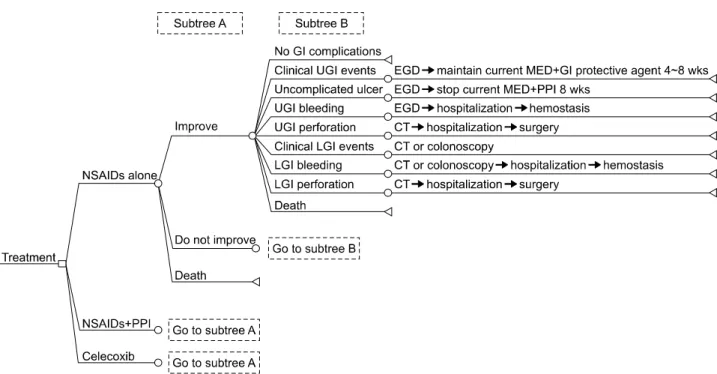
This study assumed that non-selective NSAIDs and COX2-selective inhibitor were equally effective for the control of RA in terms of anti-inflammatory and analgesic effects. Any GI toxicity such as peptic ulcers, ulcer bleed- ing, and gastric or duodenal perforation was treated through hospitalization or on an outpatient basis. The treatment protocol of GI toxicity was based on clinical ex- perience and textbook based algorithms [21]. If patients complain of clinical symptom alone that could not be pro- ven by endoscopy, patients continued the NSAID treat- ment with GI protective agents on an outpatient basis. If ulcers were detected by endoscopy, NSAID was dis- continued and GI protective agents or PPI was used for 8 weeks or longer. If GI bleeding was observed in addition to ulcers, then NSAID use is stopped and patients are hospitalized for endoscopic hemostasis. GI protective agents or PPI should be maintained for 8 weeks. If there were perforation, NSAID was discontinued, and surgical treatment was considered depending on the severity. If there were any GI problems in patients who were treated with non-selective NSAID, NSAIDs were switched to a COX2-selective inhibitor (Figure 1).
A Markov model with a 12-week transition cycle was used to estimate the cost and effectiveness of each treat- ment groups with a 3-year time horizon, and comparative parameters were separated into three groups: COX2-se- lective inhibitor group, non-selective NSAID group, and non-selective NSAID with PPI group [22]. Modeling was conducted using TreeAge Pro 2009 software (TreeAge Software, Inc., Williamstown, MA, USA).
Input parameters
Variables for transition probability were improvement in RA symptoms and development of GI toxicity. Estimates of therapeutic efficacy were based on data from the Celecoxib Long-Term Arthritis Safety Study (CLASS) clinical study [19]. CLASS study is the largest random- ized controlled trial which compared GI toxicity of cele- coxib with NSAID for osteoarthritis (OA) and RA patients.
A total of 7,968 outpatients aged 18 years or older, diag- nosed as having RA or OA evident for at least 3 months and were expected to require continuous treatment with an NSAID for the duration of the trial received at least 1 dose of medication. Of these, more than 20% of the pa- tients were taking low-dose aspirin (≤325 mg/d). In CLASS study, efficacy of each drug strategy assessed by patient’s global assessment of arthritis after 26 week use
Figure 1. Part of a decision tree for cost-effectiveness of rheumatoid arthritis treatment. Three strategies are modeled by non- steroidal anti-inflammatory drug (naproxen or meloxicam), celecoxib, and NSAID with PPI. NSAID: non-steroidal anti-in- flammatory drug, PPI: proton-pump inhibitor, GI: gastrointestinal, UGI: upper gastrointestinal, LGI: lower gastrointestinal, EGD:
esophagogastroduodenoscopy, MED: medication, CT: computed tomography.
of COX2-selective inhibitor 200 mg twice a day (bid), di- clofenac 75 mg bid, and ibuprofen 800 mg three times a day. Improvement in arthritis was observed in 1,512 of 3,987 patients of celecoxib group (38%) and in 1,441 of 3,981 patients (36%) of diclofenac and ibuprofen groups.
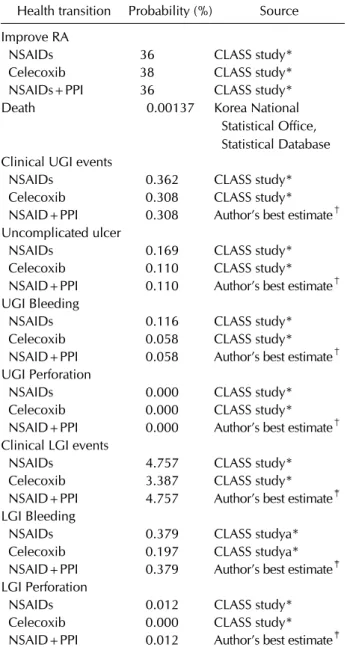
There is no difference in drug efficacy between these two groups. Thus, we assumed the improvement rate of COX2-selective inhibitor as 38%, and the improvement rate of NSAID as 36%. We assumed that PPI did not influ- ence symptom improvement effect of NSAID, and thus we assumed the improvement rate of NSAID plus PPI group to be the same as NSAID group (36%) (Table 1).
Safety parameters included clinical upper GI symptoms such as reflux or dyspepsia, uncomplicated ulcer, upper GI bleeding, and upper GI perforation. Clinical lower GI symptoms such as diverticulitis or diarrhea, lower GI bleeding, and lower GI perforation were included. The complication probabilities of non-selective NSAID group and COX2-selective inhibitor group were cited from CLASS study after time-frame adjustment. Since there is no study with exactly matching complication probability of NSAID plus PPI group, and we substituted the same data with COX2-selective inhibitor group by author’s best estimate. GI toxicity of NSAID with PPI is known to be equal or higher than COX2-selective inhibitor treat-
ment [23]. Thus, we conservatively assumed that the GI toxicity of the two groups were equal. The prevention ef- fect of lower GI toxicity of PPIs has not been proved.
Thus, the toxicity of NSAID with PPI might be regarded as the same as that of the NSAID alone strategy (Table 1).
The variables for effectiveness were utility of health states presented as quality of life (QOL) scores. The QOL scores of each health status were based on data from searched literature [22]. A utility of 0 for death and a utili- ty of 1 for health states of complete recovery from RA were assumed. A utility of 0.688 for a patient with RA, 0.504 for health states of clinical upper GI events, 0.38 for uncomplicated upper GI ulcer, 0.312 for upper GI bleed- ing and 0 for upper GI perforation were quoted. QOL scores of lower GI complications were estimated to be equal to QOL scores of upper GI complications, because there was no prior cost-effectiveness study on lower GI complications (Table 2).
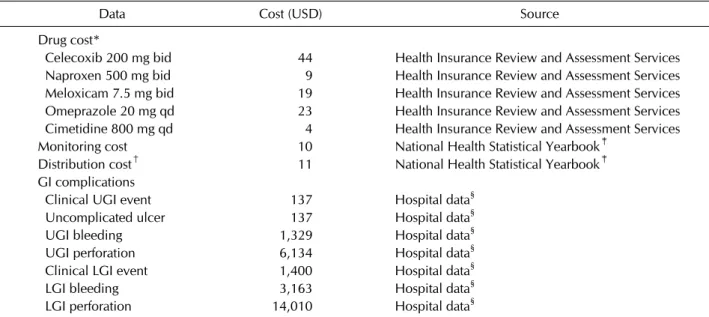
Data of medication and monitoring costs were derived from the database of the Health Insurance Review and Assessment Services of 2011∼2012. Cimetidine was chosen as primarily used GI protective agent and omeprazole as primarily used PPI. Monitoring cost was physician fee at the outpatient clinic, and distribution cost was the drug cost at the pharmacy. The cost for treating each GI event
Table 2. Utility of health status
Health status QOL Source
RA 0.688 [26]
Complete recovery from RA 1
Death 0
Clinical upper GI events 0.504 [26]
Uncomplicated upper GI ulcer 0.38 [26]
Upper GI bleeding 0.312 [26]
Upper GI perforation 0 [26]
Clinical lower GI events 0.504 Author’s best estimate*
Lower GI bleeding 0.312 Author’s best estimate*
Lower GI perforation 0 Author’s best estimate*
QOL: quality of life, RA: rheumatoid arthritis, GI: gastroin- testinal. *The QOL scores of lower GI complications were estimated to be equal to those of upper GI complications.
Table 1. Health transition probability
Health transition Probability (%) Source Improve RA
NSAIDs 36 CLASS study*
Celecoxib 38 CLASS study*
NSAIDs+PPI 36 CLASS study*
Death 0.00137 Korea National
Statistical Office, Statistical Database Clinical UGI events
NSAIDs 0.362 CLASS study*
Celecoxib 0.308 CLASS study*
NSAID+PPI 0.308 Author’s best estimate† Uncomplicated ulcer
NSAIDs 0.169 CLASS study*
Celecoxib 0.110 CLASS study*
NSAID+PPI 0.110 Author’s best estimate† UGI Bleeding
NSAIDs 0.116 CLASS study*
Celecoxib 0.058 CLASS study*
NSAID+PPI 0.058 Author’s best estimate† UGI Perforation
NSAIDs 0.000 CLASS study*
Celecoxib 0.000 CLASS study*
NSAID+PPI 0.000 Author’s best estimate† Clinical LGI events
NSAIDs 4.757 CLASS study*
Celecoxib 3.387 CLASS study*
NSAID+PPI 4.757 Author’s best estimate‡ LGI Bleeding
NSAIDs 0.379 CLASS studya*
Celecoxib 0.197 CLASS studya*
NSAID+PPI 0.379 Author’s best estimate‡ LGI Perforation
NSAIDs 0.012 CLASS study*
Celecoxib 0.000 CLASS study*
NSAID+PPI 0.012 Author’s best estimate‡ RA: rheumatoid arthritis, NSAIDs: non-steroidal anti-inflam- matory drugs, PPI: proton pump inhibitor, UGI: upper gast- rointestinal, LGI: lower gastrointestinal, CLASS: Celecoxib Long-Term Arthritis Safety Study, GI: gastrointestinal. *CLASS clinical study. †GI toxicitiy of NSAID with PPI might be equal with that if celecoxib treatment. ‡PPI could not prevent lower GI complications.
was determined by the treatment cost at our institute, a tertiary referral center in Seoul, Korea. Based on the treat- ment protocol of any GI toxicity such as peptic ulcers, ul- cer bleeding, and gastric or duodenal perforation, the re- source use was measured to estimate the cost of treating GI toxicity: hospitalization, medication, imaging tests, laboratory tests, procedures or surgery, and other medical treatment. The number of units consumed by each pa-
tient was multiplied by the cost per unit of each resource to estimate the direct costs for each patient. The cost data obtained in Korean won (KRW) are shown in Table 3.
Incremental cost effectiveness ratio
In clinical practice, a realistic option may be to compare a new treatment strategy with the standard method.
Thus, the difference in these costs would be of interest to the decision maker. The term ‘incremental costs’ is often used to refer to the difference between alternatives. The incremental cost effectiveness ratio (ICER) is the result of incremental cost of a new treatment to standard treat- ment divided by incremental effectiveness of new treat- ment to standard treatment [24].
The primary outcome measure was based on quality ad- justed life years (QALY) gained, which is used in most cost effectiveness analysis studies [25,26]. Utilities of health status were based on quality of life weight scores through a detailed review of the medical literatures.
RESULTS
Incremental cost effectiveness ratio (ICER)
Medication, monitoring costs, distribution cost and cost for treating each GI event were included in total cost. The expected 3 year total cost was 3,052,800 KRW for COX2-se- lective inhibitor treatment, 3,170,800 KRW for non-se- lective NSAID, and 3,325,900 KRW for non-selective NSAID with PPI. The direct medical cost of the COX2-selective inhibitor treatment group during routine management was also proven to be significantly lower. QALY for COX2-selective inhibitor treatment was 2.87446, for
Table 3. Estimated costs of treatment for gastrointestinal complications
Data Cost (USD) Source
Drug cost*
Celecoxib 200 mg bid 44 Health Insurance Review and Assessment Services Naproxen 500 mg bid 9 Health Insurance Review and Assessment Services Meloxicam 7.5 mg bid 19 Health Insurance Review and Assessment Services Omeprazole 20 mg qd 23 Health Insurance Review and Assessment Services Cimetidine 800 mg qd 4 Health Insurance Review and Assessment Services
Monitoring cost 10 National Health Statistical Yearbook‡
Distribution cost† 11 National Health Statistical Yearbook‡
GI complications
Clinical UGI event 137 Hospital data§
Uncomplicated ulcer 137 Hospital data§
UGI bleeding 1,329 Hospital data§
UGI perforation 6,134 Hospital data§
Clinical LGI event 1,400 Hospital data§
LGI bleeding 3,163 Hospital data§
LGI perforation 14,010 Hospital data§
USD: United States dollar, bid: twice per day, qd: once per day, GI: gastrointestinal, UGI: upper gastrointestinal, LGI: lower gastrointestinal. *Drug costs were calculated over a 4 week period. †Distribution costs were calculated over a 12 week period.
‡National Health Insurance Corporation, Health Insurance Review & Assessment Services; 2011∼2012 National Health Statistical Yearbook. §Obtained from patients who had been treated in a tertiary referral center, Seoul, South Korea.
Table 4. Cost effectiveness of three treatment strategies
Strategy Total cost (KRW) Effectiveness (QALY) ICER
Celecoxib 3,052,800 2.87446 Dominant*
NSAID 3,170,800 2.85320 Dominated†
NSAID+PPI 3,325,900 2.85533 Dominated†
KRW: Korean won, QALY: quality-adjusted life year, ICER: incremental cost effectiveness ratio, NSAID: non-steroidal anti-inflammatory drug, PPI: proton-pump inhibitor. *The intervention costs less and is at least as effective as the comparator. †The intervention costs more and is no more effective than the comparator.
nonselective NSAID 2.85320, and for non-selective NSAID with PPI 2.85533. The total cost for COX2-selective in- hibitor was lower than non-selective NSAID but QALY was higher by 0.02126, and thus the ICER for COX2-se- lective inhibitor in comparison with non-selective NSAID showed dominance (Table 4). This result suggests that COX2-selective inhibitor can be considered to be cost effective.
Sensitivity analyses
Sensitivity analysis was performed for utility value. We substituted minimum zero to maximum 0.688 for health status of lower GI complications. After substitution, cost of COX2-selective inhibitor increased to 3,079,400 KRW, and QALYs rather increased or decreased (2.82900∼
2.89100). The result also showed COX2-selective in-
hibitor strategy to be dominant ICER over non-selective NSAID or non-selective NSAID with PPI strategies.
DISCUSSION
In the present study, we performed pharmacoeconomic analysis on therapeutic efficacy and toxicities involving both upper and lower GI tracts of NSAIDs and found that the use of COX-2 selective inhibitor has a reasonable cost-effectiveness for patients with RA in Korea. Although the individual cost for COX-2 selective inhibitor is higher than non-selective NSAIDs and there is no evident differ- ence in therapeutic efficacies between them, the use of COX-2 selective inhibitor appears to be economically at- tractive compared to non-selective NSAID alone or non-selective NSAID with PPI with regards to the devel-
opment of upper and lower GI complications.
In the present study, several basic assumptions were made by authors’ best estimate. First, we hypothesized that treatment with non-selective NSAID and PPI would show very similar upper GI toxicity rate with COX-2 se- lective inhibitor group. Although some authors sug- gested that the incidence of upper GI toxicities caused by the use of non-selective NSAID with PPI were higher than the use of selective COX-2 inhibitors [2], there is no ex- actly matching study on complication probability of non-selective NSAID with PPI group versus COX-2 se- lective inhibitor group, thus we made a conservative esti- mate of the upper GI toxicity rate of NSAID plus PPI group. Second, we assumed that the protective effect of PPI does not influence the incidence and severity of lower GI toxicities and that the development of lower GI tox- icity caused by non-selective NSAID with PPI was re- garded as same as that caused by non-selective NSAID alone strategy in this study. It has been reported that NSAID is equally associated with upper and lower GI events [17,18,20]. The pathogenesis of NSAID-induced enteropathy is initiated by the inhibition of oxidative phosphorylation in the enterocytes exposed to the in- gested NSAID and further exacerbated by contact through enterohepatic circulation, and prominent apoptosis com- bined with increased intraepithelial lymphocyte counts are characteristic features of this condition [27,28]. Lower GI toxicity of NSAIDs in the small bowel and colon may be independent of acid secretion and the use of anti-secre- tary agents including PPI does not prevent lower GI com- plications as compared with the known protective effect for upper GI complications [29]. To eliminate the effect of PPI on lower GI toxicity, we performed sensitivity analy- sis varying utility estimates, and the recalculated results did not show difference. This indicates that our results are robust to the working assumptions on utility parameters.
The price of COX-2 selective inhibitor has been set high, thus it is needed to assess the clinical benefits, costs for adverse events, and cost-effectiveness of COX-2 selective inhibitor compared with non-selective NSAIDs. Most of previous studies focused on pharmacoeconomic analysis regarding upper GI toxicities of NSAID uses. However, recent reports showed that a very high incidence of lower GI damage has been reported in young, healthy, human subjects taking both a non-selective NSAID and a PPI, in- dicating that the PPI conferred little protection to lower GI tracts, which are major sites of NSAID-induced bleed- ing and perforation [30-32]. And several studies showed
that COX-2 selective inhibitor could be a better choice to reduce mucosal lesions of the small bowel compared with non-selective NSAID with PPI [33,34]. Several other eco- nomic evaluations of COX-2 selective inhibitor versus NSAID or NSAID plus PPI have been published, all with very different results [35-40]. In the present study, we an- alyzed the cost effectiveness of NASID uses associated with the risk of upper and lower GI complications and found that the use of COX-2 selective inhibitor shows reasonable cost effectiveness over non-selective NSAID alone and non-selective NSAID with PPIs. To the best of our knowledge, this is the first study that evaluated cost effectiveness of various NSAIDs use strategies for treat- ment of RA with regards to both upper and lower GI tract toxicities.
There are several limitations in the present study. We performed a detailed search of the medical literatures, and there were many differences in patient groups, drug regimens, drug doses, and definition of adverse events among the studies, which might influence the rate of GI toxicities. There was no prospective study about GI com- plications with the same NSAID, thus we extracted most of our data from the CLASS study. There have been diffi- culties with the interpretation of the CLASS study be- cause of preferential withdrawal of patients with GI risk factors from the NSAID treatment arm. Therefore, a limi- tation of the present analysis was that the economic per- spective, depending on the GI risk of the individual pa- tient was not evaluated. Although it has been suggested that COX-2 selective inhibitor may increase the risk of cardiovascular thromboembolic events via inhibition of vascular prostacyclin synthesis without a corresponding inhibition of platelet thromboxane, no such increase was evident in the CLASS study. This study did not include cardiovascular thrombotic adverse events that NSAID uses can cause [13,41]. Considering these complications, this study may lead to different conclusion and further studies are expected to consider overall complications in- cluding cardiovascular events. In addition, we did not in- clude the indirect cost in this cost-effectiveness analysis.
Further work is needed to collect real world evidence in- cluding GI toxicity event in Korea as well as indirect cost.
CONCLUSION
The ICER of COX-2 selective inhibitor was superior to those of non-selective NSAID alone and non-selective NSAID with PPI. These data showed that COX-2 selective
inhibitor had reasonable cost effectiveness for patients with RA in Korea. There have been no pharmacoeco- nomic studies comparing cost effectiveness of various NSAIDs strategies with regards to entire GI tract complications. To make a precise comparison about cost effectiveness among COX-2 selective inhibitor, non-se- lective NSAID alone and non-selective NSAID with PPI, more controlled prospective studies are warranted to compare the therapeutic efficacies, GI complications, and cardiovascular complications.
ACKNOWLEDGMENTS
The authors wish to thank Su-Kyoung Ko, PhD, Pfizer Pharmaceuticals Korea Limited, for her assistance in stat- istical analysis. This study was supported by a grant of the Korean Health Technology R&D Project, Ministry for Health and Welfare, Republic of Korea (HI14C1774).
CONFLICT OF INTEREST
No potential conflict of interest relevant to this article was reported.
REFERENCES
1. Wolfe F, Zhao S, Lane N. Preference for nonsteroidal antiin- flammatory drugs over acetaminophen by rheumatic dis- ease patients: a survey of 1,799 patients with osteoarthritis, rheumatoid arthritis, and fibromyalgia. Arthritis Rheum 2000;43:378-85.
2. Hochberg MC, Altman RD, April KT, Benkhalti M, Guyatt G, McGowan J, et al. American College of Rheumatology 2012 recommendations for the use of nonpharmacologic and pharmacologic therapies in osteoarthritis of the hand, hip, and knee. Arthritis Care Res (Hoboken) 2012;64:465- 74.
3. Patrono C. Non-steroidal anti-inflammatory drugs. In:
Hochberg MC, ed. Rheumatology. Madrid, Mosby, 2008, p.
403-10.
4. Scheiman JM, Fendrick AM. Summing the risk of NSAID therapy. Lancet 2007;369:1580-1.
5. Singh G, Ramey DR, Morfeld D, Shi H, Hatoum HT, Fries JF. Gastrointestinal tract complications of nonsteroidal an- ti-inflammatory drug treatment in rheumatoid arthritis. A prospective observational cohort study. Arch Intern Med 1996;156:1530-6.
6. Wolfe MM, Lichtenstein DR, Singh G. Gastrointestinal tox- icity of nonsteroidal antiinflammatory drugs. N Engl J Med 1999;340:1888-99.
7. Lai KC, Lam SK, Chu KM, Wong BC, Hui WM, Hu WH, et al. Lansoprazole for the prevention of recurrences of ulcer complications from long-term low-dose aspirin use. N Engl J Med 2002;346:2033-8.
8. Cullen D, Bardhan KD, Eisner M, Kogut DG, Peacock RA, Thomson JM, et al. Primary gastroduodenal prophylaxis with omeprazole for non-steroidal anti-inflammatory drug users. Aliment Pharmacol Ther 1998;12:135-40.
9. Chan FK, Hung LC, Suen BY, Wu JC, Lee KC, Leung VK, et al. Celecoxib versus diclofenac and omeprazole in reducing the risk of recurrent ulcer bleeding in patients with arthritis.
N Engl J Med 2002;347:2104-10.
10. Lai KC, Chu KM, Hui WM, Wong BC, Hu WH, Wong WM, et al. Celecoxib compared with lansoprazole and naproxen to prevent gastrointestinal ulcer complications. Am J Med 2005;118:1271-8.
11. Goldstein JL, Silverstein FE, Agrawal NM, Hubbard RC, Kaiser J, Maurath CJ, et al. Reduced risk of upper gastro- intestinal ulcer complications with celecoxib, a novel COX-2 inhibitor. Am J Gastroenterol 2000;95:1681-90.
12. Schnitzer TJ, Burmester GR, Mysler E, Hochberg MC, Doherty M, Ehrsam E, et al. Comparison of lumiracoxib with naproxen and ibuprofen in the Therapeutic Arthritis Research and Gastrointestinal Event Trial (TARGET), re- duction in ulcer complications: randomised controlled trial.
Lancet 2004;364:665-74.
13. Bombardier C, Laine L, Reicin A, Shapiro D, Burgos-Vargas R, Davis B, et al. Comparison of upper gastrointestinal tox- icity of rofecoxib and naproxen in patients with rheumatoid arthritis. VIGOR Study Group. N Engl J Med 2000;343:
1520-8.
14. Cho SK, Sung YK, Choi CB, Kwon JM, Lee EK, Bae SC.
Development of an algorithm for identifying rheumatoid ar- thritis in the Korean National Health Insurance claims database. Rheumatol Int 2013;33:2985-92.
15. Lanas A, Sekar MC, Hirschowitz BI. Objective evidence of aspirin use in both ulcer and nonulcer upper and lower gas- trointestinal bleeding. Gastroenterology 1992;103:862-9.
16. Laine L, Smith R, Min K, Chen C, Dubois RW. Systematic review: the lower gastrointestinal adverse effects of non- steroidal anti-inflammatory drugs. Aliment Pharmacol Ther 2006;24:751-67.
17. Laine L, Curtis SP, Langman M, Jensen DM, Cryer B, Kaur A, et al. Lower gastrointestinal events in a double-blind trial of the cyclo-oxygenase-2 selective inhibitor etoricoxib and the traditional nonsteroidal anti-inflammatory drug diclofenac.
Gastroenterology 2008;135:1517-25.
18. Laine L, Connors LG, Reicin A, Hawkey CJ, Burgos-Vargas R, Schnitzer TJ, et al. Serious lower gastrointestinal clinical events with nonselective NSAID or coxib use. Gastroentero- logy 2003;124:288-92.
19. Silverstein FE, Faich G, Goldstein JL, Simon LS, Pincus T, Whelton A, et al. Gastrointestinal toxicity with celecoxib vs nonsteroidal anti-inflammatory drugs for osteoarthritis and rheumatoid arthritis: the CLASS study: A randomized con- trolled trial. Celecoxib Long-term Arthritis Safety Study.
JAMA 2000;284:1247-55.
20. Wilcox CM, Alexander LN, Cotsonis GA, Clark WS.
Nonsteroidal antiinflammatory drugs are associated with both upper and lower gastrointestinal bleeding. Dig Dis Sci 1997;42:990-7.
21. Feldman M, Friedman LS, Sleisenger MH. Sleisenger and Fordtran’s gastrointestinal and liver disease. 7th ed. Vol. 1.
Philadelphia, Saunders, 2002, p. 211-42.
22. Sonnenberg FA, Beck JR. Markov models in medical deci-
sion making: a practical guide. Med Decis Making 1993;
13:322-38.
23. Chan FK, Lanas A, Scheiman J, Berger MF, Nguyen H, Goldstein JL. Celecoxib versus omeprazole and diclofenac in patients with osteoarthritis and rheumatoid arthritis (CONDOR): a randomised trial. Lancet 2010;376:173-9.
24. Rascati KL. Essentials of pharmacoeconomics. Philadelphia, Lippincott Williams & Wilkins, 2009, p. 9-23.
25. Maetzel A, Krahn M, Naglie G. The cost effectiveness of ro- fecoxib and celecoxib in patients with osteoarthritis or rheumatoid arthritis. Arthritis Rheum 2003;49:283-92.
26. Latimer N, Lord J, Grant RL, O'Mahony R, Dickson J, Conaghan PG. Cost effectiveness of COX 2 selective in- hibitors and traditional NSAIDs alone or in combination with a proton pump inhibitor for people with osteoarthritis.
BMJ 2009;339:b2538.
27. Reuter BK, Davies NM, Wallace JL. Nonsteroidal anti-in- flammatory drug enteropathy in rats: role of permeability, bacteria, and enterohepatic circulation. Gastroenterology 1997;112:109-17.
28. Price AB. Pathology of drug-associated gastrointestinal disease. Br J Clin Pharmacol 2003;56:477-82.
29. Lanas A, García-Rodríguez LA, Polo-Tomás M, Ponce M, Alonso-Abreu I, Perez-Aisa MA, et al. Time trends and im- pact of upper and lower gastrointestinal bleeding and perfo- ration in clinical practice. Am J Gastroenterol 2009;
104:1633-41.
30. Graham DY, Opekun AR, Willingham FF, Qureshi WA.
Visible small-intestinal mucosal injury in chronic NSAID users. Clin Gastroenterol Hepatol 2005;3:55-9.
31. Maiden L, Thjodleifsson B, Theodors A, Gonzalez J, Bjarnason I. A quantitative analysis of NSAID-induced small bowel pathology by capsule enteroscopy. Gastroenterology 2005;
128:1172-8.
32. Fujimori S, Gudis K, Takahashi Y, Seo T, Yamada Y, Ehara A, et al. Distribution of small intestinal mucosal injuries as a result of NSAID administration. Eur J Clin Invest 2010;
40:504-10.
33. Goldstein JL, Eisen GM, Lewis B, Gralnek IM, Zlotnick S, Fort JG; Investigators. Video capsule endoscopy to pro- spectively assess small bowel injury with celecoxib, naprox- en plus omeprazole, and placebo. Clin Gastroenterol Hepatol 2005;3:133-41.
34. Goldstein JL, Eisen GM, Lewis B, Gralnek IM, Aisenberg J, Bhadra P, et al. Small bowel mucosal injury is reduced in healthy subjects treated with celecoxib compared with ibu- profen plus omeprazole, as assessed by video capsule endoscopy. Aliment Pharmacol Ther 2007;25:1211-22.
35. Svarvar P, Aly A. Use of the ACCES model to predict the health economic impact of celecoxib in patients with osteo- arthritis or rheumatoid arthritis in Norway. Rheumatology (Oxford) 2000;39 Suppl 2:43-50.
36. Haglund U, Svarvar P. The Swedish ACCES model: predict- ing the health economic impact of celecoxib in patients with osteoarthritis or rheumatoid arthritis. Rheumatology (Oxford) 2000;39 Suppl 2:51-6.
37. Kristiansen IS, Kvien TK. Cost-effectiveness of replacing NSAIDs with coxibs: diclofenac and celecoxib in rheuma- toid arthritis. Expert Rev Pharmacoecon Outcomes Res 2002;2:229-41.
38. Spiegel BM, Targownik L, Dulai GS, Gralnek IM. The cost-effectiveness of cyclooxygenase-2 selective inhibitors in the management of chronic arthritis. Ann Intern Med 2003;138:795-806.
39. Lee KK, You JH, Ho JT, Suen BY, Yung MY, Lau WH, et al.
Economic analysis of celecoxib versus diclofenac plus ome- prazole for the treatment of arthritis in patients at risk of ul- cer disease. Aliment Pharmacol Ther 2003;18:217-22.
40. Al MJ, Maniadakis N, Grijseels EW, Janssen M. Costs and ef- fects of various analgesic treatments for patients with rheu- matoid arthritis and osteoarthritis in the Netherlands.
Value Health 2008;11:589-99.
41. Solomon SD, McMurray JJ, Pfeffer MA, Wittes J, Fowler R, Finn P, et al. Cardiovascular risk associated with celecoxib in a clinical trial for colorectal adenoma prevention. N Engl J Med 2005;352:1071-80.