Tuberc Respir Dis 2013;74:256-263
CopyrightⒸ2013. The Korean Academy of Tuberculosis and Respiratory Diseases. All rights reserved.
A Validation Study for the Korean Version of Chronic Obstructive Pulmonary Disease Assessment Test (CAT)
Yong Il Hwang, M.D.1, Ki-Suck Jung, M.D.1, Seong-Yong Lim, M.D.2, Yil-Seob Lee, M.D.3, Nam-Hee Kwon, M.D.3
1Division of Pulmonary, Allergy and Critical Care Medicine, Hallym University College of Medicine, Anyang, 2Division of Pulmonary, Sunkyunkwan University School of Medicine, 3GlaxoSmithKline Korea, Seoul, Korea
Background: Health status measure is not only important for clinical research studies but also for clinical practices of chronic obstructive pulmonary disease (COPD) patients. The objective of this study is to evaluate the validity of the Korean Version of COPD Assessment Test (CAT) in primary care clinics as well as in referral hospitals.
Methods: Smokers or ex-smokers, aged 40 years or older, with a smoking history of >10 pack-years; and a COPD diagnosis in the past 6 months or more, were recruited from 4 primary care clinics and 2 referral hospitals.
Demographic, medical, and spirometry data was collected from patients who completed the CAT and St. George Respiratory Questionnaire (SGRQ), and had their dyspnea been assessed. The primary endpoint was the correlation between of the Korean version of CAT with SGRQ in patients with COPD.
Results: A total 100 patients were enrolled. The mean age and smoking amounts were 69.2±8.4 years and 40.6±22.3 pack-years, respectively. Sixty-seven percent of the patients reported at least one exacerbation in the past year. The mean CAT score was 16.9±8.0. The internal consistency assessed by Cronbach's alpha was 0.85.
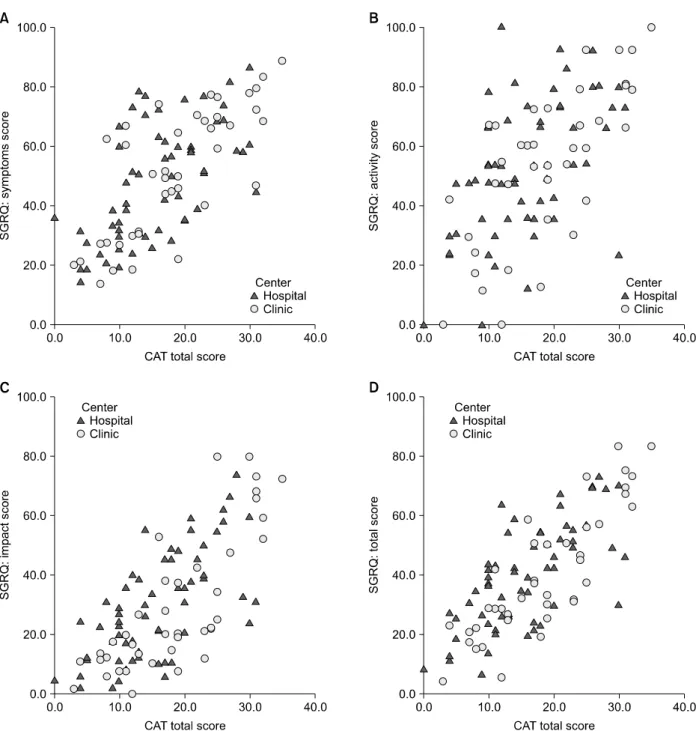
The CAT score was positively correlated with the SGRQ score (r=0.76, p<0.0001) and each component of SGRQ:
symptoms, activity and impacts; r=0.68, r=0.61, and r=0.72, respectively (all p<0.0001). These positive correlations were preserved in the different groups (r=0.86, p<0.0001 in primary care clinic group; r=0.69, p<0.0001 in hospital group). The CAT score was also positively correlated to the Medical Research Council dyspnoea scale (r=0.46, p<0.0001).
Conclusion: The Korean version of CAT had good internal consistency and showed good correlations with SGRQ.
It can be used for assessing the impacts of COPD on the patient's health including primary care setting.
Key Words: Pulmonary Disease, Chronic Obstructive; Health Status Indicators: Questionnaires
Address for correspondence: Ki-Suck Jung, M.D.
Division of Pulmonary, Allergy and Critical Care Medicine, Department of Internal Medicine, Hallym University Sacred Heart Hospital, 22 Gwanpyeong-ro 170beon-gil, Dongan- gu, Anyang 431-796, Korea
Phone: 82-31-380-3715, Fax: 82-31-380-3973 E-mail: [email protected]
Received: Sep. 12, 2012 Revised: Oct. 18, 2012 Accepted: Apr. 1, 2013
CCIt is identical to the Creative Commons Attribution Non-Commercial License (http://creativecommons.org/licenses/by-nc/3.0/).
Introduction
Chronic obstructive pulmonary disease (COPD), a common preventable and treatable disease, is charac- terised by persistent airflow limitation that is usually
progressive
1. COPD accounted for 5.1% of all deaths in 2004
2, and is expected to be third cause of death in 2020
3. In Korea, the prevalence of COPD is 12.4% from the data of fourth Korean National Health and Nutritio- nal Survey
4. COPD was reported to be seventh cause of death in Korea in 2011
5. Unfortunately, there is no pharmacologic treatment that slows the rate of decline of airflow limitation or reduces the mortality of COPD.
Quality of life is one of the treatment goals for COPD.
Recently revised Global Initiative for Chronic Obstruc-
tive Lung Disease (GOLD) guideline emphasized the as-
sessment of health status of patients with COPD
1. Our
previous study showed that only 11% of COPD patients
feel good in their health status
6.
Therefore, health status measurement is now im- portant not only in clinical research studies but also in clinical practice for COPD patients. Existing health sta- tus measures such as the St. George's Respiratory Questionnaire (SGRQ) and the Chronic Respiratory Disease Questionnaire (CRQ)−while reliable, valid, and useful for clinical trials−are lengthy, with scoring algorithms less than ideal for routine use in clinical practice
7.
The COPD Assessment Test (CAT) is an 8-item, self- administered, disease-specific questionnaire, which is recently developed
8and is recommended for the assess- ment of COPD disease severity in the GOLD guidelines
1. Initially, it was developed and validated in the USA and Europe
9,10, and has been translated into many other lan- guages
11. The aim of this study was to validate the Korean version of CAT in clinical practice not only in the referral hospitals but also in the primary care clinics.
Materials and Methods
The primary endpoint of this study was to evaluate the correlation between of the Korean version of CAT with SGRQ in patients with COPD. Secondary endpoint was to reveal the correlation between the CAT with forced expiratory volume in one second (FEV
1) values and Medical Research Council (MRC) dyspnea scale.
This study was approved by the Institutional Review Board of Hallym University Sacred Heart Hospital.
1. Study subjects
Patients were recruited from six investigational sites in South Korea. The sites comprised of 4 primary care clinics and 2 referral hospitals. Written informed con- sent was obtained from each patient prior to the partic- ipation in the study. We included the subjects who were outpatients of age 40 years or older with a smok- ing history of 10 pack-years or more. Subjects also had a diagnosis of COPD at least 6 months. Those with an active respiratory disorder other than COPD such as lung cancer or tuberculosis; or a current diagnosis of asthma; or were unable to complete the questionnaires
were excluded.
2. Study design
This study was a cross-sectional study. We collected the subjects' information including demographic charac- teristics, smoking history, medication history of COPD and comorbidities. We also asked the subjects about the history of exacerbation. The comorbidities included dia- betes, peripheral artery diseases and rheumatoid dis- ease, heart failure (any causes) and ischemic heart disease. Medication history other than COPD such as anti-hypertensive and other cardiovascular drugs was al- so collected.
Patients were asked to complete the SGRQ and CAT questionnaires during the study visit. Validated trans- lations of the standard SGRQ questionnaire with three domains for symptoms, activity and impacts, was used
12. The CAT questionnaire had 8 items, covering cough, phlegm, chest tightness, breathlessness, activity limitation, confidence, sleep, and energy. It was trans- lated into Korean by a professional translational centre, in accordance with the International Society for Pharma- coeconomics and Outcome Research (ISPOR) translation and cultural adaptation process for patient-reported out- comes
13. During the same visit, the patient's breath- lessness was assessed using the MRC dyspnea scale
14. Spirometry was performed if there were no prior docu- mented results within 6 months of the study visit.
3. Statistical methods
Demographic data and other baseline characteristics including CAT, MRC, and SGRQ scores and post-bron- chodilator FEV
1% predicted values were presented us- ing descriptive statistics. Disease severity was assessed using the GOLD severity classification
1based on the subject's post-bronchodilator FEV
1% predicted value.
Associations between the CAT and SGRQ, MRC, and
FEV
1% predicted were tested using Pearson's correla-
tions upon normality assumptions. All the statistical
analyses were performed by using the SPSS version 18
(SPSS Inc., Chicago, IL, USA). A p<0.05 was regarded
as statistically significant.
Table 1. Demographic and clinical characteristics
Characteristics Total (n=100) Clinic (n=40) Hospital (n=60)
Age, yr* 69.2±8.4 70.1±8.6 68.6±8.4
Male† 97 (97.0) 39 (97.5) 58 (96.7)
BMI, kg/m2* 22.9±3.0 22.8±2.8 22.9±3.2
Smoking amount, pack-years*,‡ 40.6±22.3 46.5±25.5 36.6±19.0
Current smoker† 31 (31.0) 14 (35.0) 17 (28.3)
Duration of COPD, mo* 55.7±42.1 48.7±44.8 60.5±39.9
Lung function*
FEV1, L 1.55±0.53 1.61±0.62 1.52±0.46
FEV1 (% of predicted)‡ 63.6±21.1 69.2±25.5 59.8±16.8
FVC, L§ 2.85±0.79 2.46±0.74 3.11±0.72
GOLD grade∥
Grade I§ 19 (19.0) 14 (35.0) 5 (8.3)
Grade II 56 (56.0) 16 (40.0) 40 (66.7)
Grade III 22 (22.0) 10 (25.0) 12 (20.0)
Grade IV 3 (3.0) 0 (0.0) 3 (5.0)
No. of exacerbations in the past year
Mean±SD*,§ 1.56±2.58 2.80±3.57 0.73±0.99
None†,§ 33 (33.0) 4 (10.0) 29 (48.3)
1† 38 (38.0) 14 (35.0) 24 (40.0)
2† 12 (12.0) 8 (20.0) 4 (6.7)
3 or more† 18 (18.0) 14 (35.0) 3 (5.0)
Values are presented as mean±SD or number (%).
*t-test. †Chi-square test. ‡p<0.05. §p<0.01. ∥Fisher's exact test.
BMI: body mass index; COPD: chronic obstructive pulmonary disease; FEV1: forced expiratory volume in one second; FVC: forced vital capacity; GOLD: Global Initiative for Chronic Obstructive Lung Disease.
Results 1. Patient characteristics
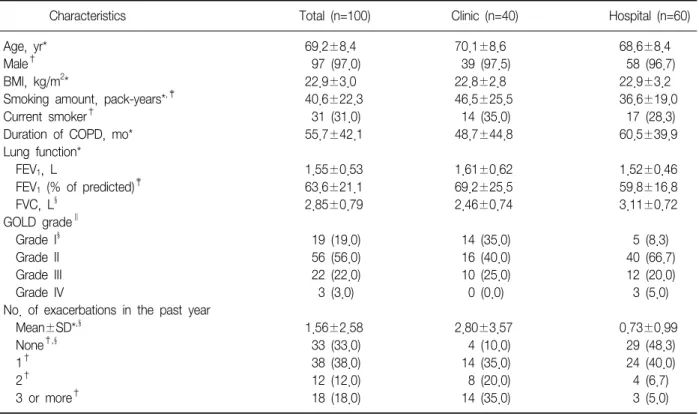
A total 100 subjects were enrolled in this study. Forty subjects were enrolled from the primary care clinics and the rest sixty subjects were from 2 referral hospitals. The clinical characteristics of the subjects are summarized in Table 1. The mean age was 69.2±8.4 years and 97% of them were male. The subjects had a mean smoking history of 40.6±22.3 pack-years and 31% of them were current smoker. The mean duration of COPD diagnosis was 55.7 months. A total 16% of the subjects had the comorbidities. Diabetes was the most frequent one (13% of the subjects). Long acting anticholinergics were the most commonly prescribed treatment (73.0% of the patients), followed by fixed combination of glucocorticoid and longt-acting β2-ag- onists (60.0%) and theophylline (60.0%). A flu vacci-
nation was given in 71% of the subjects in the past year. The mean postbronchodilator FEV
1was 63.6±
21.1% of the predicted value. A total 75.0% of the sub- jects were classified as GOLD grade I or II. More sub- jects from the primary care clinics were classified into GOLD grade 1 than form the referral hospitals (35.0%
vs. 8.3%, p=0.0019). Sixty-seven percent of the patients reported at least one exacerbation in the past year. The mean number of acute exacerbation was 1.56. Subjects from the primary care clinic experienced more ex- acerbation than subject from the referral hospital in the past year, which was statistically significant (2.80 vs.
0.73, p<0.0009). About half of subjects from the re- ferral hospital experienced no exacerbation in the past year (Table 1).
2. Result of questionnaires
The mean CAT score for the study subjects was
Table 2. Summary of COPD Assessment Tests, St. George Respiratory Questionnaires and Medical Research Council dyspnea scales
Total (n=100) Clinic (n=40) Hospital (n=60) COPD Assessment Test*
Total 16.9±8.0 18.6±8.7 15.8±7.4
Cough† 2.1±1.4 2.6±1.4 1.8±1.3
Phlegm 2.5±1.3 2.7±1.4 2.4±1.1
Chest tightness 1.6±1.5 1.9±1.7 1.5±1.4
Breathlessness 3.6±1.2 3.6±1.2 3.5±1.3
Activity limitation 1.6±1.5 1.6±1.5 1.6±1.6
Confidence 1.5±1.6 1.7±1.5 1.4±1.6
Sleep 1.6±1.6 1.9±1.7 1.4±1.6
Energy 2.3±1.3 2.6±1.4 2.2±1.3
St. George Respiratory Questionnaire, mean±SD*
Total 39.9±18.9 40.5±21.3 39.5±17.3
Symptom domain 49.2±20.2 51.5±21.7 47.6±19.2
Activity domain 52.9±23.9 53.3±26.0 52.6±22.7
Impact domain 29.6±20.3 29.7±23.3 29.5±18.3
Medical Research Council dyspnea scale†,‡
Grade 1 12 (12.0) 6 (15.0) 6 (10.0)
Grade 2 55 (55.0) 20 (50.0) 35 (58.3)
Grade 3 23 (23.0) 6 (15.0) 17 (28.3)
Grade 4 9 (9.0) 8 (20.0) 1 (1.7)
Grade 5 1 (1.0) 0 (0.0) 1 (1.7)
Values are presented as mean±SD or number (%).
*t-test. †p<0.05. ‡Fisher's exact test.
COPD: chronic obstructive pulmonary disease.
Table 3. Correlation of COPD Assessment Test with other parameters
Correlation* (p-value)
Total (n=100) Clinic (n=40) Hospital (n=60)
St. George Respiratory Questionnaire
Total 0.7641 (<0.0001) 0.8555 (<0.0001) 0.6926 (<0.0001)
Symptom domain 0.6767 (<0.0001) 0.7598 (<0.0001) 0.5984 (<0.0001)
Activity domain 0.6076 (<0.0001) 0.7253 (<0.0001) 0.5165 (<0.0001)
Impact domain 0.7224 (<0.0001) 0.7929 (<0.001) 0.6750 (<0.0001)
Medical Research Council dyspnea scale 0.4601 (<0.0001) 0.3536 (0.0252) 0.5614 (<0.0001) Lung function†
FEV1, L −0.1925 (0.0550) −0.2389 (0.1377) −0.1828 (0.1622)
FEV1 (% of predicted value) −0.0630 (0.5338) −0.1092 (0.5025) −0.1023 (0.4369)
FVC −0.1465 (0.1458) −0.1189 (0.4649) −0.0581 (0.6595)
*Pearson's correlation. †Post bronchodilator spirometry.
COPD: chronic obstructive pulmonary disease; FEV1: forced expiratory volume in one second; FVC: forced vital capacity.