pISSN 1229-3008 eISSN 2287-6251
Progress in Superconductivity and Cryogenics
Vol.18, No.1, (2016), pp.37~40 http://dx.doi.org/10.9714/psac.2016.18.1.037
```
1. INTRODUCTION
The high critical current density (J
c) at high fields and high temperatures is the prime requirement for MgB
2to replace the low temperature superconductors, such as NbTi and Nb
3Sn for cryogen-free practical applications [1-3].
Some of these applications include superconducting magnets for magnetic resonance imaging (MRI), solenoids, long power cables, and sensors for measuring liquid H
2level [4, 5]. In these applications, pinning of magnetic flux lines (vortices) is an essential requirement to maintain high critical current at high fields for operation with low noise and lower power loss. Carbon doping is known to be very effective for enhancing the high-field critical current properties of MgB
2[6]. However, the J
cenhancement achieved at high fields are usually associated with J
cdegradation in low fields due to stronger current carrier scattering and current-blocking effects on grain boundaries [7]. At the same time, we have to compromise with the reduction of superconducting transition temperature (T
c) in carbon doping. Therefore, we selected nanoscale NiO magnetic particles (mean particle size < 50 nm) as a dopant for MgB
2to introduce magnetic impurities. Magnetic impurities usually have a stronger interaction with magnetic flux line than nonmagnetic impurities and may exert a stronger force to trap the flux lines if they can be properly introduced into the superconducting matrix [8]. In this work, we study the influence of NiO magnetic
nanoparticles on crystal structure, microstructure and superconducting properties of MgB
2.
2. EXPERIMENTAL
NiO-added MgB
2bulk samples were synthesized by the solid-state reaction method. The NiO with 0, 1, 3, and 5 wt. % of total MgB
2was mixed with an appropriate amount of boron and magnesium powders under the environment of ultra-high pure Ar gas in glove box. The mixed powders were pelletized under 10 Ton pressure using mechanical hydraulic press. The pellets were put into Fe tubes and sintered in situ at temperature 800 °C for 30 min under the continuous flow of pure Ar gas.
The crystal structures of NiO-added MgB
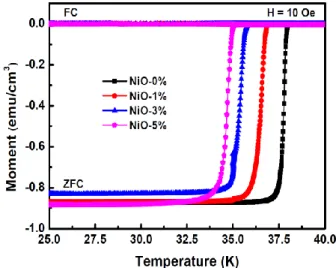
2bulk superconductors were investigated by X-ray diffraction (Rigaku, D/Max 2500) using Cu Kα as an X-ray source. In order to observe the microstructures, the samples were examined by scanning electron microscopy (SEM). The magnetization measurements were carried out on all samples by using a quantum design vibrating sample magnetometer option (Quantum Design PPMS). The superconducting transition temperature (T
c) was obtained from zero-field-cooled (ZFC) measurement by first cooling the sample in zero field and then measuring the magnetic moment as the sample was warmed up in the field of 10 Oe.
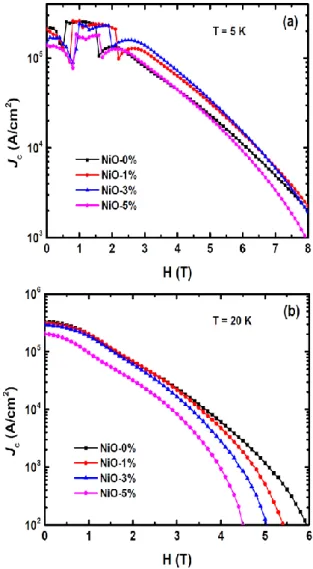
To estimate the critical current density (J
c) of samples, the magnetization hysteresis (M - H) loops were measured on all samples with magnetic field varying from -9 to 9 T applied parallel to the longest dimension of the sample.
Addition effects of nanoscale NiO on microstructure and superconducting properties of MgB 2
Mahipal Ranot
b, S. H. Jang
a, Y. S. Oh
b, K. P. Shinde
a, S. H. Kang
b, and K. C. Chung
*,aa
Powder & Ceramics Division, Korea Institute of Materials Science, Changwon 642-831, Republic of Korea
b