Progress in Superconductivity and Cryogenics
Vol.15, No.2, (2013), pp.12~15 http://dx.doi.org/10.9714/psac.2013.15.2.012
```
1. INTRODUCTION
The remarkably high transition temperature (T
c= 39 K) of MgB
2makes it practically more advantageous over conventional metallic superconductors [1]. The strongly linked nature of the intergrains with a high charge carrier density in this material makes it further an attractive candidate for the next generation of superconductor applications. For most of the practical applications, high critical current density (J
c) in the presence of a magnetic field is required [2]. The J
cof undoped MgB
2is high enough 10
6–10
7A/cm
2at low magnetic fields for practical application, however, J
cdrops rapidly with increasing magnetic field due to the low H
c2and the lack of the effective pinning sites in MgB
2[3]. Therefore the improvement of J
cunder magnetic field is indispensable for the development of MgB
2material for magnet applications.
The substitution of carbon atoms into the boron sites of MgB
2are known to be the most effective way to improve pinning properties in MgB
2and hence J
cperformance under high magnetic fields [4]. The current-carrying performance has been improved by carbon in all the form of MgB
2superconductors, such as polycrystalline bulk, single crystals, wires, tapes, filaments, fibers and thin films.
Despite much research done on enhancement of J
cin MgB
2bulk samples, only a little work has been reported for improving J
cin MgB
2films [5]. Few reports have shown the improvement in J
cby means of carbon doping in MgB
2films [6, 7]. Here, we are reporting the effect of carbon-doping on the superconducting properties of MgB
2thin films. The carbon-doped MgB
2films were fabricated
by using hot-filament-assisted hybrid physical–chemical vapor deposition (HPCVD) using methane as the doping source.
2. EXPERIMENTAL
The carbon-doped MgB
2thin films were fabricated on Al
2O
3(000l) substrates by using a modified HPCVD system. Inspite of capable of producing high-quality MgB
2films, it is difficult to dope the MgB
2films using the original HPCVD system [3]. Therefore, additional dopant methane (CH
4) gas line was installed in the original HPCVD system for doping MgB
2thin films. A separate heater, a Kanthal-super filament, was also installed to decompose CH
4gas. In this hot-filament-assisted (HFA)-HPCVD process, the Al
2O
3substrate was placed on the top surface of a susceptor and Mg chips were placed around it. The reactor was firstly evacuated to a base pressure of ~10
–3Torr using rotary pump and purged several times by flowing high purity argon and hydrogen gases. Prior to the carbon-doped MgB
2film growth, the susceptor along with substrate and Mg chips were inductively heated towards the set temperature under a reactor pressure of 100 Torr in H
2atmosphere. Upon reaching the set temperature, a boron precursor gas, B
2H
6(5% in H
2) and CH
4(100%) gas were introduced into the reactor to initiate the film growth. Finally, the fabricated C-doped MgB
2film was cooled down to room temperature in a flowing H
2carrier gas. The flow rates were 100 sccm for the H
2carrier gas and 50 sccm for the B
2H
6/H
2mixture.
CH
4gas of different flow rates was added to the carrier gas
Significant enhancement of critical current density by effective carbon-doping in MgB 2 thin films
Mahipal Ranot, O. Y. Lee, and W. N. Kang*
BK21 Physics Division and Department of Physics, Sungkyunkwan University, Suwon, Korea (Received 4 June 2013; revised or reviewed 26 June 2013; accepted 27 June 2013)
Abstract
The pure and carbon (C)-doped MgB2 thin films were fabricated on Al2O3 (0001) substrates at a temperature of 650 °C by using hot-filament-assisted hybrid physical–chemical vapor deposition technique. The Tc value for pure MgB2 film is 38.5 K, while it is between 30 and 35 K for carbon-doped MgB2 films. Expansion in c-axis lattice parameter was observed with increase in carbon doping concentration which is in contrast to carbon-doped MgB2 single crystals. Significant enhancement in the critical current density was obtained for C-doped MgB2 films as compared to the undoped MgB2 film. This enhancement is most probably due to the incorporation of C into MgB2 and the high density of grain boundaries, both help in the pinning of vortices and result in improved superconducting performance.
Keywords : MgB2 film, carbon doping, HFA-HPCVD
* Corresponding author: [email protected]
Mahipal Ranot, O. Y. Lee, and W. N. Kang
to dope the film with different carbon concentrations. All the carbon-doped MgB
2films were fabricated at a substrate temperature of 650
oC. CH
4was decomposed by the hot filament at 900
oC. A pure MgB
2film was also prepared under the same conditions for comparison. The nominal carbon concentrations were determined using the correlation between gas concentrations and flow rates. For example, for the flow rates of 50, 100, and 5 sccm of B
2H
6, H
2, and CH
4, respectively, the calculated nominal carbon concentration is 3.2%.
The crystal structures of pure and carbon-doped MgB
2films were investigated by X-ray diffraction (D8 discover, Bruker AXS) using Cu Kα as an X-ray source. Scanning electron microscopy (SEM) was used for measuring the surface morphologies and the thicknesses of the films. The standard four-probe method was used to measure the temperature dependence of resistivity for all the prepared films. The magnetization hysteresis (M −
H) measurementswere carried out using a magnetic property measurement system (XL-5S, Quantum Design).
3. RESULTS AND DISCUSSION
The X-ray θ–2θ scans of pure and carbon-doped MgB
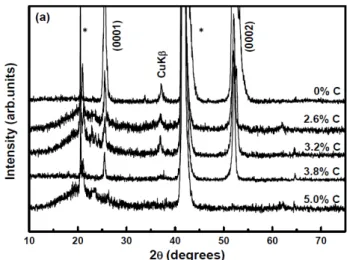
2thin films with different nominal carbon concentrations of 2.6, 3.2, 3.8, and 5.0 % are shown in Fig. 1a. The XRD patterns show only (000l) peaks of MgB
2indicating that the films are c-axis oriented. Expansion in c-axis lattice parameter was observed with increase in carbon doping concentration, which is similar to carbon-doped films [6]
but in contrast to carbon-doped single crystals, where the
c-axis remains almost constant for all the carbonconcentrations [8]. Compared to the undoped film, the MgB
2(000l) peaks are suppressed as carbon concentration increases. The magnification of MgB
2(0001) peak is shown in Fig. 1b. Moreover, there is no indication of any secondary phases, such as Mg, MgO, and MgB
4.
Fig. 1. (a) XRD patterns of pure and carbon-doped MgB
2thin films.
Fig. 1. (b) Magnified view of 0001 peak of MgB
2, suppression of peak was observed as the doping concentration increases.
The resistivity versus temperature curves for pure and carbon-doped MgB
2films are plotted in Fig. 2. The inset shows the magnified view near the superconducting transition temperature (T
c). The T
cvalue for pure MgB
2film is 38.5 K, while it is between 30 and 35 K for carbon-doped MgB
2films. The reduction in T
ccould also be an indicator of carbon substitution at boron sites of MgB
2. The carbon-doped films exhibit a systematic increase in resistivity with increasing carbon concentration, except for 3.2% C-doped sample. The residual resistivity ratio (RRR = ρ
300 K/ρ
40 K) values for the pure and C-doped films with concentrations of 2.6, 3.2, 3.8, and 5.0 % are 4.3, 1.4, 1.3, 1.5, and 1.4 respectively. It indicates that the impurity scattering is stronger in carbon-doped MgB
2films, and hence the decreased RRR values.
Fig. 2. Resistivity versus temperature curves of pure and carbon-doped MgB
2films with different nominal carbon concentrations of 2.6, 3.2, 3.8, and 5.0 %.
13
Significant enhancement of critical current density by effective carbon-doping in MgB2 thin films
Fig. 3. SEM images of pure (a) and C-doped MgB
2films with different nominal carbon concentrations of (b) 2.6 %, (c) 3.2 %, and (d) 5.0 %.
The surface morphologies of pure and doped MgB
2films with different carbon concentrations are shown in Fig. 3a–d.
The dense and smooth morphology was observed for pure MgB
2thin film. As the pure film was doped with carbon, the surface morphology changes from smooth to a planar structure for 2.6 % C-doped MgB
2film. With further increase in carbon doping concentration, the average grain size was found to decrease from 450 nm for 2.6 % C-doped film to 200 nm for 5.0 % C-doped film. It indicates that the carbon doping suppresses the MgB
2grain growth and reduces the grain size. Both the carbon doping and the high density of grain boundaries which are known to be the main pinning source in MgB
2, are expected to be beneficial for improving the J
cperformance of MgB
2superconductor.
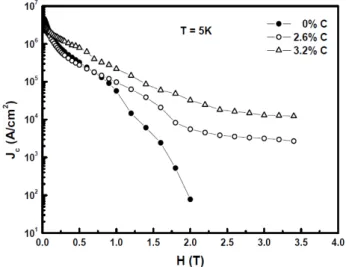
The critical current density (J
c) is evaluated from the magnetic hysteresis (M–H) loops by using the Bean critical state model. Fig. 4 shows the magnetic field dependence of
Jcat 5 K for pure and C-doped MgB
2films. At self-field both the C-doped films show nearly comparable J
cto that of pure sample. This is in contrast to the reported data on C-doped MgB
2films, where one order of magnitude of reduction in J
cwas noticed at self-field and 5 K [6]. It indicates that the inter-grain connectivity for C-doped films is denser and comparable to the pure one. For the undoped film, J
cdrops rapidly in the presence of magnetic field and it is 10
2A/cm
2at an applied field of 2 T. On the other hand, the 3.2% C-doped MgB
2film exhibits a J
cof the order of 10
5A/cm
2at the corresponding field. Significantly high J
cvalues at high fields are obtained for the C-doped films.
This enhancement in J
cis most likely due to the incorporation of C into MgB
2and the high density of grain boundaries, both help in the pinning of vertices and result in improved superconducting performance.
4. CONCLUSION
The effect of carbon-doing on microstructure and
Fig. 4. J
c(H) curves at 5 K for pure and C-doped MgB
2films with different nominal carbon concentrations of 2.6 and 3.2 %.
superconducting properties of MgB
2thin films were investigated. As compared to pure MgB
2film, reduction in
Tc, decrease in RRR values and increase in resistivity were observed for C-doped MgB
2films. The average grain size was found to decrease with increase in carbon doping concentration. It indicates that the carbon doping suppresses the MgB
2grain growth and reduces the grain size. At high magnetic fields the C-doped MgB
2films exhibit considerably larger critical current density as compared to undoped MgB
2film. The enhanced J
ccould be attributed to the strong flux pinning achieved by the incorporation of C into the MgB
2as well as by the high density of grain boundaries. These results imply that the HFA-HPCVD would be a promising technique to fabricate C-doped MgB
2superconducting wires and tapes with high
Jcvalues for large scale applications.
ACKNOWLEDGMENT
This work was supported by Mid-career Researcher Program through National Research Foundation of Korea (NRF) grant funded by the Ministry of Education, Science
& Technology (MEST) (No. 2010-0029136).
REFERENCES
[1] W. N. Kang, H. J. Kim, E. M. Choi, C. U. Jung and S. I. Lee, "MgB2
superconducting thin films with a transition temperature of 39 Kelvin," Science, vol. 292, pp. 1521, 2001.
[2] D. Larbalestier, A. Gurevich, D. M. Feldmann, A. Polyanskii,
"High-Tc superconducting materials for electric power applications," Nature (London), vol. 414, pp. 368, 2001.
[3] Mahipal Ranot and W. N. Kang,"MgB2 coated superconducting tapes with high critical current densities fabricated by hybrid physical-chemical vapor deposition," Curr. Appl. Phys., vol. 12, pp.
353, 2012.
[4] J. H. Kim et al., "Microscopic role of carbon on MgB2 wire for critical current density comparable to NbTi," NPG Asia Mater., vol.
4, pp. e3, 2012.
14
Mahipal Ranot, O. Y. Lee, and W. N. Kang
[5] X. X. Xi,"MgB2 thin films," Supercond. Sci. Technol., vol. 22, pp.
043001, 2009.
[6] C. G. Zhuang et al., "Significant improvements of the high-field properties of carbon-doped MgB2 films by hot-filament-assisted hybrid physical–chemical vapor deposition using methane as the doping source," Supercond. Sci. Technol., vol. 21, pp. 082002, 2008.
[7] M. Ranot, W. K. Seong, Soon-Gil Jung, W. N. Kang, J. Joo, C–J Kim, B–H Jun, S Oh, "Effect of SiC-impurity layer and growth temperature on MgB2 superconducting tapes fabricated by HPCVD," Chem.Vapor. Depos., vol. 18, pp. 36, 2012.
[8] S. M. Kazakov et al., "Carbon substitution in MgB2 single crystals:
structural and superconducting properties," Phys. Rev. B, vol. 71, pp. 024533, 2005.