Vol.19, No.1, (2017), pp.42~46 https://doi.org/10.9714/psac.2017.19.1.042
3```
1. INTRODUCTION
The superconducting critical temperature (T
c) of MgB
2is 39 K, which is the highest value among intermetallic low-temperature superconductors [1]. In addition to the high T
c, the low current anisotropy and long coherence length are other merits of MgB
2[2]. However, a low sintering density [3], poor mechanical strength, and flux creep [4] are problems to be solved for the practical applications of MgB
2.
The properties of MgB
2are dependent not only on the fabrication processing but also on the precursor materials used. There are two different methods that can be used to fabricate MgB
2: an ex-situ process [5-8] and an in-situ [9-12]. In the ex-situ process MgB
2powder was used as a precursor [5-8]. Although the sintering density of the ex situ processed MgB
2was high, the critical current density (J
c) was very low. This is because of the weakly-linked grain boundaries of MgB
2[5]. On the other hand, with the in-situ process, a mixture of Mg and B powders were used as raw materials [9-12]. The in situ processed MgB
2showed a J
chigher than that of the ex-situ processed MgB
2. This is attributed to the high flux pinning capability caused by the strongly coupled grain boundaries [13] and lattice strain [14]. The in situ processed MgB
2, however, showed a low sintering density. Many pores, which are a byproduct of the formation reaction of MgB
2, were included in the microstructure of the in situ processed MgB
2[9,10]. If the porosity of the in situ processed MgB
2is reduced, the J
cis expected to increase further.
Recently, a new fabrication process, which can synthesize MgB
2through a reaction between MgB
4and Mg has been developed [16-21]. In this process, instead of Mg and B powders, MgB
4and Mg powders are used as raw materials to increase the sintered density of MgB
2. A relatively smaller amount of Mg (one half of the in situ process) is used to form the same molar fraction of MgB
2, in comparison with the convention in situ process using 2Mg and 4B powder [21]. Because the pores are developed by the melting of Mg powders during heat treatment, consequently, the number of pores developed in the new process was smaller [15].
In this study the effects of the heat treatment temperature on the formation of MgB
2bulk superconductors prepared using MgB
4and Mg powders was studied. The formation of MgB
2and the microstructures developed at each reaction temperature were examined. Superconducting properties (T
cand the J
c) of the prepared MgB
2samples were also measured.
2. EXPERIMENTAL PROCEDURE
Mg (99.6% purity, average size 4-6 ㎛, spherical in shape) and B (95-97%, average size 1㎛) powders were used as raw materials to synthesize MgB
4.The powders were weighed to a ratio of Mg:B=1:4 and mixed by hand mixing using a pestle and mortar. The mixed powder was put in a steel mold with a diameter of 30 mm and pressed into a pellet. The pellet was encapsulated using a Ti tube to prevent the possible oxidation of Mg during heat treatment.
Effects of heat treatment temperature on the formation of MgB 2 bulk superconductors prepared using MgB 4 and Mg powder
S. H. Kim
a,b, W. N. Kang
b, Y. J. Lee
a,b, B.-H. Jun
a, and C.-J. Kim
*,aa
Korea Atomic Energy Research Institute, Daejeon, Korea
b
Sungkyunkwan University, Suwon, Korea
(Received 26 January 2017; revised or reviewed 20 February 2017; accepted 21 February 2017)
Abstract
The effects of the heat treatment temperature (600℃-1050℃) on the formation of MgB
2and the superconducting properties have been examined. The self-synthesized MgB
4and commercial Mg powders were used as raw materials for the formation of MgB
2. The superconducting critical temperatures (T
cs) of MgB
2bulk superconductors prepared at 600℃-850℃ were as high as 37-38 K regardless of the heat treatment temperature. However, because MgB
4is more stable than MgB
2at above 850℃, no superconducting signals were detected in the susceptibility-temperature curves of the samples prepared above 850℃. As for the critical current density (J
c), the sample heat-treated at a low temperature (600℃) for a prolonged period (40 h) showed a J
chigher than those prepared at 650℃-850℃ for a short period (1 h). The FWHM (full width at half maximum) result showed that the grain size of MgB
2of the 600℃ sample was smaller than that of the other samples. The high J
cof the 600℃sample is attributed to the presence of large numbers of grain boundaries, which can act as flux pinning centers of MgB
2.
Keywords : MgB
4, MgB
2, Critical current density (J
c), Powder reaction, Phase formation, Heat treatment temperature
* Corresponding author: [email protected]
20 30 40 50 60 70 80
@
(b) After HNO3 leaching
#
#
*
*
* *
* *
# MgO
* MgB4
@ MgB2
(222)
(311)
(220)
(200)
(111)
**
*
*
* *
**
*
*
**
*
*
*
*
# #
#
#
#
2 Theta/deg.
Intensity (a.u)
* *
*
* *
* * * *** **
**
*
* *
**
* *
*
(a) Before HNO
3 leaching
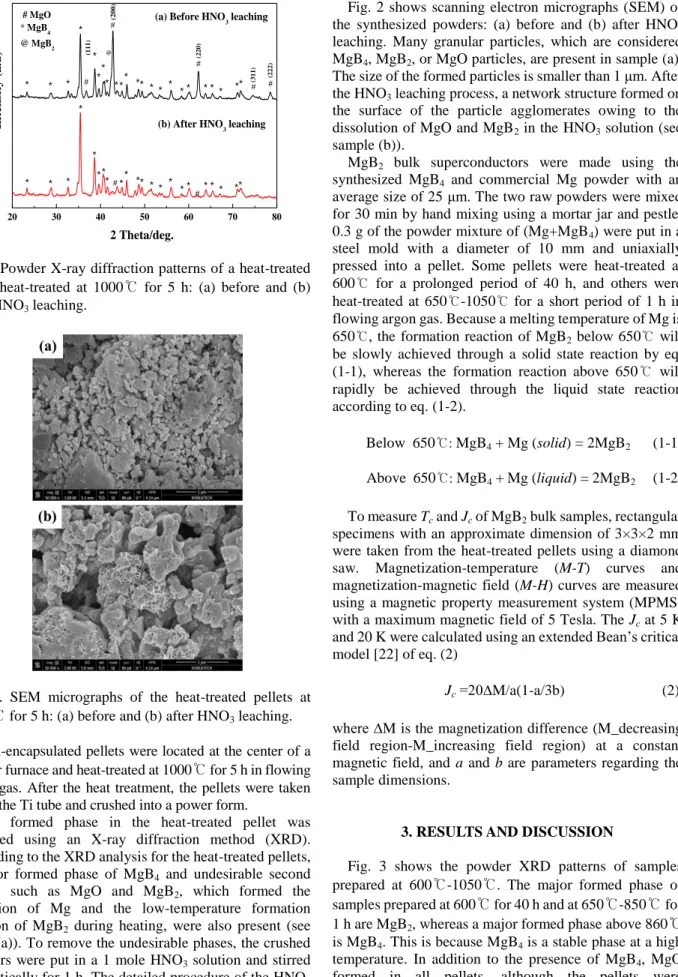
Fig.1. Powder X-ray diffraction patterns of a heat-treated pellet heat-treated at 1000℃ for 5 h: (a) before and (b) after HNO
3leaching.
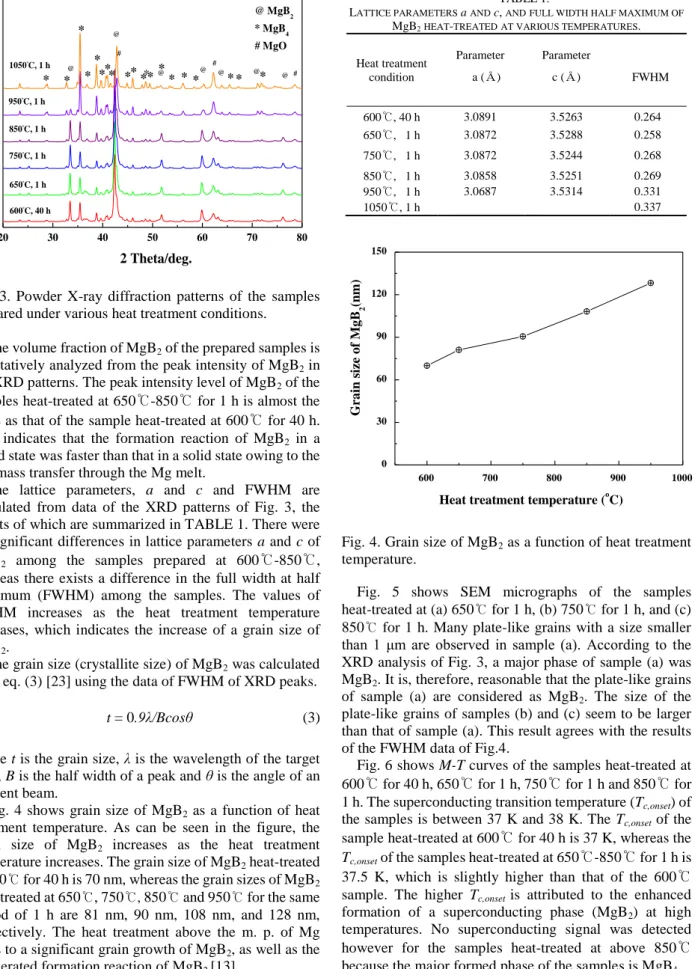
Fig. 2. SEM micrographs of the heat-treated pellets at 1000℃ for 5 h: (a) before and (b) after HNO
3leaching.
The Ti-encapsulated pellets were located at the center of a tubular furnace and heat-treated at 1000℃ for 5 h in flowing argon gas. After the heat treatment, the pellets were taken out of the Ti tube and crushed into a power form.
The formed phase in the heat-treated pellet was analyzed using an X-ray diffraction method (XRD).
According to the XRD analysis for the heat-treated pellets, a major formed phase of MgB
4and undesirable second phases such as MgO and MgB
2, which formed the oxidation of Mg and the low-temperature formation reaction of MgB
2during heating, were also present (see Fig. 1(a)). To remove the undesirable phases, the crushed powders were put in a 1 mole HNO
3solution and stirred magnetically for 1 h. The detailed procedure of the HNO
3leaching process was well described in the literature [19].
It was confirmed in our experiment that most of the MgO and MgB
2was dissolved completely in the HNO
3solution, and a high purity MgB powder was obtained (Fig. 1(b)).
Fig. 2 shows scanning electron micrographs (SEM) of the synthesized powders: (a) before and (b) after HNO
3leaching. Many granular particles, which are considered MgB
4, MgB
2, or MgO particles, are present in sample (a).
The size of the formed particles is smaller than 1 μm. After the HNO
3leaching process, a network structure formed on the surface of the particle agglomerates owing to the dissolution of MgO and MgB
2in the HNO
3solution (see sample (b)).
MgB
2bulk superconductors were made using the synthesized MgB
4and commercial Mg powder with an average size of 25 μm. The two raw powders were mixed for 30 min by hand mixing using a mortar jar and pestle.
0.3 g of the powder mixture of (Mg+MgB
4) were put in a steel mold with a diameter of 10 mm and uniaxially pressed into a pellet. Some pellets were heat-treated at 600 ℃ for a prolonged period of 40 h, and others were heat-treated at 650 ℃ -1050 ℃ for a short period of 1 h in flowing argon gas. Because a melting temperature of Mg is 650 ℃ , the formation reaction of MgB
2below 650 ℃ will be slowly achieved through a solid state reaction by eq.
(1-1), whereas the formation reaction above 650 ℃ will rapidly be achieved through the liquid state reaction according to eq. (1-2).
Below 650 ℃: MgB
4+ Mg (solid) = 2MgB
2(1-1) Above 650 ℃: MgB
4+ Mg (liquid) = 2MgB
2(1-2)
To measure T
cand J
cof MgB
2bulk samples, rectangular specimens with an approximate dimension of 3×3×2 mm were taken from the heat-treated pellets using a diamond saw. Magnetization-temperature (M-T) curves and magnetization-magnetic field (M-H) curves are measured using a magnetic property measurement system (MPMS) with a maximum magnetic field of 5 Tesla. The J
cat 5 K and 20 K were calculated using an extended Bean’s critical model [22] of eq. (2)
J
c=20∆M/a(1-a/3b) (2)
where ∆M is the magnetization difference (M_decreasing field region-M_increasing field region) at a constant magnetic field, and a and b are parameters regarding the sample dimensions.
3. RESULTS AND DISCUSSION
Fig. 3 shows the powder XRD patterns of samples prepared at 600℃-1050℃. The major formed phase of samples prepared at 600℃ for 40 h and at 650℃-850℃ for 1 h are MgB
2, whereas a major formed phase above 860℃
is MgB
4. This is because MgB
4is a stable phase at a high
temperature. In addition to the presence of MgB
4, MgO
formed in all pellets, although the pellets were
encapsulated with a Ti tube to suppress the oxidation of
Mg. The presence of MgO is attributed to the high
reactivity of Mg powder, which is easy to react with
oxygen included in argon gas.
20 30 40 50 60 70 80
1050oC, 1 h950oC, 1 h
850oC, 1 h
750oC, 1 h
650oC, 1 h
@
* *
* *
* *
* *
* *
* *
* *
*
*
*
*
*
*
##
#
@ @
@ @
@ @
In te n sity ( a.u )
2 Theta/deg.
@ MgB
2
* MgB
4# MgO
600oC, 40 h
Fig. 3. Powder X-ray diffraction patterns of the samples prepared under various heat treatment conditions.
The volume fraction of MgB
2of the prepared samples is qualitatively analyzed from the peak intensity of MgB
2in the XRD patterns. The peak intensity level of MgB
2of the samples heat-treated at 650℃-850℃ for 1 h is almost the same as that of the sample heat-treated at 600℃ for 40 h.
This indicates that the formation reaction of MgB
2in a liquid state was faster than that in a solid state owing to the fast mass transfer through the Mg melt.
The lattice parameters, a and c and FWHM are calculated from data of the XRD patterns of Fig. 3, the results of which are summarized in TABLE 1. There were no significant differences in lattice parameters a and c of MgB
2among the samples prepared at 600℃-850℃, whereas there exists a difference in the full width at half maximum (FWHM) among the samples. The values of FWHM increases as the heat treatment temperature increases, which indicates the increase of a grain size of MgB
2.
The grain size (crystallite size) of MgB
2was calculated from eq. (3) [23] using the data of FWHM of XRD peaks.
t = 0.9λ/Bcosθ (3)
where t is the grain size, λ is the wavelength of the target used, B is the half width of a peak and θ is the angle of an incident beam.
Fig. 4 shows grain size of MgB
2as a function of heat treatment temperature. As can be seen in the figure, the grain size of MgB
2increases as the heat treatment temperature increases. The grain size of MgB
2heat-treated at 600 ℃ for 40 h is 70 nm, whereas the grain sizes of MgB
2heat-treated at 650 ℃ , 750 ℃, 850 ℃ and 950 ℃ for the same period of 1 h are 81 nm, 90 nm, 108 nm, and 128 nm, respectively. The heat treatment above the m. p. of Mg leads to a significant grain growth of MgB
2, as well as the accelerated formation reaction of MgB
2[13].
TABLE 1.
L
ATTICE PARAMETERSa
ANDc,
ANDFULL WIDTH HALF MAXIMUM OFMgB
2HEAT-
TREATEDAT VARIOUS TEMPERATURES.
Heat treatment condition
Parameter a (Å)
Parameter
c (Å) FWHM
600℃, 40 h 3.0891 3.5263 0.264
650℃, 1 h 3.0872 3.5288 0.258
750℃, 1 h 3.0872 3.5244 0.268
850℃, 1 h 3.0858 3.5251 0.269
950℃, 1 h 3.0687 3.5314 0.331
1050℃, 1 h 0.337
600 700 800 900 1000
0 30 60 90 120 150
Grain size of MgB
2(nm )
Heat treatment temperature (
oC)
Fig. 4. Grain size of MgB
2as a function of heat treatment temperature.
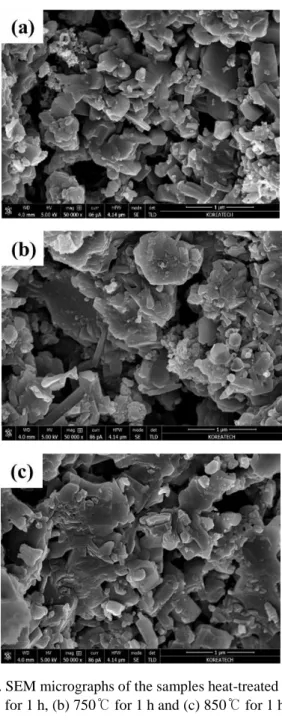
Fig. 5 shows SEM micrographs of the samples heat-treated at (a) 650 ℃ for 1 h, (b) 750 ℃ for 1 h, and (c) 850 ℃ for 1 h. Many plate-like grains with a size smaller than 1 μm are observed in sample (a). According to the XRD analysis of Fig. 3, a major phase of sample (a) was MgB
2. It is, therefore, reasonable that the plate-like grains of sample (a) are considered as MgB
2. The size of the plate-like grains of samples (b) and (c) seem to be larger than that of sample (a). This result agrees with the results of the FWHM data of Fig.4.
Fig. 6 shows M-T curves of the samples heat-treated at 600℃ for 40 h, 650℃ for 1 h, 750℃ for 1 h and 850℃ for 1 h. The superconducting transition temperature (T
c,onset) of the samples is between 37 K and 38 K. The T
c,onsetof the sample heat-treated at 600℃ for 40 h is 37 K, whereas the T
c,onsetof the samples heat-treated at 650℃-850℃ for 1 h is 37.5 K, which is slightly higher than that of the 600℃
sample. The higher T
c,onsetis attributed to the enhanced formation of a superconducting phase (MgB
2) at high temperatures. No superconducting signal was detected however for the samples heat-treated at above 850℃
because the major formed phase of the samples is MgB
4.
Fig. 5. SEM micrographs of the samples heat-treated at (a) 650℃ for 1 h, (b) 750℃ for 1 h and (c) 850℃ for 1 h.
Fig. 7 shows the J
c-B curve at 5 K and 20 K of the samples heat-treated at 650℃-850℃. The J
cat 5 K of the sample heat-treated at 600℃ for 40 h is the highest. The value of J
cat 5 K and 2 T is 19,600 A/cm
2. The value of J
cs at 5 K and the applied magnetic fields decrease as the heat treatment temperature increases. This is because the grain boundary area, which can be the flux pinning center of MgB
2[24], is reduced owing to the significant grain growth of MgB
2at high temperatures, as was previously shown in Figs. 4 and 5.
Unlike the J
c–B characteristics at 5 K, the value of J
cat 20 K below a magnetic field of 3 T of the sample heat-treated at 850℃ is the highest. At a magnetic field of larger than 3 T, there exists a crossover of J
cat 3 T. As a result of the J
ccross over, the value of J
cat 20 K of the sample heat-treated at 650℃ for 40 h is the highest.
Further study is needed for understanding the temperature dependence of J of MgB .
20 25 30 35 40
-1.0 -0.8 -0.6 -0.4 -0.2 0.0
Nomali ze d s us ce ptibity (a.u.)
Temparature (K) 600
oC, 40 h
650
oC, 1 h 750
oC, 1 h 850
oC, 1 h
Fig. 6. Normalized susceptibility-temperature curves of samples heat-treat at 650℃-850℃.
1 2 3 4 5
102 103 104 105