pISSN 1229-3008 eISSN 2287-6251
Progress in Superconductivity and Cryogenics
Vol.19, No.1, (2017), pp.36~41 https://doi.org/10.9714/psac.2017.19.1.036
3```
1. INTRODUCTION
A MgB2 superconductor has a high superconducting critical temperature (Tc) of 39 K [1] and a high critical current density (Jc) at magnetic fields [2]. In addition to the excellent superconducting properties, other merits of MgB2 are its long coherent length [3] and the small current anisotropy [4-5]. Moreover, the raw materials (Mg and B) of MgB2 are not expensive and easy to obtain. Owing to these merits, MgB2 is believed to be a promising material that can replace a conventional NbTi superconductor. A superconducting magnetic designed using MgB2
superconducting wires can be operated at 20 K using an electrical cooler instead of liquid helium.
For practical applications of a MgB2 superconductor the Jc under magnetic fields should be enhanced. The presence of defects in superconducting grains or at the grain boundaries of MgB2 leads to the Jc enhancement of MgB2. The defects can be made artificially either through physical [6-13] or chemical [14-16] methods. Particle (neutron, electron or ion) irradiation is a well-known process that can form defects physically through the collision of accelerated particles to the targeting materials.
Small defects such as vacancies and cavities can be formed in the superconducting matrix through particle irradiation [ 1 5 - 2 0 ] . As a result of the defect formation, the Jc at
* Corresponding author: [email protected]
the magnetic fields of the particle-irradiated MgB2 was much higher than that of MgB2 with no irradiation [21,22].
Along with the physical method, the Jc of MgB2 can be increased by the doping of chemical species such as silicon carbide [23], carbon-related materials [24], and other fine impurity phases [25]. The carbon doping to MgB2 not only led to the formation of a lattice strain [26], and lattice substitution [26-31] but also increased the number of grain boundaries [32]. Mechanical milling for boron powder is an alternative way to increase the Jc of MgB2 through the grain size refinement of MgB2 [32].
In this experiment, MgB4 powder was synthesized using Mg and B powder by the powder reaction process. MgB4 is a phase that is compatible with MgB2 in a Mg-B binary phase diagram. MgB4 is often formed with MgB2 in the powder reaction process using boron-enriched compositions. The synthesized MgB4 powder was used as an additive of in situ processed MgB2 bulk superconductors. The added amount of MgB4 was changed from 0 to 20 wt.%. The effects of MgB4 addition on the Jc, Tc and the microstructure of MgB2 were investigated.
2. EXPERIMENTAL PROCEDURE
MgB4 powder used as an additive for MgB2 superconductors was synthesized by the powder reaction method of (Mg + 4B = MgB4) using Mg and B powders.
Enhanced critical current density of in situ processed MgB2 bulk superconductors with MgB4 additions
S. H. Kima,b, W. N. Kang b, B.-H. Juna, Y. J. Lee a,b, and C.-J. Kim*,a
aKorea Atomic Energy Research Institute, Daejeon, Korea
bSungkyunkwan University, Suwon, Korea
(Received 25 January 2017; revised or reviewed 22 February 2017; accepted 23 February 2017)
Abstract
The effects of MgB4 addition on the superconducting properties and the microstructure of in situ processed MgB2 bulk superconductors were studied. MgB4 powder of 1-20 wt.% was mixed with (Mg + 2B) powder and then pressed into pellets. The pellets of (Mg + 2B + xMgB4) were heat-treated at 650 ℃ for 1 h in flowing argon. The powder X-ray diffraction (XRD) analysis for the heat-treated samples showed that the major formed phase in all samples was MgB2 and the minor phases were MgB4 and MgO. The full width at half maximum (FWHM) values showed that the grain size of MgB2 decreased as the amount of MgB4 addition increased. MgB4 particles included in a MgB2 matrix is considered to suppress the grain growth of MgB2. The onset temperatures (Tc,onset) of MgB2 with MgB4 addition (0-10 wt.%) was between 37-38 K. The 20 wt.% MgB4 addition slightly reduced the Tc,onset of MgB2 to 36.5 K. This result indicates that MgB4 addition did not influence the superconducting transition temperature (Tc) of MgB2 significantly.
On the other hand, the small additions of 1-5 wt.% MgB4 increased the critical current density (Jc) of MgB2. The Jc
enhancement by MgB4 addition is attributed not only to the grain size refinement but also to the possible flux pinning of MgB4 particles dispersed in a MgB2 matrix.
Keywords : MgB2, MgB4 addition, Superconductor, Critical current density (Jc), Grain refinement
The detailed preparation condition of MgB4 was well described in previous reports [33-38]. The impurity phases included in the synthesized MgB4 powder were removed by the HNO3 leaching process [36].
MgB2 bulk superconductors were fabricated through an in situ reaction process using Mg and B powders. Mg and B powders with a ratio of Mg:B=1:2 were mixed for 30 min by hand mixing using a mortar jar and pestle. To compensate the possible Mg loss during heat treatment, 10 wt.% of Mg was intentionally added to a mixture of (Mg + 2B). MgB4 powder of 1-20 wt.% was added to the mixture of (Mg + 2B) powder.
0.3 g of a powder mixture of (Mg + 2B + x wt.% MgB4) was put in a steel mold with a diameter of 10 mm and was uniaxially pressed into a pellet. The pressed pellet was encapsulated with a Ti tube to suppress the possible oxidation of Mg during heat treatment. To determine out the optimum heat treatment condition for the formation of MgB2, the heat treatment temperature and time were varied.
We determined the heat treatment temperature as 650℃, which is a temperature just above a melting point of Mg and the heat treatment period as 1 h. The short period of 1 h at 650℃ is to minimize the grain growth of MgB2. The Ti-encapsulated pellets were located at the center of a tubular furnace, heated to 650℃ at a rate of 100℃/h in flowing argon gas, maintained for 1 h and then cooled to room temperature in a furnace.
The heat treated pellets were crushed into a powder form for a phase analysis. The formed phases after heat treatment were analyzed using an X-ray diffraction method (XRD) for the power samples. From the peak intensity of each phase in XRD patterns, volume fractions of the formed phases and the second residual phases were calculated using eq. (1).
MgO MgB
MgB MgB
2 I I I
) I F(MgB
4 2
2
(1)
where F(MgB2) is a volume fraction of MgB2, and IMgB2 and IMgB4 and IMgO are the peak intensities of MgB2, MgB4 and MgO, respectively.
To measure Tc and Jc of MgB2 bulk superconductors, rectangular specimens with approximate dimensions of 3×3×2 mm were cut from the heat-treated pellets using a diamond saw. Susceptibility-temperature curves (M-T) and magnetization-magnetic field (M-H) curves are obtained using a magnetic properties measurement system (MPMS) with a maximum magnetic field of 5 Tesla. Jc at 5 K and 20 K was calculated using the extended Bean’s critical model [39] of eq. (2).
Jc =20∆M/a(1-a/3b) (2)
where ∆M is the magnetization difference (M decreasing field region-M increasing field region) in a constant magnetic field, and a and b are parameters regarding the sample dimension.
3. RESULTS AND DISCUSSION
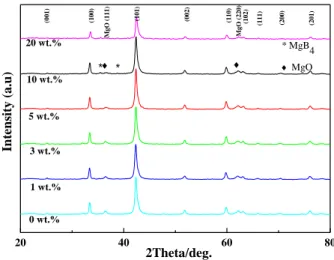
Fig. 1 shows the XRD patterns of the samples with (0-20 wt.%) MgB4 additions, heat-treated at 650℃ for 1 h. The major formed phase of all samples is MgB2 regardless of the amount of MgB4 additions. The addition of MgB4 appears to not affect the formation of MgB2. As the amount of MgB4 addition increases, the peaks of MgB4 are intensified (see the XRD patterns with 10 and 20 wt.%
MgB4 additions). Another minor phase formed in the heat-treated pellets is MgO. Small MgO peaks observed in all XRD patterns are attributed to the oxidation of Mg during heat treatment.
According to the XRD results of Fig. 1, the formation reaction of MgB4 at the give heat treatment condition can be described by eq. (3).
Mg + 2B + xMgB4 = MgB2 + xMgB4 +yMgO (3)
At the heat treatment temperature of 650℃, MgB2 forms through the liquid phase reaction between a Mg melt and a solid B powder, because the heat treatment temperature is high than m. p. (649℃) of Mg. The formation reaction of MgB2 would be conducted by the mass transfer through the Mg melt. Most of the Mg is thought to be consumed to form MgB2 throughthe reactions of (Mg + 2B = MgB2) and (MgB4 + Mg = MgB2). Some of the Mg might be consumed for the oxidation of Mg or be evaporated during heat treatment. Because 10 wt.% of Mg was intentionally added to the raw powders of (Mg + B) to compensate the Mg loss, the amount of Mg was sufficient for the formation reaction of MgB2. In the case of large MgB4 additions, The peaks of MgB4 were present together with MgB2. The MgB4 is supposed to be present as a discrete particle form within MgB2 grains or at the grain boundaries of MgB2.
Fig. 2 shows the volume fraction of the formed phases in the samples with MgB4 additions, calculated using eq. (1).
20 40 60 80
10 wt.%
0 wt.%
1 wt.%
3 wt.%
5 wt.%
MgO (220)
MgO (111) (201)
(200)
(111)
(102)
(110)
(002)
(101)
(100)
(001)
2Theta/deg.
Intensity (a.u)
20 wt.%
* *
* MgB4
MgO
Fig. 1. XRD patterns of the samples with MgB4 additions, heat-treated at 650℃ for 1 h.
Enhanced critical current density of in situ processed MgB2 bulk superconductors with MgB4 additions
0 5 10 15 20
0 20 40 60 80
MgB4 MgO
Volume fraction of formed phases (%)
MgB4 addition (wt.%)
MgB2
Fig. 2. Volume fractions of MgB2, MgB4 and MgO as a function of the amount of MgB4 addition.
TABLE I
LATTICE PARAMERS AND FWHM VS. AMOUNT OF MgB4 ADDITION.
Amount of MgB4
(wt.%)
FWHM (deg.) Lattice parameter (Å )
(110) (002) a c
0 0.389 0.443 3.090 3.532
1 0.415 0.449 3.091 3.500
3 0.405 0.413 3.087 3.534
5 0.391 0.425 3.088 3.540
10 0.403 0.455 3.090 3.526
20 0.396 0.486 3.087 3.497
The volume fraction of MgB2 of the sample with no addition is approximately 80%. As is normally expected, the volume fraction of MgB2 is dependent on the added amount of MgB4. The volume fractions of MgB2 for the sample with 10 wt.% and 20 wt.% MgB4 additions are 74%
and 66.3%, respectively. Interestingly, the volume fraction of the MgO formed during heat treatment is approximately 18% regardless of the MgB4 addition.
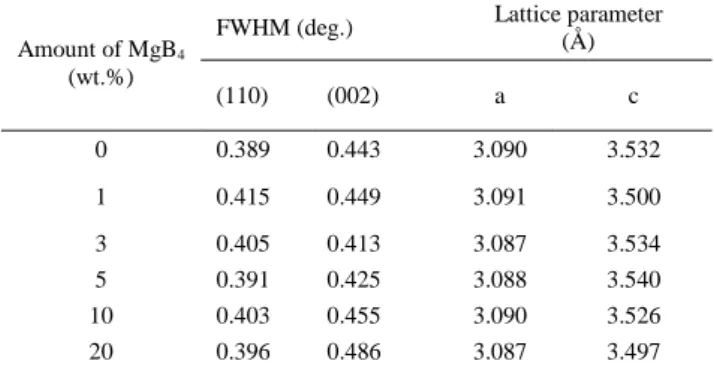
Through a precise analysis of the XRD patterns of Fig. 1, the lattice parameters of MgB2 and the full width at half maximum (FWHM) of the peaks were calculated, the results of which are summarized in TABLE I. As illustrated in TABLE I, the lattice parameters a and c were not influenced by the MgB4 additions. This is because both MgB2 and MgB4 are stoichiometric line compounds and there is no interaction between MgB2 and MgB4 (MgB4 is a high temperature phase). The values of FWHM estimated from the (110) and (002) peaks of MgB2 increase as the amount of MgB4 addition increases, which indicates the change in the grain size of MgB2.
The grain sizes of MgB2 samples with no addition and MgB4 additions were calculated from the formula t=
0.9λ/BCOSθ [40] using the FWHM data. Where t is the grain (crystallite) size, λ is the wavelength of the target used, B is the half width of the peak, and θ is the Bragg angle of the incident beam.
Fig. 3 shows the variation of the grain size of MgB2 as a function of the amount of MgB4 addition. The grain size of
0 5 10 15 20
0 10 20 30 40 50 60 70
Grain size of MgB 2 (nm)
MgB4 addition (wt.%)
Fig. 3. Variation of grain size of MgB2 as a function of the amount of MgB4 addition.
Fig. 4. SEM micrographs of samples with (a) no addition, (b) 5 wt.% MgB4 addition, and (c) 20 wt.% MgB4 addition.
(a)
(b)
(c)
38
Fig. 5. Schematics of dispersed MgB4 particles in an MgB2 grain structure.
MgB2 with no addition is 45 nm. The grain size decreases as the amount of MgB4 addition increases. For 5 wt.% and 20 wt.% MgB4 additions, the grain sizes of MgB2 are 30 nm and 22 nm, respectively. These results indicate that the MgB4 addition suppressed the grain growth of MgB2. In other words, a larger grain boundary area exists in the pellet with MgB4 addition in comparison with no addition.
Fig. 4 shows SEM micrographs of the samples with (a) no addition, (b) 5 wt.% MgB4 addition and (c) 20 wt.%
MgB4 addition. Many plate-like grains whose thickness is smaller than 1 μm are observed in sample (a). As already confirmed through the XRD analysis of Fig. 1, approximately 80 % of the formed phase of sample (a) was MgB2. It can thus be said that the plate-like grains are MgB2. The SEM investigation showed that the grain size of MgB2 decreased as the amount of MgB4 addition increased The MgB2 grains observed in the sample with 20 wt. % MgB4 addition are smaller than that of sample (a) (see Fig. 4c)). The SEM observation agrees with the XRD FWHM of Fig. 2.
The reason why the grain growth of MgB2 was suppressed by the addition of MgB4 can be explained in terms of the thermal stability of MgB4 at the heat treatment temperatures. There is a large difference in the melting temperature between Mg and B. The m. p. of B is as high as 2300℃ [41], whereas the m. p. of Mg is very low at 649℃ [42]. MgB4, which has more boron than MgB2, would be more stable at high temperature. The MgB4
particles can be present at the grain boundaries of MgB2 or trapped within MgB2 grains (see the schematic illustration in Fig. 5). The MgB4 particle present at the grain boundaries of MgB2 can suppress the grain growth of MgB2 during heat treatment.
Fig. 6 shows normalized susceptibility-temperature (M-T) curves of the samples with various MgB4 additions.
Tc,onset and Tc,mid of the sample with no addition are 37 K and 35.9 K, respectively, whereas Tc,onset and Tc,mid of the sample with 10 wt.% MgB4 addition are 37 K and 36.1 K, respectively. In the case of a large MgB4 addition of 20 wt.%, Tc,onset and Tc,mid are 36.5 K and 35.8 K, which are slightly lower than the other samples. The superconducting critical temperatures seem to not be significantly influenced by the MgB4 addition. The M-T result confirms again that MgB4 is a chemically stable and thermally compatible additive with MgB2, which does not react with
20 25 30 35 40
-1.2 -1.0 -0.8 -0.6 -0.4 -0.2 0.0
Temparature (K)
Nomalizes susceptibity (a.u.)
0 wt.%
1 wt.%
3 wt.%
5 wt.%
10 wt.%
20 wt.%
Fig. 6. Normalized susceptibility-temperature curves of the samples with MgB4 additions.
TABLE II
SUPERCONDUCTING TRANSITION TEMPERATURES OF THE SAMPLES WITH
MgB4 ADDITIONS. MgB4
addition (wt.%)
Superconducting critical temperatures of MgB2 (K)
Tc,onset Tc,mid
0 37 35.9
1 37 36.0
3 37.5 36.3
5 38 37.3
10 37 36.1
20 36.5 35.8
a superconducting MgB2. The superconducting critical temperatures of the samples with various MgB4 additions are summarized in TABLE II.
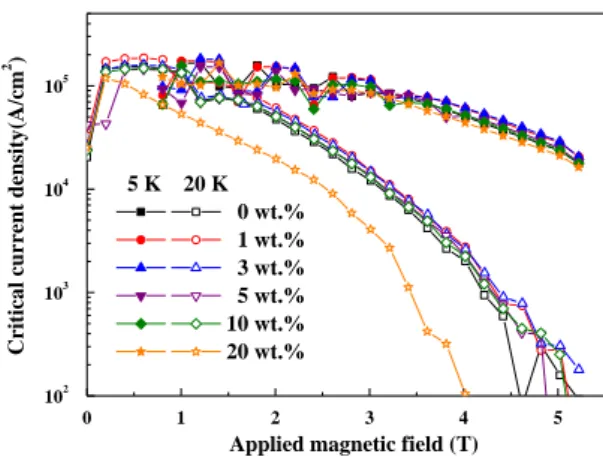
Fig. 7 shows Jc-B curves at 5 K and 20 K of samples with MgB4 additions, heat-treated at 650℃ for 1 h. The Jcs at 5 K of the samples with 1-5 wt.% MgB4 additions are slightly higher than that of the sample with no addition. Moreover, Jc at 5 K of the sample with 10 wt.% MgB4 is similar to that of the sample with no addition, in spite of the low volume fraction of MgB2. The enhanced Jc of the samples with small MgB4 additions is attributed to the grain refinement and the presence of MgB4 particles in the superconducting MgB2 matrix, which were already observed by FWHM and SEM investigations (Figs. 3 and 4). These two factors appear to act as flux pinning centers which pin the magnetic flux. When the amount of MgB2 addition is more than 20 wt.%, Jc decreases because the superconducting volume fraction in the sample decreases. Although not shown here, in our study, the addition of MgB4 up to 70% resulted in a decrease in Jc in proportion to the amount added.The Jc-B characteristics at 20 K of samples with MgB4 additions shows similar trend to that at 5 K: 1-5 wt.% MgB4 additions increases the Jc of MgB2.
Fig. 8 shows the Jc-B curves at 5 K and the magnetic fields of 3.5-5.0 T. With the exception of the 20 wt.% MgB4 addition, the Jc values at 5 K and the given applied magnetic fields of the samples are higher than that of the sample with no addition. Jc at 5 K, 4 T of the sample with no addition is 50,850 A/cm2, whereas Jcs at 5 K, 4 T of the samples with 1 wt.% and 3 wt.% MgB4 adidtions are 59,920 A/cm2 and 60,760 A/cm2, respectively.
Enhanced critical current density of in situ processed MgB2 bulk superconductors with MgB4 additions
0 1 2 3 4 5
102 103 104 105
Applied magnetic field (T) Critical current density(A/cm2 )
5 K 20 K 0 wt.%
1 wt.%
3 wt.%
5 wt.%
10 wt.%
20 wt.%
Fig. 7. Jc-B curves at 5 K and 20 K of the samples with 0-20 wt.% MgB4 additions.
3.5 4.0 4.5 5.0
4x10⁴ 5x10⁴ 6x10⁴ 7x10⁴ 8x10⁴
Applied magnetic field (T) Critical current density(A/cm2 ) 5 K
0 wt.%
1 wt.%
3 wt.%
5 wt.%
10 wt.%
20 wt.%
Fig. 8. Jc-B curves at 5 K and magnetic fields of 3.5 T-5.0 T of the samples with 0-20 wt.% MgB4 additions.
4. CONCLUSIONS
We studied the effects of MgB4 additions (1-20 wt.%) on the superconducting properties of MgB2 bulk superconductors prepared using the powder reaction process. The onset temperature (Tc,onset) of MgB2 with MgB4 addition (0-10 wt.%) was between 37-38 K. Even for a large MgB4 addition of 20 wt.%, the Tc,onset was 36.5 K. This result indicates that the MgB4 addition did not significantly influence the superconducting transition temperature (Tc) of MgB2. On the other hand, the small MgB4 additions of 1-5 wt.% increased the critical current density (Jc) of MgB2. Moreover, the Jc level of MgB2 with 10 wt.% MgB4 addition was similar to that of MgB2 with no addition in spite of the reduced superconducting volume. The FWHM and SEM investigation showed that the grain size of MgB2 decreased as the amount of MgB4 addition increased. The presence of MgB4 in a MgB2 matrix is likely to suppress the grain growth of MgB2 at the heat treatment temperature. The Jc enhancement of MgB2 by the MgB4 addition appears to be attributed to the grain size refinement of MgB2 and the possible flux pinning of MgB4 particles dispersed within MgB2 grains.
ACKNOWLEDGMENTS
This work was supported by the National Research Foundation Grant (NRF-2013M2A8A1035822) from Ministry of Science, ICT and Future Planning (MSIP) of Republic of Korea, and partially supported by Korea Institute for Advancement of Technology (KIAT) through the Promoting Regional specialized Industry.
REFERENCES
[1] J. Nagamatsu, N. Nakagawa, T. Muranaka, Y. Zenitani and J.
Akimitsu, “Superconductivity at 39 K in magnesium diboride,”
Nature, vol. 410, pp. 63-64, 2001.
[2] Y. Eltsev, S. Lee, K. Nakao, N. Chikumoto, S. Tajima, N.
Koshizuka and M. Murakami, “Anisotropic superconducting properties of MgB2 single crystals probed by in-plane electrical transport measurements,” Phys. Rev., vol. 65, pp. 140501, 2002.
[3] M. Eisterer, M. Zehetmayer and H. W. Weber, “Current percolation and anisotropy in polycrystalline MgB2,” Phys. Rev. Lett., vol. 90, pp. 247002, 2003.
[4] Y. Eltsev, S. Lee, K. Nakao, N. Chikumoto, S. Tajima, N.
Koshizuka and M. Murakami, “Anisotropic superconducting properties of MgB2 single crystals probed by in-plane electrical transport measurements,” Phys. Rev., vol. 65, pp. 140501, 2002.
[5] A. V. Pan, S. Zhou, H. Liu and S. Dou, “Properties of superconducting MgB2 wires: in situ versus ex situ reaction technique,” Supercond. Sci. Technol., vol. 16, pp. 639-644, 2003.
[6] Y. J. Zhao, W. K. Chu, M. F. Davis, J. C. Wolfe, S. C. Deshmukh and D. J. Economou, “Radiation damages and flux pinning in YBa2Cu3O7 thin films,” Physica C, vol. 184, pp. 144-148, 1991.
[7] L. Gozzelino, D. Botta, R. Cherubini, A. Chiodoni, R. Gerbaldo, G.
Ghigo and F. Laviano, “Proton irradiation induced effects on YBCO films analyzed by magnetooptics,” in Magneto-Optical Imaging, vol. 142, T. H. Johansen and D. V. Shantsev, Eds. Spinger Netherlands, 2004, pp. 197-204.
[8] F. M. Sauerzopf, H. P. Wiesinger and H. W. Weber, “Analysis of pinning effects in YBa2CuO7-δ single crystals after fast neutron irradiation,” Phys. Rev. B, vol. 51, pp. 6002-6012, 1995.
[9] F. M. Sauerzopf, H. P. Wiesinger, H. W. Weber, G. W. Crabtree and J. Z. Liu, “Neutron-irradiation effects on critical current densities in single-crystalline YBa2Cu3O7-δ,” Phys. Rev. B, vol. 43, pp.
3091-3100, 1991.
[10] T. Kato, K. Shiraishi and J. Kuniya, “Enhanced critical magnetization currents due to electron irradiation in high-Tc oxide superconductors,” Jpn. J. Appl. Phys., vol. 28, pp. 766-768, 1989.
[11] M. A. Kirk and Y. Yan, “Structure and properties of irradiation defects in YBa2Cu3O7-x,” Micron, vol. 30, pp. 507-526, 1999.
[12] H. Matsui, H. Ogiso, H. Yamasaki, M. Sohma, I. Yamaguchi, T.
Kumagai, and T. Manabe, “Influence of middle-energy ion-irradiation on the flux pinning properties of YBCO films:
Comparison between different synthesis methods,” J. Phys. Conf.
Ser., vol. 507, pp. 022019, 2014.
[13] N. M. Strickland, E. F. Talantsev, N. J. Long, J. A. Xia, S. D. Searle, J. Kennedy, A. Markwitz, M. W. Rupich, X. Li and S.
Sathyamurthy, “Flux pinning by discontinuous columnar defects in 74 MeV Ag-irradiated YBa2Cu3O7 coated conductors,” Physica C, vol. 469, pp. 2060-2067, 2009.
[14] G. Krabbes, G. Fuchs, P. Schatzle, S. Grup, J. W. Park, F.
Hardinghaus, G. Stover, R. Hayn, S. L. Drechsler and T. Fahr, “Zn doping of YBa2Cu3O7 in melt textured materials: peak effect and high trapped field,” Physica C, vol. 330, pp. 181-190, 2000.
[15] M. Daeumling, J. M. Seuntjens and D. C. Larbalestier,
“Oxygen-defect flux pinning, anomalous magnetization and intra-grain granularity in YBa2Cu3O7-δ,” Nature, vol. 346, pp.
332-335, 1990.
[16] M. Mironova, D. F. Lee and K. Salama, “TEM and critical current density studies of melt-textured YBa2Cu3Ox with silver and Y2BaCu3O5 additions,” Physica C, vol. 211, pp. 188-204, 1993.
[17] A. Dı´az, L. Mechin, P. Berghuis, and J. E. Evetts, “Evidence for vortex pinning by dislocations in YBa2Cu3O7-δ low-angle grain boundaries,” Phys. Rev. Lett., vol. 80, pp. 3855-3858, 1998.
40
[18] H. Yamasaki, Y. Nakagawa, A. Sawa, H. Obara and K. Develos, “Flux pinning effects of twin boundaries studied with unidirectionally twinned YBCO films,” Physica. C, vol. 372-376, pp. 1885-1889, 2002.
[19] Z. L. Wang, A. Goyal and D. M. Korger, “Structual and chemical disorder near the Y2BaCuO5/Yba2CuO7- δ interface and its possible relation to the flux-pinning behavior in melt-textured YBa2Cu3O7-δ,”
Phys. Rev. B, vol. 47, pp. 5773-5382, 1993.
[20] C. J. Kim and G. W. Hong, “Defect formation, distribution and size reduction of Y2BaCuO5 in melt-processed YBCO superconductors,”
Supercond. Sci. Technol., vol. 12, pp. 24-41, 1999.
[21] Tania M. Silver, J. Horvat, M. Reinhard, P. Yao, S. Keshavarzi, P.
Munroe and S. X. Dou, “Uranium Doping and Thermal Neutron Irradiation Flux Pinning Effects in MgB2,” Appl. Supercond., vol. 14, pp. 33-39, 2004.
[22] I. Pallecchi, C. Tarantini, H. U. Aebersold, V. Braccini, C. Fanciulli, C. Ferdeghini, F. Gatt, E. Lehmann, P. Manfrinetti, D. Marré, A.
Palenzona, A. S. Siri, M. Vignolo and M. Putti, “Enhanced flux pinning in neutron irradiated MgB2,” Phys. Rev. B, vol. 71, pp.
212507, 2005.
[23] X. H. Zeng, A. V. Pogrebnyakov, M. H. Zhu, J. E. Jones, X. X. Xi, S.
Y. Xu, Wertz and Qi Li, “Superconducting MgB2 thin films on silicon carbide substrates by hybrid physical–chemical vapor deposition,”
Appl. Phys. Letts., vol. 82, 13 , 2003.
[24] B. H. Jun and C. J. Kim, “The effect of heat-treatment temperature on the superconducting properties of malic acid-doped MgB2/Fe wire,”
Supercond. Sci. Technol., vol. 20, pp. 980-985, 2007.
[25] Qi Cai, Yongchang Liu, Zongqing Ma and Zhizhong Dong,
“Superconducting properties of Y2O3/SiC Co-doped bulk MgB2,” J Supercond., vol. 25, pp. 357–361, 2012.
[26] A. Serquis, Y. T. Zhu, E. J. Peterson, J. Y. Coulter, D. E. Peterson, and F. M. Mueller, “Effect of lattice strain and defects on the superconductivity of MgB2,” Amer. Inst. Phys., vol. 79, pp.
4399-4401, 2001.
[27] W. K. Yeoh and S. X. Dou, “Enhancement of Hc2 and Jc by carbon-based chemical doping,” Physica C, vol. 456, pp. 170-179, 2007.
[28] R. H. T. Wilke, S. L. Bud’ko, P. C. Canfield and D. K. Finnemore,
“Systematic Effects of Carbon Doping on the Superconducting Properties of Mg(B1-xCx)2,” Phys. Rev. Lett., vol. 92, 217003, 2004.
[29] H. Yamada, M. Hirakawa, H. Kumakura and H. Kitaguchi, “Effect of aromatic hydrocarbon addition on in situ powder-in-tube processed MgB2 Tapes,” Supercond. Sci. Technol. vol. 19, pp. 175-177, 2006.
[30] Y.-J. Kim, B.-H. Jun, K.S. Tan, B.G. Kim, J.M. Sohn and C.-J. Kim,
“Effect of glycerin addition on the superconducting properties of MgB2,” Physica C, vol. 468, pp. 1372-1374, 2008.
[31] K.S. Tan, S.K. Chen, B.-H. Jun and C.-J. Kim, “Enhancement in critical current density and irreversibility field of bulk MgB2 by C and CaCO3 co-addition,” Supercond. Sci. Technol., vol. 21, 105013, 2008.
[32] B.-H. Jun, N.-K. Kim, K.S. Tan and C.-J. Kim, “Enhanced critical current properties of in situ processed MgB2 wires using milled boron powder and low temperature solid-state reaction,” J. Alloys Compd., vol. 492, pp. 446-451, 2010.
[33] K. L. Tan, K. P. Lim, A. S. Halim and S. K. Chen, “Enhanced critical current density in MgB2 prepared by reaction of MgB4 and Mg,” Phys. Stat. Sol. A 210, no. 3, pp. 616–622, 2013.
[34] D Nardelli, D Matera, M Vignolo, G Bovone, A. Palenzona, A. S.
Siri and G. Grasso, “Large critical current density in MgB2 wire using MgB4 as precursor,” Supercond. Sci. Technol., vol. 26, pp.
075010, 2013.
[35] A. Ito, A. Yamamoto, J. Shimoyama, H. Ogino and K. Kishio
“Synthesis of denser in situ MgB2 bulks using MgB4 precursor,”
Appl. Supercond., vol. 23, pp. 7101005 , 2013.
[36] K. L. Tan, K. Y. Tan, K. P. Lim, S. A. Halim and S. K. Chen,
“Synthesis of MgB2 from MgB4 through combinatorial solid state reaction routes,” Solid State Sci. and Technol., vol. 19, pp.15-19, 2011.
[37] J. Ishiwata, M. Muralidhar, K. Inoue and M. Murakami, “Effect of MgB4 addition on the Superconducting Properties of Polycrystalline MgB2,” Physics Procedia, vol.65, pp. 69-72, 2015.
[38] K. S. Tan, B. H. Jun and C. J. Kim, “Superconducting Properties of a MgB2 Bulk Formed by Using a MgB4 + Mg Mixture,” J. Korean Phys. Soc., vol. 54, no. 4, pp.1626-1629, 2009.
[39] C. P. Bean, “Magnetization of High-Field Superconductors,” Rev.
Mod. Phys., vol. 36, pp.31-39, 1964.
[40] P. Scherrer, “Bestimmung der Grösse und der inneren Struktur von Kolloidteilchen mittels Röntgenstrahlen,” Nachr. Ges. Wiss.
Göttingen 26, pp 98-100, 1918.
[41] G. S. Brady and H. R. Clauser, Materials Handbook, 12th ed., vol.
15, pp. 104-105 , 1956.
[42] W. Goldacker, S. I. Schlachter, B. Obst and M. Eisterer, “In-situ MgB2 round wires with improved properties,” Supercond. Sci.
Technol., vol. 17, pp. S490-495, 2004.