Vol.18, No.2, (2016), pp.8~13 http://dx.doi.org/10.9714/psac.2016.18.2.008
```
1. INTRODUCTION
Since its discovery as a new superconductor in 2001 [1], MgB2 has been of great interest in scientific community. Its relatively high level of a critical temperature and a critical field, and a simple crystal structure with no weak link make it very interesting for both theoretical and technological perspective [2-5].
For application, it is of prime importance to have high critical current (Jc), which depends on the pinning centers inside the superconductor. Higher critical current density of MgB2 is required due to the fact that MgB2 superconducting tapes and wires are already on the industrial production line [6]. Understanding the vortex pinning mechanism is crucial for that purpose. Further, a multitude of approaches have been developed to enhance the critical current density Jc of superconductors: doping [7-9], adding nanoparticles [10, 11] or a buffer layer [12], irradiation of particle beams [13, 14], reduction of grain size [15, 16].
One of the promising approaches to enhance pinning properties is the introduction of defects by means of particle irradiation. There were a variety of particle beams used, such as proton [17], electrons [18], neutrons [19], and heavy ions such as helium [20], silver [21-23], silicon and gold [24], lead [25], and uranium [26], with mixed results.
Heavy ion irradiation enhances Jc significantly with
possible degradation of Tc, by creating columnar defects in the sample. It has been shown that columnar defects are very strong pinning centers [27-30].
In this paper, we report the results of -particle beam irradiation on the single crystalline MgB2 thin films. We show the irradiation effect on pinning properties and analyze the underlying physics.
2. EXPERIMENTAL PROCEDURE
Thin film MgB2 samples were prepared on Al2O3 (0001) substrates by a hybrid physical-chemical vapor deposition (HPCVD) method [31-35].
The samples were irradiated by an -particle beam at 45 MeV and 100 nA from MC-50 cyclotron in Korea Institute of Radiological & Medical Sciences (KIRAMS) at room temperature. Several samples cut from the same film were irradiated along their thickness (500 nm) with different irradiation doses from 1011 to 1014 particles/cm2.
After irradiation, the samples were brought under the magnetization measurements using Magnetic Property Measurement System (MPMS). All the measurements were performed with the applied field parallel to the beam direction. The critical current density was calculated from the M-H curves using Bean's critical state model (Jc = 30M/r), where M is the height of M-H loop at a magnetic field H, and r is the “hydraulic radius”
Effects of -particle beam irradiation on superconducting properties of thin film MgB
2superconductors
Sangbum Kima, Pham van Duongb, Donghyup Hac, Young-Hoon Ohb, Won Nam Kangb, Seung Pyo Hongd, Ranyoung Kimd, and Jong Seo Chai*,e
a IT Accelerator Engineering Center, Sungkyunkwan University, Suwon, Korea
b Department of Physics, Sungkyunkwan University, Suwon, Korea
c Department of Electrical and Computer Engineering, Sungkyunkwan University, Suwon, Korea
d Korea Institute of Radiological & Medical Sciences, Seoul, Korea
e School of Information & Communication Engineering, Sungkyunkwan University, Suwon, Korea
(Received 14 June 2016; revised or reviewed 23 June 2016; accepted 24 June 2016)
Abstract
Superconducting properties of thin film MgB2 superconductors irradiated with 45 MeV -particle beam were studied. After the irradiation, enhancement of the critical current density and pinning force was observed, scaling close to strong pinning formula.
Double logarithmic plots of the maximum pinning force density with irreversible magnetic field show a power law behavior close to carbon-doped MgB2 film or polycrystals. Variation of normalized pinning force density in the reduced magnetic field suggests scaling formulas for strong pinning mechanism like planar defects. We also observed a rapid decay of critical current density as the vortex lattice constant decreases, due to the strong interaction between vortices and increasing magnetic field.
Keywords : Superconductivity, Vortex pinning, Ion beam irradiation
* Corresponding author: [email protected]
corresponding to the area of sample surface. The pinning force density Fp was calculated from the relation Fp = Jc
0H. All the samples show a diamagnetic transition in the zero field cooling (ZFC) measurements. The critical temperatures Tc at the onset of transition are listed in Table I.
3. RESULTS AND DISCUSSION
We show the irradiation effect on pinning properties and analyze the underlying physics.
TABLEI
IRRADIATION DOSES OF PARTICLES AND MEASURED CRITICAL PROPERTIES FOR VARIOUS MgB2 SAMPLES. Sample Irradiation
dose (p/cm2)
Jc,max (T=5K) (MA/cm2)
Jc,max (T=20K) (MA/cm2)
Tc (K)
Pristine 0 6.47 4.1 37.6
K 51011 5.18 3.59 37.6
L 11012 7.95 5.55 37.8
M 51012 7.56 4.98 37.8
N 1.151013 8.74 5.75 37.8
O 5.81013 9.02 6.08 37.8
P 71013 9.06 6.44 37.8
Q 1.161014 6.99 4.76 37.8
R 5.821014 6.74 4.38 37.8
Table I lists the irradiation doses of -particles along with the maximum critical currents at T = 5 K and 20 K, and critical temperatures for samples K to R plus unirradiated, pristine sample. For samples K to R, the irradiation dose increases from 51011 to 5.821014. Therefore, extremely large number of defects were created inside the samples by irradiation. The maximum values of Jc’s occurring in self-field (H = 0) are generally higher than that of pristine sample, except for the sample K. Jc,max increases as the irradiation dose increases, for samples L to P. A further increase of the irradiation dose results in a decrease of Jc presumably due to a decrease in the superconducting volume fraction. Strangely enough, the sample R, bombarded with the enormous amount of particles 5.821014 p/cm2, has Jc,max = 6.74 MA/cm2 at T = 5 K and Jc,max = 4.38 MA/cm2 at T = 20 K. These values are even higher than the values of Jc,max of sample K, which has received the least dose of irradiation.
Fig. 1 shows the measured critical current density of Jc for the various samples. The amount of irradiation are summarized in Table I. The Jc value of a pristine sample was approximately 0.6 MA/cm2 at 20 K and 1 T, which is considerably high compared to the reported value of bulk samples [36]. For the same temperature and field, it was reported that Jc is about 1 MA/cm2 in MgB2 film on polytype SiC substrates [37], and 0.5 MA/cm2 from a 150 nm bridge in an MgB2 film on SiC substrate [38].
In Fig. 1 (a) at T = 5 K, the sample P (navy diamond) shows the maximum level of Jc at a self-field. However, the
(a)
(b)
Fig. 1. Critical current density as a function of applied field for the films irradiated various doses. (a) T = 5 K, (b) T = 20 K.
Jc of the sample falls at the fastest rate as the applied field H increases. When 0H > 2.5 T, Jc,P is the lowest except for the critical current of sample R. On the other hand, for sample Q (brown pentagon) the Jc starts at the lower level, persists up until the highest level of the magnetic field, 0H.
For all the measured samples, the Jc was found to decay monotonically with magnetic field. For pristine sample, the rapid decrease of Jc at high magnetic field is attributed to the absence of pinning centers. As magnetic field gets higher, the Jc’s of the samples diminish in the order as P - O - M - R - (Pristine, K, L, N) - Q at T = 5 K (Fig. 1 (a)). Here the Jc’s of the 4 samples (Pristine, K, L, N) diminish almost in the same way. At T = 20 K, the order becomes R - P - O - M - Pristine - L - K - N – Q (Fig. 1 (b)). This suggests that there are no effective pinning centers inside the samples with their Jc’s diminishing faster than pristine sample (M, O, P, R). The samples are likely to have been damaged due to the high dose of -particle beam. Such degradation of superconductivity of sample is already manifest in sample R. The reason of the high Jc in self-field in sample R might be that the damaged crystal structure works as grains in self-field, but eventually it is not so effective as pinning centers. The other samples (K, L, N, Q) might have effective pinning centers, although the samples K, L, N do not perform much better than pristine sample at T = 5 K.
(a)
(b)
Fig. 2. Pinning force density as a function of applied field for various irradiation doses. (a) T = 5 K, (b) T = 20 K.
Fig. 2 shows the flux pinning densities (Fp) as functions of the magnetic field, calculated from the Jc(H) data of Fig.
1 at 5 and 20 K. The Fp is enhanced as the irradiation dose increase in the low magnetic field, but becomes about the same magnitude in the high magnetic field. As the irradiation dose becomes larger, the density of defects increases and more vortices can be pinned at the defects.
However, the pinning force is not strong enough that the critical current density diminishes in the high magnetic fields around 2 T.
TABLEII
IRREVERSIBLE FIELDS AND MAXIMUM PINNING FORCE DENSITIES FOR VARIOUS MgB2 SAMPLES.
Sample B*
(T=5K) (T)
Fp,max (T=5K) (GN/m3)
B*
(T=20K) (T)
Fp,max (T=20) (GN/m3) Pristine 3.5 7.51 2.05 3.01
K 3.45 5.78 2.15 2.19
L 3.45 9.77 2.05 3.92
M 3.3 9.49 2.05 3.83
N 3.6 10.63 2.1 4.36
O 3.2 10.1 1.85 3.48
P 3.05 10.06 1.8 3.93
Q 3.8 8.22 2.15 3.21
R 3.65 6.02 1.8 2.42
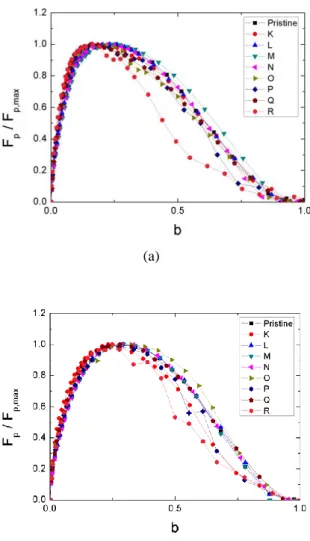
(a)
(b)
Fig. 3. Normalized pinning force density as a function of irreversible field for various irradiation doses. (a) T = 5 K, (b) T = 20 K.
From the Kramer plot Jc1/2 B1/4 (B*-B) [3,39–41], we estimate the irreversible field B* by a linear fitting in the region of high magnetic field. The values of B* are listed in Table II along with the maximum values of the flux pinning force density in each case. Double logarithmic plots of Fp,max -B* show that Fp,max roughly scales with B* according to the power law Fp,max (B*)1.7 at both temperatures T = 5 K and 20 K, which is close to the behavior of carbon-doped MgB2 films or polycrystals [8, 39].
The pinning force densities Fp are normalized by the maximum pinning force density Fp,max for each sample and plotted against the reduced magnetic field b = B/B*, which are shown in Fig. 3. These curves generally fit to the curve b0.55(1 - b)1.8 at T = 5 K, b0.75(1 - b)1.8 at T = 20 K. These relations are close to the scaling formula for a strong pinning mechanism, such as planar defects [42, 43].
It is difficult to describe the physical mechanism of the scaling model for flux pinning precisely, but the data suggest a strong intrinsic pinning where the boron layers in MgB2 are playing an important role [28].
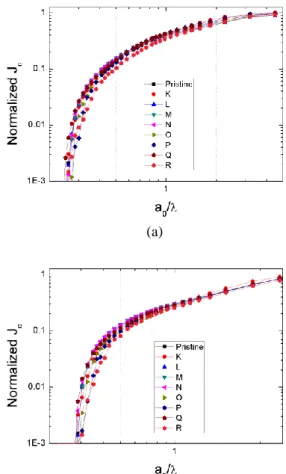
(a)
(b)
Fig. 4. Normalized critical current density as a function of vortex lattice constant (a0) nondimensionalized with penetration depth (λ) for various irradiation doses. (a) T = 5 K, (b) T = 20 K.
Fig. 4 shows normalized critical current density as a function of inter-vortex distance a0/λ for various irradiation doses. The Jc’s are normalized to the Jc,max for each sample, and the vortex lattice constant a0 is estimated by using the relation a0 ≈ (φ0/B)1/2, where φ0 is the flux quantum and B is magnetic field caused by trapped vortices in the sample.
Here, we used λ(0) = 100 nm and the relation λ(T) = λ(0)/[1-(T/Tc)2]0.5 to obtain the λ(T) at the temperatures 5 and 20 K [6,44,45]. The dependence of the penetration depth λ on magnetic field, due to the interband coupling, has been reported [46,47] but ignored in this study.
The size of the vortex–vortex interaction energy for finite films is mainly decided by the inter-vortex distance a0/λ, and the film thickness. If the film is not too thick and the inter-vortex distance is large enough, the vortex–vortex interaction energy will be much larger than that in the bulk sample, and become almost saturated in the region of a0 >
3λ [48]. Rapid increase in the interaction energy for a0 < 2λ in the MgB2 thin films is inferred in Fig. 4. The Jc’s decrease all along, because the inter-vortex interaction is strong and the pinning is weak in our samples. Furthermore, for a0/λ < 0.5, below the first dashed line, the Jc’s show an
exponential decay as the interaction between vortices becomes stronger. The suppression of superconductivity in high magnetic field might also have influenced on it. The linear region between a0/λ ≈ 0.5-2 (between the two dashed lines) are related to collective pinning [49,50]. In Fig. 4, the curves of the normalized Jc’s overlap fairly well for a0 > λ for all samples. However, when the vortex lattice constant become smaller than the penetration depth, the rates of decrease in the normalized Jc’s become higher for higher irradiation dose due to the increasing inter-vortex interactions.
4. CONCLUSION AND SUMMARY
We present the studies of the high-energy irradiation effect on the superconducting properties of single crystalline MgB2 thin film samples. We found the irradiation generally improves both the critical current density and pinning force density. It was found that Fp,max (B*)1.7 at both T = 5 K and 20 K, which is the behavior close to carbon-doped MgB2 films or polycrystals.
Variation of normalized pinning force density Fp/Fp,max in the reduced magnetic field b = B/B* roughly fits to the curve b0.55(1 - b)1.8 at T = 5 K, b0.75(1 - b)1.8 at T = 20 K, suggesting scaling formulas for strong pinning mechanism like planar defects. Exponential decay of critical current is observed as the vortex lattice constant decreases, due to the strong interaction between vortices. In the future the optimal energy and irradiation dose will be sought for further enhancement of pinning in the MgB2 film.
ACKNOWLEDGMENT
This work was supported by the Nuclear Energy Research Infrastructure Program of MSIP/NRF [2015M2B2A(4032812), Development of YBCO superconductor permanent magnets utilizing MC-50 cyclotron ion beams].
REFERENCES
[1] J. Nagamatsu, N. Nakagawa, T. Muranaka, Y. Zenitani and J.
Akimitsu, “Superconductivity at 39 K in magnesium diboride,”
Nature, vol. 410, pp. 63-64, 2001.
[2] V. Braccini, A. Gurevich, J. E. Giencke, M. C. Jewell, C. B. Eom, D.
C. Larbalestier, A. Pogrebnyakov, Y. Cui, B. T. Liu, Y. F. Hu, J. M.
Redwing, Qi Li, X. X. Xi, R. K. Singh, R. Gandikota, J. Kim, B.
Wilkens, N. Newman, J. Rowell, B. Moeckly, V. Ferrando, C.
Tarantini, D. Marré, M. Putti, C. Ferdeghini, R. Vaglio and E.
Haanappel, “High-field superconductivity in alloyed MgB2 thin films,” Phys. Rev. B, vol. 71, pp. 012504, 2005.
[3] D. C. Larbalestier L. D. Cooley, M. O. Rikel, A. A. Polyanskii, J.
Jiang, S. Patnaik, X. Y. Cai, D. M. Feldmann, A. Gurevich, A. A.
Squitieri, M. T. Naus, C. B. Eom, E. E. Hellstrom, R. J. Cava, K. A.
Regan, N. Rogado, M. A. Hayward, T. He, J. S. Slusky, P. Khalifah, K. Inumaru and M. Haashttp, “Strongly linked current flow in polycrystalline forms of the superconductor MgB2,” Nature, vol.
410, pp. 186-189, 2001.
[4] D. K. Finnemore, J. E. Ostenson, S. L. Bud’ko, G. Lapertot and P. C.
Canfield, “Thermodynamic and Transport Properties of Superconducting Mg10B2,” Phys. Rev. Lett., vol. 86, pp. 2420-2422, 2001.
[5] H.-J. Kim, W. N. Kang, E.-M. Choi, M.-S. Kim, K. H. P. Kim and S.-I. Lee, “High Current-Carrying Capability in c-Axis-Oriented Superconducting MgB2 Thin Films,” Phys. Rev. Lett., vol. 87, pp.
087002, 2001.
[6] K. Vinod, R. G. Abhilash Kumar and U. Syamaprasad, “Prospects of MgB2 superconductors for magnet application,” Supercond. Sci.
Technol., vol. 20, pp. R1-R13, 2007.
[7] S. X. Dou, O. Shcherbakova, W. K. Yeoh, J. H. Kim, S. Soltanian, X. L. Wang, C. Senatore, R. Flukiger, M. Dhalle, O. Husnjak and E.
Babic, “Mechanism of Enhancement in Electromagnetic Properties of MgB2 by Nano SiC Doping,” Phys. Rev. Lett., vol. 98, pp.
097002, 2007.
[8] J. L. Wang, R. Zeng, J. H. Kim, L. Lu and S. X. Dou, “Effects of C substitution on the pinning mechanism of MgB2,” Phys. Rev. B, vol.
77, pp. 174501, 2008.
[9] C.-J. Kim, Y. J. Kim, C.-Y. Lim, B.-H. Jun, S.-D. Park and K. N.
Choo, “Tc and Jc distribution in in situ processed MgB2 bulk superconductors with/without C doping,” Prog. Supercond. Cryog., vol. 16, pp. 36-41, 2014.
[10] G. J. Xu, J.-C. Grivel, A. B. Abrahamsen and N. H. Andersen,
“Enhancement of the irreversibility field in bulk MgB2 by TiO2
nanoparticle addition,” Physica C, vol. 406, pp. 95-99, 2004.
[11] M. Ranot, S. H. Jang, Y. S. Oh, K. P. Shinde, S. H. Kang and K. C.
Chung, “Addition effects of nanoscale NiO on microstructure and superconducting properties of MgB2,” Prog. Supercond. Cryog., vol. 18, pp. 37-40, 2016.
[12] W. B. K. Putri, B. Kang, P. V. Duong and W. N. Kang,
“Superconducting properties of SiC-buffered-MgB2 tapes,” Prog.
Supercond. Cryog., vol. 17, pp. 1-4, 2015.
[13] H. Narayan, R. K. Bhatt, H. M. Agrawal, R. P. S. Kushwaha and H.
Kishan, “Swift heavy ion irradiation of MgB2 thin films: a comparison between gold and silver ion irradiations,” J. Phys.:
Condens. Matter, vol. 19, pp. 136209, 2007.
[14] C. Tarantini, H. U. Aebersold, V. Braccini, G. Celentano, C.
Ferdeghini, V. Ferrando, U. Gambardella, F. Gatti, E. Lehmann, P.
Manfrinetti, D. Marre, A. Palenzona, I. Pallecchi, I. Sheikin, A. S.
Siri and M. Putti, “Effects of neutron irradiation on polycrystalline Mg11B2,” Phys. Rev. B, vol. 73, pp. 134518, 2006.
[15] E. Martínez, P. Mikheenko, M. Martínez-López, A. Millán, A.
Bevan and J. S. Abell, “Flux pinning force in bulk MgB2 with variable grain size,” Phys. Rev. B, vol. 75, pp. 134515, 2007.
[16] G. Giunchi, G. Ripamonti, S. Raineri, D. Botta, R. Gerbaldo and R.
Quarantiello, “Grain size effects on the superconducting properties of high density bulk MgB2,” Supercond. Sci. Technol., vol.17, pp.
S583-S588, 2004.
[17] Y. Bugoslavsky, L. F. Cohen, G. K. Perkins, M. Polichetti, T. J. Tete, R. Gwilliam and A. D. Caplin, “Enhancement of the high-magnetic-field critical current density of superconducting MgB2 by proton irradiation,” Nature, vol. 411, pp. 561-563, 2001.
[18] S. Okayasu, H. Ikeda and R. Yoshizaki, “Electron irradiation effects on MgB2 bulk samples,” Physica C, vol. 378, pp. 462-465, 2002.
[19] I. Pallecchi, V. Ferrando, E. Galleani D’Agliano, D. Marre, M.
Monni, M. Putti, C. Tarantini, F. Gatti, H. U. Aebersold, E.
Lehmann, X. X. Xi, E. G. Haanappel and C. Ferdeghini,
“Magnetoresistivity as a probe of disorder in the π and σ bands of MgB2,” Phys. Rev. B, vol. 72, pp. 184512, 2005.
[20] R. Gandikota, R. K. Singh, J. Kim, B. Wilkens, N. Newman, J. M.
Rowell, A. V. Pogrebnyakov, X. X. Xi, J. M. Redwing, S. Y. Xu and Q. Li, “Effect of damage by 2MeV He ions on the normal and superconducting properties of magnesium diboride,” Appl. Phys.
Lett., vol. 86, pp. 012508, 2005.
[21] H. Narayan, S. B. Samanta, A. Gupta, A. V. Narlikar, R. Kishore, K.
N. Sood, D. Kanjilal, T. Muranaka and J. Akimitsu, “SEM, STM/STS and heavy ion irradiation studies on magnesium diboride superconductor,” Physica C, vol. 377, pp. 1-6, 2002.
[22] H. Narayan, A. Gupta, A. V. Narlikar, K. N. Sood, R. Kishore and D.
Kanjilal, “Study of microstructural changes in MgB2 thin film superconductors irradiated with 200 MeV 107Ag ions,” Supercond.
Sci. Technol., vol. 17, pp. 1072-1076, 2004.
[23] S. R. Shinde, S. B. Ogale, J. Higgins, R. J. Choudhary, V. N.
Kulkarni, T. Venkatesan, H. Zheng, R. Ramesh, A. V.
Pogrebnyakov, S. Y. Xu, Qi Li, X. X. Xi, J. M. Redwing and D.
Kanjilal, “Modification of critical current density of MgB2 films irradiated with 200 MeV Ag ions,” Appl. Phys. Lett., vol. 84, pp.
2352-2354, 2004.
[24] S. D. Kaushik, R. Kumar, P. K. Mishra, J. E. Giencke, D. M. Kim, C.
B. Eom and S. Patnaik, “Modification of intergrain connectivity, upper critical field anisotropy and critical current density in ion irradiated MgB2 films,” Physica C, vol. 442, pp.73-78, 2006.
[25] N. Chikumoto, A. Yamamoto, M. Konczykowski and M. Murakami,
“Effect of heavy-ion irradiation on the pinning properties of MgB2,”
Physica C, vol. 388, pp. 167-168, 2003.
[26] R. J. Olsson, W-K. Kwok, G. Karapetrov, M. Iavarone, H. Claus, C.
Peterson and G. W. Crabtree, 2002 Preprint cond-mat/0201022.
[27] S.-G. Jung, W. K. Seong, N. H. Lee, M. Ranot and W. N. Kang,
“Possible Origin of Double-Peak Behavior of the Pinning-Force Density in Thick MgB2 Films with Columnar Structures,” J.
Korean Phys. Soc., vol. 53, pp. 727-731, 2008.
[28] S.-G. Jung, N. H. Lee, W. K. Seong, K. H. Cho, W. N. Kang and S.
Oh, “Observation of strong intrinsic pinning in MgB2 films,”
Supercond. Sci. Technol., vol. 24, pp. 075003, 2011.
[29] S.-G. Jung, W. K. Seong, N. H. Lee and W. N. Kang, “Flux pinning in columnar-structured and single crystalline MgB2 films,” Physica C, vol. 471, pp. 798-800, 2011.
[30] S.-G. Jung, W. K. Seong and W. N. Kang, “Effect of columnar grain boundaries on flux pinning in MgB2 films,” J. Appl. Phys., vol. 111, pp. 053906, 2012.
[31] W. K. Seong, J. Y. Huh, S.-G. Jung, W. N. Kang, H. S. Lee, E. M.
Choi and S.-I. Lee, “Growth of Superconducting MgB2 Thin Films by Using Hybrid Physical-Chemical Vapor Deposition,” J. Korean Phys. Soc., vol. 51, pp. 174-177, 2007.
[32] W. K. Seong, S. Oh and W. N. Kang, “Perfect Domain-Lattice Matching between MgB2 and Al2O3: Single-Crystal MgB2 Thin Films Grown on Sapphire,” Jpn. J. Appl. Phys., vol. 51, pp. 083101, 2012.
[33] W. K. Seong, W. N. Kang, S. Oh, J. K. Jung, C. J. Kim and J. Joo,
“Superconducting property of single-crystal like MgB2 thin film,”
Physica C, vol. 470, pp. 1465-1467, 2010.
[34] X. Zeng, A. V. Pogrebnyakov, A. Kotcharov, J. E. Jones, X. X. Xi, E. M. Lysczek, J. M. Redwing, S. Xu, Q. Li, J. Lettier, D. G. Schlom, W. Tian, X. Pan and Z-K. Liu, “In situ epitaxial MgB2 thin films for superconducting electronics,” Nature Mater., vol. 1, pp. 35-38 2002.
[35] W. K. Seong, J. Y. Huh, W. N. Kang, J-W. Kim, Y-S. Kwon, N-K.
Yang and J-G. Park, “Growth of Epitaxial MgB2 Thick Films with Columnar Structures by Using HPCVD,” Chem. Vap. Deposition, vol. 13, pp. 680-683, 2007.
[36] Y. Takano, H. Takeya, H. Fuji, H. Kumakura, T. Hatano, K. Togano, H. Kito and H. Ihara, “Superconducting properties of MgB2 bulk materials prepared by high-pressure sintering,” Appl. Phys. Lett., vol. 78, pp. 2914-2916, 2001.
[37] X. H. Zeng, A. V. Pogrebnyakov, M. H. Zhu, J. E. Jones, X. X. Xi, S.
Y. Xu, E. Wertz, Qi Li, J. M. Redwing, J. Lettieri, V. Vaithyanathan, D. G. Schlom, Zi-Kui Liu, O. Trithaveesak and J. Schubert,
“Superconducting MgB 2 thin films on silicon carbide substrates by hybrid physical–chemical vapor deposition,” Appl. Phys. Lett., vol.
82, pp. 2097-2099, 2003.
[38] C. G. Zhuang, S. Meng, C. Y. Zhang, Q. R. Feng, Z. Z. Gan, H.
Yang, Y. Jia, H. H. Wen and X. X. Xi, “Ultrahigh current-carrying capability in clean MgB2 films,” J. Appl. Phys., vol. 104, pp.
013924, 2008.
[39] D. N. Zheng, H. D. Ramsbottom and D. P. Hampshire, “Reversible and irreversible magnetization of the Chevrel-phase superconductor PbMo6S8,” Phys. Rev. B, vol. 52, pp. 12931, 1995.
[40] S. A. Keys and D. P. Hampshire, “A scaling law for the critical current density of weakly- and strongly-coupled superconductors, used to parameterize data from a technological Nb3Sn strand,”
Supercond. Sci. Technol., vol. 16, pp. 1097, 2003.
[41] J. Chen, V. Ferrando, P. Orgiani, A. V. Pogrebnyakov, R. H. T.
Wilke, J. B. Betts, C. H. Mielke, J. M. Redwing, X. X. Xi and Qi Li,
“Enhancement of flux pinning and high-field critical current density in carbon-alloyed MgB2 thin films,” Phys. Rev. B, vol. 74, pp. 174511, 2006.
[42] E. J. Kramer, “Scaling laws for flux pinning in hard superconductors,” J. Appl. Phys., vol. 44, pp. 1360, 1973.
[43] D. Dew-Hughes, “Flux pinning mechanisms in type II superconductors,” Philos. Mag., vol. 30, pp. 293-305, 1974.
[44] C. Panagopoulos, B. D. Rainford, T. Xiang, C. A. Scott, M.
Kambara and I. H. Inoue, “Penetration depth measurements in MgB2 : Evidence for unconventional superconductivity,” Phys. Rev.
B, vol. 64, pp. 094514, 2001.
[45] A. V. Pronin, A. Pimenov, A. Loidl and S. I. Krasnosvobodtsev,
“Optical Conductivity and Penetration Depth in MgB2,” Phys. Rev.
Lett., vol. 87, pp. 097003, 2001.
[46] F. D. Callaghan, M. Laulajainen, C. V. Kaiser and J. E. Sonier,
“Field Dependence of the Vortex Core Size in a Multiband Superconductor.” Phys. Rev. Lett., vol. 95, pp. 197001, 2005.
[47] T. Klein, L. Lyard, J. Marcus, Z. Holanova and C. Marcenat, “Magnetic field dependence of the coherence length and penetration depth of MgB2
single crystals,” Phys. Rev. B, vol. 73, pp. 184513, 2006.
[48] J.-C. Wei and T.-J. Yang, “Current Distribution and Vortex-Vortex Interaction in a Superconducting Film of Finite Thickness,” Jpn. J. Appl.
Phys., vol. 35, pp. 5696, 1996.
[49] G. Blatter, M. V. Feigel’man, V. B. Geshkenbein, A. I. Larkin and V. M.
Vinokur, “Vortices in high-temperature superconductors,” Rev. Mod.
Phys., vol. 66, pp. 1125, 1994.
[50] B. Dam, J. M. Huijbregtse, F. C. Klaassen, R. C. F. van der Geest, G.
Doornbos, J. H. Rector, A. M. Testa, S. Freisem, J. C. Martinez, B.
Stäuble-Pümpin and R. Griessen, “Origin of high critical currents in YBa2Cu3O7−δ superconducting thin films,” Nature, vol. 399, pp.
439-442, 1999.