pISSN 1229-3008 eISSN 2287-6251
Progress in Superconductivity and Cryogenics
Vol.21, No.2, (2019), pp.40~44 https://doi.org/10.9714/psac.2019.21.2.040
```
1. 서 론
2001년 Nagamatsu와 Akimitsu에 의해 초전도성이 발견된 MgB2[1]는 금속간 화합물(Intermetallic compound) 초전도체로 초전도 임계온도(Tc)가 39 K이다. 높은 Tc로 인해 MgB2는 고가의 액체 헬륨을 사용하지 않고 냉동기를 사용하여 냉각할 수 있다.
게다가 원료물질의 가격이 저렴하고 쉽게 선 형태로 가공할 수 있다[2]. 결맞음 길이(coherence length)가 길고[3] 결정립계가 강하게 결합되어 있으며, 결정 안에서의 전류 이방성이 작다[4]. 희소자원인 헬륨의 고갈로 인해 MgB2는 냉매로 액체 헬륨을 사용하는 NbTi 선재를 대신할 수 있는 차세대 초전도체로 주목 받고 있다[5,6]. MgB2는 20 K에서 운전하는 초전도 자석으로 사용이 가능할 것으로 예상된다[7-9]. 하지만, 응용기기에 사용되려면 고 자기장에서의 임계전류 밀도(Jc)를 높여야 한다[10].
MgB2 벌크나 초전도 선은 in-situ나 ex-situ 공정으로 제작된다. In-situ 공정에서는 Mg와 B의 분말을 화학정량비로 측량하여 균일하게 혼합한 후, 반응 열처리 과정을 통해 MgB2를 합성한다[11-15]. 반면에 ex-situ 공정에서는 이미 반응된 MgB2를 분말로 만든 후, 성형체를 만들어 소결 열처리한다[11,12,16-18]. In-situ 공정은 ex-situ 공정에 비해 상대적으로 열처리 온도가 낮다[11,17]. In-situ 공정은 Mg와 B가 반응하여 MgB2를 형성하는 공정으로 시편 내부에 다수의 기공이
형성되며 이에 따라 시편의 밀도가 낮아진다.
일반적으로 in-situ 공정으로 제작된 MgB2의 밀도는 이론 밀도(2.57 g/cm3)의 절반 정도이다[12,13]. Ex-situ 공정으로 제작된 MgB2는 내부에 기공이 적고 밀도가 높지만[12] 결정립계를 통한 전류 흐름이 약해서 전류 밀도가 낮고, 화학적 도핑(Doping)에 의한 Jc 향상이 어렵다[11,16-18]. 낮은 소결밀도에도 불구하고 결정립계가 강하고 미세결함을 많은 포함한 in-situ MgB2가 ex-situ MgB2 보다 Jc가 높다[14,15].
초전도체 내부의 기공은 초전도 내 전류 수송 면적을 감소시키는 요인으로 작용[13]하므로 밀도를 더 높일 수 있다면 Jc 향상이 기대된다. 본 연구의 목적은 MgB2
벌크 초전도체의 겉보기 밀도와 Jc에 미치는 분말 성형체에 대한 가압효과를 조사함에 있다. 초전도 벌크 제조에 사용되는 원료분말인 (Mg+2B)의 혼합 분말에 일축 가압을 적용하거나 일축 가압과 냉간등방가압 (Cold isostatic pressing, CIP)을 적용하여 MgB2 벌크 초전도체의 Tc 와 Jc에 미치는 가압효과의 영향을 연구하였다.
2. 실험과정
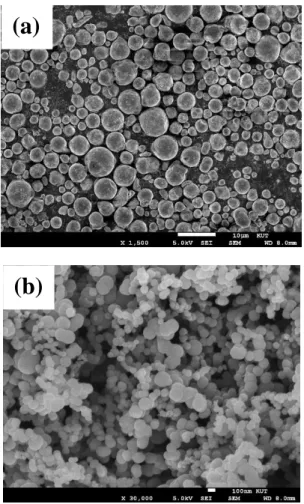
Mg 분말(99.9%, 27.5 µm, Hana AMT, Korea)과 B 분말(98.5%, 100 nm, Pavezyum, Turkey)을 혼합하여 in-situ 공정으로 MgB2 초전도 벌크를 제작하였다. 그림 1은 MgB2를 합성하기 위해 사용한 원료분말의 전계방출형 주사전자현미경(Field Emission Scanning
Effects of a compaction method for powder compacts on the critical current density of MgB 2 bulk superconductors
M. O. Kang
a,b, J. Joo
b, B.-H. Jun
a, K. N. Choo
a, and C.-J. Kim
*,aa
Korea Atomic Energy Research Institute, Daejeon, Korea
b
Sungkyunkwan University, Suwon, Korea
(Received 16 June 2019; revised or reviewed 20 June 2019; accepted 21 June 2019)
Abstract
In this study, the effects of the compaction method for (Mg+2B) powders on the apparent density and superconducting properties of MgB
2bulk superconductor were investigated. The raw powders used in this study were nano-sized boron (B) and spherical magnesium (Mg). A batch of a powder mixture of (Mg+2B) was put in a steel mold and uniaxially pressed at 1 ton or 3 tons into pellets. Another batch of the powder mixture was uniaxially pressed at 1 ton and then pressed isostatically at 1800 kg/cm
2in the water chamber. All pellets were heat-treated at 650℃ for 1 h in flowing argon gas for the formation of MgB
2. The apparent density of powder compacts pressed at 3 ton was higher than that at 1 ton. The cold isostatic pressing (CIP) in a water chamber allowed further increase of the apparent density of powder compacts, which influenced the pellet density of the final products (MgB
2). The compaction methods (uniaxial pressing and CIP) did not affect the formation of MgB
2and superconducting critical temperature (T
c) of MgB
2, but affected the critical current density (J
c) of MgB
2significantly. The sample with the high apparent density showed high J
cat 5 K and 20 K at applied magnetic fields (0-5 T).
Keywords: MgB
2, bulk superconductor, in-situ process, uniaxial pressing, cold isostatic pressing, apparent density, critical current density
* Corresponding author: [email protected]
Fig. 1. FE-SEM images of (a) Mg and (b) B used as raw powders.
TABLE I
COMPACTION INFORMATION OF PELLETS.
Sample Compaction pressure and method
A Uniaxial pressing (1 ton)
B Uniaxial pressing (1 ton) + CIP
C Uniaxial pressing (3 tons)
Electron Microscope, FE-SEM) 사진으로 (a)는 Mg, (b)는 B 이다. Mg와 B는 모두 구형의 모양을 하고 있다.
Mg:B = 1:2의 몰 비율로 정량한 Mg와 B 분말을 막자 사발을 이용하여 30 분동안 혼합하였다. 혼합 분말 0.3 g을 지름 10 mm의 스틸 몰드에 넣은 후, 1 톤과 3 톤의 압력으로 일축 가압하여 펠렛으로 성형하였다(그림 2(a) 일축 가압 참조). 1 톤의 압력으로 일축 가압된 분말 성형체의 일부를 진공 포장한 후, 그림 2(b)에서와 같이 CIP 장치의 수조에 넣어 1800 kg/cm2의 압력을 가하였다. 펠렛에 대한 가압 정보를 표 I에 간략하게 요약하였다.
모든 분말 성형체는 열처리 중 Mg의 산화를 방지하기 위해서 티타늄(Ti) 튜브에 장입한 뒤, 650℃에서 1 시간 동안 Ar 분위기에서 열처리하였다.
열처리 온도까지의 승온 속도는 5℃/분이었으며 냉각속도도 동일하였다. (Mg+2B) 분말 성형체를 열처리하는 동안 Mg은 용융되고, 용융된 Mg가 고상의 B 분말과 반응해서 식 (1)과 같이 MgB2가 생성된다.
여기에서 l과 s는 각각 액체와 고체를 나타낸다.
(a) (b)
Fig. 2. Schematic drawings of (a) uniaxial pressing and (b) cold isostatic pressing (CIP).
Mg (l)+ 2B (s) → MgB2 (s) (1) 열처리가 종료된 후 펠렛을 티타늄 튜브에서 분리하였다. 열처리 전과 후의 펠렛의 부피와 무게를 측정하여 각 펠렛의 겉보기 밀도를 계산하였다. 열처리 후에 생성된 상을 분석하고자 열처리된 MgB2 벌크를 분말로 분쇄한 뒤, 분말시료에 대해 X-선 회절 측정을 실시하였다. 측정된 결과를 통해 생성 상을 분석하였다.
펠렛의 초전도 특성인 Tc와 Jc를 측정하고자 다이아몬드 커터를 사용하여 열처리된 MgB2 벌크를 3×3×3 mm의 크기로 절단하였다. 이 시료들에 대해 비접촉 자기 측정장치인 MPMS(Magnetic Property Measurement System, Quantum Design)를 이용하여 자기장 하에서의 온도에 대한 자화도와 일정온도에서 자기장에 대한 자화 변화를 측정하고, MgB2의 Tc와 Jc를 구하였다. 30-40 K의 범위에서 각 시편의 자화도를 측정하였고, 5 K와 20 K에서 최대 5 T의 자기장을 인가하면서 자화 변화를 측정하였다. Jc는 인가된 자기장에 따른 초전도체의 모멘트 값을 식 (2)의 Bean’s model[19]에 대입하여 계산하였다.
) / 3 1 ( Δ /
20 M a a b
Jc
(2) 이 식에서 ΔM(M_decreasing field region M_increasing field region)은 동일한 자기장에서의 자화 차, a와 b는 벌크의 크기를 나타내는 매개변수이다.3. 결과 및 고찰
그림 3는 일축 가압, CIP, 열처리 단계별 시편의 부피 변화율을 나타낸 그래프이다. 펠렛의 두께와 직경을 측정하여 열처리 전/후의 부피변화를 구하였다. 일축 가압 후 CIP를 할 경우 시편의 부피가 감소하였다.
열처리 후에는 시편 A, B, C 모두 부피가 증가하였지만 CIP 처리한 경우가 증가 값이 가장 작았다. 시편 B의 경우, CIP 처리 후에 부피가 약 2.1% 감소하였고, 다른 시편에 비해 열처리 후 부피 증가율이 가장 작았다.
이는 CIP 처리에 의한 펠렛 밀도 증가에 기인한다.
In-situ 공정으로 제조한 MgB2의 열처리 시 부피증가는 여러 논문[20,21]에서 보고된 바 있다.
In-situ 공정은 분말 소결과 같이 치밀화가 일어나는
(a)
(b)
Effects of a compaction method for powder compacts on the critical current density of MgB
2bulk superconductors
Uniaxial pressing CIP Heat treatment -3
0 3 6 9 12 15 18
Volume change (%)
Process procedure
Sample A Sample B Sample C
Fig. 3. Volume change of pellets after uniaxial pressing, CIP and heat treatment.
TABLE II
APPARENT DENSITY AND VARIATION OF DENSITY CHANGE BEFORE/AFTER HEAT TREATMENT WITH VARIOUS
COMPACTION CONDITIONS.
Sample Apparent density (g/cm
3) Density change (ΔD) before after (%)
A 1.36 1.22 10.3
B 1.39 1.24 10.8
C 1.43 1.25 12.6
공정이 아니라 Mg와 B가 반응하여 MgB2가 생성되는 공정이다. 원료분말 중 Mg의 녹는점은 650℃[22]이기 때문에 열처리 온도에서 Mg 분말(구형)이 용융되어 Mg가 있던 자리가 기공이 된다. 기공의 형성과 함께 MgB2 입자들의 성장형태도 부피증가에 영향을 미친다.
MgB2 입자들이 주로 시편의 외곽 쪽으로 성장(outgrowth)하므로 성형체의 부피가 증가한다고 보고되었다[20,21]. 열처리 중 시편의 부피증가는 BiSrCaCuO와 BiPbSrCaCuO의 반응에서도 보고된 적이 있다[23,24].
표 II는 열처리 전과 후의 겉보기 밀도와 밀도 변화율을 나타낸다. 열처리 전 시편 A, B, C의 겉보기 밀도는 각각 1.36 g/cm3, 1.39 g/cm3, 1.43 g/cm3이고, 열처리 후는 1.22 g/cm3, 1.24 g/cm3, 1.25 g/cm3이다.
CIP의 적용에 의해 겉보기 밀도가 1.36 g/cm3에서 1.39 g/cm3로 증가하였고, 일축 가압의 압력이 높을수록 밀도가 더 높았다. 비록 시편 B는 시편 C보다 낮은 압력으로 일축 가압했지만 일축 가압 후에 CIP 처리를 함으로써 시편 B의 겉보기 밀도는 시편 C와 비슷하였다. 이는 CIP가 일축 가압한 펠렛을 추가적으로 압축시키는 데 효과적이며 가압방법이 열처리 후에도 영향을 준다는 것을 보여준다. 시편 C의 열처리 전/후 겉보기 밀도 변화율(ΔD)이 12.6%로 가장 컸다.
그림 4는 열처리 전/후 펠렛의 겉보기 밀도변화를 보여주는 히스토그램이다. 모든 펠렛에서 열처리 후에 겉보기 밀도가 감소하였다. 이는 그림 3에서 관찰된 열처리 후의 펠렛의 부피증가와 열처리 중의 Mg의 기화에 의한 것으로 여겨진다.
Sample A Sample B Sample C
1.0 1.1 1.2 1.3 1.4 1.5
Apparent density (g/cm
3)
Compation condition Before Heat-treatment
After Heat-treatment
Fig. 4. Histogram of an apparent density before/after heat treatment as a function of the compaction condition.
20 30 40 50 60 70 80
Sample A Sample B Sample C
*: MgB
2#: MgO
Intensity (a.u.)
Two theta (degree)
*
(0 0 1 )
*
(1 0 0 )
*
(0 0 2 )
*
(1 1 0 )
#
*
(1 0 2 )
*
(1 1 1 )
*
(2 0 0 )
*
(2 0 1 )
*
(1 0 1 )
Fig. 5. Powder X-ray diffraction patterns of MgB2 prepared with various compaction methods.
그림 5는 시편 A, B, C의 열처리 후 X-선 회절 패턴이다. 모든 시편에서 주된 생성 상은 MgB2이고, 소량의 MgO가 관찰되었다. 650℃에서 1 시간의 짧은 열처리 시간에도 불구하고 모든 시편에서 MgB2 상이 잘 생성되었다. 펠렛의 가압방식은 MgB2 상생성에 큰 영향을 주지 않은 것으로 보여진다. 열처리 분위기는 산소가 포함되지 않은 Ar 가스 분위기이고, Mg의 산화를 방지하고자 펠렛을 Ti 튜브에 넣어 열처리 했음에도 불구하고 MgO가 생성되는 이유는 Mg의 산화성이 매우 높기 때문이다.
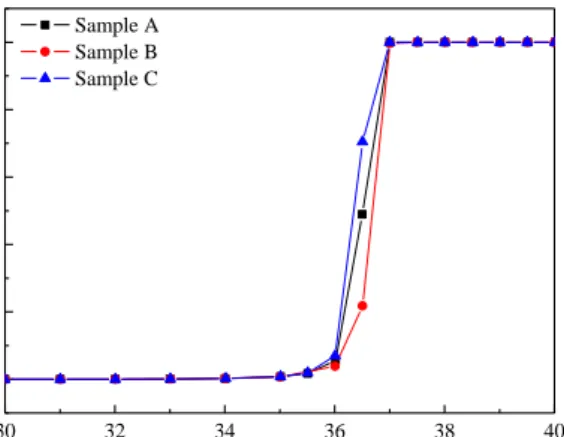
그림 6은 열처리된 시편 A, B, C의 온도에 대한 자화율 변화를 보여준다. 모든 시편의 Tc,onset는 37 K로 동일하였다. 자화곡선의 중간지점인 Tc,mid는 시편 B가 36.69 K로 가장 높았고 초전도 전이폭(ΔTc)이 1.3 K로 가장 좁았지만, 다른 시편과 큰 차이가 없었다. 즉, 펠렛의 가압조건이 열처리 후 MgB2의 Tc와 ΔTc에 미치는 영향은 미미하였다.
그림 7과 표 III은 열처리한 시편 A, B, C의 자기장에 대한 5 K와 20 K에서의 Jc의 변화를 나타낸다. 자기장 3 T에서 시편 C의 Jc가 1.17×10⁵ A/cm2 (5 K), 2.90× 10⁴
30 32 34 36 38 40 -1.0
-0.8 -0.6 -0.4 -0.2
0.0 Sample A Sample B Sample C
Normalized susceptib ility (a.u.)
Temperature (K)
Fig. 6. Normalized M-T curves of MgB2 prepared with various compaction methods.
0 1 2 3 4 5
102 103 104 105 4x10⁵
5 K 20 K Sample A Sample B Sample C
Critical current density (A /cm
2)
Applied magnetic field (T)
Fig. 7. Jc-B curves at 5 K and 20 K of MgB2 prepared with various compaction methods.
TABLE III
CRITICAL CURRENT DENSITY OF MGB
2AT 3 T, 5 K AND 20 K PREPARED WITH VARIOUS COMPACTION CONDITIONS.
Sample J
cat 3 T
5 K (A/cm
2) 20 K (A/cm
2)
A 6.65×10
41.48×10
4B 8.65×10
42.35×10
4C 1.17×10
52.90×10
4A/cm2 (20 K)로 가장 높았다. 시편 A와 C를 비교하였을 때, 더 높은 압력으로 일축 가압한 시편 C의 Jc가 시편 A보다 높았다. 이 결과에서 주목할 점은 시편 A와 B의 Jc 값이다. CIP 처리에 의해 5 K, 3 T에서 Jc가 6.65×10⁴ A/cm2에서 8.65×10⁴ A/cm2으로, 20 K에서도 1.48×10⁴ A/cm2에서 2.35×10⁴ A/cm2로 향상되었다. CIP를 통한 분말 압축이 시편의 밀도에 영향을 미쳐 궁극적으로 Jc에 영향을 미치는 것으로 여겨진다.
4. 결 론
In-situ 공정으로 제작된 MgB2 벌크 초전도체에서 원료분말 성형체에 대한 일축 가압과 CIP가 펠렛의
겉보기 밀도와 초전도 특성에 미치는 영향에 대해 조사하였다. 열처리 후에 펠렛의 부피가 증가하였고 이에 따라 겉보기 밀도는 열처리 후에 감소하였다.
일축 가압 시의 압력과 CIP 처리는 펠렛의 겉보기 밀도를 향상시켰으며, 이는 열처리 후 시편의 밀도에 영향을 미쳤다. 열처리 후에 모든 시편에서 MgB2 상이 원활하게 생성되었으며, Mg 원료분말의 산화에 의한 소량의 MgO가 생성되었다. 시편의 Tc,onset는 가압방법 과 압력에 큰 영향을 받지 않았지만 Jc는 일축 가압 시의 압력이 클수록, CIP 처리를 할 경우 증가하였다. 이 결과는 in-situ 공정으로 MgB2 벌크와 선 제작 시 원료분말에 대한 외부 가압방식이나 압력의 세기가 초전도체의 Jc에 영향을 미침을 의미한다.
ACKNOWLEDGMENT
이 논문은 정부의 재원으로 한국연구재단 (NRF-2013M2A8A1035822)과 한국원자력연구원 주요 사업의 지원을 받아 수행된 연구입니다.