• 검색 결과가 없습니다.

Superconducting properties of SiC-buffered-MgB<sub>2</sub> tapes

N/A
N/A
Protected

Academic year: 2021

Share "Superconducting properties of SiC-buffered-MgB<sub>2</sub> tapes"

Copied!
4
0
0

로드 중.... (전체 텍스트 보기)

전체 글

(1)

pISSN 1229-3008 eISSN 2287-6251

Progress in Superconductivity and Cryogenics

Vol.17, No.3, (2015), pp.1~4 http://dx.doi.org/10.9714/psac.2015.17.3.001

Seoul ```

1. INTRODUCTION

Technological applications of the low-cost MgB 2

superconductor are closely attached to its superconducting properties, such as the critical current density (J c ), the upper critical field (H c2 ), and the irreversibility field (H irr ).

Experimental results have demonstrated that superconducting properties of MgB 2 may be improved by the incorporation of defects, such as nanoparticle doping, chemical substitutions, etc. [1-3].

And one of the most effective methods to improve the performance of MgB 2 is by applying SiC as a dopant [2] or as a buffer layer [4, 5]. The effect of SiC buffer layer on the flux pinning and J c in MgB 2 films have been previously reported; with all showing improvement of J c at elevated field [4-6]. The effective pinning improvement of all the samples reported is mainly originated from their columnar grain boundaries. However, to be used in the power applications, MgB 2 needs to be accordingly manufactured in form of wire and tape.

Attempts to fabricate MgB 2 tapes with wide variety of metal substrates [7-9] along with the insertion of different dopants [10, 11] and buffer layers [11, 12] into MgB 2 tapes have been vigorously made in the past several years. Out of different processing conditions, MgB 2 grown on Hastelloy tape seems to have a good prospect in the industry due to the Hastelloy’s flexibility and its low corrosiveness [8, 13-14]. An enhancement of J c values was observed when SiC buffer layers with varied growth temperatures were added into the MgB 2 tapes; which is actually a positive indication of the effect of SiC buffer layer in MgB 2 tape [12].

Therefore, the purpose of this work is to understand the role of SiC buffer layer on H c2 , H irr , and J c of MgB 2 tapes by investigating their morphological structure as well as their relation with the superconducting properties. In this report, MgB 2 were grown on two different thickness of SiC/Hastelloy tape. The relationships between microstructures, the superconducting transition temperatures, the upper critical field, the irreversibility field, and the critical current density were studied as functions of the level of thickness of SiC buffer layer in MgB 2 tapes.

2. EXPERIMENTS

The samples were prepared as follows. First, the SiC buffer layers were deposited on Hastelloy substrates inside a vacuum chamber of a pulsed laser deposition (PLD) system. A vacuum background of ~10 -6 Torr inside the chamber was used during the deposition. A KrF excimer laser (λ = 248 nm) was employed to bombard the surface of a SiC target and the laser energy was set at 230 mJ with a repetition rate of 8 Hz. The substrate was heated at 500 o C for 10 and 16 minutes which then created thicknesses of SiC buffer layers of 170 and 250 nm.

Secondly, MgB 2 films were grown in a hybrid physical–chemical vapor deposition (HPCVD) system. The SiC/Hastelloy tapes were then heated up to 550 o C in 100 Torr of ambient H 2 for 20 minutes. During the deposition, B 2 H 6 reactive gas and H 2 carrier gas at a flow rate of 20 and 80 sccm were introduced into the quartz reactor to start the growth of MgB 2 films. At last, the fabricated films were cooled down to room temperature in a flowing H 2 carrier gas. The final thicknesses of MgB 2 were varied from 2.8 to 3.8 μm.

Superconducting properties of SiC-buffered-MgB 2 tapes

W. B. K. Putri a , B. Kang *,a , P. V. Duong b , and W. N. Kang b

a Department of Physics, Chungbuk National University, Cheongju, Korea

b Department of Physics, Sungkyunkwan University, Suwon, Korea

(Received 18 August 2015; revised or reviewed 2 September 2015; accepted 3 September 2015)

Abstract

Production of MgB 2 film on metallic Hastelloy with SiC as the buffer layer was achieved by means of hybrid physical-chemical vapor deposition technique, whereas SiC buffer layers with varied thickness of 170 and 250 nm were fabricated inside a pulsed laser deposition chamber. Superconducting transition temperature and critical current density were verified by transport and magnetic measurement, respectively. With SiC buffer layer, the reduced delaminated area at the interface of MgB 2 -Hastelloy and the slightly increased T c of MgB 2 tapes were clearly noticed. It was found that the upper critical field, the irreversibility field and the critical current density were reduced when MgB 2 tapes were buffered with SiC buffer layer. Clarifying the mechanism of SiC buffer layer in MgB 2 tape in affecting the superconducting properties is considerably important for practical applications.

Keywords: MgB

2

tapes, H

c2

, H

irr

, SiC buffer layers, Hastelloy

* Corresponding author: [email protected]

(2)

Superconducting properties of SiC-buffered-MgB

2

tapes

Lastly, the microstructural changes were examined by using a scanning electron spectroscope (SEM) and a focused ion beam – transmission electron microscope (FIB–TEM). The superconducting transition temperature was determined by measuring resistance as a function of temperature in the physical property measuring system (PPMS). The values of critical current density J c were deduced from the magnetization measurements obtained by using a magnetic property measurement system (MPMS) with varying the applied field up to 5 T.

3. RESULTS AND DISCUSSIONS

Figs. 1(a)-(c) show the plane SEM images of MgB 2 tapes.

Pure MgB 2 has the smallest grain size and the best grain connectivity of all samples and very similar to that of the MgB 2 grown on 250 nm-thick SiC buffer layer. Despite the similarity of the plane surfaces of pure MgB 2 and 250 nm-SiC buffered-MgB 2 tapes, we found two additional Boron peaks in the XRD pattern of the 250 nm-SiC buffered-MgB 2 and none of those were found in the mainly c-axis oriented 170 nm-SiC buffered-MgB 2 (not shown here). This suggests that as the SiC buffer layer adds up to more than 200 nm in thickness, the possibility of more impurities coming into the MgB 2 crystal structure is high and thus degrading the quality of MgB 2 tape. In both SiC-buffered-MgB 2 tapes, the thicknesses MgB 2 films were significantly increased (over than 3 μm). On the other hand, pure MgB 2 has less than 3 μm in thickness, indicating there was some kind of reaction between the MgB 2 and Hastelloy tape. Furthermore, with SiC buffer layer, the partial delamination spotted in pure MgB 2 -Hastelloy interface is distinctly reduced (not shown here). As can be seen in Fig.

1(d), the 170 nm-SiC buffered-MgB 2 shows clear columnar grain boundary structure with a reduced delaminated area which is also shown in the 250 nm-SiC buffered-MgB 2 .

Fig. 1. Plane SEM images of (a) pure MgB 2 and MgB 2

grown on SiC/Hastelloy buffer layers with thicknesses of (b) 170 and (c) 250 nm, and (d) a cross section SEM image of 170 nm-thick-SiC buffered-MgB 2

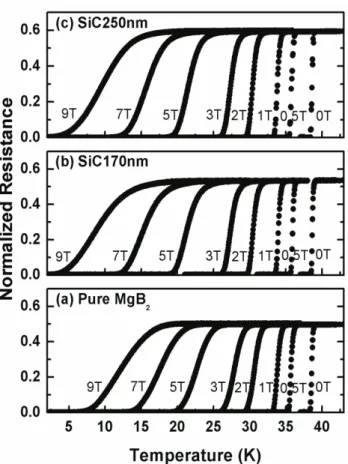
Fig. 2. Field dependence of the normalized resistance of (a) pure MgB 2 , and MgB 2 grown on (b) 170 nm, (c) 250 nm thick SiC buffer layers for different temperatures.

The field dependences of the normalized resistance of all the samples by transport measurements are shown in Fig. 2.

The smooth and sharp transition at zero external fields shown by these samples indicates their good quality. A gradual broadening behavior appears in the low dissipation part and more broadenings are well seen when the SiC buffer layer adds into the MgB 2 tape, as shown in Fig. 2 (b) and (c). This indicates that the pure MgB 2 has better grain connectivity among all samples. At a field of 9 T for all samples, a finite resistance appears down to the lowest temperature here already showing the irreversibility temperature T irr . The superconducting transition temperatures (T c ) which are determined by the resistive onset criteria at zero field show very similar values.

Interestingly, there is a slight increase-no depression of the T c after adding the SiC buffer layers into the MgB 2 tapes.

The T c values for SiC buffered-MgB 2 tapes are around 0.01 to 0.04 K higher than that of the pure sample which has a T c

of ~ 38.77 K. This increase in the T c values indicates the positive effect of SiC buffer layer in MgB 2 tape and at the same time it provides more adhesion to the MgB 2 -Hastelloy interface (shown in Fig. 1 (d)), creating firmer surface which would be favorable to the practical applications.

2

(3)

W. B. K. Putri, B. Kang, P. V. Duong, and W. N. Kang

Fig. 3. H c2 and H irr versus temperature for pure MgB 2 , and MgB 2 grown on 170 nm and 250 nm-thick SiC buffer layers.

The inset shows the FIB-TEM cross section of MgB 2

grown on 170 nm-thick SIC buffer layer.

Fig. 3 shows the temperature dependence of H c2 and H irr

for all the samples, where the H c2 and H irr obtained from the 90% and 10% values of the corresponding resistive transitions (Fig. 2). A correlation between H c2 , H irr, and the SiC thickness can be seen. In magnetic fields up to 9 T, pure MgB 2 has higher H c2 and H irr values compared to the SiC-buffered-MgB 2 tapes. A very subtle difference of the H c2 and H irr values between 170 and 250 nm-SiC-buffered-MgB 2 tapes were observed. In the C-doped and SiC-doped-MgB 2 , the intrinsic properties such as band scattering of MgB 2 were modified by C substitution into B sites which then improved the H c2 values [15, 16]. However, in our SiC-buffered-MgB 2 , different kind of schemes may have arisen. First, it is possible that SiC buffer layer may not have diffused into the MgB 2

lattice at all and only altered the morphological structure of MgB 2 (shown in Fig. 1). Second, even if the C in SiC buffer layer could enter the MgB 2 lattice, it may randomly entered into the MgB 2 sites without substituting the B sites, resulting in the lower H c2 values. A similar trend is also shown in the H irr results. The highest H irr value at 9 T was achieved in the pure MgB 2 and further addition of the SiC buffer layer caused a reduction of H irr values, clearly indicating reduced flux pinning by the SiC buffer layer, contrary to the report in another work on nanoparticle SiC-doped-MgB 2 [2]. They stated that with SiC doping, the H irr and J c (H) of MgB 2 were significantly improved because of the improvement of flux pinning. At 20 K, H c2

and H irr values of SiC buffered-MgB 2 shown here are ~ 6.5 and 5 T, respectively; little lower than those found in YSZ-buffered MgB 2 /Hastelloy tape [8], but are comparable and even slightly higher than those found in the Ti-doped MgB 2 /Ta/Cu tape [17].

In the inset of Fig. 3, an FIB-TEM cross sectional image depicts several crevices at the interface of 170 nm-SiC-buffered-MgB 2 tape, which are also visible in the pure MgB 2 , but with relatively smaller size compared to the

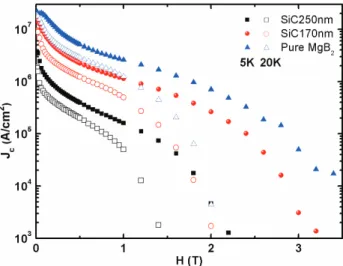
Fig. 4. J c curves measured at 5 and 20 K for pure MgB 2 and MgB 2 film grown on 170 and 250 nm-thick-SiC buffer layers.

ones found in the SiC-buffered-MgB 2 tapes. These crevices are also found in other report on MgB 2 grown on Hastelloy tape with different growth temperature [18]. In their report, even with increasing the growth temperature, the crevices at the interface of MgB 2 -Hastelloy are still clearly seen. By controlling the growth condition, the crevices detected at the interface may diminish creating a stronger pinning and thus the H irr values would possibly enhance.

In Fig. 4, the magnetic field dependences of the critical current density (J c ) for the MgB 2 tapes at 5 and 20 K are shown. The J c values were estimated from the magnetic hysteresis (M–H) loops by using Bean's critical state model [19].

The values of J c at each field in pure MgB 2 are higher than those of both the SiC-buffered-MgB 2 tapes, maybe because the grain size of pure MgB 2 is smaller than that of the SiC-buffered-MgB 2 , as described in Fig. 1. Since grain boundaries act as effective pinning centers in MgB 2 , a high grain boundary density owing to a small grain size may help flux pinning being stronger and bring higher J c in high fields [20]. The fact that the thickness of MgB 2 in pure sample is lower than those of SiC-buffered-MgB 2 tapes even with the exact growth condition applied, could also contribute to this higher J c . However, a steeper decrease of J c measured at 20 K is improved in the SiC-buffered-MgB 2

revealing a positive effect of SiC buffer layer on the field dependence of J c .

It is evident that the result of magnetic J c measurement for pure MgB 2 is in agreement with those from transport measurement of H c2 and H irr . However, a clear difference is displayed in the case of SiC-buffered-MgB 2 . The H c2 and H irr values of 170 nm-SiC-buffered-MgB 2 are slightly lower, but the J c values are higher than those of 250 nm-SiC-buffered-MgB 2 . The degraded quality of the 250 nm-SiC-buffered-MgB 2 , as mentioned earlier, may explain its lower values in the field dependence J c . Such difference in both magnetic and transport measurements is possible since in magnetic measurement, the M–H curves contain the contributions from both inter-grain loops and

3

(4)

Superconducting properties of SiC-buffered-MgB

2

tapes

intra-grain loops; while in transport measurement, superconducting current can pass through the strong links between two electrodes, and thus the different trends which are shown in H c2 , H irr and J c values of SiC-buffered-MgB 2

tapes are likely to occur. In addition, a thicker film of MgB 2

and less grain connectivity (shown in Fig. 1) of SiC-buffered-MgB 2 tapes may considerably influence the total current flows, leading to lower J c values.

CONCLUSION

With SiC buffer layers, MgB 2 tapes display a slight increment and show no depression of the T c values at zero fields. All samples show smooth and sharp transition lines at zero external fields, suggesting their good grain connectivity. The partial delamination which appears at the interface of pure MgB 2 and Hastelloy tape was reduced as SiC buffer layers were added into the MgB 2 tape and therefore, increasing the possibility of SiC-buffered-MgB 2 -tape being applied in the practical applications. Insertion of the SiC buffer layer in MgB 2 tape may have induced a different effect from C or SiC doping on band scattering, leading to a reduction in H c2 . The small-grain and high-density surface of the pure MgB 2 may contribute to the stronger flux pinning in MgB 2 tape, creating higher H irr values. A similar yet a different trend shown in the H c2 , H irr and J c values of the MgB 2 tapes is understandable as the result of using both transport and magnetic measurements. These investigations provide insights into the superconducting properties of MgB 2 tapes by SiC buffer layers and are important for the development of power applications of MgB 2 tapes.

ACKNOWLEDGMENT

This work was supported by the Basic Science Research Program through the National Research Foundation of Korea (NRF) funded by the Ministry of Education Science (NRF-2015R1D1A3A01019291).

REFERENCES

[1] W. K. Yeoh, J. Horvat, J. H. Kim, X. Xu, and S. X. Dou, “Effect of processing temperature on high field critical current density and upper critical field of nanocarbon doped MgB

2

,” Appl. Phys. Lett., vol. 90, pp. 122502-1–122502-3, 2007.

[2] S. X. Dou, S. Soltanian, J. Horvat, X. L. Wang, S. H. Zhou, M.

Ionescu, H. K. Liu, P. Munroe, and M. Tomsic, “Enhancement of the critical current density and flux pinning of MgB

2

superconductor by nanoparticle SiC doping”, Appl. Phys. Lett., vol 81, No. 18, pp. 3419–3421, 2002.

[3] S. X. Dou, V. Braccini, S. Soltanian, R. Klie, Y. Zhu, S. Li, X. L.

Wang, and D. Larbalestier,”Nanoscale-SiC doping for enhancing J

c

and H

c2

in superconducting MgB

2

,” J. Appl. Phys., vol. 96, No. 12, 2004.

[4] W. B. K. Putri, D. H. Tran, B. Kang, M. Ranot, J. H. Lee, N. H. Lee, and W. N. Kang, “Effect of different thickness crystalline SiC buffer layers on superconducting properties and flux pinning

mechanism of MgB

2

films,” IEEE Trans. Magn. vol. 50, No. 6, 2014.

[5] S-G. Jung, S. W. Park, W. K. Seong, M. Ranot, W. N. Kang, Y.

Zhao, S. X. Dou,”A simple method for the enhancement of J

c

in MgB

2

thick films with an amorphous SiC impurity layer,”

Supercond. Sci. Technol. vol. 22, pp. 075010, 2009.

[6] W. B. K. Putri, D. H. Tran, B. Kang, N. H. Lee, W. N. Kang, and S.

J. Oh,”Enhancement in high-field J

c

properties and the flux pinning mechanism of MgB

2

thin films on crystalline SiC buffer layers,”

Supercond. Nov. Magn. vol. 27, pp. 401, 2014.

[7] L.-P. Chen, F. Li, T. Guo, C.-G. Zhuang, D. Yao, L.-L. Ding, K.-C.

Zhang, Z.-Z. Gan, G.-C. Xiong, and Q.-R. Feng, “Deposition of MgB

2

superconducting films on different metal substrates,” Chin.

Phys. Lett. vol. 24, pp. 2074, 2007.

[8] K. Komori, K. Kawagishi, Y. Takano, H. Fujii, S. Arisawa, H.

Kumakura, M. Fukutomi, and K. Togano, “Approach for the fabrication of MgB

2

superconducting tape with large in-field transport critical current density,” Appl. Phys. Lett. vol. 81, No. 6, 2002.

[9] A. H. Li, X. L. Wang, M. Ionescu, S. Soltonian, J. Horvat, T. Silver, H. K. Liu, and S. X. Dou, “Fast formation and superconductivity of MgB

2

thick films grown on stainless steel substrate,” Physica C. vol.

361, pp. 73-78, 2001.

[10] Z. Gao, Y. Ma, D. Wang, and X. Zhang,”Development of doped MgB

2

wires and tapes for practical applications,” IEEE Trans. Appl.

Supercond., vol. 20, No. 3, 2010.

[11] Y. Zhu, A. Matsumoto, B. J. Senkowicz, H. Kumakura, H.

Kitaguchi, M. C. Jewell, E. E. Hellstrom, D. C. Larbalestier, and P.

M. Voyles, “Microstructures of SiC nanoparticle-doped MgB

2

/Fe tapes,” J. Appl. Phys., vol. 102, pp. 013913, 2007.

[12] W. B. K. Putri, B. Kang, M. Ranot, J. H. Lee, and W. N. Kang, “A possibility of enhancing J

c

in MgB2 film grown on metallic hastelloy tape with the use of SiC buffer layer,” Prog. Supercond.

Cryogenics, vol 16, No. 2, pp. 20-23, 2014.

[13] M. Sugano, K. Osamura, W. Prusseit, H. Adachi, and F. Kametani,

“Improvement of strain tolerance in RE-123 coated conductors by controlling the yielding behavior of Hastelloy c-276 substrates,”

IEEE Trans. Appl. Supercond. vol. 17, No. 2, 2007.

[14] M. Ranot, S. Oh, K. C. Chung, and W. N. Kang, MgB

2

coated conductors directly grown on flexible metallic Hastelloy tapes by hybrid physical-chemical vapor deposition,” Curr. Appl. Phys. vol.

13, pp. 1808-1812, 2013.

[15] X. Huang, W. Mickelson, B. C. Regan, and A. Zettl, “Enhancement of the upper critical field of MgB

2

by carbon-doping”, Solid State Comm. vol. 136, pp. 278-282, 2005.

[16] A. Matsumoto, H. Kumakura, H. Kitaguchi, B. J. Senkowicz, M. C.

Jewell, E. E. Hellstrom, Y. Zhu, P. M. Voyles, and D. C.

Larbalestier, “Evaluation of connectivity, flux pinning, and upper critical field contributions to the critical current density of bulk pure and SiC-alloyed MgB

2

,” Appl. Phys. Lett. vol. 89, pp.

132508-1–132508-3, 2006.

[17] B. Q. Fu, Y. Feng, Y. Zhao, A. K. Pradhan, C. H. Cheng, P. Ji, X. H.

Liu, C. F. Liu, G. Yan, and L. Zhou, “Microstructures and superconducting properties in Ti-doped MgB

2

/Ta/Cu tape”, Physica C, vol. 386, pp. 659–662, 2003.

[18] D. H. Kim, Y. S. Park, T. J. Hwang, M. Ranot, W. N. Kang, and K.

C. Chung, “Transport properties of MgB

2

films grown on Hastelloy tape: substrate temperature effect,” J. Kor. Phys. Soc, vol. 62, No. 2, pp. 284-287, 2013.

[19] H. J. Kim, W. N. Kang, E. M. Choi, M. S. Kim, K. H. P. Kim, and S.

I. Lee, “High current-carrying capability in c-axis-oriented superconducting MgB

2

thin films,” Phys. Rev. Lett., vol. 87, no. 8, pp. 0870021-1–0870021-3, 2001.

[20] E. Martinez, P. Mikheenko, M. Martinez-Lopez, A. Millan, A.

Bevan, and J. S. Abell, “Flux pinning force in bulk MgB

2

with variable grain size,” Phys. Rev. B., vol. 75, pp. 134515, 2007.

4

수치

Fig. 1. Plane SEM images of (a) pure MgB 2   and MgB 2
Fig. 3. H c2  and H irr  versus temperature for pure MgB 2 , and  MgB 2  grown on 170 nm and 250 nm-thick SiC buffer layers

참조

관련 문서

In this paper, the variable capacitors and the superconducting relay antenna were applied to the superconducting WPT system to increase efficiency and the transmission distance

Inclusion and Inclusiveness: Shared Vision of Youth for Local, National, and Global Village Inclusion at large stands for embracing populations with disabilities and

웹 표준을 지원하는 플랫폼에서 큰 수정없이 실행 가능함 패키징을 통해 다양한 기기를 위한 앱을 작성할 수 있음 네이티브 앱과

It is impossible to change the voltage across a capacitor by a finite amount in zero time, for this requires an infinite current through the capacitor.. (A capacitor resists

The key issue is whether HTS can be defined as the 6th generation of violent extremism. That is, whether it will first safely settle as a locally embedded group

1 John Owen, Justification by Faith Alone, in The Works of John Owen, ed. John Bolt, trans. Scott Clark, &#34;Do This and Live: Christ's Active Obedience as the

In a recent study([10]), Jung and Kim have studied the problem of scalar curvature functions on Lorentzian warped product manifolds and obtained partial

metaphors) (conceptual metonymy), (profile shift) 와 같은 인기 기제를 통해서 원형적인 의미들로부터 확장되어 나온다고 주장 한다 이러한 다의어의 의미