• 검색 결과가 없습니다.

Comparison of superconducting generator with 2G HTS and MgB<sub>2</sub> wires

N/A
N/A
Protected

Academic year: 2021

Share "Comparison of superconducting generator with 2G HTS and MgB<sub>2</sub> wires"

Copied!
5
0
0

로드 중.... (전체 텍스트 보기)

전체 글

(1)

Progress in Superconductivity and Cryogenics

Vol.15, No.4, (2013), pp.48~52 http://dx.doi.org/10.9714/psac.2013.15.4.048

```

Comparison of superconducting generator with 2G HTS and MgB 2 wires

S. I. Park, J. H. Kim, T. D. Le, and H. M. Kim

*

Jeju University, Jeju

(Received 6 December 2013; revised or reviewed 27 December 2013; accepted 28 December 2013)

Abstract

This paper compares the features of second generation (2G) High Temperature Superconducting (HTS) field coil with those of magnesium diboride (MgB

2

) field coil for a 10 MW class superconducting generator. Both coils can function effectively in their respective magnetic flux density range: 10-12 T for 2G HTS field coil, 2 T for MgB

2

superconducting field coil. Even though some leading researchers have been developing 10 MW class superconducting generator with 2G HTS field coil, other research groups have begun to focus on MgB

2

wire, which is more economical and suitable for mass production. However 2G HTS wire is still appealing in functions such as in-field property and critical temperature, it shows higher in-field property and critical temperature than MgB

2

wire.

Keywords : Superconducting generator, 2G HTS wire, MgB

2

wire, and HTS field coil

```

1. INTRODUCTION

The wind industry has been interested in a large scale wind turbine to reduce a cost of electricity of the wind power. In recent years, multi-megawatt wind generators have become the mainstream of the international wind power market. Though most wind sites presently have been used a few megawatt wind generators, most global wind power system suppliers are developing turbines with over 6 MW class generator [1]. In case of the superconducting generator for wind turbine, it is possible to develop the generator having smaller volume, lighter weight, and higher efficiency than those of conventional generators.

Superconductors such as 2G HTS and MgB

2

wires meet the challenging requirements of these large wind turbine generators. Recently, an HTS generator with a 10 MW performance has been developed by the American Superconductor Corporation Inc. (AMSC) in the United States [2] [3]. An 8 MW class HTS generator has been developed by the CONVERTEAM Inc. in the United Kingdom [4].

This paper focuses on the 2G HTS wire and MgB

2

wire for design the superconducting field coil of 10 MW class wind turbine. Consuming length of the superconducting wire required to fabricate the 10 MW class superconducting generator for wind power is expected above 600 km in case of the 2G HTS wire with a 4 mm width.

Even though some leading researchers have been developing 10 MW class superconducting generator with 2G HTS field coil, other research groups have begun to focus on MgB

2

wire, which is more economical and

suitable for mass production. However 2G HTS wire is still appealing in functions such as in-field property and critical temperature, it shows higher in-field property and critical temperature than MgB

2

wire.

This paper presents design process of the 10 MW class superconducting generator by using MgB

2

superconducting wire. We compared the design result of the MgB

2

superconducting generator to that of the 2G HTS generator [5]-[7].

2. DESIGN OF 10 MW CLASS SUPERCONDUCTING GENERATORS 2.1. Superconducting wires for the generators

To design the field coil for 10 MW class superconducting generator, we considered 2 kinds of wires which are 2G HTS coated conductor and MgB

2

superconductor. The primary factors concerned to design the superconducting generator are an economics, the superior performance and high efficiency of the system.

The operating temperatures of generators having the superconducting field coils fabricated by 2G HTS wire or MgB

2

superconducting wire were targeted at around 20 and 30 K [8] [9].

In case of the 2G HTS wire, the size of width and thickness have 12.0 and 0.24 mm, respectively and the operating current density of the field coil calculated from Fig 1.-(a) is around 167 A/mm

2

at the operating temperature of 33 K and external magnetic flux density of 6.4 T. While MgB

2

wire has round cross-section with 0.83 mm diameter and the operating current density calculated from Fig. 1-(b) is about 41.6 A/mm

2

at the operating temperature of 20 K and magnetic field of 2 T.

* Corresponding author: [email protected]

(2)

(a)

(b)

Fig. 1. I

c

-B curves of (a) MgB

2

, (b) 2G HTS wires at selected temperatures.

2.2. Design Parameters of the MgB

2

Generator

To design the 10 MW class superconducting generator, we propose design process to calculate the structural parameters by using 2 dimensional (2D) numerical design method [6] and 3 dimensional (3D) Finite Element Methods (FEM).

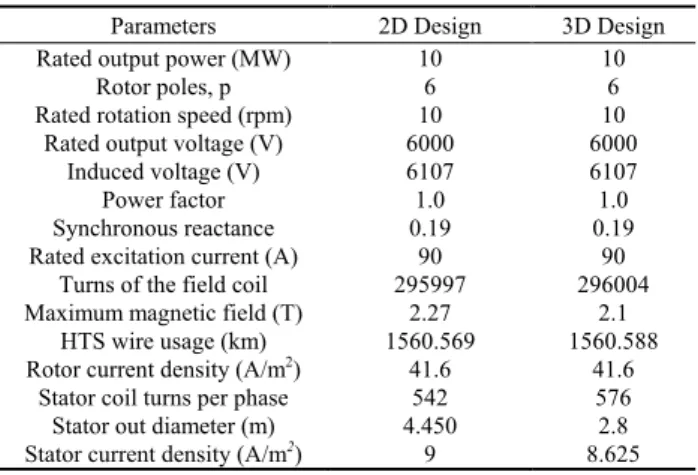
Table I shows design results of the 10 MW class superconducting generator without a main shaft part designed by 2D numerical analysis and 3D FEM.

The main factors to design the 10 MW class superconducting generator by using MgB

2

superconducting wire are as follows; (a) the maximum magnetic field on the superconducting coil is up to 2 T, (b) the weight and volume of machine is minimized.

2.3. Design of the 10 MW class MgB

2

Generator

The performance of the rotating machine is proportional to the magnetic flux density and the magnetic flux wave shape in the air-gap. Superconducting rotating machine has a larger air gap than conventional generator because of requirement of the damper shield and thermal insulation layer. Magnitude of air-gap length reaches about 50-100 mm. Therefore, the total linkage flux on the central point of the stator windings is decreased. Such decrement of the linkage flux can be compensated by generating very high magnetic flux from the HTS field coil.

TABLE I

D

ESIGN VALUES OF

10 MW

CLASS GENERATOR BY

M

G

B2

WIRE

Parameters 2D Design 3D Design

Rated output power (MW) 10 10

Rotor poles, p 6 6

Rated rotation speed (rpm) 10 10

Rated output voltage (V) 6000 6000

Induced voltage (V) 6107 6107

Power factor 1.0 1.0

Synchronous reactance 0.19 0.19

Rated excitation current (A) 90 90

Turns of the field coil 295997 296004

Maximum magnetic field (T) 2.27 2.1

HTS wire usage (km) 1560.569 1560.588

Rotor current density (A/m

2

) 41.6 41.6

Stator coil turns per phase 542 576

Stator out diameter (m) 4.450 2.8

Stator current density (A/m

2

) 9 8.625

Compared with 2D design results of the MgB

2

superconducting generator, the size of weight and volume of the total system analyzed by 3D FEM are decreased from 232.9 ton and 48.34 m

3

to 59.06 ton and 17.15 m

3

, respectively, because we have been set a limit of the maximum magnetic flux density generated in the mechanical shield region, which is allowed below 1.0 T.

The system efficiency of 84.61% for 10 MW class superconducting generator analyzed by the 2D design procedure is maximum value which can be attained from the MgB

2

superconducting field coil with critical magnetic field constraint of 2 T. Fig. 2 shows the schematic diagram of the MgB

2

superconducting generator. The machine is mainly composed of two parts: the stationary part and the rotating part.

The MgB

2

superconducting field coil installed in the rotor is to produce high magnetic flux density. The outer diameter sizes of the stator and rotor are 2800 and 2292 mm, respectively. The length of the straight parts of the field coil is about 2466 mm. The rotor of 10 MW class MgB

2

superconducting generator is composed of 12 poles.

3. COMPARISON OF THE GENERATORS The intensity of the magnetic field generated from the field and armature coils makes a decreasing effect in the performance of the superconducting generator. It is important to analysis the magnetic flux density distribution on the superconducting field coil and the central points of double-layer armature windings in circumferential direction.

Fig. 2. Schematic diagram of the MgB

2

superconducting

generator.

(3)

Comparison of superconducting generator with 2G HTS and MgB

2

wires

(b)

A field coil is composed of double pancake coil wound with 2G coated conductor tape as shown in Fig. 3-(a), and it also consists of racetrack type. The other field coil could be wound a race-track type winding with MgB

2

wire as shown in Fig. 3-(b).

TABLE II

C

OMPARISON OF SUPERCONDUCTING GENERATORS BY

2

G

HTS

AND

MgB

2FIELD COILS

.

Parameters 2G HTS wind

generator MgB

2

wind generator

Rated output power (MW) 10 10

Efficiency (%) 92 84.61

Rotor poles, p 3 6

Rated rotation speed (rpm) 10 10

Rated output voltage (V) 6000 6000

Induced voltage (V) 6837 6107

Power factor 1.0 1.0

Synchronous reactance 0.2 0.19

Rated excitation current (A) 360 90

Turns of the field coil 45474 296004

Maximum magnetic field (T) 12.59 2.1

HTS wire usage (km) 219.2 1560.6

Rotor current density (A/m

2

) 167 41.6

Number of slots 108 108

Stator coil turns per phase 324 576

Stator out diameter (m) 3.647 4.450

Stator current density (A/m

2

) 11.26 8.625 Straight length of field coil (m) 1.574 2.466

Weight (tone) 54.55 59.06

Volume (m

3

) 10.97 17.15

To fabricate all of HTS field coils installed on the 6 poles which are located in the rotating part of 10 MW class HTS generator, the total length of 2G HTS wire is to reach around 219.2 km. The efficiency of the system reaches around 92%.

Table II presents the comparison of design results for superconducting generators with the 2G HTS and MgB

2

superconducting field coils.

3.1. Analysis of 2G HTS Generator

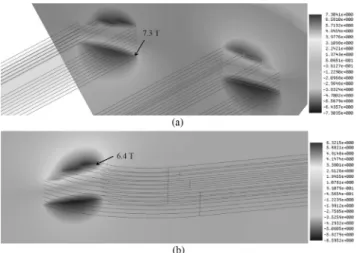
Fig. 4 presents 3D magnetic field distribution in accordance with the computational results. According to 3D FEM, when charging the field coil of 360 A, the maximum magnetic flux density of the perpendicular direction at the central section of the straight parts of the race-track type DP coils is 7.3 T. The maximum value as shown in Fig. 4-(a) appeared at 9th SP coil stacked in the HTS field coil. The maximum magnetic flux density of the perpendicular direction at the curvature part which is located at 1st SP coil reaches around 6.4 T as shown in Fig.

4-(b).

Fig. 4. Magnetic flux density distribution of the perpendicular direction on the central section of (a) straight parts and (b) curvature parts of the HTS field coil.

Fig. 5. Magnetic flux density distribution of the radial direction at the armature coil air gap.

Fig. 3. Cross-section views of the 10 MW class superconducting generators with field coils by using 2G HTS and MgB

2

wires.

(a)

(4)

Critical current density applied to the 2G HTS field coil depends on the magnetic flux density in the perpendicular direction of the winding surface which exists at the parts of the straight and curvature of the HTS field coil. Fig. 5 shows the magnetic flux density distribution of the radial component (B

r

) that is directly related to the performance of the HTS generator. Measurement locations of the results are the central points of double-layer armature windings in circumferential direction and the maximum magnetic flux density calculated from the 3D FEM analysis is approximately 1.8 T.

3.2. Analysis of MgB

2

Superconducting Generator Fig. 6 presents magnetic flux density distribution of the perpendicular direction on the central section of straight parts of the MgB

2

superconducting field coil when charging the field coil of 90 A. The maximum magnetic flux density of the perpendicular direction at the central section of the straight parts of the race-track type MgB

2

coils is 2.1 T. The maximum magnetic flux density appeared at top part of MgB

2

superconducting field coil.

The maximum magnetic flux density of the perpendicular direction at the curvature parts which is located at the end parts of superconducting field coil reaches around 1.7 T as shown in Fig. 7.

Fig. 6. Magnetic flux density distribution of the perpendicular direction on the central section of straight part of the MgB

2

superconducting field coil.

Fig. 7. Magnetic flux density distribution of the perpendicular direction on the central section of curvature part of the MgB

2

superconducting field coil.

Fig. 8. Magnetic flux density distribution on the mechanical shield of the superconducting generator.

Fig. 9. Magnetic flux density distribution of the radial direction at the armature coil air gap.

Fig. 8 presents the distribution of magnetic flux density on the mechanical shield of the MgB

2

superconducting generator. The size of mechanical shield diameter can be reduced around 825 mm in the radial direction in with the maximum magnetic field limitation with 1.0 T at the mechanical shield.

Fig. 9 shows the magnetic flux density distribution of the radial component (B

r

) that is directly related to the performance of the MgB

2

superconducting generator.

Measurement location of the results are the central points of double-layer armature windings in circumferential direction and the maximum magnetic flux density calculated from the 3D FEM analysis is approximately 0.4951 T.

4. CONCLUSION

The characteristic analysis of the 10 MW class superconducting generator is performed by using 2 kinds of superconductors in this paper. Compared with the design result of MgB

2

superconducting generator, the HTS generator fabricated by 2G HTS wire has the superior performance and efficiency due to the HTS field coil for the rotor which can generate high magnetic flux intensity.

Even though the MgB

2

superconducting wire has

(5)

Comparison of superconducting generator with 2G HTS and MgB

2

wires

cost-effective, the functional performance is lower than the 2G HTS wire. It is significantly difficult to fabricate the 10 MW class superconducting rotating machines by using MgB

2

superconducting wire without the in-field property and critical current improvement at the operating temperature condition of 20 K.

Finally, the quantities of HTS tape needed for large scale 10 MW generators with 2G and MgB

2

field coil are expected to be 640 and 1500 km long length, respectively.

It is concluded that the present production capacity of 2G HTS wire must be increased by a factor of 36 times by 2020. At the same time, the manufacturing cost should be decreased in a tenth times less than a recent 2G HTS wire cost in order to reach a realistic price level for the development of the large scale superconducting generator.

ACKNOWLEDGMENT

This research was supported by the 2013 scientific promotion program funded by Jeju National University.

REFERENCES

[1] D. Bang, H. Polinder, G. Shrestha, and J. A. Ferreira, "Review of generator systems for direct-drive wind turbines," in Proc. Eur.

Wind Energy Conf. Exhib., Belgium, pp. 1-11, 2008.

[2] Philipper J. Masson, "Wind Turbine Generator: Beyon the 10 MW Frontier," Symposium on Superconducting Devices for Wind Energy Systems, Barcelona, Spain, Feb, 2011.

[3] Superconductivity Web21, American Superconductor Corporation OK, International Superconductivity Technology Center: Tokyo, May, 2007.

[4] Clive Lewis, and Jens Muller, " A Direct Drive Wind Turbine HTS Generator," IEEE Power & Energy Society General Meeting, Tampa, FL, June, 2007.

[5] H. M. Jang, I. Muta, T. Hoshino, T. Nakamura, S. W. Kim, M. H.

Sohn, Y. K. Kwon, and K. S. Ryu, “Design and electrical characteristics analysis of 100 HP HTS synchronous motor in 21st century frontier project,” IEEE Trans. Appl. Supercond., vol. 12, no.

2, pp. 2197-2200, Jun. 2003.

[6] S. K. Baik, M. H. Sohn, S. W. Kim, E. Y. Lee, and Y. K. Kwon, "A 100 HP HTS motor design and the performance analysis," Journal of the Korea Institute of Applied Superconductivity and Cryogenics, vol. 4, no. 2, pp. 31-37, 2002.

[7] Ji Hyung Kim, Young-Sik Jo, Yong Soo Yoon, Yoon Do Chung, Hyun Chul Jo, Young Jin Hwang, Jiho Lee, Tae Kuk Ko, and Ho Min Kim, “Conceptual Design of 10 MW Class Superconducting Wind Turbine using 2G HTS wire,” ASC2012, 4LPG-04, Portland, Oct., 2012.

[8] David D, “Development of MgB

2

superconductor wire and coils for practical applications at Hyper Tech Research,”2013 CEC/ICMC, Anchorage, Alaska, Jun., 2013.

[9] Drew W. Hazelton, “Applications using Superpower 2G HTS

conductor,” 2011 CEC/ICMC, Spokane, WA, Jun., 2011.

수치

Table I shows design results of the 10 MW class  superconducting generator without a main shaft part  designed by 2D numerical analysis and 3D FEM
Table II presents the comparison of design results for  superconducting generators with the 2G HTS and MgB 2
Fig.  9.  Magnetic flux density distribution of the radial  direction at the armature coil air gap

참조

관련 문서

Current Tokyo is rich in green compared to other metro cities. In some parts, the greenery has been contributed by the many inherited gardens from the Edo era to today which

q March 28, 1906: County Magistrate Shim Heung-taek of Uldo-gun[Uldo County] heard this news from the Japanese survey team, he reported to the Korean central government

In a statement to Kuwait News Agency (KUNA) on the sidelines of a meeting of the Arab Parliament's Foreign Affairs Political and National Security

The meeting was attended by Assistant Foreign Minister for GCC Affairs, Ambassador, Nasser Al-Muzayyen, and Deputy Assistant Foreign Minister for the Office of the

“ Sheikh Nasser has a written message from HH the Amir, Sheikh Sabah Al-Ahmad Al-Jaber Al-Sabah to the Chinese President, Chi Gen Beng related to enhancing mutual

On his part, CEO of Express Roads Authority, Saud Al-Naqqi said that the heavy rains of the previous day led to clogging parts of the express

Kuwait will celebrate on Sunday the fourth anniversary of the UN honoring and proclamation of His Highness the Amir, Sheikh Sabah Al-Ahmad Al-Jaber Al-Sabah as

The Joseon government designed and promulgated the Taegeukgi as a national flag for diplomatic and political purposes, but it was the independence movement that made it