pISSN 1229-3008 eISSN 2287-6251
Progress in Superconductivity and Cryogenics
Vol.19, No.3, (2017), pp.40~43 https://doi.org/10.9714/psac.2017.19.3.040
```
1. INTRODUCTION
The prime requirement for MgB2 to be useful in practical applications is that it must carry high critical current density (Jc) at high fields and high temperatures [1 � 3].
The substitution of carbon (C) from C containing compounds into boron (B) sites of MgB2 lattice has been proven to be very effective in pinning the magnetic flux lines (vortices) and maintaining high critical current density at high fields [4 � 6]. However, the critical current performance is strongly depends on the type of C containing compounds. The oxygen containing C sources, for example, sugar (C6H12O6) [7] and other carbohydrates [8] introduce a large amount of oxygen during sintering process, resulting in high content of MgO in MgB2. The insulating MgO is the main obstacle for the transfer of superconducting current between adjacent MgB2 grains and results in a lower critical current density, mainly in the self-field and low-field region [7 � 8]. Recently, Ye et al.
used an oxygen free aromatic hydrocarbon, coronene (C24H12) as an active carbon source [9]. They achieved reasonably good critical current densities in coronene-derived carbon-doped MgB2 wires. However, despite many advantages of coronene, it faces a major drawback of being very expensive. Therefore, in the present study, we used naphthalene (C10H8) a low-cost carbon source. Naphthalene has been added into MgB2
before, however, the addition has been done through direct mixing with starting precursor powders of Mg and B [10 � 12]. Direct mixing may cause poor reactivity of C with B which leads to partial substitution of C into B sites of MgB2, and the remaining C accumulates on the grain boundaries which reduce the connectivity between the grains, and thus the critical current density deteriorates. On the other hand, the process of coating C on B first, then mixing with Mg has proven to be a powerful approach for the effective substitution of C into B, that can improve the performance of MgB2 [13]. Therefore, in the present work, first we coat C on B nano-powders by direct pyrolysis of naphthalene at 120 °C and then the C-coated B powders were mixed well with a stoichiometric amount of Mg. The influence of naphthalene-derived carbon coating on crystal structure and superconducting properties of MgB2 were investigated.
2. EXPERIMENTAL
Naphthalene (C10H8), a white powder was used as a carbon source for preparing C-doped MgB2 bulk superconductors. To achieve C-coating on B, the naphthalene of 2.5 to 20 wt. % of total (Mg + 2B)was uniformly mixed with boron nano-powders in a mortar by grinding. Then, the mixed powders were placed into an alumina crucible and heat treated at 120°C (higher than the melting point of naphthalene ~ 80oC) for 30 minutes in Ar atmosphere. The coating of C on B powders was
Carbon-coated boron using low-cost naphthalene for substantial enhancement of Jc in MgB2 superconductor
Mahipal Ranota, K. P. Shindeb, Y. S. Oha, S. H. Kanga, S. H. Jangc, D. Y. Hwangc, and K. C. Chungb,*
aMaterials Deformation Department, Korea Institute of Materials Science, Changwon 51508, Republic of Korea
bFunctional Nano Materials Department, Korea Institute of Materials Science, Changwon 51508, Republic of Korea
cKiswire Advanced Technology Ltd, Daejeon, Republic of Korea
(Received 16 August 2017; revised or reviewed 11 September 2017; accepted 12 September 2017)
Abstract
Carbon coating approach is used to prepare carbon-doped MgB2 bulk samples using low-cost naphthalene (C10H8) as a carbon source. The coating of carbon (C) on boron (B) powders was achieved by direct pyrolysis of naphthalene at 120 °C and then the C-coated B powders were mixed well with appropriate amount of Mg by solid state reaction method. X-ray diffraction analysis revealed that there is a noticeable shift in (100) and (110) Bragg reflections towards higher angles, while no shift was observed in (002) reflections for MgB2 doped with carbon. As compared to un-doped MgB2, a systematic enhancement in Jc(H) properties with increasing carbon doping level was observed for naphthalene-derived C-doped MgB2 samples. The substantial enhancement in Jc is most likely due to the incorporation of C into MgB2 lattice and the reduction in crystallite size, as evidenced by the increase in the FWHM values for doped samples.
Keywords: MgB2 bulk, naphthalene (C10H8),superconducting properties
* Corresponding author: [email protected]
Mahipal Ranot, K. P. Shinde, Y. S. Oh, S. H. Kang, S. H. Jang, D. Y. Hwang, and K. C. Chung
anticipated by pyrolysis process. This C-coating process is similar as reported by Ye et al. for coronene (C24H12) to obtain C-coated B by heat-treating coronene at a temperature above its meting point (438 °C) [9]. After obtaining C-coated B powder, then it was milled properly with an appropriate amount of Mg. The mixed powders were pelletized under 10 ton pressure using uniaxial hydraulic press. Un-doped MgB2 pellet was also prepared for comparison. The pellets were put into Fe tubes and heat treated at a temperature of 700°C for 30 min under the flow of high-purity Ar gas. Finally, the un-doped and C-doped MgB2 samples were cooled down to room temperature in a continuous flow of Ar gas.
The crystal structures of un-doped and C-doped MgB2
samples were investigated by X-ray diffraction (Rigaku, D/Max 2500) using Cu Kα as an X-ray source. The microstructures of samples were examined by field emission scanning electron microscopy (FESEM). The magnetization measurements, magnetization versus temperature (M-T) and magnetization hysteresis (M-H) loops were carried out on all samples by using a quantum design vibrating sample magnetometer option (PPMS, Quantum Design). The magnetic field varying from -9 T to + 9 T was applied parallel to the longest dimension of the samples. The Jc was estimated from M–H loops by Bean’s critical state model, Jc = 20ΔM/a(1-a/3b), where ΔM is the height of the M–H loop, a and b are the thickness and width of the sample, respectively.
3. RESULTS AND DISCUSSION
The phase analysis of un-doped and MgB2 doped with carbon using different weight percent of naphthalene are performed by X-ray diffraction (XRD) and the patterns are shown in Fig. 1(a). The MgB2 diffraction peaks are clearly observed along with MgO peaks. From XRD patterns, it is observed that as compared to un-doped MgB2 the naphthalene-derived carbon-doped MgB2 samples show a noticeable shift in (100) and (110) Bragg reflections towards higher angles as shown more clearly for (110) in Fig. 1(b), while no shift was observed in (002) reflections.
It indicates that the ‘a’ lattice parameter was decreased for doped MgB2, while the ‘c’ parameter remains unchanged, which implies that C could be substituted in the B honeycomb layer without affecting the interlayer interactions. In order to estimate the actual level of C substitution for the naphthalene-derived carbon-doped samples of MgB2 we used the relation, x = 7.5 × Δ(c/a), where x is the composition of C corresponding to the formula Mg(B1−xCx)2 and Δ(c/a) is the change in c/a compared to un-doped sample [14]. The C substitution level was observed to be 0.005, 0.005, 0.008 and 0.01 for 2.5, 5, 10 and 20 wt. % of naphthalene-derived carbon-doped MgB2, respectively. It indicates that with naphthalene of ≤ 5 wt. %, only small C is substituted into MgB2 lattice, while upon increasing the amount up to 20 wt. % a moderate level of C (x =0.01) is substituted. It is noted that the substitution levels of C for the naphthalene-derived C-doped MgB2 samples are lower than those reported with other sources of carbon [7, 13].
Fig. 1. (a) X-ray diffraction patterns of un-doped and MgB2
doped with carbon using different weight percent of naphthalene 0 – 20 wt. %. (b) The enlarged view of (002) and (110) Bragg reflections of doped and un-doped samples. (c) The FWHM of (100), (101), (002) and (110) MgB2 peaks as a function of the amount of naphthalene for all samples.
The low level substitution of C could be attributed to the volatile nature of naphthalene. Since, we have performed the C-coating B process at 120°C, above the melting point of naphthalene (~80oC). At this temperature, the vapor
Carbon-coated boron using low-cost naphthalene for substantial enhancement of Jc in MgB2 superconductor pressure of naphthalene might be high, so that some of the
naphthalene could be easily evaporated without coating onto the B. That could be the one of the reasons of small level substitution of C in doped samples. In our future work, we will try to achieve high doping level of C by performing the C-coating B process close to or slightly above the melting temperature of naphthalene.
Another important feature easily recognized from the XRD figure is the broadening in the diffraction peaks for doped samples. The full width at half maximum (FWHM) values of (100), (101), (002) and (110) MgB2 peaks are plotted as a function of the amount of naphthalene in Fig.
1(c). The FWHM values of all peaks are higher than those of the un-doped sample and they increased with increasing the doping level of naphthalene. The increase in FWHM is a good indication for the reduction in the crystallite size due to carbon doping.
The normalized magnetizations versus temperature curves for the un-doped and the naphthalene-derived carbon-doped MgB2 are shown in Fig. 2. The superconducting transition temperature (Tc) of 37.47 K was obtained for un-doped MgB2. When MgB2 was doped with different weight percent of naphthalene, a decrease in Tc
was observed. The Tc of 36.64 K was observed for 2.5 wt. % of naphthalene-derived carbon-doped MgB2 sample, which is suppressed by 0.83 K from that of un-doped MgB2. In overall, a small reduction in Tc of 0.8 to 1.2 K was observed for doped samples. The small drop in Tc is most probably due to the lower level of C was substituted in these doped samples. The suppression of Tc (even though small) for the naphthalene-derived carbon-doped MgB2
samples is more likely due to substitution of C at B sites, as evident by the shrinkage of the ‘a’ lattice parameter in XRD analysis.
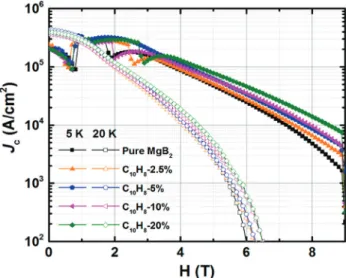
The critical current density as a function of magnetic field for the un-doped and the naphthalene-derived carbon-doped MgB2 samples measured at 5 K and 20 K are shown in Fig. 3. Both at 5 and 20 K, in the high-field region a systematic enhancement in Jc(H) properties with increas- ing carbon doping level was observed as compared to un-doped MgB2. The substantial enhancement in Jc for doped samples is most likely due to the incorporation of carbon into MgB2 lattice and the reduction in crystallite size, as evidenced by the increase in the FWHM values, both contribute in the pinning of magnetic vortices and result in the improved superconducting performance.
It is interesting to note that at 20 K and in the self-field, the C-doped MgB2 samples show nearly comparable Jc
compared to that of un-doped MgB2. This self-field Jc
behavior is quite similar as we obtained recently for MgB2
bulk through C-coated B (core/shell) precursor powder [13]. However, this is in obvious contrast to the directly added C-doped MgB2 bulks, where a reduction in self-field Jc was always noticed due to the accumulation of excess C on the MgB2 grain boundaries and thus the reduced connectivity [7, 8]. It indicates that the inter-grain connectivity of our MgB2 samples was not degraded even after doping with carbon from naphthalene. This might be due to C-coated B (core/shell) structure that could lead the active chemical reaction between C and B, and no much
Fig. 2. Temperature dependence of normalized magnetization measured in an applied field of 10 Oe for the un-doped and the naphthalene-derived carbon-doped MgB2. A decrease in Tc
was noticed for C-doped MgB2 samples.
Fig. 3. The critical current density as a function of magnetic field for un-doped and MgB2 doped with carbon using different weight percent of naphthalene measured at 5 K (closed symbols) and 20 K (open symbols). As compared to un-doped MgB2, a systematic increase in Jc with increasing carbon doping level was observed for C-doped MgB2 samples.
extra C could be remained to accumulate on the MgB2 grain boundaries.
4. CONCLUSION
The low-cost naphthalene was used as a carbon source to prepare the carbon-doped and un-doped MgB2 bulk superconductors. As compared to the un-doped MgB2, a reduction in ‘a’ lattice parameter and suppression of Tc
were observed for the naphthalene-derived carbon-doped MgB2 samples. It indicates that the C could be substituted into the B sites of MgB2 lattice. At high magnetic fields, a systematic increase in Jc with increasing carbon doping level was observed for C-doped MgB2 as compared to
Mahipal Ranot, K. P. Shinde, Y. S. Oh, S. H. Kang, S. H. Jang, D. Y. Hwang, and K. C. Chung un-doped MgB2. The substantial enhancement in Jc for
doped samples is most likely due to the substitution of C into MgB2 lattice and the reduction in crystallite size, as evidenced by the increase in the FWHM values, both help in the vortex pinning and result in the improved high-field performance.
ACKNOWLEDGMENT
This work was supported by Industrial Technology Innovation Program (Grant No.: 10053590) funded by the Ministry of Trade, Industry and Energy (MOTIE), Korea.
REFERENCES
[1] Y. Bugoslavsky, G. K. Perkins, X. Qi, L. F. Cohen and A. D. Caplin,
“Vortex dynamics in superconducting MgB2 and prospects for applications,” Nature, vol. 410, pp. 563-565, 2001.
[2] M. Ranot and W. N. Kang, “MgB2 coated superconducting tapes with high critical current densities fabricated by hybrid physical-chemical vapor deposition,” Curr. Appl. Phys., vol. 12, pp.
353-363, 2012.
[3] M. Ranot, P. V. Duong, A. Bhardwaj and W. N. Kang, “A review on the understanding and fabrication advancement of MgB2 thin and thick films by HPCVD,” Prog. Supercond. Cryog., vol. 17, pp.
1-17, 2015.
[4] J. H. Kim, et al., “Microscopic role of carbon on MgB2 wire for critical current density comparable to NbTi,” NPG Asia Materials, vol. 4, pp. e3, 2012.
[5] M. Ranot, O. Y. Lee and W. N. Kang, “Significant enhancement of critical current density by effective carbon-doping in MgB2 thin films,” Prog. Supercond. Cryog., vol. 15, pp. 12-15, 2013.
[6] M. Ranot, S. H. Jang, K. P. Shinde, B. B. Sinha, A. Bhardwaj, Y.-S.
Oh, S. H. Kang and K. C. Chung, “A safe and cost-effective PMMA carbon source for MgB2”, Prog. Supercond. Cryog., vol. 19, pp.
47-50, 2017.
[7] S. Zhou, A. V. Pan, D. Wexler and S. X. Dou, “Sugar coating of boron powder for efficient carbon doping of MgB2 with enhanced current-carrying performance,” Adv. Mater., vol. 19, pp.
1373-1376, 2007.
[8] N. Ojha, V. K. Malik, R. Singla, C. Bernhard and G. D. Varma,
“The effect of citric and oxalic acid doping on the superconducting properties of MgB2,” Supercond. Sci. Technol., vol. 22, pp. 125014, 2009.
[9] S. Ye, A. Matsumoto, Y. Zhang and H. Kumakura, “Strong enhancement of high-field critical current properties and irreversibility field of MgB2 superconducting wires by coronene active carbon source addition via new B powder carbon-coating method,” Supercond. Sci. Technol., vol. 27, pp. 085012, 2014.
[10] H. Yamada, M. Hirakawa, H. Kumakura and H. Kitaguchi, “Effect of aromatic hydrocarbon addition on in situ powder-in-tube processed MgB2 tapes,” Supercond. Sci. Technol., vol. 19, pp.
175-177, 2006.
[11] S. Yuyan, Z. Pingxiang, X. Xiaomei, L. Guoqing and Yan Guo,
“Effects of C10H8 doping on microstructure and superconductivity of MgB2 wires,” Rare Metal Mat. Eng., vol. 41, pp. 0005-0008, 2012.
[12] J. S. Hansdah and P. M. Sarun, “Doping effect of nano-Ho2O3 and naphthalene in MgB2 superconductor prepared by powder-in-sealed-tube method,” J. Appl. Phys., vol. 117, pp.
113903, 2015.
[13] M. Ranot, S. H. Jang, K. P. Shinde, B. B. Sinha, A. Bhardwaj, Y. S.
Oh, S. H. Kang and K. Chung, “Solution-processed nanometers thick amorphous carbon-coated boron as an efficient precursor for high-field performance of MgB2,” J. Alloy. Comp., vol. 724, pp.
507-514, 2017.
[14] M. Avdeev, J. D. Jorgensen, R. A. Ribeiro, S. L. Bud’ko, P. C.
Canfield, “Crystal chemistry of carbon-substituted MgB2,” Physica C, vol. 387, pp. 301-306, 2003.