Korean Journal of Microbiology (2018) Vol. 54, No. 4, pp. 463-464 pISSN 0440-2413
DOI https://doi.org/10.7845/kjm.2018.8074 eISSN 2383-9902
Copyright ⓒ 2018, The Microbiological Society of Korea
Complete genome sequence of Tamlana sp. UJ94 degrading alginate
Jaejoon Jung , Seung Seob Bae, Dawoon Chung, and Kyunghwa Baek*
National Marine Biodiversity Institute of Korea, Seocheon 33662, Republic of Korea
알긴산을 분해하는 세균 Tamlana sp. UJ94의 완전한 유전체 서열
정재준 ・ 배승섭 ・ 정다운 ・ 백경화*
국립해양생물자원관
(Received October 19, 2018; Revised November 20, 2018; Accepted November 23, 2018)
*For correspondence.
E-mail: [email protected];Tel.: +82-41-950-0748; Fax: +82-41-950-0747
Tamlana sp. UJ94 isolated from seawater can degrade alginate.
To identify the genomic basis of this activity, the genome was sequenced. The genome was composed of 4,116,543 bp, 3,609 coding sequences, and 35.2 mol% G + C content. A BLASTp search predicted the presence of 9 alginate lyases as well as 6 agarases, 5 amylases, 4 carrageenases, 1 cellulase, 4 pectate lyases, and 7 xylanases, indicating its ability to degrade diverse polysaccharides. The genome of strain UJ94 is a source of polysaccharide-degrading enzymes for bioconversion processes.
Keywords: Tamlana sp., alginate lyase, bioconversion, carbohydrate- active enzyme, polysaccharide
Strain UJ94 was isolated from seawater collected from Uljin, Republic of Korea on April 26, 2017. Analysis of the 16S rRNA gene sequence indicated that strain UJ94 has high sequence similarity with the type strain of Tamlana agarivorans JW-26
T(98.4%), T. sedimentorum KMM 9545
T(96.1%), and T. crocina HST1-43
T(95.4%). The neighbor-joining phylogenetic tree also showed that strain UJ94 formed a cluster with T.
agarivorans JW-26
T(data not shown). Therefore, we designated strain UJ94 as Tamlana sp. UJ94. Strain UJ94 can degrade alginate, as observed by the halo zone on a marine agar (BD) plate containing 1% (w/v) sodium alginate after cultivation at
30°C for 7 days. To date, 4 genomes of Tamlana species have been published in the NCBI genome database; however, only the genome of Tamlana sp. UJ94 has been sequenced completely.
To provide a genomic basis for alginate degradation, we conducted genomic analysis of strain UJ94.
Genomic DNA was isolated from cells grown on marine agar at 30°C for 2 days using a Wizard Genomic DNA isolation kit (Promega). The 20-Kbp sequencing library was constructed using a PacBio DNA Template Prep Kit 1.0. The library was sequenced using 8-well-SMART Cell v3 in PacBio RSII.
Sequencing data were assembled with PacBio SMRT Analysis 2.3.0 using the HGAP2 protocol. Library construction and sequencing were performed by ChunLab, Inc. Sequencing depth was 319.14X. The genome was annotated using the NCBI Prokaryotic Genome Annotation Pipeline. The genome was deposited to NCBI GenBank (accession number CP025938).
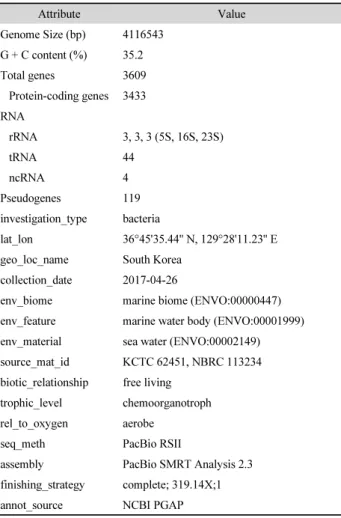
The genome of strain UJ94 consists of a single circular
chromosome composed of 4,116,543 bp (4,116,543 of N
50and
1 of L
50), 3,609 coding sequences, 3 copies of 5S, 16S, and 23S
rRNAs, and 44 tRNAs with a 35.2 mol% of G + C content
(Table 1). The CAZy database (www.cazy.org) was used to
analyze the genome of strain UJ94, which revealed many
carbohydrate-active enzymes such as 87 glycoside hydrolases,
64 glycosyltransferases, and 26 polysaccharide lyases (Lombard
et al., 2014). BLASTp search predicted 9 alginate lyases, as
464
∙ Jung et al.미생물학회지 제54권 제4호
Table 1. General feature and MIGS information of Tamlana sp. UJ94 genome
Attribute Value
Genome Size (bp) 4116543 G + C content (%) 35.2
Total genes 3609
Protein-coding genes 3433 RNA
rRNA 3, 3, 3 (5S, 16S, 23S)
tRNA 44
ncRNA 4
Pseudogenes 119
investigation_type bacteria
lat_lon 36°45'35.44'' N, 129°28'11.23'' E geo_loc_name South Korea
collection_date 2017-04-26
env_biome marine biome (ENVO:00000447) env_feature marine water body (ENVO:00001999) env_material sea water (ENVO:00002149) source_mat_id KCTC 62451, NBRC 113234 biotic_relationship free living
trophic_level chemoorganotroph rel_to_oxygen aerobe
seq_meth PacBio RSII
assembly PacBio SMRT Analysis 2.3 finishing_strategy complete; 319.14X;1
annot_source NCBI PGAP
* NCBI accession number is CP025938
expected. Additionally, the genome contained 6 agarases, 5 amylases, 4 carrageenases, 1 cellulase, 4 pectate lyases, and 7 xylanases (BLASTp cutoff values were E-value < 10
-10and sequence similarity > 25%), suggesting the ability to degrade diverse polysaccharides. Genes related to the regulation, uptake, and metabolism of polysaccharides are often co-localized in the genomic loci of the phylum Bacteroidetes, known as polysaccharide-utilization loci (PUL) (Grondin et al., 2017).
PULDB predicted 20 PULs in the genome of strain UJ94 (Terrapon et al., 2018). One of the PULs, a 22.1-kb region (1,146,465 to 1,168,568) containing 11 genes (C1A40_05190 to C1A40_05240), is thought to function in alginate metabolism.
This region harbors 4 alginate lyases, 1 transcriptional regulator, 2 transporters, 3 hypothetical protein-coding genes, and 1
pseudogene.
Polysaccharide-degrading enzymes have gained attention because of their potential in the bioconversion of polysaccharides into renewable energy sources and biochemical commodities (Trincone, 2011). Genes coding for polysaccharide-degrading enzymes from the genome of Tamlana sp. UJ94 would have potential use for such industrial applications.
적 요
Tamlana sp. UJ94 는 해수로부터 분리되었으며 알긴산을 분해할 수 있다. 알긴산 분해 관련 특성을 이해하기 위해 이 세 균의 유전체를 분석하였다. UJ94의 유전체는 4,116,543 bp 의 크기로 3,609개의 코딩서열을 가지고 있으며 35.2 mol%의 G + C 함량을 가진다. BLASTp 검색 결과 9개의 alginate lyase 외에도 6개의 agarase, 5개의 amylase, 4개의 carrageenase, 1개 의 cellulase, 4개의 pectate lyase, 7개의 xylanase의 존재가 예 측되어 UJ94의 다양한 다당류 분해 능력을 암시하였다.
Tamlana sp. UJ94 의 유전체는 생물전환 공정에 사용할 수 있 는 다당류 분해 유전자를 제공할 수 있을 것이다.
Acknowledgements
This work was supported by a grant form National Marine Biodiversity Institute of Korea (2018M00800).
References
Grondin JM, Tamura K, Dejean G, Abbott DW, and Brumer H. 2017.
Polysaccharide utilization loci: Fueling microbial communities.
J. Bacteriol. 199, e00860-16.
Lombard V, Golaconda Ramulu H, Drula E, Coutinho PM, and Henrissat B. 2014. The carbohydrate-active enzymes database (CAZy) in 2013. Nucleic Acids Res. 42, D490–D495.
Terrapon N, Lombard V, Drula E, Lapebie P, Al-Masaudi S, Gilbert HJ, and Henrissat B. 2018. PULDB: the expanded database of Polysaccharide utilization loci. Nucleic Acids Res. 46, D677–
D683.
Trincone A. 2011. Marine biocatalysts: enzymatic features and appli- cations. Mar. Drugs 9, 478–499.