Triclosan-resistant Pseudomonas sp. strain Tri1 was isolated from a farmland soil in Anseong, South Korea. The genome of strain Tri1 was assembled to a single contig that consists of 6,707,950 bp with a G + C content of 60.51%. The complete genome sequence contained 5,433 protein-coding genes, 17 rRNA genes and 66 tRNA genes. Strain Tri1 contained fabV gene which is known to confer triclosan resistance.
Keywords: Pseudomonas sp. Tri1, fabV, complete genome, farmland soil, triclosan
The genus Pseudomonas was first proposed in 1894 and isolated from various environments. Most of members have common characteristics such as aerobic, Gram-staining-negative, rod-shape and one or more polar flagella (Peix et al., 2018).
The first reported complete genome sequence of the genus Pseudomonas was P. aeruginosa PAO1 (Stover et al., 2000).
According to the genome sequences of 166 type strains of validly published species, the average of genome size and G + C content were 5.63 Mbp and 61.2%, respectively, and 794 core genes represented 11~28% of the genomes (Hesse et al., 2018). In this study, Pseudomonas sp. strain Tri1 was isolated from a farmland soil in Anseong, South Korea (37°00'43.4"N,
127°14'35.5"E) and its genome is reported.
The genomic DNA was extracted using FastDNA Spin Kit for Soil (MP Biomedicals) following the manufacturer’s protocols. A 20-kb SMRTbell sequencing library was created using SMRTbell Template Prep Kit (Pacific Biosciences) and sequencing was performed on the PacBio RS II (Pacific Bio- sciences) platform. The genome was assembled by the Hierarchical Genome Assembly Process (HGAP) using the SMRT analysis software v2.3.0. Protein-coding genes (CDS), rRNA genes and tRNA genes were predicted using Prodigal v2.6 (Hyatt et al., 2010), HMMER3 (Eddy, 1996), and tRNAscan-SE (Chan and Lowe, 2019), respectively. The genome sequence was annotated using UBLAST (Edgar, 2010) and the Swiss-Prot, KEGG, SEED and COG database. The sequencing depth was 221.77 × coverage.
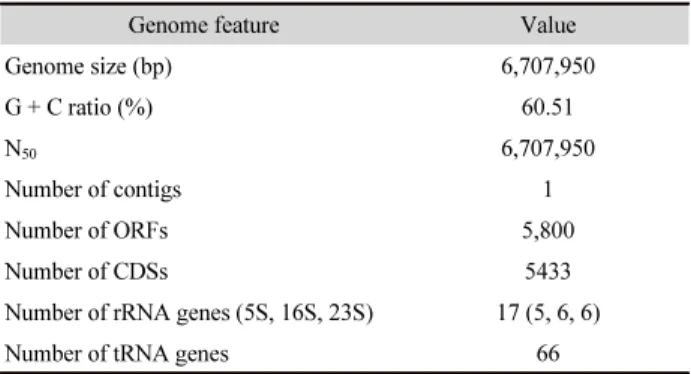
The genome size of strain Tri1 was 6,707,950 bp comprising a single contig with a G + C content of 60.51%. The genome sequence contained 5,433 CDSs, 17 rRNA genes (five rRNA operons and additional 5S rRNA and 23S rRNA genes) and 66 tRNA genes (Table 1).
According to the annotated genes from the complete genome sequence of strain Tri1, carbon metabolism system including glycolysis, citrate cycle, pyruvate metabolism, and butanoate metabolism was conserved. Cellulose and trehalose degradation genes were predicted to be endoglucanase, cellulose 1,4-β-
Korean Journal of Microbiology (2021) Vol. 57, No. 2, pp. 112-113 pISSN 0440-2413
DOI https://doi.org/10.7845/kjm.2021.1030 eISSN 2383-9902
Copyright ⓒ 2021, The Microbiological Society of Korea
Complete genome sequence of triclosan-resistant Pseudomonas sp.
Tri1, isolated from farmland soil, South Korea
Yong-Seok Kim and Chang-Jun Cha*
Department of Systems Biotechnology, Chung-Ang University, Anseong 17546, Republic of Korea
대한민국 농지 토양에서 분리된 트리클로산 내성 Pseudomonas sp. Tri1의 완전한 유전체 서열
김용석 ・ 차창준*
중앙대학교 시스템생명공학과
(Received April 23, 2021; Revised May 11, 2021; Accepted May 13, 2021)
*For correspondence. E-mail: [email protected];
Tel.: +82-31-670-4840; Fax: +82-31-675-0432
Complete genome sequence of Pseudomonas sp. Tri1∙
113
Korean Journal of Microbiology, Vol. 57, No. 2 cellobiosidase, β-glucosidase, glycogen debranching enzyme,
and α,α-trehalase. Strain Tri1 displayed triclosan resistance and the genome of strain Tri1 was found to contain fabV gene which is known to confer resistance to triclosan (Massengo- Tiassé and Cronan, 2009; Zhu et al., 2010).
Nucleotide sequence accession number(s)
Pseudomonas sp. Tri1 was deposited in the National Institute of Biological Resources (NIBR) under the deposition number NIBRBAC000500877 and the complete genome sequence has been deposited in DDBJ/EMBL/GenBank under the accession number CP072913.
적 요
트리클로산에 내성을 갖는 Pseudomonas sp. Tri1 균주가 대한민국 안성의 농지 토양에서 분리되었다. Tri1 균주의 유전 체는 크기가 6,707,950 bp이고 G + C 함량이 60.51%인 단일 contig로 조립되었다. Tri1 균주의 완전한 유전체 서열은 5,433 개의 단백질 코딩 유전자, 17개의 rRNA 유전자 및 66개의 tRNA 유전자를 포함하였다. Tri1 균주는 트리클로산 내성을 주는 것으로 알려진 fabV 유전자를 가지고 있었다.
Acknowledgments
This work was supported by a grant from the National Institute of Biological Resources (NIBR), funded by the Ministry of Environment (MOE) of the Republic of Korea (NIBR201518201) and by the National Research Foundation of Korea (NRF) grant funded by the Korea government (MSIT) (No. 2020R1A2C1011816).
Conflict of Interest
The authors have no conflicts of interest to report.
References
Chan PP and Lowe TM. 2019. tRNAscan-SE: searching for tRNA genes in genomic sequences. Methods Mol. Biol. 1962, 1–14.
Eddy SR. 1996. Hidden Markov models. Curr. Opin. Struct. Biol. 6, 361–365.
Edgar RC. 2010. Search and clustering orders of magnitude faster than BLAST. Bioinformatics 26, 2460–2461.
Hesse C, Schulz F, Bull CT, Shaffer BT, Yan Q, Shapiro N, Hassan KA, Varghese N, Elbourne LDH, Paulsen IT, et al. 2018.
Genome-based evolutionary history of Pseudomonas spp. Environ.
Microbiol. 20, 2142–2159.
Hyatt D, Chen GL, LoCascio PF, Land ML, Larimer FW, and Hauser LJ. 2010. Prodigal: Prokaryotic gene recognition and translation initiation site identification. BMC Bioinformatics 11, 119.
Massengo-Tiassé RP and Cronan JE. 2009. Diversity in enoyl-acyl carrier protein reductases. Cell. Mol. Life Sci. 66, 1507–1517.
Peix A, Ramírez-Bahena MH, and Velázquez E. 2018. The current status on the taxonomy of Pseudomonas revisited: an update.
Infect. Genet. Evol. 57, 106–116.
Stover CK, Pham XQ, Erwin AL, Mizoguchi SD, Warrener P, Hickey MJ, Brinkman FSL, Hufnagle WO, Kowalik DJ, Lagrou M, et al.
2000. Complete genome sequence of Pseudomonas aeruginosa PAO1, an opportunistic pathogen. Nature 406, 959–964.
Zhu L, Lin J, Ma J, Cronan JE, and Wang H. 2010. Triclosan resistance of Pseudomonas aeruginosa PAO1 is due to FabV, a triclosan- resistant enoyl-acyl carrier protein reductase. Antimicrob. Agents Chemother. 54, 689–698.
Table 1. The genome features of Pseudomonas sp. Tri1
Genome feature Value
Genome size (bp) 6,707,950
G + C ratio (%) 60.51
N50 6,707,950
Number of contigs 1
Number of ORFs 5,800
Number of CDSs 5433
Number of rRNA genes (5S, 16S, 23S) 17 (5, 6, 6)
Number of tRNA genes 66