Korean Journal of Microbiology (2019) Vol. 55, No. 2, pp. 174-176 pISSN 0440-2413
DOI https://doi.org/10.7845/kjm.2019.9045 eISSN 2383-9902
Copyright ⓒ 2019, The Microbiological Society of Korea
Complete genome sequence of Flavobacteriaceae strain KCTC 52651 isolated from seawater recirculating aquaculture system
Young-Sam Kim, Young Jae Jeon, and Kyoung-Ho Kim*
Department of Microbiology, Pukyong National University, Busan 48513, Republic of Korea
해수 순환여과양식시스템에서 분리된 Flavobacteriaceae 균주 KCTC 52651의 유전체 분석
김영삼 ・ 전용재 ・ 김경호*
부경대학교 미생물학과
(Received May 2, 2019; Revised May 3, 2019; Accepted May 7, 2019)
*For correspondence. E-mail: [email protected];
Tel.: +82-51-629-5611; Fax: +82-51-629-5619
A novel bacterium, designated strain RR4-38 (= KCTC 52651 = DSM 108068), belonging to the family Flavobacteriaceae was isolated from a biofilter in the seawater recirculating aquaculture system in South Korea. A single complete genome contig which is 3,182,272 bp with 41.9% G+C content was generated using PacBio RS II platform. The genome includes 2,829 protein- coding genes, 6 rRNA genes, 38 tRNA genes, 4 non-coding RNA genes, and 9 pseudogenes. The results will provide insights for understanding microbial activity in the seawater recirculating aquaculture system.
Keywords: Flavobacteriaceae, complete genome, seawater recirculating aquaculture system
Seawater recirculating aquaculture system (RAS) is an inland aquaculture system which requires less or no supply of seawater.
In the RAS system, farmed species are less exposed to environ- mental changes, such as temperature, pathogens, pH changes, seasonal changes and toxic agents produced by marine micro- organisms (Bregnballe et al., 2015). However, this closed system requires continuous management to maintain water quality suitably and therefore, for management of this system, various
chemical and biological processes are essential. In the biological process, microorganisms are key players in the degradation of toxic organic matters, such as fish excreta and nitrogen compounds. Consequently, microorganisms which utilize and eliminate toxic agents in the system have been studied to improve the RAS systems (Verreth et al., 2010; Sandu and Hallerm, 2013).
The strain RR4-38 was isolated from a biofilter installed in the RAS system (35° 11' 23.5" N 129° 13' 17.1" E, Busan, South Korea) during the investigation of microbial diversity in the RAS system and deposited to culture collections (= KCTC 52651 = DSM 108068). The sequences of two 16S rRNA genes of the genome are the same and they shared low sequence simil- arity with the close genera such as genus Ulvibacter (95.01%), Aureitalea (94.74%), and Winogradskyella (93.01%) which all belong to the family Flavobacteriaceae. The strain is aerobic, Gram-negative and non-motile.
For whole genome sequencing, the strain RR4-38 was incu- bated aerobically on Marine agar 2216 (Difco) at 28°C for 4 days and the cell mass was used to extract genomic DNA using MiniBEST bacteria genomic DNA extraction kit (TaKaRa).
Total 40 µg of genomic DNA was purified and sequenced by
PacBio RS II platform (Pacific Biosciences). A single closed
Complete genome sequence of Flavobacteriaceae strain KCTC 52651
∙175
Korean Journal of Microbiology, Vol. 55, No. 2
Fig. 1.Complete genome map of Flavobacteriaceae sp. RR4-38. From the center to the outside: genome size label, GC skew (purple and green), G+C content (black), CDSs colored by COG categories on the reverse strand, CDSs on the reverse strand, CDSs on the forward strand, CDSs colored by COG categories on the forward strand. RNA genes (tRNAs, rRNAs, and ncRNAs) are contained in the forward and reverse CDSs strands.
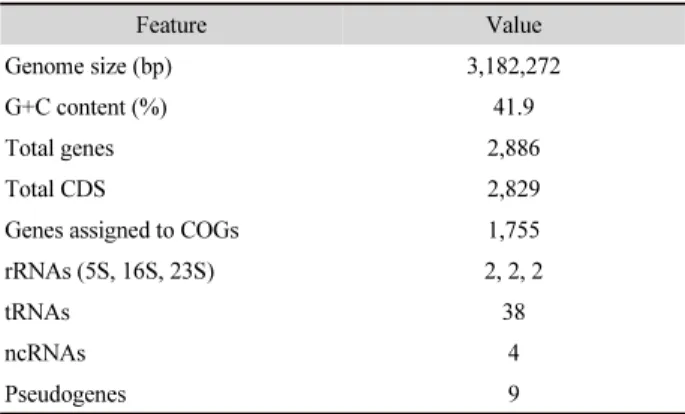
Table 1.
General genomic features of Flavobacteriaceae sp. RR4-38
Feature Value
Genome size (bp) 3,182,272
G+C content (%) 41.9
Total genes 2,886
Total CDS 2,829
Genes assigned to COGs 1,755
rRNAs (5S, 16S, 23S) 2, 2, 2
tRNAs 38
ncRNAs 4
Pseudogenes 9
contig (3,182,272 bp with G+C content 41.9%) was obtained through de novo assembly with Hierarchical Genome Assembly Process (HGAP, Version 3.0) (Chin et al., 2013).
Total 2,886 genes including 2,829 CDSs, 44 RNAs, 4 ncRNAs, and 9 pseudogenes were annotated by the NCBI Prokaryotic Genome Annotation Pipeline (DiCuccio et al., 2016). Subsystems, which present functional roles such as a metabolic pathway or a component of a cell were predicted by RAST with SEED
database (Wilke et al., 2008). The genes related to subsystems such as ammonia assimilation, denitrification, and protein degradation which may be benefit for managing RAS systems were confirmed. Additionally, the assignment of genes to Clusters of Orthologous Groups (COGs) category and the circular map which presents genome features (Fig. 1) were constructed by CGView Comparison Tool (Grant et al., 2012).
CRISPR loci were found by CRISPRFinder [http://crispr.i2bc.
paris-saclay.fr; (Grissa et al., 2007)] and three questionable CRISPR loci were detected. PHAge Search Tool Enhanced Release [PHASTER; http://phaster.ca/; (Arndt et al., 2016)]
was used to detect prophage sequence which integrated into the host chromosome and nine questionable prophage ORFs which are coding tail proteins and hypothetical proteins were detected.
The genomic properties of strain RR4-38, as a part of resident flora in the biofilm from the RAS system may provide us a basis for understanding microbial activities in the RAS systems.
Further experiments are in progress to classify its phylogenetic
position and biochemical properties for the comprehension of
strain RR4-38.
176
∙Kim et al.
미생물학회지 제55권 제2호
Nucleotide sequence accession number
The complete genome sequence of Flavobacteriaceae bac- terium strain RR4-38 has been deposited at GenBank under the accession numbers of CP027062. The strain was deposited at the Korean Collection for Type Cultures and the German Collection of Microorganisms and Cell Cultures with the pre- servation number KCTC 52651 and DSM 108068, respectively.
적 요
Flavobacteriaceae 과에 속하는 신균주인 RR4-38 (= KCTC 52651 = DSM 108068) 가 한국의 해수 순환여과양식시스템의 생물여과조에서 분리되었다. 41.9%의 G+C 함유량을 가진 3,182,272 bp의 길이의 하나의 완전한 유전체 컨티그가 PacBio RS II를 이용하여 얻어졌다. 이 유전체는 2,829개의 단백질 암 호화 유전자와 6개의 rRNA 유전자, 38개 tRNA 유전자, 4개의
ncRNA 유전자, 9개의 유사유전자를 포함하고 있다. 이 결과
는 해수 순환여과양식시스템에서 미생물의 활성을 이해하는 데 통찰력을 줄 것이다.
Acknowledgements
This work was supported by a Research Grant of Pukyong National University (2017).
References