Korean Journal of Microbiology (2019) Vol. 55, No. 4, pp. 451-453 pISSN 0440-2413
DOI https://doi.org/10.7845/kjm.2019.9132 eISSN 2383-9902
Copyright ⓒ 2019, The Microbiological Society of Korea
Complete genome sequence of Anseongella ginsenosidimutans Gsoil 524 T , a ginsenoside-converting bacterium, isolated from soil cultivating ginseng
Ji Eun Lee
1, Byoung Hee Lee
2, Ki-Eun Lee
2, Myung-Suk Kang
2, and Wan-Taek Im
1,3*
1
Department of Biotechnology, Hankyong National University, Gyeonggi-do 17579, Republic of Korea
2
Microorganism Resources Division, National Institute of Biological Resources, Incheon 22689, Republic of Korea
3
AceEMzyme Co., Ltd., Academic Industry Cooperation, Gyeonggi-do 17579, Republic of Korea
인삼토양으로부터 분리한 진세노사이드 전환 능력이 있는
Anseongella ginsenosidimutans Gsoil 524 T 의 유전체 서열 분석
이지은
1・ 이병희
2・ 이기은
2・ 강명석
2・ 임완택
1,3*
1
국립한경대학교 농업생명과학대학 생명공학과,
2국립생물자원관 미생물자원과,
3㈜에이스엠자임
(Received October 30, 2019; Revised December 6, 2019; Accepted December 7, 2019)
*For correspondence. E-mail: [email protected];
Tel.: +82-31-670-5335; Fax: +82-31-670-5339
A Gram-stain-negative, rod-shaped, non-spore-forming, aerobic bacterium, designated Anseongella ginsenosidimutans Gsoil 524
T, was isolated from the soil of a field used for cultivating ginseng. Anseongella ginsenosidimutans Gsoil 524
Tshowed the ability to convert major ginsenosides to minor ginsenosides, and its whole genome was sequenced. The whole genome of Anseongella ginsenosidimutans Gsoil 524
Tconsists of a single circular chromosome of 4,322,684 bp, with 49.9% G + C content. Based on the complete genome sequence of strain Gsoil 524
T, we found several glycoside hydrolase-encoding genes that may be involved in the conversion of major ginsenosides into minor ginsenosides and some polysaccharide lyases.
Keywords: Anseongella ginsenosidimutans, complete genome, glycoside hydrolase, PacBio RS II, the soil of ginseng field
Based on the 16S rRNA gene sequence, Anseongella gin- senosidimutans Gsoil 524
Tin a distinct lineage in the family
Sphingobacteriaceae which was first proposed by Steyn et al.
(1998), belongs to the phylum Bacteroidetes, class Sphingo- bacteriia, and order Sphingobacteriales.
Anseongella ginsenosidimutans Gsoil 524
Tis Gram-stain- negative, rod-shaped, and non-spore-forming that is isolated from soil (Siddiqi et al., 2016). Currently, the genus comprises one recognized species with published names (LPSN, http://
www.bacterio.net/niabella.html).
A Gram-strain-negative bacterium, A. ginsenosidimutans
Gsoil 524
T, were isolated from soil of a ginseng field in the
Republic of Korea. A. ginsenosidimutans Gsoil 524
Twas
milky-white colored, non-spore forming, and non-motile rod
bacterium. Based on the production of minor ginsenosides
from major ginsenosides (Siddiqi et al., 2017). A. ginseno-
sidimutans Gsoil 524
Twas selected for a whole genome study
to identify the target functional genes such as glycoside
hydrolases and polysaccharide lyases. Whole genome sequence
analysis showed many glycoside hydrolases that may be
involved in the conversion of ginsenosides. This strain is
available from the host institute and from three culture
452 ∙ Lee et al.
미생물학회지 제55권 제4호
Table 1. General features of Anseongella ginsenosidimutans Gsoil 524
TFeatures Chromosome
Genome size (bp) 4,322,684
G + C content (%) 49.9
Total genes 3,683
Pseudo genes 177
Coding sequences (CDSs) 3,448
Number of rRNA genes (5S, 16S, 23S) 9 (3, 3, 3)
Number of tRNA genes 46
collections (= KACC 14636
T= KCTC 22261
T= LMG 24494
T).
Genomic DNA of A. ginsenosidimutans Gsoil 524
Twas extracted using a MagAttract HMW DNA kit (Qiagen) and was purified using the chloroform wash method (shared protocol;
Pacific Biosciences). Genome sequencing was performed using a Pacific Biosciences RSII sequencing platform, with a 20 kb SMRTbell
TMtemplate library, at DNA Link, Inc. Se- quences were assembled using the HGAP3 protocol (Pacific Biosciences) and the sequencing depth was 173.03×. The genome sequence was annotated using the NCBI Prokaryotic Genome Automatic Annotation Pipeline (http://www.ncbi.
nlm.nih.gov/books/NBK174280/). rRNAs and tRNAs were predicted using rRNAmmer and tRNAscan-SE, respectively (Anthony and Kin, 2015).
The complete genome of A. ginsenosidimutans Gsoil 524
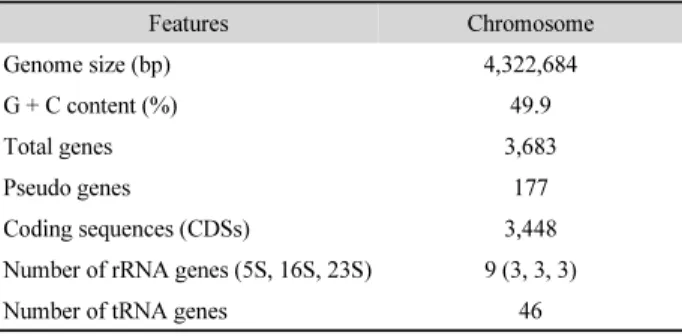
Tconsists of one circular chromosome of 4,322,684 bp, with 49.9% G + C content. Of the 3,683 predicted genes, 3,448 were protein-coding genes (CDS), and 58 were RNA genes. More- over, 177 pseudogenes were identified. The majority of the protein-coding genes (95.12%) was assigned function genes, while the remaining predicted genes were annotated as hypo- thetical or conserved hypothetical proteins. The genome statistics are presented in Table 1. Whole genome sequence analysis showed more than 20 hydrolase-encoding genes, including 2 β-glucosidases, 2 α-glucosidases, 13 β-xylosidases, 2 α-L- ara- binofuranosidases, 3 α-L-rhamnosidases, and 1 β-galactosidase, which may be responsible for its ability to convert gin- senosides. In addition, genome annotation revealed other genes of interest, including polysaccharide lyases such as cellulase, GDSL lipase with multifunctional properties such as broad substrate specificity and regiospecificity (Akoh et al., 2004), thiamine biosynthesis protein ThiF (B1) which can synthesize
vitamin B1, and nitrite reductase.
Nucleotide sequence accession number
The complete genome sequence of Anseongella ginseno- sidimutans Gsoil 524
Thas been deposited in DDBJ/EMBL/
GenBank under the accession number CP042432.
적 요
인삼 토양으로부터 분리한 Anseongella ginsenosidimutans Gsoil 524
T균주의 유전체서열을 분석하였다. 균주 Gsoil 524
T의 유전체는 G + C 비율이 49.9%이며, 3,683개의 유전자와 3,448 개의 단백질 코딩 유전자, 177개의 위유전자 그리고 58 개의 RNA 유전자를 포함한 단일 원형 염색체로 구성되었으 며 그 크기는 4,322,684 bp였다. 균주 Gsoil 524
T는 인삼사포닌 의 당 분해에 관여하는 여러 타입의 글라이코시다제 유전자, 고분자 분해 유전자를 가지고 있었다. 이러한 지놈 분석은 메 이저 진세노사이드 전환에 관여하는 유전자 특징을 이해하는 데 큰 기여가 되었다.
Acknowledgements
This work was supported by grants from the National Institute of Biological Resources, funded by the Ministry of Environment (No. NIBR201801106).
References