1. 서론
골조직은 인체의 중요한 내부 장기를 외력으로부터 보호하고, 골수를 보호하여 조혈기능을 유지하며, 인체 에서 칼슘과 인산 등의 무기물을 저장한다. 골조직은 성 장을 마친 후에도 지속적인 골개조가 일어난다. 그러나 골 흡수에는 큰 변화가 없지만 골 생성능력이 크게 저하 됨에 따라 골량과 골 밀도가 감소하고, 미세골격구조가 퇴화되면 골다공증이 발생하며, 골다공증은 골절의 주 요 원인이 된다. 골다공증은 폐경에 따라 발생하는 골다 공증, 노화에 의해 발생하는 골다공증 및 스테로이드와 같은 약물에 의한 골다공증으로 분류할 수 있다1).
골다공증과 치주염은 전 세계의 남성과 여성 모두에 게 많이 발생하는 질환으로 연령 증가에 따라 함께 증가 한다. 골다공증은 치조골을 손상시키므로 치주염 발생 에 중요한 역할을 할 뿐 아니라 치아 손실도 함께 일으 킨다2).
2009 국민건강통계에 의하면 골다공증의 경우 50세 이상 남성의 유병률은 남자 8.1%, 50세 이상 여성의 38.7%로 여성이 남성보다 4배 이상 높게 나타났으며, 연령이 증가할수록 유병 수준도 높아져 여성의 경우 50 대 14.6%, 60대 39.1%, 70대 68.2%이었고, 남성도 70 대 이상에서는 20% 수준이었다. 치주질환 유병률은 2007년 33.6%에서 2009년 27.4%로 감소하였다. 성인
교신저자 : 장영호 우) 760-709 경북 안동시 서후면 서선길 189번지 안동과학대학 치위생과 전화 : 054-851-3677 Fax : 054-851-3677 E-mail : [email protected] 접수일-22001111년년 77월월 55일일 수정일-22001111년년 77월월 2277일일 게재확정일-22001111년년 88월월 2200일일
비타민 K의 골 건강 증진 효과
장영호
안동과학대학 치위생과
Beneficial effect of vitamin K on bone health
Young-Ho Jang
Dept. of Dental Hygiene, Andong Science College
ABSTRACT
Originally, vitamin K was defined as a factor for blood coagulation. Now more attention is focused on vitamin K for bone metabolism and bone health. Vitamin K is a coenzyme for glutamate carboxylase which converts gluta- mate residues to γ-carboxyglutamate(Gla) residues. Gla residues have calcium binding ability and bound to hydroxyapatite crystals in bone. Vitamin K promotes the carboxylation of osteocalcin and matrix Gla-protein, vitamin K-dependent proteins and improves bone mineral density and bone mass. Vitamin K deficiency causes reductions in bone mineral density and increases the risk of osteoporotic bone fractures, resulting from under- carboxylated osteocalcin.
This paper is to provide a brief information of vitamin K and its role in bone health. (J Korean Soc Dent Hygiene 2011;11(4):419-426)
Key words : bone health, osteocalcin, vitamin K 색인 : 골 건강, 비타민 K, osteocalcin
44.1%, 여자 30.0%로 남자가 높았으며, 특히 50대 이 상 남자에서 50% 이상으로 나타났다3).
골다공증 치료제로 사용되는 것은 비타민 D제제와 칼 슘제제와 같은 골형성촉진제와 에스트로겐제제, 부갑상 선호르몬제, 비스포스포내이트(bisphosphonates)제제 등과 같은 골흡수억제제가 있지만 이러한 약물제제 중 에서 비스포스포내이트와 호르몬제제의 사용으로 인한 부작용이 일부 보고되고 있으므로 이러한 문제를 해결 하기 위한 대체 약제의 개발이 진행되고 있다4-6).
따라서 본 논문은 비타민 K의 골 건강 증진 효과에 대 한 자료를 제시함으로써 비타민 K의 골 건강 증진제로 의 활용 가능성에 관한 기초자료를 제공하고자 한다.
2. 본론
2.1. 비타민 K의 종류와 분포
지용성 비타민의 하나인 비타민 K는 자연계에서 비타 민 K1(phylloquinone)과 비타민 K2(menaquinone)로 발견되며, 이중에서 비타민 K1이 더 많이 분포되어 있 다. 비타민 K1과 비타민 K2의 기본구조는 2-methyl- 1,4 napthoquinone 고리의 C3 위치에 isoprenoid 측 쇄가 있으며, 여기에 phylloquinone은 prenyl기가 4 개 있으며, menaquinone는 isophenyl기가 반복적으 로 있으므로 menaquinone-n(MK-n)으로 표시한다
<Fig. 1>7).
비타민 K1(phylloquinone)은 상추, 브로콜리, 시금 치, 양배추 등 녹색 야채와 콩기름, 카놀라기름, 올리브 기름 등 식물성 기름에 많으며, menaquinone은 육류,
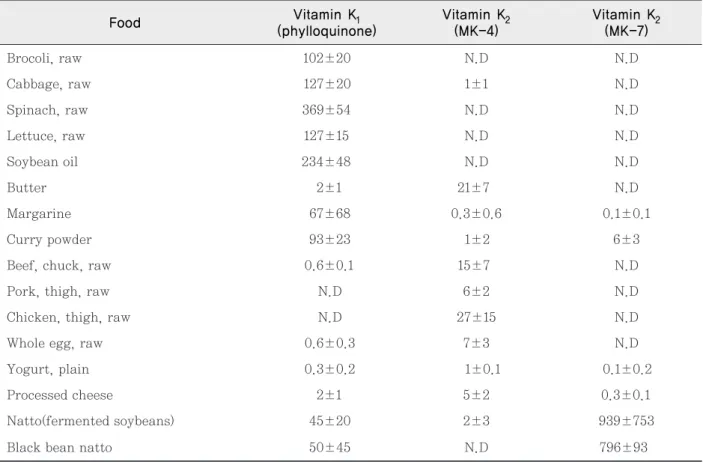
K2(menaquinone)는 식품에서 대부분 측쇄 길이가 짧 은 MK-4의 형태로 존재하며, 측쇄 길이가 긴 MK- 7~MK-10은 장내 미생물에 의해서 생산되며, 특히 나 토(natto)에 많이 함유되어 있다<Table 1>8-10). 비타민 K3(menadione)은 합성 비타민으로 자연산보다 2~3배 강하지만 골다공증의 치료나 예방에는 사용되지 않고 항암제로 사용된다11,12).
2.2 비타민 K의 골 대사 증진 효과
비타민 K는 비타민 K-의존성 단백질에서 글루타민 산(glutamic acid)의 카르복실화(carboxylation)를 촉 매하여 γ-carboxyglutamic acid(Gla)로 전환시키는 비타민 K-의존성 카르복실라아제(carboxylase)의 조 효소 기능을 갖고 있다. 비타민 K-의존성 단백질에는 혈액응고인자[Ⅱ(프로트롬빈), Ⅶ, Ⅸ, Ⅹ인자], 혈장단 백질(단백질 C, 단백질 S, 단백질 Z), 뼈 단백질(osteo- calcin, matrix Gla-protein), 기타 폐, 신장, 비장 등 에 존재하는 단백질 등이 있다13-16).
골모세포는 칼슘 결합 단백질인 osteocalcin(bone Gla-protein)을 생성하며, matrix Gla-protein(MGP) 과 단백질 S는 연골, 혈관 등을 포함한 연조직에서 생성된 다. 이들의 기능은 아직까지 명확하지 않지만 osteocal- cin과 MGP는 뼈의 무기질 형성을 촉진시키고, 단백질 S 는 세포 증식을 촉진시키는 것으로 알려져 있다16). 또한 MGP는 동맥과 연골의 석회화를 억제하기도 한다17,18).
Osteocalcin은 3개의 비타민 K-의존성 Gla를 포함 하고 있으며, MGP는 5개의 비타민 K-의존성 Gla을 포함하고 있으며, 카르복실화과정에서 생성된 Gla은 칼
Vitamin K2(menaquinone)
n-1 H
Vitamin K1(phylloquinone) 3
Fig 1. Structure of vitamin K
슘과 결합하고 수산화인회석(hydroyapatite)에 흡착되 는 성질을 갖고 있다18-20). 따라서 osteocalcin과 MGP 의 γ-카르복실화에 의해 생성된 Gla가 칼슘과 결합하고 뼈와 치아의 수산화인회석에 흡착하므로 osteocalcin과 MGP가 뼈와 치아의 석회화를 촉진시킨다.
Hara 등21)은 비타민 K2는 뼈에서 칼슘 용출을 억제 하고, 파골세포와 같은 다핵세포의 형성을 억제하지만 비타민 K1은 같은 농도에서 억제 효과가 없었다. 이와 같은 비타민 K2의 뼈 재흡수 억제효과는 γ-카르복실화 때문이 아니라 비타민 K2의 측쇄 때문이라고 하였으며, Schurgers 등22)은 비타민 K2의 측쇄가 meval- onate(mevalonic acid) 경로를 억제하여 파골세포의 활성을 억제한다고 하였다.
비타민 K는 골다공증 환자의 뼈 미네랄 밀도를 증가 시킬 뿐 아니라 파괴 속도를 줄일 수 있으며, 골 대사에 서 가장 필요한 칼슘 균형을 높일 수 있다20). 골다공증 환자에게 비타민 K1을 권장량의 15배를 복용시킬 때 혈
액 중 undercarboxylated osteocalcin(UcOC)의 비율 은 감소하였지만 뼈의 무기질 손실을 방지하기에는 부 족하였다. 그러나 비타민 K2는 뼈에서 추가적인 무기질 손실과 파절의 위험을 효과적으로 방지하였다23). 혈청 에서 비타민 K 농도가 낮은 사람은 osteocalcin의 카르 복실화가 완전하게 일어나지 않으며, 골절을 경험한 혈 액 투석 환자는 혈청에서 비타민 K 함량이 적었으며, 비 타민 K가 부족하면 순환 osteocalcin의 농도가 감소된
다24,25). 고령의 여성은 젊은 여성에 비해 UcOC의 비율
이 높으므로 골절될 가능성이 높고, 이는 비타민 K가 부 족하기 때문이다. 비타민 K 부족으로 일어나는 현상은 건강한 어린이에게도 동일하다26,27). 비타민 K와 골 건 강에 대한 역학조사 <Table 2>와 비타민 K의 골에 미치 는 영향 <Table 3>에 의하면8,28-39)비타민 K가 부족하 면 UcOC가 증가하게 되고 이에 따라 골 밀도가 감소하 므로 골절의 위험성이 증가하며, 비타민 K를 공급하면 UcOC가 감소하면서 골 밀도도 증가한다고 하였다.
Table 1. Vitamin K content of food supply unit : ㎍/100g
Food Vitamin K1
(phylloquinone)
Vitamin K2 (MK-4)
Vitamin K2 (MK-7)
Brocoli, raw 102±20 N.D N.D
Cabbage, raw 127±20 1±1 N.D
Spinach, raw 369±54 N.D N.D
Lettuce, raw 127±15 N.D N.D
Soybean oil 234±48 N.D N.D
Butter 2±1 21±7 N.D
Margarine 67±68 0.3±0.6 0.1±0.1
Curry powder 93±23 1±2 6±3
Beef, chuck, raw 0.6±0.1 15±7 N.D
Pork, thigh, raw N.D 6±2 N.D
Chicken, thigh, raw N.D 27±15 N.D
Whole egg, raw 0.6±0.3 7±3 N.D
Yogurt, plain 0.3±0.2 1±0.1 0.1±0.2
Processed cheese 2±1 5±2 0.3±0.1
Natto(fermented soybeans) 45±20 2±3 939±753
Black bean natto 50±45 N.D 796±93
N.D : not detectable
2.3 비타민 K2 생산 미생물
비타민 K2는 장내 미생물뿐 아니라 다른 미생물에 의 해서도 생산된다. Flavobacterium meningosep- ticum 돌연변이주는 MK-6를 배양액 ℓ당 3.4mg, 건 조 세포당 5.5mg을 생산하였다40). 나토(natto)에서 분 리 한 Bacillus subtilis MH-1로 부 터 분 리 한 diphenylamine에 저항성을 갖는 돌연변이주 D200- 41은 MK-7을 생산한다. MK-7은 정치배양을 할 때 생 산량이 많으며, 특히 37℃에서 1일 동안 진탕배양을 한 후 45℃에서 5일 동안 배양하여 MK-7을 최대 60mg 까지 생산하였으며, menadione에 저항성을 갖는 Bacillus subtilis 돌연변이주는 기존 균주보다 30%의 MK를 더 생산하였고, 최대 생산량은 4일 배양할 때 ℓ당 35.0mg이었다. Bacillus subtilis natto를 10mM of dipicolinic acid를 첨가한 배지에서 배양한 결과 평소 보다 MK-7을 4배 더 생산하였으며, 진탕배양과 정치 배양에 따른 MK-7 생산량의 차이점은 발견되지 않았
다41-43). 뼈 형성을 촉진시키는 나토를 개발하기 위해
osteoclacin의 카르복실화에 중요한 역할을 하는 MK- 7을 많이 생산하는 균주를 선발하였다. 선발된 균주
OUV23481는 Bacillus subtilis (Natto)이며, 기존의 균주보다 MK-7을 2배 이상(1,719㎍/100g 나토) 생산 하였으며, 이 균주를 사용하여 제조한 나토는 외관, 맛, 풍미, 질감 등에서 좋은 품질을 나타내었다44).
비타민 K2(menaquinone)을 생산하는 젖산균에는 Lactococcus lactis ssp. cremoris, Lactococcus lactis ssp. lactis, Leuconostoc lactis 등이 있으며, 이들 중에서 menaquinone을 건조 세포당 230nmol/g 생산하는 균주를 선발하였고, Lactococcus lactis ssp.
cremoris YIT2001과 Leuconostoc lactis YIT3001 을 환원탈지유 또는 두유에 배양할 때 menaquinone을 ℓ당 29~123㎍ 생산하였다45). Propionibacteria는 tetrahydromenaquinone-9[MK-9(4H)]을 생산하 며, 특히 스위스 에멘탈과 노르웨이 Jarlsberg 치즈에 는 MK-9(4H)가 200~650ng/g으로 매우 많이 포함되 어 있다46).
이와 같이 나토 또는 치즈를 발효시키는 미생물과 발 효제품에 스타터로 사용되는 젖산균이 비타민 K를 생산 하므로 이러한 미생물을 활용한 발효제품을 통하여 비 타민 K의 섭취를 보완할 수 있다.
aUcOC = undercarboxylated osteocalcin level, BMD = bone mineral density, OC = osteocalcin level.
b18-month prospective study.
cThree-year follow-up study.
Subjects Variables Studied Outcome Reference
195 elderly womenb UcOC, hip fracture rate Fracture risk 5.9 times higher in women with elevated UcOC at start of study
Szulc et al.
(1993)
72,327 women Vitamin K intake, hip fracture rate, BMD
Vitamin K intake of>109μg/day reduced risk of hip fracture by 30%; no correlation between vita- min K and BMD
Feskanish et al.
(1996)
113 postmenopausal women
UcOC, BMD UcOC and BMD inversely related Jie et al.(1996)
183 elderly womenc UcOC, hip fracture rate Fracture risk 3.1 times higher in women with elevated UcOC at start of study
Szulc et al.
(1996)
888 men and women Vitamin K intake, hip fracture rate, BMD
65% reduced risk of fractures in highest quartile of vitamin K intake compared with lowest quartile
Booth et al.
(2000)
3. 결론
비타민 K는 혈액 응고에 필요한 인자로 알려져 있을 뿐 아니라 골 대사에도 관여하고 있다. 비타민 K는 비타 민 K-의존성 단백질인 osteocalcin과 matrix Gla- protein(MGP)의 글루타민산을 γ-carboxyglutamic acid(Gla)로 전환시키는 카르복실라제의 조효소로 작용 하며, 이때 생성된 Gla는 칼슘과 결합하고 수산화인회 석(hydroyapatite)에 흡착되는 성질을 갖고 있다. 따라 서 비타민 K가 osteoclacin과 MGP의 카르복실화를 향 상시키므로 비타민 K는 골 대사를 촉진시킨다.
비타민 K가 결핍되면 uncarboxylated osteo- clacin(UcOC)가 증가하므로 골 밀도가 감소하여 골다공
증이 발생한다. 골다공증은 골절의 위험성이 높기 때문 에 반드시 약물치료가 필요하며, 사용되는 약물제제는 골 흡수 억제제와 골 합성 제제가 있다. 그러나 지속적인 약물제제의 사용은 중독성 및 부작용을 일으킬 수 있으 므로 이러한 문제를 해결하기 위하여 대체 약제에 대한 개발이 진행되고 있으며, 지금까지 제안된 대체 약제로 는 식물성 에스트로겐, 한약제제, DHEA 등이 있다.
따라서 비타민 K-의존성 단백질인 osteoclacin과 MGP의 카르복실화를 향상시켜 골 밀도를 증가시킬 수 있는 비타민 K를 골 건강 증진제로 활용할 방법을 모색 할 필요가 있으며, 이에 대한 지속적인 연구가 진행되어 부작용이 없는 새로운 골 건강 증진제가 개발되기를 기 대한다.
Table 3. Intervention studies of vitamin K’s effect on bone variablesa
aBMD = bone mineral density, UcOC = undercarboxylated osteocalcin level, OC = osteocalcin level, %carbOC = percentage of total osteocalcin that is carboxylated.
Subjects Treatment Outcome Reference
20 postmenopausal women
Phytonadione 1mg/day for 2 wk with or without vitamin D2400 units/day
Carboxylation of OC improved in both groups; vitamin D2had no effect
Douglas et al.
(1995)
219 healthy men and women
Phytonadione 1mg/day for 2 wk In all treated groups, mean UcOC decreased from 7.6% to 3.4%; age and sex did not affect the decrease
Binkley et al.
(2000)
92 postmenopausal women with osteo- porosis
Group D: Vitamin D30.75μg/day Group K: Menaquinone 45mg/day Group DK: D and K treatment Group C: Calcium 2g/day All treatments for 2 yr
BMD improved more in group DK than in group D or group K;
increase in lumbar spine BMD significantly greater in group DK than group C
Iwamoto et al.
(2000)
113 women with frac- tures and 91 women without fractures
Menaquinone 45mg/day, vitamin D31 μg/day, or both for 4 wk
UcOC decreased in menaquinone groups but not group receiving vitamin D3only
Takahashi et al.(2001)
94 postmenopausal women with osteo- porosis (84 controls, 10 treated)
Menaquinone 45mg/day with either conjugated estrogens 0.625mg/day or medroxyprogesterone acetate 2.5mg/day for 1 yr
Menaquinone-hormonal treat- ment improved BMD that had been decreasing during hor- monal treatment alone
Hidaka et al.
(2002)
46 women with osteoporosis
Menaquinone 45mg/day for 2 yr Treated group had fewer new vertebral fractures (13) than placebo group (30)
Shiraki et al.
(2002)
20 elderly women with osteoporosis
Calcium 200mg/day for 2 wk with or without menaquinone 45mg/day
Menaquinone group had reduction in UcOC without change in OC
Miki et al.
(2003)
1. 민병무. 구강생화학. 서울:대한나래출판사;2007:77- 83.
2. Pejcˇic´ A, Kojovic´ D, Grigorov I, Stamenkovic´
B. Pediodontitis and osteoporosis. Med Biol 2005;12:100-103.
3. 보건복지부 질병관리본부. 2009 국민건강통계: 국민 건강영양조사 제4기 3차년도(2009). 서울:보건복지 부;2010:56,64.
4. 강병문. 골다공증 치료의 의학약제와 대체 약물의 비 교. 대한산부인과학회지 2006;49:2459-2473.
5. Marx RE. Pamidronate(Aredia) and zolen- dronate(Zometa) induced avascular necrosis of the jaws: a growing epidemic. J Oral Maxillofac Surg 2003;61:1115-1117.
6. 박용덕, 김영한, 김덕윤 외 4인. 한국인 치과의사의 비 스포스포네이트 관련 악골괴사에 대한 인식 연구:예비 보고. 대한구강악안면외과학회지 2009;35:153-157.
7. Kaczor T. Vitamin K and osteoporosis. Natural Med J 2009;1:1-12.
8. Adam J, Pepping J. Vitamin K in the treatment and prevention of osteoporosis and arterial calcification. Am J Health-Syst Pharm 2005;62:1574-1581.
9. Kamao M, Suhara Y, Tsugawa N et al. Vitamin K Content of Foods and Dietary Vitamin K Intake in Japanese young women. J Nutr Sci Vitaminol 2007;53:464-470.
10. Damon M, Zhang NZ, Haytowitzb DB, Bootha SL. Phylloquinone(vitamin K1) content of veg- etables. J Food Com Anal 2005;18:751-758.
11. 박광균, 김영진, 박영민, 정원윤. 치과영양학. 2판. 서 울:대한나래출판사;2007:130-132.
12. Lamson, DW, Plaza SM. The anticancer effects of vitamin K. Alternative Med Rev 2003;8:303-318.
13. Suttie JW. Vitamin K and human nutrition. J Am Diet Assos 1992;92:585-590.
Soc 2003;62:839-843.
15. Uotila L. The metabolic functions and mecha- nism of action of vitamin K. Scand J Clin Lab Invest Suppl 1990;201:109-117.
16. Vermeer C, Jie KSG, Knapen MHJ. Role of vitamin K in bone metabolism. Ann Rev Nutr 1995;15:1-22.
17. Shearer MJ. Role of vitamin K and Gla pro- teins in the pathophysiology of osteoporosis and vascular calcification. Curr Opin Clin Nutr Metab Care 2000;3:433-438.
18. Price PA, Otsuka AS, Poser JW, Kristaponis J, Raman N. Characterization of a gamma-car- boxyglutamic acid containing protein from bone. Proc Nat Acad Sci USA. 1976;73:1447- 1451.
19. Hauschka PV, Lian JB, Cole DEC, Gundberg CM. Osteocalcin and matrix Gla protein: Vita- min K-dependent proteins in bone. Physiol Rev 1989;69:990-1047.
20. Weber P. Vitamin K and Bone Health. Nutr 2001;17:880-887.
21. Hara K, Akiyama Y, Nakamura T, Murota S, Morita I. The inhibitory effect of vitamin K2(menatetrenone) on bone resorption may be related to its side chain. Bone 1995;16:179- 184.
22. Schurgers LJ, Knapen MHJ, Vermeer C. Vita- min K2 improves bone strength in post- menopausal women. Int Congr Ser 2007;1297:
179-187.
23. Zittermann A. Effects of vitamin K on calcium and bone metabolism. Curr Opin Clin Nutr Metab Care 2001;4:483-487.
24. Kohlmeier H, Salomon A, Saupe J, Shearer MJ. Transport of vitamin K to bone in humans. J Nutr 1996;126:1192S-1196S.
25. Compston JE. Boning up on vitamin K. Gut 2001;48:448-449.
26. Szulc P, Chapuy MC, Meunier PJ. Serum undercarboxylated osteocalcin is a marker of the risk of hip fracture in elderly women. J Clin Invest 1993;91:1769-1774.
27. van Summeren M, Braam L, Noirt F, Kuis W, Vermeer C. Pronounced elevation of under- carboxylated osteocalcin in healthy children.
Pediatr Res 2007;61:366-370.
28. Szulc P, Chapuy MC, Meunier PJ. Serum undercarboxylated osteocalcin is a marker of the risk of hip fracture in elderly women. J Clin Invest 1993;91:1769- 1774.
29. Feskanish D, Weber P, Willett WC. Vitamin K intake and hip fractures in women: a prospec- tive study. Am J Clin Nutr 1999;69:74-79.
30. Jie KS, Bots ML, Vermeer C. 1996. Vitamin K status and bone mass in women with and without aortic atherosclerosis: a population- based study. Calcif Tissue Int 59:352-356.
31. Szulc P, Chapuy MC, Meunier PJ. Serum undercarboxylated osteocalcin is a marker of the risk of hip fracture: a three year follow- up study. Bone 1996;18:487-488.
32. Booth SL, Tucker KL, Chen H. Dietary vita- min K intakes are associated with hip frac- ture but not with bone mineral density in elderly men and women. Am J Clin Nutr 2000;71:1201-1208.
33. Douglas AS, Robins SP, Hutchison JD. Car- boxylation of osteocalcin in postmenopausal osteoporotic women following vitamin K and D supplementation. Bone 1995;17:15-20.
34. Binkley NC, Krueger DC, Engelke JA. Vitamin K supplementation reduces serum concentra- tions of undergamma-carboxylated osteocal- cin in healthy young and elderly adults. Am J Clin Nutr 2000;72:1523-1528.
35. Iwamoto J, Takeda T, Ichimura S. Effect of combined administration of vitamin D3 and vitamin K2 on bone mineral density of the lumbar spine in postmenopausal women with osteoporosis. J Orthop Sci 2000;5:546-551.
36. Takahashi M, Naitou K, Ohishi T. Effect of vitamin K and/or D on undercarboxylated and intact osteocalcin in osteoporotic patients with vertebral or hip fractures. Clin Endocrinol 2001;54:219-224.
37. Hidaka T, Hasegawa T, Fujimura M. Treat- ment for patients with postmenopausal osteo- porosis who have been placed on HRT and show a decrease in bone mineral density:
effects of concomitant administration of vita- min K2. J Bone Miner Metab 2002;20:235- 239.
38. Shiraki M, Shiraki Y, Aoki C. Vitamin K2(menatetrenone) effectively prevents frac- tures and sustains lumbar bone mineral den- sity in osteoporosis. J Bone Miner Res 2000;15:515-521.
39. Miki T, Nakatsuka K, Naka H. Vitamin K2(menaquinone 4) reduces serum undercar- boxylated osteocalcin level as early as 2 weeks in elderly women with established osteoporo- sis. J Bone Miner Metab 2003;21:161-165.
40. Tani Y, Asahi S, Yamada H. Menaquinone(vitamin K2)-6 production by mutants of Flavobacterium meningosepticum. J Nutr Sci Vitaminol 1986;32:137-45.
41. Sato T, Yamada Y, Ohtani Y et al. Production of menaquinone(vitamin K2)-7 by Bacillus subtilis. J Biosci Bioeng 2001;91:16-20.
42. Sato T, Yamada Y, Ohtani Y et al. Efficient pro- duction of menaquinone(vitamin K2) by a mena- dione-resistant mutant of Bacillus subtilis. J Ind Microbiol Biotechnol 2001;26:115-120.
production of nattokinase and vitamin K2 in natto with dipicolinic acid. Open Food Sci J 2009;3:10-14.
44. Tsukamoto Y, Kasai M, Kakuda H. Construc- tion of a Bacillus subtilis(Natto) with high productivity of vitamin K2(menaquinone-7) by analog resistance. Biosci Biotechnol Biochem 2001;65:2007-2015.
45. Morishita T, Tamura N, Makino T, Kudo S.
Production of manaquinones by lactic acid bacteria. J Dairy Sci 1999;82:1897-1903.
46. Hojo K, Watanabe R, Mori T, Taketomo N.
Quantitative measurement of tetrahydrome- naquinone-9 in cheese fermented by propi- onibacteria. J Dairy Sci 2007;90: 4078-4083.