• 검색 결과가 없습니다.

Treatment of eggshell with casein phosphopeptide reducesthe severity of ovariectomy-induced bone loss

N/A
N/A
Protected

Academic year: 2022

Share "Treatment of eggshell with casein phosphopeptide reducesthe severity of ovariectomy-induced bone loss"

Copied!
7
0
0

로드 중.... (전체 텍스트 보기)

전체 글

(1)

http://dx.doi.org/10.5625/lar.2013.29.2.70

Treatment of eggshell with casein phosphopeptide reduces the severity of ovariectomy-induced bone loss

Jung-Hoon Kim

1

, Min Seuk Kim

2

, Hong-Geun Oh

1

, Hak-Yong Lee

1

, Jeong-Woo Park

1

, Bong-Gun Lee

1

, Sang-Hoon Park

1

, Dae-In Moon

1

, Eun-Hye Shin

1

, Eun-Kyeong Oh

1

, Munkhsoyol Erkhembaatar

2

,

Okjin Kim

3

*, Yong-Rae Lee

4

, Han-Jung Chae

5

*

1

Huvet Inc., Iksan, Korea

2

Department of Oral Physiology, School of Dentistry, Wonkwang University, Iksan, Korea

3

Center for Animal Resources Development, Wonkwang University, Iksan, Korea

4

Department of Oral Biochemistry, School of Dentistry, Wonkwang University, Iksan, Korea

5
Department of Pharmacology, School of Medicine, Chonbuk National University, Jeonju, Korea

It has been generally accepted that calcium intake prevents bone loss, and frequent fracture resulted from osteoporosis. However, it is still elusive as to how effective sole calcium intake is in preventing or attenuating the severity of osteoporosis. Here, we demonstrate the effects of eggshell-casein phosphopeptide (ES-CPP), and compared these effects those of calcium supplement, for restoring ovariectomy-mediated bone loss. CPP, synthesized from the hydrolysis of casein (0.5%) using trypsin, was added to the grinded ES and was then administered to the ovariectomized (OVX) rat at 100 mg/kg for 4 weeks. Urine and feces from each group were collected each day, and were used to calculate the apparent calcium absorption rate in a day. After 4 weeks incubation, blood and femoral bones were isolated for the analysis of parameters representing osteoporosis. The apparent calcium absorption rate was significantly increased in the ES-CPP treated groups, in comparison to both the OVX and the commercial calcium supplement (CCS) treated group. Notably, treatment with ES-CPP markedly enhanced the calcium content in femoral bone and the relative weight of femoral bone to body weight, though calcium content in serum was barely changed by treatment with ES-CPP. Parameters of osteoporosis, such as osteocalcin in serum and bone mineral density, were rescued by treatment with ES-CPP, compared to treatment with commercial calcium supplement. This finding strongly suggests the possible use of ES-CPP in preventing or attenuating the severity of postmenopausal osteoporosis.

Key words: Osteoporosis, casein phosphopeptide, calcium, inorganic phosphorous, bone mineral density Received 26 February 2013; Revised version received 7 May 2013; Accepted 14 May 2013

Osteoporosis leading to loss of minerals and proteins from bone tissue can be caused by various factors, such as aging, drug abusing, and menopause, and results in not only frequent bone fracture, but also in diverse complications from disorders in calcium homeostasis [1,2]. Depending on the cause of occurrence, it can be divided into primary or secondary type osteoporosis. It has been reported that postmenopausal osteoporosis in

women accompanies a reduction of sex hormones like estrogen [3,4]. Due to this estrogen deficiency, bone density is reduced by 5% per a year, and by up to 50%

of the premenopausal level. However, it has been known that treating postmenopausal women with combined estrogen therapy may result in various side effects on women’s health [5]. In general, patients with osteoporosis are recommended to eat calcium-rich foods, such as

*Corresponding authors: Han-Jung Chae, Department of Pharmacology, School of Medicine, Chonbuk National University, 567 Baekjedaero, Deokjin-gu, Jeonju, Jeonbuk 561-756, Korea

Tel: +82-63-270-3092; Fax: +82-63-270-3087; E-mail: [email protected]

Okjin Kim, Center for Animal Resources Development, Wonkwang University, 460 Iksandaero, Iksan, Jeonbuk 570-749, Korea Tel: +82-63-850-6668; Fax: +82-63-850-7308; E-mail: [email protected]

This is an Open Access article distributed under the terms of the Creative Commons Attribution Non-Commercial License (http://creativecommons.org/licenses/

by-nc/3.0) which permits unrestricted non-commercial use, distribution, and reproduction in any medium, provided the original work is properly cited.

(2)

daily products, fish, shellfish, and green vegetables.

Increasing calcium intake enhances the accumulation of minerals in the bone, and maximizes bone mass, which can lower the risk of osteoporosis in pre and postmeno- pausal women by repressing the loss of bone mineral density [6-8].

Many studies from various groups have already suggested possible uses of eggshell (ES) as a calcium supplement [9-11]. Moreover, other elements in ES, such as strontium and fluorine are known to have positive effects on bone metabolism. Additionally, it has been proven that the bioavailability of calcium from ES is similar or slightly better than that of commercial calcium supplements. Based on this, we examined methods of improving the bioavailability of ES as an alternative to calcium supplementation, which may prevent and attenuate osteoporosis. Casein phosphopeptide (CPP), derived from the digestive processes of casein by trypsin, is known to enhance the solubility of calcium ions, which accelerates passive diffusion from the bottom of the small intestine [12,13]. Our hypothesis was that the treatment of ES with CPP increases the calcium absorptivity, which would attenuate and prevent osteoporosis. Under this hypothesis, we examined the effects of ES-CPP on ovariectomized-mediated osteoporosis, by analyzing bone mass and density. Here, we demonstrated that treatment of ES-CPP in ovariectomized (OVX) rat results in a more efficient absorption, compared to treatment with CCS, and thus, results in increased calcium and enhanced bone mass and mineral density.

Materials and Methods

Animals and materials

After monitoring health status for a week, rats were anesthetized with a mixture of ketamine (50 mg/mL) and xylazine (22.4 mg/mL) by intraperitoneal injection.

Ovariectomy was preceded by a midline dorsal skin incision [14]. ES-CPP or CCS was orally administrated at a concentration of 100 mg/kg per body weight. Each group was fed with a calcium free diet. The amount of drinking, feeding, and body weight was measured once a week from the induction of osteoporosis. To synthesize the ES-CPP, ES meal and CPP were respectively prepared by grinding junked ES and hydrolyzing casein for 3 h, using trypsin. Hydrolyzed CPP was treated by heating for 10 min at 80

o

C, and was then dialyzed with

distilled water for 65 h at 4

o

C.

Metabolite analysis

Urine and feces from each group were collected for 24 h using a metabolic cage. After weighing of urine and feces, all groups were fasted for 12 h. (when were rats sacrificed - before or after the taking of blood) Blood was taken from the abdominal aorta and was stored at 4

o

C for 10 min. After centrifugation at 3,000 rpm for 15 min, serum was collected and was stored at −70

o

C.

After blood sampling, kidney, liver, and femoral bone were isolated and were fixed in 20% ethanol prior to analysis.

Apparent calcium absorption rate

The apparent calcium absorption rate was calculated from the amount of uptake and excretion of calcium, which was obtained for 3 days before the end of experiment. Calcium or ES-CPP was administrated at 100 mg/kg, except for the OVX group. After administration of calcium and ES-CPP, each group was transferred to metabolic cage, and urine and feces were collected for the analysis of calcium excretion. The apparent calcium absorption rate was calculated based on the followed equation; [(calcium intake −calcium excretion)−calcium excretion from OVX group]/calcium intake ×100

Measurement of calcium and osteocalcin in serum Whole serum was isolated from blood which was collected from the abdominal aorta by centrifugation at 3,000 rpm for 15 min. Calcium content and osteocalcin in serum were then measured using a UV method (Modular analytics PE, Roche, Germany) and Rat osteocalcin EISA kit (Biomedical Technologies Inc, Stoughton, MA 02072, USA), respectively. Each data was expressed as ng/mL.

Analysis of isolated femoral bone

Isolated femoral bone underwent a sequential drying process in a 60

o

C dry oven for 3 h and a desiccator for 30 min. Data was expressed in units of grams per kg body weight. For calcium analysis, isolated femoral bone was dried at 70±5

o

C in a drying oven, and was then made into ashes at 550~600

o

C for 6~7 h. Resolved ashes in HCl and HNO

8

were used to measure calcium content using an auto-analyzer (Hitachi U-2000, Tokyo, Japan).

The same protocol was observed for the analysis calcium

contents in urine and feces.

(3)

Analysis of bone density using Micro-CT

Isolated femoral bone was stored in 20% ethanol prior to use. All images were taken and analyzed using Micro- CT (NFR Polaris-G90 Nano-focus X Ray Inc. ray:

60 kv, 90 µA Resolution: 13 µm FOV: 26 mm×28 mm) and CTAn, CTvol (Skyscan, Belgium) software.

Statistics

All data were expressed as means±SEM. Differences were tested for significance by one-way ANOVA (Duncan’s multiple-range test). Differences were considered significant at error probabilities smaller than 0.05.

Results

Improvement of calcium absorption by administration of ES with CPP

As described previously, ES can be considered a good calcium source due to its relative abundance, along with that of constituting elements. To confirm the efficiency of ES-CPP on calcium absorption in comparison to CCS, each of them was orally administrated to OVX rat, which were fed with a calcium free diet. General symptoms

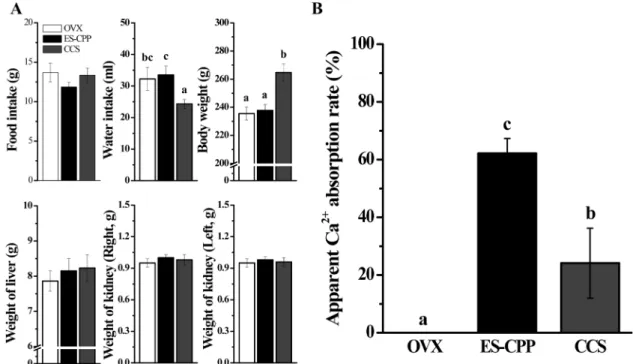
of osteoporosis, such as food and water intake, body weight, and the weight of liver and kidney were then analyzed from each group. Unexpectedly, we could not find any significant changes in food or water intake, or in body weight between the OVX group and the ES-CPP group, whereas the CCS treated group showed a reduced water intake and an increase in body weight (Figure 1A, upper panel). On the other hand, the weight of liver and kidney did not differ between groups (Figure 1A, lower panel). To further investigate the efficiency of ES-CPP on bioavailability, the apparent calcium absorption rate was determined from the calcium content of urine and feces by biochemical assay. Though OVX group was fed with a calcium free diet, some calcium excretion was shown. Importantly, the ES-CPP group (62.18±5.1%) showed a markedly enhanced calcium absorption rate, compared to the CCS group (24.11±12.1%) (Figure 1B).

Loss of calcium in femoral bone caused by OVX is partially restored by administration of ES-CPP, but not of CCS

Along with enhanced calcium absorptivity by co- treatment of ES with CPP, we also wished to determine

Figure 1. Administration of ES-CPP markedly enhances the apparent Ca

2+

absorption rate. Effects of ES-CPP on (A) the general

symptoms of OVX-mediated osteoporosis and (B) the apparent Ca

2+

absorption rate. The intake of food and water were calculated

by measuring the weight of ingested food and water in a day. The weight of body, liver, and kidney were each measured after 7

weeks of administrating ES-CPP and CCS. The apparent Ca

2+

absorption rate was calculated from the content of Ca

2+

in urine and

feces, as described in “Materials and Methods”. Each column represents the proportion of absorbed Ca

2+

in the body, from the

administration of ES-CPP and CSS. Data are means±SE.

a,b,c

Values in the row with different superscript letters are significantly

different, P<0.05. ES; eggshell, CPP; casein phosphopeptide, CCS; commercial calcium supplement.

(4)

whether absorbed calcium causes hypercalcemia or whether it is used in bone formation. It is well known that menostasis leads to estrogen deficiency, which, in turn, causes bone loss. Experimentally, the same symptoms are expected by removal of the ovaries, which sequentially induces estrogen deficiency, activating the osteoclast activities, accelerating the mineralization of calcium and phosphate from bone tissues, and causing an aberrant calcium increase in blood [15]. Thus, increased calcium in serum induces a decrease of parathyroid hormones, which worsens the severity of osteoporosis by reducing calcium absorption from the small intestine. To verify the possible use of ES-CPP on menopausal osteoporosis, we first prove whether ES- CPP induces hypercalcemia. We found that reduced calcium in serum by OVX (9.47±0.1 mg/dL) was rescued by both ES-CPP (9.64±0.1 mg/dL) and CCS (9.82±0.1 mg/dL) treatment, as sham group or more then. (Figure 2A). Notably, the increment of calcium content in serum was not as much as the apparent increment in the calcium absorption rate, suggesting a possibility that most absorbed calcium is accumulated within the bone. As we expected, ES-CPP administration increased the calcium content in femoral bone to 446.44±9.1 mg/kg. On the other hand, the CCS group showed a slight increase with no significance in comparison to the OVX group (Figure 2B).

Treatment of ES-CPP attenuates the severity of osteoporosis

Reduction of bone mass and bone density is known to cause frequent bone fractures, which is a primary and typical symptoms in osteoporosis patients. In order to estimate the effects of ES-CPP on the symptoms of ovariectomy-mediated osteoporosis, we analyzed the weight of femoral bone and bone mineral density. Reduced weight of femoral bone by OVX (740±10.4 mg) was restored to 808.57±7.9 and 794.28±16.1 mg, respectively, by ES-CPP and CCS administration (Figure 3A).

Interestingly, the administration of ES-CPP significantly improved bone mineral density to 82.83±0.8%, whereas the CCS group only showed a slight increase (74.67±

1.9%), with no significant increase in comparison to the OVX group (Figure 3B).

It has been known that osteocalcin, as a marker protein of bone turnover, is increased in postmenopausal women, which means that estrogen deficiency accelerates bone formation and resorption [16,17]. Accordingly, we measured the osteocalcin level in serum to determine the effects of ES-CPP on the bone turnover rate. As expected, increased osteocalcin in serum by OVX (37.28±2.1 ng/

mL) was markedly reduced by administration of ES- CPP (24.57±1.1 ng/mL) and CCS (30.71±1.5 ng/mL).

Notably, the ES-CPP group showed lower osteocalcin in serum than the CCS group (Figure 3C).

Figure 2. Loss of calcium from femoral bone is restored by ES-CPP administration, regardless of calcium content in serum. Effects

of ES-CPP on calcium content in (A) serum and (B) femoral bone. Calcium in serum and femoral bone was measured from isolated

blood and femoral bone from OVX rat, which was administrated with ES-CPP and CCS for 7 weeks after ovariectomy. Data are

mean±SE.

a,b,c

Values in the row with different superscript letters are significantly different, P<0.05. ES; eggshell, CPP; casein

phosphopeptide, CCS; commercial calcium supplement.

(5)

Discussion

OVX rat have been well established as an animal model for the induction of sex hormone disorders, and are widely used for the study of postmenopausal osteoporosis due to the similarity of symptoms [18]. As a result of hormonal disorders, OVX rat show significant defects in terms of bone maturation and regeneration [19]. These defects of the bone tissue result from estrogen deficiency which leads to an imbalance between osteoblasts and osteoclasts activities [20]. To estimate the efficiency of ES-CPP on the general symptoms of osteoporosis, we first examined how

effective co-treatment of ES with CPP is in enhancing the calcium absorption rate, and whether absorbed calcium from ES-CPP affects the symptoms of OVX- mediated osteoporosis.

Estrogen is known to regulate leptin secretion from the hypothalamus. Desensitization of leptin due to estrogen deficiency accelerates fat accumulation [21-23]. Taking all these factors into account, we decided to determine the effects of OVX surgery and its rescue by treatment of ES-CPP and CCS on dietary patterns. As a result, it appeared that the ES-CPP group had no difference in dietary pattern compared to the OVX group. Only the CCS group showed a reduced water intake and slight

Figure 3. Administration of ES-CPP attenuates the severity of osteoporosis. Effects of ES-CPP on (A) the weight of femoral bone,

(B) bone mineral density, and (C) osteocalcin in serum. Isolated femoral bone segments from OVX rat were weighed and then

immediately used to analyze bone mineral density using Micro-CT. Osteocalcin was analyzed from collected blood. Data are

means±SE.

a,b,c,d

Values in the row with different superscript letters are significantly different, P<0.05. ES; eggshell, CPP; casein

phosphopeptide, CCS; commercial calcium supplement.

(6)

weight gain (Figure 1A, upper panel). Moreover, we could not observe any significant changes in the weight of liver or kidney, which was not in line with our expectation that calcium uptake affects on the function of kidney and liver, due to disorders of bone metabolism (Figure 1A, lower panel). The OVX group showed some calcium excretion, despite the lack of calcium intake from the diet (data not shown), suggesting that OVX- mediated estrogen deficiency elevated calcium minerali- zation and let them release into blood. Notably, treatment of ES-CPP on OVX rat significantly enhanced the calcium absorption in the body, compared to that of CCS treatment (Figure 1B). This result clearly demonstrates that calcium derived from ES can be absorbed efficiently by co-treatment with CPP.

Absorbed calcium from the diet is transferred into the blood, and is used to maintain calcium homeostasis, which plays crucial role in diverse physiological responses, such as hormone secretion, differentiation, and proliferation [24]. In postmenopausal women, it has been known that estrogen deficiency induces an increase of parathyroid hormones, which result in stimulation of 1) osteoclastic activities, 2) calcium absorptivity from the small intestine, and 3) calcium re-absorption from renal tubules [25-27]. There are several case reports which indicate that excessive calcium intake or hormonal therapy for attenuation or prevention of osteoporosis can leads to hypercalcemia, which can cause various disorders by disruption of calcium homeostasis [28-31].

With this point in mind, we attempted to confirm whether absorbed calcium from ES-CPP induces hypercalcemia, or whether it is used for improving bone density. Both ES-CPP and CCS groups presented slight increases of calcium in serum, compared to the OVX group, but with no significant difference (Figure 2A).

Decreased calcium content in femoral bone observed for the OVX group was restored by treatment with ES-CPP (Figure 2B). Notably, treatment with CCS did not show any significant difference compared to that of the OVX group, suggesting that different proportion of absorbed calcium is used on the bone formation depending on its characteristics.

Consistent with previous data, ES-CPP treatment resulted in a rescue of decreased bone mass and bone mineral density, which are caused by OVX-mediated estrogen deficiency. Compared to the ES-CPP group, the CCS group only showed recovery of bone mass, whereas, bone mineral density was not restored by CCS

treatment (Figure 3A, 3B). Osteocalcin, which is known as a marker protein presenting the relations between bone formation and bone resorption, is released into the blood during bone maturation and mineralization [32].

As people grow older, accelerated bone turnover increases the level of osteocalcin in serum, through the inhibition of renal functions and increased parathyroid hormones [16,17]. Treating ES-CPP resulted in a significant reduction of the bone turnover rate, whereas CCS treatment only showed a tendency to decrease compared with the OVX group, with no significant difference between the two (Figure 3C). Bone density and bone mass are tightly correlated with the risk of bone fracture. Taken together, the present work shows that co-treatment of ES with CPP enhances the calcium absorptivity in the body, and thus, absorbed calcium attenuates the severity of postmenopausal osteoporosis by improving bone mass and density. Here, we strongly suggest consideration of the use of ES-CPP for the treatment of postmenopausal osteoporosis, as an alternative to calcium supplements.

References

1. Blair HC, Robinson LJ, Huang CL, Sun L, Friedman PA, Schlesinger PH, Zaidi M. Calcium and bone disease. Biofactors 2011; 37(3): 159-167.

2. Belchetz PE. Hormonal treatment of postmenopausal women. N Engl J Med 1994; 330(15): 1062-1071.

3. Mezquita Raya P, Muñoz Torres M, López Rodríguez F, Martínez Martín N, Conde Valero A, Ortego Centeno N, González Calvín J, Raya Alvarez E, Luna Jd Jde D, Escobar Jiménez F. [Prevalence of vitamin D deficiency in populations at risk for osteoporosis:

impact on bone integrity]. Med Clin (Barc) 2002; 119(3): 85-89.

4. Nelson ER, Wardell SE, McDonnell DP. The molecular mechanisms underlying the pharmacological actions of estrogens, SERMs and oxysterols: implications for the treatment and prevention of osteoporosis. Bone 2013; 53(1): 42-50.

5. Rossouw JE, Anderson GL, Prentice RL, LaCroix AZ, Kooperberg C, Stefanick ML, Jackson RD, Beresford SA, Howard BV, Johnson KC, Kotchen JM, Ockene J; Writing Group for the Women’s Health Initiative Investigators. Risks and benefits of estrogen plus progestin in healthy postmenopausal women:

principal results From the Women’s Health Initiative randomized controlled trial. JAMA 2002; 288(3): 321-333.

6. Johnston CC Jr, Slemenda CW. Diagnosis of osteoporosis. South Med J 1992; 85(8): 2S7-2S9.

7. Dawson-Hughes B. Vitamin D and calcium: recommended intake for bone health. Osteoporos Int 1998; 8(Suppl 2): S30- S34.

8. Cumming RG, Cummings SR, Nevitt MC, Scott J, Ensrud KE, Vogt TM, Fox K. Calcium intake and fracture risk: results from the study of osteoporotic fractures. Am J Epidemiol 1997;

145(10): 926-934.

9. Makai F. [The Decade of Bones and Joints 2000-2010.

Significance of the Decade of Bones and Joints for orthopedics and traumatology]. Acta Chir Orthop Traumatol Cech 2002;

69(6): 374-375.

10. Tavangar A, Tan B, Venkatakrishnan K. Synthesis of three-

(7)

dimensional calcium carbonate nanofibrous structure from eggshell using femtosecond laser ablation. J Nanobiotechnology 2011; 9: 1.

11. Rovenský J, Stancíková M, Masaryk P, Svík K, Istok R Eggshell calcium in the prevention and treatment of osteoporosis. Int J Clin Pharmacol Res 2003; 23(2-3): 83-92.

12. Mykkänen HM, Wasserman RH. Enhanced absorption of calcium by casein phosphopeptides in rachitic and normal chicks. J Nutr 1980; 110(11): 2141-2148.

13. Lee YS, Noguchi T, Naito H. Phosphopeptides and soluble calcium in the small intestine of rats given a casein diet. Br J Nutr 1980; 43(3): 457-467.

14. Lasota A, Danowska-Klonowska D. Experimental osteoporosis-- different methods of ovariectomy in female white rats. Rocz Akad Med Bialymst 2004; 49(Suppl 1): 129-131.

15. Vescini F, Grimaldi F. PTH 1-84: bone rebuilding as a target for the therapy of severe osteoporosis. Clin Cases Miner Bone Metab 2012; 9(1): 31-36.

16. Garnero P, Sornay-Rendu E, Chapuy MC, Delmas PD. Increased bone turnover in late postmenopausal women is a major determinant of osteoporosis. J Bone Miner Res 1996; 11(3): 337- 349.

17. Löfman O, Magnusson P, Toss G, Larsson L. Common biochemical markers of bone turnover predict future bone loss: a 5-year follow-up study. Clin Chim Acta 2005; 356(1-2): 67-75.

18. Cho P, Schneider GB, Krizan K, Keller JC. Examination of the bone-implant interface in experimentally induced osteoporotic bone. Implant Dent 2004 13(1): 79-87.

19. Ozawa S, Ogawa T, Iida K, Sukotjo C, Hasegawa H, Nishimura RD, Nishimura I. Ovariectomy hinders the early stage of bone- implant integration: histomorphometric, biomechanical, and molecular analyses. Bone 2002; 30(1): 137-143.

20. Augat P, Simon U, Liedert A, Claes L. Mechanics and mechano- biology of fracture healing in normal and osteoporotic bone.

Osteoporos Int 2005; 16(Suppl 2): S36-S43.

21. Li M, Wronski TJ. Response of femoral neck to estrogen depletion and parathyroid hormone in aged rats. Bone 1995;

16(5): 551-557.

22. Kramarova TV, Shabalina IG, Andersson U, Westerberg R, Carlberg I, Houstek J, Nedergaard J, Cannon B. Mitochondrial ATP synthase levels in brown adipose tissue are governed by the c-Fo subunit P1 isoform. FASEB J 2008; 22(1): 55-63.

23. Brown LM, Gent L, Davis K, Clegg DJ. Metabolic impact of sex hormones on obesity. Brain Res 2010; 1350: 77-85.

24. Berridge MJ, Bootman MD, Roderick HL. Calcium signalling:

dynamics, homeostasis and remodelling. Nat Rev Mol Cell Biol 2003; 4(7): 517-529.

25. Khosla S, Atkinson EJ, Melton LJ 3rd, Riggs BL. Effects of age and estrogen status on serum parathyroid hormone levels and biochemical markers of bone turnover in women: a population- based study. J Clin Endocrinol Metab 1997; 82(5): 1522-1527.

26. Mundy GR, Guise TA. Hormonal control of calcium homeostasis.

Clin Chem 1999; 45(8 Pt 2): 1347-1352.

27. Talmage RV, Mobley HT. Calcium homeostasis: reassessment of the actions of parathyroid hormone. Gen Comp Endocrinol 2008;

156(1): 1-8.

28. Waked A, Geara A, El-Imad B. Hypercalcemia, metabolic alkalosis and renal failure secondary to calcium bicarbonate intake for osteoporosis prevention--‘modern’ milk alkali syndrome: a case report. Cases J 2009; 2: 6188.

29. Ksiazek E, Majewski M, Borzecka H, Sikora P, Bieniaœ B, Zajaczkowska M. [Severe hypercalcemia as a complication of intensive treatment for osteoporosis due to steroid therpay in 17- year-old girl with the nephrotic syndrome]. Pol Merkur Lekarski 2008; 24(Suppl 4): 74-75.

30. Perez JB, Pazianos AG. Unusual presentation of primary hyperparathyroidism with osteoporosis, hypercalcemia, and normal parathyroid hormone level. South Med J 2001; 94(3): 339- 341.

31. GWINUP G. Hypercalcemia as a complication of vitamin D therapy in postmenopausal osteoporosis. J Clin Endocrinol Metab 1961; 21: 101-103.

32. Power MJ, Fottrell PF. Osteocalcin: diagnostic methods and

clinical applications. Crit Rev Clin Lab Sci 1991; 28(4): 287-335.

수치

Figure 1. Administration of ES-CPP markedly enhances the apparent Ca 2+  absorption rate
Figure 2. Loss of calcium from femoral bone is restored by ES-CPP administration, regardless of calcium content in serum
Figure 3. Administration of ES-CPP attenuates the severity of osteoporosis. Effects of ES-CPP on (A) the weight of femoral bone, (B) bone mineral density, and (C) osteocalcin in serum

참조

관련 문서

Approved clinical use of bone marrow stem cells for myocardial infarction treatment... Cardiac

Bone transplants, autogenous bones, allogenic bones, xenogenic bones, and synthetic bone substitutes have all been used as bone graft materials.. However,

Glucose level before use of mannitol and peak osmolarity during mannitol treatment were associated with renal failure in univariate analysis.. In logistic regression

This study aims to suggest a basic data for the activation of aromatherapy pimple treatment program with the pimple skin care and treatment by testing the actual

Bone mineral content (BMC) and bone mineral density (BMD) of the lumbar spine, total hip, and proximal femur were measured before and after exercise... Results : 1) Body

Clinical evaluation of the use of decalcified freeze-dried bone allograft with guided tissue regen- eration in the treatment of molar furca- tion invasions.. Wallace SC,

 Although van der Waals equation is still less accurate at high

In this study, two types of treatment methods, ozone treatment and combination of alkaline and ozone treatment, was used for character's variation and