33
비타민 K와 골 건강
임 상 동*․김 기 성 한국식품연구원
Vitamin K and Bone Health
Sang-Dong Lim* and Kee-Sung Kim Korea Food Research Institute, Seongnam 463-746, Korea
ABSTRACT
Vitamin K, which is a nutritional factor, play a role in the regulation of bone metabolism. Vitamin K exists naturally in 2 forms, namely, vitamin K1 (phylloquinone) in green plants and vitamin K2 (menaquinone) in animals and bacteria.
Vitamin K1 has an effect on bone metabolism. Vitamin K2 is essential for the γ-carboxylation of osteocalcin, a bone matrix protein containing γ-carboxyglutamic acid (Gla) which is synthesized in osteoblast of bone tissues. This paper is to provide the basic information of vitamin K by supplying function and biological activity of vitamin K together with vitamin K producing lactic acid bacteria and it's utilization for the dairy products production.
Keywords : vitamin K, bone health, lactic acid bacteria
* Corresponding author: Sang-Dong Lim, Korea Food Research Institute, Seongnam 463-746, Korea. Tel: +82-31-780-9082, Fax: +82-31-780-9160, E-mail: [email protected]
서 론
혈액 중에는 혈청100 mL 당 10 mg에 해당하는 극소량의 칼슘이 늘 일정한 농도로 용해되어 있다. 이러한 혈중 칼슘 의 항상성은 우리가 식사를 통해 섭취하는 칼슘과 소변, 대 변, 땀으로 배출하는 칼슘의 균형을 통해 유지된다. 그런데 칼슘의 섭취나 흡수가 부족해 혈중 칼슘농도가 떨어지게 되 면 우리 몸은 부갑상선 호르몬을 분비해 뼈에 있는 칼슘이 용출되어 혈중 칼슘의 항상성을 유지하게 된다.
일반적으로 중장년의 여성들은 폐경기에 즈음하여 난소 의 기능이 저하되면서 여성호르몬 에스트로겐의 분비가 급 격히 감소한다. 따라서 여성이 폐경기를 맞게 되면 뼈의 칼 슘 용출이 제대로 제어되지 않아 칼슘이 과도하게 용출된 다. 또한 나이가 들면 소화기능이 약해져 칼슘을 섭취해도 흡수가 제대로 되지 않아 더욱 뼈에서 칼슘 용출량이 급격 히 늘어나게 되어 결국 골다공증이 나타나게 되는 것이다.
유 및 유제품은 높은 칼슘 흡수 때문에 골 건강에 중요하 게 자리잡고 있다. 칼슘 이외에 염기성 유청단백질은 골보 호소재로서, Takada 등(1997)은 난소 절제 쥐에 급여한 결과 골 강도가 향상되었고, 더 높아진 골 강도는 콜라겐과 같은 골 단백질 증가와 관련이 있다고 하였다. 활성 염기성 유청 단백질은 골 흡수를 억제하는데, 염기성 우유단백질(MBP) 이라고 명명되고 있다. 임상시험에서 MBP는 성인 여성의 골밀도를 증가(Aoe et al., 2001)시키고, 성인 남성의 혈중 골 형성자로서 유의성 있는 효과(Toba et al., 2001)를 보였다.
유단백의 일부인 glycomacropeptide(GMP)는 칼슘이용성을 증가시켜 난소 절제 쥐에서 골 손실을 억제한다(Neeser et al., 2000). 단백질 및 일부 거대 단백질 외에 발효유제품은 골
건강에 유익한 효과를 갖는다. 유단백유래 펩타이드는 여러
젖산균에 의해 발효 중에 생성되는데, 아미노산 성분 및 서 열에 근거하여 호르몬과 같은 활성을 제공함으로써 생리적 기능을 조절할 수 있다(Fitzgerald와 Murray, 2006).
Caseinphosphopeptide(CPP)는 우유의 발효 또는 소화 중에 생성(Chabance et al., 1998)되는데, 소장에서의 칼슘염 침전을 방해함으로써 칼슘 흡수를 증가시킨다(Bennett et al., 2000). Narva
등(2004)은 Lactobacillus helveticus에 의해 발효된 유제품이 성 장하는 쥐에게 장기간 급여한 결과 골밀도 및 골 미네랄 함량 이 증가되었음을 입증하였으며, 국내에서는 Kim 등(2009)이 Lactobacillus casei 393으로 제조된 발효유가 난소 절제 쥐에 급여하였을 때 골 손실 예방 효과가 있다고 보고한 바 있다.
본 논문은 상기에 서술한 골 강화소재로MBP, GMP, CPP 외에 비타민 K의 효능과 비타민 K2 생산균에 대한 자료를 제시함으로써 유가공 연구에 기초자료를 제공하고자 한다.
본 론
1. 비타민 K의 자연계분포
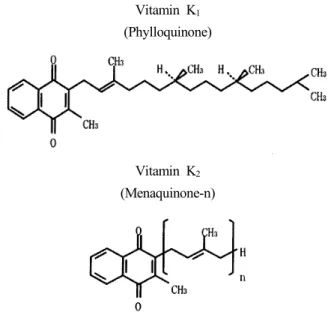
천연에서는 비타민K1(phylloquinone)과 비타민 K2(menaquinone- n)가 있는데, 비타민 K1은 식물에서는 녹황색 야채와 해조류 에 많이 함유되어 있으며, 비타민 K2는 주로 미생물에 의해 만들어지고isophenyl기 측쇄의 길이에 따라 동족체가 존재 하여 menaquinone(MK) 1-14로 분류된다(Shearer, 1990).
비타민K1은 녹차, 순무, 잎, 브로콜리, 양배추, 상추와 같 은 녹색잎이 무성한 채소에 많이 함유되어 있으며, 특히 비 타민K2는natto에 가장 많이 함유되어 있다(Table 1)(Shearer et al., 1996; Schurgers et al., 1999).
Table 1. Dietary sources of vitamin K (μg/100 g) Food source Vitamin K1 Vitamin K2
Meat 0.5~5 1~30
Fish 0.1~1 0.2~4
Fruit 0.1~3 -
Green vegetable 100~700 -
Grains 0.5~3 -
Natto 20~40 900~1,200
Cheese 0.5~10 40~90
Other milk products 0.5~15 0.2~50
Eggs 0.5~2.5 10~25
Margarin and plant oils 50~200 -
- : Not detected.
Table 2. Property of vitamin K
분류 Vitamin K1 Vitamin K2 Vitamin K3
Source 식물에 의해 합성 장내 미생물 총에 의해 합성 합성 유도체
효능 섭취 후 1일이면 소실 5일 이상 효능 발휘 Vitamin K2에 비해 2배 이상 활성
분포 상추, 시금치, 브로콜리, 녹차, 순무잎, 양배추 육류, 발효식품, Natto -
안전성 30 mg/day(허용상한 섭취량, 미국, 일본)
권장량 성인 남성 120μg/day, 여성 90μg/day
결핍증 신생아 출혈- 뇌출혈, 출혈 성향 증가
Vitamin K1
(Phylloquinone)
Vitamin K2
(Menaquinone-n)
Fig. 1. Chemical structure of vitamin K1 and K2 (Kaneki 등, 2006).
2. 비타민 K2 생산균 및 함량
Tani 등(1986)은 Flavobacterium meningosepticum mutant가 배양액L당 MK 함량이 34 mg이었고, 건조 cell g 당 5.5 mg 이었다고 하였다. Sato 등(2001)은 natto에서 분리한 B. subtillis MH-1와 diphenylamine 내성 돌연변이 균주인 D200-41을 10%
대두추출물, 5% glycerol, 0.5% yeast extract와 0.05% K2HPO4
(pH 7.3) 배지에 37℃에서 1일 교반 배양 후 45℃ 5일 정치 배양 했을 때 최대MK 함량이 60 mg/L이었다고 하였다. Tsukamoto 등(2002)은 비타민 K2(menaquinone-7)가 골단백인 osteocalcin 의 카르복실화에 중요한 역할을 하며, natto 제품이 다른 식품 에 비해 높은MK7을 함유하고 있다고 하였다. 이들은 B. subtiis mutant 균주로 생산된 Natto 제품의 MK7 함량이 1,719 μg/
100 g natto으로서 상업균주로 제조된 natto 제품에 비해 2배 더 높은 함량을 보였다고 하였다. Hojo 등(2007)은 propionibacteria 가 주요 menaquinone(비타민 K2)인 tetrahydromenaquinone-9 (MK-9 (4H)을 생산한다고 밝혔으며, propionibacteria로 발효 시킨 치즈 중Norwegian Jarlsberg 치즈와 에멘탈 치즈가 아
펜젤라 치즈나 그루웨어 치즈보다 MK-9 함량이 200~650 ng/g으로서 매우 높은 함량을 나타내었다고 하였다.
비타민K를 생산하는 젖산균에 관한 연구로는 Morishita 등 (1999)이 발표하였는데, Lactococcus lactis ssp. cremoris YIT 2001과 Leuconostoc lactis YIT 3001 균주가 환원탈지유나 두 유배지에 배양되었을 때menaquinone(비타민 K2) 함량이 29~
123 μg/L로 나타나, 유제품이나 기타 식품 발효용 스타터로 사 용될 수 있음을 시사하였다. 국내에서는 Lee 등(1998)이 항진균 성 항생물질을 생산하는Bacillus sp. LAM 97-44 균주가 Bacillus 속 세균의 전형적인isoprenoid 쇄가 7개인 menaquinone(MK-7) 을 가지고 있었음을 밝힌 바 있다.
3. 비타민 K2가 골 대사에 미치는 영향
비타민K는 혈액응고 인자 내에 glutamic acid를 카복실화 (carboxylation)시키고, 골 대사에 있어서 osteocalcin이라는 단 백질의 카복실화를 통하여 중요한 역할을 한다(Sadowski et al., 1993; Kohlmeier et al., 1996). 뼈에 존재하는 osteocalcin 은 일명bone Gla(γ-carboxyl glutamic acid) protein이라고 불
리우는 단백질로서 칼슘과 결합할 수 있는 Gla를 3개 포함
하고 있는데, 비타민 K가 칼슘이 결합할 수 있도록 보조인 자 역할을 한다(Vermeer, 1990; Hauschka et al., 1989). 비타
민K의 부족이나 결핍으로 인하여 카복실화가 되지 않은 오
스테오칼신(under carboxylated osteocalin)은 칼슘과 결합할 수 없으며, under-carboxylation 상태로 혈액 속으로 흘러나
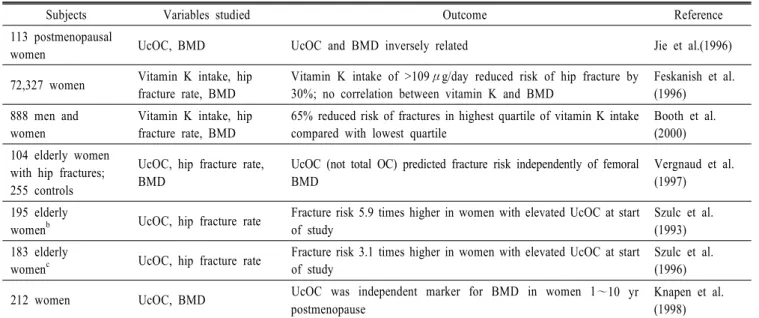
Table 3. Epidemiologic studies of vitamin K and bone healtha
Subjects Variables studied Outcome Reference
113 postmenopausal
women UcOC, BMD UcOC and BMD inversely related Jie et al.(1996)
72,327 women Vitamin K intake, hip fracture rate, BMD
Vitamin K intake of >109μg/day reduced risk of hip fracture by 30%; no correlation between vitamin K and BMD
Feskanish et al.
(1996) 888 men and
women
Vitamin K intake, hip fracture rate, BMD
65% reduced risk of fractures in highest quartile of vitamin K intake compared with lowest quartile
Booth et al.
(2000) 104 elderly women
with hip fractures;
255 controls
UcOC, hip fracture rate, BMD
UcOC (not total OC) predicted fracture risk independently of femoral BMD
Vergnaud et al.
(1997) 195 elderly
womenb UcOC, hip fracture rate Fracture risk 5.9 times higher in women with elevated UcOC at start of study
Szulc et al.
(1993) 183 elderly
womenc UcOC, hip fracture rate Fracture risk 3.1 times higher in women with elevated UcOC at start of study
Szulc et al.
(1996) 212 women UcOC, BMD UcOC was independent marker for BMD in women 1~10 yr
postmenopause
Knapen et al.
(1998)
a UcOC=undercarboxylated osteocalcin level, BMD=bone mineral density, OC=osteocalcin level.
b 18-month prospective study.
c Three-year follow-up study.
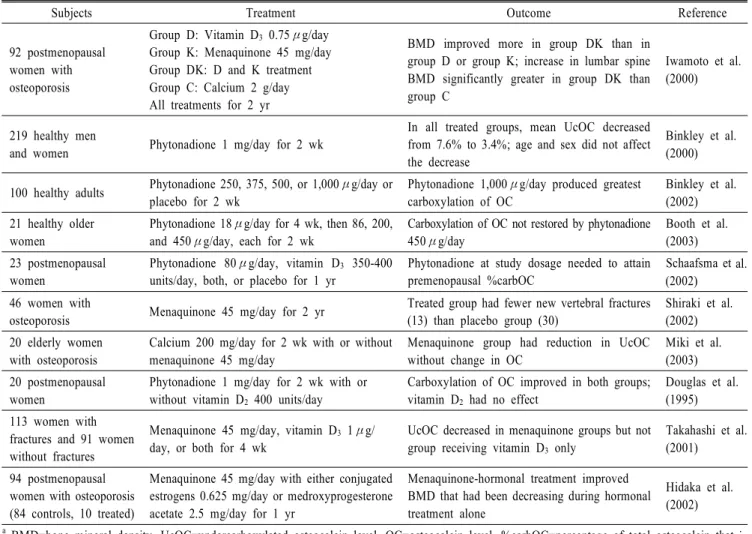
오게 된다(Merle과 Delmas, 1990). 따라서 혈액 중에 under carboxylated osteocalin의 증가는 비타민 K의 결핍과 관계되어 있음을 시사하였다(Price, 1988; Vermeer, 1990). 비타민 K와 골 건강에 관한 역학조사(Table 3)와 골에 미치는 영향(Table 4)에 대해 조사한 바에 따르면 비타민 K 결핍은 osteocalcin의 불활성화로 인해 골밀도의 감소를 일으키고 골절의 위험성 을 증가시키며, 비타민 K를 낮게 섭취하게 되면 엉덩이 골
절 위험성 증가와 밀접한 관계가 있다고 하였다.
비타민K2는 조골세포를 활성화하고, 뼈의 형성을 촉진하 는 역할을 하는데, 그 기전은 γ-carboxylase의 cofactor로써 osteocalcin의 glutamine acid residue를 γ-carboxyl glutamic acid 를 갖는 γ-carboxylated osteocalcin을 만들고, 이는 hydroxyapatite 와 결합하여 뼈의 석회화를 촉진한다(Hauschka et al., 1989;
Shearer, 1995). Szulc 등(1994)은 혈액의 under carboxylated osteocalin의 농도가 높은 그룹이 낮은 그룹에 비하여 골밀도가 낮은 것으로 보고하였다. 또한 Lambert 등(1986)과 Sadowski 등(1993)의 연구에서는 혈액내의 비타민 K 농도가 연령과 상관성이 있다고 보고하였다. 위와 같은 연구 결과는 비타
민K가 골밀도에 영향을 미치는 중요한 인자임을 시사하는
것이라고 할 수 있다.
비타민 K2는 osteocalcin의 Gla화 이외에도 골 조직에 직 접 작용하는 것으로 알려지고 있다. 비타민 K2 제제(성분은 비타민K2-4)는 골다공증의 골량 및 동통의 개선 약으로서 이미 이용되고 있어 골 작용을 가진 영양소로서 예방차원의 효
Table 4. Intervention Studies of Vitamin K’s Effect on Bone Variablesa
Subjects Treatment Outcome Reference
92 postmenopausal women with osteoporosis
Group D: Vitamin D3 0.75μg/day Group K: Menaquinone 45 mg/day Group DK: D and K treatment Group C: Calcium 2 g/day All treatments for 2 yr
BMD improved more in group DK than in group D or group K; increase in lumbar spine BMD significantly greater in group DK than group C
Iwamoto et al.
(2000)
219 healthy men
and women Phytonadione 1 mg/day for 2 wk
In all treated groups, mean UcOC decreased from 7.6% to 3.4%; age and sex did not affect the decrease
Binkley et al.
(2000)
100 healthy adults Phytonadione 250, 375, 500, or 1,000μg/day or placebo for 2 wk
Phytonadione 1,000μg/day produced greatest carboxylation of OC
Binkley et al.
(2002) 21 healthy older
women
Phytonadione 18μg/day for 4 wk, then 86, 200, and 450μg/day, each for 2 wk
Carboxylation of OC not restored by phytonadione 450μg/day
Booth et al.
(2003) 23 postmenopausal
women
Phytonadione 80μg/day, vitamin D3 350-400 units/day, both, or placebo for 1 yr
Phytonadione at study dosage needed to attain premenopausal %carbOC
Schaafsma et al.
(2002) 46 women with
osteoporosis Menaquinone 45 mg/day for 2 yr Treated group had fewer new vertebral fractures (13) than placebo group (30)
Shiraki et al.
(2002) 20 elderly women
with osteoporosis
Calcium 200 mg/day for 2 wk with or without menaquinone 45 mg/day
Menaquinone group had reduction in UcOC without change in OC
Miki et al.
(2003) 20 postmenopausal
women
Phytonadione 1 mg/day for 2 wk with or without vitamin D2 400 units/day
Carboxylation of OC improved in both groups;
vitamin D2 had no effect
Douglas et al.
(1995) 113 women with
fractures and 91 women without fractures
Menaquinone 45 mg/day, vitamin D3 1μg/
day, or both for 4 wk
UcOC decreased in menaquinone groups but not group receiving vitamin D3 only
Takahashi et al.
(2001) 94 postmenopausal
women with osteoporosis (84 controls, 10 treated)
Menaquinone 45 mg/day with either conjugated estrogens 0.625 mg/day or medroxyprogesterone acetate 2.5 mg/day for 1 yr
Menaquinone-hormonal treatment improved BMD that had been decreasing during hormonal treatment alone
Hidaka et al.
(2002)
a BMD=bone mineral density, UcOC=undercarboxylated osteocalcin level, OC=osteocalcin level, %carbOC=percentage of total osteocalcin that is carboxylated.
과도 기대할 수 있다. 효과면에서 현재 효능의약품 용도로 사 용하고 있는 menaquinone-4(MK-4)와 비교하여 menaquinone-7 (MK-7)에도 비슷한 효과가 있는 것으로 알려져 있는데, In vitro 실험계에서는 MK-4가 가장 활성이 높았지만 in vivo에
서는 MK-7과 활성이 비슷한 것으로 보고되고 있다.
또한, 대퇴골 골석 환자와 퇴행성 골다공증 환자는 정상 인에 비해 혈액 중의MK-7 농도가 저하되어 있다는 연구보 고가 유럽과 일본에서 발표되고 있다. 최근 일본에서 골다 공증 환자17명을 대상으로 임상시험연구에서 비타민 K2를 1일 45 mg 28일간 복용한 결과, 비타민 K에 의해 불활성형 osteocalcin이 현저하게 저하되는 연구결과도 있었다. Kaneki 등(2001)은 natto를 주로 섭취하는 동경지역 일본 폐경기 여 성, 거의 섭취하지 않는 히로시마지역 일본 폐경기 여성, 영 국에 사는 영국 폐경기 여성을 대상으로 임상실험 결과, 혈청 MK-7 농도가 5.26±6.13 ng/mL, 1.22±1.85 ng/mL와 0.37±0.2 ng/mL으로 나타나, natto 섭취가 혈청 MK-7의 함량을 유의
하게 증가시키며, 대퇴부 골절의 위험을 줄인다고 하였다.
또한Tsukamoto 등(2001)은 지원자 48명을 대상으로 3개의 MK-7(865, 1295, 1,730 μg/100 g) 함량이 함유된 natto(50 g) 를3 그룹으로 나누어 1일 1회 14일간 섭취하게 한 후 혈청 MK-7을 측정한 결과, natto를 섭취하지 않은 정상인은 발견 되지 않았고, 1,295 μg이나 1,730 μg MK-7/100 g 함유하는 natto를 섭취한 그룹은 혈청 MK-7과 감마 카르복실화된 osteocalcin 농도가 증가하였다고 하였다. Natto 내의 MK-7 섭취는osteocalcin의 감마 카르복실화를 자극함으로써 골 형 성에 중요한 역할을 한다고 결론지었다. 역학적으로는 골다 공증 환자의 혈중 비타민K 농도가 정상인보다 낮으며, Gla 화 되지 않은 osteocalcin의 혈청농도가 높은 고령자의 경우, 골다공증에 걸릴 위험이 높다고 알려져 있다. 또한 natto 소 비량과 여성의 대퇴골 분석에 의한 상관관계가 있다는 것이 알려지면서 비타민K2, 특히 MK-7의 혈중농도에 차이가 있
다는 것이 밝혀져서MK-7과 골다공증 예방에 관여한다는
것이 알려졌다. 이와 같이 비타민 K2는 골형성의 촉진과 골
흡수 억제 2가지 작용에 의해 칼슘대사를 정상적으로 조절
하는 물질로 알려져 있으며, 이외에도 장관으로부터 칼슘의 흡수를 촉진하는 새로운 작용도 보고되고 있다.
국내에서는Pack 등(2004)의 연구에서 신장 이식 후 발생 한 골다공증 치료에 있어서 비타민 K2 치료는 대퇴부에 발 생한 골다공증에 효과적이며, 그 효과 정도는 기존 치료 비 타민D3와 칼슘제재의 병합 투여 효과와 비슷한 정도가 있 다고 보고되었고, Huh 등(2005)은 폐경기 여성에서의 비타 민 K2 단독 투여시 골형성 표지자가 호르몬제 병용 투여보 다 통계적으로 유의하게 효과가 있다고 발표하였다. 이는
비타민 K2가 연질캅셀에 의한 골형성 표지자의 상승이 호
르몬에 의한 골형성 표지자의 저하를 충분히 상쇄시킬 수 있음을 입증한 결과이다.
4. 골다공증 치료 시장
국민건강보험공단 건강보험정책연구원이2005년부터 2009 년까지 건강보험 진료비를 분석(Table 5)한 바에 따르면 ‘골 다공증질환’의 건강보험 진료 환자가 2005년 45만 명에서 2009 년 74만 명으로 나타나 최근 4년 간 연평균 13%씩 증가하고 있는 것으로 나타났다. 여성이 남성보다 13.1배 많았으나, 남 자 환자는 4년 간 2배 이상 증가하는 추세다.
골다공증 치료 분야의 세계시장은2007년 92억 달러이며, 주요7개 국가(미국, 일본, 5 EU)의 시장 규모는 76억 달러 로서, '09년 매출 규모는 미국 36억 달러, 일본 14억 달러, 5 EU 18억 달러 순이었다.
국내 골다공증 치료제 시장은2007년 기준 1,300억 원의 시 장을 형성하고 있으며, 향후 3년간 연평균 34% 성장 증가 추세에 있다. 골다공증의 약물요법으로는 L-Ca-Asparaginate, Ca-Gluconate, Ca-Lactase 등 뼈에 칼슘을 보충해 주는 칼슘제 제, 노인의 골다공증에 유효한 Calcitol, Calcitriol 같은 vitamin D 제제, 호르몬 보충요법인 Estrogen 제제, 뼈에 칼슘을 운반 하는 호르몬인Calcitonin의 칼시토닌제제, Ipriflavone 유도체
등이 있으며 세계적으로MSD의 포사맥스(비호르몬성 골다
공증 치료제로Bisphosphonte 제제)와 릴리의 에비스타가 최 근 가장 많이 쓰이는 약물이다. 그러나 이러한 약물들은 부
Table 5. Shift of patient with osteoporosis (단위: 명)
구분 2005년 2006년 2007년 2008년 2009년
계 454,472 528,504 608,726 666,852 740,011
여자(A) 428,981 497,091 570,585 622,426 687,524
남자(B) 25,491 31,413 38,141 44,426 52,487
성비(A/B) 16.8 15.8 15.0 14.0 13.1
출처: 국민건강보험공단
수적으로 부작용이 동반됨으로 대체제로서 젖산균 및 이를 이용한 제품이 질병 예방의 대안이 될 수 있으리라 예상된다. 따라서 비타민K2를 생산하는 젖산균으로 발효유나 치즈 를 생산하게 되면 골다공증을 예방하고 더 나아가 약물 복 용의 대체제로서 이용가능성이 높다고 하겠다.
결 론
골다공증은 급격히 고령화 사회로 변화하고 있는 국내 여 건상 향후 가장 심각한 질환 중 한가지로 대두될 것이 분명하 다. 암이나 뇌혈관성 질환처럼 생명을 위태롭게 하는 경우는 적지만 노령의 삶의 질을 크게 저하시킬 우려가 많다. 비타민 K는 칼슘의 골 흡착을 조절하는데 관여하는 것으로 알려져 있으며, 혈중 비타민 K의 부족이 골다공증 유발의 원인 중 하 나라고 알려져 있다. 또한 비타민 K는 비타민 K 의존성 단백 질의 글루타민산 잔기가carboxynase에 의해 carboxyglutamin산 잔기로 전환되는데 있어서 조효소로 작용한다.
혈액응고 인자인 prothrombin, Factor VII, X와 항 응고인 자인protein C, S가 Gla를 함유한 비타민 K 의존성단백질로 서 정상적인 혈액 응고에 필수적인 인자로도 작용한다. 비타 민K2는 골형성 촉진과 골흡수 억제2가지 작용에 의해 칼 슘대사를 정상적으로 조절하는 물질로 알려져 있으며, 이외 에도 장관으로부터 칼슘의 흡수를 촉진하는 새로운 작용도 보고되고 있다, 현대 의학에 있어서 약물의 중독 및 내성 문 제, 그리고 그 외 2차적인 부작용은 해결해야할 과제로 남 아있다. 이를 해결하기 위한 한 방안으로 천연소재의 활용 이 적극 검토되고 있으며, 비타민 K는 이러한 차세대 의약 품인 동시에 건강기능 식품 소재로 매우 시장성이 큰 물질 이라 할 수 있다. 비타민 K2를 생성하는 젖산균을 이용한 발 효유 및 치즈 등이 앞으로 개발 가능할 것으로 보이며, 이에 대한 연구가 많이 이루어질 것으로 기대된다.
참고문헌
1. Aoe, S., Toba, Y., Yamamura, J., Kawakami, H., Yahiro, M.
and Kumegawa, M. 2001. Controlled trial of the effects of
milk basic protein (MBP) supplementation on bone metabolism in healthy adult women. Biosci. Biotechnol. Biochem. 65:913-918.
2. Bennett, T., Desmond, A., Harrington, M., McDonagh, D., FitzGerald, R. and Flynn, A. 2000. The effect of high intakes of casein phosphopeptide on calcium absorption in the rat.
Br. J. Nutr. 83:673-680.
3. Binkley, N. C., Krueger, D. C. and Engelke, J. A. 2000.
Vitamin K supplementation reduces serum concentrations of undergamma-carboxylated osteocalcin in healthy young and elderly adults. Am. J. Clin. Nutr. 72:1523-1528.
4. Binkley, N. C., Krueger, D. C. and Kawahara, T. N. 2002.
A high phylloquinone intake is required to achieve maxi- mal osteocalcin gamma-carboxylation. Am. J. Clin. Nutr.
76:1055-1060.
5. Booth, S. L., Tucker, K. L. and Chen, H. 2000. Dietary vitamin K intakes are associated with hip fracture but not with bone mineral density in elderly men and women. Am.
J. Clin. Nutr. 71:1201-1208.
6. Booth, S. L., Martini, L. and Peterson, J. W. 2003. Dietary phylloquinone depletion and repletion in older women. J.
Nutr. 133:2565-2569.
7. Chabance, B., Marteau, P., Rambaud, J. C., Migliore-Samour, D., Boynard, M. and Perrotin, P. 1998. Casein peptide release and passage to the blood in humans during digestion of milk or yogurt. Biochimie. 80:155-165.
8. Douglas, A. S., Robins, S. P. and Hutchison, J. D. 1995. Carboxy- lation of osteocalcin in postmenopausal osteoporotic women following vitamin K and D supplementation. Bone. 17:15-20.
9. Feskanish, D., Weber, P. and Willett, W. C. 1999. Vitamin K intake and hip fractures in women: a prospective study.
Am. J. Clin. Nutr. 69:74-79.
10. Fitzgerald, R. J. and Murray, B. A. 2006. Bioactive peptides and lactic fermentations. Int. J. Dairy Tech. 59:118-125.
11. Hauschka, P., Lian, J. B., Cole, D. E. C. and Gundberg, C. M.
1989. Osteocalcin and matrix Gla protein: Vitamin K-dependent proteins in bone. Physiological Reviews 69(3):990-1047.
12. Hidaka, T., Hasegawa, T. and Fujimura, M. 2002. Treatment for patients with postmenopausal osteoporosis who have been placed on HRT and show a decrease in bone mineral density: effects of concomitant administration of vitamin K2. J. Bone Miner. Metab. 20:235-239.
13. Hojo, K., Watanabe, R., Mori, T. and Taketomo, N. 2007.
Quantitative measurement of tetrahydromenaquinone-9 in cheese fermented by propionibacteria. J. Dairy Sci. 90:4078-4083.
14. Huh, M., Mun, Y. J., Lim, H. S., Jo, H. H., Kim, M. A., Kim, E. J., Kim, J. H. and Kim, J. H. 2005 The effects of vitamin K2 (Glakay) and vitamin K2 plus hormone replacement theraphy on bone mineral density and bone metabolism in postmenopausal women. J. Korean Menopause 11:206-212.
15. Iwamoto, J., Takeda, T. and Ichimura, S. 2000. Effect of combined administration of vitamin D3 and vitamin K2 on bone mineral density of the lumbar spine in postmenopausal women with osteoporosis. J. Orthop. Sci. 5:546-551.
16. Jie, K. S., Bots, M. L. and Vermeer, C. 1996. Vitamin K status and bone mass in women with and without aortic atherosclerosis: a population-based study. Calcif. Tissue Int.
59:352-356.
17. Kaneki, M., Hodges, S. J., Hosoi, T., Fujiwara, S., Lyons, A., Crean, S. J., Ishida, N., Nakagawa, M., Takechi, M., Sano, Y., Mizuno, Y., Hoshino, S., Miyao, M., Inoue, S., Horiki, K., Shiraki, M., Ouchi, Y. and Orimo, H. 2001.
Japanese fermented soybean food as the major determinant of the large geographic difference in circulating levels of vitamin K2: possible implications for hip-fracture risk. Nutrition 17(4):315-321.
18. Kaneki, M., Hosoi, T., Ouchi, Y. and Orimo, H. 2006.
Pleiotropic actions of vitamin K: protector of bone health and beyond. Nutrition 22(7):845-852.
19. Kim, J. G., Lee, E. S, Kim, S. H., Whang, K. Y., Oh, S.
J. and Imm, J. Y. 2009. Effects of a Lactobacillus casei 393 fermented milk product on bone metabolism in ovariectomised rats. Int. Dairy J. 19:690-695.
20. Knapen, M. H., Nieuwenhuijzen Kruseman, A. C. and Wouters, R. S. 1998. Correlation of serum osteocalcin fractions with bone mineral density in women during the first 10 years after menopause. Calcif. Tissue Int. 63:375-379.
21. Kohlmeier, H., Salomon, A., Saupe, J. and Shearer, M. J. 1996.
Transport of vitamin K to bone in humans. J. Nutr. 126:
1192S-1196S.
22. Lambert, W. E., De Leenheer, A. P. and Baert, E. J. 1986.
Wet-chemical postcolumn reaction and fluorescence detection analysis of the reference interval of endogenous serum vitamin K. Anal. Biochem. 158:257-261.
23. Lee, N. W., Kim, C. S., Do, J. H., Jung, I. C., Lee, H. W.
and Yi, D. H. 1998. Isolation and identification of Bacillus sp. Lam 97-44 producing antifungal antibiotics. Agri. Chem.
and Biotechnol. 41(3):208-212.
24. Merle, B. and Delmas, P. D. 1990. Normal caboxylation of
circulating osteocalcin (bone Gla-protein) in Paget's disease of bone. Bone Miner. 11:237-245.
25. Miki, T., Nakatsuka, K. and Naka, H. 2003. Vitamin K2
(menaquinone 4) reduces serum undercarboxylated osteocalcin level as early as 2 weeks in elderly women with established osteoporosis. J. Bone Miner. Metab. 21:161-165.
26. Morishita, T., Tamura, N., Makino, T. and Kudo, S. 1999.
Production of manaquinones by lactic acid bacteria. J. Dairy Sci. 82:1897-1903.
27. Narva, M., Hallen, J., Vaananen, K. and Korpela, R. 2004.
Effects of Lactobacillus helveticus fermented milk on bone cells in vitro. Life Sci. 75:1725-1734.
28. Neeser, J. R., Offord Cavin, E., Felix, R., Tullberg-Reinert, H., Ginty, F. and Barclay, D. 2000. Milk protein hydrolysate for addressing a bone or dental disorder. Int. Patent. WO 0049885.
29. Pack, J. A., Sin, M. T., Joen, Y. J., Woo, S. Y., Yoon, J.
M., Choi, B. S., Yang, C. W., Kim, Y. S., Kim, S. Y., Chang, Y. S. and Bang, B. K. 2004. The therapeutic effect of menatertrenone (vitamin K2) on posttransplant osteoporosis in real transplant recipient. Korean J. Nephrol. 23(6):934-941.
30. Price, P. A. 1988. Role of vitamin K-dependent proteins in bone metabolism. Annu. Rey. Nutr. 8:565-583.
31. Sadowski, J. A., Hood, S. J., Dallal, G. E. and Garry, P.
J. 1993. Phylloquinone in plasma from elderly and young adults: Factors influencing its concentration. Am. J. Clin.
Nutr. 50:100-108.
32. Sato, T., Yamada, Y., Ohtani, Y., Mitsui, N., Murasawa, H.
and Araki, S. 2001. Production of menaquinone (vitamin K2)-7 by Bacillus subtilis. J. Biosci. Bioeng. 91(1):16-20.
33. Schaafsma, A., Muskiet, F. A. and Storm, H. 2000. Vitamin D3 and vitamin K1 supplementation of Dutch ostmenopausal women with normal and low bone mineral densities: effects on serum 25-hydroxyvitamin D and carboxylated osteocalcin.
Eur. J. Clin. Nutr. 54:626-631.
34. Schurgers, L. J., Geleijnse, J. M., Grobbee, D. E., Pols, H.
A., Hofman, P. A., Witteman, J. C. M. and Vermeer, C.
1999. Nutritional intake of vitamin K1 (phylloquinone) and K2 (menaquinone) in the Netherlands. J. Nutr. Environ Med.
9(2):115-122.
35. Shearer, M. J. 1990. Vitamin K and vitamin K-dependent proteins. Br. J. Haematol. 75:156-162.
36. Shearer, M. J. 1995. Vitamin K. Lancet. 345:229-234.
37. Shearer, M. J., Bach, A. and Kohlmeyer, M. 1996. Chemistry, nutritional sources, tissue distribution and metabolism of
vitamin K with special reference to bone health. J. Nutr.
126:1181S-1186S.
38. Shiraki, M., Shiraki, Y. and Aoki, C. 2000. Vitamin K2
(menatetrenone) effectively prevents fractures and sustains lumbar bone mineral density in osteoporosis. J. Bone Miner.
Res. 15:515-521.
39. Szulc, O., Arlot, M., Chapuy, M. C., Duboeuf, F., Meunier, P. J. and Delmas, P. D. 1994. Serum undercarboxylated ostecalcin correlates with hip bone mineral density in elderly women.
J. Bone Miner. Res. 9(10):1591-1595.
40. Szulc, P., Chapuy, M. C. and Meunier, P. J. 1993. Serum undercarboxylated osteocalcin is a marker of the risk of hip fracture in elderly women. J. Clin. Invest. 91:1769-1774.
41. Szulc, P., Chapuy, M. C. and Meunier, P. J. 1996. Serum undercarboxylated osteocalcin is a marker of the risk of hip fracture: a three year follow-up study. Bone 18:487-488.
42. Takada, Y., Kobayashi, N., Matsuyama, H., Kato, K., Yamamura, J. and Yahiro, M. 1997. Whey protein suppresses the osteoclast- mediated bone resorption and osteoclast cell formation. Int.
Dairy J. 7:821-825.
43. Takahashi, M., Naitou, K. and Ohishi, T. 2001. Effect of vitamin K and/or D on undercarboxylated and intact osteocalcin in osteoporotic patients with vertebral or hip fractures. Clin.
Endocrinol. 54:219-224.
44. Tani, Y., Asahi, S. and Yamada, H. 1986. Menaquinone (vitamin K2)-6 production by mutants of Flavobacterium meningosepticum. J. Nutr. Sci. Vitaminol. 32(2):137-145.
45. Toba, Y., Takada, Y., Matsuoka, Y., Morita, Y., Motouri, M. and Hirai, T. 2001. Milk basic protein promotes bone formation and suppresses bone resorption in healthy adult men. Biosci. Biotechnol. Biochem. 65:1353-1357.
46. Tsukamoto, Y., Kasai, M. and Kakuda, H. 2001. Construction of a Bacillus subtilis (Natto) with high productivity of vitamin K2 (menaquinone-7) by analog resistance. Biosci.
Biotechnol. Biochem. 65(9):2007-2015.
47. Vergnaud, P., Garnero, P. and Meunier, P. J. 1997. Under- carboxylated osteocalcin measured with a specific immunoassay predicts hip fracture in elderly women: the EPIDOS study.
J. Clin. Endocrinol. Metab. 82:719-724.
48. Vermeer, C. 1990. Review article: γ-carboxyglutamate-con- taining proteins and the vitamin K-dependent carboxylase.
Biochem. J. 266:625-636.
(Received 2011.6.9/Revised 2011.6.23/Accepted 2011.6.24)