• 검색 결과가 없습니다.

Melatonin Induces Apoptotic Cell Death via p53 in LNCaP Cells

N/A
N/A
Protected

Academic year: 2022

Share "Melatonin Induces Apoptotic Cell Death via p53 in LNCaP Cells"

Copied!
5
0
0

로드 중.... (전체 텍스트 보기)

전체 글

(1)

365 DOI: 10.4196/kjpp.2010.14.6.365

ABBREVIATIONS: PARP, poly(ADP-ribose) polymerase; MARK, mitogen-activated protein kinase; ERK, extracellular signal-re- gulated kinase; JNK, c-JUN N-terminal kinase.

Received September 3, 2010, Revised October 14, 2010, Accepted November 22, 2010

Corresponding to: Yeong-Min Yoo, Department of Biomedical Engineering, College of Health Science, Yonsei University, 234, Maeji-ri, Heungeop-myeon, Wonju 220-710, Korea. (Tel) 82-33-760- 2898, (Fax) 82-33-760-2898, (E-mail) [email protected]

Melatonin Induces Apoptotic Cell Death via p53 in LNCaP Cells

Chi Hyun Kim, and Yeong-Min Yoo

Department of Biomedical Engineering, College of Health Science, Yonsei University, Wonju 220-710, Korea

In this study, we examined whether melatonin promotes apoptotic cell death via p53 in prostate LNCaP cells. Melatonin treatment significantly curtailed the growth of LNCaP cells in a dose- and time-dependent manner. Melatonin treatment (0 to 3 mM) induced the fragmentation of poly(ADP- ribose) polymerase (PARP) and activation of caspase-3, caspase-8, and caspase-9. Moreover, melatonin markedly activated Bax expression and decreased Bcl-2 expression in dose increments. To investigate p53 and p21 expression, LNCaP cells were treated with 0 to 3 mM melatonin. Melatonin increased the expressions of p53, p21, and p27. Treatment with mitogen-activated protein kinase (MAPK) inhibitors, PD98059 (ERK inhibitor), SP600125 (JNK inhibitor) and SB202190 (p38 inhibitor), con- firmed that the melatonin-induced apoptosis was p21-dependent, but ERK-independent. W ith the co-treatment of PD98059 and melatonin, the expression of p-p53, p21, and MDM2 did not decrease.

These effects were opposite to the expression of p-p53, p21, and MDM2 observed with SP600125 and SB202190 treatments. Together, these results suggest that p53-dependent induction of JNK/p38 MAPK directly participates in apoptosis induced by melatonin.

Key Words: Melatonin, p53, p38, JNK, LNCaP cells

INTRODUCTION

 Apoptotic cell death in androgen-sensitive LNCaP pros- tate cancer cells is mediated by p53. The combination of metformin and 2-deoxyglucose induces p53-dependent apoptosis in LNCaP cells [1]. Emodin, 1,2,8-trihydroxy-6- methylanthraquinone, is an active component contained in the root and rhizome of Rheum palmatum L. (Polygona- ceae). Wogonin is one of the primary active compounds of Scutellaria baicalensis, and decreases prostate cancer cells in a p53-dependent mechanism [2,3]. The MDM2 antago- nist Nutlin-3 specifically inhibits proliferation of LNCaP cells through cell cycle arrest and apoptosis by increasing levels of p53-responsive p21 and MDM2 expressions, dem- onstrating that MDM2 antagonists retain functional p53 and androgen receptor signaling in human prostate cancers [4].

 Melatonin, a circadian indoleamine hormone secreted by the human pineal gland, is able to directly induced cell death of several types of human tumor cells [1-9]. Many recent reports have shown that melatonin inhibits the growth of androgen-sensitive human LNCaP prostate can- cer cells [9-12]. In our previous report, we demonstrated that melatonin is able to induce apoptotic cell death in LNCaP cells via the p38 and c-JUN N-terminal kinase (JNK) pathways [13]. Here, we determined whether melato-

nin induced apoptosis via signaling mediated by p53 in LNCaP cells.

METHODS Cell culture

 LNCaP cells, an androgen-sensitive human prostate ad- enocarcinoma cell line, were cultured in Dulbecco's modified Eagle's medium (DMEM, GibcoBRL, Gaithersburg, MD, USA) supplemented with 10% heat-inactivated fetal bovine serum (FBS, GibcoBRL) at 37

o

C with 5% CO

2

in a humidi- fied incubator.

Treatment

 Cells in exponential growth were plated at a density of

1×10

6

cells/100 mm dish (Corning, Corning, NY, USA) and

cultured in 5% FBS DMEM medium. Melatonin (Sigma, St

Louis, MO, USA) was dissolved in dimethyl sulphoxide

(DMSO), and cells were treated with varying doses of mela-

tonin (0 to 3 mM) for 0 to 48 hr. In experiments to de-

termine the effects of MAPK inhibitors (PD98059,

SP600125 and SB202190 all from Calbiochem, San Diego,

CA, USA) on cell growth inhibition, cytotoxicity and apopto-

sis, cells were treated with the kinase inhibitors for 1 hr

and then co-exposed to melatonin for varying time points.

(2)

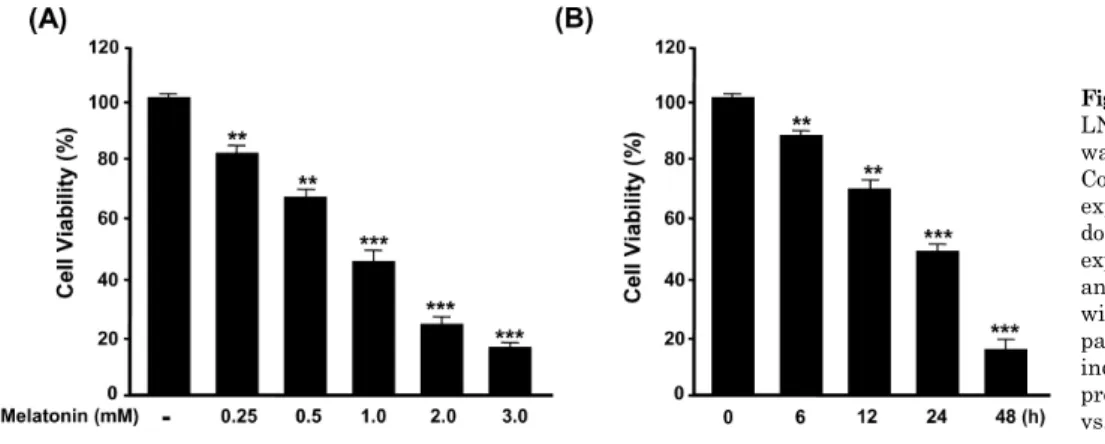
Fig. 1. Viability of melatonin-treated LNCaP cells. LNCaP cell viability was determined using the Cell Counting Kit-8 assay (A) 48 hr after exposure to melatonin at varying doses and (B) at varying times after exposure to 3 mM melatonin. In (A) and (B), results for cells not treated with melatonin are shown for com- parison. Results are the means of 3 independent experiments (bars re- present SD). **p<0.01, ***p<0.001 vs. control.

 Cell survival was determined using the Cell Counting Kit-8 (CCK-8) (Dojindo, Tokyo, Japan). Briefly, LNCaP cells were cultured in a 96-well plate (Corning Inc.) at a density of 5×10

3

cells per well, with or without dissolved melatonin.

After 48 hr, the cells were washed and treated with CCK-8 solution, and the plate was incubated in the dark for an additional 4 hr. The absorbance at 450 nm was read using a microtiter plate reader (Molecular Device, Sunnyvale, CA). Percent viability was calculated as follows: (absor- bance of melatonin-treated cells/absorbance of control cells)

×100.

Western blot analysis

  Cells were harvested, washed two times with ice-cold PBS, and then suspended in 20 mM Tris-HCl buffer (pH 7.4) con- taining protease inhibitors (0.1 mM phenylmethylsulfonyl fluoride, 5μg/ml aprotinin, 5μg/ml pepstatin A, and 1μ g/ml chymostatin) and phosphatase inhibitors (5 mM Na

3

VO

4

, 5 mM NaF). Whole cell lysate was prepared using 20 strokes of a Dounce homogenizer, followed by cen- trifugation at 13,000× g for 20 min at 4

o

C. Protein concen- tration was determined using the BCA assay (Sigma).

Proteins (50μg) were separated by 12% sodium dodecyl sul- fate-polyacrylamide gel electrophoresis (SDS-PAGE) and then transferred onto a polyvinylidene difluoride (PVDF) membrane. The membrane was incubated with antibodies directed against the following proteins, as indicated: PARP (1:1,000 dilution) (Cell Signaling Technology, Beverly, MA, USA); caspase-3, -8, and -9 (1:1,000) (Cell Signaling Technology); Bax (1:500) and Bcl-2 (1:500) (Santa Cruz Biotechnology, Santa Cruz, CA, USA); p53 (1:1,000), p21 (1:1,000), and p27 (1:1,000) (Cell Signaling Technology);

phospho-p53 (serine 15) (1:500) and MDM2 (1:500) (Santa Cruz Biotechnology); and GAPDH (1:1,000) (Assay Designs, MI, USA). Immunoreactive proteins were vi- sualized by exposure to X-ray film. The protein bands were shown by image-scanning.

Statistical analysis

 Significant differences were determined by ANOVA, fol- lowed by Tukey’s test for multiple comparisons. Analysis was performed with Prism Graph Pad v4.0 (Graph Pad Software Inc., San Diego, CA, USA). Values are expressed

RESULTS

Melatonin significantly decreases cell survival depend- ent on dose and time in LNCaP prostate cancer cells  To evaluate any anti-proliferative effects of melatonin on human LNCaP prostate cancer cells, the number of viable cells in culture was examined after a 48 hr melatonin treat- ment (0 to 3 mM) (Fig. 1A). The time dependence on cell viability was examined for 48 hr using 3 mM melatonin (Fig. 1B). Cell viability (%) was significantly decreased in both dose- and time-dependent manners (Fig. 1). Doses of melatonin greater than 1 mM decreased cell growth by more than 50% after 48 hr in culture; the lowest cell via- bility was observed at 48 hr (≅16.2%). The marked de- crease of cell viability by 3 mM melatonin beyond 48 hr of treatment most likely reflected the induction of cell death by melatonin.

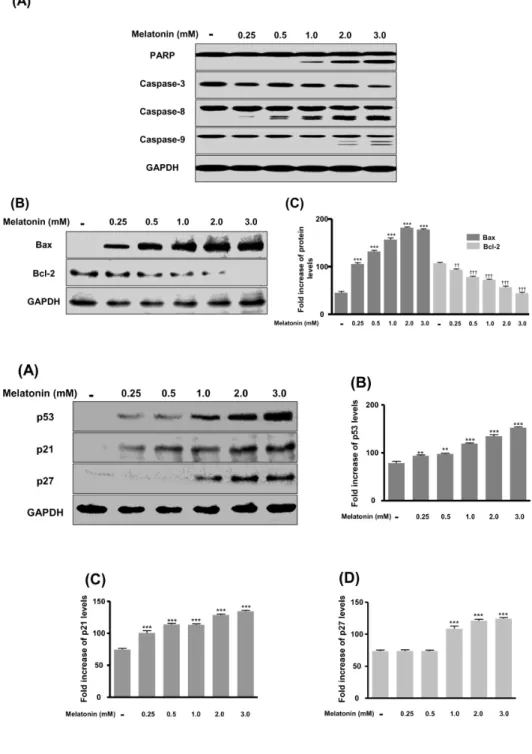
Melatonin induces apoptotic cell death in LNCaP cells  Clearer evidence for apoptosis was identified by western blot analysis using antibodies against PARP, caspase-3, -8, -9, Bax, and Bcl-2. In the presence of melatonin (0 to 3 mM), the fragmentation of poly(ADP-ribose) polymerase (PARP) and activations of caspase-3, caspase-8, and caspase-9 pro- teins in LNCaP cells occurred in a dose-dependent manner (Fig. 2A). Moreover, melatonin markedly activated Bax ex- pression and decreased Bcl-2 expression according to dose increment (Fig. 2B, C). These results indicate apoptotic cell death is induced by melatonin.

Melatonin induces apoptotic cell death via p53 activa- tion in LNCaP cells

 To identify mechanisms that might lead to melato- nin-mediated apoptosis, the expression of p53, p21, and p27 proteins was examined by western blot analysis (Fig. 3).

p53, p21, and p27 proteins were significantly activated by melatonin according to the dose increase (Fig. 3B, C, D).

To further investigate the downstream signals of p53 such

as p-p53, p21, and MDM2 by melatonin treatment, LNCaP

cells were treated with the mitogen-activated protein kin-

ase (MAPK) inhibitors PD98059 (ERK inhibitor), SP600125

(3)

Fig. 2. Induction of LNCaP cell apoptotic cell death by melatonin.

LNCaP prostate cancer cells were cultured in DMEM containing 10%

FBS and then treated with melato- nin at varying doses for 48 h. (A) Cell lysates prepared at the indi- cated culture times were separated by 10% SDS-PAGE and immuno- blotted with antibodies to PARP, caspase-3, -8, -9, and GAPDH. (B) Cell lysates prepared at the indi- cated culture times were separated by 12% SDS-PAGE and immuno- blotted with antibodies to Bax, Bcl-2, and GAPDH. (C) The relative amounts of Bax and Bcl-2 were quantified as described in Materials and Methods. ***p<0.001 vs.

control.

††

p<0.01,

†††

p<0.001 vs.

control.

Fig. 3. Activation of p53, p21, and p27 in melatonin-treated LNCaP cells. Cells were cultured in DMEM medium containing 10% FBS and then treated with melatonin at varying doses for 48 h. (A) Cell lysates prepared at the indicated culture times were separated by 12%

SDS-PAGE and immunoblotted with antibodies to p53, p21, p27, and GAPDH. The relative amounts of p53 (B), p21 (C), and p27 (D) were quantified as described in Materials and Methods. **p<0.01, ***p<

0.001 vs. control.

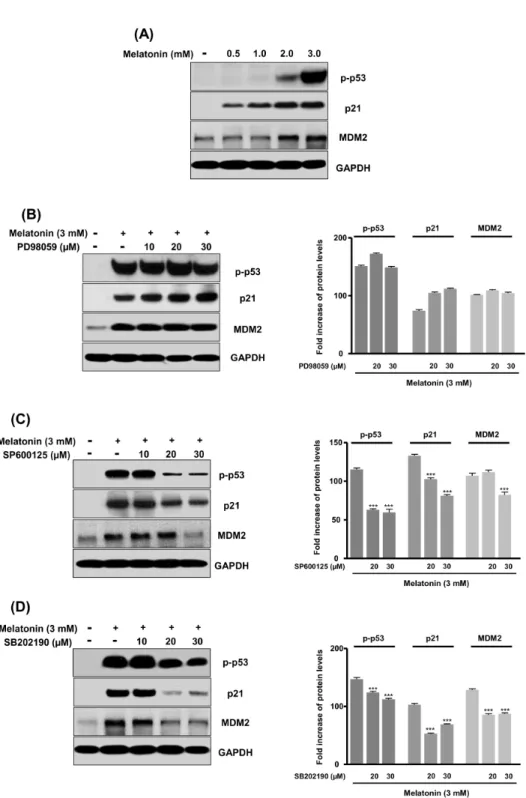
(JNK inhibitor), and SB202190 (p38 inhibitor) in the pres- ence of melatonin (Fig. 4). Melatonin treatment increased the expression of p-p53, p21, and MDM2 in a dose-depend- ent manner (Fig. 4A). Co-treatment of melatonin and PD98059 did not inhibit the expressions of p-p53, p21, or MDM2; suggesting PD98059 does not influence their ex- pression (Fig. 4B). However, treatment of melatonin plus SP600125 or SB202190 suppressed the expression of p-p53, p21, and MDM2; indicating treatment of SP600125 or SB202190 inhibits their expression in a dose-dependent manner (Fig. 4C and Fig. 4D). These results indicate that melatonin effectively induces apoptosis via the p53 path- way and is directly involved with the JNK and p38 path- ways, as was seen in the treatment profiles of MAPK

inhibitors.

DISCUSSION

 Our previous study demonstrated that melatonin results

in apoptosis and induces oncostasis via modulation of sig-

naling mediated by JNK and p38 MAPK in LNCaP prostate

cancer cells and that melatonin may play an important role

in androgen-dependent prostate cancer as an apoptotic and

oncostatic anti-cancer agent [13]. The present report shows

that melatonin also induces apoptotic cell death in LNCaP

prostate cancer cells via signaling mediated by p53. Both

pathways include a common pathway of p21 and MDM2

(4)

Fig. 4. Activation of p-p53, p21, and MDM2 by blockade with PD98059, SP600125, and SB202190 inhibitors on melatonin-induced apoptotic cell death. Inhibitor concentrations of 10 to 30 μM for PD98059, SP600125 and SB202190 were added to cells 1 hr before melatonin (3 mM) treat- ment for 48 hr. (A) LNCaP cells were cultured with melatonin at varying doses. (B), (C), and (D) Cells were treated with 3 mM melatonin for 48 hr in the presence of various concen- trations of PD98059 (B), SP600125 (C), or SB202190 (D). Cell lysates prepared at the indicated culture times were separated by 12% SDS- PAGE and immunoblotted with antibodies to p-p53, p21, MDM2, and GAPDH. ***p<0.001 vs. control.

and both result in the activation of caspase-3 and apoptotic cell death.

It is important that the concentration of melatonin used in treatment determines the induction of one of the two types of cell death pathways. For example, the signal path- way via the JNK and p38 MAPK in LNCaP cells is acti- vated by melatonin [13]. In our previous research, we found that melatonin markedly activated JNK and p38 kinase.

Treatment with PD98059 (ERK inhibitor), SP600125 (JNK inhibitor) and SB202190 (p38 inhibitor) confirmed that melatonin-induced apoptosis was JNK- and p38-dependent,

but ERK-independent [13]. Here, we showed that melato- nin increases the expressions of p53 and p21. Treatment with PD98059, SP600125 and SB202190, confirmed that the melatonin-induced apoptosis was p21-dependent, but ERK-independent. Together, these results strongly suggest that the melatonin induces the apoptotic cell death signal- ing pathway by p53-dependent induction of JNK/p38 MAPK in LNCaP cells.

Target p53 may be important for many cancer therapies.

p53 has been shown to trans-activate a broad range of proa-

poptotic proteins from the Bcl-2 family (Bax, the BH3-only

(5)

proteins Bid, Puma and Noxa), and to downregulate anti- apoptotic proteins from the Bcl-2 family (Bcl-2, Bcl-

xL

), as well as to induce the upregulation of proteins that localize to the mitochondria [14]. Knowledge of the p53-dependent pathway in prostate cancer could allow the development of selective and effective anti-cancer strategies involved with the apoptotic response [15].

We confirmed that melatonin caused apoptosis by p53 phosphorylation at serine 15, increasing the expression of downstream signals such as MDM2 and p21 in LNCaP cells; this is similar to our previous data, which indicated that melatonin induced caspase-3 activation and cyto- chrome c and Bax release into the cytosol [13]. However, MAPK inhibitors, SP600125 and SB202190, caused the down-regulation of p-p53, p21, and MDM2 after a co-treat- ment with melatonin, while PD98059 did not affect the ex- pressions of p-p53, p21, or MDM2 during cell death induced by melatonin, indicating that the JNK and p38 MAPK pathways are closely associated with p53 phosphorylation.

The phosphorylation of p53 can usually be induced at serine 15 or/and 18. Especially, the phosphorylation of p53 at ser- ine 15 was reported to be a key phosphorylation target dur- ing the p53 activation process to apoptotic cell death [16,17]. Of the MAPK families, p53 can be phosphorylated either directly or indirectly by p38 kinase [18-21] and JNK [22,23]. Compared to several studies on the role of p38 kin- ase or JNK in p53 regulation, there is less evidence to in- dicate phosphorylation and/or accumulation of p53 by ERK.

In the present study, JNK and p38 were able to mediate p53 phosphorylation leading to apoptosis by melatonin. In our previous study, SP600125 and SB202190 significantly disturbed the caspase-3 activation induced by melatonin, suggesting roles for JNK and p38 in the control of caspase-3 activation [13]. Finally, our previous and present studies confirm that melatonin induces apoptotic cell death through a common signal pathway including caspase-3-de- pendent pathway.

In conclusion, melatonin can induce apoptotic cell death through p53 activation in LNCaP cells. The MAPK families, JNK and p38, can play important roles in mediating apop- totic signal including p53 expression and caspase-3 activa- tion during melatonin-induced apoptosis. Overall, these re- sults suggest that melatonin can induce apoptotic cell death by p38/JNK pathway-dependent p53 activation in LNCaP cells.

ACKNOWLEDGEMENTS

 This work was supported by a National Research Founda- tion of Korea grant funded by the Korean government (2009-0069858).

REFERENCES

1. Ben Sahra I, Laurent K, Giuliano S, Larbret F, Ponzio G, Gounon P, Le Marchand-Brustel Y, Giorgetti-Peraldi S, Cormont M, Bertolotto C, Deckert M, Auberger P, Tanti JF, Bost F. Targeting cancer cell metabolism: the combination of metformin and 2-deoxyglucose induces p53-dependent apop- tosis in prostate cancer cells. Cancer Res. 2010;70:2465-2475.

2. Yu CX, Zhang XQ, Kang LD, Zhang PJ, Chen WW, Liu WW, Zhang JY. Emodin induces apoptosis in human prostate cancer cell LNCaP. Asian J Androl. 2008;10:625-634.

3. Lee DH, Kim C, Zhang L, Lee YJ. Role of p53, PUMA, and

Bax in wogonin-induced apoptosis in human cancer cells.

Biochem Pharmacol. 2008;75:2020-2033.

4. Logan IR, McNeill HV, Cook S, Lu X, Lunec J, Robson CN.

Analysis of the MDM2 antagonist nutlin-3 in human prostate cancer cells. Prostate. 2007;67:900-906.

5. Sainz RM, Mayo JC, Tan DX, León J, Manchester L, Reiter RJ. Melatonin reduces prostate cancer cell growth leading to neuroendocrine differentiation via a receptor and PKA independent mechanism. Prostate. 2005;63:29-43.

6. Tam CW, Mo CW, Yao KM, Shiu SY. Signaling mechanisms of melatonin in antiproliferation of hormone-refractory 22Rv1 human prostate cancer cells: implications for prostate cancer chemoprevention. J Pineal Res. 2007;42:191-202.

7. Cucina A, Proietti S, D'Anselmi F, Coluccia P, Dinicola S, Frati L, Bizzarri M. Evidence for a biphasic apoptotic pathway induced by melatonin in MCF-7 breast cancer cells. J Pineal Res. 2009;46:172-180.

8. Martín-Renedo J, Mauriz JL, Jorquera F, Ruiz-Andrés O, González P, González-Gallego J. Melatonin induces cell cycle arrest and apoptosis in hepatocarcinoma HepG2 cell line. J Pineal Res. 2008;45:532-540.

9. Xi SC, Tam PC, Brown GM, Pang SF, Shiu SY. Potential involvement of MT1 receptor and attenuated sex steroid induced calcium influx in the direct anti-proliferative action of melatonin on androgen-responsive LNCaP human prostate cancer cells. J Pineal Res. 2000;29:172-183.

10. Lupowitz Z, Zisapel N. Hormonal interactions in human prostate tumor LNCaP cells. J Steroid Biochem Mol Biol. 1999;

68:83-88.

11. Moretti RM, Marelli MM, Maggi R, Dondi D, Motta M, Limonta P. Antiproliferative action of melatonin on human prostate cancer LNCaP cells. Oncol Rep. 2000;7:347-351.

12. Xi SC, Siu SWF, Fong SW, Shiu SYW. Inhibition of androgen sensitive LNCaP prostate cancer growth in vivo by melatonin:

association of antiproliferative action of the pineal hormone with MT1 receptor protein expression. Prostate. 2001;46:52-61.

13. Joo SS, Yoo YM. Melatonin induces apoptotic death in LNCaP cells via p38 and JNK pathways: therapeutic implications for prostate cancer. J Pineal Res. 2009;47:8-14.

14. Galluzzi L, Morselli E, Kepp O, Tajeddine N, Kroemer G.

Targeting p53 to mitochondria for cancer therapy. Cell Cycle.

2008;7:1949-1955.

15. Califice S, Waltregny D, Castronovo V, van den Brûle F.

Prostate carcinoma cell lines and apoptosis: a review. Rev Med Liege. 2004;59:704-710.

16. Shieh SY, Ikeda M, Taya Y, Prives C. DNA damage-induced phosphorylation of p53 alleviates inhibition by MDM2. Cell.

1997;91:325-334.

17. Kim YS, Lee HJ, Jang C, Kim HS, Cho YJ. Knockdown of RCAN1.4 Increases Susceptibility to FAS-mediated and DNA- damage-induced Apoptosis by Upregulation of p53 Expression.

Korean J Physiol Pharmacol. 2009;13:483-489.

18. Bulavin DV, Saito S, Hollander MC, Sakaguchi K, Anderson CW, Appella E, Fornace AJ Jr. Phosphorylation of human p53 by p38 kinase coordinates N-terminal phosphorylation and apoptosis in response to UV radiation. EMBO J. 1999;18:6845- 6854.

19. Huang C, Ma WY, Maxiner A, Sun Y, Dong Z. p38 kinase mediates UV-induced phosphorylation of p53 protein at serine 389. J Biol Chem. 1999;274:12229-12235.

20. She QB, Chen N, Dong Z. ERKs and p38 kinase phosphorylate p53 protein at serine 15 in response to UV radiation. J Biol Chem. 2000;275:20444-20449.

21. Sayed M, Kim SO, Salh BS, Issinger OG, Pelech SL. Stress- induced activation of protein kinase CK2 by direct interaction with p38 mitogen-activated protein kinase. J Biol Chem.

2000;275:16569-16573.

22. Hu MC, Qiu WR, Wang YP. JNK1, JNK2 and JNK3 are p53 N-terminal serine 34 kinases. Oncogene. 1997;15:2277-2287.

23. Kwon YW, Ueda S, Ueno M, Yodoi J, Masutani H. Mechanism of p53-dependent apoptosis induced by 3-methylcholanthrene.

J Biol Chem. 2002;277:1837-1844.

수치

Fig. 1. Viability of melatonin-treated  LNCaP cells. LNCaP cell viability  was determined using the Cell  Counting Kit-8 assay (A) 48 hr after  exposure to melatonin at varying  doses and (B) at varying times after  exposure to 3 mM melatonin
Fig. 2. Induction of LNCaP cell  apoptotic cell death by melatonin.
Fig. 4. Activation of p-p53, p21, and  MDM2 by blockade with PD98059,  SP600125, and SB202190 inhibitors  on melatonin-induced apoptotic cell  death

참조

관련 문서

In conclusion, PD induces the cell death via the inhibition of MAPK/ERK pathway in the human cervical cancer cell line, HeLa S 3 cells.. The inhibition of MAPK/ERK pathway

Arylquin 1 induces morphological changes (cell body shrinkage and cell detachment) and decreases cell viability in various cancer cells.. Arylquin 1-induced cell death is

We demonstrated that ionizing radiation utilizes PI3K-JNK signaling pathway for amplifying mitochondrial dysfunction and susequent apoptotic cell death: We showed

We found that [6]-gingerol inhibited the cell growth, disrupted the cell cycle progression in both HPac cells (wild type p53) and BXPC-3 cells (mutant p53 protein), and also

Our results indicate that the activation of p38 and JNK, but not ERK, is involved in the induction of pip92 during NMDA-mediated neuronal cell death, suggesting that different

Conclusions: The study suggests possibilities that the blue-light promotes retinal damage and causes apoptotic cell death via ERK and SRC pathway in mouse retina, and blue-light

In addition, to examine whether HoxB4 affects cell death induced by cell cycle arrest, we treated Ba/F3-GFP and Ba/F3-HoxB4 cells with 100 nM DOX for 24 h, and then

Taken together, we found curcumin-induced ROS down-regulation of E2F4 expression and modulation of E2F4 target genes which finally lead to the apoptotic cell death in HCT116