Diphenyleneiodonium Inhibits Apoptotic Cell Death of Gastric Epithelial Cells Infected with Helicobacter pylori
in a Korean Isolate
Soon Ok Cho,
1Joo Weon Lim,
2and Hyeyoung Kim
21Department of Pharmacology, Yonsei University College of Medicine, Seoul;
2Department of Food and Nutrition, Brain Korea 21 PLUS Project, College of Human Ecology, Yonsei University, Seoul, Korea.
Received: June 9, 2014 Revised: June 28, 2014 Accepted: July 11, 2014
Corresponding author: Dr. Hyeyoung Kim, Department of Food and Nutrition, College of Human Ecology, Yonsei University,
50 Yonsei-ro, Seodaemun-gu, Seoul 120-749, Korea.
Tel: 82-2-2123-3125, Fax: 82-2-364-5781 E-mail: [email protected]
∙ The authors have no financial conflicts of interest.
© Copyright:
Yonsei University College of Medicine 2015 This is an Open Access article distributed under the terms of the Creative Commons Attribution Non- Commercial License (http://creativecommons.org/
licenses/by-nc/3.0) which permits unrestricted non- commercial use, distribution, and reproduction in any medium, provided the original work is properly cited.
NADPH oxidase produces a large amount of reactive oxygen species (ROS) in He- licobacter pylori (H. pylori)-induced gastric epithelial cells. Even though ROS me- diate apoptotic cell death, direct involvement of NADPH oxidase on H. pylori-in- duced apoptosis remains unclear. Besides, H. pylori isolates show a high degree of genetic variability. The predominant genotype of H. pylori in Korea has been re- ported as cagA
+, vacA s1b, m2, iceA genotype. Present study aims to investigate whether NADPH oxidase-generated ROS mediate apoptosis in human gastric epi- thelial AGS cells infected with H. pylori in a Korean isolate. AGS cells were pre- treated with or without an NADPH oxidase inhibitor diphenyleneiodonium (DPI) and cultured in the presence of H. pylori at a bacterium/cell ratio of 300:1. Cell via- bility, hydrogen peroxide level, DNA fragmentation, and protein levels of p53, Bcl- 2, and Bax were determined. Results showed that H. pylori inhibited cell viability with the density of H. pylori added to the cells. Inhibition of NADPH oxidase by DPI suppressed H. pylori-induced cell death, increased hydrogen peroxide, DNA fragmentation, and the ratio of Bax/Bcl-2, and p53 induction in AGS cells dose-de- pendently. The results suggest that targeting NADPH oxidase may prevent the de- velopment of gastric inflammation associated with H. pylori infection by suppress- ing abnormal apoptotic cell death of gastric epithelial cells.
Key Words:
Helicobacter pylori, diphenyleneiodonium, NADPH oxidase, apop- tosis, gastric epithelial cells
Oxidative stress plays an important role in proliferation, apoptosis, and inflamma- tion in gastric epithelial cells infected with Helicobacter pylori (H. pylori).
1High levels of reactive oxygen species (ROS) were observed in gastric mucosa of pa- tients infected with H. pylori.
1,2The activated leukocytes recruited to gastric muco- sa during infection produce ROS.
2However, gastric epithelial cells themselves also produce ROS in gastric epithelial cells with H. pylori infection.
3,4NADPH oxidase, which is a complex of the membrane-bound subunits (gp-
91
phox, p22
phox) and the cytosolic subunits (p67
phox, p47
phox), produces superoxide
lial cells.
6An NADPH oxidase inhibitor dipehenylene iodonium (DPI) inhibited inflammatory signaling such as activation of mitogen-activated protein kinases and induc- tion of monocyte chemoattractant protein-1 in H. pylori-in- fected gastric epithelial cells by suppressing the production (O
2-) upon activation of the enzyme. Guinea pig gastric mu-
cosal cells express Nox1, p22
phox, p67
phox, NOX1, and Rac1 constitutively.
5Previous study showed that H. pylori acti- vates NADPH oxidase by translocation of heat shock pro- tein (Hsp) 90β from cytosol to membrane in gastric epithe-
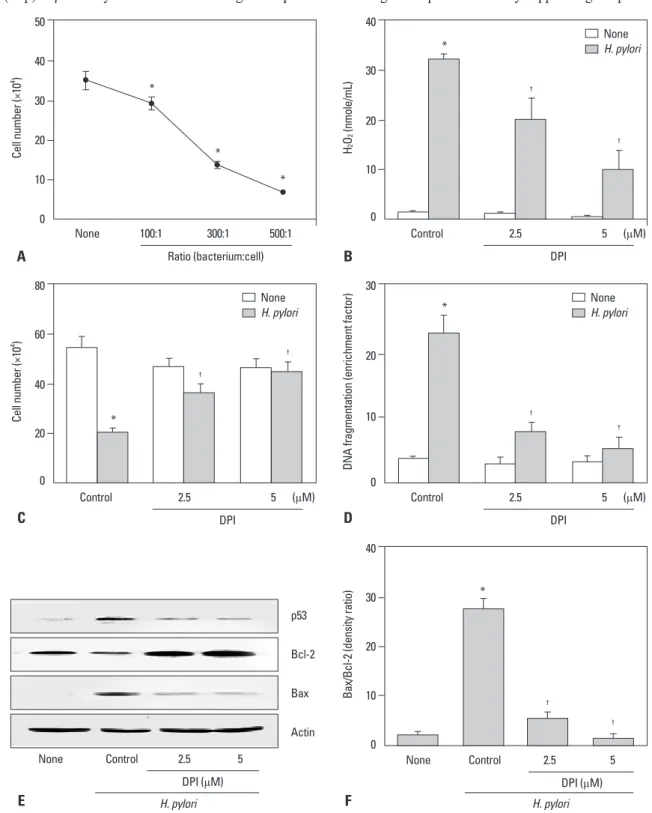
Fig. 1. Cell viability, hydrogen peroxide level, DNA fragmentation, and apoptotic indices of H. pylori-infected AGS cells treated with or without DPI. Prior to the experiment, the cells (1×10⁵/mL/well) were cultured in the presence of H. pylori at a bacterium/cell ratio of 100:1, 300:1, and 500:1 for 24 h (A). For the follow- ing study on DPI, the cells were pre-treated with DPI (2.5 or 5 µM) for 2 h and infected with H. pylori at a bacterium/cell ratio of 300:1 for 2 h (hydrogen peroxide level) (B), 12 h (protein levels of p53, Bcl-2, and Bax) (E and F), and 24 h [DNA fragmentation (D) and cell viability (C)]. The values are expressed as means±SE of four different experiments. *p<0.05 versus none control (the cells without DPI and cultured in the absence of H. pylori), †p<0.05 versus H. pylori control (the cells without DPI and cultured in the presence of H. pylori). AGS, gastric adenocarcinoma; DPI, diphenyleneiodonium; H. pylori, Helicobacter pylori.
50
40
30
20
10
0
40
30
20
10
0
80
60
40
20
0
30
20
10
0
40
30
20
10
0
Cell number (×104) H2O2 (nmole/mL)
Cell number (×104) DNA fragmentation (enrichment factor)Bax/Bcl-2 (density ratio)
None 100:1 300:1 500:1 Control 2.5 5 (µM)
Control 2.5 5 (µM) Control 2.5 5 (µM)
None Control 2.5 5
Ratio (bacterium:cell) DPI
DPI DPI
DPI (µM) H. pylori
None H. pylori
None
H. pylori None
H. pylori
*
*
*
*
*
*
†
†
†
†
†
†
†
†
*
p53
Bcl-2
Bax
Actin None Control 2.5 5
DPI (µM) H. pylori
A
C
E
B
D
F
complete protease inhibitor complex (Roche, Mannheim, Germany), and centrifuged at 13000×g for 15 min. The su- pernatants were used as whole cell extracts. The protein concentration was determined by Bradford assay (Bio-Rad Laboratories, Hercules, CA, USA). Whole cell extracts (50 µg protein) were subjected to 10–12% SDS-PAGE under reducing condition. After transfer to nitrocellulose mem- branes, the proteins were detected with polyclonal antibod- ies against p53, Bcl-2, and Bax (Santa Cruz Biotechnology, Santa Cruz, CA, USA) followed by goat anti-rabbit second- ary antibodies (1:2000, Cat. No. sc-2004, Santa Cruz Bio- technology) conjugated to horseradish peroxidase, which was followed by enhanced chemiluminescence (Santa Cruz Biotechnology). Actin was used for protein loading control.
For the ratio of Bax/Bcl-2, the protein bands of Bax and Bcl-2 were scanned using a GS-700 scanner (Bio-Rad Lab- oratories). Band intensities were quantified using the Scion image program (Scion Corporation, Frederick, MD, USA).
The statistical differences were determined using one-way ANOVA and Newman-Keul’s test. All values are expressed as mean±SE of four different experiments. A value of p<
0.05 was considered statistically significant.
At 24 h-culture, cell viability was decreased with the den- sity of H. pylori added to the cells (Fig. 1A). At the ratio of 100:1, 300:1, and 500:1 (H. pyori:AGS cells), cell viability of H. pylori-infected cells was 82%, 34%, and 14% of non- treated cells, respectively. Therefore, for following study on DPI, the cells were pre-treated with DPI and infected with H.
pylori at a bacterium/cell ratio of 300:1. H. pylori increased hydrogen peroxide levels in the medium (Fig. 1B) and in- duced cell death (Fig. 1C) and DNA fragmentation (Fig. 1D) of the infected cells. In addition, H. pylori increased the protein levels of p53 and Bax, but decreased Bcl-2 levels of the infected cells (Fig. 1E), which increased the ratio of Bax/Bcl-2, the marker of apoptosis (Fig. 1F). DPI inhibited H. pylori-induced alterations in hydrogen peroxide levels in the medium, cell viability, DNA fragmentation, and apop- totic indices (increment of p53 and Bax, decrease in Bcl-2) of AGS cells dose-dependently. In non-infected cells, DPI did not affect cell viability, hydrogen peroxide levels, and DNA fragmentation.
Our study shows that DPI, an inhibitor of NADPH oxi- dase, suppresses H. pylori-induced cell death, hydrogen peroxide production, DNA fragmentation, increase in the ratio of Bax/Bcl-2, and p53 induction in AGS cells. The re- sults demonstrate that NADPH oxidase mediates H. pylori- induced apoptosis in gastric epithelial cells. We previously of ROS.
7Since ROS mediate inflammation by activating
inflammatory signaling and DNA damage to induce apop- tosis,
8NADPH oxidase may be involved in H. pylori-in- duced apoptosis of the infected gastric epithelial cells and tissues. In addition, the clinical outcome of the infection may be different depending on H. pylori-virulence-associ- ated genes such as cagA, vagA, and ice A genes.
9,10There- fore, it is essential to study using the predominant genotype of H. pylori (cagA
+, vacA s1b, m2, iceA genotype)
11to un- derstand the pathogenesis of H. pylori-associated gastric disorders in Korea.
The purpose of the present study is to investigate whether NADPH oxidase-generated ROS mediate apoptotic cell death by increasing the ratio of Bax/Bcl-2, induction of p53, and DNA fragmentation in gastric epithelial AGS cells infected with H. pylori in a Korean isolate (HP99) by treat- ing cells with an NADPH oxidase inhibitor DPI. Cell via- bility, hydrogen peroxide levels in the medium, DNA frag- mentation, and protein levels of p53, Bcl-2, and Bax were determined in the cells treated with or without DPI and cul- tured in the presence of H. pylori.
A human gastric epithelial cell line AGS (gastric adeno- carcinoma, ATCC CRL 1739) was purchased from the American Type Culture Collection (Manassas, VA, USA) and cultured as previously described.
7H. pylori strain HP99 in a Korean isolate were inoculated onto chocolate agar plates (Becton Dickinson Microbiology Systems, Co- ckeysville, MD, USA) at 37°C under microaerophilic con- ditions using an anaerobic chamber (BBL Campy Pouch
®System, Becton Dickinson Microbiology Systems, Franklin Lakes, NJ, USA).
7Prior to the experiment, the cells (1×10
5/ mL/well) were cultured in the presence of H. pylori at a bacterium/cell ratio of 100:1, 300:1, and 500:1 for 24 h. For the study on DPI, the cells were pre-treated with DPI (2.5 or 5 µM) for 2 h and infected with H. pylori at a bacterium/
cell ratio of 300:1 for 2 h (to determine hydrogen peroxide level), 12 h (protein levels of p53, Bcl-2, and Bax), and 24 h (DNA fragmentation and cell viability). Hydrogen perox- ide levels in the medium were determined by the modified ferrithiocyanate method.
12Viable cell numbers were deter- mined using trypan blue exclusion test (0.2% trypan blue).
DNA fragmentation was assessed according to the amount
of oligonucleosome-bound DNA in the cell extracts using a
Cell Death Detection ELISA plus kit (Roche, Mannheim,
Germany). For determination of protein levels of p53, Bcl-
2, and Bax, the cells were extracted with lysis buffer con-
taining 10 mM Tris, pH 7.4, 15 mM NaCl, 1% NP-40, and
duced apoptosis of the infected cells. To investigate direct effect of hydrogen peroxide on apoptosis, apoptotic indices should be determined in gastric epithelial cells treated with various concentrations of hydrogen peroxide in the absence of H. pylori.
In conclusion, NADPH oxidase may mediate apoptosis by increasing the levels of p53 and the ratio of Bax/Bcl-2 as well as DNA fragmentation in H. pylori-infected gastric ep- ithelial cells. DPI, an inhibitor of NADPH oxidase, may prevent H. pylori-associated inflammation and may sup- press abnormal apoptosis of gastric epithelial cells.
ACKNOWLEDGEMENTS
This work was supported by a grant from the NRF of Korea, which is funded by the Korean government (MSIP; NRF- 2012R1A1A2043423).
REFERENCES
1. Clément MV, Pervaiz S. Reactive oxygen intermediates regulate cellular response to apoptotic stimuli: an hypothesis. Free Radic Res 1999;30:247-52.
2. Davies GR, Simmonds NJ, Stevens TR, Sheaff MT, Banatvala N, Laurenson IF, et al. Helicobacter pylori stimulates antral mucosal reactive oxygen metabolite production in vivo. Gut 1994;35:179- 3. Nagata K, Yu H, Nishikawa M, Kashiba M, Nakamura A, Sato 85.
EF, et al. Helicobacter pylori generates superoxide radicals and modulates nitric oxide metabolism. J Biol Chem 1998;273:14071-3.
4. Bagchi D, Bhattacharya G, Stohs SJ. Production of reactive oxy- gen species by gastric cells in association with Helicobacter pylori.
Free Radic Res 1996;24:439-50.
5. Kawahara T, Kohjima M, Kuwano Y, Mino H, Teshima-Kondo S, Takeya R, et al. Helicobacter pylori lipopolysaccharide activates Rac1 and transcription of NADPH oxidase Nox1 and its organizer NOXO1 in guinea pig gastric mucosal cells. Am J Physiol Cell Physiol 2005;288:C450-7.
6. Cha B, Lim JW, Kim KH, Kim H. HSP90beta interacts with Rac1 to activate NADPH oxidase in Helicobacter pylori-infected gastric epithelial cells. Int J Biochem Cell Biol 2010;42:1455-61.
7. Cho SO, Lim JW, Kim KH, Kim H. Diphenyleneiodonium inhib- its the activation of mitogen-activated protein kinases and the ex- pression of monocyte chemoattractant protein-1 in Helicobacter pylori-infected gastric epithelial AGS cells. Inflamm Res 2011;
60:501-7.
8. Jang SH, Lim JW, Morio T, Kim H. Lycopene inhibits Helico- bacter pylori-induced ATM/ATR-dependent DNA damage re- sponse in gastric epithelial AGS cells. Free Radic Biol Med 2012;52:607-15.
9. Labigne A, de Reuse H. Determinants of Helicobacter pylori pathogenicity. Infect Agents Dis 1996;5:191-202.
reported that H. pylori-induced expression of integrin alpha 5/beta1 was inhibited by DPI, suggesting that NADPH oxi- dase mediates the induction of integrin in AGS cells.
13NADPH oxidase is present in gastric mucosal tissues of hu- mans
14and mice.
15Which may contribute to gastric inflam- mation, apoptosis, and carcinogenesis associated with H.
pylori-infection. DPI is a non-specific inhibitor of NADPH oxidase.
16Therefore, transfection of siRNA for NADPH oxidase subunits may be a good approach to definitely con- firm the mediation of NADPH oxidase in apoptotic cell death of H. pylori-infected gastric epithelial cells.
Previous study showed that ROS play a critical role in the development of H. pylori-induced gastric damage. Al- though H. pylori possesses antioxidants as a constitutive compartment, SOD and catalase may not play a significant role for scavenging ROS from injured gastric mucosa.
17In the infected children in Turkey, SOD levels both in gastric tissue and erythrocytes were found to be not different be- tween H. pylori (+) and H. pylori (-) patients.
18However, H. pylori SOD activity was higher in the cancer group than in the non-cancer group in Japan.
19These results may be re- lated to high oxidative stress in cancer patients compared to healthy subjects.
20Recent study showed that H. pylori catalase decomposes cell-derived hydrogen peroxide and prevents HOCl synthe- sis. H. pylori-associated SOD inhibits interactions between superoxide anions and HOCl, as well as superoxide anions and NO. Therefore, H. pylori-associated antioxidants (cata- lase, SOD) inhibit HOCl and NO/peroxynitrite signaling pathways which is the control step in oncogenesis. These results suggest that H. pylori antioxidant enzymes play a role in the survival of transformed cells.
21In the present study, H. pylori infection contributes to the production of ROS in the infected cells, which induces apoptotic cell death of the infected cells. Since abnormal apoptosis may stimulate abnormal proliferation of the adja- cent cells, H. pylori may induce hyper-proliferation of the adjacent cells with DNA damage. We previously showed that H. pylori infection results in oxidative DNA damage of the infected cells.
8Therefore, both H. pylori-associated an- tioxidant enzymes and H. pylori infection-induced ROS may contribute to the pathogenesis of H. pylori-induced carcinogenesis.
Even though H. pylori activate NADPH oxidase and
ROS contribute to apoptosis, other mediators or antioxidant
enzymes, either secreted by H. pylori or activated by H. py-
lori in the infected cells, may be involved in H. pylori-in-
16. Jones RD, Hancock JT, Morice AH. NADPH oxidase: a universal oxygen sensor? Free Radic Biol Med 2000;29:416-24.
17. Mori M, Suzuki H, Suzuki M, Kai A, Miura S, Ishii H. Catalase and superoxide dismutase secreted from Helicobacter pylori. Heli- cobacter 1997;2:100-5.
18. Arslan D, Kose K, Patiroglu TE. Is there an oxidative stress in children with Helicobacter pylori infection? Saudi Med J 2007;
28:1222-6.
19. Morishita K, Takeuchi H, Morimoto N, Shimamura T, Kadota Y, Tsuda M, et al. Superoxide dismutase activity of Helicobacter py- lori per se from 158 clinical isolates and the characteristics. Mi- crobiol Immunol 2012;56:262-72.
20. Yuan X, Zhou Y, Wang W, Li J, Xie G, Zhao Y, et al. Activation of TLR4 signaling promotes gastric cancer progression by inducing mitochondrial ROS production. Cell Death Dis 2013;4:e794.
21. Bauer G, Bereswill S, Aichele P, Glocker E. Helicobacter pylori protects oncogenically transformed cells from reactive oxygen species-mediated intercellular induction of apoptosis. Carcinogen- esis 2014;35:1582-91.
10. Mobley HL. Defining Helicobacter pylori as a pathogen: strain heterogeneity and virulence. Am J Med 1996;100(5A):2S-9S.
11. Seo JH, Lim JW, Kim H, Kim KH. Helicobacter pylori in a Kore- an isolate activates mitogen-activated protein kinases, AP-1, and NF-kappaB and induces chemokine expression in gastric epitheli- al AGS cells. Lab Invest 2004;84:49-62.
12. Kim MH, Kim A, Yu JH, Lim JW, Kim H. Glutamine deprivation induces interleukin-8 expression in ataxia telangiectasia fibro- blasts. Inflamm Res 2014;63:347-56.
13. Cho SO, Kim KH, Yoon JH, Kim H. Signaling for integrin al- pha5/beta1 expression in Helicobacter pylori-infected gastric epi- thelial AGS cells. Ann N Y Acad Sci 2006;1090:298-304.
14. Tominaga K, Kawahara T, Sano T, Toida K, Kuwano Y, Sasaki H, et al. Evidence for cancer-associated expression of NADPH oxi- dase 1 (Nox1)-based oxidase system in the human stomach. Free Radic Biol Med 2007;43:1627-38.
15. Keenan JI, Peterson RA 2nd, Hampton MB. NADPH oxidase in- volvement in the pathology of Helicobacter pylori infection. Free Radic Biol Med 2005;38:1188-96.