
Identification of the Interaction between Insulin-like Growth Factor Binding
Protein-4 (IGFBP-4) and Heterogeneous Nuclear Ribonucleoprotein L (hnRNP L)
Mieyoung Choi*
Department of Biomedical Sciences, Sunmoon University, Asan, Chungnam 336-708, Korea
Received October 2, 2013 /Revised November 6, 2013 /Accepted November 11, 2013Heterogeneous nuclear ribonucleoprotein L (hnRNP L) is a major pre-mRNA binding protein and it is an abundant nuclear protein that shuttles between the nucleus and the cytoplasm. hnRNP L is known to be related to many cellular processes, including chromatin modification, pre-mRNA splic- ing, mRNA export of intronless genes, internal ribosomal entry site (IRES)-mediated translation, mRNA stability, and spermatogenesis. In order to identify the cellular proteins interacting with hnRNP L, this study performed a yeast two-hybrid screening, using a human liver cDNA library. The study identified insulin-like growth factor binding protein-4 (IGFBP-4) as a novel interaction partner of hnRNP L in the human liver. It then discovered, for the first time, that hnRNP L interacts specifi- cally with IGFBP-4 in a yeast two-hybrid system. The authenticity of this two-hybrid interaction of hnRNP L and IGFBP-4 was confirmed by an in vitro pull-down assay.
Key words : Heterogeneous nuclear ribonucleoproteins (hnRNPs), hnRNP L, yeast two-hybrid system, Insulin-like growth factor binding protein-4 (IGFBP-4), GST pull-down assay
*Corresponding author
*Tel : +82-41-530-2274, Fax : +82-41-530-2939
*E-mail : [email protected]
This is an Open-Access article distributed under the terms of the Creative Commons Attribution Non-Commercial License (http://creativecommons.org/licenses/by-nc/3.0) which permits unrestricted non-commercial use, distribution, and reproduction in any medium, provided the original work is properly cited.
Journal of Life Science 2013 Vol. 23. No. 11. 1311~1316 DOI : http://dx.doi.org/10.5352/JLS.2013.23.11.1311
Introduction
The heterogeneous nuclear ribonucleoproteins (hnRNPs) are abundant RNA-binding proteins which play important roles in multiple aspects of the biogenesis of mRNA and mRNA metabolism, including activation of transcription, packaging of nascent transcripts into hnRNP particles, regu- lation of pre-mRNA processing, the transport of mature RNAs to the cytoplasm, regulation of translation, and regu- lation of mRNA stability [13]. More than 20 hnRNPs have been determined to exist in human nuclei, and are des- ignated hnRNP A1 through U [3]. hnRNPs are able to bind to RNA with differential binding specificities and interact via protein-protein interaction both with themselves and with other protein factors [12, 13].
The hnRNP L protein is composed of 558 amino acid resi- dues, and contains four loosely conserved RNP-consensus (CS) RNA-binding domains (RBDs) that bind to CA-rich ele- ments [3, 10]. hnRNP L was first identified as a nuclear protein. However, it is not restricted to the nucleus, rather
shuttles between the nucleus and cytoplasm [16]. hnRNP L has been proposed as a global regulator on the level of mRNA processing, markedly in alternative splicing [15]. It was reported that hnRNP L binds to pre-mRNA processing enhancer of Herpes Simplex Virus thymidine kinase gene and promotes both polyadenylation and nucleocytoplasmic export of intronless mRNAs [6]. hnRNP L was found to spe- cifically interact with the hepatitis C virus (HCV) internal ribosomal entry site (IRES) and facilitate HCV IRES-medi- ated translation initiation [8, 11]. It was suggested that hnRNP L plays a novel functional role in RNA stability through binding with high affinity to CA repeats [10].
Moreover, the hnRNP L protein was suggested as a key fac- tor involved in apoptosis, death and growth of spermato- genic cells from functional proteomic studies of azoospermia patients with sertoli cell only syndrome [18].
In order to better understand the function of hnRNP, this study searched for novel binding partners of hnRNP L in human liver cells. hnRNP L was used as a bait in a yeast two-hybrid screening for that purpose. Several independent cDNA clones were identified and their nucleotide sequences and predicted amino acid sequences were analyzed. The nu- cleotide sequence of some of these clones was identical with that of human IGFBP-4 (Insulin-like growth factor binding protein-4) (GeneBank accession number NM_001552.2).
IGFBP-4 is one of the insulin-like growth factor binding pro-
teins (IGFBPs). IGFBP-4 is known to be the protein that me-
diates cell proliferation by binding to insulin-like growth fac- tor (IGF)-I and IGF-II. It is also known to mediate its actions through a mechanism which is independent of IGFs [22].
In addition, IGFBP-4 has been shown to inhibit DNA syn- thesis induced by IGF-I in both cancerous and non-cancerous cells [9]. Finally, IGFBP-4 has been implicated predom- inantly in inhibitory functions, which include reducing cel- lular proliferation and DNA synthesis as well as inducing apoptosis in a cell type-specific manner [4].
This study showed for the first time that hnRNP L inter- acts specifically with IGFBP-4 in a yeast two-hybrid system.
The authenticity of this interaction between hnRNP L and IGFBP-4 was verified by an in vitro binding assay.
Materials and Methods Plasmid constructs
The plasmids pGBT9 and pACT2 were purchased from Clontech Inc. Plasmids pGBT9/hnRNP L (1~558), pGAD424/
hnRNP L (1~558) and pTM1/hnRNP L were a kind gift from Dr. Sung Key Jang (Department of Life Science, Pohang University of Science and Technology, Korea) [7]. The gen- eration of plasmids pGBT9/hnRNP A1 (1~320) and pGAD424/hnRNP A1 (1~320) was obtained as described previously [12].
For the construction of pACT2/IGFBP4 (2~258), the origi- nal clone #9, which included a partial cDNA of IGFBP4 from nt#84 to nt#2094 as an in-frame fusion with GAL4 activation domain, was used as a template for PCR. A fragment of IGFBP4 coding sequence corresponding to amino acids 2-258 was amplified using the following primers: 5'CCGGAAT- TCTGCCCCTCTGCCTCGTGGCC3' (forward) and 5'CCGCT- CGAGTCACTCTGAAAGCTGTCAGC3' (reverse). The re- sultant PCR product was digested with EcoRI and XhoI, in- serted in-frame into the EcoRI- and XhoI-digested pACT2 vector. The construct was then verified by sequencing to ex- clude possible errors introduced during PCR (Bionex, Korea).
pGBT9/IGFBP-4 (2~258) was created by cloning the DNA fragment from pACT2/IGFBP-4 (2~258) digested with BamHI/XhoI into pGBT9 vector treated with BamHI/SalI.
pTM1/IGFBP-4 (2~258) was constructed by inserting the DNA fragment from pACT2/IGFBP-4 (2~258) treated with EcoRI/XhoI into similarly digested pTM1 vector [12]. A DNA fragment encoding IGFBP-4 (2~258) was isolated by diges- tion of pTM1/IGFBP-4 (2~258) with NcoI and XhoI. This in-
sert DNA was ligated with similarly treated pCS3-MT vector [19], resulting in a construct pCS3-MT/ IGFBP-4 (2~258). The plasmid pGEX-KG/hnRNP L (141~558) was constructed as described by Park et al. [21].
Yeast two-hybrid screening
The human liver cDNA library and yeast strains were purchased from Clontech, Inc. Yeast two-hybrid screening [5] was carried out as suggested by the manufacturer’s instructions. The plasmid pGBT9/hnRNP L (1~558) and hu- man liver cDNA library were introduced into Saccharomyces cerevisiae strain HF7c (MATa, ura3-52, his3-200, lys2-801, ade2-101, trpl-901, leu2-3, 112, gal4-542, gal80-538, cyh
r2, LYS2::
GAL1
uas-GAL
tata-HIS3, URA3::GAL4
17mers(X3)-CyCl
tata-laZ). Trans- formants were selected on triple selectable media (synthetic medium lacking leucine, tryptophan, and histidine) and were subsequently screened for β–galactosidase activity us- ing a filter lift assay. After His
+transformants were trans- ferred to filter paper, liquid nitrogen was added to the filter to lyse the cells. The filter was then laid on top of another filter paper pre-soaked with Z-buffer (60 mM Na
2HPO
4/ 40 mM NaH
2PO
4/ 10 mM KCl/1 mM MgSO
4) containing 5-bro- mo-4-chloroindol-3-yl β-D-galactopyranoside (X-Gal) (20 ng/ml). The color change in the yeast colonies was moni- tored by keeping filters at 30℃ for up to 30 h of reaction time.
Production of recombinant proteins
E. coli BL21 (DE3) pLysS (Novagen) was transformed with the plasmid pGEX-KG/hnRNP L (141~558) as well as with pGEX-KG vector to obtain unfused GST protein. Transform- ants were grown at 37℃ until optical density (OD) at 600 nm reached 0.5. Expression of the proteins was induced by 0.5 mM Isopropyl-β-D-thiogalactopyranoside (IPTG) for 6 h at 27℃. After harvest, the cells were resuspended in lysis buffer [20 mM Na-phosphate (pH 7.6), 150 mM NaCl, 0.5 mM phenylmethylsulfonyl fluroride (PMSF), 1mM β-mer- captoethanol and 10% glycerol] and sonicated. After cen- trifugation, the supernatant was stored at -70℃.
In vitro pull-down assays
The plasmids pTM1/hnRNP L and pCS3-MT/IGFBP-4
(2~258) were employed as templates for in vitro tran-
scription-translation reaction. Radio-labeled hnRNP L and
IGFBP-4 were synthesized in a rabbit reticulocyte lysate
(Promega) in the presence of [
35S]-methionine and cysteine
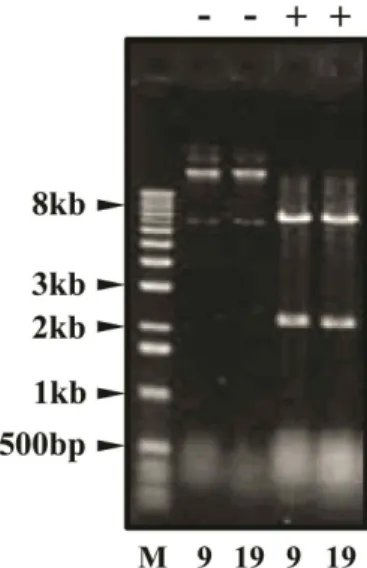
Fig. 1. Analysis of library plasmids. Library plasmids of clone
#9 and #19 were rescued from the β-galactosidase+and His+ yeast colony and transformed into
E. coli
JBE181.Bacterial colonies were then grown on M63-Leu plate.
The plasmid DNAs were extracted and the size of insert DNAs was analyzed on the 0.8% agarose gel after diges- tion with
Eco
RI andXho
I (indicated as +). Undigested plasmid DNAs were marked as -. Size marker was in- dicated as M.(Perkin Elmer Life Sciences, Inc.). GST pull-down experi- ment was performed as described [21].
Results and Discussion
Identification of a novel interaction partner of hnRNP L by two-hybrid cloning
In order to identify novel interaction partners of hnRNP L, the yeast two-hybrid screening [5] was conducted. The screening procedure utilized the hnRNP L cDNA which was fused to the DNA-binding domain of the yeast transcription factor GAL4 (DB-hnRNP L) as a bait. A human liver cDNA library fused to the GAL4 activation domain was employed as a target. About 2.2×10
6cotransformants were screened by carrying out the selection in yeast strain HF7c, which con- tains both HIS3 and LacZ reporter genes under the control of GAL4-responsive elements. Twenty eight positive colo- nies revealed both β-galactosidase activity and histidine prototrophy. Library plasmids recovered from the β-galacto- sidase
+and His
+yeast colony were transformed into E. coli JBE181. After bacterial colonies were grown on M63-Leu plates, the amplified library plasmid DNA was extracted.
The plasmid DNA was analyzed after restriction digestion.
In order to confirm interaction, library plasmids containing the cDNA sequence of the putative interaction partners were retransformed with pGBT9/hnRNP L into the reporter yeast strain. In addition, in order to check for self-activating prop- erties of the corresponding cDNAs, they were reintroduced into the reporter yeast strain with pGBT9 only. The library plasmids that conferred His
+and blue color to the reporter yeast strain only in the presence of DB-hnRNP L were fur- ther analyzed. The cDNA of these plasmids was sequenced and the sequences were characterized by BLAST analysis.
BLAST search confirmed that seven independent clones con- tain partial human IGFBP-4 cDNA (GeneBank accession number NM_001552.2). The mRNA of IGFBP-4 is composed of 2246 nucleotides and includes a single ORF of 777 nucleotides. This coding sequence, residing in between nt#313 and nt#1089, encodes 258 amino acid residues. The size of the insert DNAs of those seven clones was about 2.0 kb-long (Fig. 1). Two of them, clone #9 and clone #19, seemed to be identical. They contained the complete ORF of IGFBP-4 fused in-frame to the Gal4 activation domain.
In contrast, other clones were found to be inserted out-of- frame with the Gal4 activation domain. Clone #9, which in- cluded a partial cDNA of IGFBP-4 from nt#84 to nt#2094,
corresponding 5’UTR, complete ORF, and 3’UTR, was used as a template for PCR. A fragment of the IGFBP-4 coding sequence corresponding to amino acids 2~258 was amplified and ligated into the coding sequence of the Gal4 activation domain of pACT2. The nucleotide sequences of the PCR-am- plified inserts were confirmed by sequencing.
In vivo analysis of the interaction between hnRNP L and IGFBP4
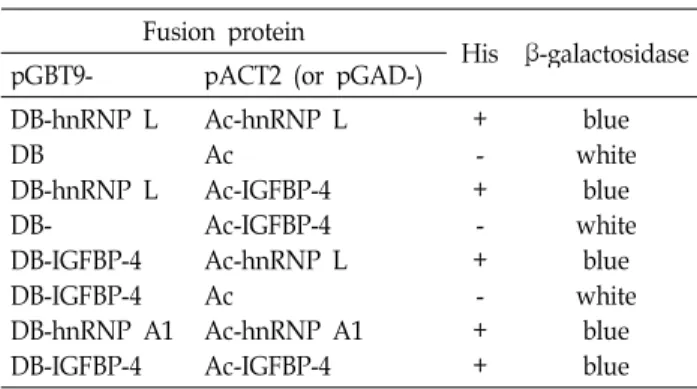
In vivo analysis of protein-protein interaction of hnRNP L and IGFBP-4 was verified after re-transformation of two plasmids into the reporter yeast strain. Visual inspection of activation of the HIS3 and LacZ reporters showed that hnRNP L interacted with IGFBP-4 (Fig. 2B, Table 1). IGFBP-4 did not induce β–galactosidase activity in cells that carried only GAL4 DNA-binding domain (Fig. 2C). This result in- dicates that IGFBP-4 does not have self-activating property.
To further confirm the interaction of hnRNP L with IGFBP-4,
the plasmid containing the IGFBP-4 cDNA fused to the Gal4
DNA-binding domain was also constructed. The interaction
between hnRNP L and IGFBP-4 was then examined. When
fusion proteins of DB-IGFBP-4 and Ac-hnRNP L were ex-
pressed in the reporter yeast strain, His
+and β-galactosidase
activity were demonstrated. (Fig. 2H, Table 1). IGFBP-4 did
Fig. 2. Interaction between hnRNP L and IGFBP-4 revealed by yeast two-hybrid analysis. HF7c yeast cells were trans- formed with the pairs of indicated plasmids. The viability of the transformed yeast cells on Trp-Leu-His-plates, indicates interactions between the hybrid proteins. The plasmids pGBT9-hnRNP L and pGAD-hnRNP L were used as positive controls. pGBT9-hnRNP A1 and pGAD- hnRNP A1 were also employed as positive controls.
Table 1. Analysis of the two-hybrid interaction between hnRNP L and IGFBP-4
Fusion protein
His β-galactosidase
pGBT9- pACT2 (or pGAD-)
DB-hnRNP L DB
DB-hnRNP L DB-
DB-IGFBP-4 DB-IGFBP-4 DB-hnRNP A1 DB-IGFBP-4
Ac-hnRNP L Ac
Ac-IGFBP-4 Ac-IGFBP-4 Ac-hnRNP L Ac
Ac-hnRNP A1 Ac-IGFBP-4
+- +- +- + +
whiteblue whiteblue whiteblue blue blue Reporter yeast strain, HF7c was transformed with the pairs of indicated plasmids. Each colony of transformed yeast cells was streaked onto Trp-Leu-plates. Yeast cells were then plated onto Trp-Leu-His-plates for the viability test. Simultaneously, these yeast cells were also transferred onto filter paper that was then incubated for a β-galactosidase filter assay. Interaction of hybrid proteins results in the activation of the
HIS3
andLacZ
reporter genes. Growth in the absence of histidine or blue color change by β–galactosidase filter assay is indicated. ‘+’ indicates growth and ‘-’ indicates ‘no growth’ on Trp- Leu- His-plates.not induce β-galactosidase activity in cells that carried only GAL4 transcription activation domain (Fig. 2G). These re- sults therefore indicate that hnRNP L specifically interacts with human IGFBP-4 in yeast two-hybrid system regardless
of the fused domains. Furthermore, when fusion proteins of DB-IGFBP-4 and Ac-IGFBP-4 were expressed in the re- porter yeast strain, His
+and β-galactosidase activity were detected (Fig. 2D). This result suggests that IGFBP-4 exists in oligomeric form as well as monomeric form.
In vitro pull-down assay indicates that IGFBP-4 interacts with hnRNP L
In order to confirm the physical interaction between two proteins, the examination of protein-protein interaction be- tween hnRNP L and IGFBP-4 was carried out, using in vitro pull-down assay. hnRNP L (141~558) was expressed as a fusion protein with bacterial glutathione S-transferase (GST).
The GST protein was used as a negative control. [
35S]-labeled IGFBP-4 protein was produced from the plasmid pCS3-MT/
IGFBP-4 (2~258), which includes six c-myc epitope tag se- quences upstream of the IGFBP-4 coding sequence. They were labeled with [
35S]-methionine and cysteine by in vitro transcription-translation in reticulocyte lysate. The GST pro- tein or GST-hnRNP L (141~558) fusion protein was bound to glutathione-Sepharose resin. Resin-immobilized GST- hnRNP L was incubated with either [
35S]-labeled IGFBP-4 or, as a control, [
35S]-labeled hnRNP L (1~558) protein. To exclude the possibility that the protein-protein interaction was mediated by protein-RNA-protein interactions, RNase A and RNase T1 were added to the reaction mixture. After washing the sample, bound GST fusion protein and any as- sociated proteins were dissociated by boiling it in SDS-con- taining buffer and were analyzed by SDS-PAGE. As shown in Figure 3, GST-hnRNP L (141~558) fusion protein was able to pull-down both radio-labeled hnRNP L and IGFBP-4. On the other hand, these labeled proteins could not be pre- cipitated by GST alone (Fig. 3). Therefore, this study con- cludes that IGFBP-4 is capable of interacting specifically and physically with hnRNP L in an in vitro pull-down assay.
IGFBP-4 is one of the insulin-like growth factor binding proteins. Six IGFBPs have been identified so far. IGFBPs reg- ulate the biological activity of IGF, either inhibiting or poten- tiating its effects by modulating bioavailability of IGFs [2].
IGFBP-4 acts by binding to IGF-I and IGF-II and modulating
their biological effects. IGFBP-4 is a very important in-
hibitory binding protein of the IGF system and inhibits IGF-I
activity by sequestering IGFs but cleavage by pregnancy as-
sociated plasma protein-A (PAPP-A) protease releases active
IGF-I [1]. IGFBP-4 was found to play a role not only as a
negative regulator, but also as a positive regulator of IGF-in-
Fig. 3.
In vitro
binding of hnRNP L to IGFBP-4 in GST pull-down assay. Thein vitro
translated and [35S]-labeled hnRNP L and IGFBP-4 proteins are shown in lanes 1 and 2, respectively. These radio-labeled proteins were incubated with resin-bound GST-hnRNP L (141~558) (lanes 3 and 4) or GST (lanes 5 and 6) in the presence of RNase A and RNase T1. After washing the samples, the resin- bound proteins were resolved on 12% SDS-polyacrylamide gel. Autoradiograph of the SDS-PAGE is shown.duced cell proliferation and differentiation [20]. Moreover, IGFBP-4 acts independent of IGF-I and IGF-II. It was sug- gested that IGF-independent activities modulate numerous cellular processes, including cell growth, differentiation, and apoptosis, although the mechanism of the IGF-independent action of IGFBP-4 is not well understood [22].
IGFBP-4 is produced mainly in the liver, but many other tissues, especially neoplastic tissue, produce it, as well [14, 17]. It has been found that most of the endogenously ex- pressed IGFBP-4 was secreted and some cellular IGFBP-4 was also detected in a variety of cells [23]. Cellular IGFBP-4 was identified as slightly bigger than the secreted IGFBP-4, presumably because of the presence of a secretion signal [23]. The function of cellular IGFBP-4 is not yet known. On the other hand, there is accumulated evidence showing the link between IGFBP-4 and a variety of cancers [4]. As a re- sult, IGFBP-4 is rapidly gaining attention as a protein related to the progression of some cancer cells.
Previous studies suggest that hnRNP L is involved in reg- ulating both translation and mRNA stability in the cytoplasm. This regulation is likely to be achieved with the assistance of other cellular factors. The function of cytoplas- mic IGFBP-4, in contrast, has not yet been identified. At this
moment, the functional consequences of protein-protein in- teraction between hnRNP L and IGFBP-4 is unknown. A fur- ther study of the in vivo interaction between these two pro- teins in human cells is required to gain insight into the cel- lular function of this protein complex.
Acknowledgements
I want to thank Dr. S. K. Jang (Department of Life Science, Pohang University of Science and Technology, Korea) for the generous gift of plasmids pGBT9/hnRNP L (1~558), pGAD424/hnRNP L (1~558) and pTM1/hnRNP L. I am grateful to Hong Gyu Park and Sun-Young Han for their assistance.
References
1. Bunn, R. C., Green, L. D., Overgaard, M. T., Oxvig, C. and Fowlkes, J. L. 2004. IGFBP-4 degradation by pregnancy-as- sociated plasma protein-A in MC3T3 osteoblasts.
Biochem Biophys Res Commun
325, 698-706.2. Clemmons, D. R. 1997. Insulin-like growth factor binding proteins and their role in controlling IGF actions.
Cytokine Growth Factor Rev
8, 45-62.3. Dreyfuss, G., Matunis, M. J., Pinol-Roma, S. and Burd, C.
G. 1993. hnRNP proteins and the biogenesis of mRNA.
Annu Rev Biochem
62, 289-321.4. Durai, R., Davies, M., Yang, W., Yang, S. Y., Seifalian, A., Goldspink, G. and Winslet, M. 2006. Biology of insulin-like growth factor binding protein-4 and its role in cancer (review).
Int J Oncol
28, 1317-1325.5. Fields, S. and Song, O. 1989. A novel genetic system to de- tect protein-protein inter-actions.
Nature
340, 245-246.6. Guang, S., Felthauser, A. M. and Mertz, J. E. 2005. Binding of hnRNP L to the pre-mRNA processing enhancer of the Herpes Simplex Virus thymidine kinase gene enhances both polyadenylation and nucleocytoplasmic export of intronless mRNAs.
Mol Cell Biol
25, 6303-6313.7. Hahm, B., Cho, O. H., Kim, J. E., Kim, Y. K., Kim, J. H., Oh, Y. L. and Jang, S. K. 1998. Polypyrimidine tract-binding protein interacts with HnRNP L.
FEBS Lett
425, 401-406.8. Hahm, B., Kim, Y. K., Kim, J. H., Kim, T. Y. and Jang, S.
K. 1998. Heterogeneous nuclear ribonucleoprotein L inter- acts with the 3' border of the internal ribosomal entry site of hepatitis C virus.
J Virol
11, 8782-8788.9. Hsieh, T., Goegon, R. E., Clemmons, D. R., Busby, W. H.
Jr. and Duan, C. 2003. Regulation of vascular smooth muscle cell responses to insulin-like growth factor (IGF)-I by local IGF-binding proteins.
J Biol Chem
278, 42886-42892.10. Hui, J., Reither, G. and Bindereif, A. 2003. Novel functional role of CA repeats and hnRNP L in RNA stability.
RNA
9, 931-936.11. Hwang, B. H., Lim, J. H., Hahm, B. S., Jang, S. K. and Lee,
초록:IGF결합 단백질-4(IGFBP-4)와 이질 핵 리보핵산단백질 L (hnRNP L)의 상호결합의 식별 최미영*
(선문대학교 의생명과학과)
hnRNP L은 pre-mRNA에 결합하는 단백질들 중에서 핵심이 되는 단백질이다. hnRNP L은 양이 아주 많은 핵 단백질로서 핵과 세포질을 왕복하는 특성을 지니고 있다. 이 단백질은 염색질 변형(chromatin modification), pre-mRNA 스플라이싱, 인트론이 없는 유전자들에서 유래한 mRNA들의 세포질로의 반출(export), IRES-매개성 번역, mRNA의 안정성 조절, 정자형성과정 등, 세포 내의 여러 가지 과정에 관여하고 있는 것으로 알려져 있다.
이 논문에서는 hnRNP L과 결합하는 세포 내 단백질을 찾아내기 위하여 사람의 간세포 cDNA library를 사용하여 이스트 two-hybrid 탐색 실험을 수행하였다. 그 결과 사람의 간세포에서 IGFBP-4가 hnRNP L과 상호결합하는 새로운 파트너라는 것을 발견하였다. 본 연구를 통하여 hnRNP L이 이스트 two-hybrid 시스템에서 IGFBP-4와 특이적으로 상호 결합한다는 것을 처음으로 발견하였다. 본 연구에서는 또한 이스트 two-hybrid 시스템에서 hnRNP L이 IGFBP-4와 상호결합한다는 점을 in vitro pull-down 실험을 통하여 재확인하였다.
S. W. 2009. hnRNP L is required for the translation mediated by HCV IRES.
Biochem Biophys Res Commun
378, 584-588.12. Kim, J. H., Hahm, B., Kim, Y. K., Choi, M. and Jang, S.
K. 2000. Protin-protein interaction among hnRNPs shut- tling between nucleus and cytoplasm.
J Mol Biol
298, 395-405.13. Krecic, A. M. and Swanson, M. S. 1999. hnRNP complexes:
composition, structure, and function.
Curr Opin Cell Biol
11, 363-371.14. Kroc-Grodzicki, B., Ren, N. and Hilf, R. 1993. Insulin-like growth factor-binding proteins in R3230AC mammary tu- mors of intact and diabetic rats.
Endorcinology
133, 2362- 2370.15. Lee, H. H., Monica, H., Hui, J., Silke, S., Vladimir, B. and Albrecht, B. 2008. Diverse roles of hnRNP L in mammalian mRNA processing : A combined microarray and RNAi analysis.
RNA
14, 284-296.16. Lee, S. Y., Jang, S. K. and Choi, M. 2003. Human hnRNP L shuttles between nucleus and cytoplasm.
Korean J Genetics
25, 141-145.17. Lewinski, A., Marcinkowska, M., Brzezianska, E., Jeziorow- ska, A., Wloch, J. and Brzezinski, J. 2004. Expression of in- sulin-like growth factor I (IGF-I) gene and of genes for IGF-binding proteins 1,2,3,4 (IGFBP-1-IGFBP-4) in non-neo- plastic human thyroid cells and in certain human thyroid cancers. Effect of exogenous IGH-I on this expression.
Endorcr Res
30, 47-59.18. Li, J., Guo, W., Li, F., He, J., Yu, Q., Wu, X., Li, J. and Mao, W. 2012. HnRNP L as a key factor in spermatogenesis:
Lession from functional proteomic studies of azoospermia patients with sertoli cell only syndrome
. J Proteomics
75, 2879-2891.19. Loiodice, I., Alves, A., Rabut, G., Van Overbeek, M., Ellen- berg, J., Sibarita, J. B. and Doye, V. 2004. The entire Nup107-160 complex, including three new members, is tar- geted as one entity to kinetochores in mitosis.
Mol Biol Cell
7, 3333-3344.20. Ning, Y., Schuller, A. G. P., Conover, C. A. and Pintar, J.
E. 2008. Insulin-like growth factor (IGF) binding protein-4 is both a positive and negative regulator of IGF activity
in vivo
.Mol Endocrinol
22, 1213-1225.21. Park, H. G., Yoon, J. Y. and Choi, M. 2007. Heterogeneous nuclea ribonucleoprotein D/AUF1 interacts with heteroge- neous nuclear ribonucleoprotein L.
J Biosci
32, 1263-1272.22. Ricort, J. M. 2004. Insulin-like growth factor binding protein (IGFBP) signaling.
Growth Horm IGF Res
14, 277-286.23. Ryan, A. J., Napoletano, S., Fitzpatrick, P. A., Currid, C. A., O’sullivan, N. C. and Harmey, J. H. 2009. Expression of a protease-resistant insulin-like growth factor-binding pro- tein-4 inhibits tumor growth in a murine model of breast cancer.
![Fig. 3. In vitro binding of hnRNP L to IGFBP-4 in GST pull-down assay. The in vitro translated and [ 35 S]-labeled hnRNP L and IGFBP-4 proteins are shown in lanes 1 and 2, respectively](https://thumb-ap.123doks.com/thumbv2/123dokinfo/5015243.549956/5.892.132.388.161.473/vitro-binding-igfbp-translated-labeled-igfbp-proteins-respectively.webp)
