https://doi.org/10.14734/PN.2018.29.3.121 pISSN 2508-4887•eISSN 2508-4895
Misun Yang, MD1, Jin Wha Choi, MD2, Ji Sook Kim, MD3, So Yoon Ahn, MD, PhD1, Se In Sung, MD, PhD1, Yun Sil Chang, MD, PhD1, Won Soon Park, MD, PhD1
1Department of Pediatrics, Samsung Medical Center, Sungkyunkwan University School of Medicine, Seoul; 2Department of Pediatrics, Korea University College of Medicine, Seoul; 3Department of Pediatrics, School of Medicine, Kyungpook National University, Daegu, Korea
Objective: The purpose of this study is to compare the clinical characteristics of newborn hearing test results between infants in well-baby nursery (WBN) versus neonatal intensive care unit (NICU) and to determine the optimal strategies of hearing screening for each group.
Methods: A total of 2,161 newborns admitted to WBN and NICU were enrolled in this retrospective cohort study. Automated audio brainstem response was used for hearing screening test. The screening rates, referral rates, prevalence rates, false positive rates and predictive positive value (PPV) were an- alyzed for infants in WBN and NICU.
Results: The referral rates of the screening test were 2.2% and 5.0% in WBN and NICU groups (P<0.01);
the prevalence rate of congenital hearing loss (HL) were 0.5% and 4.6% in the WBN and NICU groups (P<0.01). The false positive rates and PPV of screening test were 0.9% and 36.8% in WBN; 0.8% and 80% in NICU. Infants with bilateral refer results in both WBN and NICU were at the higher risk of con- genital HL, compared with infants with unilateral refer results in WBN who were mostly confirmed to have false positive.
Conclusion: The infants in WBN showed high unilateral referral rate with low prevalence rate of HL.
However, the infants with bilateral refer results in WBN and uni- or bi-lateral refer results in NICU had higher prevalence rate of HL, compared with those with unilateral refer results in WBN. Different strategies for hearing screening might be considered in infants in WBN and NICU.
Key Words: Neonatal screening, Hearing loss, Auditory brainstem responses
서론
신생아 난청은 전체 생존 출생아 중 0.1-0.3%, 신생아중환자실 퇴원 아기 중 2-4%를 차 지하여 발생률이 높은 선천성 질환에 속한다.1 또한 언어 및 인지 발달을 위한 조기 중재의 중요성이 강조되면서 조기 진단과 이를 위한 선별검사에 대한 관심이 증대되고 있다. 이에 따라 검사 도구 및 방법의 질을 높여 선별검사 의뢰율(referral rate)을 낮추고자 하나, 나라 혹은 기관마다 선별검사 도구와 방법이 일관되지 않고 비용 대비 효과에 대한 논란 역시 지 속되고 있다.2-4
미국국립보건원(National Institutes of Health)과 미국국립보건원유아청력합동위원회 (Joint Committee on Infant Hearing, JCIH)는 유발이음향방사검사(otoacoustic emission, OAE) 또는 자동화청성뇌간반응(automated audio brainstem response, AABR)을 이용한 2단계 선별검사를 시행할 것을 권고하고 있다.5 본 병원에서는 AABR을 이용하여 신생아실 과 신생아중환자실 아기 모두에게 1단계 난청 선별검사를 동일하게 적용하고 있다. 하지만 신생아실과 신생아중환자실에 입원하는 아기들의 난청 위험도는 다를 것으로 판단되어5,6 같은 프로토콜을 적용하는 것이 합당한지에 대한 의문이 제기되었다. 이에 저자들은 본 병 Received: 26 April 2018
Revised: 8 June 2018 Accepted: 6 July 2018 Correspondence to Yun Sil Chang, MD, PhD
Department of Pediatrics, Samsung Medical Center, Sungkyunkwan University School of Medicine, 81 Irwon-ro, Gangnam-gu, Seoul 06351, Korea
Tel: +82-2-3410-3539 Fax: +82-2-3410-0043 E-mail: [email protected]
Copyright© 2018 by The Korean Society of Perinatology
This is an Open Access article distributed under the terms of the Creative Com- mons Attribution Non-Commercial License (http://creativecommons.org/
license/by-nc/4.0/), which permits unrestricted non-commercial use, distribution, and reproduction in any
Newborn Hearing Screening Test: A Com
parison between Infants in Neonatal In
tensive Care Unit versus Nursery
대상 및 방법
1. 대상군
본 연구는 연구심의위원회(IRB SMC 2018-03-057)의 승인 을 받은 후 2015년 8월부터 2016년 12월까지 삼성서울병원 신 생아실과 신생아중환자실에서 퇴원한 신생아 2,161명(신생아 실 1,544명, 신생아중환자실 617명)을 대상으로 의무기록의 후 향적 차트 분석을 통하여 청력 손상 양상을 조사하였다.
2. 난청검사 방법
난청 선별검사는 보호자의 동의를 얻은 후 AABR로 검사하였 으며 검사 시기는 신생아실 아기는 출생 후 2-5일 이내에, 신생 아중환자실 아기는 교정 주수 34주 이상이면서 생체 활력 징후 가 안정되어 퇴원이 예정된 시기로 정하였다. 검사는 주변 소음이 최소화된 조용한 방에서 아기가 정상 수면 상태일 때 숙련된 신생 아실/신생아중환자실 간호사가 시행하였다. AABR은 ALGO5 (Natus Medical Inc®, San Carols, CA, USA)를 이용하였으며, 기계의 원리는 다음과 같다. 헤드폰을 통하여 아기의 양쪽 귀에 클릭 소리의 35 dB 음향 자극을 번갈아 준 후 피부에 부착된 전 극을 통하여 뇌간에 들어오는 전기적 신호를 분석한다. 기계 내 의 프로그램이 피검사자의 제5파형을 정상 아기들의 데이터와 비교 후 99% 이상 일치시 ‘통과(pass)’로, 15,000회 이상의 비 교에도 일치하지 않을 시 ‘의뢰(refer)’로 판정하여 결과를 송출 한다.
난청 진단검사는 청성뇌간반응(auditory brainstem response, ABR)으로 생후 3개월 이내에 시행하는 것을 원칙으로 하였다.
중증의 뇌실내출혈, 선천성 거대세포바이러스 감염 및 청력 손 상을 초래할 수 있는 중추신경계 질환이 있는 아기들은 선별검 사 없이 바로 진단검사를 시행하였다. 검사는 클로랄하이드레 이트(chloral hydrate) 시럽을 투여 후 수면이 유도된 상태에서 이비인후과 외래에 있는 청력검사실 안에서 청각사가 진행하였 다. ABR은 Nicolet Viking Select (Natus Medical Inc®)를 이용 하여 제5파형 그래프의 최저자극치가 40 dB 이상일 때 난청이라 진단하였다. 보조적 진단 도구로 청성지속반응(auditory steady state response)과 OAE를 사용하였고, 이비인후과 전문의가 고 막관찰을 함께 시행하였다.
3. 데이터 수집
이를 토대로 신생아실 아기와 신생아중환자실 아기의 선별검 사 시행률, 선별검사 의뢰율, 진단검사 시행률, 난청 발생률, 선 별검사 위양성률 및 양성예측도를 구하였다. 각 용어의 정의는 다음과 같다. 선별검사 시행률은 해당 기간 동안 퇴원한 아기 중
선별검사를 시행한 아기 수의 비율, 의뢰율은 선별검사를 시행 한 아기 중 의뢰로 판정된 수의 비율, 진단검사 시행률은 선별검 사를 시행한 아기 중 진단검사를 시행한 아기 수의 비율, 난청 발생률은 선별검사를 시행한 아기 중 진단검사상 난청으로 나 타난 아기 수의 비율로 정의하였다. 위양성률은 진단검사상 정 상으로 나온 아기 중 선별검사상 의뢰로 나타난 아기 수의 비율, 양성예측도는 선별검사상 의뢰로 나타난 아기 중 진단검사상 실제 난청으로 확인된 아기 수의 비율로 정의하였다.
4. 통계분석 방법
선별검사에서 의뢰된 아기 중 진단검사에서 난청으로 진단된 아기와 정상으로 확인된 아기(위양성군)에게 난청 위험요인의 빈도를 Fisher’s exact test를 통하여 비교하였고, 출생 체중, 재 태 주수 및 아프가 점수 항목 비교는 independent t-test를 이용 하였다. 통계프로그램은 SPSS version 24.0 (IBM Corp., Ar- monk, NY, USA)을 이용하였고 P값이 0.05 미만일 시 두 군이 통계적으로 유의한 차이가 있는 것으로 평가하였다.
결과
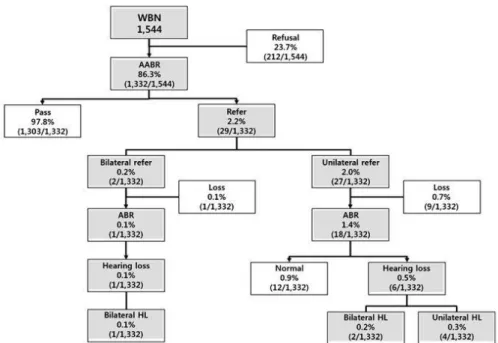
1. 신생아실의 난청 진단 과정 및 난청 양상
해당 기간 동안 신생아실을 퇴원한 총 1,544명 중 1,332명이 난청 선별검사를 받아 선별검사 시행률은 86.3%, 의뢰율은 2.2%
였으며 일측성 의뢰군이 양측성 의뢰군보다 13.5배 많았다. 양성 예측도는 양측성 의뢰군에서 일측성 예측도보다 3배 높았다. 난 청 발생률은 0.5%로 일측성이 양측성의 1.5배였다(Fig. 1).
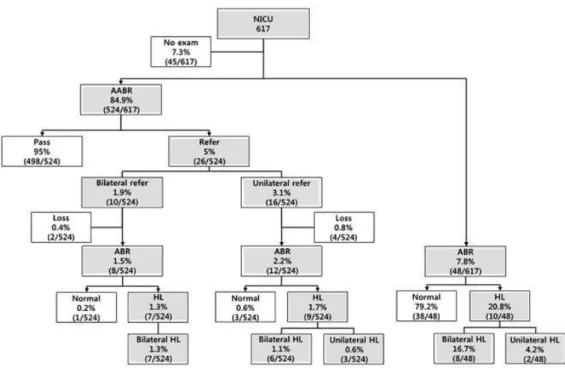
2. 신생아중환자실의 난청 진단 과정 및 난청 양상
해당 기간 동안 신생아중환자실을 퇴원한 총 617명 중 524명 이 난청 선별검사를 받아 선별검사 시행률은 84.9%, 의뢰율은 5.0%였으며 일측성 의뢰군이 양측성 의뢰군보다 1.6배 많았다.
선별검사를 받지 않은 93명 중 48명은 진단검사를 시행하였으 며(Table 1) 이 중 난청으로 진단된 수는 10명이었다. 따라서 신 생아중환자실에서 퇴원 전 선별검사 및 진단검사를 시행받은 아기는 92.7% (572/617명)였고 추적 소실된 6명을 제외하였을 시 난청 발생률은 4.6% (26/566명)였으며 양측성 난청이 일측 성 난청의 4.2배에 해당하였다(Fig. 2).
3. AABR을 이용한 난청 선별검사 결과
난청 선별검사 의뢰율과 난청 발생률은 신생아중환자실이 신 생아실보다 유의하게 더 높았다(P<0.01). 특히 양측성 난청 발
신생아실보다 높았으나 2단계 선별검사를 실시하여 의뢰율을 1.58%까지 낮추었다.7 실제 난청 발생률은 0.46%로, 본원의 0.5%와 큰 차이 없었으며 최종 선별검사의 양성예측도 및 위양성 률은 각각 30.4%, 1.05%로 본원 신생아실의 양성예측도 36.8%, 위양성률 0.9%와 비슷하여 본원의 선별검사 방법이 1단계임에 도 효용성이 크다는 것을 알 수 있었다. 이는 오랜 경력을 갖춘 생률이 각각 0.2%, 3.7%로 신생아중환자실이 유의하게 높았다
(P<0.01). 난청 선별검사의 양성예측도는 추적 소실된 아기를 제외하였을 때 신생아중환자실이 신생아실보다 유의하게 더 높 았고(P=0.01), 양측성 의뢰군에서 양성예측도가 일측성 의뢰군 에서의 양성예측도보다 높았다(Table 2).
4. 난청(양성)과 위양성 간의 위험인자 비교
난청 선별검사에서 의뢰된 신생아실 아기 중 실제 난청인 아 기들과 위양성으로 나온 아기들 간 위험인자의 유의한 차이는 없었다. 신생아중환자실의 경우 고령 산모, 임신성 고혈압, 기관 지폐이형성증, 이독성 약물 투여, 패혈증, 염색체 이상을 포함한 두개안면기형 및 선천성 심기형 비율이 난청위양성 아기들에서 보다 실제 난청인 아기들에서 더 높았으나 유의한 차이는 아니 었다(Tables 3, 4).
고찰
본원의 AABR을 이용한 난청 선별검사의 의뢰율은 신생아실 과 신생아중환자실 각각 2.2%, 5.0%였고 양성예측도는 신생아 실 36.8%, 신생아중환자실 80%였다. 본원과 비슷한 규모의 국 내 타기관에서 발표한 연구 결과에 따르면 신생아실 아기들에게 AABR을 이용한 1단계 난청 선별검사 의뢰율은 3.95%로 본원
Table 1. Indications for Infants Who Underwent Diagnostic Test without Screening
Value Metabolic encephalopathy, neonatal epilepsy 4 (8.3) Congenital brain anomaly, cerebral artery infarction, fetal
hydrops with hydrocephalus
6 (12.5)
Grades III-IV IVH with posthemorrhagic hydrocephalus 11 (22.9)
Hypoxic-ischemic encephalopathy 6 (12.5)
Periventricular leukomalacia 9 (18.8)
Brain abscess 1 (2.1)
Skull bone fracture 1 (2.1)
In utero infection (congenital CMV infection) 2 (4.2)
Transfer from NICU to general ward 5 (10.4)
Others 3 (6.2)
Total 48
Values are presented as number (%).
Abbreviations: IVH, intraventricular hemorrhage; CMV, cytomegalovirus; NICU, neonatal intensive care unit.
Fig. 1. Flowchart of newborn hearing screening and diagnostic test for well-baby nursery infants.
WBN, well-being nursery; AABR, automated audio brainstem response; ABR, audio brainstem response; HL, hearing loss.
숙련된 간호사가 검사를 수행하며 아기가 깊은 수면을 유지할 수 있도록 조용하고 어두운 환경을 조성하여 환경 소음과 근육 운동으로 인한 위양성률을 최대한 줄이고자 하였기 때문으로 판단된다.
신생아중환자실의 경우 브라질에서 시행한 대규모 연구에서 AABR을 이용한 1단계 선별검사의 양성예측도는 36.3%였으나 2단계 선별검사의 양성예측도는 85.7%였다.8 또한 독일에서 신 생아중환자실을 대상으로 시행한 연구에서 AABR을 이용한 선 별검사의 양성예측도는 77.7%, 2단계 선별검사를 통한 양성예 Fig. 2. Flowchart of newborn hearing screening and diagnosis test for neonatal intensive care unit in fants.
NICU, neonatal intensive care unit; AABR, automated audio brainstem response; ABR, audio brainstem res- ponse; HL, hearing loss.
Table 3. Comparison of Risk Factors between Hearing Loss Group and False Positive Group in Well-Baby Nursery Infants
Total
(n=19) HL group
(n=7) False positive group (n=12) P-
value Elderly gravida (>35 years) 4 (21.1) 1 (14.3) 3 (25.0) 1.00
Maternal GDM 3 (15.8) 1 (14.3) 2 (16.7) 1.00
Gestational age (weeks) 38.6±1.6 38.1±2.6 39.1±1.0 0.30 Birth weight (g) 3,078±540 2,901±664 3,207±416 0.09
<1,500 g birth weight 4 (21.1) 3 (42.9) 2 (16.7) 0.31
Apgar score, 1 minute 8.7±1.0 8.9±0.4 8.6±1.2 0.56
Apgar score, 5 minutes 9.5±0.8 9.8±0.5 9.4±0.9 0.43
Male 11 (57.9) 4 (57.1) 7 (58.3) 1.00
NSVD 14 (73.7) 4 (57.1) 10 (83.3) 0.31
Chromosome abnormality 1 (5.3) 0 (0) 1 (8.3) 1.00
Craniofacial anomaly 0 (0) 0 (0) 0 (0) -
Congenital heart disease 2 (10.5) 1 (14.3) 1 (8.3) 1.00 Values are presented as number (%).
Abbreviations: HL, hearing loss; GDM, gestational diabetes mellitus; NSVD, normal spontaneous vaginal delivery.
Table 2. Comparison of Newborn Hearing Screening Test in Well- Baby Nursery and Neonatal Intensive Care Unit Infants
WBN infants NICU infants P-value Coverage rate of screening test 1,332/1,544 (86.3) 524/617 (84.9) 0.64
Referral rate 29/1,332 (2.2) 26/524 (5.0) <0.01
Bilateral HL 2/1,332 (0.2) 10/524 (1.9) <0.01
Unilateral HL 27/1,332 (2.0) 16/524 (3.1) 0.23
Coverage rate of diagnostic test 19/29 (65.5) 20/26 (76.9) 0.39 Prevalence rate 7/1,322 (0.5) 26/566 (4.6) <0.01
Bilateral HL 3/1,322 (0.2) 21/566 (3.7) <0.01
Unilateral HL 4/1,322 (0.3) 5/566 (0.9) 0.13
False positive rate 0.9% 0.8% 1.00
Bilateral refer 0% 0.2% 0.28
Unilateral refer 0.9% 0.6% 0.77
Predictive positive value 7/19 (36.8) 16/20(80.0) 0.01
Bilateral refer 1/1 (100.0) 7/8 (87.5) 1.00
Unilateral refer 6/18 (33.3) 9/12(75.0) 0.06
Values are presented as number (%).
Abbreviations: WBN, well-baby nursery; NICU, neonatal intensive care unit; HL, hearing loss.
측도는 83.9%로 나타났다.9 이렇듯 2단계 선별검사는 최종 의 뢰율을 낮춤으로써 양성예측도를 높일 수 있으며 특히 1단계 선 별검사의 양성예측도가 낮을 때 2단계 선별검사의 효용성이 더 클 것으로 기대할 수 있다.
본원 신생아실의 일측성 의뢰군의 양성예측도가 33.3%였으 나 양측성 의뢰군의 양성예측도는 100%였고, 신생아중환자실 의 일측성, 양측성 의뢰군에서 양성예측도는 각각 75%, 87.5%
로 나타났다. 신생아실과 신생아중환자실 모두 일측성 의뢰군 에서보다 양측성 의뢰군에서의 양성예측도가 더 높았고 특히 신생아실의 경우 그 차이가 컸다. 2010년 영국에서 발표한 대규 모 연구에서도 선별검사의 일측성 의뢰군보다 양측성 의뢰군의 양성예측도가 약 4배 더 높았다.10 따라서 신생아실의 일측성 의 뢰군에 대해서는 2단계 선별검사를 시행하는 것을 고려해 볼 수 있다. 이는 2010년 대한이과학회와 대한청각학회가 신생아 청
각선별검사 지침서에서 권고한 ‘신생아실 아기의 선별검사 결 과 일측성 또는 양측성 의뢰가 나올 시 재선별검사를 시행한다’
와 부분적으로 일치한다.11 단, 본 연구에서 신생아실의 양측성 의뢰군의 수가 2명으로 적었고 양성예측도를 구할 때 추적 소실 된 1명의 아기를 제외하였기 때문에 신생아실의 양측성 의뢰군 의 높은 양성예측도가 과대평가되었을 가능성이 있다. 따라서 신생아실에서 양측성 의뢰로 나올 시 진단검사를 바로 시행하 는 것이 효과적일 것으로 고려되나 더 많은 수를 대상으로 조사 하여 같은 결과가 나오는지에 대하여 추가 연구가 필요하다.
신생아 난청은 언어 발달의 지연과 이로 인한 의사소통, 인지 및 사회정서 장애를 초래할 수 있는 중요한 질환이다.12 신생아 선별검사 없이 언어 발달 지연을 통하여 청력손실을 인지하게 될 경우 난청의 진단 시기는 만 18-24개월, 경증 청력손실의 진 단 시기는 만 48개월 이후가 되며, 6개월에서 1세 이전에 치료 를 시작하지 않을 경우 이미 진행된 언어 발달 지연을 개선시키 기 어렵다.13-15 따라서 1999년, JCIH는 생후 1개월 이전의 모든 신생아에게 난청 선별검사를 시행하고 만 3개월 이전에 진단적 검사를 시행하며 만 6개월 이내에 조기 중재를 시행할 것을 권 고하였다.12 또한 1999년 미국소아학회(American Academy of Pediatrics, AAP)와 2000년 JCIH는 신생아 난청 선별검사(uni- versal newborn hearing screening)의 목표로 95% 이상의 선 별검사 시행률, 4% 이하의 의뢰율, 95% 이상의 추적검사 시행 률 그리고 3% 이하의 위양성률을 달성할 것을 제시하였다.5,16
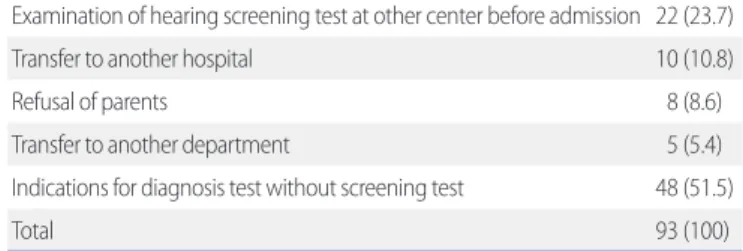
본원에서의 선별검사 시행률은 85.9%이고, 이 중 신생아실은 86.3%, 신생아중환자실은 84.9%로 이전 대규모 연구들의 결과 인 81.2-99.8% 범위 내에 해당되나 JCIH에서 권고하는 95%에 미치지 못하였다.5-9,15 선별검사 시행률이 기준에 미치지 못한 가장 흔한 이유로는 보건소에서 검사 비용을 지원받은 후에 검 사를 시행하기 위함이었으며 신생아실 미시행 아기의 100%와 신생아중환자실 미시행 아기의 8%가 이에 해당되었다. 우리나 라는 2007년 이후 복지정책의 일환으로 보건소에서 일부 저소 득층 가정(시, 도에 따라 모든 가정)에게 난청 선별검사쿠폰을 발급하여 무료검사를 시행받을 수 있도록 안내하고 있다.7 그러 나 보건소 방문 등의 절차상 번거로움 때문에 저소득층의 난청 선별검사의 시행률이 낮아질 수 있으므로 온라인쿠폰 발급 등 절차의 개선을 통하여 선별검사 시행률을 높이는 것이 필요하 다. 선별검사 미시행의 두 번째로 흔한 이유로는 신생아중환자 실에서 중추신경계 질환과 관련된 난청의 고위험군에게 선별검 사 없이 진단적 검사를 바로 시행하였기 때문이며, 그 외 타원으 로 전원 등의 이유가 있었다(Table 5).
신생아중환자실의 난청 선별검사 의뢰율은 다른 대규모 연구 들의 결과인 2.8-9.2% 내에 해당되나 JCIH이 권고한 4.0%보다 Table 4. Comparison of Risk Factors between Hearing Loss Group
and False Positive Group in Neonatal Intensive Care Unit Infants Total
(n=20) HL group
(n=16) False positive group (n=4) P-
value Elderly gravida (>35 years) 6 (30) 6 (37.5) 0 (0) 0.27
Maternal GDM 0 (0) 0 (0) 0 (0) -
Maternal preeclampsia 2 (10) 2 (12.5) 0 (0) 1.00
Gestational age (weeks) 32.6±5.1 33.4±5.1 29.1±1.7 0.15 Birth weight (g) 2,032±1,032 2,151±1,031 1,558±1,028 0.32
<1,500 g birth weight 11 (55) 8 (50) 3 (75) 0.59
Male 10 (50) 8 (50) 2 (50) 1.00
NSVD 8 (40) 6 (37.5) 2 (50) 1.00
Apgar score, 1 minute 6.6±2.0 6.7±2.1 6.3±1.7 0.70
Apgar score, 5 minutes 8.3±1.3 8.3±1.3 8.0±1.4 0.67
RDS 8 (40) 6 (37.5) 2 (50) 1.00
BPD 8 (40) 7 (43.8) 1 (25) 0.62
Pulmonary hypertension 1 (5) 1 (6.2) 0 (0) 1.00
IVH 16 (80) 12 (75) 4 (100) 0.54
Periventricular leukomalacia 2 (10) 1 (6.2) 1 (25) 0.37
Neonatal seizure 5 (25) 4 (25) 1 (25) 1.00
Exposure to ototoxic medications
12 (60) 11 (68.8) 1 (25) 0.26
Sepsis 3 (15) 3 (18.8) 0 (0) 1.00
Chromosome abnormality 2 (10) 2 (12.5) 0 (0) 1.00
Craniofacial anomaly 5 (25) 5 (31.2) 0 (0) 0.53
Congenital heart disease 6 (30) 5 (31.2) 1 (25) 1.00
Congenital infection 0 (0) 0 (0) 0 (0) -
Values are presented as number (%).
Abbreviations: HL, hearing loss; GDM, gestational diabetes mellitus; NSVD, normal spontaneous vaginal.
높았다.5,6,8,9,16 이는 실제 난청 발생률이 4.6%로 난청 발생률 자 체가 높았기 때문이라고 생각된다. 이는 기존 연구 결과인 2.2- 2.9%보다 높은 발생률을 나타내는데 본원의 경우, AAP에서 제 시한 신생아 케어 레벨 중 최상급인 4레벨에 속하는 병원으로17 비교 대상이었던 다른 기관의 2-3레벨보다는 질환의 중증도가 높고 난청 위험인자를 상대적으로 더 많이 갖고 있기 때문으로 판단된다. 신생아중환자실의 선별검사 위양성률은 0.8%로 오 히려 JCIH 권고수준과 다른 연구들에 비하여 낮은 수준이었
다.5,6,8,9,16 또한 신생아실의 난청 발생률은 0.5%로, 기존 대규모
연구의 결과인 0.4-0.5%와 비슷하였다.6,7,9
선별검사 의뢰군 중 진단검사상 난청으로 확인된 아기들과 위 양성인 아기들 간에 위험인자의 유의한 차이는 없었다. 또한 신 생아실에서 난청 아기 7명 중 6명(85.7%)은 위험인자가 없었 다. 이는 난청 선별검사가 고위험군뿐 아니라 모든 신생아에게 필요하다는 기존의 연구 결과에 부합한다.16
이 연구의 한계는 단일기관의 자료를 분석한 것으로, 연구의 정확도를 위하여 다기관에서 더 많은 수의 데이터 수집이 필요 하다. 또한 난청 아기의 위험인자를 알아보기 위하여 선별검사 를 시행한 모든 아기들의 위험인자를 조사하여 난청 아기들과 정상 아기들에서의 비교가 필요하겠다.
본 병원 신생아실 아기들은 난청 선별검사 상 일측성 의뢰율 이 높았으며 일측성의 경우 진단검사상 실제 난청률은 낮아 양 성예측도가 낮았다. 신생아중환자실 아기들은 난청 선별검사 상 양측성과 일측성 의뢰의 빈도에서 큰 차이가 없었으며 양성 예측도 또한 두 군 모두 높았다. 따라서 신생아실에서 선별검사 상 일측성 의뢰일 경우 2단계 선별검사 시행을 고려해야 하며, 양측성 의뢰이거나 신생아중환자실에서 일측성/양측성 의뢰일 경우 진단검사의 시행을 고려해야 한다. 그러나 이것은 단일기 관의 결과로 전체에 적용하기 위해서는 더 많은 수의 대상자와 다기관에서의 연구가 필요하다.
References
1) Wroblewska-Seniuk KE, Dabrowski P, Szyfter W, Mazela J. Universal new- born hearing screening: methods and results, obstacles, and benefits.
Pediatr Res 2017;81:415-22.
2) Clemens CJ, Davis SA, Bailey AR. The false-positive in universal newborn hearing screening. Pediatrics 2000;106:E7.
3) Hessel F, Grill E, Schnell-Inderst P, Siebert U, Kunze S, Nickisch A, et al.
Economic evaluation of newborn hearing screening: modelling costs and outcomes. Ger Med Sci 2003;1:Doc09.
4) Lemons J, Fanaroff A, Stewart EJ, Bentkover JD, Murray G, Diefendorf A.
Newborn hearing screening: costs of establishing a program. J Perinatol 2002;22:120-4.
5) Joint Committee on Infant Hearing, American Academy of Audiology, American Academy of Pediatrics, American Speech-Language-Hearing Association, Directors of Speech and Hearing Programs in State Health and Welfare Agencies. Year 2000 position statement: principles and guidelines for early hearing detection and intervention programs. Joint Committee on Infant Hearing, American Academy of Audiology, Ame- rican Academy of Pediatrics, American Speech-Language-Hearing As- sociation, and Directors of Speech and Hearing Programs in State Health and Welfare Agencies. Pediatrics 2000;106:798-817.
6) Li PC, Chen WI, Huang CM, Liu CJ, Chang HW, Lin HC. Comparison of newborn hearing screening in well-baby nursery and NICU: a study applied to reduce referral rate in NICU. PLoS One 2016;11:e0152028.
7) Lim HW, Han MW, Lee HS, Kim KS, Chung JW, Kim YJ, et al. The validity using two-stage automated auditory brainstem response as a universal newborn hearing screening protocol: experiences in Asan medical center. Korean J Otolaryngol-Head Neck Surg 2007;50:108-14.
8) Colella-Santos MF, Hein TA, de Souza GL, do Amaral MI, Casali RL. New- born hearing screening and early diagnostic in the NICU. Biomed Res Int 2014;2014:845308.
9) van Dommelen P, van Straaten HL, Verkerk PH; Dutch NICU Neonatal Hearing Screening Working Group. Ten-year quality assurance of the nationwide hearing screening programme in Dutch neonatal intensive care units. Acta Paediatr 2011;100:1097-103.
10) Wood SA, Sutton GJ, Davis AC. Performance and characteristics of the newborn hearing screening programme in England: the first seven years. Int J Audiol 2015;54:353-8.
11) Korean Audiological Society, Korean Otologic Society. Korean Clinical Practice Guildline: Newborn Hearing Screening 2010. Seoul: ML Com- munications; 2011:1-80.
12) American Academy of Pediatrics, Joint Committee on Infant Hearing.
Year 2007 position statement: principles and guidelines for early hearing detection and intervention programs. Pediatrics 2007;120:898-921.
13) Stein LK, Jabaley T, Spitz R, Stoakley D, McGee T. The hearing-impaired infant: patterns of identification and habilitation revisited. Ear Hear 1990;
11:201-5.
14) Coplan J. Deafness: ever heard of it? Delayed recognition of permanent hearing loss. Pediatrics 1987;79:206-13.
Table 5. Causes of Undoing the Hearing Screening Test in Neonatal Intensive Care Unit
Value Examination of hearing screening test at other center before admission 22 (23.7)
Transfer to another hospital 10 (10.8)
Refusal of parents 8 (8.6)
Transfer to another department 5 (5.4)
Indications for diagnosis test without screening test 48 (51.5)
Total 93 (100)
Values are presented as number (%).
15) Pimperton H, Kennedy CR. The impact of early identification of perma- nent childhood hearing impairment on speech and language outcomes.
Arch Dis Child 2012;97:648-53.
16) Erenberg A, Lemons J, Sia C, Trunkel D, Ziring P. Newborn and infant hearing loss: detection and intervention. American academy of pedia-
trics. Task force on newborn and infant hearing, 1998- 1999. Pediatrics 1999;103:527-30.
17) American Academy of Pediatrics Committee on Fetus Newborn. Levels of neonatal care. Pediatrics 2012;130:587-97.