https://doi.org/10.14734/PN.2020.31.4.179 pISSN 2508-4887•eISSN 2508-4895
Jung Eum Lee, MD, Hyon Jee Yoon, MD, Yu-Ri Jang, RN, Hyun Sun Ko, MD, PhD Department of Obstetrics and Gynecology, Seoul St. Mary’s Hospital, College of Medicine, The Catholic University of Korea, Seoul, Korea
Objective: The aim of this study was to analyze the relationship between maternal origin and risks of term low birth weight (TLBW) or macrosomia in Korea.
Methods: Using Korean birth statistics from 2009 to 2015, we examined the association between maternal nationality and risks of TLBW (less than 2.5 kg) or term macrosomia (over 4.0 kg). Birth stati
stics included singleton live births in women, from 37 to 41 weeks’ gestation, during the period 2009
2015. Immigrant mothers were defined as women born in any country other than Korea, and were grouped by economic level of maternal country of origin. Odds ratios (ORs) and 95% confidence in
tervals (CIs) were estimated with multivariate logistic regression analysis.
Results: There were significant differences in neonatal birth weights between Korean mothers and immigrant mothers (3.28±0.38 kg vs. 3.24±0.39 kg, P<0.001). In multivariate logistic regression ana
lysis, the risk of TLBW was significantly higher (OR: 1.268, 95% CI: 1.1811.361, P<0.001) and the risk of macrosomia was significantly lower (OR: 0.607, 95% CI: 0.5180.71, P<0.001), in mothers from low and lower middle income countries, compared to Korean mothers. The risk of macrosomia was signi
ficantly higher (OR: 1.387, 95% CI: 1.2281.566, P<0.001) and the risk of TLBW was significantly lower (OR: 0.879, 95% CI: 0.810.954), in mothers from high and upper middle income countries, compared to Korean mothers.
Conclusion: After adjustment for relevant characteristics, the risk of TLBW was higher in immigrant mothers from low and lower middle income countries, but the risk of macrosomia was higher in im
migrant mothers from high and upper middle income country. Prenatal care and education needs to consider the origin of immigrant mothers.
Key Words: Immigrants, Low birth weight, Macrosomia, Mothers, Prenatal care
Introduction
Low birth weight (LBW) reflects intrauterine growth. It is an important determinant for perinatal morbidity and death, growth and cognitive development in childhood. It also in
creases the risk of morbidity later in life such as insulin resistance, obesity, dyslipidemia, and hypertension.15
LBW is defined as a birth weight of an infant of 2,499 g or less, regardless of gestational age.6 LBW can be caused by preterm birth or small for gestational age at term with or without intrauterine growth restriction. LBW at term (TLBW) can be constitutional (i.e., without an underlying pathological cause) or secondary to intrauterine growth restriction. Risk factors for TLBW include poor maternal nutrition,7 maternal infections and other morbidities,8 young maternal age,9 and so on. And it has been reported that TLBW is highly prevalent in low and middleincome countries, particularly in South Asia.10 The numbers of international marriages in Korea has increased significantly during the first decade of the 21st century, from 111 834 in 2007 to 281 295 in 2015.11 The majority (83.9%) of international marriages Received: 1 June 2020
Revised: 30 June 2020 Accepted: 13 July 2020 Correspondence to Hyun Sun Ko, MD, PhD Department of Obstetrics and Gynecology, Seoul St. Mary’s Hospital, College of Medicine, The Catholic University of Korea, 222 Banpodaero, Seochogu, Seoul 06591, Korea
Tel: +82222583021 Fax: +8225951549
E-mail: [email protected] Copyright© 2020 by The Korean Society of Perinatology
This is an Open Access article distributed under the terms of the Creative Com
mons Attribution NonCommercial License (http://creativecommons.org/
license/bync/4.0/), which permits unrestricted noncommercial use, distribution, and reproduction in any
Term Low Birth Weight or Macrosomia
among Immigrant Mothers in Korea
(40.2%), Vietnam (26.3%), Japan (8.3%) and the Philippines (7.3%). Because of this rapid growth in international marriage in Korea, 3.4% of all live births in the country involve immigrant women.11
Although term macrosomia is considered for newborns who weigh 4,500 g or more at birth by American College of Obstetri
cians and Gynecologists,12 definition of macrosomia in Asian countries remains unclear. Newborn weight exceeding 4,000 g is also a frequently used threshold to define macrosomia.13 New
borns with macrosomia are prone to neonatal complications, as well as cardiovascular or metabolic disease in childhood.14,15 Immigrant women and children are a vulnerable group that faces health challenges different from native ones.16 Whether immi
grant status is a risk factor for adverse fetal and infant health is currently unclear, yet.17 Some studies have reported that immi
grant mothers are associated with higher rates of prematurity, lower birth weights and higher rates of perinatal mortality com
pared to native mothers.18 However, other studies have reported that fetal/infant mortality and the risk of LBW are comparable between immigrant women and nativeborn women after adju
sting for influencing factors.19,20 The aim of this study was to de
termine risks of TLBW and term macrosomia associated with immigrant mothers compared to nativeborn mothers living in South Korea according to economic level of origin countries of immigrant mothers.
Methods
Deidentified Korean Vital Statistics Birth Certificate data were obtained from Statistics Korea, a nationwide database.
This study was approved by Institutional Review Boards (IRB) (approval number: KC17ZESI0265). The IRB waived the need for consent because records were accessed anonymously. Raw data on all live fetuses delivered from 2009 to 2015 (444,849 in 2009, 470,171 in 2010, 471,265 in 2011, 484,550 in 2012, 436,455 in 2013, 435,435 in 2014 and 438,420 in 2015) were analyzed.11 Our results were based on 2,369,329 singleton live births after applying exclusion criteria. Data regarding newborns at gestational age (GA) <37 weeks or >42 weeks (n=207,845), twin (n=98,229), triplet (n=1,865), unknown number of fetuses (n=5,142), unknown maternal nationality (n=451,632), unknown
paternal nationality (n=467,562), unknown maternal age or pa ternal age (n=36,570), extreme maternal age (<15 or >45 years old, n=1,572), extreme paternal age (<19 or >50 years old, n=14,440), unknown paternal education status (n=40,754), unknown maternal education status (n=16,300), unknown pa
ternal occupation status (n=110,820) and unknown maternal occupation status (n=28,715) were excluded. Some of these exclusions (n=726,818) were duplicated. Pregnancy date was determined using the best obstetric estimate rather than the last menstrual period. However, if the estimated age based on the last menstrual period was significantly different from that esti mated by ultrasound, GA determined by ultrasound was used. GA correction following birth was not allowed. GA was ex pressed in intervals of completed weeks. For example, a GA of 40 weeks refers to 40 weeks plus 0–6 days. Body weight was measured to the nearest 10 g.
This study used anonymous registry data. The mother's origin was defined based on her nationality at birth. Immigrants were defined as women born in a country other than Korea. An immi
grant's country of origin was classified according to income group defined with the 2015 World Bank Atlas Method.21 Based on gross national income per capita, a country's economy was categorized as low income (US $1025 or less), lower middle income (US$2016$4035), upper middle income (US $4035
$12475), or high income (US $12475 or more). This method con
siders the average income of a country's citizens that reflects social, economic and environmental wellbeing of the country and its people. Then we combined ‘low income’ and ‘lower middle income’ to ‘lower middle income countries’. And we com
bined ‘upper middle income’ and ‘high income’ to ‘high and upper middle income countries’.
1. Outcome measures
TLBW was defined as birth weight of an infant of 2,499 g or less while term macrosomia was defined as birth weight of an infant of 4,000 g or more among live births between 37 and 41 gestational weeks.
2. Statistical analysis
Statistical calculations were performed with SPSS version 24.0 (IBM Corp., Armonk, NY, USA), including means, proportions and odds ratio (OR) with 95% confidence intervals (CIs). Chi
nationalities. Percentages of maternal occupation and maternal/
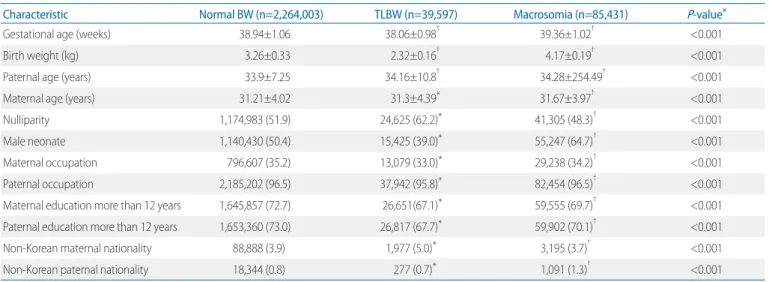
paternal education longer than 12 years were the highest in the normal birth weight group. There was no significant difference in paternal occupation between normal birth weight group and macrosomia group, although the percentage of paternal occu
pation in normal birth weight group was significantly higher than that in TLBW group (96.6% vs. 95.9%, P<0.001). The percentage of nonKorean maternal nationality was highest in TLBW group and the percentage of nonKorean paternal nationality was highest in the macrosomia group. Gestational age at birth, per
centage of male neonates, maternal age and paternal age were the highest in macrosomia group.
2. Comparison of live births from Korean mothers vs. immigrant mothers grouped by country of origin according to the World Bank Atlas definition of low and lower middle income and high and upper middle income countries
Neonatal birth weights from immigrant mothers originated from low and lower middle income countries were significantly less (3.19±0.38 kg) while those from immigrant mothers originated from high and upper middle income countries were significantly higher (3.31±0.4 kg) than neonatal birth weights from Korean mothers (3.28±0.38 kg) (Table 2). In mothers from low and lower middle income countries, the incidence of TLBW was square tests were performed to compare proportions of indepen
dent variables. Oneway analysis of variance or ttest was performed to compare means. OR and 95% CIs were used to evaluate the independent association between economic level of maternal origin of country and TLBW or macrosoma, using multivariate logistic regression analysis. Statistical significance was considered when P value was less than 0.05 or if 95% CIs did not include 1.
Results
1. Baseline characteristics
The total number of singleton live births between 37 and 41 weeks of gestation in Korea from 2009 to 2015 was 2,923,587.
Our analysis included 2,389,031 singleton live births after ex
cluding those that met the exclusion criteria. A total of 2,264,003 (94.8%) newborns had normal birth weights while 85,431 (3.6%) had macrosomia and 39,597 (1.7%) had TLBW. Baseline demo
graphic characteristics are summarized in Table 1.
There were significant differences in gestational age at birth, birth weight, paternal age, maternal age, parity, neonatal sex, maternal and paternal occupation, level of maternal and paternal education and percentage of nonKorean maternal or paternal
Table 1. Baseline Characteristics
Characteristic Normal BW (n=2,264,003) TLBW (n=39,597) Macrosomia (n=85,431) P-value*
Gestational age (weeks) 38.94±1.06 38.06±0.98† 39.36±1.02† <0.001
Birth weight (kg) 3.26±0.33 2.32±0.16† 4.17±0.19† <0.001
Paternal age (years) 33.9±7.25 34.16±10.8† 34.28±254.49† <0.001
Maternal age (years) 31.21±4.02 31.3±4.39* 31.67±3.97† <0.001
Nulliparity 1,174,983 (51.9) 24,625 (62.2)* 41,305 (48.3)† <0.001
Male neonate 1,140,430 (50.4) 15,425 (39.0)* 55,247 (64.7)† <0.001
Maternal occupation 796,607 (35.2) 13,079 (33.0)* 29,238 (34.2)† <0.001
Paternal occupation 2,185,202 (96.5) 37,942 (95.8)* 82,454 (96.5)† <0.001
Maternal education more than 12 years 1,645,857 (72.7) 26,651(67.1)* 59,555 (69.7)† <0.001
Paternal education more than 12 years 1,653,360 (73.0) 26,817 (67.7)* 59,902 (70.1)† <0.001
NonKorean maternal nationality 88,888 (3.9) 1,977 (5.0)* 3,195 (3.7)† <0.001
NonKorean paternal nationality 18,344 (0.8) 277 (0.7)* 1,091 (1.3)† <0.001
Values are presented as mean±standard deviation or number (%).
Abbreviations: BW, birth weight; TLBW, term low birth weight.
*All Pvalues were calculated by oneway analysis of variance test or chai square test. The other statistical comparisons by independent ttest were performed with approp
riate for gestational age group.
†P<0.05.
income countries.
3. Multivariate logistic regression analysis
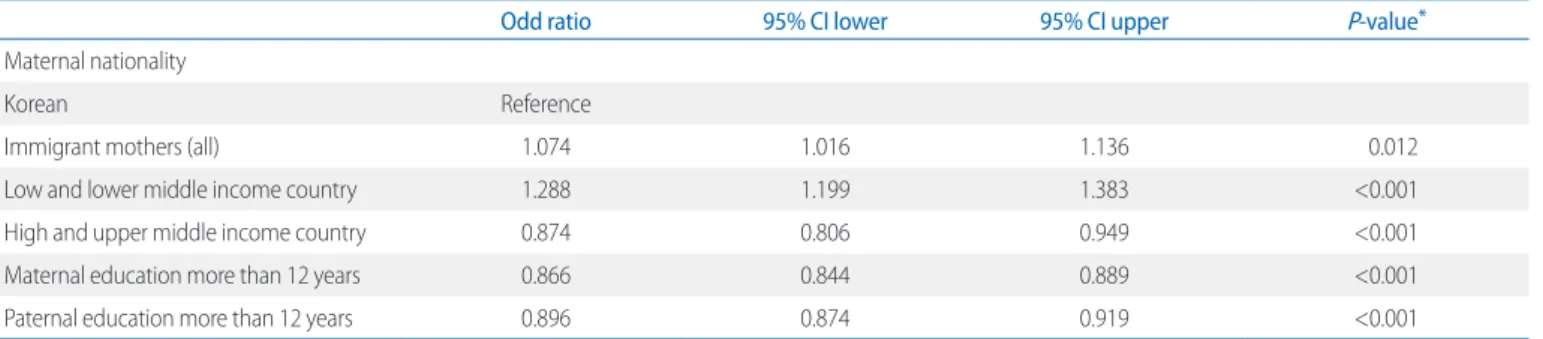
In multivariate logistic regression analysis, adjusted by neonatal sex, paternal age, maternal age, gestational week at delivery, paternal occupation, maternal occupation, paternal nationality, maternal ethnicity, paternal ethnicity, and parity, the risk of TLBW was significantly higher (OR: 1.074, 95% CI: 1.0161.136, P=
0.012) while the risk of macrosomia was not significant in immi
grant mothers compared to that in Korean mothers (Table 4, 5).
The risk of TLBW was significantly higher in mothers from low significantly higher (2.5% vs 1.6%, P<0.001) while the incidence
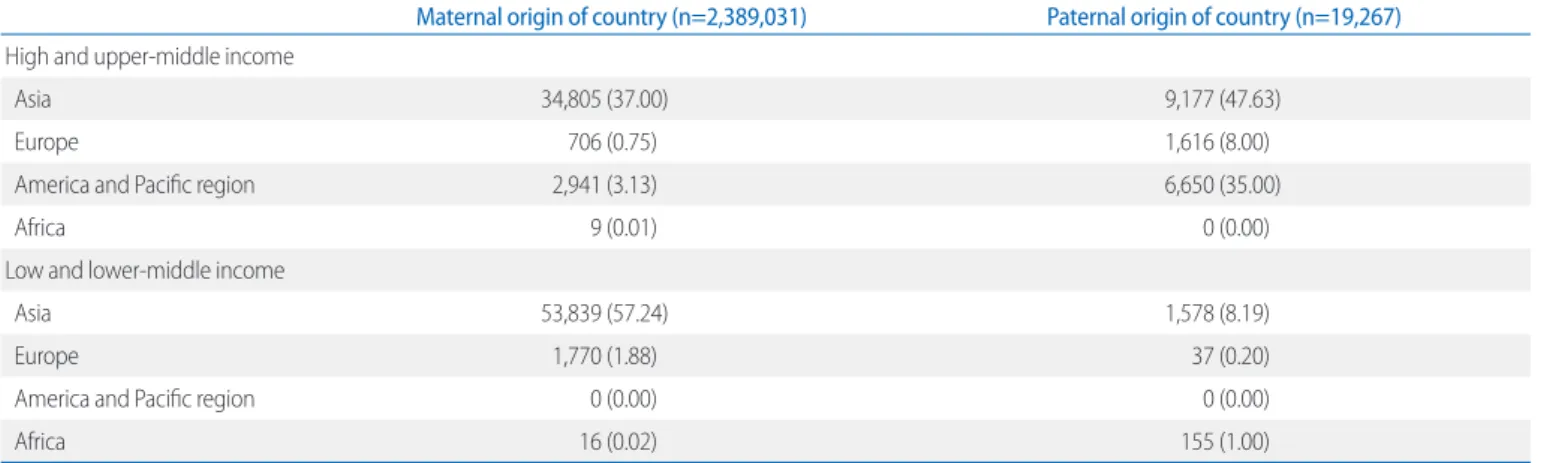
of macrosomia was significantly lower (2.2% vs 3.6%, P<0.001) than that in Korean mothers. There was no significant difference in TLBW between immigrant mothers from high and upper middle income countries and Korean mothers. However, the incidence of macrosomia was significantly higher in mothers from high and upper middle income countries than that in Korean mothers (4.9% vs. 3.6%, P<0.001). Maternal and paternal origins of country were described in Table 3. 59.12% of immigrant women came from low and lowermiddle income countries and 90.63% of immigrant fathers came from high and uppermiddle
Table 2. Comparison of Live Births from Korean Mothers and Immigrant Mothers Grouped by Country of Origin Korean mothers
(n=2,294,971) Immigrant mothers
(n=94,533) Low and lower middle income
country group (n=52,577) High and upper middle income country group (n=41,483)
Gestational age at birth (weeks) 38.95±1.07 38.94±1.05 38.9±1.03* 39.0±1.07*
Birth weight (kg) 3.28±0.38 3.24±0.39* 3.19±0.38* 3.31±0.4*
Paternal age (years) 33.69±7.11 39.41±8.6* 41.41±9.8* 36.65±5.51*
Maternal age (years) 31.38±3.89 27.4±5.29* 24.99±4.34* 30.49±4.73*
Nulliparity 1,185,046 (51.6) 55,867 (59.4)* 31,571 (60.1)* 24,296 (58.6)*
Male neonate 1,163,150 (50.7) 47,952 (51.0) 26,734 (50.8) 21,218 (51.1)
Maternal occupation 828,063 (36.1) 10,861 (11.5)* 4,000 (7.6)* 68,631 (16.5)*
Paternal occupation 2,216,858 (96.6) 88,740 (94.3)* 49,760 (94.6)* 38,980 (94.0)*
Maternal education more than 12 years 1,702,996 (74.2) 28,967 (30.8)* 8,132 (15.5)* 20,835 (50.2)* Paternal education more than 12 years 1,706,119 (74.3) 33,960 (36.1)* 12,866 (24.5)* 21,094 (50.8)*
NonKorean paternal nationality 14,534 (0.6) 5178 (5.5)* 767 (1.5)* 4,411 (10.6)*
Neonatal birth weight (g)
<2,500 37,620 (1.6) 1,977 (2.1)* 1,336 (2.5)* 641 (1.5)
>4,000 82,236 (3.6) 3,195 (3.4)* 1,156 (2.2)* 2,039 (4.9)*
Values are presented as mean±standard deviation or number (%). Statistical comparisons were performed with Korean mother group.
*P<0.05.
Table 3. Maternal and Paternal Origin of Countries in Immigrant Parents
Maternal origin of country (n=2,389,031) Paternal origin of country (n=19,267) High and uppermiddle income
Asia 34,805 (37.00) 9,177 (47.63)
Europe 706 (0.75) 1,616 (8.00)
America and Pacific region 2,941 (3.13) 6,650 (35.00)
Africa 9 (0.01) 0 (0.00)
Low and lowermiddle income
Asia 53,839 (57.24) 1,578 (8.19)
Europe 1,770 (1.88) 37 (0.20)
America and Pacific region 0 (0.00) 0 (0.00)
Africa 16 (0.02) 155 (1.00)
Values are presented as number (%).
and lower middle income countries (OR: 1.268, 95% CI: 1.181
1.361, P<0.001) but significantly lower in mothers from high and upper middle income countries (OR: 0.879, 95% CI: 0.81
0.954, P<0.001) compared to that in Korean mothers. The risk of ma crosomia was significantly higher in mothers from high and upper middle income countries (OR: 1.387, 95% CI: 1.228
1.566, P<0.001) but significantly lower in mothers from low and lower middle income countries (OR: 0.607, 95% CI: 0.5180.71, P<0.001) compared to that in Korean mothers. Both maternal and paternal education for more than 12 years significantly lowered risks of TLBW and macrosomia.
Discussion
The present study analyzed associations between economic level of maternal origin of country and risks of TLBW and ma
crosomia using a nationwide registry data. In this study, we found significant differences in risks of TLBW and macrosomia of im
migrant mothers compared to Korean mothers. Overall, the risk
of TLBW was higher while the risk of macrosomia was lower in immigrant mothers. However, results were variable according to economic level of maternal origin of country based on the clas
sification of country income by word bank. The risk of TLBW was significantly higher in immigrant women from low and lower middle income countries compared to that it in Korean mothers, but significantly higher in immigrant women from high and upper middle income countries. In addition, the risk of term macro
somia was significantly lower in immigrant mothers from low and lower middle income countries but significantly higher in immigrant mothers from middle or highincome countries com
pared to that in Korean mothers after adjusting for neonatal sex, paternal age, maternal age, gestational week at delivery, pa ternal occupation, maternal occupation, paternal nationality, maternal ethnicity, paternal ethnicity, and parity. Economic level of South Korea is included in the high income countries, but also included in Asia. Therefore, the results from multivariate analysis adjusted for variables can be meaningful.
A previous study has reported that Korean fatherforeign mo
ther pregnancies have higher risk of TLBW compared to Korean Table 4. Risk of Term low Birth Weight (Multivariate Analysis)
Odd ratio 95% CI lower 95% CI upper P-value*
Maternal nationality
Korean Reference
Immigrant mothers (all) 1.074 1.016 1.136 0.012
Low and lower middle income country 1.288 1.199 1.383 <0.001
High and upper middle income country 0.874 0.806 0.949 <0.001
Maternal education more than 12 years 0.866 0.844 0.889 <0.001
Paternal education more than 12 years 0.896 0.874 0.919 <0.001
Abbreviations: CI, confidence interval.
*Multivariate logistic regression analysis. Adjusted by neonatal sex, paternal age, maternal age, gestational week at delivery, paternal occupation, maternal occupation, paternal nationality, maternal ethnicity, paternal ethnicity and parity. Less than high school graduation was used as a reference education.
Table 5. Risk of Term Macrosomia (Multivariate Analysis)
Odd ratio 95% CI lower 95% CI upper P-value*
Nationality
Korean Reference
Immigrant mothers (all) 1.019 0.914 1.138 0.731
Low and lower middle income country 0.607 0.518 0.710 <0.001
High and upper middle income country 1.387 1.228 1.566 <0.001
Maternal education more than 12 years 0.872 0.831 0.915 <0.001
Paternal education more than 12 years 0.885 0.866 0.905 <0.001
*Multivariate logistic regression analysis. Adjusted by neonatal sex, paternal age, maternal age, gestational week at delivery, paternal occupation, maternal occupation, paternal nationality, maternal ethnicity, paternal ethnicity, and parity. Less than high school graduation was used as a reference education.
fatherKorean mother pregnancies.22 A recent study with si
milar population has shown that Chinese mothers have higher risk of term macrosomia but lower risk of TLBW compared to Korean mothers while mothers from Vietnam or Philippines have inverse risks.23 Nowadays, the origin of mothers is getting more and more diverse. Therefore, it is important to evaluate available pregnancy outcomes in immigrant mothers according to their socioeconomic background including the country of origin.
There have been similar studies worldwide focusing on neo
natal outcome of immigrant mothers. Women from Asia, the Pacific islands and subSaharan Africa have higher risks of low birth weight and preterm birth than women from Finland in a Swedish study performed between 1978 and 1990.24 Newborns of Spanish mothers have higher likelihood of low birth weight but the lowest risk for macrosomia compared to immigrants from Morocco, Romania, Ecuador, Bolivia, or Colombia.25 This Vik et al.26 (2019) also reported that migrant women from certain countries, mostly low and lower middle income countries, are at increased risk of stillbirth.
The current study has several limitations. First, we were unable to exclude maternal complications that could affect neo
natal birth weight. In addition, database did not include duration of stay in Korea for immigrant women or individual family in
come level. Lastly, this study did not include maternal body mass index, individual economic level, due to the limitation of data. However, in the present study, the risk of TLBW was in
creased in immigrant women from low and lower middle income countries and the risk of term macrosomia was increased in immigrant women from high and upper middle income countries after adjusting for neonatal sex, paternal age, maternal age, ges
tational week at delivery, paternal occupation, maternal occu
pation, paternal nationality, maternal ethnicity, paternal ethnicity, and parity. Therefore, we can consider that maternal origin of country is an independent risk factor for TLBW and term macrosomia. For example, adequate nutritional support and education for women from low and lower middle income countr
ies can be more emphasized, but balanced diet with regular exercise plan can be more emphasized in women from high and upper middle income countries. In this study, higher level of maternal and paternal education independently decreased the risk of TLBW and term macrosomia in this study. This suggests that more education of expecting parents might lead to better
pregnancy outcomes.
Cultural globalization is accelerating due to technical develop
ment, resulting in more international marriages from diverse countries, in accordance with increasing ‘marriagebased im
migration’ in rural areas, in Korea. However, conservative cul
ture or unified policy does not help diverse couples. Results of this study suggest that risks of abnormal neonatal birth weights could be different for immigrant mothers depending on econo
mic level of maternal country of origin. Antenatal care and edu
cation including diet, exercise, weight gain and possible adverse pregnancy outcomes according to maternal background and socioeconomic characteristics might be able to improve preg
nancy outcomes that could affect future health of neonates in childhood and adulthood, especially for immigrant women.
Ethical approval
This study was approved by Seoul St. Mary’s hospital Institu
tional Review Boards (IRB) of Catholic University of Korea (approval number: KC17ZESI0265).
Acknowledgement
The authors wish to acknowledge the financial support of the Catholic Medical Center Research Foundation made in the pro
gram year of 2019.
Conflict of interest
No potential conflict of interest relevant to this article was reported.
References
1) Lawn JE, Cousens S, Zupan J; Lancet Neonatal Survival Steering Team. 4 million neonatal deaths: when? where? why? Lancet 2005;365:891-900.
2) Katz J, Lee AC, Kozuki N, Lawn JE, Cousens S, Blencowe H, et al. Mortality risk in preterm and small-for-gestational-age infants in low-income and middle-income countries: a pooled country analysis. Lancet 2013;382:
417-25.
3) Murray E, Fernandes M, Fazel M, Kennedy SH, Villar J, Stein A. Differential effect of intrauterine growth restriction on childhood neurodevelop- ment: a systematic review. BJOG 2015;122:1062-72.
4) Hanson MA, Gluckman PD. Early developmental conditioning of later health and disease: physiology or pathophysiology? Physiol Rev 2014;
94:1027-76.
5) Taal HR, Vd Heijden AJ, Steegers EA, Hofman A, Jaddoe VW. Small and large size for gestational age at birth, infant growth, and childhood overweight. Obesity (Silver Spring) 2013;21:1261-8.
6) ICD10Data. P07-Disorders related to short gestation and low birth weight in ICD-10. [online] 2019 Oct 20 [cited 2018 Nov 29]. Available from:
https://www.icd10data.com/ICD10CM/Codes/P00-P96/P05-P08/P07-.
7) Imdad A, Bhutta ZA. Maternal nutrition and birth outcomes: effect of balanced protein-energy supplementation. Paediatr Perinat Epidemiol 2012;26 Suppl 1:178-90.
8) Robinson JS, Moore VM, Owens JA, McMillen IC. Origins of fetal growth restriction. Eur J Obstet Gynecol Reprod Biol 2000;92:13-9.
9) Kozuki N, Lee AC, Silveira MF, Sania A, Vogel JP, Adair L, et al. The associa- tions of parity and maternal age with small-for-gestational-age, preterm, and neonatal and infant mortality: a meta-analysis. BMC Public Health 2013;13 Suppl 3:S2.
10) Lee AC, Kozuki N, Cousens S, Stevens GA, Blencowe H, Silveira MF, et al.
Estimates of burden and consequences of infants born small for gesta- tional age in low and middle income countries with INTERGROWTH- 21st standard: analysis of CHERG datasets. BMJ 2017;358:j3677.
11) Statistics Korea. International Marriage Immigrants (female) (2007- 2015). [online] 2016 Nov 29 [cited 2018 Nov 29]. Available from: http://
kosis.kr/statHtml/statHtml.do?orgId=110&tblId=TX_11025_A010&vw_
cd=MT_OTITLE&list_id=110_11025_005&scrId=&seqNo=&lang_
mode=ko&obj_var_id=&itm_id=&conn_path=E1#/.
12) Practice Bulletin No. 173 summary: fetal macrosomia. Obstet Gynecol 2016;128:1191-2.
13) Cunningham FG. Williams Obstetrics. 24th ed. New York: McGraw-Hill Education/Medical; 2014.
14) Weissmann-Brenner A, Simchen MJ, Zilberberg E, Kalter A, Weisz B, Achi- ron R, et al. Maternal and neonatal outcomes of large for gestational age pregnancies. Acta Obstet Gynecol Scand 2012;91:844-9.
15) Kuciene R, Dulskiene V, Medzioniene J. Associations between high birth weight, being large for gestational age, and high blood pressure among adolescents: a cross-sectional study. Eur J Nutr 2018;57:373-81.
16) Adanu RM, Johnson TR. Migration and women's health. Int J Gynaecol Obstet 2009;106:179-81.
17) Gissler M, Alexander S, MacFarlane A, Small R, Stray-Pedersen B, Zeitlin J, et al. Stillbirths and infant deaths among migrants in industrialized countries. Acta Obstet Gynecol Scand 2009;88:134-48.
18) Bollini P, Pampallona S, Wanner P, Kupelnick B. Pregnancy outcome of migrant women and integration policy: a systematic review of the inter- national literature. Soc Sci Med 2009;68:452-61.
19) Racape J, Schoenborn C, Sow M, Alexander S, De Spiegelaere M. Are all immigrant mothers really at risk of low birth weight and perinatal mor- tality? The crucial role of socio-economic status. BMC Pregnancy Child- birth 2016;16:75.
20) Gillet E, Saerens B, Martens G, Cammu H. Fetal and infant health out- comes among immigrant mothers in Flanders, Belgium. Int J Gynaecol Obstet 2014;124:128-33.
21) The World Bank. The world bank coundtry and lending groups. [online]
[cited 2019 Mar 15]. Available from: http://data.worldbank.org/about/
country-classifications.
22) Yang SY, Jung US, Hong HR, Hwang SY, Oh MJ, Kim HJ, et al. Analysis of pregnancy outcomes among interracial couples in Korea. J Korean Med Sci 2017;32:1657-61.
23) Song IG, Kim MS, Shin SH, Kim EK, Kim HS, Choi S, et al. Birth outcomes of immigrant women married to native men in the Republic of Korea: a population register-based study. BMJ Open 2017;7:e017720.
24) Rasmussen F, Oldenburg CE, Ericson A, Gunnarskog J. Preterm birth and low birthweight among children of Swedish and immigrant women between 1978 and 1990. Paediatr Perinat Epidemiol 1995;9:441-54.
25) Restrepo-Mesa SL, Estrada-Restrepo A, González-Zapata LI, Agudelo- Suárez AA. Newborn birth weights and related factors of native and immigrant residents of Spain. J Immigr Minor Health 2015;17:339-48.
26) Vik ES, Aasheim V, Schytt E, Small R, Moster D, Nilsen RM. Stillbirth in re- lation to maternal country of birth and other migration related factors:
a population-based study in Norway. BMC Pregnancy Childbirth. 2019 Jan 5 [Epub]. https://doi.org/10.1186/s12884-018-2140-3.