• 검색 결과가 없습니다.

Very Late Stent Thrombosis in a Drug-Eluting Stent due to Interruption of Anti-Platelet Agents in Patients With Acute Myocardial Infarction and Thrombocytosis

N/A
N/A
Protected

Academic year: 2022

Share "Very Late Stent Thrombosis in a Drug-Eluting Stent due to Interruption of Anti-Platelet Agents in Patients With Acute Myocardial Infarction and Thrombocytosis"

Copied!
4
0
0

로드 중.... (전체 텍스트 보기)

전체 글

(1)

417

Print ISSN 1738-5520 / On-line ISSN 1738-5555 Copyright © 2011 The Korean Society of Cardiology CASE REPORT

DOI 10.4070/kcj.2011.41.7.417

Open Access

Very Late Stent Thrombosis in a Drug-Eluting Stent due to Interruption of Anti-Platelet Agents in Patients With Acute Myocardial Infarction and Thrombocytosis

Hong Sang Choi, MD, Myung Ho Jeong, MD, Il Kook Seo, MD, Min Goo Lee, MD, Jum Suk Ko, MD, Keun Ho Park, MD, Doo Sun Sim, MD, Nam Sik Yoon, MD, Kye Hun Kim, MD, Hyung Wook Park, MD, Young Joon Hong, MD,

Ju Han Kim, MD, Youngkeun Ahn, MD, Jeong Gwan Cho, MD, Jong Chun Park, MD, and Jung Chaee Kang, MD The Heart Center of Chonnam National University Hospital, Cardiovascular Research Institute of Chonnam National University, Gwangju, Korea

ABSTRACT

Stent thrombosis is a fatal complication in patients who have undergone percutaneous coronary intervention, and discon- tinuation of anti-platelet agent is a major risk factor of stent thrombosis. We report a rare case of very late stent thrombosis (VLST) following discontinuation of anti-platelet agents in a patient who experienced acute myocardial infarction and es- sential thrombocytosis. She had undergone implantation of a drug eluting stent (DES) and a bare metal stent (BMS) two and half years prior to her presentation. VLST developed in DES, not in BMS, following interruption of anti-platelet therapy.

(Korean Circ J 2011;41:417-420)

KEY WORDS: Drug-eluting stents; Thrombosis; Essential thrombocythemia.

Received: October 28, 2010

Revision Received: November 5, 2010 Accepted: November 12, 2010

Correspondence: Myung Ho Jeong, MD, The Heart Research Center of Chonnam National University Hospital, 167 Jaebong-ro, Dong-gu, Gwang- ju 501-757, Koaea

Tel: 82-62-220-6243, Fax: 82-62-228-7174 E-mail: [email protected]

• The authors have no financial conflicts of interest.

cc
This is an Open Access article distributed under the terms of the Cre- ative Commons Attribution Non-Commercial License (http://creativecom- mons.org/licenses/by-nc/3.0) which permits unrestricted non-commer- cial use, distribution, and reproduction in any medium, provided the origi- nal work is properly cited.

Introduction

Drug-eluting coronary artery stents (DES) are currently being widely used. The advantage of DES is that it markedly reduces the rate of restenosis and the need for repeat revas- cularization.

1-3)

Despite these promising advances, stent th- rombosis appears to occur more frequently with DES. There- fore, in patients with implanted DES, longer duration of anti- platelet therapy is needed, and they should maintain anti-pla- telet therapy even when they undergo endoscopic procedures.

We report a case of very late stent thrombosis (VLST) that occurred only in DES, not in bare metal stent (BMS), follow- ing discontinuation of anti-platelet therapy, in a patient present-

ed with essential thrombocytosis (ET) and acute myocardial infarction.

Case

A 65-year-old female was transferred to the emergency de- partment at our hospital, complaining of stabbing chest pain that radiated to her left arm and back that persisted over four hours. She had a history of acute ST-elevation myocardial in- farction and underwent BMS implantation (4.0×25 mm and 4.0×13 mm Coroflex Blue Stent) for the proximal and middle right coronary artery (RCA), respectively, as well as DES (a 3.0×18 mm Cypher stent) implantation for the distal left cir- cumflex artery (LCX) two-and-half years previously (Fig. 1).

She had since commenced on dual anti-platelet therapy (as- pirin 100 mg, clopidogrel 75 mg daily). Coronary angiography (CAG) performed after eight months showed no evidence of restenosis. She ceased taking aspirin and clopidogrel for an en- doscopic procedure two days before her latest presentation.

On examination, she appeared to be in acute distress. Her blood pressure was 110/60 mmHg, her heart rate was 60 beat per minute, her respiratory rate was 16/min, and her temper- ature was 37°C. Her oxygen saturation was 97% on room air.

Pertinent findings on chest examination included fine crack-

(2)

418 Late Stent Thrombosis in DES

B

D A

C

Fig. 1. Patient underwent percutaneous coronary intervention (PCI) in the right coronary artery (RCA) due to inferior ST elevation myocardial infarction two and a half years ago. Initial coronary angiogram revealed critical stenosis in middle RCA (95%) and distal left circumflex ar- tery (LCX) (80%) (A and C). We deployed bare metal stent in the proximal and middle RCA (B), and drug-eluting stent in the distal LCX by staged PCI (D).

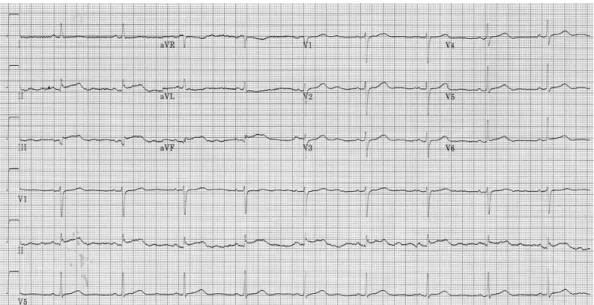
Fig. 2. Electrocardiogram showed ST-segment elevation in lead II, III and aVF.

(3)

Hong Sang Choi, et al. 419

les heard at the bases. Her cardiovascular examination reveal- ed normal first and second heart sounds, with no evidence of jugular venous distention, murmurs, rubs, or gallops. The re- mainder of her physical examination was unremarkable.

Electrocardiogram showed ST-segment elevation in lead II, III and aVF (Fig. 2), and cardiac enzymes were within the nor- mal limits (creatine kinase-MB 3.9 U/L, troponin-I 0.04 ng/

mL). Complete blood count (CBC) results were as follows: he- moglobin level was 17.5 g/dL, hematocrit was 52.8%, and pla- telet count was 1,168×10

3

/mm

3

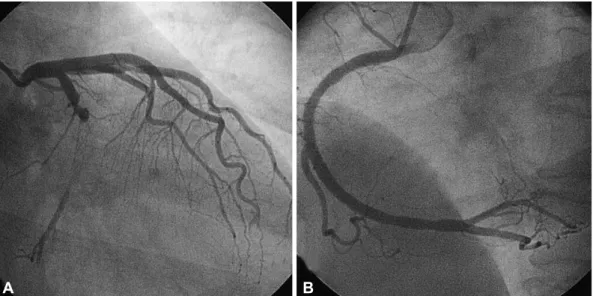
. She underwent emergent CAG, which demonstrated thrombotic total occlusion of the distal LCX secondary to stent thrombosis, but the RCA stent was patent (Fig. 3). Therefore, we performed emergent PCI using 3.0 mm balloon for the distal LCX, and applied intraco-

ronary abciximab (Clotinab

®

) for thrombi visualization. Post- PCI CAG showed no residual stenosis and relatively good distal flow (Fig. 4).

During the patient’s hospitalization, we performed bone marrow biopsy to further evaluate the cause of thrombocyto- sis, which confirmed ET. She was subsequently managed with repeated phlebotomy and platleletapharesis to reduce the level of hematocrit and platelet count. In addition, she was com- menced with anagrelide and hydroxyurea, but her CBC pro- file fluctuated during hospital stay. She subsequently made an uneventful recovery, and was discharged with continuous tri- ple anti-platelet agent therapy of aspirin, clopidogrel and cilo- stazol. After discharge, the patient has been followed up at the outpatient cardiology and hematology clinics without expe- riencing further symptoms.

Discussion

We report this case to raise the awareness of coronary stent thrombosis associated with anti-platelet therapy discontinu- ation. This case is very interesting in that the difference be- tween DES and BMS, or essential thrombosis which might contribute to the development of VLST.

VLST is defined as stent thrombosis presented one year after PCI. Recently, some concerns have been raised that late or VLST tends to be more common in DES than BMS.

4-8)

In this case, VLST has occurred in DES only, but not in a BMS.

Similarly, Kim et al.

9)

reported a case of VLST solely in DES, not in BMS. Some clinical data demonstrated that neointimal coverage after DES implantation was later than that in BMS.

10)11)

Therefore, we hypothesized that the uncovered strut of DES persisted and stent thrombosis might have occurred under special circumstances, such as discontinuation of anti-plate- let agents.

Fig. 3. Emergent coronary angiogram showed thrombotic total occlusion of the distal left circumflex artery due to drug-eluting stent thrombosis (A), and patent right coronary artery bare metal stent (B).

B A

Fig. 4. Coronary angiogram after balloon dilatation showed no re-

sidual stenosis and relatively good distal flow.

(4)

420 Late Stent Thrombosis in DES

The role of anti-platelet therapy discontinuation in early st- ent thrombosis is well-recognized,

12-14)

but its role in LST and VLST remains unclear. However, current guidelines on anti- platelet and anticoagulant therapy in endoscopic procedu- res

15)16)

recommend continuation of aspirin regardless of ble- eding risk, and continuation of clopidogrel in low risk proce- dures. On the contrary, the guidelines recommended stopp- ing clopidogrel 7 days before a high risk procedure if the pa- tient is at least 12 months post-DES insertion, and at least 1 month post-BMS insertion. As such, our patient would have benefited from uninterrupted aspirin administration.

ET is a myeloproliferative disorder characterized by clonal proliferation of megakaryocytes, resulting in thrombocytosis.

Thrombosis and hemorrhage are typical complications in patients with ET. Tefferi et al.

17)

reported that major throm- botic complications, such as cerebral ischemic attack and ac- ute coronary syndrome, occurred in 7% of ET patients. Cases of acute coronary syndrome with ET were reported by some authors,

18-20)

but our experience of VLST associated with ET was unique.

In conclusion, ET and discontinuation of antiplatelet ag- ent might have contributed to VLST of the DES in our pa- tient. Discontinuation of antiplatelet therapy, even after one year in patients who have undergone DES placement, requ- ires extreme caution, particularly in patients with thrombo- sis and acute coronary syndrome.

REFERENCES

1) Colombo A, Drzewiecki J, Banning A, et al. Randomized study to as- sess the effectiveness of slow- and moderate-release polymer-based pa- clitaxel-eluting stents for coronary artery lesions. Circulation 2003;

108:788-94.

2) Serruys PW, Degertekin M, Tanabe K, et al. Intravascular ultrasound findings in the multicenter, randomized, double-blind RAVEL (RAn- domized study with the sirolimus-eluting VElocity balloon-expand- able stent in the treatment of patients with de novo native coronary artery Lesions) trial. Circulation 2002;106:798-803.

3) Zhang F, Ge J, Qian J, et al. Sirolimus-eluting stents in real-world patients with ST-segment elevation acute myocardial infarction. Int Heart J 2007;48:303-11.

4) Daemen J, Wenaweser P, Tsuchida K, et al. Early and late coronary st- ent thrombosis of sirolimus-eluting and paclitaxel-eluting stents in routine clinical practice: data from a large two-institutional cohort st-

udy. Lancet 2007;369:667-78.

5) Kastrati A, Mehilli J, Pache J, et al. Analysis of 14 trials comparing si- rolimus-eluting stents with bare-metal stents. N Engl J Med 2007;356:

1030-9.

6) Pinto Slottow TL, Steinberg DH, Roy PK, et al. Observations and out- comes of definite and probable drug-eluting stent thrombosis seen at a single hospital in a four-year period. Am J Cardiol 2008;102:298-303.

7) Spaulding C, Daemen J, Boersma E, Cuttlip DE, Serruys PW. A pool- ed analysis of data comparing sirolimus-eluting stents with bare-me- tal stents. N Engl J Med 2007;356:989-97.

8) Stone GW, Moses JW, Ellis SG, et al. Safety and efficacy of sirolimus- and paclitaxel-eluting coronary stents. N Engl J Med 2007;356:998- 1008.

9) Kim SS, Jeong MH, Sim DS, et al. Very late thrombosis of a drug- eluting stent after discontinuation of dual antiplatelet therapy in a pa- tient treated with both drug-eluting and bare-metal stents. Korean Circ J 2009;39:205-8.

10) Awata M, Kotani J, Uematsu M, et al. Serial angioscopic evidence of incomplete neointimal coverage after sirolimus-eluting stent implan- tation: comparison with bare-metal stents. Circulation 2007;116:

910-6.

11) Takano M, Yamamoto M, Xie Y, et al. Serial long-term evaluation of neointimal stent coverage and thrombus after sirolimus-eluting stent implantation by use of coronary angioscopy. Heart 2007;93:1353-6.

12) Iakovou I, Schmidt T, Bonizzoni E, et al. Incidence, predictors, and outcome of thrombosis after successful implantation of drug-eluting stents. JAMA 2005;293:2126-30.

13) Kuchulakanti PK, Chu WW, Torguson R, et al. Correlates and long- term outcomes of angiographically proven stent thrombosis with si- rolimus- and paclitaxel-eluting stents. Circulation 2006;113:1108-13.

14) Park DW, Park SW, Park KH, et al. Frequency of and risk factors for stent thrombosis after drug-eluting stent implantation during long- term follow-up. Am J Cardiol 2006;98:352-6.

15) Veitch AM, Baglin TP, Gershlick AH, et al. Guidelines for the man- agement of anticoagulant and antiplatelet therapy in patients undergo- ing endoscopic procedures. Gut 2008;57:1322-9.

16) Zuckerman MJ, Hirota WK, Adler DG, et al. ASGE guideline: the ma- nagement of low-molecular-weight heparin and nonaspirin antipla- telet agents for endoscopic procedures. Gastrointest Endosc 2005;61:

189-94.

17) Tefferi A, Fonseca R, Pereira DL, Hoagland HC. A long-term retro- spective study of young women with essential thrombocythemia. Mayo Clin Proc 2001;76:22-8.

18) Turgut T, Harjai KJ, Edupuganti R, et al. Acute coronary occlusion and in-stent thrombosis in a patient with essential thrombocythemia.

Cathet Cardiovasc Diagn 1998;45:428-33.

19) Watanabe T, Fujinaga H, Ikeda Y, et al. Acute myocardial infarction in a patient with essential thrombocythemia who underwent success- ful stenting: a case report. Angiology 2005;56:771-4.

20) Kumagai N, Mitsutake R, Miura S, et al. Acute coronary syndrome

associated with essential thrombocythemia. J Cardiol 2009;54:485-9.

수치

Fig. 2. Electrocardiogram showed ST-segment elevation in lead II, III and aVF.
Fig. 3. Emergent coronary angiogram showed thrombotic total occlusion of the distal left circumflex artery due to drug-eluting stent thrombosis  (A), and patent right coronary artery bare metal stent (B).

참조

관련 문서

Purpose: This study compared the impact of paclitaxel-coated balloons (PCB) or drug eluting stents (DES) on peri-procedural myocardial infarction (PMI) on de novo coronary lesion

"Biodegradable polymer drug-eluting stents reduce the risk of stent thrombosis at 4 years in patients undergoing percutaneous coronary intervention: a pooled analysis

Angiographic and clinical characteristics associated with increased in-hospital mortality in elderly patients with acute myocardial infarction undergoing percutaneous

Methods: This study included a total of 3,566 acute MI survivors with CKD from the Korea Acute Myocardial Infarction Registry who were treated with stenting and followed up

This study compared clinical outcomes of drug-eluting stents (DES) versus bare-metal stents (BMS) in large coronary arteries in patients with acute myocardial infarction

Appendix: Korea Acute Myocardial Infarction Registry (KAMIR) Study Group of Korean Society of Cardiology Myung Ho Jeong, MD (Chonnam National University Hospital), Youngkeun Ahn,