INTRODUCTION
About one-third of all elective percutaneous coronary interven-
tion (PCI) procedures are associated with significant myocar- dial injury, termed peri-procedural myocardial infarction (PMI), which is characterized by cardiac biomarker elevation.1 Although the clinical significance of small PMI as character- ized by low-level biomarker elevation remains controversial,2,3 many studies have suggested that PMI is associated with an increased risk of mortality during long-term follow-up.4-7 Wh- ereas the use of drug eluting stents (DESs) has dramatically reduced the rate of restenosis,8 up to 30% of cases are still com- plicated by PMI.9,10 The most common mechanism of PMI is side-branch occlusion by foreign object such as stent struts th- rough both plaque shift from the main vessel and carina shift.9,11 In the DES era, most side-branch occlusions occur after post-
A Comparison of Peri-Procedural Myocardial
Infarction between Paclitaxel-Coated Balloon and Drug-Eluting Stent on De Novo Coronary Lesions
Ae-Young Her1, Kyoung-Im Cho2, Gillian Balbir Singh3, Scot Garg4, Yong Hoon Kim1, Bon-Kwon Koo5, and Eun-Seok Shin3
1Division of Cardiology, Department of Internal Medicine, Kangwon National University School of Medicine, Chuncheon;
2Division of Cardiology, Department of Internal Medicine, Kosin University Gospel Hospital, Busan;
3Department of Cardiology, Ulsan University Hospital, University of Ulsan College of Medicine, Ulsan, Korea
4East Lancashire Hospitals NHS Trust, Blackburn, Lancashire, UK
5Department of Internal Medicine and Cardiovascular Center, Seoul National University Hospital, Seoul, Korea.
Purpose: This study compared the impact of paclitaxel-coated balloons (PCB) or drug eluting stents (DES) on peri-procedural myocardial infarction (PMI) on de novo coronary lesion in stable patients.
Materials and Methods: In this observational study, we compared the incidence of PMI amongst patients with single vessel de novo coronary lesions who underwent treatment with a PCB or DES. Propensity score-matching analysis was used to assemble a cohort of patients with similar baseline characteristics. PMI was classified as myocardial infarction occurring within 48 hours af- ter percutaneous coronary intervention with a threshold of 5 x the 99th percentile upper reference limit of normal for creatine ki- nase-myocardial band (CK-MB) or troponin T (TnT).
Results: One hundred four patients (52 receiving PCB and 52 receiving DES) were enrolled in this study. The peak mean values of CK-MB and TnT were significantly higher in the DES group. There was a significantly higher rate of PMI in the DES group (23.1%
vs. 1.9%, p=0.002). Total occlusion of the side-branch occurred in two patients treated with DES, while no patients treated with PCB. In multivariable analysis, DES was the only independent predictor of PMI compared with PCB (odds ratio 42.85, 95% confi- dence interval: 3.44–533.87, p=0.004).
Conclusion: Treatment with a PCB on de novo coronary lesion might be associated with a significant reduction in the risk of PMI compared to DES.
Key Words: Paclitaxel-coated balloon, drug eluting stent, peri-procedural, myocardial infarction, de novo coronary artery pISSN: 0513-5796 · eISSN: 1976-2437
Received: April 27, 2016 Revised: July 25, 2016 Accepted: August 16, 2016
Corresponding author: Dr. Eun-Seok Shin, Department of Cardiology, Ulsan Uni- versity Hospital, University of Ulsan College of Medicine, 877 Bangeojinsunhwan- do-ro, Dong-gu, Ulsan 44033, Korea.
Tel: 82-52-250-7056, Fax: 82-52-250-7058, E-mail: [email protected]
•The authors have no financial conflicts of interest.
© Copyright: Yonsei University College of Medicine 2017
This is an Open Access article distributed under the terms of the Creative Com- mons Attribution Non-Commercial License (http://creativecommons.org/licenses/
by-nc/3.0) which permits unrestricted non-commercial use, distribution, and repro- duction in any medium, provided the original work is properly cited.
Yonsei Med J 2017 Jan;58(1):99-104 https://doi.org/10.3349/ymj.2017.58.1.99
stent dilation, which is performed with high-pressure balloon inflation.12 In this regard, paclitaxel-coated balloon (PCB) treat- ment is an attractive therapeutic option and may have bene- fits over DES. In the absence of stent struts, PCB has consider- ably less chance of side-branch occlusion in theory, compared to stents. However, the impact of treatment with PCB com- pared to DES on PMI has not been previously investigated. Th- erefore, the aim of this study was to compare the impact of PCB versus DES on PMI in stable patients.
MATERIALS AND METHODS
This population-based cohort study was conducted using the DES database at Ulsan University Hospital. In total, 679 pa- tients who underwent successful elective PCI with DES were enrolled from March 2004 through August 2007, and patients treated successfully with PCB were enrolled from April 2011 through July 2013. Patients with stable angina pectoris who were scheduled to undergo elective PCI for de novo coronary single lesions were enrolled if they had lesions with a ≥70% di- ameter stenosis, a reference vessel diameter of more than 2.0 mm and lesion length of ≤24 mm. In the PCB group, all pa- tients were unable to receive long-term dual antiplatelet ther- apy due to high bleeding risk, poor compliance or because they await for non-cardiac surgery. Of these patients, only those who had documented simultaneous measurements of creatine kinase-myocardial band (CK-MB) and troponin T (TnT) at ba- seline and 8-hour intervals post-PCI for 24 hours (until the time to decrease from the peak values of cardiac biomarkers within 48 hour after procedure) were included in our analysis.
In this study, to reduce the effect of treatment selection bias and other confounding, with different recruitment periods, we performed propensity score-matching. To adjust potential confounders, a propensity score-matched analysis was per- formed using binomial logistic regression analysis including the following covariates: target vessel of PCI, diagnosis, diam- eter of device and length of device.
Exclusion criteria were multi-vessel disease, acute myocar- dial infarction preceding the index procedure, bypass grafting, bifurcation lesions treated with a 2-stent strategy, left ventric- ular ejection fraction <30%, left main disease, heavily calcified or thrombotic lesions, life expectancy <1 year and known ch- ronic kidney disease (creatinine >2 mg/dL).
Definitions
The definition of myocardial infarction was a threshold of 5 x the 99th percentile upper reference limit of normal for CK-MB or TnT.13 PMI was classified as myocardial infarction occur- ring within 48 hours after PCI.14 Death was considered cardiac in origin unless obvious non-cardiac causes were identified.
Target vessel revascularization was defined as PCI of the tar- get lesion or any segment of the epicardial coronary artery con-
taining the target lesion. Target lesion revascularization was defined as any clinically driven repeat revascularization caused by a >50% stenosis within the PCI site or within a 5-mm border proximal or distal to the PCI site. Side-branch occlusion was defined as Thrombolysis In Myocardial Infarction flow grade 0 or 1 after device use. Side-branch compromise was defined as
≥70% diameter stenosis of side-branch >1.5 mm arising from the culprit lesion after device apply. The clinical outcomes were cardiac death, myocardial infarction, target vessel revascular- ization and target lesion revascularization. This study was car- ried out according to the Declaration of Helsinki guidelines and was approved by the Institutional Review Board Ethics Commit- tee. All enrolled patients provided written informed consent.
Interventional procedure, data acquisition and analysis All patients were treated with acetylsalicylic acid 200 mg and loading dose of clopidogrel 300 mg before the procedure fol- lowed by maintenance clopidogrel 75 mg daily for at least 12-months in DES group and for 6 weeks and for extended periods thereafter at the physician’s discretion in PCB group.
DESs for all implanted lesions were CypherTM (Cordis, John- son & Johnson Co., New Jersey, FL, USA), Taxus ExpressTM (Boston Scientific, Natick, MA, USA) and EndeavorTM (Medtro- nic Co., Minneapolis, MN, USA). For PCB treatment, the stan- dard balloon was shorter than the intended PCB size, and the PCB (SeQuent Please®, PCB catheter, B. Braun, Melsungen, Germany) was inflated at nominal pressure for 60 seconds.
Post-dilation was not performed in all PCB cases. Coronary an- giographies before and after the procedure were analyzed using the Cardiovascular Angiography Analysis System (CAAS 5.10, Pie Medical Imaging B.V., Maastricht, the Netherlands) by an independent investigator, who was blinded to clinical presen- tations.
Statistical analysis
All statistical analyses were done using SPSS version 18.0 (SPSS, Inc., Chicago, IL, USA). Descriptive statistical methods were used to describe the data. Results are presented as mean±st- andard deviation for continuous variables and frequency (per- centages) for categorical variables. After propensity matching, comparisons between the two groups were performed using the paired t-test for continuous variables and the McNemar test for categorical variables. To identify the independent pre- dictors of PMI, we performed multivariable logistic regression analysis using the following covariates: all variables with val- ues of p<0.10 on the univariate analysis and those judged to be of clinical significance. The multivariable model was created with a stepwise elimination procedure, where the independent variables were entered into the model at the 0.20 significance level and removed at the 0.25 level. All tests were two-sided, and a p-value <0.05 was considered statistically significant.
RESULTS
Patient characteristics
The matched cohort included 104 patients who had been suc- cessfully treated with PCB (n=52 patients) and DES (n=52 pa- tients). Baseline clinical characteristics of the patients are sh- own in Table 1. The prevalence of past history of dyslipidemia was lower in DES group than in PCB group. The peak mean values of CK-MB (6.4±8.5 ng/mL vs. 2.0±1.8 ng/mL, p<0.001) and TnT (0.14±0.20 ng/mL vs. 0.06±0.07 ng/mL, p=0.007) were significantly higher in DES group than PCB group.
Procedural, angiographic characteristics and incidence of PMI
The procedural, angiographic characteristics and incidence of PMI are shown in Table 2. The maximal pressure in DES group was higher than in PCB group (13.1±2.8 mm Hg vs. 8.2±1.8 mm Hg, p<0.001). Side-branch occlusion occurred only in 2 patients treated with DES (DES: 3.8% vs. PCB: 0%, p=0.495).
Similarly, slow- or no-reflow following device use occurred in only 2 patients treated with DES. In pre-procedure, there were no significant between-group differences in the reference ves- sel diameter, minimal lumen diameter (MLD), diameter ste- nosis and lesion length. In post-procedure, the DES group had a significantly higher MLD (2.4±0.4 mm vs. 1.7±0.4 mm, p<
0.001) and a smaller diameter stenosis (9±6% vs. 31±12%, p<
0.001). The incidence of PMI was significantly higher in the DES group (23.1%, n=12 vs. 1.9%, n=1, p=0.002). At 12-months follow-up, the clinical events observed were cardiac death, myocardial infarction, target vessel revascularization and tar-
get lesion revascularization which occurred with no signifi- cant differences between the 2 groups (cardiac death: PCB, 0%, n=0 vs. DES, 0%, n=0, p=1.000; target vessel revascularization:
PCB, 1.9%, n=1 vs. DES, 1.9%, n=1, p=1.000; target lesion re- vascularization: PCB, 1.0%, n=1 vs. DES, 0%, n=0, p=1.000).
Predictors of PMI
The covariates entered into the final logistic regression analy- sis included age, treatment with PCB/DES, maximal pressure of device, lesion length after device use, reference diameter af- ter device use, MLD after device use, diameter stenosis after device use and side-branch occlusion by univariate analysis.
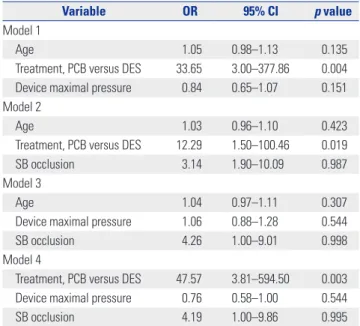
The predictors of PMI by binomial logistic regression analysis are shown in Table 3. Because of low incidence of PMI, we used multi-model logistic regression analysis including 3 covariates in each analysis. The use of DES was the only independent predictor of PMI (p<0.05 in all models).
DISCUSSION
This propensity score-matched analysis evaluated the impact of PCB or DES on PMI in stable patients, and demonstrated that treatment with a PCB was associated with a significant reduction in the risk of PMI.
PMI has been reported to be associated with increased ad- verse clinical outcomes.6,15-17 A large meta-analysis showed higher mortality for increasing levels of CK-MB; with even a minor increase of CK-MB 1-3x the upper limit of normal con- ferring a 1.5 times higher relative risk of death [95% confidence Table 1. Baseline Clinical Characteristics
Variables PCB (n=52) DES (n=52) p value
Age, years 58.8±8.7 61.0±10.7 0.261
Male, n (%) 14 (26.9) 20 (38.5) 0.296
Cardiovascular risk factors, n (%)
Hypertension 31 (59.6) 29 (55.8) 0.843
Diabetes mellitus 28 (53.8) 16 (30.8) 0.158
Dyslipidemia 30 (57.7) 17 (32.7) 0.018
Current smoker 21 (40.4) 16 (30.8) 0.403
LV ejection fraction, % 64.5±7.0 62.9±7.9 0.283
Total cholesterol, mg/dL 175.7±39.6 184.7±44.7 0.279
Triglyceride, mg/dL 166.8±102.8 129.7±68.0 0.047
High density lipoprotein, mg/dL 44.3±10.2 43.1±17.9 0.691
Low density lipoprotein, mg/dL 103.4±30.5 106.2±37.3 0.705
HbA1C, % 6.8±1.6 6.5±1.0 0.381
Creatinine, mg/dL 1.3±1.2 1.1±0.2 0.266
Basal CK-MB, ng/mL 1.3±0.8 1.7±1.5 0.056
Peak CK-MB, ng/mL 2.0±1.8 6.4±8.5 <0.001
Basal TnT, ng/mL 0.01±0.02 0.02±0.04 0.376
Peak TnT, ng/mL 0.06±0.07 0.14±0.20 0.007
PCB, paclitaxel-coated balloon; DES, drug eluting stent; LV, left ventricular; CK-MB, creatine kinase-myocardial band; TnT, troponin T.
Data are mean±SD or number (percentage).
interval (CI): 1.2–1.8].1 A later meta-analysis showed that any troponin elevation was associated with a significantly increased risk of mortality (4.4% vs. 3.3%, p=0.001; odds ratio 1.35, 95%
CI: 1.1–1.6).18 To date, PCI has not been shown to reduce mor- tality in patients with stable coronary artery disease, however, if PMI can be reduced, these clinical outcomes would be ex- pected to improve.
Although several therapeutic strategies have been suggest- ed to reduce PMI, a procedural complication has been report- ed in about 5% to 30% of patients.19-21 The most common mech- anisms of PMI during PCI are side-branch occlusion and distal embolization.9 The main proposed mechanisms of side-branch
occlusion are a snow plough effect (plaque shift) from the main vessel and carina shift,9,11,22 with most side-branch occlusions occurring after post-stent dilation performed with high-pres- sure balloon inflation.12 Theoretically, PCB has a considerably lower chance of side-branch occlusion compared to a stent, because there is no plaque- or carina shift due to the absence of foreign objects such as stent struts. In this context, we recent- ly demonstrated that using a PCB in main vessels with side- branches may be an option to avoid compromise of the side- branch ostium compared to PCI with DES using optical co- herence tomography.23 Previously, we showed that PCB tr- eatment of de novo coronary lesions of main vessels resulted in Table 2. Procedural, Angiographic Characteristics and Incidence of PMI
Variable PCB (n=52) DES (n=52) p value
Procedural findings
Culprit vessel, n (%) 0.695
LAD 26 (50.0) 22 (42.3)
LCX 15 (28.8) 16 (30.8)
RCA 11 (21.2) 14 (26.9)
ACC/AHA B2/C lesion, n (%) 35 (67.3) 33 (63.5) 0.837
DES type NA
Cypher 40 (77.0)
Taxus 6 (11.5)
Endeavor 6 (11.5)
Device diameter, mm 2.7±0.3 2.8±0.3 0.214
Device maximal pressure, mm Hg 8.2±1.8 13.1±2.8 <0.001
Device length, mm 22.6±4.0 23.6±6.0 0.305
Presence of SB, n (%) 11 (21.1) 11 (21.1) 1.000
Post Device Use
SB diameter stenosis, % 37.3±39.3 58.2±31.2 0.182
SB compromise, n (%) 4 (36.4) 5 (45.5) 1.000
SB occlusion, n (%) 0 2 (3.8) 0.495
SB TIMI flow 0.549
0 0 1 (9.1)
1 0 1 (9.1)
2 1 (9.1) 0
3 10 (90.9) 9 (81.8)
MV slow flow or no-reflow 0 2 (3.8) 0.495
Pre-procedure QCA
Reference vessel diameter, mm 2.3±0.5 2.2±0.4 0.295
Minimal lumen diameter, mm 0.6±0.2 0.6±0.3 0.236
Diameter stenosis, % 70±8 70±9 0.750
Lesion length, mm 16.1±4.1 16.6±3.3 0.522
Post-procedure QCA
Reference vessel diameter, mm 2.7±0.4 2.8±0.4 0.092
Minimal lumen diameter, mm 1.7±0.4 2.4±0.4 <0.001
Diameter stenosis, % 31±12 9±6 <0.001
Lesion length, mm 19.8±4.1 20.6±3.8 0.273
PMI, n (%) 1 (1.9) 12 (23.1) 0.002
PMI, peri-procedural myocardial infarction; PCB, paclitaxel-coated balloon; DES, drug eluting stent; LAD, left anterior descending artery; LCX, left circumflex ar- tery; RCA, right coronary artery; SB, side-branch; MV, main vessel; QCA, quantitative coronary analysis.
Data are mean±SD or number (percentage).
an increase in the SB ostial lumen area at 9-months follow-up.
Historically, stents reduce target vessel revascularization compared to plain old balloon angioplasty, however, a para- doxical increase in the incidence of PMI has been reported fol- lowing stent implantation compared with that of plain old bal- loon angioplasty.24,25 Compared with plain old balloon angio- plasty in which the lumen expansion is predominantly due to plaque redistribution and plaque dissection, lumen enlarge- ment after stenting involves a combination of plaque redistri- bution, plaque extrusion, vessel expansion, plaque compres- sion, and plaque embolization.26 Stenting per se can be a cause, as small thrombi may form on their unendothelized surface and embolize distally.24 In addition, plaque disruption after stenting releases prothrombotic biofactors into the coronary circulation, leading to microvascular thrombosis, platelet acti- vation, microcirculatory inflammation and oxidative stress, and no-reflow phenomenon.27
In this aspect, PCB treatment is an attractive therapeutic op- tion and may have benefits over DES in further reducing the rate of PMI. Of note, PCB treatment is vastly superior to plain old balloon angioplasty for de novo coronary lesions because it can homogeneously deliver a drug to the vessel wall.28 In the present study, we demonstrated that PCB treatment for de novo coronary disease in patients who were unable to receive long- term dual antiplatelet therapy is promising in better tackling PMI than DES implantation. In terms of the safety and efficacy of PCB treatment for de novo coronary lesions, we have al- ready shown that fractional flow reserve guided PCB treatment is safe and effective with good anatomical and physiological patency at follow-up.29 Therefore, we hope that PCB treatment will be used in a broader patient population with de novo cor- onary disease, thus reducing PMI post-PCI.
There are some limitations to the present study. Firstly, this study was an observational study with a small numbers of pa- tients and lesions. Although there was a difference of side-br- anch occlusion between both groups, the number of side-br- anch occlusion was too small to assess the relationship with the risk of PMI. In addition, although the clinical outcomes were not included in the objectives of this study, we could not show the differences in clinical outcomes between PCB and DES in this study. Since this study was a single center trial with a small study population, the results cannot be applied to pa- tients beyond the inclusion criteria and study protocol. Also, al- though this study performed a propensity score-matched analy- sis to adjust for potential confounding factors, it could not correct for unmeasured variables. Therefore, further studies in larger sample size with randomized study are required to con- firm these findings. Fourthly, because we compared the first- generation DES to PCB, the results could be different from comparison results between other generation DES, but not first-generation and PCB. Finally, even though we applied the propensity score analysis in this study, we could not completely eliminate the selection bias in terms of excluding the cases of flow-limiting dissection after balloon angioplasty at pre-PCB procedure time. Nevertheless, we also excluded the failed PCI cases in the DES group.
In conclusion, treatment with a PCB on de novo coronary lesion might significantly reduce the risk of PMI compared to DES.
REFERENCES
1. Ioannidis JP, Karvouni E, Katritsis DG. Mortality risk conferred by small elevations of creatine kinase-MB isoenzyme after percuta- neous coronary intervention. J Am Coll Cardiol 2003;42:1406-11.
2. Bhatt DL, Topol EJ. Does creatinine kinase-MB elevation after percutaneous coronary intervention predict outcomes in 2005?
Periprocedural cardiac enzyme elevation predicts adverse out- comes. Circulation 2005;112:906-15.
3. Cutlip DE, Kuntz RE. Does creatinine kinase-MB elevation after percutaneous coronary intervention predict outcomes in 2005?
Cardiac enzyme elevation after successful percutaneous coronary intervention is not an independent predictor of adverse out- comes. Circulation 2005;112:916-22.
4. Kong TQ, Davidson CJ, Meyers SN, Tauke JT, Parker MA, Bonow RO. Prognostic implication of creatine kinase elevation following elective coronary artery interventions. JAMA 1997;277:461-6.
5. Saucedo JF, Mehran R, Dangas G, Hong MK, Lansky A, Kent KM, et al. Long-term clinical events following creatine kinase--myo- cardial band isoenzyme elevation after successful coronary stent- ing. J Am Coll Cardiol 2000;35:1134-41.
6. Park DW, Kim YH, Yun SC, Ahn JM, Lee JY, Kim WJ, et al. Fre- quency, causes, predictors, and clinical significance of peri-pro- cedural myocardial infarction following percutaneous coronary intervention. Eur Heart J 2013;34:1662-9.
7. Chen SL, Zhang JJ, Ye F, Tian NL, Sheiban I, Jepson N, et al. Peri- procedural myocardial infarction is associated with increased mor- tality in patients with coronary artery bifurcation lesions after im- plantation of a drug-eluting stent. Catheter Cardiovasc Interv 2015;
Table 3. Predictors of PMI by Binomial Logistic Regression Analysis
Variable OR 95% CI p value
Model 1
Age 1.05 0.98–1.13 0.135
Treatment, PCB versus DES 33.65 3.00–377.86 0.004 Device maximal pressure 0.84 0.65–1.07 0.151 Model 2
Age 1.03 0.96–1.10 0.423
Treatment, PCB versus DES 12.29 1.50–100.46 0.019
SB occlusion 3.14 1.90–10.09 0.987
Model 3
Age 1.04 0.97–1.11 0.307
Device maximal pressure 1.06 0.88–1.28 0.544
SB occlusion 4.26 1.00–9.01 0.998
Model 4
Treatment, PCB versus DES 47.57 3.81–594.50 0.003 Device maximal pressure 0.76 0.58–1.00 0.544
SB occlusion 4.19 1.00–9.86 0.995
PMI, peri-procedural myocardial infarction; PCB, paclitaxel-coated balloon;
DES, drug eluting stent; SB, side-branch; OR, odds ratio; CI, confidence interval.
85 Suppl 1:696-705.
8. Stone GW, Ellis SG, Cannon L, Mann JT, Greenberg JD, Spriggs D, et al. Comparison of a polymer-based paclitaxel-eluting stent with a bare metal stent in patients with complex coronary artery dis- ease: a randomized controlled trial. JAMA 2005;294:1215-23.
9. Babu GG, Walker JM, Yellon DM, Hausenloy DJ. Peri-procedural myocardial injury during percutaneous coronary intervention: an important target for cardioprotection. Eur Heart J 2011;32:23-31.
10. Prasad A, Herrmann J. Myocardial infarction due to percutaneous coronary intervention. N Engl J Med 2011;364:453-64.
11. Koo BK, Waseda K, Kang HJ, Kim HS, Nam CW, Hur SH, et al. An- atomic and functional evaluation of bifurcation lesions undergoing percutaneous coronary intervention. Circ Cardiovasc Interv 2010;
3:113-9.
12. Aliabadi D, Tilli FV, Bowers TR, Benzuly KH, Safian RD, Goldstein JA, et al. Incidence and angiographic predictors of side branch occlusion following high-pressure intracoronary stenting. Am J Cardiol 1997;80:994-7.
13. Thygesen K, Alpert JS, Jaffe AS, Simoons ML, Chaitman BR, White HD, et al. Third universal definition of myocardial infarction. J Am Coll Cardiol 2012;60:1581-98.
14. Vranckx P, Cutlip DE, Mehran R, Kint PP, Silber S, Windecker S, et al. Myocardial infarction adjudication in contemporary all-comer stent trials: balancing sensitivity and specificity. Addendum to the historical MI definitions used in stent studies. EuroIntervention 2010;5:871-4.
15. Fuchs S, Kornowski R, Mehran R, Satler LF, Pichard AD, Kent KM, et al. Cardiac troponin I levels and clinical outcomes in patients with acute coronary syndromes: the potential role of early percu- taneous revascularization. J Am Coll Cardiol 1999;34:1704-10.
16. Cantor WJ, Newby LK, Christenson RH, Tuttle RH, Hasselblad V, Armstrong PW, et al. Prognostic significance of elevated troponin I after percutaneous coronary intervention. J Am Coll Cardiol 2002;
39:1738-44.
17. Fujii K, Carlier SG, Mintz GS, Kobayashi Y, Jacoboff D, Nierenberg H, et al. Creatine kinase-MB enzyme elevation and long-term clini- cal events after successful coronary stenting in lesions with rup- tured plaque. Am J Cardiol 2005;95:355-9.
18. Nienhuis MB, Ottervanger JP, Bilo HJ, Dikkeschei BD, Zijlstra F.
Prognostic value of troponin after elective percutaneous coronary intervention: a meta-analysis. Catheter Cardiovasc Interv 2008;
71:318-24.
19. Nallamothu BK, Bates ER. Periprocedural myocardial infarction and mortality: causality versus association. J Am Coll Cardiol 2003;
42:1412-4.
20. Lansky AJ, Stone GW. Periprocedural myocardial infarction: prev- alence, prognosis, and prevention. Circ Cardiovasc Interv 2010;3:
602-10.
21. Cuculi F, Lim CC, Banning AP. Periprocedural myocardial injury during elective percutaneous coronary intervention: is it impor- tant and how can it be prevented? Heart 2010;96:736-40.
22. Vetrovec GW, Cowley MJ, Wolfgang TC, Ducey KC. Effects of per- cutaneous transluminal coronary angioplasty on lesion-associat- ed branches. Am Heart J 1985;109(5 Pt 1):921-5.
23. Her AY, Ann SH, Singh GB, Kim YH, Okamura T, Garg S, et al. Se- rial morphological changes of side-branch sstium after paclitaxel- coated balloon treatment of de novo coronary lesions of main ves- sels. Yonsei Med J 2016;57:606-13.
24. Kini A, Kini S, Marmur JD, Bertea T, Dangas G, Cocke TP, et al. In- cidence and mechanism of creatine kinase-MB enzyme elevation after coronary intervention with different devices. Catheter Cardio- vasc Interv 1999;48:123-9.
25. Dirschinger J, Kastrati A, Neumann FJ, Boekstegers P, Elezi S, Me- hilli J, et al. Influence of balloon pressure during stent placement in native coronary arteries on early and late angiographic and clini- cal outcome: a randomized evaluation of high-pressure inflation.
Circulation 1999;100:918-23.
26. Ahmed JM, Mintz GS, Weissman NJ, Lansky AJ, Pichard AD, Satler LF, et al. Mechanism of lumen enlargement during intracoronary stent implantation: an intravascular ultrasound study. Circulation 2000;102:7-10.
27. Herrmann J. Peri-procedural myocardial injury: 2005 update. Eur Heart J 2005;26:2493-519.
28. Her AY, Ann SH, Singh GB, Kim YH, Yoo SY, Garg S, et al. Compari- son of paclitaxel-coated balloon treatment and plain old balloon angioplasty for de novo coronary lesions. Yonsei Med J 2016;57:
337-41.
29. Shin ES, Ann SH, Balbir Singh G, Lim KH, Kleber FX, Koo BK.
Fractional flow reserve-guided paclitaxel-coated balloon treatment for de novo coronary lesions. Catheter Cardiovasc Interv 2016;
88:193-200.