190 ORIGINAL ARTICLE
DOI 10.4070 / kcj.2009.39.5.190
Print ISSN 1738-5520 / On-line ISSN 1738-5555 Copyright ⓒ 2009 The Korean Society of Cardiology
Efficacy of Triple Anti-Platelet Therapy Including Cilostazol in Acute Myocardial Infarction Patients Undergoing
Drug-Eluting Stent Implantation
Keun-Ho Park, MD, Myung Ho Jeong, MD, Min Goo Lee, MD, Jum Suk Ko, MD, Shin Eun Lee, MD, Won Yu Kang, MD, Soo Hyun Kim, MD, Doo Sun Sim, MD, Nam Sik Yoon, MD,
Hyun Ju Youn, MD, Young Joon Hong, MD, Hyung Wook Park, MD, Ju Han Kim, MD, Youngkeun Ahn, MD, Jeong Gwan Cho, MD, Jong Chun Park, MD and Jung Chaee Kang, MD The Heart Center of Chonnam National University Hospital, Cardiovascular Research Institute
of Chonnam National University, Gwangju, Korea ABSTRACT
Background and Objectives: Triple anti-platelet therapy is known to prevent restenosis after drug-eluting stent (DES) implantation. However, there is little available data concerning the efficacy of triple anti-platelet therapy for acute myocardial infarction (AMI). Subjects and Methods: We analyzed 528 consecutive patients with AMI undergoing DES implantation between Nov 2005 and Apr 2008. We compared clinical outcomes in the triple anti-platelet therapy (group I, n=413: cilostazol combined with aspirin and clopidogrel for at least one month) and dual anti- platelet therapy groups (group II, n=115: aspirin and clopidogrel). Results: There were no significant differences in baseline characteristics. However, ST elevation myocardial infarction (STEMI) and use of TAXUS
®stents were more common (70.9% vs. 55.7%, p=0.002; 83.5% vs. 73.0%, p=0.011) in Group I. Group I had lower incidences of cardiac death, 6-month target lesion revascularization (TLR), and major adverse cardiac and cerebrovascular events (MACCE) compared to Group II (1.7% vs. 5.7%, p=0.022; 5.7% vs. 11.5%, 0.035; 7.9% vs. 16.0%, p=0.011). On subgroup analysis, the incidence of 6-month TLR was lower among patients with American College of Cardiology/
American Heart Association (ACC/AHA) B2 or C lesions and non-STEMI (6.0% vs. 14.9%, p=0.012; 4.3% vs.
19.1%, p=0.002) in Group I compared to those in Group II. The rates of bleeding complications were no different between the two groups. On multivariate analysis, Killip III or IV and triple anti-platelet therapy were independent predictors of 6-month MACCE {hazard ratio (HR)=3.382; 95% confidence interval (CI)=1.384-8.262, HR=0.436;
95% CI=0.203-0.933}. Conclusion: Triple anti-platelet therapy is safe and efficacious, and it prevents TLR in patie- nts with AMI, especially those with complex lesions and non-STEMIs.
(Korean Circ J 2009;39:190-197)KEY WORDS: Platelets; Drug-eluting stents; Myocardial infarction.
Introduction
Percutaneous coronary intervention (PCI) with drug- eluting stents (DES) is well known to reduce the re-steno- sis rate to a significant extent compared to bare-metal stents (BMS) in patients with acute myocardial infarction (AMI).
1)2)It has been reported, however, that DESs in-
crease the incidence of stent thrombosis as time passes.
3)The treatment guidelines from the American College of Cardiology/American Heart Association (ACC/AHA) recommend that double anti-platelet therapy with aspirin and clopidogrel be prescribed for at least 12 months in patients who have undergone DES implantation.
4)Cilostazol selectively inhibits the action of phospho- diesterase type 3, and it thereby has various functions, such as anti-platelet, vasodilatory, anti-atherosclerotic, and anti-proliferative actions. Cilostazol is also known to suppress neointimal hyperplasia following stent implan- tation.
5-7)Recent studies have shown that triple anti-pla- telet therapy including cilostazol reduces the occurrence of stent thrombosis compared to anti-platelet therapy based on aspirin and clopidogrel.
8)Triple anti-platelet
Received: October 28, 2008
Revision Received: December 10, 2008 Accepted: January 1, 2009
Correspondence: Myung Ho Jeong, MD, The Heart Research Center of Chonnam National University Hospital, Cardiovascular Research Institute of Chonnam National University, 671 Jaebong-ro, Dong-gu, Gwangju 501- 757, Korea
Tel: 82-62-220-6243, Fax: 82-62-228-7174 E-mail: [email protected]
Keun-Ho Park, et al.·
191
therapy including cilostazol has also been shown to sig- nificantly reduce restenosis and target lesion revascula- rization, particularly in patients with diabetes mellitus.
9)10)To date, however, no studies have reported the effect of triple anti-platelet therapy in patients with AMI, a high- risk group for stent thrombosis and re-stenosis.
The aim of this study was to compare the effectiveness of triple anti-platelet therapy with cilostazol with that of standard dual anti-platelet therapy in patients with AMI who have undergone DES implantation.
Subjects and Methods
Subjects
We conducted a single-center, retrospective study of 528 AMI patients who underwent successful TAXUS
®or Cypher
®stent implantation at the Heart Center of Chonnam National University Hospital during a 30- month period (November 2005 to April 2008). The mean age of these patients was 61.6±11.72 years, and 395 of them were men.
Patients who received cilostazol in addition to standard dual anti-platelet therapy following successful stent im- plantation (aspirin+clopidogrel+cilostazol) were assign- ed to Group I (n=413), and those who received the standard dual anti-platelet therapy (aspirin+clopidogrel) were assigned to Group II (n=115).
Percutaneous coronary intervention and medical treatment
In patients with AMI, emergency or early invasive tre- atments were determined based on patient status, accord- ing to the clinical decision of the operator. In inter- ventional treatment, the femoral artery was punctured and a 6 or 7-Fr sheath was inserted. Following catheter insertion, the procedure was performed using a guide wire. DESs were implanted in cases in which coronary artery stenoses were present following balloon angioplasty.
The type of DES was decided by the operator. Success- ful PCI was defined as a target vessel at the treatment site with antegrade thrombolysis in myocardial infarction- 3 (TIMI-3) flow and angiographic residual stenosis less than 50% following stent implantation. Anti-platelet agents were administered to all patients prior to inter- vention: aspirin 300 mg and clopidogrel 300-600 mg.
Standard post-intervention treatment was aspirin 100 mg for life and clopidogrel 75 mg for at least one year. In accordance with the subjective decision of each operator, cilostazol was given to patients at a daily dose of 200 mg for at least one month.
Other medical treatments, including angiotensin-con- verting enzyme inhibitors, beta-blockers, calcium channel blockers, and lipid-lowering agents, were also used in a non-restrictive manner based on the standard treatment regimen for patients with AMI.
Clinical outcomes
Patients were told to visit the outpatient clinic one month after discharge and every two to three months thereafter on a regular basis. In “lost to follow-up” cases, specialized personnel monitored the clinical course by means of a telephone call. We measured the incidences of target lesion revascularization (TLR), cardiac death, non-fatal myocardial infarction, coronary artery bypass graft, major adverse cardiac and cerebrovascular accident (MACCE), bleeding, and stent thrombosis in all patients within the 6-month period after the procedure. TLR was defined as any percutaneous revascularization performed on the treated segment. Myocardial infarction was defin- ed as a rise or fall in troponins (with at least one value above the 99
thpercentile of the upper reference limit) together with evidence of myocardial ischemia with at least one of the following: symptoms of ischemia, ECG change indicative of new ischemia, and imaging evidence of new loss of viable myocardium or new regional wall motion abnormality. Stroke was defined as a brain lesion on MRI or CT within 72 hours after the onset of neu- rological deficits. Stent thrombosis was defined as defi- nite or probable stent thrombosis according to the cri- teria of the Academic Research Consortium (ARC).
11)Any death for which the cause was not determined to have a definitive non-cardiac origin was classified as a cardiac death. MACCE was defined as cardiac death, non-fatal myocardial infarction, stroke, stent thrombosis, coronary bypass surgery, or TLR. Bleeding rates were also defined based on the TIMI bleeding classification.
12)TIMI major bleeding was defined as intracranial hemor- rhage or bleeding, with a hemoglobin decrease of >5 g/dL or a hematocrit decrease of >15%.
If a bleeding site was found, then TIMI minor bleeding was defined as a hemoglobin decrease of >3 g/dL or a he- matocrit decrease of >10%; if no site was found, then it was defined as a hemoglobin decrease of >4 g/dL or a hematocrit decrease of >12%. TIMI minimal bleeding was defined as any clinically overt sign of hemorrhage associated with a hemoglobin decrease of <3 g/dL or a hematocrit decrease of 9%. Stent thrombosis was defined as definite or probable stent thrombosis according to the criteria of the ARC.
12)Statistical analysis
Continuous variables were expressed as means±stan-
dard deviation (SD), and categorical variables were expre-
ssed as frequencies. An analysis of continuous variables
was performed using Student’s t-test, and an analysis of
categorical variables was performed using the chi-square
test or Fisher’s exact test. Cox regression analysis was
used to identify the factors affecting the incidence of
MACCE following the implantation of DES in patients
with AMI. All statistical analyses were performed using
Statistical Package for Social Science (SPSS, SPSS Inc,
192 ·
Triple Anti-Platelet Therapy in AMIChicago, IL, USA) for Windows, version 15.0. P<0.05 were considered statistically significant.
Results
Clinical characteristics
In Group I, the mean cilostazol administration period was 107.6±59.0 days, and 211 patients (51%) were pre- scribed the drug for at least 90 days.
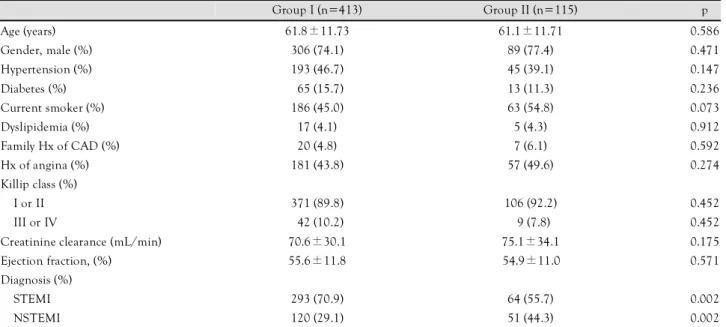
The number of patients diagnosed with ST elevation myocardial infarction (STEMI) at the time of admission was 293 (70.9%) in Group I and 64 (55.7%) in Group II (p=0.002). However, there were no significant differences in mean age, sex, hypertension, diabetes mellitus, smok- ing history, hyperlipidemia, family history of cardiovas- cular disease, or past history of angina pectoris between the two groups. There were also no significant differen- ces in Killip class III or IV ratio, glomerular filtration rate (GFR), or left ventricular ejection fraction (Table 1).
Coronary angiographic findings and percutaneous coronary intervention
In our coronary angiography series, infarction-related disease was found in the left anterior descending coro- nary artery in 275 cases (52.1%), left circumflex artery in 80 cases (15.1%), right coronary artery in 164 cases (31.1%), and left main coronary artery in 9 cases (1.7%).
There were no significant differences in these parameters between the two groups (Table 2). Single-vessel disease was seen in 62 (53.9%) patients in Group II and in 193 (46.7%) patients in Group I (p=NS). Triple-vessel disease or left main disease was seen in 104 (25.2%) patients in Group I and in 21 (18.3%) patients in Group II (p=NS).
The number of cases in which the degree of blood flow was TIMI flow 0 was 185 (44.8%) in Group I and 42
(36.5%) in Group II. However, this difference was not statistically significant. TAXUS
®was the predominant DES used in Group I (83.5% vs. 73.0%, p=0.011), and Cypher
®was the predominant DES used in Group II (16.5% vs. 27.0%, p=0.011). There was no significant difference in the proportion of cases in which the stent was successfully placed between the two groups (99.8%
vs. 98.9%, p=0.258).
Major adverse cardiac and cerebrovascular events Of the total patients, 511 were available for follow-up observation, excluding eight patients (2.0%) in Group I and nine patients (7.8%) in Group II (Table 3). Two hun- dred twenty-seven patients (55.5%) in Group I and 49 patients (45.0%) in Group II underwent a 6-month fol- low-up angiography (p=0.05). During the 6-month fol- low-up period, non-fatal myocardial infarction developed in only one patient in Group II. ARC definite or probable stent thrombosis developed in ten patients (2.5%) in Group I and in three patients (2.8%) in Group II, but this difference was not statistically significant. Stroke developed in one patient each in Group I and in Group II (p=0.372). One patient in Group II underwent coro- nary bypass surgery at two months following the proce- dure. Cardiac death occurred in seven patients (1.7%) in Group I and in six patients (5.7%) in Group II (p=0.022).
The cardiac death cases were as follows: three cases of ste- nt thrombosis, one case of severe aortic valve stenosis, one case of aggravated heart failure, and two cases of cardiac death suspected on a telephone interview in Group I, and two cases of stent thrombosis and four cases of car- diac death suspected on a telephone interview in Group II. The incidence of TLR was significantly lower in Group I than it was in Group II (5.7% vs. 11.5%, p=0.035). The incidence of MACCE within the 6-month period was
Table 1. Baseline characteristics of triple (group I) and dual (group II) anti-platelet therapy
Group I (n=413) Group II (n=115) p
Age (years) 61.8±11.73 61.1±11.71 0.586
Gender, male (%) 306 (74.1) 89 (77.4) 0.471
Hypertension (%) 193 (46.7) 45 (39.1) 0.147
Diabetes (%)
065 (15.7)13 (11.3) 0.236
Current smoker (%) 186 (45.0) 63 (54.8) 0.073
Dyslipidemia (%) 17 (4.1) 5 (4.3) 0.912
Family Hx of CAD (%) 20 (4.8) 7 (6.1) 0.592
Hx of angina (%) 181 (43.8) 57 (49.6) 0.274
Killip class (%)
I or II 371 (89.8) 106 (92.2) 0.452
III or IV
042 (10.2) 09 (7.8)0.452
Creatinine clearance (mL/min) 70.6±30.1 75.1±34.1 0.175
Ejection fraction, (%) 55.6±11.8 54.9±11.0 0.571
Diagnosis (%)
STEMI 293 (70.9) 64 (55.7) 0.002
NSTEMI 120 (29.1) 51 (44.3) 0.002
Hx of CAD: history of coronary artery disease, STEMI: ST elevation myocardial infarction, NSTEMI: non-ST elevation myocardial infarction
Keun-Ho Park, et al.·
193
also significantly lower in Group I than it was in Group II (7.9% vs. 16.0%, p=0.011). Two months following dis- charge, subarachnoid hemorrhage developed in one pa- tient in Group II. However, there were no significant dif- ferences in the incidences of TIMI major or minor ble- eding between the two groups (Table 4).
Subgroup analyses
Subgroup analyses were performed based on such pa- rameters as lesion severity, ST-segment elevation, and the type of DES used. In accordance with the ACC/AHA
lesion classification, in the simple lesions (type A or B1), there were no significant differences in the clinical events between the two groups. However, in the complex lesions (type B2 or C), the incidences of TLR and MACCE were significantly lower in Group I than they were in Group II (6.0% vs. 14.9%, p=0.012; 8.8% vs. 17.1%, p=0.037) (Table 5).
In patients diagnosed with non-STEMI, the incidences of TLR and MACCE within a recent 6-month period were significantly lower in Group I than they were in Group II (4.3% vs. 19.1%, p=0.002; 5.2% vs. 20.4%, p=0.003). However, in patients diagnosed with STEMI, there were no significant differences between the two
Table 2. Coronary angiographic findings and procedural characteristics in triple triple (group I) and dual (group II) anti-platelet therapy group
Group I (n=413) Group II (n=115) p
Infarct-related artery (%)
LAD 209 (50.6) 66 (57.4) 0.198
LCX
064 (15.5)16 (13.9) 0.675
RCA 134 (32.4) 30 (26.1) 0.192
LM
06 (1.5)3 (2.6) 0.417
Involved vessel number (%)
Single vessel 193 (46.7) 62 (53.9) 0.173
Two vessel 116 (28.1) 32 (27.8) 0.956
Three vessel or LM disease 104 (25.2) 21 (18.3) 0.123
ACC/AHA classification (%)
A or B1 125 (30.3) 32 (27.8) 0.613
B2 or C 288 (69.7) 83 (72.2) 0.613
Pre-PCI TIMI flow grade (%)
0 185 (44.8) 42 (36.5) 0.113
I 23 (5.6) 11 (9.6) 0.123
II 104 (25.2) 33 (28.7) 0.447
III 101 (24.5) 29 (25.2) 0.867
Type of DES used (%)
TAXUS
®345 (83.5) 84 (73.0) 0.011
Cypher
® 068 (16.5)31 (27.0) 0.011
Use of gylcoprotein IIb/IIIa inhibitor 142 (34.4) 42 (36.5) 0.670
Successful PCI (%) 401 (99.8) 92 (98.9) 0.258
LAD: left anterior descending artery, LCX: left circumflex artery, RCA: right coronary artery, LM: left main, ACC/AHA: American College of Cardiology/American Heart Association, PCI: percutaneous coronary intervention, TIMI: Thrombolysis In Myocardial Infarction, DES: drug- eluting stent, LM: let main artery
Table 3. Six-month clinical outcomes of triple (group I) and dual (group II) anti-platelet therapy group
Group I (n=405)
Group II
(n=106) p
Cardiac death (%)
07 (1.7)6 (5.7) 0.022 Non-cardiac death (%)
00 (0.0)1 (0.9) 0.207
CVA (%)
01 (0.2)1 (0.9) 0.372
Stent thrombosis (%) 11 (2.7) 3 (2.8) 0.999 Non-fatal AMI (%)
07 (1.7)2 (1.9) 0.999 Bypass surgery (%)
00 (0.0)1 (0.9) 0.207
TLR (%) 23 (5.7) 12 (11.3) 0.041
MACCE (%) 32 (7.9) 17 (16.0) 0.011
AMI: acute myocardial infarction, CVA: cerebrovascular accident, TLR: target lesion revascularization, MACCE: major adverse cardiac and cerebrovascular events
Table 4. Bleeding complications after triple (group I) and dual (group II) anti-platelet therapy
Group I (n=413)
Group II (n=115) p Degree of bleeding according to
TIMI criteria (%)
Major
00 (0.0)1 (0.9) 0.218
Minor
00 (0.0)0 (0.0) 1.000
Minimal
07 (1.7)1 (0.9) 0.999
Large-sized hematoma ≥5 cm 16 (3.9) 8 (7.0) 0.160
Small-sized hematoma <5 cm 38 (9.2) 6 (5.2) 0.172
Need for blood transfusion 19 (4.6) 4 (3.5) 0.797
TIMI: thrombolysis in myocardial infarction
194 ·
Triple Anti-Platelet Therapy in AMIgroups (Table 5).
In the Cypher
®stent group, there were no significant differences in the incidences of clinical events between Groups I and II. However, in the TAXUS
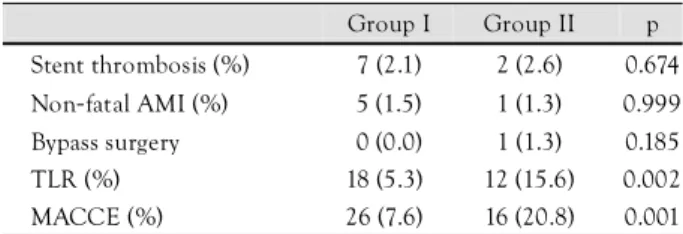
®stent group, the incidences of TLR and MACCE within a recent 6- month period were significantly lower in Group I than they were in Group II (5.3% vs. 15.6%, p=0.002; 7.6%
vs. 20.8%, p=0.001) (Table 5).
Independent predictors for major adverse cardiac and cerebrovascular events
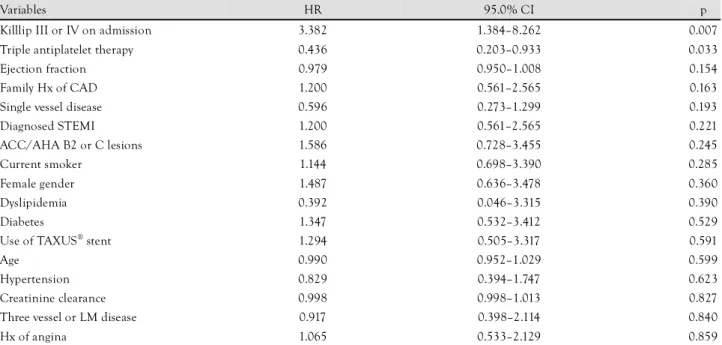
Cox proportional regression analysis was performed to identify predictors of MACCE. Variables included age, sex, hypertension, diabetes mellitus, hyperlipidemia, a past history of smoking, a family history of cardiovascular disease, a past history of angina pectoris, left ventricular ejection fraction, creatinine clearance, Killip classification, classification of ACC/AHA lesions, ST-segment elevation, the number of diseased vessels, the type of DES used, and triple anti-platelet therapy. Independent predictors for MACCE in AMI patients undergoing DES implan- tation included Killip class III or IV [hazard ratio (HR)=
3.382; 95% confidence interval (CI)=1.384-8.262, p=
0.007] and triple anti-platelet therapy (HR=0.436; 95%
CI=0.203-0.933, p=0.017) (Table 6).
Discussion
This study was conducted in order to evaluate the effect of triple anti-platelet therapy following DES implantation in AMI patients. Our study showed that, although there were no significant differences in non-fatal myocardial infarction, stroke, or stent thrombosis between the group receiving triple anti-platelet therapy and the group receiv- ing dual anti-platelet therapy, the incidences of cardiac death and TLR were significantly lower in the group re- ceiving triple anti-platelet therapy. These findings indicate that triple anti-platelet therapy was effective in lowering the incidence of MACCE. It was particularly effective in lowering the incidence of TLR in patients with complex lesions and those diagnosed with non-STEMI.
Recent studies have shown that DES significantly re- duces repeat target-vessel revascularization in patients with
Table 5. Six-month clinical outcomes on subgroup analysis
Group I Group II p Patients with ACC/AHA A
or B1 lesions (%)
N=122 N=30
Cardiac death 0 (0.0) 3 (10.0) 0.007 Non-cardiac death 0 (0.0) 0 (0.0) 1.000
CVA 0 (0.0) 1 (3.3) 0.197
Stent thrombosis 1 (0.8) 0 (0.0) 0.999 Non-fatal AMI 1 (0.8) 0 (0.0) 0.999 Bypass surgery 0 (0.0) 0 (0.0) 1.000
TLR 6 (4.9) 1 (3.3) 0.999
MACCE 7 (5.7) 4 (13.3) 0.229
Patients with ACC/AHA B2 or C lesions (%)
N=283 N=76
Cardiac death 7 (2.5) 3 (3.9) 0.447 Non-cardiac death 0 (0.0) 1 (1.3) 0.212
CVA 1 (0.4) 0 (0.0) 0.999
Stent thrombosis 9 (3.2) 3 (3.9) 0.724 Non-fatal AMI 6 (2.1) 2 (2.6) 0.678 Bypass surgery 0 (0.0) 1 (1.3) 0.212
TLR 17 (6.0) 11 (14.9) 0.012
MACCE 25 (8.8) 13 (17.1) 0.037
NSTEMI group (%) N=116 N=49
Cardiac death 1 (0.9) 3 (6.1) 0.079 Non-cardiac death 0 (0.0) 1 (2.0) 0.297
CVA 0 (0.0) 0 (0.0) 1.000
Stent thrombosis 2 (1.7) 2 (4.1) 0.582 Non-fatal AMI 1 (0.9) 1 (2.0) 0.507 Bypass surgery 0 (0.0) 0 (0.0) 1.000
TLR 5 (4.3) 9 (19.1) 0.002
MACCE 6 (5.2) 10 (20.4) 0.003
STEMI group (%) N=289 N=57
Cardiac death 6 (2.1) 3 (5.3) 0.171 Non-cardiac death 0 (0.0) 0 (0.0) 1.000
CVA 1 (0.3) 1 (1.8) 0.303
Stent thrombosis 8 (2.8) 1 (1.7) 0.999 Non-fatal AMI 6 (2.1) 1 (1.8) 0.999 Bypass surgery 0 (0.0) 1 (1.8) 0.165
TLR 18 (6.2) 3 (5.3) 0.999
(MACCE) 26 (9.0) 7 (12.3) 0.440
Use of Cypher
®stent (%) N=65 N=29
Cardiac death 1 (1.5) 0 (0.0) 0.171 Non-cardiac death 0 (0.0) 0 (0.0) 1.000
CVA 0 (0.0) 0 (0.0) 1.000
Stent thrombosis 3 (4.6) 1 (3.4) 0.999 Non-fatal AMI 2 (3.1) 1 (3.4) 0.999 Bypass surgery 0 (0.0) 0 (0.0) 1.000
TLR 0 (0.0) 5 (7.7) 0.319
(MACCE) 6 (9.2) 1 (3.4) 0.431
Use of TAXUS
®stent (%) N=340 N=77
Cardiac death 6 (1.8) 6 (7.8) 0.004 Non-cardiac death 0 (0.0) 1 (1.3) 0.185
CVA 1 (0.3) 1 (1.8) 0.336
Table 5. Continued
Group I Group II p Stent thrombosis (%) 7 (2.1) 2 (2.6) 0.674 Non-fatal AMI (%) 5 (1.5) 1 (1.3) 0.999 Bypass surgery 0 (0.0) 1 (1.3) 0.185
TLR (%) 18 (5.3) 12 (15.6) 0.002
MACCE (%) 26 (7.6) 16 (20.8) 0.001
ACC/AHA: American College of Cardiology/American Heart As-
sociation, CVA: cerebrovascular accident, AMI: acute myocardial in-
farction, TLR: target lesion revascularization, MACCE: major ad-
verse cardiac and cerebrovascular events, NSTEMI: non-ST elevation
myocardial infarction, STEMI: ST elevation myocardial infarction
Keun-Ho Park, et al.·
195
AMI and also significantly lowers the two-year mortali- ty.
13)However, varying opinions still exist regarding the use of DES in patients with AMI, as an off-label indica- tion.
14)The rate of in-stent restenosis is markedly decreas- ed with DES compared to BMS. Some investigators have reported that DESs are relatively free from compli- cations of stent thrombosis,
11)15)but this opinion is still controversial. To avoid this complication, medical treat- ment plays a crucial role in addition to the development of novel stents
16)17)and the development of technology for stent implantation.
In the setting of percutaneous intervention, dual anti- platelet agents including aspirin and clopidogrel can pre- vent the occurrence of acute or subacute stent thrombosis and have been reported to lower the incidence of major adverse cardiac events.
18)19)Therefore, at present, the use of dual anti-platelet agents prior to or following the pro- cedure has been accredited as the standard treatment.
Cilostazol selectively inhibits phosphodiesterase type 3, which is released from the platelet, and thereby raises the intracellular concentration of cyclic adenosine mono- phosphate (cAMP) and calcium. This leads to suppression of platelet aggregation and relaxation of vascular smooth muscle cells, which ultimately have a vasodilatory effe- ct.
20)21)Cilostazol has been reported to have a greater degree of anti-platelet effect compared to aspirin or tic- lopidine.
22)Concomitant use of cilostazol with aspirin and clopidogrel has also been reported to suppress the expression of P-selectin, the indicator of platelet activity, and to thereby strengthen the anti-platelet effect.
23)In addition to its anti-platelet effects, cilostazol is kno- wn to reduce in-stent restenosis in the primary lesions
of native vessels.
7)24)This effectiveness is associated with the inhibitory effect of cilostazol on the proliferation of vascular smooth muscle cells.
25)26)The following patho- physiology has been proposed to explain this occurrence.
Expression of the p53 gene is enhanced, and thereby the progression of the cell cycle is inhibited and apoptosis is induced. Hepatocyte growth factor (HGF) secretion is enhanced, and vascular endothelial cell function is im- proved. Hence, restenosis is improved following angiopla- sty.
27)This anti-proliferative effect plays a crucial role in reducing in-stent restenosis, along with the anti-platelet and vasodilatory effects. Therefore, triple anti-platelet th- erapy including cilostazol has been reported to signifi- cantly reduce in-stent restenosis in patients with diabetes mellitus or long lesions, who are at high risk of resteno- sis.
9)10)28)Myocardial infarction is also associated with coronary artery stenosis due to severe atherosclerosis or coronary occlusion due to atherosclerotic plaque rupture.
29)Res- tenosis remains problematic following stent implantation.
In this study, we showed that triple anti-platelet therapy including cilostazol reduced the incidence of TLR in pa- tients with myocardial infarction (relative risk reduction:
50%). These findings indicate that cilostazol has an anti- proliferative effect, even in patients with myocardial in- farction.
In our study, subgroup analysis showed that triple anti- platelet therapy significantly lowered the incidence of TLR in ACC/AHA type B2 or C lesions compared to ACC/AHA type A or B1 lesions, and in patients diag- nosed with non-STEMI compared to patients diagnosed
Table 6. Independent predictors of 6-month MACCE
Variables HR 95.0% CI p
Killlip III or IV on admission 3.382 1.384–8.262 0.007
Triple antiplatelet therapy 0.436 0.203–0.933 0.033
Ejection fraction 0.979 0.950–1.008 0.154
Family Hx of CAD 1.200 0.561–2.565 0.163
Single vessel disease 0.596 0.273–1.299 0.193
Diagnosed STEMI 1.200 0.561–2.565 0.221
ACC/AHA B2 or C lesions 1.586 0.728–3.455 0.245
Current smoker 1.144 0.698–3.390 0.285
Female gender 1.487 0.636–3.478 0.360
Dyslipidemia 0.392 0.046–3.315 0.390
Diabetes 1.347 0.532–3.412 0.529
Use of TAXUS
®stent 1.294 0.505–3.317 0.591
Age 0.990 0.952–1.029 0.599
Hypertension 0.829 0.394–1.747 0.623
Creatinine clearance 0.998 0.998–1.013 0.827
Three vessel or LM disease 0.917 0.398–2.114 0.840
Hx of angina 1.065 0.533–2.129 0.859
MACCE: major adverse cardiac and cerebrovascular events, HR: hazard ratio, CI: confidence interval, Hx of CAD: history of coronary artery di-
sease, STEMI: ST elevation myocardial infarction, ACC/AHA: American College of Cardiology/American Heart Association, LM: let main artery
196 ·
Triple Anti-Platelet Therapy in AMIwith STEMI (Table 4). These findings indicate that the anti-proliferative effect of cilostazol is greater in more severe atherosclerotic lesions. This is also demonstrated by the fact that the incidence of TLR was decreased in NSTEMI (where atherosclerosis is more prevalent and there are more AC/AHA type B2 or C lesions) compared to STEMI (where there are more lesions with thrombotic total occlusion). However, this merits further study. The incidence of TLR was significantly lower in the TAXUS
®stent group compared to the Cypher
®stent group. This finding also merits further study, because the number of enrolled patients who had Cypher
®stents was much smaller.
The incidence of stent thrombosis has been reported to increase in cases in which primary stent implantation is performed for AMI.
30)Lee et al.
8)reported that triple anti- platelet therapy including cilostazol significantly lowered the incidence of stent thrombosis following stent implan- tation. In our study, a total of 13 patients (2.5%) had definite or probable stent thrombosis. Of these, nine patients were diagnosed with STEMI and underwent DES implantation. There was no significant difference in the incidence of stent thrombosis between the triple anti-platelet therapy group and the dual anti-platelet therapy group (2.5% vs. 2.8%, p=0.738). Considering that the triple anti-platelet therapy group had a greater number of patients with STEMI who had a greater th- rombotic burden, we believe triple anti-platelet therapy offers an effective treatment for the prevention of stent thrombosis.
Cilostazol therapy was not associated with any adverse effects, such as TIMI major hemorrhage. This implies that triple anti-platelet therapy following DES implanta- tion is safe.
Our study was conducted in patients to whom cilo- stazol was administered for more than one month. In approximately 51% of the patients, however, cilostazol was administered for more than three months. A mini- mal treatment period of one month is not sufficient for determining if cilostazol is an effective drug. Hence, further large-scale studies are warranted to examine the appropriate period of cilostazol treatment.
The greatest limitation of our study is that it was con- ducted as a single-center, retrospective, non-randomized, comparative study. Furthermore, regular follow-up cor- onary angiography was performed in only approxima- tely 53% of the patients. TLR were performed based on the operators’ judgment of regular follow-up coronary angiography, rather than on ischemic symptoms. Because of this, the possibility of selection bias cannot be comple- tely ruled out. Intravascular ultrasonography, which is capable of assessing in-stent restenosis and neointimal hyperplasia more accurately, was not performed in all the patients.
The current study is significant, however, in that it
included a relatively large number of patients and the incidence of TLR was further decreased. This occurred despite the presence of an “ocular-stenotic reflex” in the triple anti-platelet therapy group secondary to the higher prevalence of follow-up coronary angiography in this group.
In conclusion, triple anti-platelet therapy following DES implantation in AMI patients was safe and effec- tive in reducing the occurrence of TLR and MACCE within six months, as compared to dual anti-platelet the- rapy. This reduction was particularly significant in pa- tients with complex lesions and those diagnosed with non-STEMIs.
Acknowledgments
This study was supported by a grant of the Korea Healthcare tec- hnology R&D Project, Ministry for Health, Welfare and Family Affairs (A084869), Republic of Korea.
REFERENCES
1)
Lee SR, Jeong MH, Ahn YK, et al. Clinical safety of drug-elu- ting stents in the Korea acute myocardial infarction registry. Circ J 2008;72:392-8.
2)
Pasceri V, Patti G, Speciale G, Pristipino C, Richichi G, Di Sciascio G. Meta-analysis of clinical trials on use of drug-eluting stents for treatment of acute myocardial infarction. Am Heart J 2007;153:
749-54.
3)
Melikian N, Wijns W. Drug-eluting stents: a critique. Heart 2008;
94:145-52.
4)
Antman EM, Hand M, Armstrong PW, et al. 2007 Focused up- date of the ACC/AHA 2004 guidelines for the management of pa- tients with ST-elevation myocardial infarction: a report of the American College of Cardiology/American Heart Association Task Force on Practice Guidelines: developed in collaboration with the Canadian Cardiovascular Society endorsed by the Ame- rican Academy of Family Physicians: 2007 writing group to re- view new evidence and update the ACC/AHA 2004 guidelines for the management of patients with ST-elevation myocardial infarc- tion, writing on behalf of the 2004 writing committee. Circulation 2008;117:296-329.
5)
Goto S. Cilostazol: potential mechanism of action for antithrom- botic effects accompanied by a low rate of bleeding. Atheroscler Suppl 2005;6:3-11.
6)
Douglas JS Jr. Role of adjunct pharmacologic therapy in the era of drug-eluting stents. Atheroscler Suppl 2005;6:47-52.
7)
Douglas JS Jr, Holmes DR Jr, Kereiakes DJ, et al. Coronary stent restenosis in patients treated with cilostazol. Circulation 2005;
112:2826-32.
8)
Lee SW, Park SW, Hong MK, et al. Triple versus dual antiplate- let therapy after coronary stenting: impact on stent thrombosis. J Am Coll Cardiol 2005;46:1833-7.
9)
Ahn Y, Jeong MH, Jeong JW, et al. Randomized comparison of cilostazol vs clopidogrel after drug-eluting stenting in diabetic patients: clilostazol for diabetic patients in drug-eluting stent ( CIDES ) trial. Circ J 2008;72:35-9.
10)
Lee SW, Park SW, Kim YH, et al. Drug-eluting stenting followed
by cilostazol treatment reduces late restenosis in patients with
diabetes mellitus the DECLARE-DIABETES Trial ( A Randomized
Comparison of Triple Antiplatelet Therapy with Dual Antiplatelet
Therapy After Drug-Eluting Stent Implantation in Diabetic Pati-
ents ) . J Am Coll Cardiol 2008;51:1181-7.
Keun-Ho Park, et al.·
197
11)
Mauri L, Hsieh WH, Massaro JM, Ho KK, D’Agostino R, Cutlip DE. Stent thrombosis in randomized clinical trials of drug-elu- ting stents. N Engl J Med 2007;356:1020-9.
12)
Rao AK, Pratt C, Berke A, et al. Thrombolysis in Myocardial In- farction ( TIMI ) Trial: phase I. hemorrhagic manifestations and changes in plasma fibrinogen and the fibrinolytic system in pa- tients treated with recombinant tissue plasminogen activator and streptokinase. J Am Coll Cardiol 1988;11:1-11.
13)
Mauri L, Silbaugh TS, Garg P, et al. Drug-eluting or bare-metal stents for acute myocardial infarction. N Engl J Med 2008;359:
1330-42.
14)
Nakazawa G, Finn AV, Joner M, et al. Delayed arterial healing and increased late stent thrombosis at culprit sites after drug- eluting stent placement for acute myocardial infarction: an auto- psy study. Circulation 2008;118:1138-45.
15)
Stone GW, Moses JW, Ellis SG, et al. Safety and efficacy of si- rolimus- and paclitaxel-eluting coronary stents. N Engl J Med 2007;356:998-1008.
16)
Kim W, Jeong MH, Kim KH, et al. The clinical results of a pla- telet glycoprotein IIb/IIIa receptor blocker ( abciximab: ReoPro ) - coated stent in acute myocardial infarction. J Am Coll Cardiol 2006;47:933-8.
17)
Mitka M. New drug-eluting stents under study. JAMA 2007;297:
2064-7.
18)
Mehta SR, Yusuf S, Peters RJ, et al. Effects of pretreatment with clopidogrel and aspirin followed by long-term therapy in patie- nts undergoing percutaneous coronary intervention: the PCI- CURE study. Lancet 2001;358:527-33.
19)
Yusuf S, Zhao F, Mehta SR, Chrolavicius S, Tognoni G, Fox KK.
Effects of clopidogrel in addition to aspirin in patients with acute coronary syndromes without ST-segment elevation. N Engl J Med 2001;345:494-502.
20)
Tanaka T, Ishikawa T, Hagiwara M, Onoda K, Itoh H, Hidaka H.
Effects of cilostazol, a selective cAMP phosphodiesterase inhibitor on the contraction of vascular smooth muscle. Pharmacology
1988;36:313-20.
21)
Chu YH, Park SW, Lee CW, et al. Effects of cilostazol treatment on angiographic restenosis after coronary stent placement. Korean Circ J 2000;30:1494-500.
22)
Ikeda Y, Kikuchi M, Murakami H, et al. Comparison of the inhi- bitory effects of cilostazol, acetylsalicylic acid and ticlopidine on platelet functions ex vivo: randomized, double-blind cross-over study. Arzneimittelforschung 1987;37:563-6.
23)
Ahn JC, Song WH, Kwon JA, et al. Effects of cilostazol on plate- let activation in coronary stenting patients who already treated with aspirin and clopidogrel. Korean J Intern Med 2004;19:230-6.
24)
Kim SM, Kim DI, Cho HJ, et al. Effect of cilostazol on the drug- eluting stent in native coronary arteries. Korean Circ J 2007;37:
304-11.
25)
Takahashi S, Oida K, Fujiwara R, et al. Effect of cilostazol, a cy- clic AMP phosphodiesterase inhibitor, on the proliferation of rat aortic smooth muscle cells in culture. J Cardiovasc Pharmacol 1992;20:900-6.
26)
Lee KJ, Yun SW, Kim SW, Kim TH, Kim CJ, Ryu WS. The ef- fect of cilostazol on proliferation of vascular smooth muscle cells and expression of iNOS and p21. Korean Cir J 2004;34:500-6.
27)
Morishita R. A scientific rationale for the CREST trial results:
evidence for the mechanism of action of cilostazol in restenosis.
Atheroscler Suppl 2005;6:41-6.
28)
Lee SW, Park SW, Kim YH, et al. Comparison of triple versus dual antiplatelet therapy after drug-eluting stent implantation ( from the DECLARE-Long trial ) . Am J Cardiol 2007;100:1103-8.
29)
Viles-Gonzalez JF, Fuster V, Badimon JJ. Atherothrombosis: a wi- despread disease with unpredictable and life-threatening con- sequences. Eur Heart J 2004;25:1197-207.
30)