581
Open Access
Comparison of Plaque Composition in Diabetic and Non-Diabetic Patients With Coronary Artery Disease Using Multislice CT Angiography
Yong-Seop Kwon, MD
1, Jae-Sik Jang, MD
3, Chang-Won Lee, MD
1, Dong-Kie Kim, MD
2, Ung Kim, MD
2, Sang-Hoon Seol, MD
2, Doo-Il Kim, MD
2, Young-Wan Jo, MD
3, Han Young Jin, MD
3, Jeong-Sook Seo, MD
3, Tae-Hyun Yang, MD
3, Dae-Kyeong Kim, MD
3and Dong-Soo Kim, MD
31
Department of Internal Medicine, Busan St. Mary’s Hospital, Busan,
2
Department of Internal Medicine, Inje University College of Medicine, Haeundae Paik Hospital, Busan,
3
Department of Internal Medicine, Inje University College of Medicine, Busan Paik Hospital, Busan, Korea
ABSTRACT
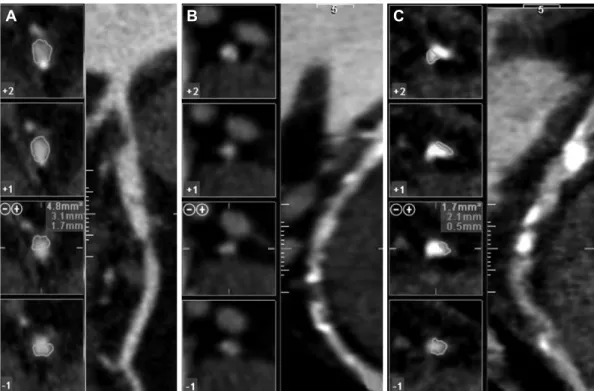
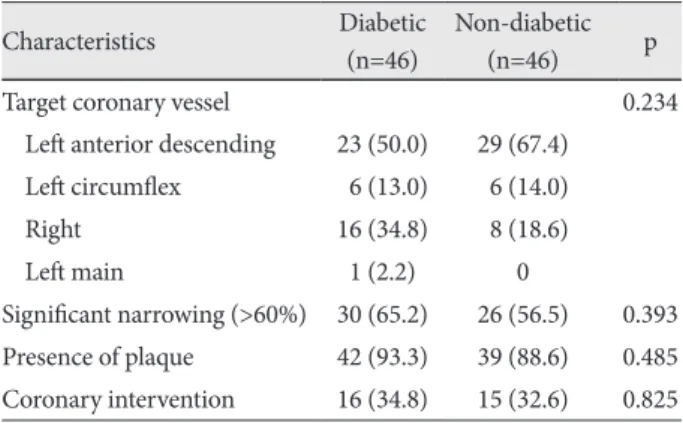
Background and Objectives: Plaque composition rather than degree of luminal narrowing may be predictive of future cor- onary events in high risk patients. The purpose of this study was to compare degree of plaque burden and composition with mul- tislice computed tomography (MSCT) angiography between diabetic and non-diabetic patients. Subjects and Methods: A total of 452 consecutive MSCT angiography examinations were performed between July 2007 and June 2009. Of these, the pa- tients who underwent invasive coronary angiography were evaluated for the presence and type of atherosclerotic plaque and se- verity of luminal narrowing. Results: Ninety two (46 in the diabetic group and 46 in the non-diabetic group) patients under- went both MSCT angiography and invasive coronary angiography. Among them, 30 patients (65.2%) in the diabetic group and 26 patients (56.5%) in the non-diabetic group had significant coronary narrowing on MSCT angiography. Sixteen patients (34.8%) in the diabetic group and 15 patients (32.6%) in non-diabetic group underwent coronary angioplasty and stenting. Forty-two patients (93.3%) in the diabetic group and 39 patients (88.6%) in the non-diabetic group had multiple types of coronary plaque (p=0.485). MSCT angiography was similar to conventional coronary angiography in its ability to predict significant coronary ar- tery disease in that the area under the curve was 0.88 (95% confidence interval, 0.81 to 0.95). Diabetic patients had more mixed plaque compared with non-diabetic patients. Conclusion: Differences in coronary plaque composition between diabetic and non-diabetic patients can be determined noninvasively by MSCT angiography. In patients with diabetes, mixed plaque types contribute to the total plaque burden to a higher degree than in non-diabetic patients. (Korean Circ J 2010;40:581-586) KEY WORDS: Coronary artery diseases; Diabetes.
Received: March 12, 2010 Revision Received: May 3, 2010 Accepted: May 11, 2010
Correspondence: Jae-Sik Jang, MD, Department of Medicine, Inje University College of Medicine, Busan Paik Hospital, 633-165 Gaegeum- dong, Jin-gu, Busan 614-735, Korea
Tel: 82-51-890-6947, Fax: 82-51-892-0273 E-mail: [email protected]
cc