• 검색 결과가 없습니다.

Current Limiting and Interrupting Operation of Hybrid Self-Excited Type Superconducting DCCB

N/A
N/A
Protected

Academic year: 2021

Share "Current Limiting and Interrupting Operation of Hybrid Self-Excited Type Superconducting DCCB"

Copied!
5
0
0

로드 중.... (전체 텍스트 보기)

전체 글

(1)

Vol.20, No.4, (2018), pp.55~59 https://doi.org/10.9714/psac.2018.20.4.055

```

1. INTRODUCTION

In the last century, to research AC circuit breaker is a main research topic of safety devices’ area. Large number of high voltage experiments had to be performed to obtain various results. However, it takes much time and a lot of money to get enough data from the actual high-voltage test.

In DC circuit breaker, to make matter worse, testbed of DC circuit breakers does not get ready enough, to experiment of DC circuit breaker’s operating test could be harder than AC; relatively high costs and too much time for these experiments would be needed. Therefore, to simulate the behavior of DC circuit breaker (DCCB) interrupting on computer software is necessary method.

At first, this paper is analyzed mathematically the self-excited DCCB which is one kind of existing DC circuit breaker, and studied the superconducting self-excited DCCB which is a more developed method than that. In addition, one of the ancillary studies is the hybrid DCCB.

Most of the hybrid DCCBs use a large number of power semiconductor devices as the main circuit and auxiliary circuit, and require additional control circuit to operate them. Due to the characteristics of semiconductors, operating speed and breaking performance are much better than mechanical CB. Currently, commercial hybrid CB can interrupt 16 [kA] or more fault within 3ms, within rated voltage of CB is 320 [kV]. It is enough to satisfy the condition that DC power system is needed. However, the cost of hybrid type of DCCB is extremely high and it has high power losses, because power electronic switch is

relatively expensive than mechanical CB. For reducing electrical capacity of switch, current limiting resistance (CLR) is used. On the other hand, operating time and current amplitude of main CB are most important visible index in DCCB. In this paper, we analyzed the magnitude of the current, the burden of the superconducting device, and the interrupting speed according to the CLR resistance, because the resistance of the superconducting element cannot easily be changed.

2. MATHMEMATICAL INVESTIGATION OF COMPONENTS

2.1. Resistance of Arc

The electrical arc is the interrupting element of the self-excited DCCB, so the essential part of the self-excited DCCB model is the arc model. In the middle of last century, two basic mathematical model was developed within the field of current interruption: One of models, the Mayr’s arc equation, is defined by equation (1).

May’s Arc model : m m arc 2 1

m

dg g i

dtP

 

  

 -  (1) In the equations, i arc is the current through the circuit breaker when arc occur. The g m is arc conductance and τ m is arc time constant. P represents the power consumed as heat at the space between contacts.

When the arc of the CB is expressed as a resistance, each parameter means the performance of the CB. On the other

Current Limiting and Interrupting Operation of Hybrid Self-Excited Type Superconducting DCCB

S. J. Choi, and S. H. Lim * Soongsil University, Seoul, Korea

(Received 16 November 2018; revised or reviewed 24 December 2018; accepted 25 December 2018)

Abstract

Currently, the development of industry makes needs larger electric supply. Providers must consider the efficiency about losses and reliability of the system. In this case, DC power system can save electrical energy; long-distance transmission line losses.

Relevance to switch technology with a voltage-source converter (VSC) in AC-DC conversion system have been researched. But, protection device of DC-link against fault current is still needed to study much. VSC DC power system is vulnerable to DC-cable short-circuit and ground faults, because DC-link has a huge size of capacitor filter which releases extremely large current during DC faults. Furthermore, DC has a fatal flaw that current zero crossing is nonexistence. To interrupt the DC, several methods which make a zero crossing is used; parallel connecting self-excited series LC circuit with main switch, LC circuit with power electronic device called hybrid DC circuit breaker. Meanwhile, self-excited oscillator needs a huge size capacitor that produces big oscillation current which makes zero crossing. This capacitor has a quite effective on the price of DCCB. In this paper, hybrid self-excited type superconducting DCCB which are using AC circuit breaker system is studied by simulation tool PSCAD/EMTDC.

Keywords: hybrid self-excited type superconducting DC circuit breaker(DCCB), zero crossing, voltage sourced converter (VSC)

* Corresponding author: [email protected]

(2)

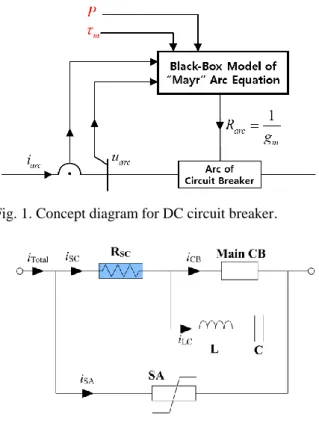
Fig. 1. Concept diagram for DC circuit breaker.

Fig. 2. Existing model topology: conventional self-excited type superconducting DCCB.

hand, the equation from Mayr could be expressed arc force and interrupting force. Being founded on Halmoy, arc force is written by CB model.

In Fig. 1, the black box arc model of circuit breaker is used for simple physical arc because the accurate resistance cannot act as an arc in the whole simulation. The resistance is controlled at each time step by ‘black box arc model’

whose outputs follow the mathematical Mayr’s arc model defined by differential equations.

2.2. Derivation of Self-Excited DCCB

Superconducting self-excited DCCB is used for reaching current zero crossing. From the Fig. 2, the circuit equation is given by

2 2

1 1

( )

CB CB

CB SC

di di

L r k i i

dt   dtCC (2)

CB SC LC

ii - i (3) In equation (2), r is small resistance of resonance circuit.

To solve these equations, two of assumption are needed:

first, k which means

arc arc

di du matched 1 g c from Mayr’s arc equation. And

i is zero until fully open of Main CB. SA

Then, from upper equations, amplitude and frequency of arc current

i arc could be derived. Arc current is given by (2 2 )

sin 1

n q pt

arc CB

i i e e qt

     

 

               

- -

- (4)

( )

2 r k

p L

= + (5)

4 2

( )

2 L r k q C

L - +

= (6)

To break large direct current, large scale of oscillated current is required. Meanwhile, the inductor L and the capacitor C are the most important elements for controlling the arc current amplitude and the oscillation frequency, thereby controlling the direct current interrupting time and the peak current.

Amplitude :

2

2 2

4 ( )

( )

4

n L

L r k

r k t

C L

arc CB

i i e e

 

  

 

 

 

  

- 2 -

- -

(7)

Frequency :

4 2

( )

4 L r k C

πL + -

(8)

As capacitor C decreases smaller, amplitude decreases and frequency increases. And the smaller the inductor L, the bigger amplitude and frequency.

If self-excited DCCB is applied with SC like Fig. 2, all of value will be equal to non-SFCL self-excited DCCB.

However total current

Total

i will decrease by insertion of R SC . 2.3. Resistance of Superconducting Element

Superconducting element model is used for basic model.

The most attractive area for lots of engineers is quenching phenomena in the last century. Some part of that research is formulating superconducting element theoretically. For our simulation of superconducting element, that is based on the quenching operation of superconducting element, is described by equation (9).

0

1 ( ) 1 t τ

SC n

R = R 1- e - + (9 )

3. STURCUTRE AND OPERATING PRINCIPLE 3.1. Structure and Role

Main circuit is made of CB and parallel LC circuit.

Superconducting element is connected in series to the main circuit breaker and the power electronic switch is connected in parallel throughout it with current limiting resistance. The surge arrestor, which limits the voltage of the DC circuit breaker, is connected in parallel to the entire circuit as Fig. 3.

First, the main CB interrupt the current mechanically by using the physical arc characteristic. The LC circuit produces a zero point of the main circuit breaker by creating a resonance. The superconducting element limits, and commutates the current toward the auxiliary circuit.

The auxiliary circuit limits the current through the CLR

element, and the power electronics of the auxiliary circuit

are opened as well when the main breaker is fully

opened.

(3)

Fig. 3. Proposed model topology: self-excited type superconducting DCCB with auxiliary circuit.

Fig. 4. Operating order signal of arc, SC resistance and IGBT.

3.2. Operating Principle

The superconducting element has a critical current and the main circuit breaker has a pick-up current. Depending on these current factors, the operating characteristics of the presented model may change. This paper is considered the case where the critical current of the superconducting device is larger than the pick-up current of the main CB.

As can be seen in Fig. 4, after a fault has occurred at 30 [ms], the arc current exceeds the critical current at 30.25 and pick-up current exceeds at 30.33 [ms]. Therefore, the superconducting element is quenched and the main circuit breaker operates at each time.

When the amplitude of the arc current is lower than the command value, no arc occurs, current doesn’t flow through the LC circuit and all the current flows to the main circuit breaker. If the arc current exceeds the command value of the pick-up current, an arc is generated, and a circulation current flows between the arc and the LC circuit to cause resonance. At the same time, superconducting element current exceeds the critical current and superconducting element is quenched and fault current is divided into the CLR circuit. However, after the main

Fig. 5. Current operating waveform on conventional self-excited type superconducting DCCB.

Fig. 6. Current operating waveform on proposed hybrid self-excited type superconducting DCCB.

circuit breaker and the power electronic switch are completely opened, the total current still flows through the LC circuit and the time to completely open according to the capacitor value is determined. When the decreasing oscillation is completed according to the time constant of LC oscillated circuit, the hybrid self-excited type superconducting DCCB is completely open.

Fig. 5 and 6 show the results of the conventional DCCB and the proposed hybrid circuit when CLR is 5 [ohm], respectively. First, in Fig. 5, the oscillation current is generated through the LC circuit immediately after the interrupting operation starts and the current approaches zero crossing. However, when there is an auxiliary circuit to which a power electronic is added, superconducting element current flows to the CLR circuit, and the burden of the main CB is shared by the power electronic switch.

4. SIMULATION AND RESULTS 4.1. Setup and Simulation

In superconducting element on simulation, the first

(4)

Fig. 7. Equivalent Circuit of Simulation Circuit of Hybrid Self-Excited Type Superconducting DCCB.

TABLE 1

P ARAMETERS OF ARC AND SUPERCONDUCTING ELEMENT MODEL .

consideration in determining the fabricated form and material of a superconducting element is the characteristics of the applied system and the characteristics of the circuit breaker. In other words, since the superconducting element is a subsidiary device of the system and the circuit breaker, it is first determined that the electrical parameters such as the superconducting resistance and the capacity should be obtained, then the physical design should be made accordingly. Therefore, this paper simulates with the superconducting resistance modeling in the simplest form.

The DC power source used in the simulation was MVDC class 10 [kV] and the resistance and inductance of the transmission cable were considered. In case of failure, the simulation assumes that the load is dropped at 0.03 [s]. The critical current of the superconducting element and the pick-up current of the main breaker were set to 10 [kA]. Fig.

7 below shows the testbed used in the simulation.

The above simulation setup values and the parameters of the arc and superconducting element used in the simulation are shown in Table 1 below.

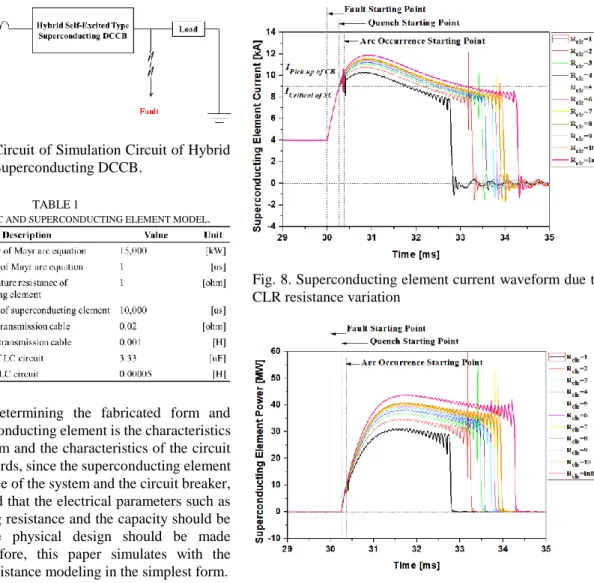
As shown in the previous 3.2. operating principle, the arc quenching time (breaking time), the electrical capacity of the circuit breaker and the size of power electronic switch are determined by the CLR impedance value and the normal resistance value of the superconducting element. In this paper, we investigated the impact of interrupting time, superconducting element capacity and main circuit breaker capacity due to the CLR impedance’s variation from 1 [ohm] to 10 [ohm], when the superconducting element resistance was constant 1 [ohm]. The power burden share of the main circuit breaker and the power electronics depends on the CLR impedance. As can be seen in Fig. 6, the larger the CLR impedance, the longer the interrupting time and the more power burden the superconducting element will bear.

As can be seen in Fig. 8, the quench of the superconducting element occurred after 32 millisecond

Fig. 8. Superconducting element current waveform due to CLR resistance variation

Fig. 9. Superconducting element power burden due to CLR resistance change

after the fault, and the start time of quench did not change with the change of CLR resistance. And the power burden of the superconducting element according to the CLR value becomes larger as the CLR resistance becomes larger. The larger the CLR resistance is, the less current flows to the power electronic switch and the superconducting element current increases. Finally, the time to interruption is also reduced. That is, the CLR resistance affects interrupting time, superconductor capacity, CB capacity, and power electronics capacity, which are in a trade-off relationship.

5. CONCLUSION

In this paper, the operation characteristics of the hybrid

self-excited type superconducting DCCB are verified. In

this model, the dependence of the power burden on the

superconducting element according to the CLR resistance

value affecting the interrupting time is researched. As the

CLR resistance increases, the capacity of the power

electronic switch decreases, but the capacity of the

superconducting element and the main circuit breaker

becomes relatively large. In addition, we can see that C of

capacitor of LC resonance circuit should be small.

(5)

As mentioned earlier, the higher the CLR resistance of the auxiliary circuit, the shorter the interrupting time. The interrupting time is very important for the DC system. This is because the fault in the DC system is so large that the fault current is usually 4-10 times larger than usual. In superconducting element case, The lower the CLR resistance, the lower the temperature rise due to the reduced burden on the superconductor, and the shorter the recovery time to return to the superconducting state. The volume of the superconducting element and the cooling facility can also be reduced. Since the burden of superconducting element is related to the main circuit breaker and also to the surge arrestor, so a complex analysis is needed later.

In sum, the economics of power semiconductors, superconducting elements and main breakers are in a trade-off relationship with each other, so economic evaluation should be done through optimization based on CLR resistance.

ACKNOWLEDGMENT

This work was supported by the National Research Foundation of Korea (NRF) grant funded by the Korea government (MOE) (No. 2017R1D1A1B03036530).

REFERENCES

[1] Hiroyuki Nakao, Yoshihiko Nakagoshi, Masayuki Hatano, Tadashi Koshizuka, Member, IEEE, D.C. Current Interruption in HVDC SF6 Gas MRTB by Means of Self-Excited Oscillation Superimposition IEEE TRANSACTIONS ON POWER DELIVERY, VOL. 16, NO. 4, OCTOBER 2001

[2] Bin Xiang, Yaxiong Tan, Kun Yang, Zhiyuan Liu, Senior Member, IEEE, "Quenched Resistance Effects on a Superconducting Current-Limiting-Type DC Breaker ”, IEEE TRANSACTIONS ON APPLIED SUPERCONDUCTIVITY, VOL. 26, NO. 7, OCTOBER 2016

[3] Magnus Callavik, Anders Blomberg, Jürgen Häfner, Björn Jacobson, The Hybrid HVDC Breaker an innovation breakthrough enabling reliable HVDC grids, ABB Grid Systems

[4] Lou van der Sluis, Trasient in Power Systems, 2001 John Wiley &

Sons Ltd

[5] Halmoy, E. 1979. The pressure of the arc acting on the weld pool.

Arc Physics and Weld Pool Behavior. Cambridge, England: The Welding Institute.

[6] B. Xiang et al., "DC Interrupting With Self-Excited Oscillation Based on the Superconducting Current-Limiting Technology," in IEEE Transactions on Power Delivery, vol. 33, no. 1, pp. 529-536, Feb. 2018.

[7] B. Xiang et al., "Quenched Resistance Effects on a Superconducting Current-Limiting-Type DC Breaker," in IEEE Transactions on Applied Superconductivity, vol. 26, no. 7, pp. 1-5, Oct. 2016, Art no. 5603105.

[8] Boris Žitnik, Numerical modelling of metal oxide varistors, Proceedings of the XIVth International Symposium on High Voltage Engineering, Tsinghua University, Beijing, China, August 25-29, 2005

[9] H. Yamaguchi and T. Kataoka, "Current Limiting Characteristics of Transformer Type Superconducting Fault Current Limiter With Shunt Impedance and Inductive Load," in IEEE Transactions on Applied Superconductivity, vol. 18, no. 2, pp. 668-671, June 2008 [10] M. Babaei, S. Abdelwahed, J. V. Kluss and R. Jafari-Marandi, "A

novel approach for optimal design of superconducting fault current limiter," 2018 IEEE Texas Power and Energy Conference (TPEC), College Station, TX, 2018, pp. 1-5.

[11] J. Yang, J. E. Fletcher and J. O'Reilly, "Short-Circuit and Ground Fault Analyses and Location in VSC-Based DC Network Cables,"

in IEEE Transactions on Industrial Electronics, vol. 59, no. 10, pp.

3827-3837, Oct. 2012.

수치

Fig. 1. Concept diagram for DC circuit breaker.
Fig.  3.  Proposed  model  topology:  self-excited  type  superconducting DCCB with auxiliary circuit
Fig. 7. Equivalent Circuit of Simulation Circuit of Hybrid  Self-Excited Type Superconducting DCCB

참조

관련 문서

The performance and characteristics of resistive superconducting fault current limiters are reviewed and other standards including circuit breakers, transformers, reactors, power

Taniguchi, "Setting Mothod of Specific Parameter of a Superconducting Fault Current Limiter Considering the Operation of Power System Protection,"

Authors expect that the hybrid type SFCL can control the magnitude of the fault current by adjusting the firing angles of thyristors after the superconducting coil limits

To analyze the transient current limiting characteristics of the flux-lock type SFCL using double quench, the short-circuit tests according to the fault angles, which

The flux-lock type SFCL has the structure to install the magnetic application circuit, which can increase the resistance of HTSC (high-T C superconducting

The series connection-type SFCL designed with the additive polarity winding was shown to perform more effective fault current limiting and load voltage

Through the short-circuit tests, the flux-lock type SFCL using transformer winding was shown to perform more effective fault current limiting operation compared