http://dx.doi.org/10.17703/JCCT.2021.7.2.247
JCCT 2021-5-28
*정회원, 이화여자대학교 간호대학 부교수 (제1저자)
**정회원, 부산가톨릭대학교 간호대학 조교수 (제2저자)
***정회원, 이화여자대학교 간호대학 석사과정생 (제3저자) 접수일: 2021년 3월 20일, 수정완료일: 2021년 4월 16일 게재확정일: 2021년 4월 31일
Received: March 20, 2021 / Revised: April 16, 2021 Accepted: April 31, 2021
*Corresponding Author: [email protected] Dept. of Nursing, Ewha Woman Univ, Korea
노인요양시설 간호인력이 입소노인 케어의 질 및 삶의 질에 미치는 영향에 대한 문헌고찰 : Castle과 Engberg의 개념적 기틀 활용
Review of Nurse Staffing and Residents Quality of Care and Quality of Life in Nursing Homes
: Applying Castle & Engberg’s Conceptual Framework
신주현*, 이지연**, 이예나***
Juh Hyun Shin*, Ji Yeon Lee**, Yae Na Lee***
요 약
목적: Castle과 Engberg의 이론적 기틀을 활용하여 노인요양시설의 간호인력이 입소노인의 케어의 질과 삶의 질에 미치는 영향을 파악하고자 한다. 방법: 6개의 데이터베이스에서 “Nurse staffing(간호인력 배치)”, “Nursing staff(간 호인력)”, “Outcome(결과)”, “Quality of care(케어의 질)”, “Quality of life(삶의 질)”, “residents outcomes(입소자 결과)”, “nursing home(노인요양시설)”, “long-term care(장기요양)”를 키워드로 1996년 1월부터 2021년 3월까지 출 판된 문헌을 수집하여 총 31편의 연구가 도출되었다. Castle과 Engberg의 이론적 기틀을 활용하여 체계적인 고찰을 수행하였다. 결과: 간호인력의 제공 시간, 간호사 면허를 가진 인력 확보, 간호인력과 입소노인 간 우호적 관계, 관대 한 관리감독 체계가 입소노인의 케어의 질 및 삶의 질에 긍정적인 영향을 미쳤다. 이직률과 agency 간호사 고용 여 부에 관해서는 일관적인 연구 결과가 보고되지 않았다. 결론: 노인요양시설의 간호인력은 노인요양시설 입소노인의 케어의 질 및 삶의 질에 영향을 미치는 주요 요인이므로, 의무적인 간호사 인력 배치 수준을 제시하는 정책 마련이 필요하다. 또한 현재 대부분의 연구가 케어의 질을 중점으로 보고하여, 삶의 질에 대한 연구가 추가적으로 수행될 필 요가 있다.
주요어 : 노인요양시설, 간호인력, 케어의 질, 삶의 질, 체계적 고찰
Abstract
Purpose: The purpose of this study was to figure out the effect of nurse staffing in nursing home on the quality of care and quality of life of the residents, using Castle & Engberg’s conceptual framework. Methods: A total of 31 studies published between 1996 and 2021 were selected from 6 databases, searched for keyword such as “Nurse staffing”, “Nursing staff”, “Outcome”, “Quality of care”, “Quality of life”, “residents outcomes”,
“nursing home”, “long-term care”. By using Castle & Engberg’s conceptual framework, systematic review was conducted. Results: More time provided by nursing staff, high level of licensed nurse staffing, good relationship between nursing staff and residents, and generous supervision system have a positive effect on resident outcomes. Conclusion: Establishing regulatory strategies of having mandatory Registered Nurse is needed because nurse staffing in nursing homes was related to resident outcomes. In addition, it is necessary to conduct further research about quality of life beyond quality of care for residents.
Key words : Nursing home, Nursing staff, Quality of care, Quality of Life, Systematic review
Ⅰ. 서 론
1. 연구의 필요성
2021년 기준 우리나라 전체 인구 중 약 16.5%가 노 인 인구로 추정되며, 2050년에는 총 인구 중 약 39.8%
가 노인 인구로 주요 OECD (Organisation for Economic Cooperation and Development) 국가들과 비 교해 초고령화 속도가 빠를 것으로 예상된다[1]. 초고령 사회에 진입하고 있는 한국은 노인 가족의 부양과 보호 가 사회적 문제로 대두되면서 2008년 7월 1일 노인장기 요양보험이 도입되어 시행되고 있다[2]. 노인장기요양 보험은 정부와 사회가 공동으로 치매, 뇌졸중, 파킨슨 등의 노인성 질환을 앓고 있는 노인들을 대상으로 재가 및 노인요양시설에서 의료서비스 및 가사활동, 일상생 활 수행 보조 등의 노인장기요양 서비스를 제공하는 보 험으로, 제5의 사회보험으로 간주되고 있다[3].
노인장기요양보험 시행 결과, 노인요양시설은 급속 도로 증가하여 2008년 1,379개(약 66,224명)에서 2019년 3,604개(약 174,634명)로 약 161.3% 증가하였다[4]. 노인 요양시설과 관련된 장기요양보험의 공단부담금은 2019 년 기준 약 3조 634억원으로 집계되었으며, 급여비용은 약 3조 4319억원으로 2018년 대비 16.4% 증가하여 앞 으로도 계속 증가할 전망이다[5]. 또한 2021년 1월 말 기준 장기요양보험 누적 신청자 수는 약 1,187,711명으 로 우리나라 전체 노인인구의 약 13.9%가 신청한 상태 이고 약 860,834명이 장기요양보험 등급판정을 받은 상 태(1등급-43,085명, 2등급-86,882명, 3등급-238,987명)로, 노인요양시설을 이용하는 노인 인구가 지속적으로 증 가할 것으로 예상된다[6]. 우리나라 노인장기요양보험 수급자는 평균 3.4개의 만성질환을 가지고 있으며, 주요 질병의 비율은 고혈압이 60.3%, 치매 57.2%, 당뇨병 29.3%, 골관절염이나 류마티즘 27.8%, 뇌졸중 25.8%로 나타났다[7]. 수급자 평균연령은 81.8세이며 80세 이상 의 고령 수급자가 전체의 65% 이상을 차지하고, 이중 29.7%가 노인요양시설을 이용하고 있는 상황이다[7].
입소노인의 대부분은 심신의 기능상태 장애로 다른 인 력의 도움이 필요한 장기요양 1, 2등급 인정자이고[8], 입소노인의 73.9%가 세 종류 이상의 약을 복용하는 만 성질환자임을 고려해볼 때 지속적이고 전문적인 건강 관리가 요구된다[9]. 또한, 현재 우리나라에서는 노인요 양시설에서 거주 인구 중 약 20.3%(88,083명)가 치매로
인해 노인요양시설을 이용하고 있는 것으로 보고되어, 간호인력을 통한 전문적인 간호가 필요하다[10].
노인요양시설 이용자는 신체적·인지적으로 중증도 이상의 장기요양을 필요로 하는 노인들로 간호 인력이 직접적으로 노인장기요양 서비스를 제공하는 특징을 가지고 있으며, 간호사나 간호보조인력의 건강서비스 제공시간이 전체 서비스의 92%를 차지하고 있다[11].
따라서 노인요양시설의 간호 인력의 질 관리(quality)는 노인장기요양 서비스의 질(quality)을 결정하는 중요한 요인이다[12]. 일반 병원 및 노인요양시설에서의 간호인 력 문제는 수십년간 연구가 진행되었으며[13], 이미 미 국 등 선진국에서는 노인요양시설의 최소 간호사 인력 배치를 위한 연구가 진행되고 이에 따른 법제화가 이루 어진 상황이다[14]. 그러나, 선진국에 비해 뒤늦게 도입 된 노인장기요양보험이 도입된 후 약 13년이 지났음에 도 여전히 노인장기요양서비스의 질에 대한 문제점들 이 지속적으로 제시되고 있어, 노인요양시설의 입소 노 인들의 욕구 충족 및 신체적, 정신적 건강유지증진에 개선이 요구되고 있다. 노인요양시설 촉탁의 중 45.8%
가 입소노인의 건강관리가 적절하게 이루어지지 않고 있다고 답하여[15], 질 높은 노인장기요양 서비스가 제 공되지 않는 상황이다.
개념적 기틀(conceptual framework)을 활용한 과학 적이고 체계적인 문헌고찰은 주요 개념들 사이의 가설 적 관계에 대해 규명한다[16]. 1968년 Donabedian’s 학 자는 National Health Forum에서 노인요양시설의 질을 평가하기 위한 개념의 틀을 발표하였다[17]. 이후 대부 분 간호인력 연구의 간호인력과 질 평가에서는 대부분 Donabedian’s framework (1996)에 기초하였는데, 이는 노인요양시설의 간호 및 규제 개혁 등과 관련한 연구들 이 구조(structure), 과정(process), 결과(outcome)를 포 함하여 문제해결을 위한 수단도 제공하기 때문이다 [18-20]. 구조(structure)에는 시설, 장비, 인적 자원, 자 금 등이 해당되고, 과정(process)은 간호중재 제공 과정 을 의미하며, 결과(outcome)는 환자의 건강 상태에 대 한 결과를 의미한다[21]. 이후 노인요양시설 관련 연구 가 정교화되면서 2005년 Castle and Engberg는 노인요 양시설에서 간호사 인력 배치와 입소 노인의 건강결과 간의 관계를 조사하기 위해 이론적 기틀을 개발하였으 며, 인력의 일관성(consistency), 조정(coordination), 케 어의 양 및 케어 행위(practices)를 영역을 중심으로 노
인요양시설 질에 영향에 관한 이론적 기틀을 제시하였 다[22]. 일관성은 작업을 수행할 때 따라야 하는 이해할 수 있는 일련의 단계로 정의하며[23], 안정적인 인력이 일관된 케어를 제공할 가능성이 있음에 따라 이직률 (turnover), 5년 이상 근무한 인력의 수(stability), 에이 전시 (agency) 간호사 고용 여부 등과 관계가 있다[24].
조정은 조직 또는 직원의 다양한 상호의존적인 부분이 다른 시스템의 필요와 요구 사항에 따라 각각 기능하는 정도로 정의하며[25], 직접 감독 및 규칙에서 조직 문화 에 이르는 조정 달성을 위한 메커니즘을 포함한다[24].
전문적인 간호사가 전문적 케어 제공과 실무간호사 (Licensed Practical Nurse) 및 간호조무사(Certified Nurse Aide)의 행위 지시 및 감독을 일차적으로 책임 지고 있기 때문에, 간호인력 중 간호사가 차지하는 비 율인 skill mix가 중요하다[24]. 케어의 양은 각 입소자 에게 직접 제공되는 케어의 양을 의미하며, 간호 인력 에 의한 하루간호제공시간(Hours Per Resident Day, HPRD)과 관계가 있다[24]. 케어 행위(practices)는 서비 스를 제공할 때 조직의 규범이 수행되는 정도로 정의하 며[23], 입소자에게 치료를 제공해야 하는 시기 등이 해 당된다[24].
장기요양보험이 정착된지 30년이 넘은 미국의 경우 는 노인요양시설 간호인력의 다양한 특성(일관성, 조정, 케어의 양, 케어 행위)과 입소노인의 케어의 질 및 삶의 질과의 관계에 관하여 연구가 활발하게 진행된 상태이 다. 하지만 연구자마다 관심을 갖고 있는 단편적인 변 수만을 이용하여 도출한 결과로는 관련 요인간의 체계 적인 관계를 유추하기에는 한계가 있다. 따라서 본 연 구는, 체계적 문헌 고찰을 통해 선행연구에서 독립변수 로서 활용된 다양한 간호인력 특성들을 Castle &
Enberg의 개념적 기틀을 활용하여 체계화하고, 간호인 력의 특성이 입소노인의 케어의 질(quality of care)과 삶의 질(quality of life)에 미치는 영향을 파악하여 관련 요인을 통합적으로 규명하기 위해 시행되었다.
2. 연구 목적
이 연구의 목적은 노인요양시설 간호 인력이 노인요 양시설 입소노인의 케어의 질 및 삶의 질에 미치는 영 향에 관한 체계적인 선행연구 고찰을 위하여, Castle &
Engberg의 개념적 기틀을 활용하여 고찰되었다.
Ⅱ. 연구방법
1. 연구설계
본 연구는 Castle & Engberg(2005)의 개념적 기틀을 활용하여 노인요양시설의 간호 인력이 노인요양시설 입소노인의 케어의 질 및 삶의 질에 미치는 영향을 파 악하기 위한 체계적 문헌고찰 연구이다.
2. 문헌검색 및 선정
본 연구는 6개의 데이터베이스 (CINAHL Pub Med, EBSCO host, Ovid, Medline, Riss)를 검색하여 자료를 수집하였다. 키워드는 “Nurse staffing(간호인력 배치)”
“Nursing staff (간호인력)”, “Outcome(결과)” “Quality of care (케어의 질)” “입소자 결과”(residents outcomes), “Quality of life (삶의 질)”, “노인요양시설 (nursing home)”, “장기요양(long-term care)”이였고, 출판연도는 1996년 1월부터 2021년 3월까지 제한하여 검색하였다. 데이터베이스를 통해 검색된 문헌 중 연구 자들의 검토를 통해 동료심사(peer-reviewed) 학술지에 발표된 연구, 전체 텍스가 제공되는 연구, 영어 또는 한 국어로 작성된 연구만을 포함시켰다.
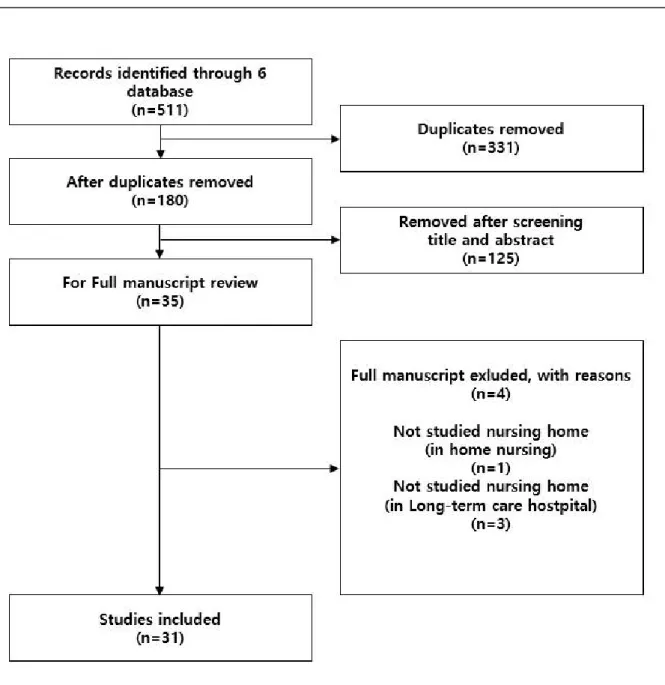
문헌 선정 과정은 Figure 1과 같다. 6개의 데이터베 이스에서 총 511편이 검색되었다. 이 중 중복되는 331 편을 제외하고 180편의 제목과 초록을 검토하여 31편을 선정하였다. 31편의 전문을 검토한 결과 3편의 연구가 노인요양시설이 아닌 요양병원에서, 1편의 연구가 가정 간호(home nursing) 셋팅에서 연구가 시행되어 제외하 였다. 최종 31편의 논문을 체계적 고찰 문헌으로 선정 하였다. 분석 문헌 선택의 전 과정은 세 명의 연구자에 의해 독립적으로 수행되었다. 의견의 불일치가 있는 경 우 연구자들간의 충분하 논의를 통해 의견을 수렴하여 최종 논문을 선정하였다.
3. 분석방법
연구대상으로 선정된 31편의 논문의 일반적 특성으 로서 저자, 출판 년도를 분석하였고, 연구에서 활용된 독립변수인 간호인력의 특성들을 Castle & Engberg의 개념적 기틀에 기반하여, 일관성, 조정, 케어의 양, 케어 행위로 분류하였다. 이러한 독립변수들과 입소자의 케 어의 질 및 삶의 질과의 관계를 분석하였다.
Ⅲ. 연구결과
최종 분석된 31편의 연구 중 27편의 연구가 종속변 수로 케어의 질을 보고하였고, 삶의 질에 대한 연구는 약 4편으로 매우 부족한 실정이다[26-29]. 삶의 질을 측 정한 연구는 관련 변수로 최소자료세트(Minimum Data Set, MDS) 3.0의 삶의 질 영역인 안위, 프라이버시, 존 엄성, 의미있는 활동, 관계, 자율성, 즐거움, 영적 웰빙, 개성, 삶의 질 결핍, 존중을 사용하였다[26-29].
Castle & Engberg의 개념적 기틀에 근거한 체계적 인 검토 결과, ‘케어 수행’에 대한 연구는 제한적이며
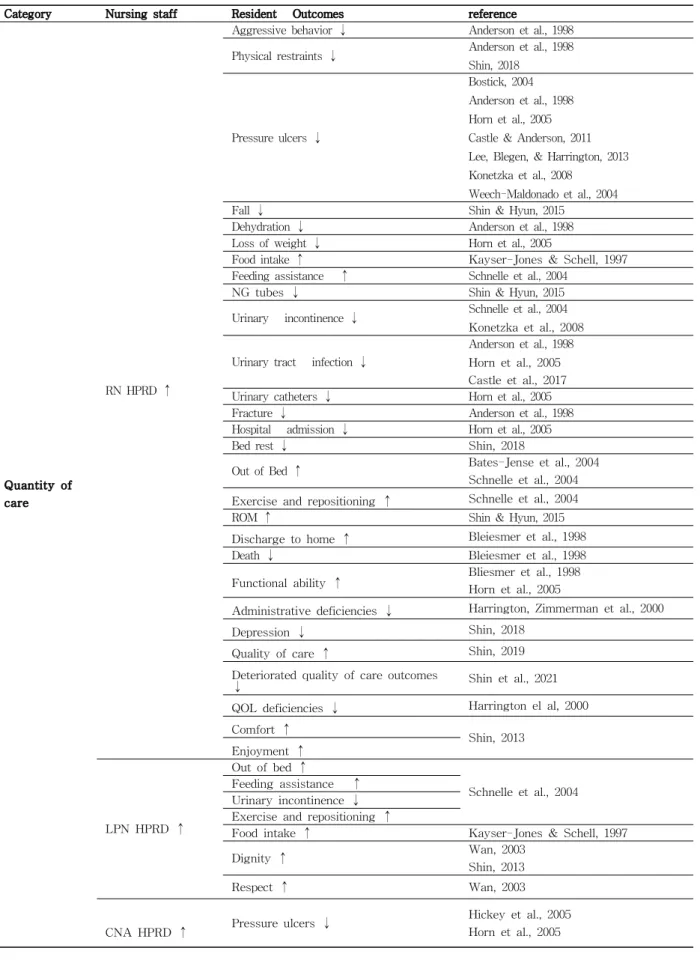
‘케어의 양’, ‘조정’, ‘일관성’에 따른 분석 결과는 다음과 같다(Table1).
1. 케어의 양 (quantity of care)
총 23개의 연구에서 간호사의 하루간호제공시간으로 케어의 양이 측정되었으며(17,26-27,29-48), 케어의 양 이 많을수록 공격적 성향 감소[30], 억제대 사용 감소 [30,45], 욕창 발생 감소[17,30-35], 낙상 감소[46], 탈수 감소[30], 체중 감소된 입소 노인 수 감소[31], 호전된 식사 양상[36], 식사 도움 증가[37], 효율적인 요실금 관 리[34,37], 감소된 요로 감염증[30-31, 48], 도뇨관 설치 그림 1. 문헌 선정 과정의 흐름도
Figure 1. Flow Diagram of the Literature Screening Process
Category Nursing staff Resident Outcomes reference
Quantity of care
RN HPRD ↑
Aggressive behavior ↓ Anderson et al., 1998 Physical restraints ↓ Anderson et al., 1998
Shin, 2018
Pressure ulcers ↓
Bostick, 2004 Anderson et al., 1998 Horn et al., 2005 Castle & Anderson, 2011 Lee, Blegen, & Harrington, 2013 Konetzka et al., 2008
Weech-Maldonado et al., 2004
Fall ↓ Shin & Hyun, 2015
Dehydration ↓ Anderson et al., 1998
Loss of weight ↓ Horn et al., 2005
Food intake ↑ Kayser-Jones & Schell, 1997
Feeding assistance ↑ Schnelle et al., 2004
NG tubes ↓ Shin & Hyun, 2015
Urinary incontinence ↓ Schnelle et al., 2004 Konetzka et al., 2008
Urinary tract infection ↓
Anderson et al., 1998 Horn et al., 2005 Castle et al., 2017
Urinary catheters ↓ Horn et al., 2005
Fracture ↓ Anderson et al., 1998
Hospital admission ↓ Horn et al., 2005
Bed rest ↓ Shin, 2018
Out of Bed ↑ Bates-Jense et al., 2004
Schnelle et al., 2004 Exercise and repositioning ↑ Schnelle et al., 2004
ROM ↑ Shin & Hyun, 2015
Discharge to home ↑ Bleiesmer et al., 1998
Death ↓ Bleiesmer et al., 1998
Functional ability ↑ Bliesmer et al., 1998 Horn et al., 2005
Administrative deficiencies ↓ Harrington, Zimmerman et al., 2000
Depression ↓ Shin, 2018
Quality of care ↑ Shin, 2019
Deteriorated quality of care outcomes
↓ Shin et al., 2021
QOL deficiencies ↓ Harrington el al, 2000
Comfort ↑ Shin, 2013
Enjoyment ↑
LPN HPRD ↑
Out of bed ↑
Schnelle et al., 2004 Feeding assistance ↑
Urinary incontinence ↓ Exercise and repositioning ↑
Food intake ↑ Kayser-Jones & Schell, 1997
Dignity ↑ Wan, 2003
Shin, 2013
Respect ↑ Wan, 2003
CNA HPRD ↑ Pressure ulcers ↓ Hickey et al., 2005
Horn et al., 2005 표 1. Castle과 Engberg의 이론적 기틀에 기초한 간호인력과 입소노인 케어의 질 및 삶의 질의 관계
Table 1. Relationship between Nursing staff and Resident outcomes based on Castle & Engberg’s Conceptual Framework
* ↑: 증가 *↓: 감소 * RN: Registered Nurse *LPN: Licensed Practical Nurse *CNA: Certified Nurse Aide
* HPRD: Hours per Resident Day *QCW: Qualified Care workers *QOL: Quality of LIfe *NG tube: Nasogastric tube Out of bed↑
Schnelle et al., 2004 Feeding assistance ↑
Urinary incontinence ↓ Exercise and repositioning ↑
Food intake ↑ Kayser-Jones & Schell, 1997
Loss of Weight ↑
Shin, 2018 Cognitive impairment ↑
Aggressive behavior ↑
NG tubes ↑ Shin & Hyun, 2015
QOL deficiencies ↓ Harrington el al, 2000
Dignity ↑
Wan, 2003 Respect ↑
Functional competence ↑ Shin, 2013 Total Nursings
staff(RN+LPN+CN A) HPRD ↑
Pressure ulcers ↓ Hickey et al., 2005
Fluid intake ↑ Kayser-Jones & Schell, 1997
administrative RN HPRD ↑
Aggressive behavior ↓
Shin & Hyun, 2015 Cognitive decline ↓
Coordination
RN↑:CNA↓
Pressure ulcers ↓
Bliesmer et al., 1998 Bates-Jensen et al., 2004 Discharge to home ↑
Death ↓ Health function ↑
Fall ↓ Shin & Hyun, 2015
ROM ↑
Functional competence ↑ Shin, 2013
RN↑:CNA&QCW↓
Aggressive behavior ↓
Shin, 2018 Depreesion ↓
Loss of weight ↓
QOL deficiencies ↓ Kang, 2008
Poor
relationship between residents and CNAs
Food intake ↓ Bowers et al., 2000
Poor relationship between RNs and
CNAs Food intake ↓ Crogan & Shultz, 2000
Supervision
constraints ↑ Food intake ↓ Crogan & Shultz, 2000
Gerontological Advanced Practice Nurses HPRD ↑
Health function ↑ Krichbaum et al., 2005
Consistency
RN+CNA turnover ↑
Residents’ outcome ↓ Castle & Anderson, 2011
Antipsychotic drug use ↑ Shin, 2018
RN turnover ↑
Residents’ outcome ↑ Castle & Engberg, 2007 Dehydration ↑
Shin & Hyun, 2015 Bed rest ↑
Antipsychotic drug use ↑
Enjoyment ↑ Shin, 2013
LPN turnover ↑ Privacy, Relationship, Individuality ↑ Shin, 2013
QCW turnover ↑
Activities of daily living ↓
Shin, 2018 Range of motion ↓
Urinary tract infections ↑ Changes in staffing
patterns Pressure Ulcer ↑ Hickey et al., 2005
감소[31], 골절 사고 감소[30], 입원 감소[31], 침상 안정 감소[45], 침상 외 활동 증가[37-38], 운동 및 바른 자세 유지 증가[37], 관절가동범위(Range Of Motion, ROM) 증가[46], 집으로의 퇴소 증가[39], 사망률 감소[39], 기 능성 향상[31,39], 감소된 행정적 오류[26], 우울 감소 [45], 케어의 질(quality of care) 증가[44], 저하된 건강 결과 감소[47], 삶의 질 결핍(deficiencies) 감소[26], 편 안함 및 즐거움 증가[29]를 보였다. 간호사, 실무간호사, 간호조무사를 모두 합친 총 간호 인력 시간은 감소된 욕창 발생[40], 수분 섭취량 증가[36]를 보였다. 하지만, 일부 연구에서는 총 간호 인력 제공 시간과 입소 노인 의 케어의 질과 통계적으로 유의한 관계를 보이지 않았 다[27,41-43]. 간호관리자의 간호 제공시간은 공격적 행 동 양상 감소 및 인지기능 장애 감소에 영향을 미쳤다 [46].
2. 조정 (Coordination)
조정은 skill mix(간호사와 간호 대체인력의 비율), 간호 인력과 입소 노인들과의 상호작용, 케어에 관한 감독 유무 등으로 정의되었다. 간호 면허증을 가지고 있는 인력과 면허가 없는 인력의 비율에 따른 연구에 따르면, 간호 면허가 있는 인력확보 수준이 높을수록 욕창 발생 감소, 집으로 퇴소 증가, 사망률 감소, 건강 기능 향상 등이 보고되었다[37-38]. 또한 간호조무사 대 비 간호사 수의 증가는 낙상 감소와 관절가동범위 (ROM)의 증가[46]와 기능적 역량 향상[29]에 영향을 주었고, 간호조무사 및 요양보호사 대비 간호사 수의 증가는 입소 노인의 공격적 행동 양상 및 우울증 감소, 체중 감소된 입소 노인 비율 감소, 그리고 삶의 질 결 핍 저하와 통계적으로 유의한 관계를 보였다[28,45]. 입 소 노인들과 미국에서 수행된 연구에서 간호조무사와 의 관계가 좋을수록 입소 노인 결과가 좋게 보고되었으 며[49], 간호사와 간호조무사와의 관계가 좋지 않을수록 입소 노인들의 음식 섭취량이 감소하였다[50]. 관리․감 독 체계가 엄격할수록 입소 노인들의 음식 섭취량이 감 소하였으며[50], 노인전문간호사 투입이 입소 노인들의 건강 기능 향상과 관련 있다고 보고되었다[51].
3. 일관성 (Consistency)
간호 인력의 일관성은 이직률(turnover), 안정성 (stability, 오래 근무한 직원 확보 여부), agency(미국에
서 간호사 부족 시 임시로 간호사를 파견을 알선하는 업체) 간호사 고용 여부로 연구되었으며, 주로 이직률 에 관한 연구가 다수 보고되었다(29,32,45-46,52). 간호 사와 간호조무사의 이직률이 높을수록 입소 노인 결과 악화와 관련되게 보고되었다[32]. 구체적으로, 간호사와 간호조무사의 이직률이 증가함에 따라 입소 노인의 항 우울제 복용이 증가하였으며[45], 간호사의 이직률 증가 는 입소 노인의 탈수, 침상안정, 그리고 항우울제 복용 증가에 영향을 미쳤다[46]. 또한, 요양보호사의 이직률 이 높을수록 입소 노인의 일상생활활동(Activities of Daily Living, ADL) 및 관절가동범위(ROM)의 악화와 요로감염증 노인의 비율이 증가하였다[45]. 하지만, 소 수 연구에서는 실무간호사(LPN) 인력의 이직률과 입소 노인 결과와 통계적으로 유의한 관계가 없었으며 [32,52], 간호조무사 인력 이직률이 입소 노인 결과와 통계적으로 유의한 관계가 없었다[52]. 이에 반하여, 간 호사의 이직률이 높을수록 향상된 입소 노인 결과를 보 인 연구도 보고되었으며[29,52], 다른 연구에서는 이직 기간이 길수록 향상된 입소 노인 결과가 보고되어[52]
일치된 연구 결과가 보고되고 있지 않다. 안정성 측면 에서는 인력 구조의 변화가 욕창 발생률 증가와 관련 있게 보고되었다[40]. agency 간호사와 간호조무사 인 력 활용은 향상된 입소 노인 결과에 영향을 미치지 않 았고, agency 실무간호사 채용시 향상된 입소 노인결과 를 보인 연구와, 통계적으로 유의하지 않은 결과를 보 고한 연구가 다양하여, 일치된 연구 결과가 보고되지 않았다[32,52].
4. 케어 행위(care practices)
Castle & Engberg의 개념적 기틀의 ‘케어 행위(care practices)’ 영역에 대한 연구는 진행되지 않고 있다. 이 개념적 기틀에서는 케어 행위(care practices)를 서비스 를 제공할 때 조직의 규범이 수행되는 정도로 정의하였 으며[23], 입소자에게 치료를 제공해야 하는 시기[24], 절차 설명서, 직무 체계화, 그리고 구조화 정도를 포함 한다[23]. 이 개념적 기틀을 개발한 연구에서는 agency 직원은 시설의 규범에 익숙하지 않아 케어 행위(care practices)를 저하시키고, 간호사가 케어 행위(care practices)를 수행하기 때문에 간호사와 간호 대체인력 의 비율이 클수록 케어 행위(care practices)에 긍정적 인 영향을 미친다고 보았다[24]. 또한 인력의 안정성
(stability)이 조직 규범에 대한 경험이나 노출 정도와 연관이 있기 때문에, 안정적인 직원이 케어 행위(care practices)를 더 제대로 인식할 가능성이 있다고 보았다 [24].
Ⅳ. 논 의
본 연구는 노인요양시설의 간호 인력이 노인요양시 설 입소노인의 케어의 질 및 삶의 질에 미치는 영향에 대한 체계적인 분석을 통해 간호인력의 중요성을 파악 하였다. 이에 따라 노인요양시설의 질 높은 서비스 제 공에 기여할 수 있는 효율적·일관적인 노인요양시설 간 호 인력 수급 정책을 수립하는 데 기초자료로 기여하고 자 한다. 본 연구결과 선행 연구에서 노인요양시설에서 의 적절한 간호 인력 배치의 중요성이 강조되었고 [12,44,53-54], 노인요양시설에서 간호사 대신 간호조무 사를 배치할 수 있도록 하는 우리나라의 노인장기요양 보험 법령이 입소노인의 케어의 질을 위협할 수 있다는 점을 고려하여[45], 우리나라의 노인요양시설 간호인력 배치와 관련한 제도의 개선이 필요한 때이다. 현재 노 인요양시설 입소 노인들에게 의료적 요구가 발생하였 을 경우 촉탁의나 협약의료기관을 이용한 급성치료 위 주의 건강관리가 이루어지고 있어, 복합적인 노인성 질 환 및 기능상태 저하, 일상생활 수행능력 저하, 독립적 생활이 어려운 노인요양시설의 입소 노인들에 대한 장 기적·효율적·효과적인 관리가 불가능한 상태이다. 특히, 노인요양시설은 인지기능이 감소된 치매 노인 또는 일 상생활 수행 능력이 감소된 노인들이 대부분이며 뇌졸 중 등의 질환과 관련되어 낙상, 식사 시 흡인 위험성 같은 응급상황이 빈번히 발생하는 점, 상주 의사가 부 재하고 촉탁의에 의존한다는 특성, 촉탁의 진료과목 한 계, 협약 의료기관 이용의 한계 등을 고려하여, 전문직 간호사의 신속하고 전문적인 판단과 이에 따른 응급처 치가 시행되어야함에도 불구하고, 현재 우리나라 노인 요양시설의 제도는 간호사와 간호조무사의 역할 및 기 능 차이를 반영하지 못하여 전문직 간호사 인력이 현저 히 부족한 상태이다. 면허와 자격, 교육적·법적 역할과 책임에 의해 구분이 있는 간호사(면허제도)가 간호조무 사(자격제도)를 대체할 수 있는 관련 법령 제정으로 노 인요양시설 간호 인력의 배치기준이 완화되어있고, 이 에 따라 대부분의 노인요양시설에서 비용 절감을 위해 간호조무사를 고용하고 있다[55-56]. 2019년 기준 장기
요양기관에서의 간호사와 간호조무사의 비는 1:4.5로, 간호조무사의 비중이 훨씬 큰 것으로 보고되었다[57].
이와 더불어, 현재 노인요양시설 인력 기준의 문제점은 최소 인력의 수만 제시하며 최상의 간호 서비스를 받기 위한 적정 인원수는 제시하고 있지 않다는 점이다. 전 체 노인요양시설 종사자 중 간호사 비율은 2.1%로, OECD 국가들의 비중(미국:34.3%, 네덜란드:28.2%, 독 일:50.9%, 일본:20.7%)보다 현저히 낮은 비율이다[58].
이미 우리나라 노인요양시설의 노인장기요양서비스 의 질의 한계를 보고하였으며, 이에 대한 노인요양시설 입소자의 의료적 요구 관리 방안으로 노인요양시설 간 호사 및 전문간호사 인력 배치기준 강화, 역할 및 기능 확대의 방안을 제시하고 있다[59]. 이와 마찬가지로, 노 인요양시설 입소자의 케어의 질을 향상시키기 위해서 노인요양시설 간호사의 의무적인 하루간호제공시간 (hours per resident day, HPRD)의 법적 제정이 강조되 고 있다[44]. 또한, 미국의 국립의학연구소(Institute of Medicine)는 간호 서비스의 질 향상을 위하여 간호 교 육 수준을 높이도록 학사 학위 간호사 비율을 2020년까 지 80% 이상 높이도록 권고하고 있으며[60], 세계간호 사협회 (International Council of Nurses), 세계보건기 구(World Health Organization), 미국 보건의료 연구 및 질에 대한 기구(Agency for Healthcare Research Quality), 미국의 의료기관의 의료 수준을 평가하는 비 영리법인인 JCAHO (Joint Commission on Accreditation of Healthcare Organizations)에서도 질 높은 간호 서비스 제공을 통한 환자의 건강과 안전을 강조하고 있는만큼[61-64], 노인요양시설에서 간호인력 의 중요성이 높다 할 수 있다.
체계적 문헌고찰 결과, 35편의 연구 중 31편의 연구 가 케어의 질을 중점적으로 보고하였고 삶의 질에 대한 연구는 약 4편으로 제한적인 실정이다. 미국에서는 노 인요양시설 입소노인의 케어의 질 향상을 위해 입소노 인의 개인별 건강상태를 포괄적으로 사정하여 평가할 수 있도록 하는 표준화된 도구인 최소자료세트 (Minimum Data Set, MDS)를 개발하여 각 시설에서 의무적으로 활용하고 보고하도록 하고 있다[65]. 최소자 료세트는 입소노인의 인구사회학적 특성, 인지기능 장 애 정도, 의사소통 및 청력, 시력, 신체적 기능, 실금, 질 병, 건강상태, 약물복용, 피부상태, 구강건강 등에 대한 건강상태에 대한 포괄적인 자료뿐만 아니라, 정신 사회
학적 안녕, 기분, 행동을 측정하는 삶의 질 영역을 포함 하고 있다[28]. 입소노인의 케어의 질 향상의 궁극적인 목표가 삶의 질 향상이라는 점을 고려해볼 때[29], 케어 의 질에 관한 연구뿐만 아니라 삶의 질에 영향을 미치 는 요인에 관한 연구가 지속적으로 수행되고, 이를 바 탕으로 간호인력의 중요성에 대한 근거를 마련할 필요 가 있다. 이러한 연구결과를 바탕으로 우리나라 노인요 양시설의 최적의 간호 인력 수준이 제시되어야 한다.
이에 관한 정책 반영을 통하여, 한국의 효율적인 노인 장기요양보험 정착에 기여하고 국민들의 노인장기요양 보험 제도에 대한 공감대 형성에 이바지할 수 있을것이 다. 이는 국가의 도움을 필요로 하는 취약 노인들과 그 가족들의 삶의 질을 향상시켜 결과적으로 대한민국 국 민들의 전반적인 행복 증진에 기여할 것이다.
Ⅴ. 결론 및 제언
본 연구에서는 Castle과 Enberg의 이론적 기틀을 기 반으로, 최근 25년간 국내·외 노인요양시설 간호인력의 특성(일관성, 조정, 케어의 양, 케어 행위)과 입소노인의 케어의 질 및 삶의 질 간의 관계에 관한 연구 35편을 선정하여 체계적으로 고찰하였다. 체계적 고찰 결과, 간 호인력의 일관성이 높을수록, 조정의 측면인 간호대체 인력 대비 간호사 비율이 높을수록, 간호인력과 입소노 인과의 상호작용이 높을수록, 케어의 양이 증가할수록 입소노인의 케어의 질 및 삶의 질이 향상되었다. 그러 나, 대부분의 연구가 케어의 질을 중점적으로 보고하였 으며, 삶의 질에 대한 연구는 제한적인 실정이므로 이 와 관련한 연구가 수행될 필요가 있다. 또한, 병원 간호 인력의 케어 행위는 대상자의 케어의 질 및 삶의 질에 영향을 미치는 주요 요인임이 보고됨에도 불구하고, 노 인요양시설 간호인력의 케어 행위와 관련한 연구는 수 행되지 않은 실정이다. 따라서 추후 노인요양시설 간호 사의 간호인력 특성으로써 케어 행위와 케어의 질 및 삶의 질 간의 관계를 확인하는 연구수행으로 입소 노인 의 전반적인 삶의 질 향상에 기여해야 한다.
References
[1] Statistics Korea. Major Population Indicators [Internet]. Daejeon: Statistics Korea; 2019 [updated 2019 Mar 28; cited 2021 Mar 7].
Available from:
https://kosis.kr/statHtml/statHtml.do?orgId=101&tb lId=DT_1BPA002&conn_path=I2
[2] Korean Ministry of Health and Welfare. The 2nd Basic Plan for Long-Term Care Insurance for the Elderly(2018-2022) [Internet]. Sejong: Korean Ministry of Health and Welfare; 2018 [updated 2018 Aug 3; cited 2021 Mar 7]. Available from:
http://www.mohw.go.kr/react/gm/sgm0701vw.jsp?
PAR_MENU_ID=13&MENU_ID=1304081001&C ONT_SEQ=358258
[3] Y.S. Lee, “A study on the main contents and the point at issue of the law of longterm care insurance for senior citizens,” Journal of Korean Insurance, Vol. 79, No. 4, pp. 163-193, 2008.
[4] Statistics Korea. Long-term care institution status [Internet]. Daejeon: Statistics Korea; 2020 [updated 2020 Sep 10; cited 2021 Mar 8].
Available from:
https://kosis.kr/statHtml/statHtml.do?orgId=350&tb lId=DT_35006_N019&conn_path=I2
[5] National Health Insurance Service. Long term care insurance statistical yearbook 2019 [Internet].
Wonju: National Health Insurance Service; 2020 [updated 2020 Sep 4; cited 2021 Mar 7]. Available from:
https://www.nhis.or.kr/nhis/together/wbhaec07200 m01.do
[6] National Health Insurance Service. Current status of long-term care insurance rating for the elderly [Internet]. Wonju: National Health Insurance Service; 2021 [updated 2021 Feb 16; cited 2021 Mar 8]. Available from:
https://www.longtermcare.or.kr/npbs/d/m/000/mov eBoardView?menuId=npe0000000950&bKey=B00 19&zoomSize=
[7] Korean Ministry of Health and Welfare. 2019 장 기요양 실태조사 결과 발표 [Internet]. Sejong:
Korean Ministry of Health and Welfare; 2020 [updated 2020 Mar 30; cited 2021 Mar 10].
Available from:
http://www.mohw.go.kr/react/al/sal0301vw.jsp?PA R_MENU_ID=04&MENU_ID=0403&page=1&CO NT_SEQ=353801
[8] J.S. Lee, R.I. Whang, S.Y. Park, and E.J. Han,
“Residents' Nursing Care Needs and Provision of Nursing Care by the Size of Long Term Care Facilities.” Journal of East-West Nursing Research, Vol. 26, No. 1, pp. 28-38, Apr 2020.
https://doi.org/10.14370/jewnr.2020.26.1.28
[9] G. Han and E. Yang, “Status of health and
nutritional intake of the elderly in long-term care facilities: focus on Gwangju Metropolitan City.”
Journal of Nutrition and Health, Vol. 53, No. 1, pp. 27-38, Feb 2020.
http://doi.org/10.4163/jnh.2020.53.1.27
[10] Korean National Health Insurance Corporation.
Long term care insurance statistics(No 11-B550928-000038-09) [Internet]. Wonju: Korean National Health Insurance Corporation; 2013 [updated 2013; cited 2021 Mar 7]. Available from:
http://khiss.go.kr/board/bbs_read.jsp?bbs_seq=367&
bbsid=B301&tname=MINBOARD358
[11] Y.H. Park, H.L. Bang, G.H. Kim, S. Oh, Y.I.
Jung, and H. Kim, “Current status and barriers to health care services for nursing home residents: perspectives of staffs in Korean nursing homes,” Korean Journal of Adult Nursing, Vol. 27, No. 4, pp. 418-427, Aug 2015.
https://doi.org/10.7475/kjan.2015.27.4.418
[12] J.H. Shin, E.M. Kim, and J.Y. Lee, “Factors relating to the quality of care for nursing home residents in Korea: Using the delphi method,”
Journal of Korean Academy of Nursing, Vol. 49, No. 6, pp. 783-794, Dec 2019.
https://doi.org/10.4040/jkan.2019.49.6.783
[13] R. McCloskey, C. Donovan, C. Stewart, and A.
Donovan, “How registered nurses, licensed practical nurses and resident aides spend time in nursing homes: An observational study,”
International Journal of Nursing Studies, Vol. 52, No. 9, pp. 1475-1483, Sep 2015.
http://doi.org/10.1016/j.ijnurstu.2015.05.007
[14] C. Harrington, M.E. Dellefield, E. Halifax, M.L.
Fleming, and D. Bakerjian, “Appropriate nurse staffing levels for US nursing homes,” Health services insights, Vol. 13, Jun 2020.
https://doi.org/10.1177/1178632920934785
[15] Y.K. Roh, Service blind spots in long-term care:
medical aspects [Internet]. Seoul: The Korean Academy of Long-Term Care; 2019 [updated 2019 Nov 28; cited 2021 Mar 8]. Available from:
http://www.kaltc.co.kr/board_common/file_downloa d.asp?Board_Key=92&File_Key=135&flag=1 [16] A. Ager and A. Strang, “Understanding
integration: A conceptual framework,” Journal of refugee studies, Vol. 21, No. 2, pp. 166-191, Jun 2008.
https://doi.org/10.1093/jrs/fen016
[17] J.E. Bostick, “Relationship of nursing personnel and nursing home care quality,” Journal of nursing care quality, Vol. 19, No. 2, pp. 130-136,
Apr 2004.
http://doi.org/10.1097/00001786-200404000-00010 [18] M.H. Frost, “Quality: a concept of importance to
nursing,” Journal of Nursing Care Quality, Vol. 7, No. 1, pp. 64-69, Oct 1992.
[19] W.L. Holzemer, “The impact of multiskilling on quality of care,” International Nursing Review, Vol. 43, No. 1, pp. 21-25, Jan 1996.
[20] V. Schirm, T. Albanese, and T.N. Garland,
“Understanding nursing home quality of care:
incorporating caregivers' perceptions through structure, process, and outcome,” Quality management in health care, Vol. 8, No. 1, pp.
55-63, Jan 1999.
https://doi.org/10.1097/00019514-199908010-00007 [21] K.H. Edwards, G. FitzGerald, R.C. Franklin, and
M.T. Edwards, “Air ambulance outcome measures using Institutes of Medicine and Donabedian quality frameworks: protocol for a systematic scoping review,” Systematic reviews, Vol. 9, No.
1, pp. 1-8, Apr 2020.
https://doi.org/10.1186/s13643-020-01316-7
[22] M.E. Dellefield, N.G. Castle, K.S. McGilton, and K. Spilsbury, “The relationship between registered nurses and nursing home quality: an integrative review (2008-2014),” Nursing economic$, Vol. 33, No. 2, pp. 95-108, Mar 2015.
[23] J.L. Price and C.W. Mueller, Handbook of organizational measurement, Pitman, pp. 137,241, 1986.
[24] N.G. Castle and J. Engberg,. “Further examination of the influence of caregiver staffing levels on nursing home quality,” The Gerontologist, Vol. 48, No. 4, pp. 464-476, Aug 2008.
http://doi.org/10.1093/geront/48.4.464
[25] B.S. Georgopoulos and F.C. Mann, The community general hospital, Macmillan, pp. 273, 1962.
[26] C. Harrington, D. Zimmerman, S.L. Karon, J.
Robinson, and P. Beutel, “Nursing home staffing and its relationship to deficiencies,” Journals of Gerontology, Series B: Psychological Sciences and Social Sciences, Vol. 55, No. 5, pp. S278–S287, Sep 2000.
https://doi.org/10.1093/geronb/55.5.S278
[27] T.T. Wan, “Nursing care quality in nursing homes: Cross-sectional versus longitudinal analysis,” Journal of Medical Systems, Vol. 27, No. 3, pp. 283–295, Jun 2003.
http://doi.org/10.1023/a:1022579512926
[28] Kang, D., The effects of resident ethnic mix, staffing patterns, and Medicaid census on quality of care and quality of life in New York State nursing homes, Ph.D. Thesis. University of Columbia, New York City, NY, USA., 2008.
[29] J.H. Shin, “Relationship between nursing staffing and quality of life in nursing homes,”
Contemporary Nurse, Vol. 44, No. 2, pp. 133-143, Jun 2013.
https://doi.org/10.5172/conu.2013.44.2.133
[30] R.A. Anderson RA, P.C. Hsieh, and H.F. Su,
“Resource allocation and resident outcomes in nursing homes: Comparisons between the best and worst,” Research in Nursing & Health, Vol.
21, No. 4, pp. 297–313, Aug 1998.
https://doi.org/10.1002/(SICI)1098-240X(199808)21:4
<297::AID-NUR3>3.0.CO;2-A
[31] S.D. Horn, P. Buerhaus, N. Bergstrom, and R.J.
Smout,. “RN staffing time and outcomes of long-stay nursing home residents: Pressure ulcers and other adverse outcomes are less likely as RNs spend more time on direct patient care,”
American Journal of Nursing, Vol. 105, No. 11, pp. 58–70, Nov 2005.
http://doi.org/10.1097/00000446-200511000-00028 [32] N.G. Castle and R.A. Anderson, “Caregiver
staffing levels in nursing homes and their influence on quality of care: Using dynamic panel estimation methods,” Medical Care, Vol. 49, No.
6, pp. 545-552, Jun. 2011.
http://doi.org/10.1097/MLR.0b013e31820fbca9 [33] H.Y. Lee, M.A. Blegen, and C. Harrington, “The
effects of RN staffing hours on nursing home quality: A two-stage model,” International Journal of Nursing Studies, Vol. 51, No. 3, pp. 409-417, Mar 2014.
https://doi.org/10.1016/j.ijnurstu.2013.10.007
[34] R.T. Konetzka, S.C. Stearns, and J. Park, “The staffing-outcomes relationship in nursing homes,”
Health Services Research, Vol. 43, No. 3, pp.
1025-1042, Jun 2008.
https://doi.org/10.1111/j.1475-6773.2007.00803.x [35] R. Weech-Maldonado, L. Meret-Hanke, M.C.
Neff, and V. Mor, “Nurse staffing patterns and quality of care in nursing homes,” Health Care Management Review, Vol. 29, No. 2, pp. 107–
116, Apr 2004.
http://doi.org/10.1097/00004010-200404000-00004 [36] J. Kayser-Jones and E. Schell, “The effect of
staffing on the quality of care at mealtime,”
Nursing Outlook, Vol. 45, No. 2, pp. 64–72, Mar
1997.
https://doi.org/10.1016/S0029-6554(97)90081-6 [37] J.F. Schnelle, S.F. Simmons, C. Harrington, M.
Cadogan, E. Garcia, and B.M. Bates-Jensen,
“Relationship of nursing home staffing to quality of care,” Health Services& Research, Vol. 39, No.
2, pp. 225-250, Apr 2004.
https://doi.org/10.1111/j.1475-6773.2004.00225.x [38] B.M. Bates-Jensen, J.F. Schnelle, C.A. Alessi ,
N.R. Al-Samarrai. and L. Levy-Storms, “The effects of staffing on in-bed times of nursing home residents,” Journal of the American Geriatric Society, Vol. 52, No. 6, pp. 931–938, Jun 2004.
https://doi.org/10.1111/j.1532-5415.2004.52260.x [39] M.M. Bliesmer, M. Smayling, R.L. Kane, and I.
Shannon, “The relationship between nursing staffing levels and nursing home outcomes,”
Journal of Aging and Health, Vol. 10, No. 3, pp.
351–371, Aug 1998.
https://doi.org/10.1177/089826439801000305
[40] E.C. Hickey, G.J. Young, V.A. Parker, E.J.
Czarnowski, D. Saliba, and D.R. Berlowitz, “The effects of changes in nursing home staffing on pressure ulcer rates,” Journal of the American Medical Directors Association, Vol. 6, No. 1, pp.
50–53, Jan 2005.
https://doi.org/10.1016/j.jamda.2004.12.003
[41] C.B. Moseley and L. Jones, “Registered nurse staffing and OBRA deficiencies in Nevada nursing facilities,” Journal of Gerontological Nursing, Vol. 29, No. 3, pp. 44–50, Mar 2003.
https://doi.org/10.3928/0098-9134-20030301-10 [42] M.J. Rantz, L. Hicks, V. Grando, G.F. Petroski ,
R.W. Madsen, D.R. Mehr, et al, “Nursing home quality, cost, staffing, and staff mix,” The Gerontologist, Vol. 44, No. 1, pp. 24–38, Feb 2004.
https://doi.org/10.1093/geront/44.1.24
[43] J. Johnson-Pawlson and D.L. Infeld, “Nurse staffing and quality of care in nursing facilities,”
Journal of Gerontological Nursing, Vol. 22, No. 8, pp. 36-45, Aug 1996.
https://doi.org/10.3928/0098-9134-19960801-11 [44] J.H. Shin, “Appropriate nursing home nurse
hours per resident day in Korea: a secondary analysis of longitudinal data,” Journal of Nursing Scholarship, Vol. 51, No. 5, pp. 569-579, Sep 2019.
https://doi.org/10.1111/jnu.12498
[45] J.H. Shin, “Why do we require registered
nurses in nursing homes? Using longitudinal hierarchical linear modeling,” Journal of Nursing Scholarship, Vol. 50, No. 6, pp. 705-713, Nov 2018.
https://doi.org/10.1111/jnu.12412
[46] J.H. Shin and T.K. Hyun, “Nurse staffing and quality of care of nursing home residents in Korea,” Journal of Nursing Scholarship, Vol. 47, No. 6, pp. 555-564, Nov 2015.
https://doi.org/10.1111/jnu.12166
[47] J.H. Shin, R.A. Renaut, M. Reiser, J.Y. Lee, and T.Y. Tang, “Increasing Registered Nurse Hours Per Resident Day for Improved Nursing Home Residents’ Outcomes Using a Longitudinal Study,” International Journal of Environmental Research and Public Health, Vol. 18, No. 2, pp.
402, Jan 2021.
https://doi.org/10.3390/ijerph18020402
[48] N. Castle, J.B. Engberg, L.M. Wagner, and S.
Handler, “Resident and facility factors associated with the incidence of urinary tract infections identified in the nursing home minimum data set,” Journal of Applied Gerontology, Vol. 36, No.
2, pp. 173-194, Feb 2017.
https://doi.org/10.1177/0733464815584666
[49] B.J. Bowers, S. Esmond, and N. Jacobson, “The relationship between staffing and quality in long-term care facilities: Exploring the views of nurse aides,” Journal of Nursing Care Quality, Vol. 14, No. 4, pp. 55–64, Jul 2000.
http://doi.org/10.1097/00001786-200007000-00009 [50] N.L. Crogan and J.A. Shultz, “Nursing
assistants’ perceptions of barriers to nutrition care for residents in long-term care facilities,”
Journal of Nurses in Staff Development, Vol. 16, No. 5, pp. 216–221, Sep 2000.
http://doi.org/https://doi.org/10.1097/00124645-2000 09000-00004
[51] K. Krichbaum, V. Pearson, K. Savik, and C.
Mueller, “Improving resident outcomes with GAPN organization level interventions,” Western Journal of Nursing Research, Vol. 27, No. 3, pp.
322–337, Apr 2005.
https://doi.org/10.1177/0193945904270300
[52] N.G. Castle and J. Engberg, “The influence of staffing characteristics on quality of care in nursing homes,” Health Services Research, Vol.
42, No. 5, pp. 1822-1847, Oct 2007.
https://doi.org/10.1111/j.1475-6773.2007.00704.x [53] American Nurses Association. Optimal nurse
staffing to improve quality of care and patient
outcomes. Avalera Health. 2015. Available from:
https://cdn.ymaws.com/www.anamass.org/resource /resmgr/docs/NurseStaffingWhitePaper.pdf [54] P. Johnson-Carlson, C. Costanzo, and D.
Kopetsky, “Predictive staffing stimulation model methodology,” Nursing Economics, Vol. 35, No. 4, pp. 161–169, Jul 2017.
[55] Korean Office of Legislation. Enforcement regulation of Walfare of the Aged Act [Internet].
Sejong: Korean Office of Legislation; 2020 [updated 2020 Dec 31; cited 2021 Mar 7].
Available from: https://www.law.go.kr/법령/노인복 지법시행규칙
[56] J.H. Shin, “Nursing staff characteristics on resident outcomes in nursing homes,” The Journal of Nursing Research, Vol. 27, No. 1, pp.
1-9, Feb 2019.
http://doi.org/10.1097/jnr.0000000000000269
[57] National Health Insurance Service. Health Life Information Statistical Data Collection 2020 [Internet]. Wonju: National Health Insurance Service; 2020 [updated 2020 Oct 19; cited 2021 Mar 7]. Available from:
https://www.nhis.or.kr/nhis/together/wbhaec06700 m01.do?mode=view&articleNo=138660&article.o ffset=0&articleLimit=10
[58] Organization for Economic Cooperation and Development. OECD Health Statistics [Internet].
Paris: OECD; 2020 [updated 2020 Jul 1 ; cited 2021 Mar 9]. Available from:
https://stats.oecd.org/Index.aspx?DataSetCode=HE ALTH_LTCR
[59] J.M. Lee, M.J. Park, E.J. Han, and E.Y. Seo, Management plan for medical needs of residents in nursing homes. Regular Research Report.
Seoul: Korean Health Insurance Policy Institute;
2012. Report No. 2012-19.
[60] Institute of Medicine. The future of nursing:
Leading change, advancing health. Washington, DC: The National Academies Press; 2011.
[61] International Council of Nurses. Leading nursing, past, present and future – ICN Annual Report 2019 [Internet]. Geneva: International Council of Nurses; 2020 [updated 2020 May 1 ; cited 2021 Mar 10]. Available from:
https://issuu.com/icn9/docs/web_icn_ra_2019_v04__
1_
[62] World Health Organization. Dublin Declaration on Human Resources for Health: building the health workforce of the future. 4th Global Forum on Human Resources for Health; 2017 Nov 13-17;
Dublin, Ireland.
[63] Agency for Healthcare Research and Quality.
AHRQ Report Reviews 47 Practices To Improve Patient Safety [Internet]. Rockville: Agency for Healthcare Research and Quality; 2020 [updated 2020 Mar 10; cited 2021 Mar 10]. Available from:
https://www.ahrq.gov/news/newsroom/press-relea ses/making-healthcare-safer3.html
[64] Joint Commission on Accreditation of Healthcare Organizations. National Patient Safety Goals Effective January 2021 for the Nursing Care Center Program [Internet]. Chicago: Joint Commission on Accreditation of Healthcare Organizations; 2020 [updated 2020 Oct 28; cited 2021 Mar 10]. Available from:
https://www.jointcommission.org/-/media/tjc/docu ments/standards/national-patient-safety-goals/
2021/ncc_npsg_jan2021.pdf
[65] J.D. Niznik, S. Zhang, M.K. Mor, X. Zhao, M.
Ersek, S.L. Aspinall et al, “Adaptation and initial validation of Minimum Data Set (MDS) mortality risk index to MDS version 3.0.,“ Journal of the American Geriatrics Society, Vol. 66, No. 12, pp.
2353-2359, Dec 2018.
https://doi.org/10.1111/jgs.15579
※ This work was supported by the National Research Foundation of Korea (NRF) grant funded by the Korea government (Ministry of Science, ICT &
Future Planning, (2021R1AC2007104)