—230—
INTRODUCTION
From the Korean waters, two eleotrid fishes, Eleotris oxycephala Temminck and Schlegel, 1845 and Perccot- tus glenii Dybowski, 1877, have been recognized to date (Kim et al., 2005; Kim, 2011). It has been known that the former species was recorded from Jeju Island and Suwon since Mori (1952) firstly reported in his checklist of the Korean fishes and the latter was known to inhabit in the Tumen and Seongcheon rivers, North Korea (Mori, 1952; Chyung, 1977; Kim, 1997; Kim et al., 1986; Kim et al., 2005). During a survey on ichthyofauna of the Korean Peninsula conducted by junior authors, a single goby-like specimen was accidently collected from the lower reach of Jwagwang stream near Busan, Korea in 2006 and identified as a member of the genus Eleotris Bloch and Schneider, 1801 by having separated dorsal and pelvic fins as well as the number of fin rays (Jang et al., 2007), although their identification of this Eleotris specimen did not reach to the species level afterward.
In the present study this goby-like specimen from the Jwagwang stream was identified as E. oxycephala on the basis of the pattern of sensory papillae on head region as
well as general morphology. We, therefore, describe E.
oxycephala as the first reliable record from Korea based on a single specimen collected from the Korean waters to date. Counts and measurements follow generally those of Hubbs and Lagler (1964). Notations of cephalic sen- sory papillae are those of Akihito et al. (2002). Vertical fins and vertebrae were counted by radiographs. The specimen is deposited in the fish collection of the Natio- nal Institute of Biological Resources (NIBR-P), Korea as voucher.
Eleotris oxycephala Temminck and Schlegel, 1845 (Korean name: Gu-gul-mu-chi)
(Figs. 1~2; Table 1)
Eleotris oxycephala Temminck and Schlegel, 1845: 150 (type locality: Japan); Chyung, 1977: 470 (Jeju Island, Seoho, Korea, in part); Kim et al., 1986: 393 (Jeju Island, Korea); Kim, 1997: 422 (Jeju Island, Korea);
Kim et al., 2005: 419 (Jeju Island, Korea).
Eleogris pisonis oxycephala: Mori, 1952: 140 (Quelpart Island, Korea).
Eleotris sp.: Jang et al., 2007: 343 (Jwagwang stream, Gijang, Korea).
Material examined. NIBR-P23462, 62.1 mm in stan- dard length (SL), female, Jwagwang stream, Jwacheon- ri, Jangan-eup, Gijang-gun, Busan-si, Korea, January
First Reliable Record of an Eleotrid Fish, Eleotris oxycephala (Perciformes: Eleotridae) from the Lower Reach of Jwagwang Stream Near Busan, Korea
By Byung-Jik Kim*, Min-Ho Jang
1, Ju-Duk Yoon
2and Ho-Bok Song
3Biological and Genetic Resources Utilization Division, National Institute of Biological Resources, Incheon 404-708, Korea
1Department of Biology Education, Kongju National University, Gongju 314-701, Korea
2Biological Resource Center, Kongju National University, Gongju 314-701, Korea
3Korea Freshwater Fish Ecology Institute, Geodu-gil 335-2, Dongnae-myeon, Chuncheon-si, Gangwon-do 200-883, Korea
ABSTRACT Eleotris oxycephala was described in detail as the first reliable record from Korea based on a single specimen (62.1 mm SL) collected from the lower reach of Jwagwang stream near Busan, Korea. The specimen is easily distinguished from three congeners occurring in the northern West Pacific by having separation between two rows of sensory papillae on opercle and the fourth row of the papillae on cheek not extending beyond the 11th longitudinal sensory-papillae.
Key words : Eleotris oxycephala, description, Jwagwang stream, cephalic sensory papillae
*Corresponding author: Byung-Jik Kim Tel: 82-32-590-7127 Fax: 82-32-590-7223, E-mail: [email protected]
Accepted: September 17, 2014
http://www.fishkorea.or.kr
2006, collected by M.H. Jang and J.D. Yoon, kick net.
Diagnosis. An eleotrid species with having separation of two rows of sensory papillae on opercle and not extend- ing the fourth row of sensory papillae beyond the longi- tudinal sensory-papillae row 11 (sensu Akihito, 1967).
Description. Dorsal fin rays VI-I, 8; anal fin rays I, 8;
pectoral fin rays 17; pelvic fin rays, I, 5; principal caudal fin rays 16; gill rakers 4++10; vertebrae 25; scales in lon- gitudinal row 49; scales in transverse row 21.
Proportion of percentage in SL: body depth at origin of pectoral fin 17.7; body width 17.4; head length 32.2;
head width 19.6; head depth at center of interorbital re- gion 13.0; eye diameter 5.8; interorbital width 5.6; snout length 7.4; length between nostrils 2.3; upper jaw leng- th 11.4; postorbital length 19.5; snout to origin of first dorsal fin 41.5; snout to origin of second dorsal fin 60.1;
snout to origin of pectoral fin 32.9; snout to origin of pelvic fin 31.2; snout to origin of anal fin 61.8; base of first dorsal fin 16.9; base of second dorsal fin 15.0; base of anal fin 14.2; length of pectoral fin 23.2; length of pelvic fin 19.2; length of caudal fin 22.9; depth of caudal peduncle 12.1; length of caudal peduncle 25.0.
Body elongate, cylindrical anteriorly and slightly com- pressed posteriorly with rather deep caudal peduncle.
Head moderate and somewhat depressed anteriorly. Mou- th oblique, lower jaw slightly longer than upper jaw, its posterior tip reaching a vertical at anterior margin of eye;
small conical teeth on upper and lower jaws, in three to four and five to six irregular rows, respectively; vomer
Fig. 1.Dorsal (top), lateral (middle) and ventral (bottom) aspects of Eleotris oxycephala, NIBR-P23462, 62.1 mm SL, collected from the lower reach of Jwagwang stream near Busan, Korea. Right pectoral fin was removed for genetic works.
Fig. 2.Sensory papillae on lateral head region in Eleotris oxycephala, NIBR-P23462. Numerals as Akihoto (1967) and arrow shows the char- acter state of the opercular sensory-papillae rows between row ‘a’ and row ‘b’. Bar==2 mm.
and palatines without teeth. Anterior nostril tubular and posterior nostril simple pore. Eye rather large and interor- bital space somewhat convex. Preopercle with a blunt spine directed downward. Upper end of gill opening sit- uated over origin of pectoral fin and gill membranes fused to isthmus. Dorsal fin two and separated each other; se- cond dorsal fin slightly higher than first dorsal fin and of nearly equal height as anal fin. Fin rays of first dorsal fin not elongated and third to fourth spines longest; all soft rays of second dorsal fin branched. Pectoral fin ra- ther large, all rays branched, its posterior margin nearly reaching a vertical at last dorsal spine of first dorsal fin when depressed. Pelvic fin separated. Caudal fin round.
Head and body with ctenoid scales, except for snout region including upper and lower jaws as well as lower part of head. Cephalic sensory canal absent. Upper and lower papillae rows on opercle not connected each other at posterior opercular margin; fourth transverse row of sensory papillae not extending beyond longitudinal sen- sory-papillae row 11 (sensu Akihito, 1967).
Color after preservation. Head dusky laterally with small whitish dots at lower part and two dark brownish thin bands on postorbital region, upper band longer than lower one and its upper margin nearly connected to lat- eral brown color of body and also dusky ventrally with small whitish dots scattered irregularly. One fourth of lateral body pale brownish and remaining part dark brown and pale ventrally. First dorsal fin with two dark bands;
broadly pale brownish on dorsal aspect from tip of mouth to base of caudal fin. Second dorsal and anal fins with three dark bands, distal ones pale. Pectoral fin transparent with small dark dots along each ray and two rough round blotches on base. Pelvic fin with four dark bands, proxi- mal one pale. Caudal fin dark broadly with whitish mar- gin and caudal base rather pale.
Distribution. Known from Viet Nam, Taiwan, China, Hongkong, Japan (Akihito, 1967; Akihito et al., 2002), and in also Korea (Jang et al., 2007; present study). In
Korea, the species has been reported only from Jeju Island (Mori, 1952) and Jwagwang stream near Busan (present study).
Remarks. In the genus Eleotris, about 30 species have been recognized as valid worldwide and the following four species of them have been reported from the north- ern West Pacific: E. fusca (Forster in Bloch and Schnei- der, 1801), E. melanosoma Bleeker, 1853, E. acanthopo- ma Bleeker, 1853, and E. oxycephala Temminck and Schlegel, 1854. According to both Akihito (1967) and Akihito et al. (2002), the above four Eleotris species were divided into two groups by the row pattern of cephalic sensory papillae on opercle, i.e., two rows of sensory papillae in the latter two species are separated each other at the posterior margin of opercle (Fig. 2, arrow), where- as those in former two species are connected. The speci- men examined in this study has separation between two rows of sensory papillae on opercle and the fourth row of sensory papillae on cheek also does not extending be- yond the 11th longitudinal sensory-papillae row (Fig. 2) in accordance with E. oxycephala noted as Akihito (1967).
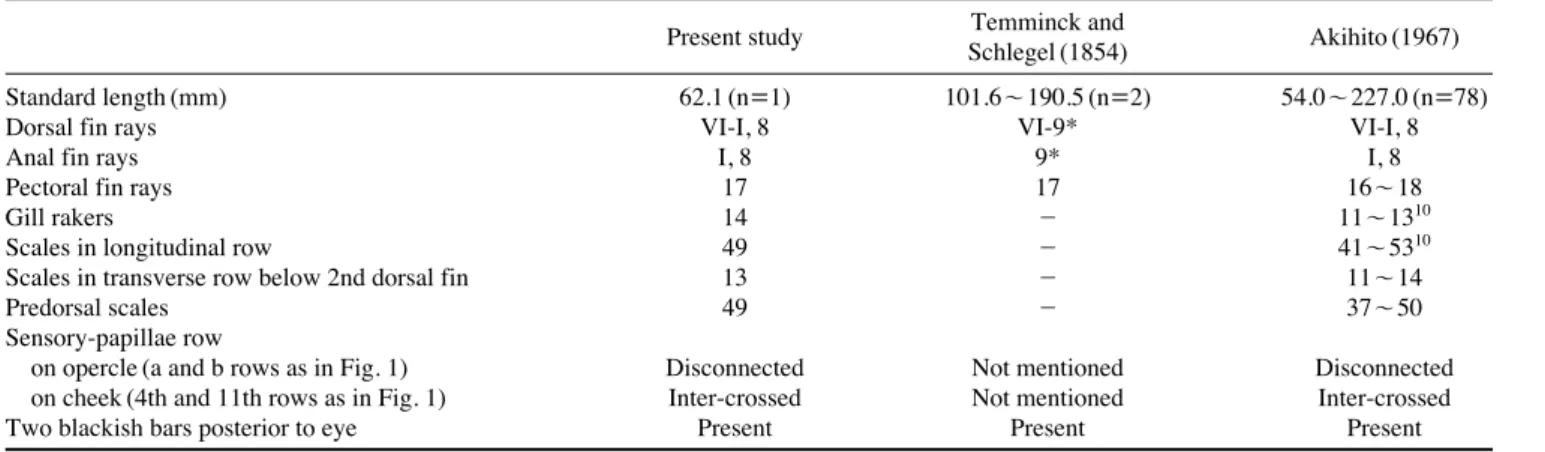
The general morphology including meristic and morpho- metric characters of the present specimen agrees well with the original description of E. oxycephala (Table 1).
Chyung (1977) reported that E. oxycephala was distrib- uted at also Seodun stream, flowing into Seoho (Lake), Suwon, middle Korea as well as from Jeju Island with reference of Mori (1952). He briefly described the species providing a color photograph (Color Pl. 99: 3) and also selected ‘Gu-gul-mu-chi’ as a standard Korean name for the species among several vernacular names to avoid tax- onomical confusion between E. oxycephala and a cyprind species, Gobiobotia macrocephala Mori which was named as ‘Gu-gu-ri’ or ‘Gu-gul-mu-chi’ in Suwon, Korea. How- ever the occurrence of the species in the Seodun stream and its adjacent waters at present is doubtful due to not only the absence of any specimen record but also not any additional reports of the species to date (Kim et al., 1986).
Table 1.Comparison of major meristic characters of Eleotris oxycephala
Present study Temminck and Akihito (1967)
Schlegel (1854)
Standard length (mm) 62.1 (n==1) 101.6~190.5 (n==2) 54.0~227.0 (n==78)
Dorsal fin rays VI-I, 8 VI-9* VI-I, 8
Anal fin rays I, 8 9* I, 8
Pectoral fin rays 17 17 16~18
Gill rakers 14 - 11~1310
Scales in longitudinal row 49 - 41~5310
Scales in transverse row below 2nd dorsal fin 13 - 11~14
Predorsal scales 49 - 37~50
Sensory-papillae row
on opercle (a and b rows as in Fig. 1) Disconnected Not mentioned Disconnected
on cheek (4th and 11th rows as in Fig. 1) Inter-crossed Not mentioned Inter-crossed
Two blackish bars posterior to eye Present Present Present
*, spine and soft ray not differentiated. Superscription means the number of specimens examined.
The specimen used in Chyung (1977)’s description does not exist any more at present and his figure of E. oxycep- hala was not of an actual specimen but of an illustration by Abe (1958, not listed in the references of Chyung, 1977). The present specimen collected from Jwagwang stream, Korea is therefore the first reliable and only spec- imen from Korea to date since Mori (1952)’s first record from Jeju Island. As mentioned by Kim et al. (1986), occurrence of E. pisonis oxycephala (=E. oxycephala) in the Seodun Stream, Suwon, Korea by Chyung (1977) may be erroneous identification of Odontobutis interrupta Iwata and Jeon or O. platycephala Iwata and Jeon (Odon- tobutidae) resulted from the morphological similarities (for example, general body appearance, separated pelvic fins, and so on). Although Choi (1969) reported E. pisonis oxycephala from three stations in the Chuncheon Reser- voir, middle Korea, Choi (2005) reported Odontobutis oxycephala at the same reservoir without E. oxycephala.
ACKNOWLEDGMENTS
We thank to Mr. Hyun-Geun Cho (NIBR) and Ms. Ye- Seul Lee (NIBR) for their kind assistance to taking radi- ographs and specimen processing. This work was sup- ported by a grant from the National Institute of Biologi- cal Resources, funded by the Ministry of Environment of the Republic of Korea (NIBR No. 2014-01-001).
REFERENCES
Akihito, Prince. 1967. On four species of the gobiid fishes of the genus Eleotris found in Japan. Japanese Journal of Ichthyology, 14: 135-166. (in Japanese)
Akihito, Prince, K. Sakamoto, Y. Ikeda and K. Sugiyama.
2002. Suborder Gobioidei. In: Nakabo, T. (ed.), Fishes of Japan with pictorial key to the species. English edi- tion. Tokai University Press, Tokyo, pp. 1139-1310.
Bleeker, P. 1853. Diagnostische beschrijvingen van nieuwe of weinig bekende vischsoorten van Sumatra. Tiental V-X. Natuurkundig Tijdschrift voor Nederlandsch Indië, 4: 243-302.
Bloch, M.E. and J.G. Schneider. 1801. M. E. Blochii, Sys- tema Ichthyologiae Iconibus cx Ilustratum. Post obi- tum auctoris opus inchoatum absolvit, correxit, inter-
polavit Jo. Gottlob Schneider, Saxo. Berolini. Sumti- bus Auctoris Impressum et Bibliopolio Sanderiano Commissum. lx+584pp, 110pls.
Choi, J.S. 2005. Ichthyofauna and fish community structure in Chuncheon Reservoir. Korean Journal of Environ- mental Biology, 23: 173-183. (in Korean)
Choi, K.C. 1968. Fish population dynamics in the Choon Chun impoundment, Korea. Korean Journal of Lim- nology, 2: 31-38.
Chyung, M.K. 1977. The fishes of Korea. Iljisa, Seoul, 727 pp, 238pls.
Dybowski, B.N. 1877. Fishes of the Amur water system.
Izvestiya Zapadno-Sibirskogo otdiela Imperatorskago russkago geograpficheskago obshchestva, 8: 1-29.
Hubbs, C.L. and K.F. Lagler. 1964. Fishes of the Great Lakes region. University of Michigan Press, Ann Arbor, xv +213pp.
Jang, M.H., J.D. Youn and H.B. Song. 2007. Fish belongs to the genus Eleotris collected from Jwagwang stream, Gijang-gun, Gyeongnam-do, Korea. Abstract of An- nual Meeting, The Ichthyological Society of Korea, 343pp. (in Korean)
Kim, B.J. 2011. Fish species of Korea. In: National Institute of Biological Resources, Environment of Ministry, National list of species of Korea (Vertebrates), pp. 3- 189.
Kim, I.S. 1997. Illustrated encyclopedia of fauna and flora of Korea. Vol. 37. Freshwater fishes. The Ministry of Education, 629pp. (in Korean)
Kim, I.S., Y. Choi, C.L. Lee, Y.J. Lee, B.J. Kim and J.H. Kim.
2005. Illustrated book of Korean fishes. Kyo-Hak Publishing Co., Seoul, 615pp. (in Korean)
Kim, I.S., Y.J. Lee and Y.U. Kim. 1986. Synopsis of the fam- ily Gobiidae (Pisces, Perciformes) from Korea. Bulle- tin of the Korean Fisheries Society, 19: 387-408. (in Korean)
Mori, T. 1952. Check list of the fishes of Korea. Memoirs of the Hyogo University of Agriculture, 1: 1-228.
Temminck, C.J. and H. Schlegel. 1845. Pisces. In: Fauna Japonica, sive descriptio animalium quae in itinere per Japoniam suscepto annis 1823-30 collegit, notis observationibus et adumbrationibus illustravit P. F.
de Siebold. Parts 7-9: 113-172, 143pls.
경남 기장군 좌광천에서 채집된 구굴무치 Eleotris oxycephala의 기재
김병직∙장민호1∙윤주덕2∙송호복3
국립생물자원관 유용자원활용과, 1공주대학교 생물교육과,
2공주대학교 생물자원연구센터, 3한국민물고기생태연구소
간추림 :2006년 부산시 기장군 일광읍 좌광천 하류역에서 채집된 구굴무치 Eleotris oxycephala 1개체 (표준체 장 62.1 mm)를 근거로 국내에서 표본에 근거한 구굴무치의 최초 기록으로서 보고한다. 본 종은 새개부 상하 공 기열이 새개부 후단에서 서로 만나지 않는 점, 협부 4번째 공기열이 11번째 공기열을 넘지 않는 점 등에서 북부 서태평양에 출현하는 3종의 동속 유사종과 쉽게 구별된다.
찾아보기 낱말 :Eleotris oxycephala, 기재, 좌광천, 두부 공기열