Short Communication KOREAN JOURNAL OF APPLIED ENTOMOLOGY
한국응용곤충학회지 ⓒ The Korean Society of Applied Entomology
Korean J. Appl. Entomol. 54(4): 449-454 (2015) pISSN 1225-0171, eISSN 2287-545X
DOI: http://dx.doi.org/10.5656/KSAE.2015.11.1.071
New record of Caliothrips tongi (Thysanoptera: Thripidae) in Korea
Gwan-Seok Lee and Wonhoon Lee*
Crop Protection Division, National Academy of Agricultural Science, RDA, Jeollabuk-do 55365, Korea
한국 미기록종 Caliothrips tongi (총채벌레목: 총채벌레과)에 대한 보고
이관석ㆍ이원훈*
국립농업과학원 작물보호과
ABSTRACT: A panchaetothripine species Caliothrips tongi Mound et al., 2011 is recorded in Korea for the first time. The species was previously known only from the southern China. C. tongi were widely collected from several regions of Korea, causing severe damage to the leaves of Lactuca indica L. (Compositae).
Key words: Thysanoptera, Thripidae, Caliothrips tongi, Lactuca, Korea
초 록: 그물총채벌레아과의 중국 남부에서만 알려졌던 고들빼기총채벌레(신칭, Caliothrips tongi Mound et al.)를 한국에서 처음 보고한다. 이 종은 우리나라 전국에 걸쳐 널리 분포하고 있으며, 아시아 원산인 왕고들빼기(Lactuca indica, 국화과)가 주요 기주이고 잎에 심각한 피해를 준다.
검색어: 총채벌레과, 고들빼기총채벌레, Caliothrips tongi, 왕고들빼기, 한국
*Corresponding author: [email protected]
Received December 11 2014; Revised November 4 2015 Accepted November 18 2015
Caliothrips Daniel is the second largest genus of the subfamily Panchaetothripinae in the family Thripidae, comprising 22 living species up to now (ThripsWiki, 2015). Various species of the genus are distributed worldwide (Faure, 1962; Bhatti, 1972; Wilson, 1975; Nakahara, 1991; Kudo, 1995; Mound et al., 2011). A total of 12 species of the genus were known from the Nearctic or Neotropical regions, five species from Afrotropical, and eight from Indomalaysian and Australasian. In Asian continent, about 10 species including two from Iran (Minaei, 2013) and four from China (Mirab-balou et al., 2011) have been reported.
The genus Caliothrips is easily distinguishable from other genera belonging to Panchaetothripinae by the presence of a coiled apodeme within each hind coxa (Bhatti, 2006). Based on
this character, Bhatti placed Caliothrips in a new monobasic family Caliothripidae. Host relationships of Caliothrips species are various (Wilson, 1975). For examples, C. insularis (Hood) inhabit mainly on glasses, while C. indicus (Bagnall) and C.
phaseoli (Hood) associate with dicotyledonous plants such as cotton or bean.
In this paper we report Caliothrips tongi Mound et al., 2011 as a newly recorded species to Korea, with a key to the Korean genera of the subfamily Panchaetothripinae. The species was previously known only from the southern China (Zhejiang and Fujian). The species was widely collected in several regions of Korea, and caused severe damage to the leaves of Lactuca indica L. (Compositae).
Materials and Methods
The thrips were mainly collected on leaves of Lactuca indica L. (Compositae) in Korea nation-wide. Examined specimens were macerated in 10% NaOH solution to remove the body contents and mounted into Canada balsam. Measurements were taken using Nikon Optiphot 100S and the images were photographed using Cannon EOS 5D attached to the microscope.
All specimens were deposited in the Insect Collection of Plant Protection Division, National Academy of Agricultural Science, Rural Development Administration, Korea.
Systematic Accounts
Caliothrips Daniel, 1904
Caliothrips Daniel, 1904: 296. Type species C. woodworthi Daniel, a junior synonym of C. fasciatus (Pergande)
Diagnosis. Head and pronotum dark with prominent reticulate sculpture; wrinkle- or dot-shaped markings present within the reticulations. Head with cheeks more or less parallel- sided, not constricted into a neck-like region; occiput with a transverse posterior marginal band of smooth reticles, not forming a conspicuous collar. Antennae 8-segmented. Fore wings usually with dark and light bands, first vein with wide interval in setal row. Metathorax with enlarged, U-shaped furca extending to mesothorax. Hind coxa with a prominent coiled apodeme.
Tarsi one-segmented. Abdominal tergites I-VIII reticulate laterally; tergite X usually with longitudinal split.
Remarks. Previously in Korea, two genera, Helionothrips Bagnall, 1932 and Hercinothrips Bagnall, 1932, have been also recorded in the subfamily Pancaetothripinae. The genus Caliothrips is can be easily distinguished from Helionothrips and Hercinothrips by the presence of a coiled apodeme in hind coxa (Fig. 4) as the following key.
A key to the Korean genera of the subfamily Panchaetothripinae 1. Hind coxa each with a coiled apodeme ··· Caliothrips - Hind coxa each without a coiled apodeme ··· 2 2. Head without occipital collar; fore wing with first veinal
setal row complete ··· Hercinothrips
- Head with conspicuous occipital collar; fore wing with first veinal setal row widely interrupted ··· Helionothrips
Caliothrips fasciatus (Pergande)
Heliothrips fasciata Pergande, 1895: 391.
Caliothrips fasciatus: Woo et al., 1991 : 142.
The bean thrips, C. fasciatus, is native to North America and its reports elsewhere are considered dubious (Hoddle et al., 2006; Mound et al., 2011). In Korea, Woo et al. (1991) recorded C. fasciatus based on two females. However, their descriptions are not appropriate for the distinguishing characters of C.
fasciatus (Hoddle et al., 2012) as follows: basal part of fore wing “brown” instead of “pale”, reticulate sculptures forming long teeth laterally on “abdominal tergite III” instead of
“abdominal tergites II to VIII”. Unfortunately, the voucher specimens were lost. After Woo et al. (1991), there has been no report about the species in Korea. Consequently, the record is considered to be dubious in Korea as well.
Caliothrips tongi Mound, Zhang & Bei 고들빼기총채벌레 (신칭)
Caliothrips tongi Mound, Zhang & Bei, 2011: 58. Type locality: China.
Diagnosis. <Female macroptera> Body dark brown (Fig. 1);
antennal segments III-V largely yellow with apices light brown;
fore wing dark with two pale areas, sub-basally and sub-apically, apical dark area shorter than distal pale area (Fig. 6). Antennae 8-segmented; III-IV with strongly constricted apical neck;
sensoria forked. Head wider than long (Fig. 2); cheeks a little convex, constricted to weak basal neck; vertex reticulate with markings within the reticles, one row of submarginal reticles forming a transverse ridge; compound eye ventrally with six-pigmented facets; one pairs of curved anteocellars and two pairs of long pale postoculars present. Pronotum (Fig. 3), mesonotum and metanotum reticulate with many markings within each reticle. Metathoracic furca enlarged and lyre-shaped, extending to mesothorax (Fig. 5). Hind coxa with a prominent coiled apodeme (Fig. 4); tarsi 1-segmented. Fore wing first vein with about five setae at base, two setae near apex; second vein with five or six setae. Abdominal tergites I-VIII posterior
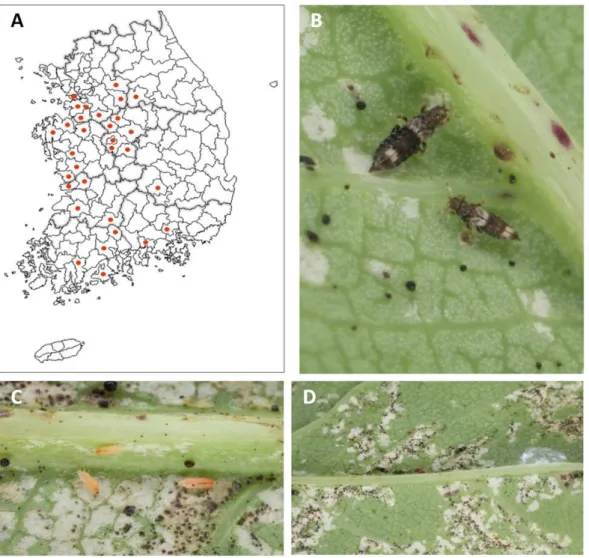
Fig. 1. Distribution, larvae and adults, and symptoms of Caliothrips tongi in Korea; A, distribution map; B, dorsal view of living adults (upper, female; lower, male); C, dorsal view of living larvae; D, silver spots on Lactuca indica.
margin with craspedum, forming long teeth laterally; median area of I-V tergites mostly reticulate (Fig. 7) but VI-VIII reticulate anteriorly (Fig. 8); IX with no campaniform sensilla;
X with median split complete. Sternites II-VII with 3 pairs of marginal setae anterior to broad craspedum. Body length 1213 to 1345 microns (n = 7). <Male macroptera> Color and sculpture similar to female but smaller in size (Fig. 1); tergite IX median discal setae shorter and stouter than posterior and midlateral pairs; sternites III-VII with transversely slender pore plate.
Specimens examined. Korea. Gangwon: 3♀♀, Wonju (Hojeo, Oksan), on Lactuca indica, 03.vii.2013. Gyeonggi: 7
♀♀1♂, Pyeongtaek (Poseung, Dogok), on L. indica, 25.ix.
2012; 2♀♀1♂, Ansan (Sangrok, Ansan), same data, 26.ix.
2012; 2♀♀4♂♂, Osan (Geumam), same data, 11.vi.2013; 5
♀♀, same data, on Crepidiastrum sonchifolium; 3♀♀3♂♂, Anseong (Wongok, Sanha), on L. indica, 18.vii.2013; 1♀, Hwaseong (Maesong, Sukgok), same data, 22.vii.2013; 2♀♀, same data, on Lactuca scariola; 1♀1♂, Yeoju (Bubal, Sinwon), on L. indica, 25.vii.2013; 1♀, Yangpyeong (Gaegun, Gongse), same data, 02.x.2013. Chungbuk: 13♀♀4♂♂, Cheongwon (Munui, Deogyu), on L. indica, 12.vii.2012; 2♀♀2♂♂, Boeun (Maro, Jeokam), same data; 4♀♀2♂♂, Eumseong (Samseong, Youngseong), same data, 03.vii.2013; 2♀♀, Jincheon (Iwol, Jungsan), same data, 01.x.2013; 1♀. Goesan (Cheongan, Cheongyoung), same data, 02.x.2013; 1♀, Cheongju (Heungdeok, Gagyeong), same data. Chungnam: 4♀♀1♂, Asan (Yeongin, Wolseon), on L. indica, 25.ix.2012; 3♀♀2♂
♂, Dangjin (Myeoncheon, Jagae), same data, 15.vi.2003; 3♀
♀2♂♂, Cheongyang (Mok-myeon, Daepyeong), same data,
Figs. 2-6. Female adult of Caliothrips tongi. 2, head; 3, pronotum; 4, coiled apodeme within hind coxa; 5, metathoracic furca; 6, fore wing.
11.vii.2013; 1♀, Buyeo (Sedo, Cheongpo), same data; 3♀♀, Seosan (Haemi, Samsong), on Sonchus oleraceus, 22.vii.2013;
2♀♀, Seocheon (Biin, Seongsan), on L. indica, same data.
Gyeongbuk: 2♀♀1♂, Seongju (Youngam, Munmyeong), on L. indica, 24.vii.2013. Gyeongnam: 5♀♀1♂, Sacheon (Gonyang, Mukgok), on L. indica, 24.vii.2013; 1♀, same data, on L.
scariola; 1♀, Haman (Gunbuk, Yuhyeon), on L. indica, same data; 4♀♀2♂♂, Haman (Sanin, Sinsan), same data; 2♀♀, same data, on S. oleraceus. Jeonbuk: 5♀♀2♂♂, Iksan (Yeosan, Wonsu), on L. indica, 12.vi.2013; 3♀♀1♂, Gunsan (Impi, Chuksan), same data, 22.vii.2013; 4♀♀2♂♂, Namwon (Chunhyang-ro) same data; 1♀, Jeongeup (Buk-myeon, Namsan), same data, 31.vii.2013. Jeonnam: 7♀♀3♂♂, Gurye (Sandong, Sinhakhasan-gil), on L. indica, 23.vii.2013; 5♀♀2♂♂, Suncheon (Seo-myeon, Guman), same data; 2♀♀, Jangheung (Busan, Hyangyang), on L. indica, 01.viii.2013; 2♀♀, Goheung
(Donggang, Jangdeok), same data. Distribution map in Korea as in Fig. 1A. All specimens were collected on leaves of each plant by the first author (GS Lee).
Distribution. Korea (New record; Central, South), China (Zhejiang, Fujian)
Host plants. Adults: Compositae - Lactuca indica L., L.
scariola L., Crepidiastrum sonchifolium (Bunge), Sonchus oleraceus L. (in this study); Convolvulaceae - sweet potato (Ipomoea batata) (Mound et al., 2011). Larvae: L. indica L.
with more than 10 individuals at following localities: Gangwon (Wonju), Gyeonggi (Ansan, Anseong, Pyeongtaek), Chungbuk (Cheongwon, Eumseong), Chungnam (Asan, Cheongyang, Dangjin, Seocheon), Gyeongbuk (Mungyeong, Seongju).
Gyeongnam (Sacheon), Jeonbuk (Gunsan, Iksan), Jeonnam
Figs. 7-8. Female adult of Caliothrips tongi. 7, abdominal tergites III-IV; 8, abdominal tergites VII-VIII.
(Gurye, Jangheung, Suncheon); C. sonchifolium and S. oleraceus with a few individuals (in this study).
Remarks. According to Mound et al. (2011), C. tongi is distinct by the transverse ridge prominent across the vertex (Fig. 2) and abdominal tergites reticulated medially (Figs. 7 &
8). Compared with the original descriptions, the Korean specimens have no differences except for number of postoculars on vertex of head (not three pairs but two pairs). However, this difference is a considered to be a result of the difficulty for examining postocular setae because of dark sculpture reticulations.
As listed in host plants above, both adults and larvae of the species prefer to Lactuca indica L. (Compositae) in Korea.
They usually live on the inner surface rather than the outer of leaves (Fig. 1B, C). We observed that the species caused severe
damage to the leaves, of which damaged areas are resulted in silver spots, later turned bright yellow, and finally withered (Fig. 1D). Besides wild plants of Compositae, there was no agricultural crops damaged by C. tongi in Korea. In China, although the species was originally described from the sweet potato (Ipomoea batata) (Convolvulaceae), the economic effect on the crop is still unknown.
Acknowledgment
This study was supported by a grant from the Cooperative Research Program for Agricultural Science & Technology Development (Project No. PJ009194), Rural Development Administration, Republic of Korea.
Literature Cited
Bhatti, J.S., 1972. A review of the Indian Species of Caliothrips, with notes on other heliothripines. Oriental Insects 6, 65-73.
Bhatti, J.S., 2006., The classification of Terebrantia (Insecta) into families. Oriental Insects 40, 339-375.
Daniel, S.M., 1904. New California Thysanoptera. Entomological News 15, 293-297.
Faure, J.C. 1962., Thysanoptera of Africa – 7. Entomologisk Tidskrift 83, 4-43.
Hoddle, M.S., Mound, L.A., Paris, D.L., 2012. Thrips of California. CBIT Publishing, Queensland. Available online at http://keys.lucidcentral.org/keys/v3/thrips_of_california/
Thrips_of_California.html (accessed 1 November 2015) Hoddle, M.S., Stosic, C.D., Mound, L.A., 2006. Populations of
North American thrips, Caliothrips fasciatus (Pergande) (Thysanoptera: Thripidae: Panchaetothripinae) not detected in Australia. Australian Journal of Entomology 45, 122-129.
Kudo, I., 1995. Some Panchaetothripinae from Nepal, Malaysia and the Philippines (Thysanoptera: Terebrantia: Thripidae).
Insecta Matsumurana, new series 52, 81-103.
Minaei, K., 2013. Thrips (Insecta: Thysanoptera) of Iran: a revised
and updated checklist. Zookeys 330, 53–74.
Mirab-balou, M., Tong, X.L., Feng, J.N., Chen, X.X., 2011. Thrips (Insecta: Thysanoptera) of China. Check List 7, 720–744.
Mound, L.A., Zhang, H.R., Bei, Y.W., 2011. Caliothrips tongi sp.n.
(Thysanoptera, Thripidae) from China, and a dubious record of North American Bean Thrips. Zootaxa 2736, 57-62.
Nakahara, S., 1991. Two new species of Caliothrips (Thysanoptera:
Thripidae) and a key to the Nearctic species. Journal of the New York Entomological Society 99, 97-103.
Pergande, T., 1895. Observations on certain Thripidae. Insect Life 7, 390-395.
ThripsWiki, 2015. ThripsWiki – providing information on the World’s thrips. Available from: http://thrips.info/wiki/Main_
Page (accessed 2 November 2015).
Wilson, T.H., 1975. A monograph of the subfamily Panchaetothripinae (Thysanoptera: Thripidae). Memoirs of the American Entomological Institute 23, U.S.A.
Woo, K.S., Kweon, O.K., Cho, K.S., 1991. Studies on the dis- tribution, host plants and taxonomy of Korean thrips (Insecta:
Thysanoptera). Seoul National University J. Agricultural Science 16, 133-148.