The subfamily Neophyllaphidinae (Hemiptera: Aphididae) was erected based on the type genus Neophyllaphis Takahashi, 1920. Since then, Hille Ris Lambers (1967), Russell (1982) and Quednau (2010) reviewed world species with illustrations and keys. Neophyllaphidinae is comprised with the two paleogenera, †Aniferella Richards, 1966 and †Conicaudus Heie, 1972, and the only present genus Neophyllaphis with 18 species under 2 subgenera, Chileaphis Essig, 1953 and Neophyllaphis, in the world (Favret, 2017). Chileaphis species are distributed only in South America and Neophyllaphis species are distributed in South-east Asia through Southern
hemisphere (Blackman and Eastop, 2017; Quednau, 2010).
Some species such as N. araucariae and N. podocarpi have been invaded into other countries and cause severe damage to street trees. (Aguiar et al., 2013; Carver, 1959; Carver, 1971;
Blackman and Eastop, 2017; Limonta, 1990; Pérez Hidalgo et al., 2015; Quednau, 2010; Russell, 1982). All species are monoecious on Podocarpaceae and Araucariaceae (Blackman and Eastop, 2017). Unusually, sexual morphs and partheno- genetic morphs occur together in spring, summer and autumn (Russell, 1982). Fundatrices of Chileaphis can produce sexual morphs (Quednau, 2010).
In this study, the subfamily Neophyllaphidinae is reported for the first time in Korea based on the type species N. podocarpi.
This species was collected on Podocarpus macrophyllus in Jeju island. A diagnostic note, biometric data and illustrations
Short communication KOREAN JOURNAL OF APPLIED ENTOMOLOGY
한국응용곤충학회지 ⓒ The Korean Society of Applied Entomology
Korean J. Appl. Entomol. 57(1): 19-24 (2018) pISSN 1225-0171, eISSN 2287-545X
DOI: https://doi.org/10.5656/KSAE.2017.04.1.080
First Record of the Subfamily Neophyllaphidinae Takahashi, 1921 (Hemiptera: Aphididae) in Korea
Yerim Lee and Seunghwan Lee*
Laboratory of Insect Biosystematics, Department of Agricultural Biotechnology, Research Institute of Agriculture and Life Sciences, Seoul National University, Seoul 08826, Korea
한국의 미기록아과 Neophyllaphidinae Takahashi, 1921 (노린재목: 진딧물과)에 대한 보고
이예림ㆍ이승환*
서울대학교 농업생명과학대학 응용생물화학부 곤충계통분류학연구실
ABSTRACT: The subfamily Neophyllaphidinae Takahashi, 1921 is newly recognized in Korea based on the recently collected species Neophyllaphis podocarpi Takahashi, 1920. Diagnosis and illustrations for alate and apterous viviparous females, alate oviparous female and male are provided.
Key words: Aphids, New record, Neophyllaphis, Podocarpus tree
초 록: 본 연구에서는 최근 확인된 Neophyllaphis podocarpi Takahashi, 1920를 기반으로 Neophyllaphidinae Takahashi, 1921 아과를 국내 최초 로 보고한다. 무시형과 유시형 처녀생식세대의 암컷 사진 및 유시형 산란모, 수컷 형태 정보를 수록하였다.
검색어: 진딧물, 미기록 종, 나한송진딧물속, 나한송
*Corresponding author: [email protected]
Received November 7 2016; Revised April 2 2017 Accepted January 19, 2018
are given for apterous and alate viviparae, alate ovipara and alate male.
Materials and Methods
Aphid samples were collected in Korea in 2014. Samples were preserved in 90% ethanol for a month, and then mounted in Canada balsam, following the method of Blackman and Eastop (2000) and Martin (1983) methods. Illustrations for the species were taken by a digital camera attached to the microscope (Leica 400B, Leica Microsystems, Germany) at a resolution of 600 dpi. Measurements for each specimen are taken from the digital images by using image analysis software (Active measure ver. 3.0.3 from Mitani Co. Ltd, Japan). All specimens were preserved in the College of Agriculture and Life sciences, Seoul National University Korea (CALS).
Abbreviations used for diagnosis and biometric data are:
ANT I-VI, antennal segments I-VI; BASE, base of the last antennal segment; PT, processus terminalis of the last antennal segment; BD III, basal diameter of antennal segment III; Ls ANT III, longest setae on ANT III; HT II, second segment of hind tarsus; SIPH, siphunculus; URS, ultimate rostral segment.
Taxonomy
Subfamily Neophyllaphidinae Takahashi, 1921 나한송진딧 물아과(신칭)
Neophyllaphidinae Takahashi, 1921: 76. (Neophyllaphidini) Neophyllaphidinae Takahashi, 1921: Nieto Nafría et al., 1997: 84; Heie and Wegierek, 2009: 70; Quednau, 2010: 19, 19;
Nieto Nafría et al., 2011: 63.
Type genus: Neophyllaphis Takahashi, 1920.
Diagnosis. This subfamily is closely related to Mindarinae Tullgren, 1909 by having long and slender rostrum, PT shorter than BASE and less developed 3 lensed compound eyes in apterous morph (Chileaphis has mulifaced eye) but can be distinguished by having well developed epicranial suture, cauda knobbed, ANT III with slit-like secondary sensoria in alate morph, pterostigma of fore wing not elongated of alate morph. Some species have pseudosensoria on hind tibiae in alate viviparae.
Host plant. Podocarpaceae and Araucariaceae.
Distribution. Africa (Angola, Cameroon, Ethiopia, Kenya, South Africa, Tanzania), Asia (China, India, Indonesia, Japan, Korea, Malaya, Taiwan, and Vietnam), Europe (Azores, Italy, and Spain)Oceania (Australia, New Guinea, and New Zealand), North America (Bahamas and USA), South America (Argentica, Brazil, Chile, Costa Rica, Mexico, Peru, and Venezuela).
Remarks. This subfamily is regarded as a group of primitive drepanosiphine aphids (Quednau, 2010). Most species are distributed in tropical and temperate region of southern hemishpere. Neophyllaphidinae species show distinct biological and morphological features. In most species, alate oviparae occur throughout spring to autumn. Alate viviparae of some species have paeudosensoria on hind tibiae which exists only in oviparae in other subfamilies.
Genus Neophyllaphis Takahashi, 1920 나한송진딧물속(신칭) Neophyllaphis Takahashi, 1920: 19.
Neophyllaphis Takahashi, 1920: Hille Ris Lambers, 1967:
55; Eastop and Hille Ris Lambers, 1976: 314; Smith and Parron, 1978: 218; Qiao et al., 2001: 92; Quednau, 2010: 26;
Nieto Nafría et al., 2011: 282.
Type species: Neophyllaphis podocarpi Takahashi, 1920.
Diagnosis. This genus is recognized from two paleogenera,
†Aniferella Richards, 1966 and †Conicaudus Heie, 1972 by having slit like secondary sensoria on ANT III and three branched median vein of fore wing.
Remarks. This genus is comprised with 2 subgenera, Chileaphis and Neophyllaphis. Russell (1982) regarded Chileaphis as a synonym of Neophyllaphis because, N. grobleri Eastop, 1955 exhibits intermediate form of Chileaphis and Neophyllaphis. Morphologically, Chleaphis is distinguished from Neophyllaphis by having fully developed compound eyes, knob of cauda globular shaped with many hairs, some species have marginal tubercles on abdominal tergite I in alate morph and oviparae with pseudosensoria on all tibiae (Hille Ris Lambers, 1967; Russell, 1982; Quednau, 2010). Species in the subgenus Neophyllaphis have no elevations and tubercles on abdominal tergite and oviparae have pseudosensoria only on hind tibiae (Hille Ris Lambers, 1967; Quednau, 2010).
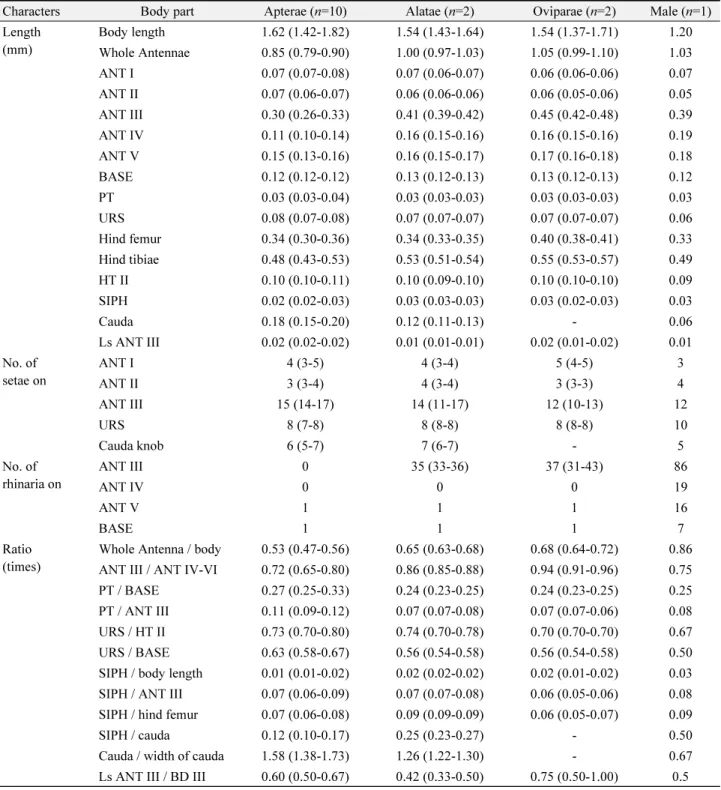
Neophyllaphis (Neophyllaphis) podocarpi Takahashi, 1920 나한송진딧물(신칭) (Table 1; Figs. 1-3)
Neophyllaphis podocarpi Takahashi, 1920: 20.
Neophyllaphis podocarpi Takahashi, 1920: Takahashi, 1921: 77; Takahashi, 1923: 129; Takahashi, 1924: 69, 112;
Takahashi, 1950: 587; Eastop, 1966: 516; Higuchi, 1972: 100;
Eastop and Hille Ris Lambers, 1976: 315; Smith and Parron, 1978: 218; Russell, 1982: 558; Limonta, 1990: 98; Remaudière and Remaudière, 1997: 230; Noordam, 2004: 126; Miller and Halbert, 2014: 77.
Table 1. Biometric data of Neophyllaphis podocarpi in Korea
Characters Body part Apterae (n=10) Alatae (n=2) Oviparae (n=2) Male (n=1)
Length (mm)
Body length 1.62 (1.42-1.82) 1.54 (1.43-1.64) 1.54 (1.37-1.71) 1.20 Whole Antennae 0.85 (0.79-0.90) 1.00 (0.97-1.03) 1.05 (0.99-1.10) 1.03
ANT I 0.07 (0.07-0.08) 0.07 (0.06-0.07) 0.06 (0.06-0.06) 0.07
ANT II 0.07 (0.06-0.07) 0.06 (0.06-0.06) 0.06 (0.05-0.06) 0.05
ANT III 0.30 (0.26-0.33) 0.41 (0.39-0.42) 0.45 (0.42-0.48) 0.39
ANT IV 0.11 (0.10-0.14) 0.16 (0.15-0.16) 0.16 (0.15-0.16) 0.19
ANT V 0.15 (0.13-0.16) 0.16 (0.15-0.17) 0.17 (0.16-0.18) 0.18
BASE 0.12 (0.12-0.12) 0.13 (0.12-0.13) 0.13 (0.12-0.13) 0.12
PT 0.03 (0.03-0.04) 0.03 (0.03-0.03) 0.03 (0.03-0.03) 0.03
URS 0.08 (0.07-0.08) 0.07 (0.07-0.07) 0.07 (0.07-0.07) 0.06
Hind femur 0.34 (0.30-0.36) 0.34 (0.33-0.35) 0.40 (0.38-0.41) 0.33 Hind tibiae 0.48 (0.43-0.53) 0.53 (0.51-0.54) 0.55 (0.53-0.57) 0.49
HT II 0.10 (0.10-0.11) 0.10 (0.09-0.10) 0.10 (0.10-0.10) 0.09
SIPH 0.02 (0.02-0.03) 0.03 (0.03-0.03) 0.03 (0.02-0.03) 0.03
Cauda 0.18 (0.15-0.20) 0.12 (0.11-0.13) - 0.06
Ls ANT III 0.02 (0.02-0.02) 0.01 (0.01-0.01) 0.02 (0.01-0.02) 0.01 No. of
setae on
ANT I 4 (3-5) 4 (3-4) 5 (4-5) 3
ANT II 3 (3-4) 4 (3-4) 3 (3-3) 4
ANT III 15 (14-17) 14 (11-17) 12 (10-13) 12
URS 8 (7-8) 8 (8-8) 8 (8-8) 10
Cauda knob 6 (5-7) 7 (6-7) - 5
No. of rhinaria on
ANT III 0 35 (33-36) 37 (31-43) 86
ANT IV 0 0 0 19
ANT V 1 1 1 16
BASE 1 1 1 7
Ratio (times)
Whole Antenna / body 0.53 (0.47-0.56) 0.65 (0.63-0.68) 0.68 (0.64-0.72) 0.86 ANT III / ANT IV-VI 0.72 (0.65-0.80) 0.86 (0.85-0.88) 0.94 (0.91-0.96) 0.75
PT / BASE 0.27 (0.25-0.33) 0.24 (0.23-0.25) 0.24 (0.23-0.25) 0.25
PT / ANT III 0.11 (0.09-0.12) 0.07 (0.07-0.08) 0.07 (0.07-0.06) 0.08 URS / HT II 0.73 (0.70-0.80) 0.74 (0.70-0.78) 0.70 (0.70-0.70) 0.67 URS / BASE 0.63 (0.58-0.67) 0.56 (0.54-0.58) 0.56 (0.54-0.58) 0.50 SIPH / body length 0.01 (0.01-0.02) 0.02 (0.02-0.02) 0.02 (0.01-0.02) 0.03 SIPH / ANT III 0.07 (0.06-0.09) 0.07 (0.07-0.08) 0.06 (0.05-0.06) 0.08 SIPH / hind femur 0.07 (0.06-0.08) 0.09 (0.09-0.09) 0.06 (0.05-0.07) 0.09
SIPH / cauda 0.12 (0.10-0.17) 0.25 (0.23-0.27) - 0.50
Cauda / width of cauda 1.58 (1.38-1.73) 1.26 (1.22-1.30) - 0.67
Ls ANT III / BD III 0.60 (0.50-0.67) 0.42 (0.33-0.50) 0.75 (0.50-1.00) 0.5 Abbreviations are explained in materials and methods.
Neophyllaphis (Neophyllaphis) podocarpi Takahashi, 1920:
Hille Ris Lambers, 1967: 57; Qiao et al., 2001: 94; Quednau, 2010: 30.
Mindarus podocarpi Shinji, 1922: 532.
Diagnosis. This species can be recognized from other congeneric species by having entirely pigmented cauda knob, ANT III 0.85-0.88 × ANT IV-VI, 26-45 secondary sensoria on ANT III in alate viviparae, genital plate with 30-43 peg-shaped hairs in alate oviarae.
Fig. 1. Neophyllaphis podocarpi (A-B) in life. A, apterous viviparous female and nymphs of N. podocarpi ; B, alate viviparous female of N.
podocarpi.
Fig. 2. Apterous and alate viviparous female of N. podocarpi. Apterous viviparous femlae (A-G) and Alate viviparous female (H-N): A, H, body; B, I, URS; C, J, anal plate and cauda; D, K, leg; E, L, head; F, M, SIPH; G, N, antenna.
Materials examined. 9 apterous viviparous females, Andeok- myeon, Seoguipo-si, Jeju-island, South Korea, 13.ix.2014., on Podocarpus macrophyllus (Podocarpaceae), Coll# 140913JY-1, J. Choi; 2 alate viviparous females, same data as apterous viviparous females; 2 alate oviparous females same data as apterous viviparous females; 1 alate male same data as apterous viviparous females.
Host plant. Podocarpus spp. and Neageia nagi (China) (Podocarpaceae).
Distribution. Originally described in Asia (China, Indonesia, Japan, Malaysia, Taiwan, and Vietnam), distributed in New Zealand, Australia, and has been introduced into Europe (Azores, Italy, and Spain) and North America.
Remarks. This species is new to Korea. Currently, this species is only collected in Jeju island.
Acknowledgements
We deeply thank to Mr. Jinyeong Choi for collecting specimens in Jeju-island. This work was supported by a grant from the National Institute of Biological Resources (NIBR), funded by the Ministry of Environment (MOE) of the Republic of Korea (NIBR201701203) and the Basic Science Research Program through the National Research Foundation of Korea (NRF) funded by the Ministry of Education, Science (NRF- 2015R1D1A1A01059031).
Literature Cited
Aguiar, A.M.F., Ilharco, F.A., Khadem, M., Moreira, M., 2013.
New records of aphids (Hemiptera: Aphidoidea) from Madeira and Azores Archipelagos. Entomol. Mag. 149, 235-254.
Blackman, R.L., Eastop, V.F., 2000. Aphids on the world’s crops.
Fig. 3. Alate oviparous female and male of N. podocarpi. Alate oviparous female (A-E) and alate male (F-J): A, F, body; B, genital plate and anal plate; C, H, leg; D, I, head; G, male genitalia; E, J, antenna.
An Identification and Information guide, 2nd eds. John Wiley and Sons, London, 1460 pp.
Blackman, R.L., Eastop, V.F., 2017. Aphids on the world’s plants:
An online identification and information guide. Available at:
http://www.aphidinwordsplants.info/.
Carver, M., 1959. Two new and possibly indigenous aphids from Australia (Homoptera: Aphidoidea). Syst. Entomol. 28, 19-27.
Carver, M., 1971. New species of Anomalaphis Baker, 1920 and Neophyllaphis Takahashi, 1920 (Homoptera: Aphididae). Syst.
Entomol. 40(1), 31-42.
Eastop, V.F., 1966. A taxonomic study of Australian Aphidoidea (Homoptera). Aust. J. Zool., 14(3), 399-592.
Eastop, V.F., Hille Ris Lambers, D., 1976. Survey of the World’s Aphids. W. Junk, The Hague, 573 pp.
Favret, C., 2016. Aphid species file ver. 5.0. Available at: http://
Aphid.SpeciesFile.org/.
Heie, O.E., Wegierek, P., 2009. A classification of the Aphidomorpha (Hemiptera: Sternorrhyncha) under consideration of the fossil taxa. Redia 92, 69-77.
Higuchi, H., 1972. A taxonomic study of the subfamily Callipterinae in Japan (Homoptera: Aphididae). Insecta Matsumurana, 35(2), 19-126.
Hille Ris Lambers, 1967. On the genus Neophyllaphis Takahashi, 1920 (Homoptera, Aphididae) with description of two new species. Zool. Meded. 42, 55-66.
Limonta, L., 1990. Callaphididae (Aphidoidea) new to Italy. Boll.
Zool. Agrar. Bachic. 22(1), 93-99.
Martin, J., 1983. The identification of common aphid pests of tropical agriculture. Trop. Pest Manage. 29, 197-212.
Miller, G.L., Halbert, S.E., 2014. A new species of Neophyllaphis (Hemiptera: Aphididae: Neophyllaphidinae) with keys to species on Podocarpus (Pinales: Podocarpaceae). Proc. Entomol. Soc.
Wash. 116(1), 69-79.
Nieto Nafría, J.M., Favret, C., Akimoto, S., Barbagallo, S., Chakrabarti, S., Mier Durante, M.P., Miller, G.L., Qiao, G., Sano, M., Pérez Hidalgo, N., Stekolshchikov, A.V., Wegierek,
P., 2011. Register of genus-group taxa of Aphidoidea, in: Nieto Nafría, J.M., Favret, C. (Eds.), Registers of Family-Group and Genus-Group Taxa of Aphidoidea (Hemiptera Sternorrhyncha).
Universidad de León, León, pp. 81-404.
Nieto Nafria, J.M., Mier Durante, M.P., Remaudière, G., 1997.
Les noms des taxa du groupe-famille chez les Aphididae [Hemiptera]. Revue française d’entomologie, 19(3-4), 77-92.
Noordam, D., 2004. Aphids of Java. Part V: Aphidini (Homoptera:
Aphididae). Zool. Verh. 346, 1-212.
Pérez Hidalgo, N., Hernández-Castellano, C., Garcia Figueres, F., 2015. First record of Neophyllaphis podocarpi Takahashi (Hemiptera:
Aphididae) in the Iberian Peninsula. EPPO Bull. 45(1), 103-105.
Qiao, G.X., Zhang, G.X., Cao, Y., 2001. The genus Neophyllaphis Takahashi (Homoptera: Aphididae) from China with description of one new species. Orient. Insects 35(1), 91-96.
Quednau, F.W., 2010. Atlas of the drepanosiphine aphids of the world part III: Am. Entomol. Inst., Florida, 361 pp.
Remaudière, G., Remaudière, M., 1997. Catalogue des Aphididae du Monde. INRA, Paris, pp. 473.
Russell, L.M., 1982. The genus Neophyllaphis and its species (Hemiptera: Homoptera: Aphididae). Fla. Entomol. 538-573.
Shinji, O., 1922. New species of Japanese Aphididae. Dobuts.
Zasshi (Zoological Magazine) 34, 531-534.
Smith, C.F., Parron, C.S., 1978. An annotated list of Aphididae of North America. NC. Agric. Exp. Stn. Tech. Bull. 255, 1-428.
Takahashi, R., 1920. A new genus and species of aphid from Japan.
Can. Entomol. 52, 19-20.
Takahashi, R., 1921. Aphididae of Formosa 1. Rep. Gov. Res. Inst.
Formosa. 20, 1-97.
Takahashi, R., 1923. Aphididae of Formosa 2. Rep. Gov. Res. Inst.
Formosa. 4, 1-173.
Takahashi, R., 1924. Aphididae of Formosa 3. Rep. Gov. Res. Inst.
Formosa. 10, 1-121.
Takahashi, R., 1950. List of the Aphididae of the Malay Peninsula, with descriptions of new species (Homoptera). Ann. Entomol.
Soc. Am. 43(4), 587-607.