Korean J. Environ. Biol. 35(3) : 265~272(2017) https://doi.org/10.11626/KJEB.2017.35.3.265
INTRODUCTION
In recent years, water temperature around Jeju Island has been increasing due to climate change caused by global warming(Yeh and Kim 2010). There has been low salinity phenomena due to Changjiang River runoff from China(Moon et al. 2010). The marine environment of the surrounding sea around Jeju Island and Korean peninsula has been changing. In addition, species diversity due to in- troduction of alien species is changing as well. Compared with studies of environmental change phenomenon, recent research on phytoplankton diversity around Korean waters is scant. This study has been conducted to investigate the species in terms of unrecorded and new species not de- scribed in Korean waters as part of projects funded National Institute of Biological Resources(NIBR) from 2006.
Prorocentroid dinoflagellates differ in morphology from other dinoflagellates. This species lacks a cingulum and a sulcus, and reveals an apical insertion of flagella(Dodge 1975). The order Prorocentales currently includes two genera such as Prorocentrum Ehrenberg and Mesoporos
Lillick(Hoppenrath et al. 2009). Among two genera, Proro- centrum genus is a predominant group throughout the year in Korean waters and includes some toxic species such as P. balticum and P. lima in tropical areas(Hoppenrath et al.
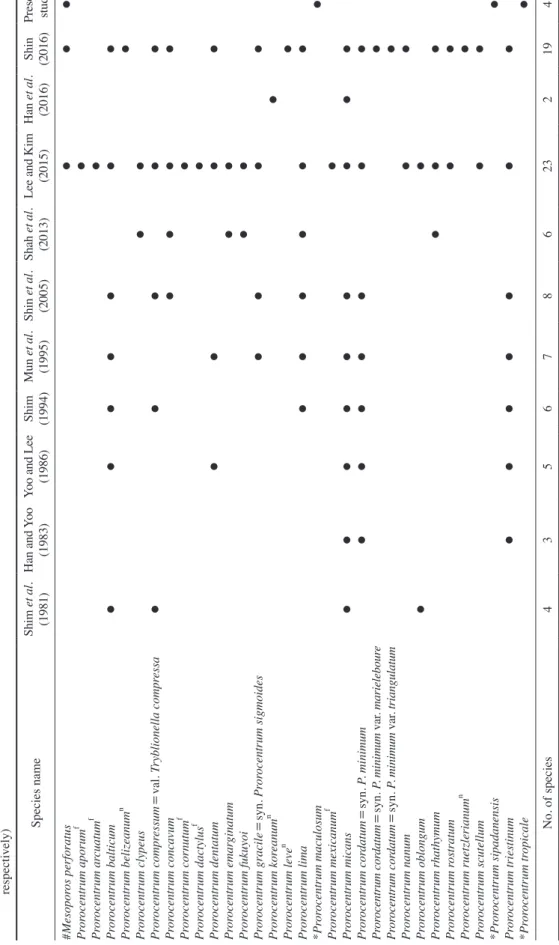
2014). To date, Prorocentrum genus includes 31 species and Mesoporos genus has only one species in Korean waters (Table 1), since Shim et al.(1981) described four species from the southern coast of Korea for the first time, followed with five species reported by Yoo and Lee(1986) and six species reported by Shim(1994), respectively. Recently, Shin(2016) described 19 Prorocentrum species, and Han et al.(2016) found a new Prorocentrum species from coastal waters of Korea, respectively. Some benthic Prorocentrum species were reported by Shah et al.(2013). Lee and Kim (2015) listed one species of Mesoporos genus and 22 spe- cies of Prorocentrum genus from Korean waters(Table 1).
In this study, we identified one Mesoporos species and three Prorocentrum species around coast of Jeju Island, and de- scribed as newly recorded species in Korean waters.
MATERIALS AND METHODS
Samplings were conducted at coastal stations around Jeju
* Corresponding author: Young Sik Kim, Tel. 064-754-3435, Fax. 064-725-2461, E-mail. [email protected]
ⓒ2017. Korean Society of Environmental Biology.
New Records of Two Genera Mesoporos and Prorocentrum (Prorocentraceae, Prorocentrales, Dinophyceae) in Korean Waters
Joon-Baek Lee* and Gyu-Beom Kim
Department of Earth and Marine Sciences, College of Ocean Sciences, Jeju National University, Jeju 63243, Republic of Korea
Abstract - The order Prorocentales currently includes two genera Prorocentrum Ehrenberg and Mesoporos Lillick. The Prorocentrum genus is a predominant group throughout the year found in Korean waters. To date, the Prorocentrum genus includes 31 species and the Mesoporos genus has only one species in Korean waters. In this study, we identified one Mesoporos species and three Prorocentrum species around a coast of Jeju Island, and described them as newly recorded species in Korean waters.
Key words : dinoflagellates, Jeju Island, Mesoporos, Prorocentraceae, Prorocentrum
<Original article>
Table 1. Checklist of family Prorocentraceae in Korean waters(newly recorded and re-described species are marked with asterisks(*) and sharps(#) in this study, respectively, and ‘n’ indicates a species newly recorded in Korean waters by other researchers, ‘f’ a species recorded only in floristic lists(Lee and Kim 2015), ‘val’ a valid name and ‘syn’ a synonym, respectively) Species nameShim et al. (1981)Han and Yoo (1983)Yoo and Lee (1986)Shim (1994)Mun et al. (1995)Shin et al. (2005)Shah et al. (2013)Lee and Kim (2015)Han et al. (2016)Shin (2016) Present study
#Mesoporos perforatus●●● Prorocentrum aporumf ● Prorocentrum arcuatumf ● Prorocentrum balticum●●●●●●● Prorocentrum belizeanumn ● Prorocentrum clypeus●● Prorocentrum compressum=val. Tryblionella compressa●●●●● Prorocentrum concavum●●●● Prorocentrum cornutumf ● Prorocentrum dactylusf ● Prorocentrum dentatum●●●● Prorocentrum emarginatum●● Prorocentrum fukuyoi●● Prorocentrum gracile=syn. Prorocentrum sigmoides●●●● Prorocentrum koreanumn ● Prorocentrum leven ● Prorocentrum lima●●●●●● *Prorocentrum maculosum● Prorocentrum mexicanumf ● Prorocentrum micans●●●●●●●●● Prorocentrum cordatum=syn. P. minimum●●●●●●● Prorocentrum cordatum=syn. P. minimum var. marieleboure● Prorocentrum cordatum=syn. P. minimum var. triangulatum● Prorocentrum nanum●● Prorocentrum oblongum●● Prorocentrum rhathymum●●● Prorocentrum rostratum●● Prorocentrum ruetzlerianumn ● Prorocentrum scutellum●● *Prorocentrum sipadanensis● Prorocentrum triestinum●●●●●●● *Prorocentrum tropicale● No. of species4356786232194
Island and East China Sea from 2006-2016, as the station’s informations are mentioned in Shah et al.(2013) and Lee et al.(2014). Plankton samples were obtained by using a 20- μm-mesh plankton net and fixed with formaldehyde(final concentration of approximately 1%) or glutaraldehyde(final concentration of approximately 1%). Planktonic dinofla- gellates were identified by using light microscope(LM) (Axioplan; Carl Zeiss, Oberkochen, Germany). To make slide specimens for one species, dinoflagellate samples were washed with distilled water, and the method described in Kim et al.(2013) was followed. To allow for more de- tailed observations, dinoflagellate cells were isolated with a micropipette, placed on a cover slip, air-dried and coated with gold for observation under a field emission scanning electron microscope(JSM-6700F; JEOL, Tokyo, Japan).
For species identification, several monographs were used, that were reported from different oceans, such as the Indian Ocean(Taylor 1976), Japan’s adjacent sea(Yamaji 1984), the British and Atlantic Ocean(Dodge 1982), the Kuroshio Current(Fujioka 1990), Korean waters(Shim 1994), and Gulf of Mexico(Okolodkov 2014) with some critical crite- ria(Hoppenrath et al. 2013; Table 2). A dinoflagellate clas- sification of the new combination with the family Prorocen- traceae was cited from AlgaeBase(http://www.algaebase.
org)(Guiry and Guiry 2017).
RESULTS AND DISCUSSION
A total of four species of two genera(Mesoporos, Pro- rocentrum) of the family Prorocentraceae from the coast of Jeju Island were identified and classified below. Among them, three species were described as newly recorded species in Korean waters in this study, and one species as a re-described species. Newly recorded and re-described species were marked with asterisks(*) and sharps(#), re- spectively. ‘C’ indicates a currently accepted name, ‘S’ a synonym, ‘P’ a preliminary AlgaeBase entry based on the species database of AlgaeBase(Guiry and Guiry 2017), re- spectively.
Systematics of the family Prorocentraceae from Korean waters
Class Dinophyceae Fritsch
Order Prorocentrales Lemmermann Family Prorocentraceae Stein
Genus Mesoporos Lillick Table 2. Comparison of morphological features of species described in this study(Cited by Hoppenrath 2013)
Key of species M. perforatus P. maculosum P. sipadanensis P. tropicale
Cell shape Oval, round or
Chordate in valve view Oval to ovoid Round to oval Broad oval to ovoid Cell size
Length(μm) 14-27 40-50 18-19 50-55
Width(μm) 18-21 30-40 15-16 40-45
Periflagellar area
Shape Narrow U-shaped Wide V-shaped Wide V-shaped Wide V-shaped
Collar on left plate No No Yes Yes
Thick flange No Both No Yes
Wing-shaped spine Yes No No No
Protrusions Yes No No No
Platelet list(s) No Yes Yes No
No. of platelets Unknown 8 8 8 or 9
Flagellar pore Unknown Yes Yes Yes
Theca ornamentation Foveate Foveate Foveate Foveate/Reticulate-foveate
Pore pattern No, Row around No, scattered Yes No
Marginal pores Yes Yes Yes No
Central pores Yes Devoid Devoid No
Pore size
(Large >0.1μm or small ≤0.1μm) Both Both Small Large
Intercalary band Smooth(Vertical Str.) Smooth Smooth(Horiz. Str.) Granulated
Nucleus Posterior Oval Unknown Posterior(No in LM)
#Mesoporos perforatus(Gran) Lillick C Genus Prorocentrum Ehrenberg
Prorocentrum aporum(Schiller) Dodge C Prorocentrum arcuatum Issel
Prorocentrum balticum(Lohmann) Loeblich C Prorocentrum belizeanum Faust C
Prorocentrum clipeus Hoppenrath C Prorocentrum compressum(Bailey) Abé ex Dodge S
=Tryblionella compressa(Bailey) Poulin C Prorocentrum concavum Fukuyo C
Prorocentrum cornutum Schiller C Prorocentrum dactylus(Stein) Dodge C Prorocentrum dentatum Stein C Prorocentrum emarginatum Fukuyo C Prorocentrum fukuyoi Murray et Nagahama C Prorocentrum gracile Schütt C
=Prorocentrum sigmoides Böhm S
Prorocentrum koreanum Han, Cho et Wang C Prorocentrum leve Faust, Kibler, Vandersea, Tester et Litaker C
Prorocentrum lima(Ehrenberg) Stein C
*Prorocentrum maculosum Faust C Prorocentrum mexicanum Osorio-Tafall C Prorocentrum micans Ehrenberg C
Prorocentrum cordatum(Ostenfeld) Dodge C
=Prorocentrum minimum(Pavillard) Schiller S
= Prorocentrum minimum var. marieleboure(Park et Ballantine) Hulburt S
= Prorocentrum minimum var. triangulatum(Mar- tin) Hulburt S
Prorocentrum nanum Schiller C
Prorocentrum oblongum(Schiller) Abé P
Prorocentrum rhathymum Loeblich III, Sherley et Schmidt C
Prorocentrum rostratum Stein C Prorocentrum ruetzlerianum Faust C Prorocentrum scutellum Schröder C
*Prorocentrum sipadanensis Mohammad-Noor, Daugbjerg et Moestrup C
Prorocentrum triestinum Schiller C
*Prorocentrum tropicale Faust C Taxonomic description of unrecorded species.
Genus Mesoporos Lillick 1937
Lectotype species: Mesoporos globulus(Schiller) Lillick 1937.
Description: Cell is round, oval or heart-shaped. It is in the form of a locked valves due to the edge. A flagellar area is V-shaped at the anterior of the cell. Each wall plate has a conical dented situation in the center, inconspicuous in dorsi-ventral view but very clear in lateral view. This is the characteristic key of Mesoporos from Prorocentrum. It has two flagella at the anterior end of the cell for moving for- ward with a spiraling motion. Chloroplasts of various types, with yellow-brown color.
Mesoporos perforatus(Gran)Lillick 1937(Fig.1a) Basionym: Exuviaella perforate Gran.
Synonym: Homotypic synonym: Exuviaella perforate Gran, Porella perforate(Gran) Schiller, Porotheca per- forate(Gran) Silva, Dinoporella perforate(Gran) Halim.
Heterotypic synonym: Exuviaella bisimpressa Schiller, Porella adriatica Schiller, Porella globulus Schiller, Porel- la asymmetrica Schiller, Mesoporos globulus(Schiller) Lillick, Mesoporos adriaticus(Schiller) Lillick, Mesoporos asymmetricus(Schiller) Lillick, Mesoporos bisimpressus (Schiller) Lillick, Dinoporella globulus(Schiller) Silva, Porotheca globulus(Schiller) Silva, Porotheca bisimpressa (Schiller) Silva, Porotheca asymmetrica(Schiller) Silva, Porotheca adriatica(Schiller) Silva.
References: Dodge 1982, p. 29, Figs. 2a, b; Shin 2016, p.
87; Omura et al. 2012, p. 55.
Specimen examined: Serial No. LJB2015019/NIBR No.
NIBRDN0000000012.
Description: Cells are oval or round shape in dorso-ventral view. In each plate row of small pore is arrange around the center pore. There are two chloroplasts and they are located under each plate, sometimes contours are visible. The nu- cleus is present at the posterior part of the cell.
Size: 14-27μm long, 18-21μm wide.
Sampling: 25 Mar 2015. Sehwa coast in Jeju Island(33°
31′29.8″N, 126°51′40.5″E).
Habitat: Marine and planktonic species.
Distribution: Australia and New Zealand: New Zealand (Chang et al. 2012); Asia: China(Liu 2008); Atlantic Is- lands: Canary Islands(Gil-Rodriguez et al. 2003; Afonso- Carrillo 2014), Europe: Adriatic Sea(Dodge 1982), Bal-
tic Sea(Hällfors 2004), Black Sea(Gómez and Boicenco 2004), Britain(Parke and Dixon 1976; Dodge 1982), Croa- tia(Vilicic et al. 2009), Helgoland(Hoppenrath 2004), Med- iterranean(Gómez 2003), Norway(Dodge 1982); Polar:
Antarctic/Sub Antarctic Islands(McMinn and Scott 2005).
Note: This species was reported as unrecorded indigenous species by NIBR in 2015(Lee and Kim 2015), described by Shin(2016), and re-described in the present study.
Genus Prorocentrum Ehrenberg 1834
Holotype species: Prorocentrum micans Ehrenberg.
Description: Cell size ranges from small to medium(15- 100μm). The shape of the cells is round, lanceolate or oval and flattened to the dorso-ventral side. Thecal plates are composed of two smooth valve-shaped plates with pores or spines on the surface. It consists of two flagella on apical of the cell and this flagella region has 7-14 small plates. All species have 1-2 chloroplasts on cell plates. This species is distributed globally and only two species were found in
freshwater in Australia and the rest were marine species.
The heterogeneous habitat of this species is diverse, plank- tonic, epiphytic, benthic, and some species live in sand.
Sometimes this species blooms enough to change the color of the sea. Some species produce harmful toxic substances such as P. lima and related species have a ciguatera and okadaic acid, some populations of P. minimum also cause shellfish poisoning.
Prorocentrum maculosum Faust 1993(Fig.1b,c) Synonym: Homotypic synonym: Exuviaella maculosum (Faust) McLachlan, Boalch et Jahn.
References: Faust 1993, p. 410, figs. 1-6; Omura et al.
2012, p. 57; Hoppenrath et al. 2014, p. 136, Fig. 62.
Specimen examined: Serial No. LJB2015020/No NIBR No. LM photo only.
Description: The cell is round or oval. Thecal surface con- sists of scattered large pores and a marginal row of large pores except for the center of the plate. The flagellar area is Fig. 1. Light micrographs of the genus Mesoporos and Prorocentrum. (a) Mesoporos perforates, right lateral view, (b) Prorocentrum macu-
losum, right lateral view, (c) Prorocentrum maculosum, left lateral view, (d) Prorocentrum sipadanensis, right lateral view, (e) Pro- rocentrum sipadanensis, left lateral view, (f) Prorocentrum tropicale, right lateral view, (g) Prorocentrum tropicale, left lateral view.
Scale bars, 10μm.
a b c
d e f g
wide V-shaped, with collar and lists. It has eight plates. A round nucleus is posterior of the cell.
Size: 40-50μm long, 30-40μm wide.
Sampling: 25 Mar 2015. Tap-dong coast in Jeju Island(33°
32′18″N, 126°41′2″E).
Habitat: Marine and benthic species, found in the sand and subtropical area.
Distribution: Central America: Twin Cays, Belize(Faust 1993), Panama(Chomérat et al. 2011); Europe: Salt Island, British Virgin Islands(Zhou and Fritz 1993); North Ameri- ca: Caribbean, Maxico(Almazán-Becerril et al. 2015).
Note: This species was reported as unrecorded indigenous species by NIBR in 2015 and reported as newly recorded species in Korea waters in the present study.
Prorocentrum sipadanensis Mohammad-Noor, Daugbjerg et Moestrup 2007(Fig.1d,e) Synonym: No synonym.
References: Mohammad-Noor et al. 2007, p. 655, figs.
12a-e, 23a, b; Hoppenrath et al. 2014, p. 137, Fig. 63.
Specimen examined: Serial No. LJB2016014/No NIBR No. LM photo only.
Description: The cell is small and has a round oval shape.
The surface has pores that are widely distributed at irregular intervals. There are no pores in the center of the plate and several pores are spread widely around it. The flagellar area is wide and V-shaped, consisting of eight plates, with lists.
Size: 18-19μm long, 15-16μm wide.
Sampling: 11 Aug 2015. Hallim beach in Jeju Island (33°23′39″N, 126°14′23″E).
Habitat: Marine and benthic species.
Distribution: Asia: Sipadan Island, Malaysia(Mohammad- Noor et al. 2007).
Note: This species was reported as unrecorded indigenous species by NIBR in 2016 and reported as newly recorded species in Korea waters in the present study.
Prorocentrum tropicale Faust 1997(Fig.1f,g) Synonym: No synonym.
References: Faust 1997, p. 854, figs. 7-12, 16(as Proro- centrum tropicalis); Hoppenrath et al. 2014, p. 137, Fig. 63.
Specimen examined: Serial No. LJB2015021/No NIBR No. LM photo only.
Description: The cells are wide oval or ovoid. The thecal
surface is foveated like pits. The distribution pattern of pores is like Prorocentrum concavum. The flagellar area is broad, V-shaped, have a collar and eight or nine plates.
Size: 50-55μm long, 40-45μm wide.
Sampling: 19 Jan 2015. Sagae beach in Jeju Island(33°13′
52.3″N, 126°18′37.8″E).
Habitat: Marine species and attached to tropical coral rub- ble.
Distribution: Central America: Lagoon at Carrie Bow Cay, Belize(Faust 1997).
Note: This species was reported as unrecorded indigenous species by NIBR in 2015 and reported as newly recorded species in Korea waters in the present study.
ACKNOWLEDGEMENT
This work was supported by a grant from the National Institute of Biological Resources(NIBR), funded by the Ministry of Environment(MOE) of the Republic of Korea (NIBR201701204), and by Jeju Sea Grant Center, funded by the Ministry of Ocean and Fisheries(MOF) of the Re- public of Korea.
REFERENCES
Afonso-Carrillo J. 2014. Lista Actualizada de Las Algas Ma- rinas de Las Islas Canarias. Elaborada para la Sociedad Española de Ficologia(SEF), Las Palmas.
Almazán-Becerril A, S Escobar-Morales, G Rosiles-González and F Valadez. 2015. Benthic-epiphytic dinoflagellates from northern portion of the Mesoamerican reef system.
Bot. Marina 58:115-128.
Chang FH, WAG Charleston, PB Mckenna, CD Clowes, GJ Wilson and PA Boady. 2012. Phylum Myzozoa: Dinofla- gellates, Perkinsids, Ellobiopsids, Sporozoans. pp. 175- 216. In New Zealand Inventory of Biodiversity. Volume Three, Kingdoms Bacteria, Protozoa, Chromista, Plantae, Fungi(Gordon DP ed.). Canterbury University Press, Christchurch.
Chomérat N, F Zentz, S Boulben, G Bilien, A van Wormhoudt and E Nézan. 2011. Prorocentrum glenanicum sp. nov. and Prorocentrum pseudopanamense sp. nov.(Prorocentrales, Dinophyceae), two new benthic dinoflagellate species from south Brittany(northwestern France). Phycologia 50:202-
214.
Dodge JD. 1975. The Prorocentrales(Dinophyceae). II. Revi- sion of the taxonomy within the genus Prorocentrum. Bot. J.
Linn. Soc. 71:103-125.
Dodge JD. 1982. Marine Dinoflagellates of the British Isles.
Her majesty’s Stationary Office, London.
Faust MA. 1993. Three new benthic species of Prorocentrum (Dinophyceae) from Twin Cays, Belize: P. maculosum sp.
nov., P. foraminosum sp. nov. and P. formosum sp. nov.
Phycologia 32:410-418.
Faust MA. 1997. Three new benthic species of Prorocentrum (Dinophyceae) from Belize: P. norrisianum sp. nov., P.
tropicalis sp. nov., and P. reticulatum sp. nov. J. Phycol.
33:851-858.
Fujioka S. 1990. Illustrations of the Plankton of the Kuroshio Waters: Plankton in Amami-oshima Island Coastal Waters.
Nagasaki Publication Culture Association, Nagasaki(in Japanese).
Gil-Rodriguez MC, R Haroun, AO Rodriguez, EB Zugasti, PD Santana and BH Morán. 2003. Protoctista. pp. 5-30. In Lista de Especies Marinas de Canarias(Algas, Hongos, Plantas Y Animales)(Moro L et al. eds.). Consejeria de Politica Territorial y Medio Ambiente del Gobierno de Canarias, Las Palmas.
Goméz F. 2003. Checklist of Mediterranean free-living dinofla- gellates. Bot. Marina 46:215-242.
Goméz F and L Boicenco. 2004. An annotated checklist of dino- flagellates in the Black Sea. Hydrobiologica 517:43-59.
Guiry MD and GM Guiry. 2017. AlgaeBase. World-wide elec- tronic publication, National University of Ireland, Galway.
http://www.algaebase.org; searched on 20 August 2017.
Hällfors G. 2004. Checklist of Baltic Sea phytoplankton spe- cies(including some heterotrophic protistan groups). Baltic Sea Environment Proceedings 95:1-208.
Han MS and KI Yoo. 1983. A taxonomical study on the dino- flagellates in Jinhae Bay 1. Armored and unarmored dino- flagellates. Bull. KORDI 5:37-47(in Korean).
Han MS, PB Wang, HK Kim, SY Cho, BS Park, JH Kim, T Katano and BH Kim. 2016. Morphological and molecular phylogenetic position of Prorocentrum micans sensu stricto and description of Prorocentrum koreanum sp. nov. from southern coastal waters in Korea and Japan. Protist 167:32- Hoppenrath M. 2004. A revised checklist of planktonic diatoms 50.
and dinoflagellates from Helgoland(North Sea, German Bight). Helgol. Mar. Res. 58:243-251.
Hoppenrath M, M Elbrachter and G Drebes. 2009. Marine Phy- toplankton: Selected Microphytoplankton Species from the North Sea around Helgoland and Sylt. Kleine Serckenerg-
Reihe 49, E. Schweizerbart Science Publishers, Stuttgart.
Hoppenrath M, N Chomérat, T Horiguchi, M Schweikert, Y Nagahama and S Murray. 2013. Taxonomy and phylogeny of the benthic Prorocentrum species(Dinophyceae)-a pro- posal and review. Harmful Algae 27:1-28.
Hoppenrath M, SA Murray, N Chomérat and T Horiguchi. 2014.
Marine Benthic Dinoflagellates-Unravelling Their World- wide Biodiversity. Kleine Senckenberg-Reihe Vol. 54.
Kim HS, SH Kim, MM Jung and JB Lee. 2013. New records of dinoflagellates around Jeju Island. J. Ecol. Environ. 36:
273-291.
Lee JB and HS Kim. 2015. National List of Species of Korea- Flagellates. National Institute of Biological Resources, Ministry of Environment, Korea.
Lee JB, SJ An, HS Chung and MMR Shah. 2014. New records of genus Tripos(Dinophyceae) around Jeju Island, Korea. J.
Ecol. Environ. 37:271-284.
Liu R ed. 2008. Checklist of Biota of Chinese Seas. Science Press, Academia Sinica, Beijing.
McMinn A and FJ Scott. 2005. Dinoflagellates. pp. 202-250. In Antarctic Marine Protists(Scott FJ and HJ Marchant eds.).
Australian Biological Resources Study; Australian Antarc- tic Division, Canberra and Hobart.
Mohammad-Noor N, N Daugbjerg, Ø Moestrup and A Anton.
2007. Marine epibenthic dinoflagellates from Malaysia-a study of live cultures and preserved samples based on light and scanning microscopy. Nord. J. Bot. 24:629-690.
Moon JH, N Hirose, JH Yoon and IC Pang. 2010. Offshore detachment process of the low-salinity water around Changjiang Bank in the East China Sea. J. Phys. Oceanogr.
40:1035-1053.
Mun SG, SG Lee and CG Hong. 1995. A study of the genus Prorocentrum. J. Kor. Environ. Sci. Soc. 4:105-116(in Korean).
Okolodkov YB. 2014. Dinophysiales(Dinophyceae) of the National Park Sistema Arrecifal Veracruzano, Gulf of Mex- ico, with a key for identification. Act. Bot. Mex. 106:9-71.
Omura T, M Iwataki, VM Borja, H Takayama and Y Fukuyo.
2012. Marine Phytoplankton of the Western Pacific. Kou- seisha Kouseikaku, Tokyo.
Parke M and PS Dixon. 1976. Checklist of British marine algae-third revision. J. Mar. Biol. Assoc. UK 56: 527-594.
Shah MMR, SJ An and JB Lee. 2013. Presence of dinoflagel- lates around coastal waters of Jeju Island including newly recorded species. J. Ecol. Environ. 36:347-371.
Shim JH. 1994. Illustrated Encyclopedia of Fauna and Flora of Korea Vol. 34 Marine Phytoplankton. Ministry of Educa- tion, Korea(in Korean).
Shim JH, EY Shin and JK Choi. 1981. A taxonomical study on
the dinoflagellates of the coastal waters in the vicinity of Yeosu, Korea. J. Oceanol. Soc. Kor. 16:57-98(in Korean).
Shin EY. 2016. Dinoflagellates. pp. 71-526. In Protists of Ko- rea vol. 1(Choi JG ed.). The Korean Society of Protistolo- gists, Korea(in Korean).
Shin EY, HG Yeo and JG Park. 2005. Morphological re-exam- ination of Prorocentrum spp. in Korean coastal waters.
Korean J. Environ. Biol. 23:184-190.
Taylor FJR. 1976. Dinoflagellates from the International Indian Ocean Expedition. Bibl. Bot. 132:1-243.
Vilicic D, T Djakovac, Z Buric and S Bosak. 2009. Composi- tion and annual cycle of phytoplankton assemblages in the Adriatic Sea. Bot. Marina 52:291-305.
Yamaji I. 1984. Illustrations of the Marine Plankton of Japan.
3rd ed. Hoikusha Publishing Co. Ltd., Osaka(in Japanese).
Yeh SW and CH Kim. 2010. Recent warming in the Yellow/
East China Sea during winter and the associated atmo- spheric circulation. Cont. Shelf. Res. 30:1428-1434.
Yoo KI and JB Lee. 1986. Taxonomical studies on dinoflagel- lates in Masan Bay 1. Genus Prorocentrum Ehrenberg. J.
Oceanol. Soc. Kor. 21:46-55
Zhou J and L Fritz. 1993. Ultrastructure of two toxic marine dinoflagellates, Prorocentrum lima and Prorocentrum mac- ulosum. Phycologia 32:444-450.
Received: 24 August 2017 Revised: 8 September 2017 Revision accepted: 8 September 2017