carps, and reproductive structures limited to distal portions of the thallus(Mikami 1965). According to Matsumoto and Shimada(2013), C. retortus is very similar to Chondrus verrucosus in morphology. In the present study, a species
similar to Chondrus verrucosus and C. retortus was collected
from the southern coast of Korea, and is newly recorded in Korean marine algal flora based on morphological and mo-lecular analysis.
MATERIALS AND METHODS
Specimens for this study were collected from Honghy-eon-ri, Namhae located in the southern coast of Korea. Morphological data were obtained from fresh, liquid-pre-served and herbarium specimens. Liquid-preliquid-pre-served ma-terial was stored in a 10% solution of Formalin/seawater. Blades dissected from the cleared materials were hand sectioned, transferred to a slide with distilled water, and mounted in pure glycerin. Measurements are given as
https://doi.org/10.11626/KJEB.2020.38.3.481
INTRODUCTION
The red algal genus Chondrus(Gigartinales, Gigartinace-ae) was typified with Chondrus crispus Stackhouse, which
is distributed across the North Atlantic coast(Brodie et al. 1991; Hommersand et al. 1993, 1994). This genus is
primarily characterized by lacking an envelope separating carposporangia from gametophytic tissues(Mikami 1965; Hommersand et al. 1993), and currently includes 17
spe-cies worldwide(Hommersand et al. 1993; Brodie et al.
1997; Guiry and Guiry 2020). These species are mainly distinguished by thallus shape and position of reproductive structures(Taylor and Chen 1994; Matsumoto and Shima-da 2013).
Of these, Chondrus verrucosus Mikami(1965) was ori-ginally described from Inubosaki, Chiba Prefecture, Japan, based on Chondrus ocellatus Holmes f. canaliculatus
Okamu-ra(1932) with linear to cuneate, canaliculated fronds. This species seems to be delimited from other Chondrus
species by strongly canaliculated fronds, verruciform
cysto-Original article
New record of Chondrus retortus
(Gigartinales, Rhodophyta) in Korea
Pil Joon Kang, Jae Woo An and Ki Wan Nam*
Department of Marine Biology, Pukyong National University, Busan 48513, Republic of Korea
Korean J. Environ. Biol. 38(3) : 481-485(2020) ISSN 1226-9999(print) ISSN 2287-7851(online) * Corresponding author Ki Wan Nam Tel. 051-629-5922 E-mail. [email protected] Received: 18 August 2020 Revised: 22 September 2020
Revision accepted: 22 September 2020
Abstract: A marine red algal species was collected from Honghyeon-ri, Namhae
located on the southern coast of Korea during a survey of marine algal flora. This alga shares the generic features of Chondrus, and is characterized by short and thin, canaliculated and crisped fronds as C. retortus. Tetrasporangia are developed from shallow medullary cells on both sides of branches. In a phylogenetic tree based on
rbcL sequences, the Korean alga nests in the same clade as C. retortus originally
described from Japan. The genetic distance between both sequences within the clade was calculated as 0.0-0.1%. Based on the morphological and molecular data, the alga is identified as Chondrus retortus. This is the first record of C. retortus in Korean marine algal flora.
width and length. For permanent slides, the glycerin was exchanged with 10-20% corn syrup.
Total genomic DNA was extracted from silica-gel-pre-served sample using the DNeasy Plant Mini Kit(Qiagen, Hilden, Germany) according to the manufacturer’s
pro-tocol. Before extraction, dried material was crushed with liquid nitrogen using a mortar and pestle. Extracted DNA was used for amplification of ribulose-1, 5-bisphosphate carboxylase large subunit(rbcL) regions. For rbcL, the gene
was amplified in three overlapping parts with the primer
Fig. 1. Chondrus retortus. A. Tetrasporangial plant. B. Details of branches with tetrasporangial sori scattered on both sides. C. Cortical cell
layers. D. Medullary cells. E. Mature tetrasporangial sorus bulging from one side of branch. F. Mature tetrasporangia developed from swal-low medullary cells.
A B
C D
pairs FrbcL start (5ʹ-TGTGTTGTCGACATGTCTA-ACTCTGTAGAAG-3ʹ) - R753 (5ʹ-GCTCTTTCATA-CATATCTTCC-3ʹ), F492
(5ʹ-CGTATGGATAAATTTG-GTCG-3ʹ) - R1150
(5ʹ-GCATTTGTCCGCAGT-GAATACC-3ʹ), and F993 (5ʹ-GGTACTGTTGTAGG-TAAATTAGAAGG-3ʹ) - RrbcS (5ʹ-TGTGTTGCGGC-CGCCCTTGTGTT AGTCTCAC-3ʹ)(Freshwater and Rueness 1994). PCR amplifications were performed in a TaKaRa PCR Thermal Cycler Dice(TaKaRa Bio Inc., Otsu, Japan). PCR was performed with an initial dena-turation step at 94°C for 4 min, followed by 35 cycles of 1 min at 94°C, 1 min at 50°C, and 2 min at 72°C, with a final 7-min extension at 72°C. The PCR products were moved to Macrogen Sequencing Service for sequencing (Macrogen, Seoul, Korea). Sequences for the rbcL region
were aligned using BioEdit(Hall 1999). Phylogenetic analyses were performed using neighbor joining and max-imum-likelihood methods. Bootstrap values were calculat-ed with 1,000 replications. RbcL sequences of other species
were obtained from GenBank. Gelidium corneum(Hudson) J.V. Lamouroux was used as an outgroup.
RESULTS AND DISCUSSION
Chondrus retortus K. Matsumoto & S. Shimada 2013 Korean name: Ae-gi-jin-du-bal-sa-chon nom. nov. (신칭: 애기진두발사촌)
Type locality. Enoshima, Kanagawa Prefecture, Japan. Specimens examined: NIBRRD0000004364-NIBRRD 0000004366(Honghyeon-ri, Namhae: 25.x.2018). Habitat: Epilithic near upper to lower intertidal.
Morphology: Thalli up to 5-10cm high, compressed, thin, somewhat canaliculated, crispy, yellowish to dark brown in color, cartilaginous in texture, attached to substrate by small discoid holdfast; main axes issuing numerous branch-es and proliferations on margin and surface; proliferations lanceolate, pinnately arranged, more or less constricted at base, 5-10mm in length, 1-2mm in width; cortex 5-8 cell layer thick, with 2-3 cell layer thick in outer cortex; inner cortical cells ellipsoid to round in shape; medullary cells densely arranged; tetrasporangial sori round to polygonal, scattered on both sides of branches; tetrasporangia round to ellipsoidal, developed from shallow medullary cells, 10-30 μm in diam., divided tetrahedrally. Sexual plants were
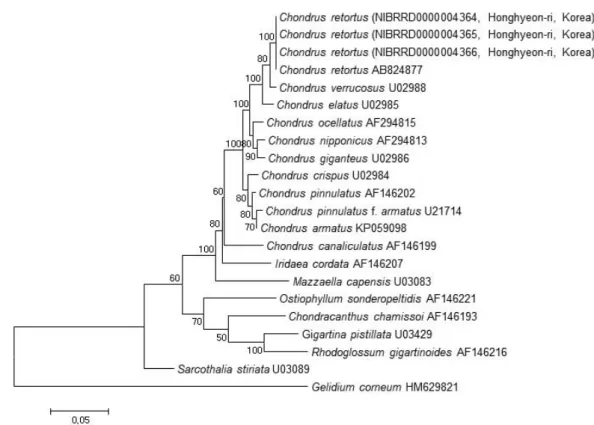
Fig. 2. Phylogenetic tree of Chondrus species obtained from maximum-likelihood method based on rbcL sequences. Bootstrap proportion
not collected during the present study.
According to the original description(Matsumoto and Shimada 2013), C. retortus appears to be characterized by
short, canaliculated and crisped fronds, carposporangia developing among roundish medullary and tetrasporangial development from shallow medullary. The vegetative and tetrasporangial features are found in the Korean alga col-lected from Namhae(Fig. 1).
Chondrus retortus is readily distinguished from the
simi-lar species, C. verrucosus, by the cell shape of the medullary
layer around young carposporangia(Matsumoto and Shi-mada 2013). In the former, the cells are roundish, while the latter has a linear form(Matsumoto and Shimada 2013). In addition, both species are also distinguishable from each other in some vegetative features including thallus size in the mature stage. C. retortus has thinner, somewhat
canalic-ulate and relatively small mature fronds rather than thicker, comparatively regularly canaliculate and typical large ma-ture fronds(Matsumoto and Shimada 2013).
The position of tetrasporangial sori is an important diag-nostic feature among the Gigartinaceae, though it is para-phyletic with respect to some genera(Mikami 1965; Kim 1976; Hommersand et al. 1999; Matsumoto and Shimada
2013). In Chondrus, the type species C. crispus has
tetra-sporangial sori filling the whole medulla, whereas in some species such as C. elatus, C. ocellatus, C. verrucosus and C. yendoi, they are developed from shallow medullary cells
(Mikami 1965; Brodie et al. 1991; Fredericq et al. 1992;
Matsumoto and Shimada 2013). Chondrus retortus also
shows the same developmental features of tetrasporangial sori as C. verrucosus and C. elatus of the sister clade.
Although female plants were not collected during the present study, our Korean specimens can be identified as C. retortus based on the vegetative features. Their identity is
supported by molecular data.
In general, the value of interspecific divergence in the Gigartinales varies from 2.8 to 16.5%(Hommersand et al.
1994; Kato et al. 2009). In the phylogenetic tree based on rbcL sequence, the Korean alga nests in the same clade as Chondrus retortus with a genetic distance of 0.0-0.1%(Fig. 2). Based on these morphological and molecular data, this species is identified as Chondrus retortus. This is the first
record of C. retortus in Korean marine algal flora.
ACKNOWLEDGEMENTS
This work was supported by a grant from the National
Institute of Biological Resources(NIBR) funded by the Ministry of Environment(MOE) of the Republic of Ko-rea(NIBR202002117), and by the Marine Biotechnolo-gy Program of the Korea Institute of Marine Science and Technology Promotion(KIMST) funded by the Ministry of Oceans and Fisheries(MOF)(No. 20170431).
REFERENCES
Brodie J, MD Guiry and M Masuda. 1991. Life history and mor-phology of Chondrus nipponicus(Gigartinales, Rhodophyta) from Japan. Br. Phycol. J. 26:33-50.
Brodie J, M Masuda, I Mine and MD Guiry. 1997. Two morpho-logically similar biological species: Chondrus pinnulatus and C.
armatus(Gigartinaceae, Rhodophyta). J. Phycol. 33:682-698.
Fredericq S, J Brodie and MH Hommersand. 1992. Developmen-tal morphology of Chondrus crispus(Gigartinaceae, Rhodo-phyta). Phycologia 31: 542-563.
Freshwater DW and J Rueness. 1994. Phylogenetic relationships of some European Gelidium(Gelidiales, Rhodophyta) species based upon rbcL nucleotide sequence analysis. Phycologia 33:187-194.
Guiry MD and GM Guiry. 2020. AlgaeBase. World-wide electron-ic publelectron-ication, National University of Ireland, Galway. http:// www.algaebase.org. Accessed 13 August 2020.
Hall TA. 1999. BioEdit: a user-friendly biological sequence align-ment editor and analysis program for Windows 95/98/NT. Nucl. Acids Symp. Ser. 41:95-98.
Hommersand MH, MD Guiry, S Fredericq and GL Leister. 1993. New perspectives in the taxonomy of the Gigartinaceae (Gigartinales, Rhodophyta). Hydrobiologia 260/261:105-120. Hommersand MH, S Fredericq and DW Freshwater. 1994.
Phylo-genetic systematics and biogeography of the Gigartinaceae (Gigartinales, Rhodophyta) based on sequence analysis of
rbcL. Bot. Mar. 37:193-203.
Hommersand MH, S Fredericq, DW Freshwater and J Hughey. 1999. Recent developments in the systematics of the Gigar-tinaceae(Gigartinales, Rhodophyta) based on rbcL sequence analysis and morphological evidence. Phycol. Res. 47:139-151.
Kim DH. 1976. A study of the development of cystocarps and tetrasporangial sori in Gigartinaceae(Rhodophyta, Gigartina-les). Nova Hedwigia 27:1-146
Kato A, SMPB Guimarães, H Kawai and M Masuda. 2009. Char-acterization of the crustose red alga Peyssonnelia japonica (Rhodophyta, Gigartinales) and its taxonomic relationship with Peyssonnelia boudouresquei based on morphological and molecular data. Phycol. Res. 57:74-86.
Matsumoto K and S Shimada. 2013. Taxonomic reassessment of
Chondrus verrucosus(Rhodophyta, Gigartinales), with a
de-scription of Chondrus retortus sp. nov. Phycol. Res. 61:299-309.
Mikami H. 1965. A systematic study of the Phyllophoraceae and Gigartinaceae from Japan and its vicinity. Sci. Papers Inst.
Algol. Res. Fac. Sci., Hokkaido Univ. 5:181-285.
Okamura K. 1932. Icones of Japanese Algae, Vol. 6. Published by the author, Tokyo.
Taylor ARA and LCM Chen. 1994. Chondrus Stackhouse. pp. 35-76. In: Biology of Economic Algae(Akatsuka I, ed.). SPB Academic Publishing, The Hague, Netherlands.