Introduction
The dragonet fishes of the family Callionymi- dae are a group of benthic marine fishes, mostly living in warm and temperate sea. This family was recorded 19 genera 190 species in the world (Nakabo, 1982; Fricke, 1983), among them 5 genera and 15 species were recorded from Korea (Lee and Kim, 1993; Lee et al., 1995). In Cheju- do of Korea has revealed additional specimens of the dragonet fishes. In this paper we described them as the first record in Korea and provided the keys to species and genera of the Callionymi- dae from Korea.
Materials and Methods
Specimens examined were collected at Mun- seom, Seogwipo-si, Cheju-do by scuba diving on July 23, 1997 and fixed in 10% formalin solution immediately. Measurements and Counts follow- ed Nakabo (1982) and Fricke (1983). Vertebral and fin-ray counts were taken from the radio- graphy by soft x-ray (Hitex 80-A, Japan). The
specimens used in this study are deposited at the Department of Biology, Chonbuk National Uni- versity, Chonju, Korea (CNUC).
Results
Family Callionymidae
Genus Neosynchiropus Nakabo, 1982 (New Korean name : Yeon-ji-al-long-yang-
tae-sog)
Body cylindrical. Mouth small. Tip of snout slightly anterior to tip of upper jaw. Preopercular spine with antrose process at base. Lower lateral side of body without longitudinal dermal fold.
Lateral line reaching tip of median caudal ray.
First dorsal fin is large and colorful in male. Dor- sal fin soft rays bifurcate. Last anal fin soft rays branched. Pectoral and caudal fins rounded. Pel- vic fin without free ray. When fresh, body brown or red.
Neosynchiropus ijimai
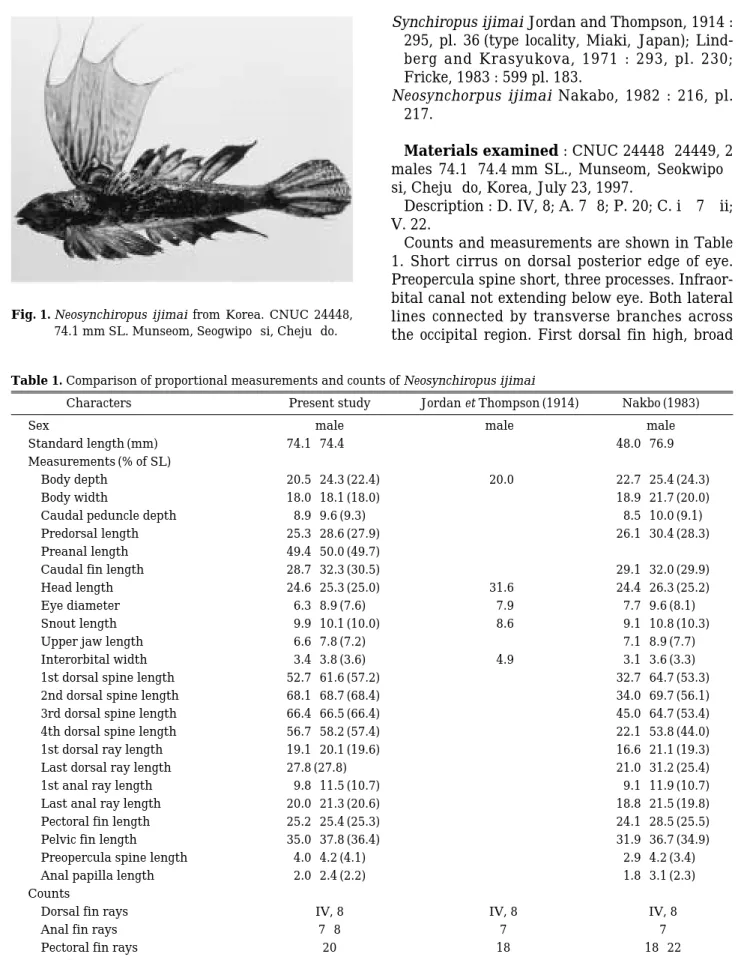
(Jordan and Thompson, 1914) (Fig. 1) (New Korean name : Yeon-ji-al-long-yang-tae)
Korean J. Ichthyol. 14(4), 300~303, 2002─
─ 300 ──
First Record of the Dragonet Fish, Neosynchiropus ijimai (Pisces: Callionymidae) from Korea
Seung-ho Choi, Seong-Sig Cha* and Youn Choi**
Laboratory of Fisheries Resources of Applided Biological Science, Hiroshima University, 1-4-4 Kamamiyama, Higashihiroshima 739-8528, Japan
*Department of Oceanography, Chonnam National University, Kwangju 500-757, Korea
**Faculty of Marine Life Science, Kunsan National University, Kunsan 573-701, Korea
The dragonet fish, Neosynchiropus ijimai (Jordan and Thompson, 1914) is recorded from two specimens newly collected from Cheju--do of Korea. We provide the Korean name “Yeon--ji--al--long--yang--tae” for this species, and a key to genera and species of the family Callionymidae from Korea. Neosynchiropus ijimai is characterized by having unbranched soft rays in the anal fin, except the last one, preopercular spine with three processes, a pair of supraorbital cirri, and a dark blotch on the cheek in adult males.
Key words : Neosynchiropus ijimai, Callionymidae, first record, Korea
Synchiropus ijimai Jordan and Thompson, 1914 : 295, pl. 36 (type locality, Miaki, Japan); Lind- berg and Krasyukova, 1971 : 293, pl. 230;
Fricke, 1983 : 599 pl. 183.
Neosynchorpus ijimai Nakabo, 1982 : 216, pl.
217.
Materials examined : CNUC 24448-24449, 2 males 74.1-74.4 mm SL., Munseom, Seokwipo- si, Cheju-do, Korea, July 23, 1997.
Description : D. IV, 8; A. 7 -8; P. 20; C. i±7±ii;
V. 22.
Counts and measurements are shown in Table 1. Short cirrus on dorsal posterior edge of eye.
Preopercula spine short, three processes. Infraor- bital canal not extending below eye. Both lateral lines connected by transverse branches across the occipital region. First dorsal fin high, broad
First Record of Neosynchiropus ijimai 301
Fig. 1. Neosynchiropus ijimai from Korea. CNUC 24448, 74.1 mm SL. Munseom, Seogwipo-si, Cheju-do.
Table 1. Comparison of proportional measurements and counts of Neosynchiropus ijimai
Characters Present study Jordan et Thompson (1914) Nakbo (1983)
Sex male male male
Standard length (mm) 74.1-74.4 48.0-76.9
Measurements (% of SL)
Body depth 20.5-24.3 (22.4) 20.0 22.7-25.4 (24.3)
Body width 18.0-18.1 (18.0) 18.9-21.7 (20.0)
Caudal peduncle depth 8.9-9.6 (9.3) 8.5-10.0 (9.1)
Predorsal length 25.3-28.6 (27.9) 26.1-30.4 (28.3)
Preanal length 49.4-50.0 (49.7)
Caudal fin length 28.7-32.3 (30.5) 29.1-32.0 (29.9)
Head length 24.6-25.3 (25.0) 31.6 24.4-26.3 (25.2)
Eye diameter 6.3-8.9 (7.6) 7.9 7.7-9.6 (8.1)
Snout length 9.9-10.1 (10.0) 8.6 9.1-10.8 (10.3)
Upper jaw length 6.6-7.8 (7.2) 7.1-8.9 (7.7)
Interorbital width 3.4-3.8 (3.6) 4.9 3.1-3.6 (3.3)
1st dorsal spine length 52.7-61.6 (57.2) 32.7-64.7 (53.3)
2nd dorsal spine length 68.1-68.7 (68.4) 34.0-69.7 (56.1)
3rd dorsal spine length 66.4-66.5 (66.4) 45.0-64.7 (53.4)
4th dorsal spine length 56.7-58.2 (57.4) 22.1-53.8 (44.0)
1st dorsal ray length 19.1-20.1 (19.6) 16.6-21.1 (19.3)
Last dorsal ray length 27.8 (27.8) 21.0-31.2 (25.4)
1st anal ray length 9.8-11.5 (10.7) 9.1-11.9 (10.7)
Last anal ray length 20.0-21.3 (20.6) 18.8-21.5 (19.8)
Pectoral fin length 25.2-25.4 (25.3) 24.1-28.5 (25.5)
Pelvic fin length 35.0-37.8 (36.4) 31.9-36.7 (34.9)
Preopercula spine length 4.0-4.2 (4.1) 2.9-4.2 (3.4)
Anal papilla length 2.0-2.4 (2.2) 1.8-3.1 (2.3)
Counts
Dorsal fin rays IV, 8 IV, 8 IV, 8
Anal fin rays 7-8 7 7
Pectoral fin rays 20 18 18-22
Caudal fin rays i(7)ii i(7)ii
Vertebrae 22
and colorful in males. Pectoral fin reaching 2nd or 3rd anal rays. Pelvic fin reaching 1st anal ray in males. Anal rays simple except last one divid- ed at base.
Color in fresh, body surface dark red. Cheek in male with a large dark mark. First dorsal fin yellow with short and long bar, but in 10% for- malin, dark brown.
Distribution : South sea of Korea (Cheju-do), Japan.
Remarks : The genus Neosynchiropus differed from the related genus Synchiropus based on having no lateral line commissure on the dorsal surface of the caudal peduncle (Nakabo, 1982).
Neosynchiropus ijimai recorded for the first time from Korea by Ryu et al. (1995), they provided the Korean name “Yeon-ji-al-long-yang-tae”
for this species. Here they provided only photo- graph by scuba diving and simple features with- out its complete monograph.
Key to the genera and species of the family Call- ionymidae from Korea
1a First dorsal fin present
∙∙∙∙∙∙∙∙∙∙∙∙∙∙∙∙∙∙∙∙∙∙∙∙∙∙∙∙∙∙∙∙∙∙∙∙∙∙2 1b First dorsal fin absent
∙∙∙∙∙∙∙∙∙∙∙∙∙∙∙∙Eleucheorchir
∙∙∙∙∙∙∙∙∙∙∙∙∙∙∙∙∙∙∙∙∙∙∙∙∙∙∙∙∙∙∙∙∙∙∙∙∙∙∙∙∙∙∙∙∙
E. mirabilis (Snyder) 2a Soft rays of second dorsal fin branched
∙∙∙∙∙∙∙∙∙3 2b Soft rays of second dorsal fin simple except last one
∙∙∙∙∙∙∙∙∙∙∙∙∙∙∙∙∙∙∙∙∙∙∙∙∙∙∙∙∙∙∙∙∙∙∙∙∙∙∙∙∙∙∙∙∙∙∙∙∙∙∙∙∙∙∙∙∙∙∙∙∙∙∙∙∙∙4 3a Last soft ray of anal fin simple; When fresh, body reddish
∙∙∙∙∙∙∙∙∙∙∙∙∙∙∙∙∙∙∙∙∙∙∙∙∙∙∙∙∙∙∙∙∙∙∙∙∙∙∙Foetorepus
∙∙∙∙∙∙∙∙∙∙∙∙∙∙∙∙∙
F. altivelis (Temminck and Schlegel) 3b Last soft ray of anal fin branched; When fresh, body brown or red
∙∙∙∙∙∙∙∙∙∙∙∙∙∙∙∙∙∙∙∙Neosynchiropus
∙∙∙∙∙∙∙∙∙∙∙∙∙∙∙∙∙∙∙∙∙∙∙
N. ijimai (Jordan and Thompson) 4a Tip of median caudal rays branched
∙∙∙∙∙∙∙∙∙∙∙∙∙∙5 4b Tip of two median caudal rays simple
∙∙∙∙∙∙∙∙∙∙∙∙∙∙∙Bathycallionymus
∙∙∙∙∙∙∙∙∙∙B. kaianus (Günther) 5a Transverse lateral line commissure on dorsal surface of caudal penduncle and 9-10 anal rays
∙∙∙∙∙∙∙∙∙∙∙∙∙∙∙∙∙∙∙∙∙Repomucenus
∙∙∙∙∙∙∙∙∙∙∙∙∙∙∙∙∙∙∙∙∙∙∙∙6 5b Transverse lateral line commissure present on dorsal surface of caudal peduncle and 8 anal rays
∙∙∙∙∙∙∙∙∙∙∙∙∙∙∙∙∙∙∙∙∙∙∙∙∙∙∙∙∙∙∙∙∙∙∙∙∙∙∙Calliurichthys
∙∙∙∙∙∙∙∙∙∙∙∙∙∙∙∙∙∙∙∙∙∙∙∙∙∙∙∙∙∙∙∙∙∙∙∙∙∙∙∙
C. japonicus (Houttuyn) 6a Preopercular spine strongly curved upward at the posterior end and 3-5 upward processes on the inner side
∙∙∙∙∙∙∙∙∙∙∙∙∙∙∙∙∙∙∙∙∙∙∙∙∙∙∙∙∙∙∙∙∙∙∙∙∙∙∙∙∙∙∙∙∙∙∙∙∙∙7 6b Preopercula spine straight with many short upward processes on the inner side
∙∙∙∙∙∙∙∙∙∙∙∙∙∙∙∙∙∙∙∙∙∙∙∙∙∙∙∙∙∙∙∙∙∙∙∙∙∙∙∙∙∙∙∙∙∙∙∙∙∙∙∙∙∙∙∙∙∙∙∙∙
R. huguenini (Bleeker) 7a Infraorbital canal with 1-4 short downward
branch
∙∙∙∙∙∙∙∙∙∙∙∙∙∙∙∙∙∙∙∙∙∙∙∙∙∙∙∙∙∙∙∙∙∙∙∙∙∙∙∙∙∙∙∙∙∙∙∙∙∙∙∙∙∙∙∙∙∙∙∙∙∙∙∙∙∙∙∙8 7b Infraorbital canal with no downward branch
∙∙∙∙∙∙∙∙∙∙∙∙∙∙∙∙∙∙∙∙∙∙∙∙∙∙∙∙∙∙∙
R. virigis (Jordan and Fowler) 8a First dorsal spine not filamentous
∙∙∙∙∙∙∙∙∙∙∙∙∙∙∙∙∙∙9 8b First dorsal spine filamentous
∙∙∙∙∙∙∙∙∙∙∙∙∙∙∙∙∙∙∙∙∙∙∙10 9a Infraorbital canal with 3-4 downward branch
∙∙∙∙∙∙∙∙∙∙∙∙∙∙∙∙∙∙∙∙∙∙∙∙∙∙∙∙∙∙∙∙∙∙∙∙∙∙∙∙∙∙∙∙∙∙∙∙∙∙∙∙∙∙∙∙∙∙∙∙∙∙∙∙∙∙∙∙∙∙∙∙∙∙∙∙∙∙∙∙
11 9b Infraorbital canal with one downward branch
∙∙∙∙∙∙∙∙∙∙∙∙∙∙∙∙∙∙∙∙∙∙∙∙∙∙∙∙∙∙
R. curvicornis (Valenciennes) 10a Rays of first dorsal fin in male elongated
∙∙∙∙∙∙∙∙∙∙∙∙∙∙∙∙∙∙∙∙∙∙∙∙∙∙∙∙∙∙∙∙∙∙∙∙∙∙∙∙∙∙∙∙∙∙∙∙∙∙∙∙∙∙∙∙∙∙∙∙∙∙∙∙∙∙∙∙∙∙∙∙∙∙∙∙∙∙∙∙∙∙∙∙∙
14 10b First spine of first dorsal fin in male elongat-
ed
∙∙∙∙∙∙∙∙∙∙∙R. lunatus (Temminck and Schlegel)
11a First dorsal fin with 4 rays
∙∙∙∙∙∙∙∙∙∙∙∙∙∙∙∙∙∙∙∙∙∙∙∙∙∙∙12 11b First dorsal fin with 3 rays
∙∙∙∙∙∙∙∙∙∙∙∙∙∙∙∙∙∙∙∙∙∙∙∙∙∙∙∙∙∙∙∙∙∙∙∙∙∙∙∙∙∙∙∙∙∙∙∙∙∙∙∙∙∙∙∙∙∙∙∙∙∙∙∙∙∙∙∙∙∙∙∙∙∙∙∙∙∙∙
R. olidus (Günther) 12a Second dorsal fin with 9 rays
∙∙∙∙∙∙∙∙∙∙∙∙∙∙∙∙∙∙∙∙∙∙∙13 12b Second dorsal fin with 10 rays
∙∙∙∙∙∙∙∙∙∙∙∙∙∙∙∙∙∙∙∙∙∙∙∙∙∙∙∙∙∙∙∙∙∙∙∙∙∙∙∙∙∙∙
R. koreannus (Nakabo, Jeon and Li)
13a Caudal fin with i±5±ii
∙∙∙∙∙∙∙∙∙∙∙∙∙∙∙∙∙∙∙∙∙∙∙∙∙∙∙∙∙∙∙∙∙∙∙∙∙∙∙∙∙∙∙∙∙∙∙∙∙∙∙∙∙∙∙∙∙∙∙∙∙
R. leucopoecilus (Fricke and Lee) 13b Caudal fin with i±7±ii
∙∙∙∙R. sagitta (Pallas) 14a First and second spines of first dorsal fin in male elongate
∙∙∙∙∙∙∙∙∙∙∙∙∙∙∙∙∙∙∙∙∙∙∙∙∙∙∙∙∙∙∙∙∙∙∙∙∙∙∙∙∙∙∙∙∙∙∙∙∙∙∙∙15 14b First dorsal spine of first dorsal fin in male elangated
∙∙∙∙∙∙∙∙∙∙∙∙∙∙∙∙∙∙∙∙∙∙∙∙∙∙∙∙∙∙∙∙∙∙∙∙∙∙∙∙∙∙∙∙∙∙∙∙∙∙∙∙∙∙∙∙∙∙∙∙∙∙∙∙∙∙∙∙∙∙∙∙
R. valenciennei (Temminck and Schlegel)
15a Anal fin membrane with dark oblique line in males
∙∙∙∙∙∙∙∙R. bentieguri (Jordan and Synder) 15b Second dorsal fin with a median row of dark marks in males
∙∙∙∙∙∙∙∙∙∙R. ornatipinnis (Regan)
Reference
Fricke, R. 1983. Revision of the Indo -Pacific genera and species of the dragonet, family Callionymi- dae (Teleostei). Braunschweig, J. Cramer, x±
774 pp.
Jordan, D.S. and W.F. Thompson. 1914. Record of the fishes obtained in Japan in 1911. Mem. Car- negie Mus., 6(4) : 205 -313.
Lee, C.L. and I.S. Kim. 1993. Synopsis of dragonet fish, family Callionymidae (Pisces, Perciformes) from Korea. Korean J. Ichthyol., 5(1) : 1 -40.
Lee, W.O., C.H. Youn and I.S. Kim. 1995. Two new records of the family Callionymidae (Pisces:
Perciformes) from Korea. Korean J. Ichthyol., 7(1) : 2-17.
Lindberg, G.U. and Z.J. Karasyukova. 1971. Fishes of the sea of Japan and adjacent territories of the Okhotsk and Yellow Sea. Pt. 4, 29, Perci- formes, 2 -13 : 1-463.
Nakabo, T. 1982. Revision of genera of the drago- nets (Pisces: Callionymidae). Publ. Seto Mar.
302 Seung--ho Choi, Seong--Sig Cha and Youn Choi
Biol. Lab., 27(1/3) : 77 -131.
Nakabo, T. 1983. Revision of the dragonets (Pisces:
Callionymidae) found in the waters of Japan.
Publ. Seto Mar. Biol. Lab., 27(4/6) : 193 -259.
Ryu, J.M., S. Kim, E.K. Lee, W.S. Kim and C.S.
Myeong. 1995. Marine fishes around Cheju Island. Hyeonamsa, p. 84.
First Record of Neosynchiropus ijimai 303
Received : November 24, 2002 Accepted : December 20, 2002
한국산 돛양태과 어류
1
미기록종Neosynchiropus ijimai (Jordan and Thompson, 1914)
최 승 호∙차 성 식*∙최 윤**히로시마대학 응용생물과학부
*전남대학교 해양학과
**군산대학교 해양생명과학부
1997