Address for correspondence:
Chang-Wook Nam, MD Cardiovascular Medicine Keimyung University Dongsan Medical Center
194 Dongsan-dong, Jung-gu Daegu, Korea 700-712 [email protected]
Two-Year Clinical Outcomes After Large Coronary Stent (4.0 mm) Placement:
Comparison of Bare-Metal Stent Versus Drug-Eluting Stent
Hyun-Tae Kim, MD; Chang-Wook Nam, MD, PhD; Seung-Ho Hur, MD, PhD;
Kwon-Bae Kim, MD, PhD; Sang-Hee Lee, MD; Geu-Ru Hong, MD, PhD;
Jong-Seon Park, MD, PhD; Young-Jo Kim, MD, PhD; Ung Kim, MD; Tae-Hyun Yang, MD;
Doo-Il Kim, MD, PhD; Dong-Soo Kim, MD, PhD
Keimyung University Dongsan Medical Center (H.-T. Kim, Nam, Hur, K.-B. Kim), Daegu, Republic of Korea; Yeungnam University Hospital (Lee, Hong, Park, Y.-J. Kim), Daegu, Republic of Korea;
Inje University Busan Paik Hospital (U. Kim, Yang, D.-I. Kim, D.-S. Kim), Busan, Republic of Korea
Background: The absolute benefit of drug-eluting stents (DES) in low-risk patients and lesions is not well established.
Hypothesis: The long term clinical outcomes after percutaneous coronary intervention in a single coronary artery disease may not be affected by the type of stent.
Methods: This study assessed and compared 2-year clinical outcomes of 304 consecutive patients (147 BMS patients and 157 DES patients) treated with a single coronary stent (4.0 mm) for single de novo large coronary artery disease in 3 referral cardiac centers. The primary outcome was a composite of major adverse cardiac events at 2 years after the index procedure.
Results: The reference vessel diameter was similar in both groups (3.92 ± 0.29 mm in BMS vs 3.95 ± 0.24 mm in DES, P = 0.50). Late loss was larger in the BMS group (1.04 ± 0.83 mm vs 0.73 ± 0.91 mm in DES, P = 0.03). The incidence of major adverse cardiac events at the 2-year clinical follow-up was very low, 24 of 304 patients (7.9%), regardless of stent type deployed (7.5% in BMS vs 8.3% in DES, P = 0.83). The rate of target vessel revascularization was also similar in both groups (4.8% in BMS vs 5.7% in DES, P = 0.80).
Conclusions: Two-year clinical outcomes after PCI with a single large coronary stent (4.0 mm) were excellent.
The clinical outcomes were not affected by the type of stent used.
Introduction
Large coronary artery disease is not uncommon in daily interventional practice, and previous studies have shown favorable clinical outcomes following percutaneous coronary intervention (PCI) in this clinical setting, compared with PCI in small vessels. There is an inverse relationship between vessel size and the incidence of clinical adverse outcomes after PCI with the use of bare- metal stents (BMS).
1 – 3According to the results of many large randomized clinical trials, use of drug-eluting stents (DES) has recently accounted for a large proportion of coronary interventional load relative to BMS.
4 – 6However, the absolute benefit of DES in low-risk patients and lesions is not well established. Previous studies, which defined a large coronary artery as ≥3.5 mm, demonstrated good clinical outcomes after PCI in large coronary arteries, and no additional benefit of DES implantation compared with BMS.
7 – 10The aim of this study was to investigate the 2-year clinical outcomes of patients treated with a single 4.0-mm stent in a single large coronary artery, and to compare the outcomes of PCI with BMS to outcomes with DES.
The authors have no funding, financial relationships, or conflicts of interest to disclose.
Methods
Patient Population and Study Design
The patient population consisted of 304 consecutive patients who successfully underwent single 4.0-mm coronary stent implantation for the treatment of single large coronary artery disease between January 2004 and October 2007. Patients with a history of stable angina or acute coronary syndrome (ACS) and signs of myocardial ischemia were enrolled.
Inclusion criteria included a single de novo target lesion with ≥50% diameter stenosis in a large coronary artery suitable for implantation of a 4.0-mm stent. Patients were not eligible for enrollment if they had undergone intervention in the setting of: (1) cardiogenic shock or (2) coronary artery bypass graft, and if they had (3) multivessel disease or multifocal lesions in the same coronary artery, (4) left main coronary artery disease, (5) intolerance or a contraindication to aspirin or clopidogrel, (6) a major life-threatening illness, or (7) chronic renal insufficiency.
This registry was a collaborative work of 3 referral cardiac interventional centers, designed to record data pertaining to all PCI and to perform clinical follow-up at 30 days, 12 months, and 24 months after index procedures.
The type of stent implanted was at each operator’s
discretion. Two types of DES were commercially available
(Medtronic, Shoreview, MN), and Vision (Guidant, Santa Clara, CA).
Procedural Details
Intracoronary stenting was performed with standard interventional techniques. Before the index procedure, all patients received oral aspirin (a loading dose of 200 mg) and clopidogrel (a loading dose of 300–600 mg). Oral antiplatelet therapy during the study period followed guidelines recommending a combination of aspirin and clopidogrel for 1 month for BMS and >12 months for DES. Intravenous boluses of heparin (100 U/kg) were administered before intervention, and the dose was adjusted to maintain an activated clotting time exceeding 250 seconds during the procedure.
Quantitative Angiographic Analysis
Coronary angiography was performed in multiple views after the intracoronary injection of nitroglycerin to control for vasomotor tone. All coronary angiograms were analyzed using standard definitions and measurements. Quantitative coronary angiography (Quantcor QCA, version 4.0; Pie Medical Imaging, Maastricht, the Netherlands) was performed by a single experienced technician who was blinded to the type of stent deployed. Minimal lumen diameter (MLD), percent stenosis, and reference vessel diameter were measured. Minimal lumen diameter was measured during diastole at the tightest lumen narrowing site preintervention and postintervention from multiple projections. Acute gain was calculated as the difference between the final and the original MLD. Late loss was defined as the difference between the MLD immediately after the procedure and the MLD at follow-up coronary angiography. Net gain was defined as the difference between acute gain and late loss.
Definitions and Study Outcomes
Lesions were also qualitatively classified according to the modified American College of Cardiology/American Heart Association grading system. Type A and B1 lesions were considered simple, and type B2 and C complex.
Death was defined as all-cause mortality. The diagnosis of myocardial infarction (MI) was based on either the development of new pathological Q waves in ≥2 contiguous electrocardiogram leads and/or cardiac enzyme level elevation >3 × the upper limit of normal value. Target vessel revascularization (TVR) included target lesion revascularization and bypass surgery of pertinent lesion.
TVR was only based on the presence of symptoms and/or
Data are expressed as mean ± SD for continuous variables and as percentages for discrete variables. Continuous variables were compared using the Student unpaired t test. Categorical variables were compared using χ
2tests as appropriate. All calculated P values were 2-sided, and differences were considered to be statistically significant when the respective P values were <0.05. We estimated cumulative incidence of primary outcome curve according to the Kaplan-Meier method and used the log-rank test to evaluate differences between groups. Multivariate logistic regression analysis was used to assess independent predictors of major adverse coronary events (MACE). The parameters analyzed in multivariate analysis were selected when P value was <0.5 in univariate analysis. All statistical analyses were performed using SPSS version 15.0 (SPSS Inc., Chicago, IL).
Results
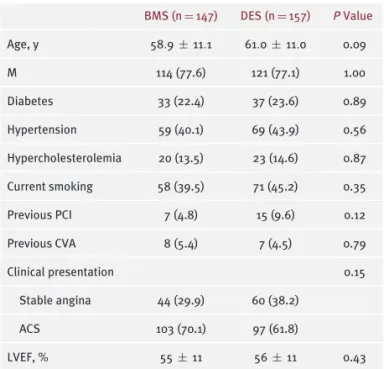
Baseline clinical and procedural characteristics are sum- marized in Tables 1 and 2. Among the 304 consecutive patients during the study period, BMS were implanted in 147 patients and DES in 157 patients. Two-year clinical follow-up was available in all patients. Follow-up angiogra- phy was obtainable in 50% between 6 to 9 months after the index procedure. The groups were well matched, with no significant differences in the frequency of car- diac risk factors. The most frequent target lesion location was the right coronary artery (49.7%). Complex lesion type was more frequently managed by DES (58.0% vs 43.5% in BMS, P = 0.02). Both groups had equivalent reference vessel diameters (3.92 ± 0.29 mm in BMS vs 3.95 ± 0.24 mm in DES, P = 0.50). Lesion length and stent length were slightly shorter in BMS compared with DES (lesion length 18.1 ± 5.3 mm vs 19.4 ± 5.4 mm, P = 0.04;
stent length 19.5 ± 4.7 mm vs 20.8 ± 5.3 mm, P = 0.02).
However, the ratio of stent length and lesion length was not different between the groups (1.11 vs 1.09, P = 0.43).
Late loss was larger in the BMS group (1.04 ± 0.83 mm vs 0.73 ± 0.91 mm in DES, P = 0.03). The duration of dual antiplatelet therapy was shorter in the BMS group (7 ± 5 months vs 16 ± 8 months in DES, P < 0.001).
Cumulative MACE rates at 30 days, 12 months, and
24 months are summarized in Table 3. At 30-day follow-
up, there were no significant differences in overall MACE
rates (2.0% in BMS vs 0.6% in DES, P = 0.36). Four cases
of cardiac death were observed. Probable stent thrombosis
was seen in 2 cases in the BMS group. Each group had
1 case of post-MI ventricular septal rupture–related death
during hospital stay. Likewise, at 12-month follow-up, there
Clinical Investigations
continuedTable 1. Baseline Patient Clinical Characteristics
BMS (n= 147) DES (n= 157) P Value
Age, y 58.9± 11.1 61.0± 11.0 0.09
M 114 (77.6) 121 (77.1) 1.00
Diabetes 33 (22.4) 37 (23.6) 0.89
Hypertension 59 (40.1) 69 (43.9) 0.56
Hypercholesterolemia 20 (13.5) 23 (14.6) 0.87
Current smoking 58 (39.5) 71 (45.2) 0.35
Previous PCI 7 (4.8) 15 (9.6) 0.12
Previous CVA 8 (5.4) 7 (4.5) 0.79
Clinical presentation 0.15
Stable angina 44 (29.9) 60 (38.2)
ACS 103 (70.1) 97 (61.8)
LVEF, % 55± 11 56± 11 0.43
Abbreviations: ACS, acute coronary syndrome; BMS, bare-metal stent;
CVA, cerebrovascular accident; DES, drug-eluting stent; LVEF, left ventricular ejection fraction; M, male; PCI, percutaneous coronary intervention.
Values are expressed as n (%) or mean± SD.
were no significant differences in the MACE rate (6.8% in BMS vs 7.6% in DES, P = 0.83). There was 1 case of late stent thrombosis–related death in the DES group, and 1 case of unknown cause of death in the BMS group after 30 days.
PCI of large vessels using a 4.0-mm coronary stent carried a very low rate of MACE at the end of 24 months’
follow-up (7.9%, 24/304 patients), irrespective of the type of stent deployed (7.5% in BMS, 8.3% in DES, P = 0.83). No differences emerged with regard to death, MI, and stent thrombosis. There was one more case of death of unknown cause in the BMS group after 12 months. The cumulative incidence of 24-month ischemia-driven TVR rate was 4.8%
in the BMS group and 5.7% in the DES group (P = 0.80).
In the multivariate logistic regression analysis, there was no unique independent predictor for 2-year MACE except a slightly higher tendency of adverse events in left anterior descending artery (LAD) lesions (Table 4). Kaplan-Meier estimates of cumulative freedom from MACE and freedom from TVR during the 2-year follow-up are shown in Figure 1.
Discussion
The major findings in the current study are that: (1) PCI with a single 4.0-mm coronary stent in a single large coronary artery was associated with excellent 2-year clinical outcomes, and (2) there were no significant differences in
Table 2. Lesion and Procedural Characteristics
BMS (n= 147) DES (n= 157) P Value
Treated vessel 0.27
Left anterior descending
54 (36.7) 70 (44.6)
Left circumflex 17 (11.6) 12 (7.6)
Right coronary 76 (51.7) 75 (47.8)
Lesion complexitya 0.02
Simple 83 (56.5) 66 (42.0)
Complex 64 (43.5) 91 (58.0)
Lesion length, mm 18.1± 5.3 19.4± 5.4 0.04 Stent length, mm 19.5± 4.7 20.8± 5.3 0.02 Stent length/lesion
length ratio
1.11 1.09 0.43
Reference vessel diameter, mm
Pre-PCI 3.92± 0.29 3.95± 0.24 0.50
Post-PCI 3.94± 0.30 3.95± 0.23 0.79
Follow-up angiography 3.74± 0.56 3.83± 0.40 0.24 MLD, mm
Pre-PCI 0.61± 0.40 0.63± 0.35 0.64
Post-PCI 3.68± 0.39 3.64± 0.25 0.33
Follow-up angiography 2.67± 0.75 2.90± 0.90 0.10 Diameter stenosis, %
Pre-PCI 84.8± 10.2 84.1± 8.7 0.54
Post-PCI 7.8± 8.1 8.7± 5.0 0.23
Follow-up angiography 28.0± 18.1 24.0± 22.3 0.23 QCA analysis
Acute gain, mm 3.09± 0.47 3.01± 0.43 0.16
Late loss, mm 1.04± 0.83 0.73± 0.91 0.03
Net gain, mm 2.12± 0.83 2.29± 1.01 0.26
Abbreviations: BMS, bare-metal stent; DES, drug-eluting stent; MLD, minimal lumen diameter; PCI, percutaneous coronary intervention; QCA, quantitative coronary angiography.
Values are expressed as n (%) or mean± SD.
aAccording to the American College of Cardiology/American Heart Association classification, type A and B1 as simple, type B2 and C as complex.
long-term clinical outcomes according to implanted stent
type, whether BMS or DES.
Death 3 (2.0) 1 (0.6) 0.36
MI 1 (0.7) 0 0.48
TVRa 1 (0.7) 0 0.48
MACE 3 (2.0) 1 (0.6) 0.36
Stent thrombosis 2 (1.4) 0 0.23
12 mo (cumulative)
Death 4 (2.7) 3 (1.8) 0.72
MI 1 (0.7) 2 (1.2) 1.00
TVR 7 (4.8) 8 (5.1) 1.00
MACE 10 (6.8) 12 (7.6) 0.83
Stent thrombosis 2 (1.4) 1 (0.6) 0.61
24 mo (cumulative)
Death 5 (3.4) 3 (1.8) 0.49
MI 1 (0.7) 2 (1.2) 1.00
TVR 7 (4.8) 9 (5.7) 0.80
MACE 11 (7.5) 13 (8.3) 0.83
Stent thrombosis 2 (1.4) 1 (0.6) 0.61
Abbreviations: BMS, bare-metal stents; DES, drug-eluting stents; MACE, major adverse cardiac events; MI, myocardial infarction; TVR, target vessel revascularization.
Values are expressed as n (%).
aTVR included target lesion revascularization and bypass graft.
Elezi and colleagues demonstrated that patients with smaller vessel size have a less-favorable clinical outcome after coronary stent placement than patients with larger vessels.
2The obvious benefits of DES associated with neointimal hyperplasia reduction are well demonstrated in several clinical trials.
4 – 6However, DES’s superiority to BMS for the treatment of large vessels has yet to be proven. In subgroup analysis of DES trials, DES could not prove a beneficial effect over BMS in large reference vessels.
5,12 – 14Our results are consistent with 4 previous cohort studies comparing the effectiveness of BMS and DES in large coronary artery disease.
7 – 10Steinberg et al reported that implantation of DES in large coronary arteries (≥3.5 mm) confers no additional benefit compared with BMS, with similar low incidence of MACE at 1 year (7.7% in BMS vs 8.5% in DES, P = 0.80).
7However, the implanted stent diameter of that cohort was significantly different
Age 1.02 0.98–1.07 0.36
Male sex 0.79 0.24–2.64 0.70
Diabetes 1.20 0.37 –3.88 0.77
Previous PCI 0.64 0.07–5.18 0.64
ACS 1.52 0.50–4.65 0.46
LVEF 0.99 0.95 –1.04 0.79
Lesion complexity 1.93 0.69 –5.40 0.21
LAD (vs non-LAD) lesion 2.66 0.99 –7.17 0.05 Reference vessel diameter 0.56 0.09 –3.35 0.52
Stent length 1.01 0.91 –1.11 0.86
Acute gain 1.07 0.36 –3.18 0.90
Abbreviations: ACS, acute coronary syndrome; BMS, bare-metal stent;
CI, confidence interval; DES, drug-eluting stent; LAD, left anterior descending coronary artery; LVEF, left ventricular ejection fraction;
PCI, percutaneous coronary intervention; RR, relative risk.
(3.88 ± 1.76 mm in BMS vs 3.57 ± 1.09 mm in DES,
P= 0.024). Three other studies used a similar definition of large coronary artery as that treated with a ≥3.5-mm coronary stent or a reference vessel diameter ≥3.5 mm.
Similar clinical outcomes at 6 months and 12 months were observed between BMS and DES.
8 – 10In this study, reference vessel diameter and implanted stent diameter were equivalent in both groups and long-term (2-year) clinical outcomes were evaluated, which is a distinctive feature from previous studies. Late loss was slightly larger in the BMS group (1.04 ± 0.83 mm vs 0.73 ± 0.91 mm,
P= 0.03). However, vessel diameter was large enough to maintain sufficient patency that neither compromised hemodynamics nor required further intervention. Although this study included a real-world population with high incidence of ACS, in nearly two-thirds of all patients (65.8%) overall incidence of MACE was very low, namely 7.9% (24 of 304 patients) at the end of 24-month follow-up. We could not find any independent predictors for MACE in this large- vessel PCI setting. Only LAD lesions demonstrated a slightly higher tendency of events (relative risk: 2.66, P = 0.053).
Because a larger amount of myocardium may be in jeopardy
in a large LAD disease, it seems to be intuitive. Traditional
risk factors for adverse outcomes appeared ineffective in
large coronary artery disease. In a subanalysis of the DES
group comparing a zotarolimus-eluting stent (77 lesions)
and a paclitaxel-eluting stent (80 lesions), there was no
difference not only between the 2 types of DES, but also
Clinical Investigations
continuedFigure 1.Kaplan-Meier estimates of cumulative freedom from composite MACE including death, MI, TVR, and stent thrombosis (A) and freedom from TVR (B) at 2-year follow-up in patients who underwent DES (solid line) and BMS (dotted line) implantation. Abbreviations: BMS, bare-metal stent; DES; drug-eluting stent; MACE, major adverse cardiac event; MI, myocardial infarction; TVR, target vessel revascularization.
including BMS. However, the number of lesions was not high enough for confidence in this subanalysis.
The real benefits of DES should not be overestimated, especially in the subset of low-risk patients or lesions.
There are still several safety concerns with DES, such as late stent thrombosis, bleeding complications related to prolonged dual antiplatelet therapy, problems with managing interruptions in antiplatelet therapy at times of
surgery, and a late catch-up phenomenon that can lower the benefit of DES.
15 – 18DES can be selected when the benefit is larger than its risk. This might pertain to large- vessel-disease PCI. However, left main coronary artery disease, which was excluded in this study, is one of the most important large vessels. Left main disease should be excluded from the discussion in the result of this study.
Study Limitations
There are several limitations in this study, including its retrospective nature and the lack of randomization. We cannot exclude the selection bias. However, after controlling for several different characteristics such as lesion length and complexity using a multivariate regression analysis, DES could not prove a beneficial effect on 2-year clinical outcome. Second, the total number of patients might not be high enough to predict the difference in clinical outcomes between stent groups considering the low event rate. Because several types of stents were used in this study, it could neglect some advantages of each stent.
Finally, although the period from index PCI to follow-up angiography was not statistically different, it was slightly longer in the DES group, which might affect late loss and clinical outcomes.
Conclusion
PCI with a 4.0-mm stent in large single coronary artery disease carries a very low risk of MACE and TVR up to 2 years. The clinical outcomes were not affected by the type of stent used, whether BMS or DES.
Acknowledgments
The authors thank Dr. Roberto Patarca for editorial help.
References
1. Foley DP, Melkert R, Serruys PW. Influence of coronary vessel size on renarrowing process and late angiographic outcome after successful balloon angioplasty. Circulation. 1994;90:1239–1251.
2. Elezi S, Kastrati A, Neumann FJ, et al. Vessel size and long-term outcome after coronary stent placement. Circulation.
1998;98:1875–1880.
3. Cutlip DE, Chauhan MS, Baim DS, et al. Clinical restenosis after coronary stenting: perspectives from multicenter clinical trials.
J Am Coll Cardiol.2002;40:2082–2089.
4. Morice MC, Serruys PW, Sousa JE, et al. A randomized compari- son of a sirolimus-eluting stent with a standard stent for coronary revascularization. N Engl J Med. 2002;346:1773–1780.
5. Moses JW, Leon MB, Popma JJ, et al; SIRIUS Investigators.
Sirolimus-eluting stents versus standard stents in patients with stenosis in a native coronary artery. N Engl J Med. 2003;349:
1315–1323.
6. Marzocchi A, Piovaccari G, Manari A, et al. Comparison of effec- tiveness of sirolimus-eluting stents versus bare metal stents for percutaneous coronary intervention in patients at high risk for coronary restenosis or clinical adverse events. Am J Cardiol. 2005;
95:1409–1414.
vessels. Am Heart J. 2007;154:373–378.
9. Yan BP, Ajani AE, New G, et al; Melbourne Interventional Group Investigators. Are drug-eluting stents indicated in large coronary arteries? Insights from a multi-centre percutaneous coronary intervention registry. Int J Cardiol. 2008;130:374–379.
10. Na JO, Kim JW, Choi CU, et al. Bare-metal stents versus drug- eluting stents in large (≥3.5 mm) single coronary artery:
angiographic and clinical outcomes at 6 months. J Cardiol. 2009;54:
108–114.
11. Cutlip DE, Windecker S, Mehran R, et al; Academic Research Consortium. Clinical end points in coronary stent trials: a case for standardized definitions. Circulation. 2007;115:2344–2351.
12. Stone GW, Ellis SG, Cox DA, et al; TAXUS-IV Investigators.
One-year clinical results with the slow-release, polymer-based, paclitaxel-eluting TAXUS stent: the TAXUS-IV trial. Circulation.
2004;109:1942–1947.
13. Stone GW, Ellis SG, Cannon L, et al; TAXUS-V Investigators.
Comparison of a polymer-based paclitaxel-eluting stent with a bare metal stent in patients with complex coronary artery disease:
a randomized controlled trial. JAMA. 2005;294:1215–1223.
term benefit-risk balance of drug-eluting vs. bare-metal stents in daily practice: does stent diameter matter? Three-year follow-up of BASKET. Eur Heart J. 2009;30:16–24.
16. Grines CL, Bonow RO, Casey DE Jr, et al. Prevention of premature discontinuation of dual antiplatelet therapy in patients with coronary artery stents: a science advisory from the American Heart Association, American College of Cardiology, Society for Cardiovascular Angiography and Interventions, American College of Surgeons, and American Dental Association, with representation from the American College of Physicians. Catheter Cardiovasc Interv.2007;69:334–340.
17. Yan BP, Gurvitch R, Ajani AE. Double jeopardy: balance between bleeding and stent thrombosis with prolonged dual antiplatelet therapy after drug-eluting stent implantation. Cardiovasc Revasc Med.2006;7:155–158.
18. Virmani R, Liistro F, Stankovic G, et al. Mechanism of late in-stent restenosis after implantation of a paclitaxel derivate- eluting polymer stent system in humans. Circulation. 2002;106:
2649–2651.