서 론
비타민 D는 호르몬과 유사한 기능을 갖고 있는 스테롤 군으로 칼 슘과 인의 혈장 농도를 조절하는 역할을 한다. 비타민 D는 소장에서 칼슘과 인산의 흡수를 자극하고 뼈로부터 칼슘과 인산을 동원하도 록 자극하여 결과적으로 혈장 칼슘과 인산이 증가하게 한다. 비타민 D는 식사를 통해서나 햇빛에 의해 피부에서 합성되어 간에서
25(OH)D3로 저장된다.1)
비타민 D의 부족으로 인한 골격계 질환 외에도 대사증후군, 심혈 관 질환, 치매, 우울증, 수면장애 등 다양한 질환에 관한 연구가 많이 이루어져 왔다.2-4) 또한 비타민 D 부족이 성인과 소아에서 다양한 폐 질환과 연관되어 있다는 사실이 많은 연구를 통해 밝혀져 있다.5-7)
비타민 D가 호흡기의 선천, 후천성 면역계와 관련이 있다는 연구 가 있고,8) 세포사멸(apoptosis)과 세포분화와 관련된 900개 이상의 유
Original Article
정상 폐기능을 가진 한국 남성에서 혈중 비타민 D와 폐 기능 지표와의 연관성: 국민건강영양조사 2012-2013년 분석 결과
김소정, 이태영*, 최다혜, 정복선
대전보훈병원 가정의학과
Association between Serum Vitamin D and Pulmonary Function Index: Korea National Health and Nutrition Examination Survey 2012–2013
So-Jung Kim, Tae-Young Lee*, Da-Hye Choi, Bog-Seon Jeong
Department of Family Medicine, Daejeon Veterans Hospital, Daejeon, KoreaBackground: There are studies that have demonstrated that the lack of vitamin D tends to deteriorate lung function, and consuming vitamin D supplements improves lung function and prevents many respiratory infections. However, studies on whether vitamin D and lung function are related in normal people are lacking. This study was conducted to analyze the association between serum vitamin D and each pulmonary function test (PFT) indicator in men with normal lung function.
Methods: Using the Korea National Health and Nutrition Examination Survey in 2012 and 2013, 2,440 men were included. Based on the plasma vitamin D level, the subjects were divided into two groups: a normal group with >20 ng/mL of vitamin D and a deficient group with lower levels. The basic characteristics and PFT indicators were analyzed using the chi-square and t-tests. The association between vitamin D and PFT indicators was analyzed using multiple regression analysis controlled by confounding variables.
Results: A comparison of the PFT indicators between the groups revealed that the forced vital capacity (FVC) (normal, 4.25±0.02; deficient, 4.13±0.01;
P=0.03) and FVC% (normal, 92.19±0.47; deficient, 91.16±0.33; P=0.04) significantly differed between the groups. The PFT indicators that were positively associated with serum 25(OH)D were FVC (β=0.007, R
2=0.526, P=0.0023), %FVC (β=0.147, R
2=0.149, P=0.0032), forced expiration volume in the first second (FEV1) (β=0.005, R
2=0.583, P=0.0166), %FEV1 (β=0.13, R
2=0.036, P=0.0227), and FEV6 (β=0.006, R
2=0.576, P=0.006).
Conclusion: The serum vitamin D of male adults appeared to be associated with FVC, %FVC, FEV1, %FEV1, and FEV6.
Keywords: Vitamin D; Lung Function Test; National Health and Nutrition Examination Survey
http://dx.doi.org/10.21215/kjfp.2016.6.2.84pISSN 2233-9019 · eISSN 2233-9116 Korean J Fam Pract. 2016;6(2):84-88
KJFP
Korean Journal of Family PracticeReceived January 14, 2016 Accepted March 19, 2016 Corresponding author Tae-Young Lee
Tel: +82-42-939-0316, Fax : +82-42-939-0567 E-mail : [email protected]
Copyright © 2016 The Korean Academy of Family Medicine
This is an open-access article distributed under the terms of the Creative Commons At- tribution Non-Commercial License (http://creativecommons.org/licenses/by-nc/4.0) which permits unrestricted noncommercial use, distribution, and reproduction in any medium, provided the original work is properly cited.
김소정 외. 한국 남성에서 혈중 비타민 D와 폐 기능과의 연관성 Korean Journal of Family Practice
KJFP
전자 발현에 관여하여9) 조직개형(tissue remodeling)과 관련이 있으 며,10) 비타민 D 수용체가 폐 상피세포와 폐 내 대식세포에도 존재한 다는 연구9)가 발표됨에 따라 비타민 D가 폐 기능에 영향을 줄 것이 라는 의견이 제기되고 있다.
전 세계적으로 비타민 D 결핍이 증가하는 추세이고,11) 실내 활동 이 많은 우리나라 국민들도 예외는 아니다. 국내10,12)와 해외13,14)에서 발표된 논문에 의하면 비타민 D가 부족할수록 폐 기능이 저하되는 경향이 있고, 비타민 D 보충제를 섭취한 군에서 호흡기 감염도 줄어 들고 폐 기능도 향상된다는 연구결과도 있다.15)
하지만 정상 폐 기능을 가진 성인에서 혈중 비타민 D와 폐 기능 지 표와의 관련성에 대한 연구는 부족한 실정이다.
본 연구에서는 국가통계자료로 대표성과 신뢰성이 확보된 국민건 강영양조사를 이용하여 정상 폐 기능을 가진 사람을 대상으로 혈중 비타민 D와 각 폐 기능 검사 지표 간의 상관관계를 분석하고 비타민 D 부족 시 나타나는 폐 기능 지표의 특징을 알아보고자 하였다.
방 법
1. 연구대상
국민건강영양조사 5기 중 2012년도와 6기 중 2013년도 조사에 참여 한 남성들 중 폐 기능 검사와 혈중 비타민 D 농도 측정을 시행한 2,440 명을 대상으로 하였다. 폐결핵, 폐암, 천식이 있는 자들은 제외하였다.
2. 자료의 수집 및 변수
나이, 거주지역, 흡연 정도, 활동 정도는 자기기입식 설문조사를 하 였다. 사는 지역은 동, 읍ㆍ면으로 구분하여 읍ㆍ면에 거주할 경우 시 골(rural)로 구분하였다.
흡연 상태는 현재 흡연, 과거 흡연, 비흡연으로 구분하였고 활동 정도는 1주일간 중등도나 격렬한 신체활동을 하지 않은 군을 1그룹, 중등도 운동을 3일 이하로 하거나 격렬한 운동을 1일 정도 하는 군 을 2그룹, 중등도 운동을 4–6일 정도 하거나 격렬한 운동을 2–4일 정 도 하는 그룹을 3그룹, 중등도 운동을 매일 하거나 격렬한 운동을 5 일 이상 하는 그룹을 4그룹으로 정의하였다.
신체계측은 숙련된 검사자가 키(cm)와 몸무게(kg)를 측정하였으 며 체질량지수는 몸무게(kg)를 키(m)의 제곱으로 나눈 값(kg/m2)으 로 하였다. 허리둘레(cm)는 수검자의 최하위 늑골하부와 골반 장골 능과의 중간부위에서 줄자로 측정하였다.
혈액검사는 최소한 8시간 금식한 후 채혈한 정맥혈을 이용하여 혈 중 비타민 D 농도를 측정하였다. 혈중 비타민 D 농도는 체내에 가장 많고 안정적인 25(OH)D를 네오딘의학연구소의 방사면역측정법(ra-
dioimmunoassay)로 측정하였고, 혈중 농도 20 ng/mL를 기준으로 그 이상인 군을 정상군, 미만인 군을 부족군으로 분류하였다.
폐 기능 검사는 검진차량에서 숙련된 검진자가 dry rolling seal spi- rometer (model 2130; SensorMedics, Yorba Linda, CA, USA)를 사용하 여 측정하였다.
폐 기능 검사 항목은 노력성 폐활량(forced vital capacity, FVC), 노 력성 폐활량 정상추정치와의 비율(FVC%), 1초간 노력성 호기량 (forced expiratory volume in the first second, FEV1), 1초간 노력성 호기 량 정상추정치와의 비율(FEV1%), 1초간 노력성 호기량/노력성 폐활 량(FEV1/FVC), 6초간 노력성 호기량(forced expiratory volume in the sixth seconds, FEV6), 노력성 호기 중간유량(maximal midexpiratory flow rate, FEF 25%–75%) 그리고 최대호기유속(peak expiratory flow rate, PEFR)이 포함되었다.
3. 통계분석
국민건강영양조사는 복합표본설계로 구성된 자료이므로 분산추 정층, 층화변수 및 표본가중치를 부여하여 분석하였다.16)
혈중 비타민 D 정상군과 부족군의 기본적 특징은 카이제곱과 t-test 를 이용하여 비교하였고 평균±표준오차와 대상자수(%)로 제시하였 다. 혈중 비타민 D 정상군과 결핍군 사이의 폐 기능 검사 지표의 차 이는 t-test를 사용하여 비교하였고, 혈중 비타민 D와 폐 기능 지표의 연관성은 혼란변수를 통제하여 다중회귀분석을 이용하여 분석하 였다. 혼란변수는 폐 기능과 관련이 있다고 여겨지는 나이, 키, 몸무 게(피어슨 상관계수), 흡연 상태, 활동 정도(activity score) (분산분석) 를 포함하였다.
통계분석은 SAS 프로그램 ver. 9.3 (SAS Institute, Cary, NC, USA)을 이용하였고 통계적 유의수준은 P<0.05로 정의하였다.
결 과
연구 대상자의 일반적인 특징은 Table 1과 같다. 전체 대상자는 2,440명으로 혈중 비타민 D 부족군은 1,526명, 정상군은 914명이었 다. 혈중 비타민 D 부족군의 평균 25(OH)D 농도는 15.3±0.1이었고, 정 상군은 24.6±0.2이었다. 부족군이 정상군보다 연령이 유의하게 낮았 고(53.7±0.4 vs. 55.7±0.4, P<0.001), 체중 및 체질량지수는 부족군이 정 상군보다 유의하게 높은 것으로 나타났다(70.2±0.3 vs. 68.9±0.4, P=0.009; 24.6±0.1 vs. 24.2±0.1, P=0.012). 비타민 D 정상군에서 지방 거 주자가 더 많은 것으로 나타났다(284 [18.9%] vs. 316 [34.6%], P<0.001).
흡연 상태는 부족군, 정상군 간의 유의한 차이는 없었다(P=0.171).
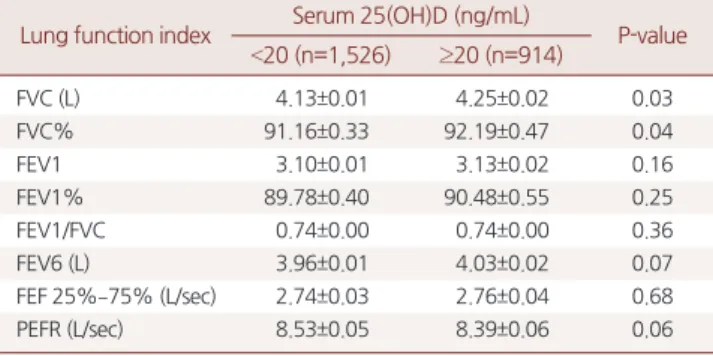
혈중 비타민 D 수준에 따른 폐 기능 지표의 차이를 비교해 본 결
So-Jung Kim, et al. Association between Serum Vitamin D and Pulmonary Function in Men
Korean Journal of Family Practice
KJFP
과, 혈중 비타민 D가 정상인 군은 FVC가 4.25±0.02, 부족군은 4.13±
0.01로 유의한 차이를 보였고(P=0.03), FVC%의 경우 정상군은 92.19±
0.47, 부족군은 91.16±0.33으로 유의한 차이를 보였다(P=0.04). 정상군 과 부족군 간에 FEV1/FVC의 유의한 차이는 없었다(Table 2).
혈중 비타민 D 농도와 폐 기능 지표의 관련성에 대해 알아보기 위 해 나이, 키, 몸무게, 흡연 상태, 활동 정도를 보정한 결과, 혈중 25(OH)D와 연관성 있는 폐 기능 지표는 FVC (β=0.007, R2=0.526, P=0.0023), %FVC (β=0.147, R2=0.149, P=0.0032), FEV1 (β=0.005, R2=0.583, P=0.0166), %FEV1 (β=0.13, R2=0.036, P=0.0227), FEV6 (β=
0.006, R2=0.576, P=0.006)으로 양의 연관성을 보였다. FEV1/FVC는 혈 중 비타민 D와 유의한 연관성이 없었다(Table 3).
고 찰
본 연구에서는 정상 폐 기능을 가진 40대 이상 남성에서 혈중 비타 민 D와 폐 기능과의 관계를 연구하였다. 폐 기능에 대한 평가는 측정 하기 쉽고 경제적인 단순 폐 기능 검사(simple spirometry) 결과 항목 을 이용하였으며, FVC는 최대로 내쉰 공기량, FEV1, FEV6 은 각각 1 초, 6초 간격으로 측정한 최대로 내쉰 공기량, FEF 25%–75%는 강제폐 활량의 초기와 말기 25%를 제외한 중간 50% 지점에서 환기량을 나 타낸 수치이고, PEFR은 강제로 호기할 때의 최고유속을 나타낸다.
FEV1/FVC는 기도폐쇄를 평가하는 가장 예민한 방법이며 FEV6은 FVC를 대신할 수 있는 지표이다.17)
Kang8)의 연구에 따르면 비타민 D 수용체는 macrophage, 수지상세 포 등 항원제시 세포에 항상 발현되어 있고, macrophage와 수지상세 포에는 25(OH)D3를 활성형인 1,25-dihydroxyvitamin D3로 변화시키 는 효소를 발현하여 비타민 D가 면역반응에 효과적으로 관여할 수 있게 한다. 또한 비타민 D는 FOXP3를 발현시키는 T 림프구를 증가 시킴으로써 다른 T cell들을 억제시켜 면역반응을 조절한다. 그리고 항원제시 세포의 major histocompatibility complex class II의 발현과 T cell을 자극하는 능력을 감소시키고 수지상세포의 성숙을 강력하게 억제함이 보고되었다.18)
한편, 기관상피세포와 폐 내 면역세포에 cathelicidin이라는 생리적 항생제를 유도시켜서 감기 등 상기도 감염증을 유발하는 200종류 이상의 virus 등의 폐 내 감염을 저해한다.19-23) 혈중 비타민 D가 항생 물질을 유도하여 감염을 막고, 전반적 면역반응은 억제함으로써 과 도한 염증반응은 제한한다는 것이다. Kroner 등24)이 발표한 연구에 Table 1. Baseline characteristics
Serum 25(OH)D (ng/mL)
P-value
<20 (n=1,526) ≥20 (n=914)
Serum 25(OH)D (ng/mL) 15.3±0.1 24.6±0.2 <0.001
Age (y) 53.7±0.4 55.7±0.4 <0.001
BMI (kg/m2) 24.6±0.1 24.2±0.1 0.012
Height (cm) 168.7±0.2 168.5±0.2 0.485
Weight (kg) 70.2±0.3 68.9±0.4 0.009
WC (cm) 86.2±0.3 85.8±0.4 0.367
Smoking 0.171
Never 879 (57.6) 558 (61.1)
Ex-smoker 43 (2.8) 15 (1.6)
Current 604 (39.6) 341 (37.3)
Acitivity score 0.303
Group 1 935 (61.3) 544 (59.5)
Group 2 188 (12.3) 118 (12.9)
Group 3 301 (19.7) 170 (18.6)
Group 4 102 (6.7) 82 (9.0)
Place (rural) 284 (18.9) 316 (34.6) <0.001
Values are presented as mean±standard deviation or number (%). P-value by t- test and χ2 test.
BMI, body mass index; WC, waist circumference.
Table 2. Index of lung function according to serum 25(OH)D in subjects Lung function index Serum 25(OH)D (ng/mL)
P-value
<20 (n=1,526) ≥20 (n=914)
FVC (L) 4.13±0.01 4.25±0.02 0.03
FVC% 91.16±0.33 92.19±0.47 0.04
FEV1 3.10±0.01 3.13±0.02 0.16
FEV1% 89.78±0.40 90.48±0.55 0.25
FEV1/FVC 0.74±0.00 0.74±0.00 0.36
FEV6 (L) 3.96±0.01 4.03±0.02 0.07
FEF 25%–75% (L/sec) 2.74±0.03 2.76±0.04 0.68
PEFR (L/sec) 8.53±0.05 8.39±0.06 0.06
Values are presented as mean±standard deviation. P-value by t-test.
FVC, forced vital capacity; %FVC, % forced vital capacity; FEV1, forced expirato- ry volume in the first second; %FEV1, % forced expiratory volume in the first second; FEV6, forced expiratory volume in the sixth seconds, FEF 25%–75%, maximal midexpiratory flow rate; PEFR, peak expiratory flow rate.
Table 3. Relationship between serum 25(OH)D and lung function index
Lung function index β SE R2
FVC (L) 0.007 0.002 0.526*
%FVC 0.147 0.050 0.149*
FEV1 (L) 0.005 0.002 0.583*
%FEV1 0.130 0.057 0.036*
FEV1/FVC <-0.001 <0.001 0.281
FEV6 (L) 0.006 0.002 0.576*
FEF25%–75% (L/sec) 0.003 0.004 0.404
PEFR (L/sec) -0.002 0.007 0.339
Analyzed by multiple regression test.
β, standardized coefficient; SE, standard error; R2, coefficient of determination, adjusted by smoking, height, weight, age and activity score; FVC, forced vital ca- pacity; %FVC, % forced vital capacity; FEV1, forced expiratory volume in the first second; %FEV1, % forced expiratory volume in the first second; FEV6, forced expiratory volume in the sixth seconds; FEF 25%–75%, maximal midexpiratory flow rate; PEFR, peak expiratory flow rate.
*P-value <0.05.
김소정 외. 한국 남성에서 혈중 비타민 D와 폐 기능과의 연관성 Korean Journal of Family Practice
KJFP
서도 비슷한 결과를 보인 바 있다. 그 외에도 혈중 비타민 D과 자가면 역질환과 연관성이 있다는 연구도 많이 보고되었다.25-27) 또한 비타민 D 부족은 유전자 수준에서 기관 내의 기관 평활근을 증가시킬 수 있 다.28)
Choi 등12)이 발표한 연구에서는 비타민 D가 폐 기능(FEV1, FVC)과 연관이 있고 그 외 나이, 성별, 체질량지수, 생활습관(흡연 상태, 활동 상태)과 관련이 있다고 보고하였다.
Kim 등10)이 발표한 연구에서는 혈중 비타민 D 농도와 FVC와의 상 관계수는 0.125 (P<0.01), FEV1%와의 상관계수는 0.035 (P<0.05)로 통 계적으로 유의한 양의 상관관계를 보였고, FEV1/FVC와의 상관계수 는 -0.083 (P<0.01)로 음의 상관관계를 보였다. 이 연구에서 비타민 D 결핍시 반복되는 호흡기 감염과 폐 내 염증반응의 지속으로 인한 폐 기능 감소로 FEV1보다 FVC가 더 영향을 받을 수 있다고 밝혀 본 연 구와 비슷한 결과를 보였으나, 본 연구에서는 혈중 비타민 D가 FEV1/FVC와 관련이 없었다. 즉, 정상 폐 기능의 남성에서 체내 비타 민 D는 폐활량과 좀 더 많은 관련이 있으나 기도폐쇄 정도를 평가하 기에는 상대적으로 부족한 것으로 추측할 수 있다.
결론적으로 본 연구에서는 정상 폐 기능을 지닌 남성에서 혈중 25(OH)D 농도가 20 ng/mL 이상인 군이 미만인 군보다 FVC, %FVC 가 의미 있게 높았고, 폐 기능 지표 중 FVC, %FVC, FEV1, %FEV1, FEV6가 혈중 비타민 D 농도와 유의한 양의 상관관계를 보였다. 본 연 구에서도 흡연이 폐 기능과 유의한 상관관계를 보였으나 기존 연구10,12) 와 다른 점은 부족군, 정상군 간의 흡연 상태의 유의한 차이가 없었다 는 점이다.
본 연구의 제한점은 첫째, 단면 연구로 이루어져 혈중 비타민 D과 폐 기능 항목 사이의 뚜렷한 인과관계를 밝힐 수가 없고, 두 번째는 정상 폐 기능 보유자의 폐 기능 지표에서 보이는 수치상의 차이가 임 상적으로 의의가 있는지 본 연구에서 확인할 수 없다는 점, 세 번째 는 기존자료(2012–2013년)에서 기저질환인 만성폐쇄성 폐질환에 대 한 평가가 없었다는 점이다.
많은 비타민 D 전문가들이 체내 비타민 D 보충방법 중 하나로 매 일 1,000–2,000 IU 이상의 고함량의 비타민 D 단일제제를 복용하도 록 추천하고 있다.23,29) 차후, 정상 폐 기능을 가진 성인에서 고함량의 비타민 D 섭취가 유용한지 여부와 비타민 D 독성 등 부작용에 대해 대규모 임상연구 등 많은 연구가 필요할 것으로 보인다. 그리고 호흡 기 증상 여부, 성별, 연령을 고려하여 체내 비타민 D와 폐 기능 지표 간의 연관성에 대한 다변수 연구가 필요할 것으로 보인다.
요 약
연구배경:
비타민 D가 부족할수록 폐 기능이 저하되는 경향이 있 고, 비타민 D 보충제를 섭취한 군에서 호흡기 감염도 줄어들고 폐 기 능도 향상된다는 연구결과도 있다. 하지만 정상인에서 비타민 D가 폐 기능과 어떤 연관성이 있는지에 대한 연구는 부족한 실정이다. 본 연구는 정상 폐 기능을 가진 남성을 대상으로 혈중 비타민 D와 각 폐 기능 검사 지표 간의 연관성을 분석하고자 하였다.방법:
2012년과 2013년의 국민건강영양조사를 이용하여 2,440명의 정상 남성을 대상으로 하였다. 비타민 D의 혈중 농도 20 ng/mL를 기 준으로 그 이상인 군을 정상, 미만인 군을 부족군으로 분류하였고, 두 군 간의 기본적 특징과 폐 기능 검사 지표 차이를 카이제곱과 t- test를 이용해 분석하였다. 혼란변수(나이, 키, 몸무게, 흡연 상태, 활 동 정도)를 통제하여 비타민 D와 폐 기능 지표의 연관성을 다중회귀 분석을 이용하여 분석하였다.결과:
혈중 비타민 D 정상군과 부족군 간의 폐 기능 지표를 비교한 결과, 정상군은 FVC가 4.25±0.02, 부족군은 4.13±0.01로 유의한 차이 를 보였고(P=0.03), FVC%의 경우 정상군은 92.19±0.47, 부족군은 91.16±0.33으로 유의한 차이를 보였다(P=0.04). 혈중 25(OH)D와 연관 성 있는 폐 기능 지표는 FVC (β=0.007, R2=0.526, P=0.0023), %FVC (β=0.147, R2=0.149, P=0.0032), FEV1 (β=0.005, R2=0.583, P=0.0166), %FEV1 (β=0.13, R2=0.036, P=0.0227), FEV6 (β=0.006, R2=0.576, P=0.006)으로 양 의 연관성을 보였다.
결론:
정상 남성 성인의 혈중 비타민 D가 폐 기능 지표 중 FVC,%FVC, FEV1, %FEV1, FEV6과 관련이 있다.
중심단어:
비타민D; 폐 기능 테스트; 국민건강영양조사REFERENCES
1. Harvey RA, Ferrier DR. Lippincott’s illustrated review: biochemistry. 5th ed.
Seoul: Shinil books; 2012. p. 386-9.
2. Kunadian V, Ford GA, Bawamia B, Qiu W, Manson JE. Vitamin D deficiency and coronary artery disease: a review of the evidence. Am Heart J 2014; 167:
283-91.
3. Chung JY, Hong SH. Vitamin D status and its association with cardiometa- bolic risk factors in Korean adults based on a 2008-2010 Korean National Health and Nutrition Examination Survey. Nutr Res Pract 2013; 7: 495-502.
4. Koo S, Park K. Associations of serum 25(OH)D levels with depression and depressed condition in Korean adults: results from KNHANES 2008-2010.
J Nutr Health 2014; 47: 113-23.
5. Choi EJ, Bag NR, Jung JA, Kim DC, Ahn HS, Yun HJ. Factors associated with serum vitamin D levels in children with recurrent wheezing less than 3
So-Jung Kim, et al. Association between Serum Vitamin D and Pulmonary Function in Men
Korean Journal of Family Practice
KJFP
years old. Allergy Asthma Respir Dis 2014: 2; 293-7.
6. Karatekin G, Kaya A, Salihoğlu O, Balci H, Nuhoğlu A. Association of sub- clinical vitamin D deficiency in newborns with acute lower respiratory in- fection and their mothers. Eur J Clin Nutr 2009; 63: 473-7.
7. Gupta A, Sjoukes A, Richards D, Banya W, Hawrylowicz C, Bush A, et al. Re- lationship between serum vitamin D, disease severity, and airway remodel- ing in children with asthma. Am J Respir Crit Care Med 2011; 184: 1342-9.
8. Kang SW. Vitamin D and immune responses. J Korean Rheum Assoc 2010;
17: 16-22.
9. Jung JY, Choi DP, Won S, Lee Y, Shin JH, Kim YS, et al. Relationship of vita- min D binding protein polymorphisms and lung function in Korean chronic obstructive pulmonary disease. Yonsei Med J 2014; 55: 1318-25.
10. Kim YW, Ryu DS, Lee JS. Relationship between serum 25-hydroxyvitamin D and lung function among Korean adults. Allergy Asthma Respir Dis 2015; 3: 35-9.
11. Montero-Arias F, Sedo-Mejia G, Ramos-Esquivel A. Vitamin D insufficien- cy and asthma severity in adults from Costa Rica. Allergy Asthma Immunol Res 2013; 5: 283-8.
12. Choi CJ, Seo M, Choi WS, Kim KS, Youn SA, Lindsey T, et al. Relationship between serum 25-hydroxyvitamin D and lung function among Korean adults in Korea National Health and Nutrition Examination Survey (KNHANES), 2008-2010. J Clin Endocrinol Metab 2013; 98: 1703-10.
13. Black PN, Scragg R. Relationship between serum 25-hydroxyvitamin d and pulmonary function in the third national health and nutrition examination survey. Chest 2005; 128: 3792-8.
14. Burchfiel CM, Enright PL, Sharp DS, Chyou PH, Rodriguez BL, Curb JD.
Factors associated with variations in pulmonary function among elderly Japanese-American men. Chest 1997; 112: 87-97.
15. Hornikx M, Van Remoortel H, Lehouck A, Mathieu C, Maes K, Gayan- Ramirez G, et al. Vitamin D supplementation during rehabilitation in COPD: a secondary analysis of a randomized trial. Respir Res 2012; 13: 84.
16. Fact sheet: 6th Korean Health Nutrition Survey and Adolescent heath ac- tion online survey data using work shop [Internet]. Cheongju: Korean Health Nutrition Survey; 2015. [cited 2015 Mar 17]. Available from: https://
knhanes.cdc.go.kr/knhanes/index.do.
17. Gleeson S, Mitchell B, Pasquarella C, Reardon E, Falsone J, Berman L. Com- parison of FEV6 and FVC for detection of airway obstruction in a commu-
nity hospital pulmonary function laboratory. Respir Med 2006; 100: 1397- 401.
18. Adorini L, Penna G, Giarratana N, Roncari A, Amuchastegui S, Daniel KC, et al. Dendritic cells as key targets for immunomodulation by Vitamin D re- ceptor ligands. J Steroid Biochem Mol Biol 2004; 89-90: 437-41.
19. Hughes DA, Norton R. Vitamin D and respiratory health. Clin Exp Immu- nol 2009; 158: 20-5.
20. Greiller CL, Martineau AR. Modulation of the immune response to respira- tory viruses by vitamin D. Nutrients 2015; 7: 4240-70.
21. Turner TL, Kopp BT, Paul G, Landgrave LC, Hayes D Jr, Thompson R. Re- spiratory syncytial virus: current and emerging treatment options. Clinico- econ Outcomes Res 2014; 6: 217-25.
22. Bergman P, Norlin AC, Hansen S, Rekha RS, Agerberth B, Björkhem-Berg- man L, et al. Vitamin D3 supplementation in patients with frequent respira- tory tract infections: a randomised and double-blind intervention study.
BMJ Open 2012; 2: e001663.
23. Healthspanlife -the Official Life! Blog [Internet]. Cape Town, South Africa:
Healthspan research; c2007. [cited 2015 Jun 13]. Available from: http://
healthspanlife.wordpress.com/tag/vitamin-d-deficiency.
24. Kroner Jde C, Sommer A, Fabri M. Vitamin D every day to keep the infec- tion away? Nutrients 2015; 7: 4170-88.
25. Yang CY, Leung PS, Adamopoulos IE, Gershwin ME. The implication of vi- tamin D and autoimmunity: a comprehensive review. Clin Rev Allergy Im- munol 2013; 45: 217-26.
26. Evliyaoğlu O, Acar M, Özcabı B, Erginöz E, Bucak F, Ercan O, et al. Vitamin D deficiency and hashimoto's thyroiditis in children and adolescents: a criti- cal vitamin D level for this association? J Clin Res Pediatr Endocrinol 2015;
7: 128-33.
27. Oguz Topal I, Kocaturk E, Gungor S, Durmuscan M, Sucu V, Yıldırmak S.
Does replacement of vitamin D reduce the symptom scores and improve quality of life in patients with chronic urticaria? J Dermatolog Treat 2016;
27: 163-6.
28. Foong RE, Bosco A, Jones AC, Gout A, Gorman S, Hart PH, et al. In utero vi- tamin D deficiency increases airway smooth muscle mass and impairs lung function. Am J Respir Cell Mol Biol 2015; 13: 1165-75.
29. Grant WB, Holick MF. Benefits and requirements of vitamin D for optimal health: a review. Altern Med Rev 2005; 10: 94-111.