www.kafm.or.kr
371
서 론빈혈은 세계적으로 가장 많이 발생하는 임상소견의 하나로, 다양 한 질병에서 발생하는 비특이적인 소견이다.1) 빈혈은 순환하는 적혈 구의 양이 조직 내 산소요구량을 충족시키지 못할 정도로 감소된 경 우 발생할 수 있는데 조직 내 산소요구량의 충족 여부는 적혈구의
양뿐만 아니라 폐기능, 심장기능, 혈관 등의 상태에 따라서도 좌우된 다.1) 적혈구는 혈색소에 의해 붉은 색을 띠고 산소 운반을 담당하므 로 빈혈 환자는 얼굴이 창백하고, 쉽게 피로해지며, 현기증과 쇠약감 을 느낀다. 혈액의 산소 운반능력이 떨어지면 폐는 보다 많은 양을 처리하고 공급해야 하므로 과도한 운동을 필요로 한다.2)
혈색소에 영향을 미치는 인자로는 인종, 나이, 성별, 체중, 체질량
Brief
Communication
제6기 국민건강영양조사 자료를 이용한 비흡연자의 폐기능과 혈색소, 빈혈과의 관련성
정용준, 신새론*, 한아름, 이수영, 김자형
원광대학교병원 가정의학과
The Association between Pulmonary Function and Hemoglobin, Anemia in Non‑Smokers Using the 6th Korea National Health and Nutrition Examination Survey
Yong-Joon Jeong, Sae-Ron Shin*, A Lum Han, Su-Young Lee, Ja-Hyung Kim
Department of Family Medicine, Wonkwang University Hospital, Iksan, KoreaBackground: Smoking causes a deterioration of pulmonary function and affects hemoglobin levels. However, no studies have investigated the relationship between pulmonary function and anemia and hemoglobin levels in non-smokers. Therefore, this study aimed to investigate the abovementioned relationship.
Methods: This study used data from the 6th Korea National Health and Nutrition Examination Survey conducted from 2013 to 2015. Among the 2,886 people who underwent pulmonary function tests (PFTs), smokers and those who had pulmonary diseases, such as pulmonary tuberculosis, asthma, lung cancer, and chronic obstructive pulmonary disease, were excluded. Finally, 487 participants were included in this analysis. PFT components such as forced vital capacity (FVC), forced expiratory volume 1 second (FEV1), FEV1/FVC, forced expiratory flow between 25% and 75% (FEF 25%- 75%), and peak expiratory flow rate (PEFR) were dependent variables, while anemia and hemoglobin level were independent variables. Multivariate regression analysis was performed to adjust for age, height, body weight, days of walking per week, and amount of vigorous exercise in male and female participants.
Results: Among the PFT components, FVC had a negative effect on anemia in male participants; none of the other components had any association with anemia. None of the components had any significant influence in female participants. Moreover, the PFT components had no significant effect on the hemoglobin levels in both male and female participants.
Conclusion: There is no clear association between the pulmonary function of healthy non-smokers and anemia or hemoglobin levels.
Keywords: Anemia; Hemoglobin; Pulmonary Function Test
http://dx.doi.org/10.21215/kjfp.2016.6.4.371 eISSN 2233-9116
Korean J Fam Pract. 2016;6(4):371-374
KJFP
Korean Journal of Family PracticeReceived March 16, 2016 Revised June 3, 2016 Accepted July 7, 2016 Corresponding author Sae-Ron Shin
Tel: +82-63-859-1300, Fax: +82-63-859-1306 E-mail: [email protected]
Copyright © 2016 The Korean Academy of Family Medicine
This is an open-access article distributed under the terms of the Creative Commons At- tribution Non-Commercial License (http://creativecommons.org/licenses/by-nc/4.0) which permits unrestricted noncommercial use, distribution, and reproduction in any medium, provided the original work is properly cited.
Yong-Joon Jeong, et al. The Association between Pulmonary Function and Hemoglobin, Anemia in Non-Smokers
www.kafm.or.kr
372
Korean J Fam Pract. 2016;6(4):371-374Korean Journal of Family Practice
KJFP
지수, 페리틴, 흡연 등을 들 수 있다.3) 흡연자에서는 흡연으로 인해 발 생한 일산화탄소로 인해 비흡연자에 비해 혈색소량이 증가하는 것 으로 알려져 있다. 흡연 시 나오는 일산화탄소가 혈색소에 부착되어 carboxyhemoglobin이 형성됨에 따라 산소 운반능력이 없어지면서 전체적인 혈색소의 산소 운반 능력이 감소하게 된다.4) 따라서 흡연자 에서 감소된 산소 운반능력을 보상하기 위해서 혈색소를 높게 유지 하게 된다.4)
이전의 연구에서 흡연은 폐기능의 감소를 유발하며 혈색소의 변 화에 영향을 미칠 수 있다고 하였으나,5) 건강한 비흡연자를 대상으 로 폐기능에 따른 빈혈, 혈색소에 대해 연구한 국내 보고는 매우 적 은 실정이다. 이에 본 연구에서는 폐기능에 직접적인 영향을 끼치는 흡연 및 호흡기 질환을 제외하고, 폐기능과 빈혈, 혈색소 사이의 관 련성에 대해 고찰해 보고자 하였다.
방 법
1. 연구 대상
국민건강영양조사는 보건복지부 질병관리본부가 주관하는 국가 기간통계이다. 본 연구는 2013년도부터 2015년까지 시행된 제6기 국 민건강영양조사 자료를 이용하였다. 폐기능검사를 시행한 사람들 2,886명 중 평생 흡연 여부에 대한 설문조사에 ‘피운 적 없음’으로 응 답한 사람들만 대상으로 하였다. 그런 다음 이들 중 과거 또는 현재 에 폐결핵 환자, 천식 환자, 폐암 환자, 만성폐쇄성 호흡부전 환자, 조 사자료 기입이 완전하지 않은 사람들을 제외하고 남은 487명을 분석 의 대상으로 하였다. 본 연구는 원광대학교병원 기관생명윤리위원 회의로부터 심의를 면제 받았다(WKUH 201602-HRE-021).
2. 측정 변수
임상 변수로, 만 나이, 성별, 키(cm), 몸무게(kg), 체질량지수(kg/m2), 비만, 혈색소(hemoglobin), 빈혈, 고강도 신체활동 유무, 1주일 간 걷 기 일수를 조사하였다. 비만은 체질량지수 25 kg/m2 이상으로 정의 하였고, 빈혈은 혈색소가 여성 12 g/dL 미만, 남성 13 g/dL 미만일 때 로 정의하였으며, 고강도 신체활동을 하는 사람들은 일이나 여가 시 에 고강도 신체활동을 묻는 질문에 ‘예’라고 대답한 사람들로 정의 하였다.
모든 폐기능은 Digital Computed Spirometry (1022 Digital Comput- ed Spirometry; Sensomedic, Yorba Linda, CA, USA)를 사용하여 측정 하였다. 폐기능의 측정변수들은 강제 폐활량(forced vital capacity, FVC), 1초 강제 호기량(forced expiratory volume in 1 second, FEV1), 1 초 강제 호기량의 폐활량에 대한 비율(FEV1/FVC), 최고 중간 호기
유속(forced expiratory flow [FEF] 25%–75%), 최고 호기 유속(peak ex- piratory flow rate, PEFR)이었다.
3. 통계분석
통계분석을 위해 PASW Statistics for Windows ver. 18.0 (IBM Co., Armonk, NY, USA) 통계 프로그램을 사용하였으며, 통계적 유의성은 P<0.05로 하였다. 비연속변수 간의 비교는 chi-square test로 하였고, 연속변수 간의 비교는 unpaired t-test를 이용하였다. 그리고 빈혈, 혈 색소와 폐기능검사 변수들의 관련성은 다변량 회귀분석(multiple re- gression test)을 사용하였다.
결 과
1. 연구 대상자들의 일반적 특성
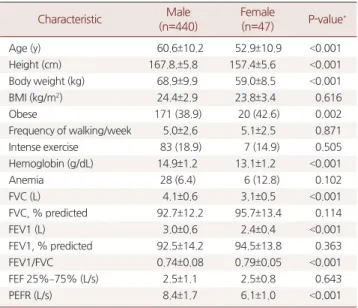
대상자 487명 중 남성은 440명이었으며 이들의 평균 만 나이는 60.6±10.2세였다. 그리고 여성은 47명, 평균 나이는 52.9±10.9세로 남 성에 비해 유의하게 나이가 적었다. 신장은 167.8.±5.8 cm (P<0.001), 체 중은 68.9±9.9 kg (P<0.001), 혈색소는 14.9±1.2 g/dL (P<0.001), FVC 4.1±0.6 L (P<0.001), FEV1 3.0±0.6 L (P<0.001), PEFR 8.4±1.7 L/s (P<0.001) 모두 남성이 유의하게 더 높았다. 체질량지수는 남녀 간에 통계적으 로 유의한 차이가 없었으나 비만비율은 여성에서 42.6% (P=0.002),
Table 1. General characteristics of study participants Characteristic Male
(n=440)
Female
(n=47) P-value*
Age (y) 60.6±10.2 52.9±10.9 <0.001
Height (cm) 167.8.±5.8 157.4±5.6 <0.001
Body weight (kg) 68.9±9.9 59.0±8.5 <0.001
BMI (kg/m2) 24.4±2.9 23.8±3.4 0.616
Obese 171 (38.9) 20 (42.6) 0.002
Frequency of walking/week 5.0±2.6 5.1±2.5 0.871
Intense exercise 83 (18.9) 7 (14.9) 0.505
Hemoglobin (g/dL) 14.9±1.2 13.1±1.2 <0.001
Anemia 28 (6.4) 6 (12.8) 0.102
FVC (L) 4.1±0.6 3.1±0.5 <0.001
FVC, % predicted 92.7±12.2 95.7±13.4 0.114
FEV1 (L) 3.0±0.6 2.4±0.4 <0.001
FEV1, % predicted 92.5±14.2 94.5±13.8 0.363
FEV1/FVC 0.74±0.08 0.79±0.05 <0.001
FEF 25%–75% (L/s) 2.5±1.1 2.5±0.8 0.643
PEFR (L/s) 8.4±1.7 6.1±1.0 <0.001
Values are presented as mean±standard deviation or number (%)
BMI, body mass index calculated as weight in kilograms divided by height in me- ters squared; FVC, forced vital capacity; FEV1, forced expiratory volume in 1 sec- ond; FEF 25%–75%, forced expiratory flow 25%–75%; PEFR, peak expiratory flow rate.
*Unpaired t-test for continuous variables and Pearson’s chi-square test for dis- crete variables.
www.kafm.or.kr 정용준 외. 비흡연자의 폐기능과 혈색소, 빈혈과의 관련성
Korean J Fam Pract. 2016;6(4):371-374
373
Korean Journal of Family Practice
KJFP
FEV1/FVC는 0.79±0.05 (P<0.001)로 남성보다 유의하게 더 높은 수치 를 보였다(Table 1).
2. 폐기능검사 지표들의 빈혈, 혈색소에 대한 영향
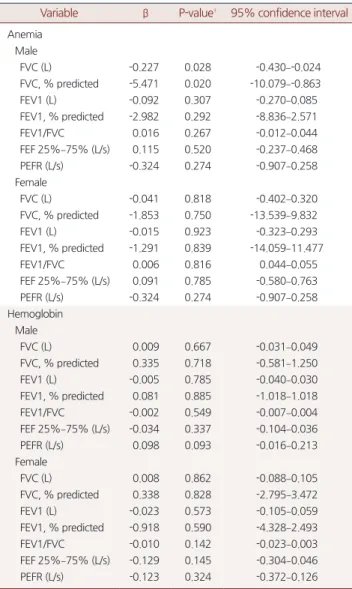
폐기능검사 지표들의 빈혈에 대한 영향을 알기 위하여 폐기능검 사 지표들을 원인변수로, 빈혈 유무를 독립변수로 두고 남성과 여성 각각에서 만 나이, 신장, 체중, 주당걷기 일수, 고강도 신체활동 여부 를 보정하여 다변량 회귀분석을 하였다. 그 결과 남성에서는 FVC (β=-0.227, P=0.028), FVC % predicted (β=-5.471, P=0.020)에서 빈혈 시 음의 영향을 주고 있었고, FEV1, FEV1/FVC, FEF 25%–75%, PEFR 등
다른 폐기능검사 지표와는 유의한 영향을 보이지 않았다. 그리고 여 성에서는 모두 유의한 영향을 보이지 않았다. 또한 폐기능검사 지표 들의 혈중 평균 혈색소 농도에 대한 영향을 알기 위하여 동일한 방법 으로 다변량 회귀분석을 시행하였다. 그 결과 남녀 모두에서 폐기능 검사 지표들은 혈색소 농도에 유의한 영향을 보이지 않았다(Table 2).
고 찰
흡연이 폐기능을 감소시킨다는 사실은 이미 많은 연구를 통하여 잘 알려져 있다.6-8) Fletcher 등6)의 연구에서는 흡연량에 비례하여 폐 기능의 매년 감소율도 비례하여 감소한다고 하였고, Xu 등9)의 연구 에서는 흡연자는 비흡연자와 과거 흡연자에 비하여 FEV1 감소가 의 미 있게 더 심하다고 하였다. 흡연으로 인한 폐기능의 감소는 혈색소 증가에 영향을 미친다. Mahsud 등10)이 발표한 연구에서는 흡연이 전 혈에서의 혈색소를 증가시키는 것과 관련이 있다고 하였고, Milman 과 Pedersen11)의 연구에서는 흡연이 여성과 남성 모두에게서 혈색소 증가 효과가 있다고 하였다.
본 연구는 폐기능에 영향을 미칠 수 있는 호흡기 질환을 가진 자 들을 제외하고 비흡연자들을 대상으로, 폐기능과 빈혈, 혈색소 사이 의 관련성을 알아본 연구이다. 폐기능검사 지표들과 빈혈과의 관련 성에서 남성의 경우 FVC에서 빈혈 시 음의 영향을 주고 있었고 나머 지 다른 폐기능검사 지표와는 관련성을 보이지 않았다. 그리고 여성 에서는 모두 유의한 영향을 보이지 않았다. 그리고 남녀 모두에서 폐 기능검사 지표들은 혈색소 농도에 유의한 영향을 보이지 않았다. 결 론적으로 폐기능과 빈혈, 혈색소 간에 통계적으로 명확한 상관관계 를 확인할 수 없었다. 따라서 비흡연자이며 호흡기 질환이 없는 성인 에서 폐기능에 따른 혈색소, 빈혈의 변화는 의미가 미약할 것으로 판단된다.
본 연구는 몇 가지 제한점을 가진다. 첫째, 국민건강영양조사에서 흡연, 호흡기 질환을 제외하고 남은 인원으로 분석을 하였기에 빈혈 대상자 수는 남성이 28명, 여성이 6명으로서 통계적 유의성을 확인 하기에 제한된 숫자로 여겨질 수 있다. 둘째로 폐기능에 영향을 줄 수 있는 호흡기질환을 모두 배제하고 연구를 진행하기 위해 폐결핵, 천식, 폐암, 만성폐쇄성 호흡부전을 진단 받은 대상자를 모두 제외했 지만, 이는 국민건강영양조사의 설문조사에 의존한 것으로 질병을 앓고 있지만 의사의 진단을 받은 적이 없거나 진단 받은 것을 알지 못하는 참여자들이 연구에 포함되어 있을 가능성을 완전히 배제할 수 없다. 셋째, 국민건강영양조사를 이용한 단면연구로서, 폐기능과 빈혈, 혈색소 사이의 시간적 선후관계나 인과관계를 밝히기 어렵다 는 제한점이 있다.
Table 2. Multiple regression analysis of anemia*, hemoglobin* on pul- monary function in male and female
Variable β P-value† 95% confidence interval Anemia
Male
FVC (L) -0.227 0.028 -0.430–-0.024
FVC, % predicted -5.471 0.020 -10.079–-0.863
FEV1 (L) -0.092 0.307 -0.270–0.085
FEV1, % predicted -2.982 0.292 -8.836–2.571
FEV1/FVC 0.016 0.267 -0.012–0.044
FEF 25%–75% (L/s) 0.115 0.520 -0.237–0.468
PEFR (L/s) -0.324 0.274 -0.907–0.258
Female
FVC (L) -0.041 0.818 -0.402–0.320
FVC, % predicted -1.853 0.750 -13.539–9.832
FEV1 (L) -0.015 0.923 -0.323–0.293
FEV1, % predicted -1.291 0.839 -14.059–11.477
FEV1/FVC 0.006 0.816 0.044–0.055
FEF 25%–75% (L/s) 0.091 0.785 -0.580–0.763
PEFR (L/s) -0.324 0.274 -0.907–0.258
Hemoglobin Male
FVC (L) 0.009 0.667 -0.031–0.049
FVC, % predicted 0.335 0.718 -0.581–1.250
FEV1 (L) -0.005 0.785 -0.040–0.030
FEV1, % predicted 0.081 0.885 -1.018–1.018
FEV1/FVC -0.002 0.549 -0.007–0.004
FEF 25%–75% (L/s) -0.034 0.337 -0.104–0.036
PEFR (L/s) 0.098 0.093 -0.016–0.213
Female
FVC (L) 0.008 0.862 -0.088–0.105
FVC, % predicted 0.338 0.828 -2.795–3.472
FEV1 (L) -0.023 0.573 -0.105–0.059
FEV1, % predicted -0.918 0.590 -4.328–2.493
FEV1/FVC -0.010 0.142 -0.023–0.003
FEF 25%–75% (L/s) -0.129 0.145 -0.304–0.046
PEFR (L/s) -0.123 0.324 -0.372–0.126
FVC, forced vital capacity; FEV1, forced expiratory volume in 1 second; FEF 25%–75%, forced expiratory flow 25%–75%; PEFR, peak expiratory flow rate.
*Adjusted for age, height, weight, and intense exercise. †P-value was taken by multiple linear regression test.
Yong-Joon Jeong, et al. The Association between Pulmonary Function and Hemoglobin, Anemia in Non-Smokers
www.kafm.or.kr
374
Korean J Fam Pract. 2016;6(4):371-374Korean Journal of Family Practice
KJFP
그렇지만 이번 연구는 우리나라 일반 인구를 대표하는 신뢰성을 갖춘 통계인 국민건강영양조사의 자료를 분석하였다는 장점이 있으 며, 폐기능에 영향을 줄 수 있는 흡연 및 호흡기 질환을 처음부터 배 제하여 보다 직접적으로 폐기능과 빈혈, 혈색소 사이의 관계에 대해 고찰해 보고자 한 것도 본 연구의 장점이라고 할 수 있다. 이번 연구 결과 폐기능이 빈혈, 혈색소에 영향을 미치는 요소라고 결론지을 수 는 없으나, 향후 더 많은 표본을 대상으로 한 추가적인 연구를 통해 이에 대한 관련성을 찾는 연구가 지속될 필요가 있다.
요 약
연구배경:
흡연은 폐기능의 감소를 유발하며 혈색소에 영향을 미 친다. 하지만 건강한 비흡연자의 폐기능과 빈혈, 혈색소 간의 관계에 관한 연구는 적은 실정이다. 이에 본 연구는 건강한 비흡연자의 폐기 능과 빈혈, 혈색소 사이의 연관성에 관해 알아보았다.방법:
본 연구는 2013년도부터 2015년까지 시행된 제6기 국민건강영 양조사 자료를 이용하였다. 폐기능검사를 시행한 2,886명 중 흡연자 및 폐결핵, 천식, 폐암, 만성폐쇄성 호흡부전 등 호흡기질환이 있는 자를 제외하고 남은 487명을 분석의 대상으로 하였다. 강제 폐활량, 1초 강제 호기량, 1초 강제 호기량의 폐활량에 대한 비율, 최고 중간 호기 유속, 최고 호기 유속 등 폐기능검사 지표들을 원인변수로 두 고 빈혈 유무, 혈색소 농도를 독립변수로 하였으며, 남녀 각각에서 만 나이, 신장, 체중, 주당걷기 일수, 고강도 신체활동 여부를 보정하 여 다변량 회귀분석을 하였다결과:
폐기능검사 지표들의 빈혈과의 관련성에서 남성의 경우 강제 폐활량에서 빈혈 시 음의 영향을 주고 있었고 나머지 다른 폐기능검 사 지표와는 관련성을 보이지 않았다. 그리고 여성에서는 모두 유의 한 영향을 보이지 않았다. 그리고 남녀 모두에서 폐기능검사 지표들 은 혈색소 농도에 유의한 영향을 보이지 않았다.결론:
건강한 비흡연자에서 폐기능과 빈혈, 혈색소 사이의 명확한 상관관계를 확인할 수 없었다.중심단어:
빈혈; 혈색소; 폐기능검사REFERENCES
1. Choi CW. Diagnosis and treatment of anemia: an out-patient approach. Ko- rean J Fam Med 2003; 24: 303-11.
2. Park SY. Diagnostic approach to patients with anemia. J Korean Med Assoc 2006; 49: 868-73.
3. Yun SH, Choi YH, Moon YS, Ahn SH, Kim TG. Difference in hemoglobin between smokers and non-smokers. Korean J Fam Med 2002; 23: 80-6.
4. Shah BK, Nepal AK, Agrawal M, Sinha AK. The effects of cigarette smoking on hemoglobin levels compared between smokers and non-smokers. Sun- sari Technical College Journal 2012; 1: 42-4.
5. Ashish G, Desh D, Naveen G. Study of relationship of tobacco smoking with haemoglobin concentration in healthy adult. J Pharm Biomed Sci 2010; 1:
1-3.
6. Fletcher C. The natural history of chronic bronchitis and emphysema: an eight-yearstudy of early chronic obstructive lung disease in working men in London. London: Oxford University Press; 1976.
7. Buist AS, Nagy JM, Sexton GJ. The effect of smoking cessation on pulmo- nary function: a 30-month follow-up of two smoking cessation clinics. Am Rev Respir Dis 1979; 120: 953-7.
8. Camilli AE, Burrows B, Knudson RJ, Lyle SK, Lebowitz MD. Longitudinal changes in forced expiratory volume in one second in adults. Effects of smoking and smoking cessation. Am Rev Respir Dis 1987; 135: 794-9.
9. Xu X, Dockery DW, Ware JH, Speizer FE, Ferris BG Jr. Effects of cigarette smoking on rate of loss of pulmonary function in adults: a longitudinal as- sessment. Am Rev Respir Dis 1992; 146: 1345-8.
10. Mahsud MAJ, Khan A, Hussain J. Hematological changes in tobacco using type II diabetic patients. Gomal J Med Sci 2010; 8: 8-11.
11. Milman N, Pedersen A. Blood haemoglobin concentrations are higher in smokers and heavy alcohol consumers than in non-smokers and abstainers:
should we adjust the reference range? Ann Hematol 2009; 88: 687-94.