520 Korean Chem. Eng. Res., 55(4), 520-529 (2017)
https://doi.org/10.9713/kcer.2017.55.4.520 PISSN 0304-128X, EISSN 2233-9558
Viscometric Studies of Molecular Interactions in Binary Mixtures of Formamide with Alkanol at 298.15 and 308.15 K
Suman Gahlyan, Sweety Verma, Manju Rani* and Sanjeev Maken†
Department of Chemistry, Deenbandhu Chhotu Ram University of Science and Technology, Murthal-131 039, India
*Department of Chemical Engineering, Deenbandhu Chhotu Ram University of Science and Technology, Murthal-131 039, India (Received 20 February 2017; Received in revised form 27 March 2017; accepted 31 March 2017)
Abstract − Viscosity data were measured at 298.15 K and 308.15 K for formamide + 1-propanol, 2-propanol, 1-butanol, 2-methyl-1-propanol or 2-methyl-2-propanol mixtures. For an equimolar mixture, deviation in viscosity follows the sequence:
2-methyl-2-propanol >2-methyl-1-propanol>1-butanol>2-propanol>1-propanol. The viscosity data were further analyzed in terms of graph theory. Free energy of activation was also calculated from experimental viscosity data along with previ- ously reported excess volume data. The deviation in viscosity and free energy of activation were fitted to Redlich-Kister polyno- mial equation. The viscosity data were also correlated by correlations like Grunberg-Nissan, Tamura-Kurata, Hind- McLaughlin-Ubbelohde, and Katti-Chaudhari relation. Various adjustable parameters, G12, T12, H12, and Wvis/RT, of var- ious correlations were used to predict viscosity deviation of binary mixtures. Positive value of G12 indicates strong inter- action in the studied systems. Grunberg-Nissan relation has lowest deviation among the four correlations for formamide + 1-propanol or 2-propanol mixtures; and for mixtures of formamide with 1-butanol or 2-methyl-1-propanol, Tamura- Kurata has lowest deviation. Grunberg-Nissan gives lowest deviation for formamide + 2-methyl-2-propanol mixtures.
Key words: Viscosity, Graph theoretical approach, Formamide, Butanol, Propanol, Intermolecular interactions
1. Introduction
Viscosity of various binary mixtures was measured extensively to correlate and derive its relation with other physical properties to get significant knowledge about the various types of molecular interac- tions taking place in the binary mixtures. This is very important for the solutions of many engineering problems concerning heat, mass transport and fluid flow [1,2]. Viscosity data on various liquids and liquid mixtures at varying temperature and pressures have been reported from time to time [3-8]. Formamide was selected for this study, as it is the simplest amide that contains a peptide linkage, the fundamental building block of proteins. Formamide molecules are highly polar [9] and are strongly self-associated through extensive three-dimensional network of hydrogen bonds, through its three hydro- gen bond donors (3 H-atoms) and three acceptors (two lone pairs of electrons at oxygen and one on nitrogen atom). Alcohols are self- associated organic compounds through hydrogen bonding of their hydroxyl groups. These are biologically and industrially important amphiphilic materials.
Amide-alkanol mixtures have been widely studied as both are bio- logically interesting compounds. The excess and deviation of a ther- modynamic property of their binary mixture as function of composition, temperature and pressure could be a very effective tool to get infor-
mation about molecular structure and intermolecular forces in liquid mixtures.
Ultrasonic and viscosity measurements of formamide with etha- nol, 1-propanol, 1,2-ethanediol and 1,2-propanediol at temperatures of 293.15 to 318.15 K were performed by Nain [10]. Densities and viscosities of formamide with polar 2-alkanol (C1-C7) were reported by Almasi as a function of composition and temperatures and inter- preted the data in terms of the statistical associating fluid theory and perturbed chain statistical associating fluid theory [2]. Kondaiah et al. measured the volumetric and viscometric properties of propanoic acid in equimolar mixtures of N,N-dimethyl formamide + alkanols [5].
Negative and positive values of various excess and deviation param- eters were attributed to the existence of strong interactions, like dipole-dipole interactions, H-bonding between the carbonyl group of acid molecules and hydroxyl group of alcohol groups. The viscosity of formamide with 2-methoxyethanol and 2-ethoxyethanol was dis- cussed in terms of molecular interactions due to physical, chemical and structural effects between the unlike molecules [8]. Gracia et al.
and Gomez Marigliano and Solimo also studied formamide with alkanol (C1-C3) and observed the sigmoid behavior in viscosity deviation versus mole fraction of formamide curves [11,12].
We have reported excess volume, enthalpy and ultrasonic velocity data for formamide + alkanol in our previous publications [13-19]. In the present paper, viscosity data at 298.15 K and 308.15 K for formamide + 1-propanol, 2-propanol, 1-butanol, 2-methyl-1-propanol or 2-methyl- 2-propanol mixtures are reported. The viscosity data were correlated by using various correlations like Grunberg-Nissan, Tamura-Kurata, Hind-McLaughlin-Ubbelohde, Katti-Chaudhari relation. The measured
†To whom correspondence should be addressed.
E-mail: [email protected]
This is an Open-Access article distributed under the terms of the Creative Com- mons Attribution Non-Commercial License (http://creativecommons.org/licenses/by- nc/3.0) which permits unrestricted non-commercial use, distribution, and reproduc- tion in any medium, provided the original work is properly cited.
data were further analyzed in terms of graph theory and free energy of activation was also calculated from experimental viscosity data employing excess volume data [17].
2. Experimental
Formamide, 1-propanol, 2-propanol, 1-butanol, 2-methyl-1-propa- nol or 2-methyl-2-propanol mixtures (Merck or Sigma) were purified by standard procedures [14,19,20]. Refractive indices were mea- sured with a thermostatically controlled Abbe refractometer (OSAW, India) using sodium D-line with an accuracy of ±0.001 unit. The temperature of water thermostat was controlled to ±0.01 K by a mer- cury-in-toluene regulator. The binary mixtures were prepared by weight using a weighing balance (Shimadzu UniBloc 321-62900-64, AUX 120), which can measure with an accuracy of ±0.00001 g and accu- racy in mole fraction is ±0.0001. Viscosities in the pure liquids and their binary mixtures were measured by using a modified suspended level Ubbelodhe viscometer. The viscometer was calibrated at work- ing temperatures beforehand. A freshly distilled liquid was filled in the reservoir of the viscometer through the side tube. Then it was clamped gently at the top in a vertical position after immersing it to an appropriate depth in the water thermostat to maintain the required temperature. To avoid the change in the effective length of capillary from one reading to another, the viscometer was hung exactly verti- cal. After remaining in bath for about 30 minutes, the liquid was drawn up through the capillary tube into bulb. The time of flow of each liq- uid was measured at least 3~4 times until reproducible timing was attained. The characteristic constants A and B of viscometer were then determined from the measured times of flow of two liquids of known viscosities at desired temperatures using following equation:
where υi, ηi and ρi are the kinematic viscosity, absolute viscosity and density of pure liquids respectively and ti is the time of flow in seconds. The dynamic viscosity, η, is deduced with an uncer- tainty of ±0.003×10⁻³ Ns m−2. For viscometer, the values of con-
stants at 298.15 K, A=4.2673×10⁻⁹ m2S−2, B=1.984×10⁻⁶ m2 and at 308.15 K are A=4.32×10⁻⁹ m2s−2, B=8.6×10⁻⁸ m2, respectively.
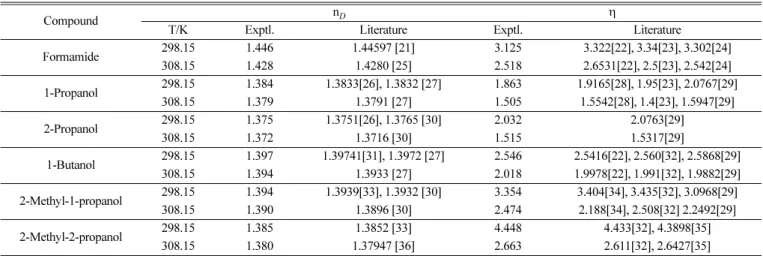
The purities of purified samples were checked by measuring vis- cosities and refractive indices of the pure compounds and these agree well with their respective literature values as shown in Table 1. The purified samples were also analyzed by gas chromatography for their purity and found to have better than 99.6 wt%.
3. Results and Discussion
Experimental values of viscosities of binary mixture of forma- mide with 1-propanol, 2-propanol, 1-butanol, 2-methyl-1-propanol or 2-methyl-2-propanol over the entire composition range at 298.15 and 308.15 K were reported in Table 2. Viscosity deviation (Δη) of various binary mixtures was calculated using Eq. (1)
Δη = η − x1η1− x2η2 (1)
In the above equation, η represents the measured viscosity of binary mixture; the symbols η1 and η2 refer to the viscosity of pure components of the mixture. The Δη data were also fitted to the following Redlich-Kister equation [37]:
(2)
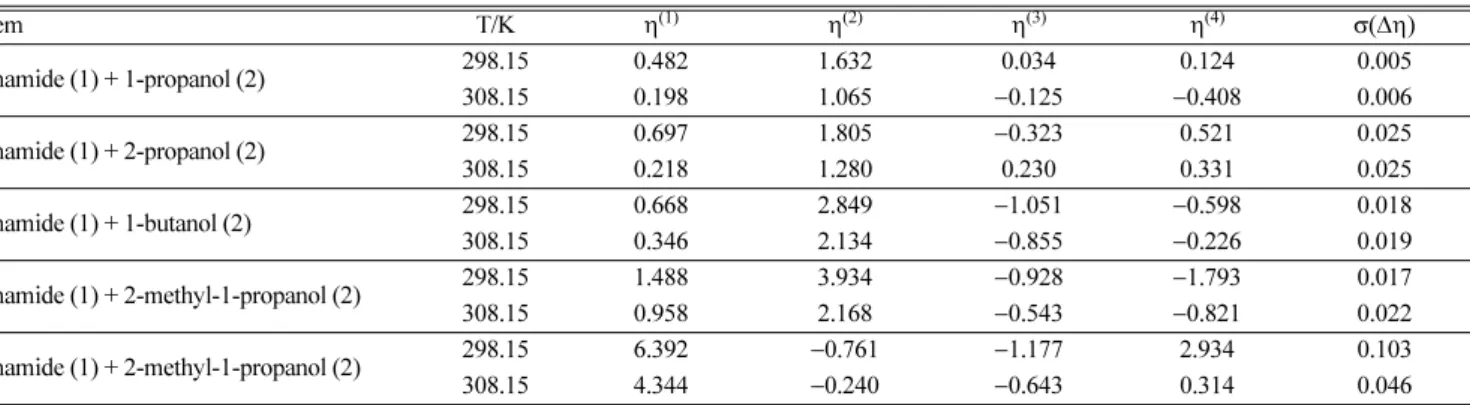
where η(n) are the adjustable parameters, and x1 is the mole fraction of formamide in formamide (1) + alkanol (2) mixture. These parameters were evaluated by fitting measured Δη data to Eq. (2) by the least squares method and reported in Table 3 along with the standard deviations σ(Δη) of Δη.
(3)
where m is the number of experimental values, and n is the num- ber of adjustable parameters in Eq. (2). The choice of n to have 1~4 values was dictated by the consideration that the maximum deviation σmax (Δη) of Δη (as calculated from Eq. (2) from the υi=ηi/ρi=Ati–B/ti
Δη x1(1 x– 1) η( )n(1 2x– 1)n
n 1=
∑
4=
σ Δη( )={[
∑
(Δηexptl.–Δηcalcd. Eq. 2( ( )))2]/ m n( – )}1/2Table 1. Comparison of experimental values of refractive index, nD and viscosity, η(m Ns m−2) of pure liquids with the corresponding literature values
Compound nD η
T/K Exptl. Literature Exptl. Literature
Formamide 298.15 1.446 1.44597 [21] 3.125 3.322[22], 3.34[23], 3.302[24]
308.15 1.428 1.4280 [25] 2.518 2.6531[22], 2.5[23], 2.542[24]
1-Propanol 298.15 1.384 1.3833[26], 1.3832 [27] 1.863 1.9165[28], 1.95[23], 2.0767[29]
308.15 1.379 1.3791 [27] 1.505 1.5542[28], 1.4[23], 1.5947[29]
2-Propanol 298.15 1.375 1.3751[26], 1.3765 [30] 2.032 2.0763[29]
308.15 1.372 1.3716 [30] 1.515 1.5317[29]
1-Butanol 298.15 1.397 1.39741[31], 1.3972 [27] 2.546 2.5416[22], 2.560[32], 2.5868[29]
308.15 1.394 1.3933 [27] 2.018 1.9978[22], 1.991[32], 1.9882[29]
2-Methyl-1-propanol 298.15 1.394 1.3939[33], 1.3932 [30] 3.354 3.404[34], 3.435[32], 3.0968[29]
308.15 1.390 1.3896 [30] 2.474 2.188[34], 2.508[32] 2.2492[29]
2-Methyl-2-propanol 298.15 1.385 1.3852 [33] 4.448 4.433[32], 4.3898[35]
308.15 1.380 1.37947 [36] 2.663 2.611[32], 2.6427[35]
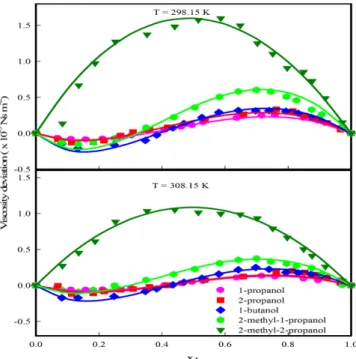
corresponding experimental Δη values) satisfied the relation σmax (Δη) ≤ 2σ(Δη). Comparison of experimental Δη values for the studied systems together with smoothing curves from Eq. (2) are shown in Fig. 1 and adjustable parameters η(n) along with standard
deviations σ(Δη) are recorded in Table 3.
It has been observed from Fig. 1 that Δη is negative at lower mole fraction (x1≤ 0.4) for all the studied binary mixtures except for for- mamide (1) + 2-methyl-2-propanol (2), for which Δη is positive over the entire composition range. Positive value of Δη indicates the pres- ence of strong specific interaction among unlike molecules. Large positive deviation in the formamide (1) + 2-methyl-2-propanol (2) Table 2. Experimental viscosity and viscosity deviation (×10−3 Ns M−2)
data for various (1+2) binary mixtures as functions of mole fractions of formamide
x1 η Δη x1 η Δη
Formamide (1) + 1-propanol (2); T = 298.15 K
0.0684 1.882 −0.068 0.5306 2.685 0.152
0.1116 1.922 −0.082 0.6374 2.879 0.211
0.1582 1.976 −0.087 0.6532 2.920 0.233
0.2120 2.054 −0.077 0.7166 3.010 0.242
0.2624 2.139 −0.055 0.7584 3.070 0.250
0.3030 2.211 −0.034 0.8496 3.148 0.213
0.4082 2.421 0.043 0.8958 3.166 0.172
0.4613 2.531 0.086 0.9658 3.155 0.072
0.4958 2.599 0.110
Formamide (1) + 1-propanol (2); T = 308.15 K
0.0684 1.547 −0.028 0.5306 2.102 0.059
0.1116 1.556 −0.063 0.6374 2.258 0.107
0.1582 1.602 −0.063 0.6532 2.284 0.117
0.2120 1.661 −0.060 0.7166 2.363 0.131
0.2624 1.716 −0.055 0.7584 2.395 0.121
0.3030 1.773 −0.040 0.8496 2.460 0.094
0.4082 1.920 0.001 0.8958 2.481 0.068
0.4613 1.999 0.026 0.9658 2.507 0.023
0.4958 2.054 0.046
Formamide (1) + 2-propanol (2); T = 298.15 K
0.0699 2.027 −0.082 0.5364 2.798 0.179
0.1139 2.029 −0.128 0.6585 3.015 0.263
0.1821 2.108 −0.124 0.7627 3.199 0.332
0.216 2.167 −0.102 0.8147 3.231 0.308
0.2685 2.293 −0.033 0.8526 3.209 0.245
0.308 2.385 0.016 0.8837 3.204 0.205
0.3604 2.472 0.046 0.9237 3.186 0.144
0.4178 2.571 0.082 0.9666 3.140 0.051
Formamide (1) + 2-propanol (2); T = 308.15 K
0.0699 1.580 −0.006 0.5364 2.130 0.077
0.1139 1.512 −0.118 0.6585 2.301 0.125
0.1821 1.589 −0.110 0.7627 2.467 0.186
0.216 1.650 −0.083 0.8147 2.535 0.202
0.2685 1.726 −0.060 0.8526 2.550 0.179
0.308 1.775 −0.049 0.8837 2.552 0.150
0.3604 1.857 −0.021 0.9237 2.553 0.111
0.4178 1.937 0.003 0.9666 2.554 0.069
Formamide (1) + 1-butanol(2); T = 298.15 K
0.0824 2.449 -0.146 0.6422 3.234 0.316
0.1332 2.413 -0.211 0.6975 3.262 0.311
0.2478 2.531 -0.160 0.7399 3.289 0.314
0.3473 2.648 -0.100 0.7935 3.311 0.305
0.3833 2.744 -0.025 0.8318 3.305 0.277
0.4346 2.874 0.076 0.8737 3.272 0.220
0.4697 2.953 0.134 0.9066 3.243 0.172
0.5271 3.071 0.220 0.9719 3.175 0.065
0.5804 3.173 0.290
Table 2. Continued
x1 η Δη x1 η Δη
Formamide (1) + 1-butanol(2); 308.15 K
0.0824 1.887 −0.173 0.6422 2.558 0.218
0.1332 1.913 −0.172 0.6975 2.616 0.249
0.2478 1.990 −0.153 0.7399 2.611 0.223
0.3473 2.109 −0.083 0.7935 2.596 0.180
0.3833 2.163 −0.047 0.8318 2.608 0.173
0.4346 2.243 0.008 0.8737 2.610 0.154
0.4697 2.297 0.044 0.9066 2.610 0.138
0.5271 2.381 0.099 0.9719 2.522 0.017
0.5804 2.467 0.158
Formamide (1) + 2-methyl-1-propanol (2); T = 298.15 K
0.0832 3.210 −0.125 0.6422 3.788 0.581
0.1344 3.170 −0.154 0.6997 3.797 0.603
0.1821 3.188 −0.125 0.7457 3.763 0.579
0.2497 3.226 −0.071 0.7952 3.681 0.508
0.3496 3.352 0.078 0.8263 3.623 0.457
0.4371 3.476 0.222 0.8748 3.481 0.327
0.5042 3.598 0.359 0.9066 3.410 0.263
0.5829 3.726 0.505 0.9722 3.199 0.067
Formamide (1) + 2-methyl-1-propanol (2); T = 308.15 K
0.0832 2.413 −0.065 0.6422 2.858 0.355
0.1344 2.392 −0.088 0.6997 2.879 0.373
0.1821 2.420 −0.062 0.7457 2.839 0.331
0.2497 2.483 −0.002 0.7952 2.813 0.303
0.3496 2.565 0.075 0.8263 2.785 0.274
0.4371 2.648 0.154 0.8748 2.756 0.243
0.5042 2.723 0.226 0.9066 2.676 0.161
0.5829 2.808 0.308 0.9722 2.523 0.005
Formamide (1) + 2-methyl-2-propanol (2); T = 298.15 K
0.0843 4.472 0.135 0.6482 5.086 1.497
0.1361 4.933 0.665 0.7026 4.766 1.249
0.1879 5.171 0.972 0.7515 4.554 1.102
0.2524 5.387 1.273 0.7975 4.297 0.906
0.3529 5.353 1.373 0.8492 4.176 0.854
0.4406 5.346 1.482 0.8764 4.012 0.726
0.5155 5.339 1.574 0.9182 3.718 0.487
0.5864 5.269 1.599 0.9726 3.310 0.151
Formamide (1) + 2-methyl-2-propanol (2); T = 308.15 K
0.0843 2.923 0.272 0.6482 3.555 0.986
0.1361 3.097 0.453 0.7026 3.495 0.934
0.1879 3.249 0.612 0.7515 3.344 0.789
0.2524 3.512 0.885 0.7975 3.210 0.662
0.3529 3.646 1.033 0.8492 3.043 0.503
0.4406 3.651 1.051 0.8764 2.947 0.410
0.5155 3.602 1.013 0.9182 2.791 0.261
0.5864 3.575 0.996 0.9726 2.586 0.063
mixture seems reasonable in view of weak intermolecular hydrogen bonding and van der Waals interactions due to bulkiness of tertiary alcohol in pure 2-methyl-2-propanol; while on mixing 2-methyl-2- propanol to formamide there is an increase in ability of alcoholic oxygen of 2-methyl-2-propanol (due to presence of three methyl group substituent on its carbon atom) to form hydrogen bond with formamide, which leads to strong interaction between unlike mole- cules. For the systems containing other alkanols, the Δη value is neg- ative for x1≤ 0.4. This may be due to breaking of intermolecular hydrogen bonding, and dipole-dipole interaction between monomer and polymer of like molecule. These effects overweigh the intermo- lecular hydrogen bonding between formamide and butanol due to lesser number of formamide molecules available for hydrogen bond- ing. As the concentration of formamide increases beyond x1> 0.4, Δη becomes positive due to increase in specific interactions between unlike molecules. The sigmoid behavior was also confirmed by Gra- cia et al. as well as by Gomez Marigliano and Solimo for viscosity
deviation of binary mixtures of formamide + 1-alkanol (C1-C3) [11, 12].
Δη values at equimolar composition for these systems follow the order: 2-methyl-2-propanol>2-methyl-1-propanol>1-butanol>2- propanol>1-propanol. The higher positive viscosity for 2-methyl-2- propanol over 2-methyl-1-propanol is due to branching of alkyl group and van der Waals interactions due to bulkiness of tertiary alcohol in 2-methyl-2-propanol. Thus, addition of formamide to 2-methyl-2- propanol favors the formation of intermolecular hydrogen bonding between unlike molecules resulting in more viscous solution than pure component [38]. While 1-butanol (due to greater hydrogen bond- ing and van der Waals dispersion forces in comparison to 2-methyl- 1-propanol) has weak intermolecular hydrogen bonding with forma- mide. So 2-methyl-1-propanol has larger Δη value than 1-butanol.
Same behavior was observed for the isomers of propanol as 2-propa- nol has higher value of Δη than 1-propanol. This is also due to pres- ence of two methyl groups as substituent on carbon atom in 2- propanol.
3-1. Graph Theory on Viscosity Deviation
An analysis of excess molar volume, VE, and excess molar enthalpy, HE, data of formamide (1) + alkanol (2) mixtures have revealed that formamide exists as dimer in propanol [14] and as tri- mer in butanol, and the mixture formation involves: (a) a mixing of 1n with 2n to establish 1n-2n; (b) these 1n-2n contacts between forma- mide and butanol would then cause rupture of intermolecular associ- ation in formamide and alkanol to yield monomer; (c) the monomers of formamide then interact with butanol to give 1-2 molecular entity.
The change in viscosity due to mixing processes (a), (b) and (c) is then expressed [39-42] by
(4)
According to Graph theory [43], if the atoms in a structural formula of a molecule are represented by vertices and bonds joining them by edges, then the resulting graph describes the totality of information contained in that molecule [44-47]. Consequently, if δmv, δnv… represents the degrees of mth and nth vertices of the graph of a molecule, then connectivity parameters of third degree, ξi, are
Δη x1x2V2 xiVi
---
∑
[χ12+(2x1+x2)χ*]= Fig. 1. Viscosity deviation of binary mixture of formamide (1) +
alkanol (2). Solid line represents values calculated from Eq.
( ) and symbol represents experimental value.
Table 3. Adjustable parameters, η(n), of Redlich-Kister Eq. (2) along with standard deviation, σ(Δη)
System T/K η(1) η(2) η(3) η(4) σ(Δη)
Formamide (1) + 1-propanol (2) 298.15 0.482 1.632 0.034 0.124 0.005
308.15 0.198 1.065 −0.125 −0.408 0.006
Formamide (1) + 2-propanol (2) 298.15 0.697 1.805 −0.323 0.521 0.025
308.15 0.218 1.280 0.230 0.331 0.025
Formamide (1) + 1-butanol (2) 298.15 0.668 2.849 −1.051 −0.598 0.018
308.15 0.346 2.134 −0.855 −0.226 0.019
Formamide (1) + 2-methyl-1-propanol (2) 298.15 1.488 3.934 −0.928 −1.793 0.017
308.15 0.958 2.168 −0.543 −0.821 0.022
Formamide (1) + 2-methyl-1-propanol (2) 298.15 6.392 −0.761 −1.177 2.934 0.103
308.15 4.344 −0.240 −0.643 0.314 0.046
defined [47] by Eq. (5):
(5)
where δmv… reflects explicitly the valency of mth vertex in molec- ular graph of i (i=1 or 2) and is related [47] to maximum valency, Zm, and number of H-atoms, hm, attached to mth... vertex by the relation:
(6)
The 3ξi values for the compound selected for the present mixtures are reported elsewhere [14]. Further, Kier [44] has suggested that the information regarding the effect of branching in the molecules can be obtained by evaluation of 3ξi of molecules. It has been found that 3ξi for various isomers of heptane follow the order: n-heptane
< 3-methyl hexane < 2,3-dimethylpentane, and the sequence for their molar volume is the reverse of this [14]. The 3ξi values for the pure compounds are recorded in Table 4.
Thus V2/V1=(3ξ1/3ξ2), and Eq. (4) then reduces to:
(7)
The derivation of Eq. (7) and assumptions made therein were dis- cussed earlier [15,17]. Calculation of Δη from Eq. (7) requires the knowledge of two unknown interaction parameters χ12* and χ*. These parameters are calculated using ηE data at two compo- sitions (x1=0.4 and 0.5) for various binary mixtures, and parameters χ12 and χ* along with (3ξi) values calculated from Graph theoret- ical approach [14] are recorded in Table 4. These were subsequently used to evaluate Δη at other mole fraction (x1). Such values of Δη are recorded in Table 5. As the calculated Δη was found to compare well with their corresponding experimental data (Fig. 2), this lends further support to the assumptions made in the deriva- tion of Eq. (7).
Gibbs free energy of activation is calculated using Eyring viscos- ity equation
G*E= RT (8)
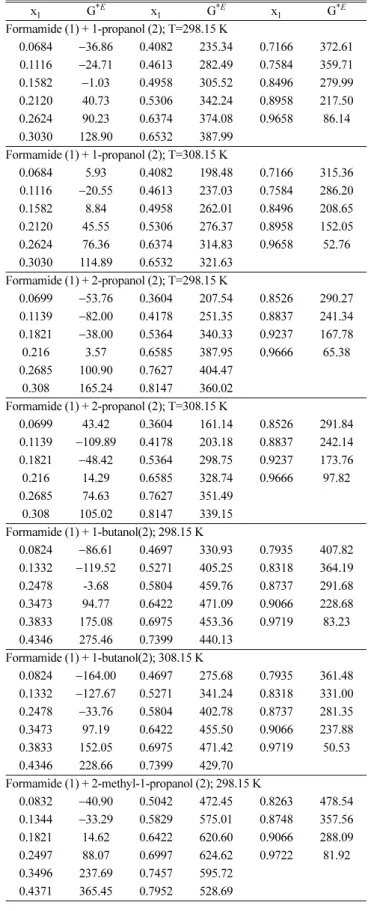
where G*E is the free energy of activation, R is the gas constant, T is temperature, η is viscosity of binary mixture, Vi and ηi are the molar volumes and molar viscosities of pure components, respec- tively. The G*E data were also fitted to Redlich-Kister Eq. (2).
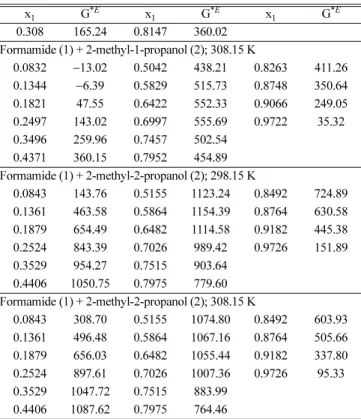
Adjustable parameters G*(n) and standard deviations σ(G*E) were recorded in Table 6 and compared with smoothing curves from Redlich-Kister equation in Fig. 3, and G*E values are tabulated in Table 7.
Excess Gibbs free energy of activation is negative at lower mole fraction for all the studied binary mixtures. Positive value of excess Gibbs free energy of activation indicates the presence of specific interaction among unlike molecules. Negative value of excess Gibbs free energy of activation indicates the presence of weak interaction among unlike molecules and strong interaction among like mole- cules. Excess Gibbs free energy of activation follows the order: 2- methyl-2-propanol>2-methyl-1-propanol>1-butanol>2-propanol>
1-propanol.
3ξ
i δm
vδn vδo
vδp
( v)–0.5
m n o p< < <
∑
=
δm
v =Zm–hm
Δη x1x2(3ξ1/3ξ2) x1+x2(3ξ1/3ξ2)
--- [χ12+(2x1+x2)χ*]
=
Vη
( )
ln xiln(Viηi)
i 1=
∑
2⎝ – ⎠
⎛ ⎞
Table 4. Values of the various (3ξi) parameters, χ12 and χ* involved in Graph theoretical approach
System Temp. 3ξ1 3ξ2 χ12 χ*
Formamide (1) + 1-propanol (2) 298.15 0.312 0.4082 −5.161 3.811
308.15 0.312 0.4082 −3.482 2.474
Formamide (1) + 2-propanol (2) 298.15 0.312 0.4714 −6.491 4.910
308.15 0.312 0.4714 −4.400 3.115
Formamide (1) + 1-butanol (2) 298.15 0.312 0.7020 −13.825 9.940
308.15 0.312 0.7020 −10.419 7.321
Formamide (1) + 2-methyl-1-propanol (2) 298.15 0.312 0.5000 −14.478 10.943
308.15 0.312 0.5000 −7.972 6.146
Formamide (1) + 2-methyl-1-propanol (2) 298.15 0.312 0.6123 1.937 5.021
308.15 0.312 0.6123 0.575 3.906
Fig. 2. Comparison of experimental viscosity deviation with the values predicted using graph theory. Solid line represents graph theory and symbol represents experimental value.
Experimental values of viscosities of the present binary systems were also correlated using the following relations.
Grunberg and Nissan [48] suggested a logarithmic relation between Table 5. Viscosity deviation, Δη(×10−3 Ns M−2), values calculated from
Redlich Kister Eq. and Graph Theory
x1
Δη
T = 298.15 K T = 308.15 K
Exptl Graph Exptl Graph
Formamide (1) + 1-propanol (2)
0.1 −0.078 −0.085 −0.047 −0.066
0.2 −0.082 −0.089 −0.064 −0.077
0.3 −0.037 −0.040 −0.047 −0.051
0.4 0.037 0.037 −0.004 −0.004
0.5 0.120 0.120 0.050 0.050
0.6 0.195 0.190 0.097 0.096
0.7 0.241 0.228 0.121 0.125
0.8 0.240 0.218 0.113 0.125
0.9 0.169 0.147 0.069 0.086
Formamide (1) + 2-propanol (2)
0.1 −0.110 −0.093 −0.075 −0.083
0.2 −0.098 −0.087 −0.086 −0.096
0.3 −0.023 −0.020 −0.059 −0.064
0.4 0.076 0.076 −0.008 −0.008
0.5 0.174 0.174 0.054 0.054
0.6 0.252 0.251 0.117 0.107
0.7 0.294 0.287 0.165 0.139
0.8 0.284 0.267 0.182 0.137
0.9 0.198 0.175 0.140 0.094
Formamide (1) + 1-butanol (2)
0.1 −0.178 −0.231 −0.161 −0.189
0.2 −0.207 −0.243 −0.191 −0.209
0.3 −0.126 −0.138 −0.132 −0.138
0.4 0.015 0.015 −0.027 −0.027
0.5 0.167 0.167 0.087 0.087
0.6 0.286 0.285 0.177 0.178
0.7 0.336 0.344 0.220 0.227
0.8 0.299 0.325 0.203 0.220
0.9 0.177 0.214 0.125 0.148
Formamide (1) + 2-methyl-1-propanol (2)
0.1 −0.120 −0.207 −0.063 −0.103
0.2 −0.131 −0.192 −0.058 −0.085
0.3 −0.025 −0.045 0.012 0.003
0.4 0.163 0.163 0.122 0.122
0.5 0.372 0.372 0.240 0.240
0.6 0.534 0.534 0.327 0.328
0.7 0.588 0.609 0.354 0.366
0.8 0.500 0.564 0.302 0.334
0.9 0.281 0.368 0.173 0.216
Formamide (1) + 2-methyl-2-propanol (2)
0.1 0.427 0.612 0.357 0.400
0.2 0.927 1.068 0.670 0.706
0.3 1.327 1.379 0.907 0.921
0.4 1.554 1.554 1.047 1.047
0.5 1.598 1.598 1.086 1.086
0.6 1.492 1.517 1.026 1.038
0.7 1.278 1.314 0.875 0.905
0.8 0.983 0.992 0.646 0.688
0.9 0.588 0.554 0.351 0.386
Table 6. Value of Gibbs excess molar free energy of activation (J mol−1) of binary mixture of formamide (1) + alkanol (2)
x1 G*E x1 G*E x1 G*E
Formamide (1) + 1-propanol (2); T=298.15 K
0.0684 −36.86 0.4082 235.34 0.7166 372.61 0.1116 −24.71 0.4613 282.49 0.7584 359.71 0.1582 −1.03 0.4958 305.52 0.8496 279.99 0.2120 40.73 0.5306 342.24 0.8958 217.50 0.2624 90.23 0.6374 374.08 0.9658 86.14 0.3030 128.90 0.6532 387.99
Formamide (1) + 1-propanol (2); T=308.15 K
0.0684 5.93 0.4082 198.48 0.7166 315.36 0.1116 −20.55 0.4613 237.03 0.7584 286.20 0.1582 8.84 0.4958 262.01 0.8496 208.65 0.2120 45.55 0.5306 276.37 0.8958 152.05 0.2624 76.36 0.6374 314.83 0.9658 52.76 0.3030 114.89 0.6532 321.63
Formamide (1) + 2-propanol (2); T=298.15 K
0.0699 −53.76 0.3604 207.54 0.8526 290.27 0.1139 −82.00 0.4178 251.35 0.8837 241.34 0.1821 −38.00 0.5364 340.33 0.9237 167.78
0.216 3.57 0.6585 387.95 0.9666 65.38
0.2685 100.90 0.7627 404.47 0.308 165.24 0.8147 360.02 Formamide (1) + 2-propanol (2); T=308.15 K
0.0699 43.42 0.3604 161.14 0.8526 291.84 0.1139 −109.89 0.4178 203.18 0.8837 242.14 0.1821 −48.42 0.5364 298.75 0.9237 173.76
0.216 14.29 0.6585 328.74 0.9666 97.82
0.2685 74.63 0.7627 351.49 0.308 105.02 0.8147 339.15 Formamide (1) + 1-butanol(2); 298.15 K
0.0824 −86.61 0.4697 330.93 0.7935 407.82 0.1332 −119.52 0.5271 405.25 0.8318 364.19 0.2478 -3.68 0.5804 459.76 0.8737 291.68 0.3473 94.77 0.6422 471.09 0.9066 228.68 0.3833 175.08 0.6975 453.36 0.9719 83.23 0.4346 275.46 0.7399 440.13
Formamide (1) + 1-butanol(2); 308.15 K
0.0824 −164.00 0.4697 275.68 0.7935 361.48 0.1332 −127.67 0.5271 341.24 0.8318 331.00 0.2478 −33.76 0.5804 402.78 0.8737 281.35 0.3473 97.19 0.6422 455.50 0.9066 237.88 0.3833 152.05 0.6975 471.42 0.9719 50.53 0.4346 228.66 0.7399 429.70
Formamide (1) + 2-methyl-1-propanol (2); 298.15 K
0.0832 −40.90 0.5042 472.45 0.8263 478.54 0.1344 −33.29 0.5829 575.01 0.8748 357.56 0.1821 14.62 0.6422 620.60 0.9066 288.09 0.2497 88.07 0.6997 624.62 0.9722 81.92 0.3496 237.69 0.7457 595.72
0.4371 365.45 0.7952 528.69
the viscosity of a liquid mixture (η) and that of its pure components (ηi),
(9)
where G12 is a constant that is regarded as a measure of the strength of the molecular interactions between the mixing com- ponents and is proportional to the interchange energy.
Tamura and Kurata [49] developed the following one parameter equation to predict the viscosity of binary mixtures.
(10)
where φi is the volume fraction of ith component and T12 is an adjustable parameter.
Hind, McLaughlin and Ubbelohde [50] proposed the following
equation to predict the viscosity of binary liquid mixtures
(11)
where H12 is the interaction parameter.
Katti and Chaudhari [51, 52] derived the following equation
(12)
where Wvis is an interaction term and Vi is the molar volume of pure component i. To numerically compare the estimation capability of the various relations, percentage standard deviations were cal- η exp (xilnηi)
i 1=
∑
2 G12 xi i 1=∏
2+
=
η xiφiηi i 1=
∑
2 2T12 (xiφi)1/2 i 1=∏
2+
=
η xi2ηi i 1=
∑
2 2H12 xi i 1=∏
2+
=
ηVm
ln xiln(ηiVi) x+ 1x2(Wvis/RT)
i 1=
∑
2=
Fig. 3. Gibbs free energy of activation of binary mixture of forma- mide (1) + alkanol (2).
Table 6. Continued
x1 G*E x1 G*E x1 G*E
0.308 165.24 0.8147 360.02 Formamide (1) + 2-methyl-1-propanol (2); 308.15 K
0.0832 −13.02 0.5042 438.21 0.8263 411.26 0.1344 −6.39 0.5829 515.73 0.8748 350.64 0.1821 47.55 0.6422 552.33 0.9066 249.05 0.2497 143.02 0.6997 555.69 0.9722 35.32 0.3496 259.96 0.7457 502.54
0.4371 360.15 0.7952 454.89 Formamide (1) + 2-methyl-2-propanol (2); 298.15 K
0.0843 143.76 0.5155 1123.24 0.8492 724.89 0.1361 463.58 0.5864 1154.39 0.8764 630.58 0.1879 654.49 0.6482 1114.58 0.9182 445.38 0.2524 843.39 0.7026 989.42 0.9726 151.89 0.3529 954.27 0.7515 903.64
0.4406 1050.75 0.7975 779.60 Formamide (1) + 2-methyl-2-propanol (2); 308.15 K
0.0843 308.70 0.5155 1074.80 0.8492 603.93 0.1361 496.48 0.5864 1067.16 0.8764 505.66 0.1879 656.03 0.6482 1055.44 0.9182 337.80 0.2524 897.61 0.7026 1007.36 0.9726 95.33 0.3529 1047.72 0.7515 883.99
0.4406 1087.62 0.7975 764.46
Table 7. Adjustable parameters, G(n), of Redlich-Kister Eq. along with standard deviation, σ(G*E) of the viscosity deviation Δη for the various (1+2) binary mixtures
System T/K G(1) G(2) G(3) G(4) σ(G*E)
Formamide (1) + 1-propanol (2) 298.15 1260.9 1447.8 −379.3 344.4 4.18
308.15 1062.3 1279.1 −419.9 −317.6 7.66
Formamide (1) + 2-propanol (2) 298.15 1361.3 1492.4 −769.2 894.3 22.57
308.15 1089.0 1468.2 −171.5 704.8 35.46
Formamide (1) + 1-butanol (2) 298.15 1436.3 2531.4 −1131.0 −207.6 16.18
308.15 1300.8 2489.1 −1238.5 131.8 19.48
Formamide (1) + 2-methyl-1-propanol (2) 298.15 1914.0 2947.5 −607.3 −961.7 10.18
308.15 1796.2 2182.8 −502.7 −431.6 20.06
Formamide (1) + 2-methyl-2-propanol (2) 298.15 4516.7 285.7 161.97 1901.16 53.13
308.15 4536.18 163.9 124.91 207.99 35.17
culated using following relation:
(13)
where n represents the number of experimental data points.
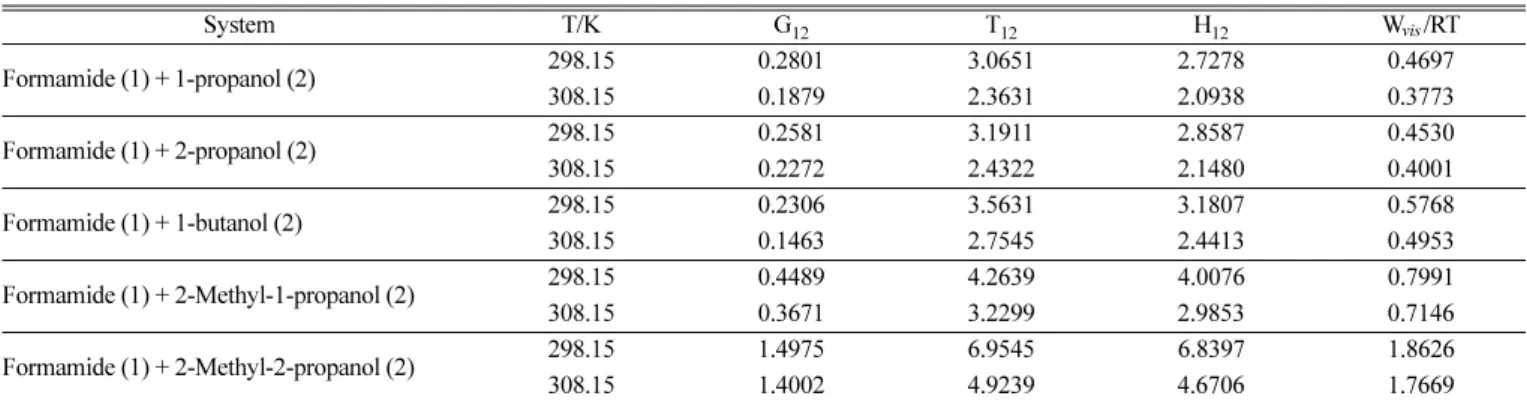
Adjustable parameters, G12, T12, H12, Wvis/RT of various correla- tions used to predict viscosity deviation for the present binary mix- tures are given in Table 8. Standard deviations of calculated values of viscosity using various correlations are given in Table 9.
Grunberg-Nissan relation has lowest deviation among the four correlations for formamide + 1-propanol or 2-propanol mixtures; and for mixtures of formamide with 1-butanol or 2-methyl-1-propanol, Tamura-Kurata has lowest deviation. Grunberg-Nissan gives lowest deviation for formamide + 2-methyl-2-propanol mixtures. Forte and Moore [53] and Ramamoorthy [54] reported that for a binary mix- ture, a positive value of G12 indicates the presence of the strongest interactions and a negative value means the presence of weak inter- action between components. On the basis of generalization we can conclude that like viscosity deviation, G12 values are positive, which shows strong interaction for all studied binary mixtures.
4. Conclusion
Viscosity data were measured at 298.15 K and 308.15 K for formamide + 1-propanol, 2-propanol, 1-butanol, 2-methyl-1-propa- nol or 2-methyl-2-propanol mixtures. For an equimolar mixture, vis-
cosity deviation follows the sequence: 2-methyl-2-propanol >2- methyl-1-propanol>1-butanol>2-propanol>1-propanol. The viscos- ity data were correlated by using various correlations like Grunberg- Nissan, Tamura-Kurata, Hind-McLaughlin-Ubbelohde, Katti-Chaud- hari relations. Various adjustable parameters G12, T12, H12, Wvis/RT of these correlations were used to predict viscosity deviation of binary mixtures. Positive value of G12 indicates strong interaction in the studied systems. For binary mixture of formamide with 1-propa- nol or 2-propanol, Grunberg-Nissan had lowest deviation. Tamura- Kurata showed lowest deviation for binary mixture of formamide with 1-butanol or 2-methyl-1-propanol, whereas for formamide and 2-methyl-2-propanol Grunberg-Nissan gave lowest deviation. The viscosity data were further analyzed in terms of graph theory. Free energy of activation was also calculated from experimental viscosity data employing previously reported excess volume data.
Acknowledgment
Suman Gahlyan thanks the University Grant Commission, India for the award of Senior Research Fellowship.
References
1. Iloukhani, H. and Mohammadlou, Z. B., “Densities, Viscosities, and Refractive Indices for Binary and Ternary Mixtures of For- mamide (1) + N,N-dimethylacetamide (2) + 2-methyl-1-butanol σ %( )
∑
{100(ηexptl.–ηtheo.)/ηexptl.}2n 1–
( )
---
1/2
=
Table 8. Adjustable parameters, G12, T12, H12, Wvis/RT of various correlations used to predict viscosity deviation Δη for the various (1+2) binary mixtures
System T/K G12 T12 H12 Wvis/RT
Formamide (1) + 1-propanol (2) 298.15 0.2801 3.0651 2.7278 0.4697
308.15 0.1879 2.3631 2.0938 0.3773
Formamide (1) + 2-propanol (2) 298.15 0.2581 3.1911 2.8587 0.4530
308.15 0.2272 2.4322 2.1480 0.4001
Formamide (1) + 1-butanol (2) 298.15 0.2306 3.5631 3.1807 0.5768
308.15 0.1463 2.7545 2.4413 0.4953
Formamide (1) + 2-Methyl-1-propanol (2) 298.15 0.4489 4.2639 4.0076 0.7991
308.15 0.3671 3.2299 2.9853 0.7146
Formamide (1) + 2-Methyl-2-propanol (2) 298.15 1.4975 6.9545 6.8397 1.8626
308.15 1.4002 4.9239 4.6706 1.7669
Table 9. Standard deviations of calculated values of viscosity using various correlations Grunberg-Nissan, Tamura-Kurata, Hind-McLaughlin- Ubbelohde, and Katti-Chaudhari
System T/K G-N T-K H-Mc-U Wvis/RT
Formamide (1) + 1-propanol (2) 298.15 4.457 4.619 5.040 4.692
308.15 3.218 3.373 3.556 3.446
Formamide (1) + 2-propanol (2) 298.15 5.516 5.554 6.081 5.723
308.15 5.015 5.455 5.783 5.375
Formamide (1) + 1-butanol (2) 298.15 6.317 5.907 6.551 6.914
308.15 6.269 6.036 6.444 6.867
Formamide (1) + 2-Methyl-1-propanol (2) 298.15 8.087 5.982 7.256 7.976
308.15 5.694 4.415 5.468 6.013
Formamide (1) + 2-Methyl-2-propanol (2) 298.15 3.230 4.400 2.372 3.754
308.15 1.232 4.763 1.498 1.405
(3) at 298.15 K for the Liquid Region and at Ambient Pressure,”
Arabian Journal of Chemistry, In press. http://dx.doi.org/10.1016/j.
arabjc.2016.12.004.
2. Almasi, M., “Densities and Viscosities of the Mixtures (forma- mide + 2-alkanol): Experimental and Theoretical Approaches,”
The Journal of Chemical Thermodynamics, 69, 101-106(2014).
3. Almasi, M., “'Densities and Viscosities of the Mixtures (forma- mide+2-alkanol): Experimental and Theoretical Approaches,”
The Journal of Chemical Thermodynamics, 69, 106(2014).
4. Mohammad, A. A., Alkhaldi, K. H. A. E., Altuwaim, M. S. and Al-Jimaz, A. S., “'Viscosity and Surface Tension of Binary Sys- tems of N,N-dimethylformamide with Alkan-1-ols at Different temperatures,” The Journal of Chemical Thermodynamics, 56, 113(2013).
5. Kondaiah, M., Sreekanth, K., Sravana Kumar D. and Krishna Rao D., “'Volumetric and Viscometric Properties of Propanoic acid in Equimolar Mixtures of N,N-dimethyl formamide + alkanols at T/K = 303.15, 313.15, and 323.15,” J. Solution Chem, 42, 494- 515(2013).
6. Habibullah, M., Rahman, I. M. M., Uddin, M. A., Anowar, M., Alam, M. and Iwakabe, K., et al., “Densities, Viscosities, and Speeds of Sound of Binary Mixtures of Heptan-1-ol with 1,4- Dioxane at Temperatures from (298.15 to 323.15) K and Atmo- spheric Pressure,” Journal of Chemical & Engineering Data, 58, 2887-2897(2013).
7. Rajagopal, K., Chenthilnath, S. and Nain, A. K., “Volumetric and Viscometric Studies in Binary Liquid Mixtures of 2-methyl- 2-propanol with Some ketones at Different Temperatures,” J.
Solution Chem, 41, 1401-1411(2012).
8. Awasthi, A. and Awasthi, A., “Intermolecular Interactions in Forma- mide + 2-alkoxyethanols: Viscometric Study,” Thermochimica Acta, 537, 57-64(2012).
9. Marcus, Y., “Introduction to Liquid State Chemistry,” New York, Wiley Interscience(1977).
10. Nain, A. K., “'Molecular Interactions in Binary Mixtures of For- mamide with 1-butanol, 2-butanol, 1,3-butanediol and 1,4-butanediol at Different Temperatures, An Ultrasonic and Viscometric Study,”
Fluid Phase Equilibria, 265, 46-56(2008).
11. Garcia, B., Alcalde, R., Leal, J. M. and Matos, J. S., “'Forma- mide-(C1-C5) Alkan-1-ols Solvent Systems,” J. of the Chemical Society Faraday Transactions, 92, 3347-3352(1996).
12. Gomez Marigliano, A. C. and Solimo, H., “'Density, Viscosity, Excess Molar Volume, Viscosity Deviation, and Their Correla- tions for Formamide + Three Alkan-1-ols Binary Systems,” J. of Chemical & Engineering Data, 47, 796-800(2002).
13. Rani, M. and Maken, S., “Erratum to: Topological Studies of Molecular Interactions of Formamide with Propanol and Butanol at 298.15 K,” J. of Industrial and Engineering Chemistry, 19, 1760 (2013).
14. Rani, M. and Maken, S., “Topological Studies of Molecular Interactions of Formamide with Propanol and Butanol at 298.15 K,” J. of Industrial and Engineering Chemistry, 18, 1694-1704 (2012).
15. Rani, M., Agarwal, S., Lahot, P. and Maken, S., “Excess Molar Enthalpies of Binary Mixtures of Formamide with Butanol at 298.15 K Application of Prigogine-Flory-Patterson Theory and Treszczanowicz-Benson Association Model,” J. of Industrial and
Engineering Chemistry, 19, 1715-1720(2013).
16. Rani, M. and Maken, S., “Thermodynamics of Molecular Inter- actions in Binary Mixtures Containing Associated Liquids,” Korean J Chem Eng., 30, 1636-1643(2013).
17. Rani, M. and Maken, S., “Excess Molar Enthalpies and Excess Molar Volumes of Formamide+1-propanol or 2-propanol and Ther- modynamic Modeling by Prigogine-Flory-Patterson Theory and Treszczanowicz-Benson Association Model,” Thermochimica Acta, 559, 98-106(2013).
18. Rani, M., Gahlyan, S., Om, H., Verma, N. and Maken, S., “Ultra- sonic Studies of Molecular Interactions in Binary Mixtures of Formamide with Some Isomers of Butanol at 298.15 K and 308.15 K,” J. of Molecular Liquids, 194, 100-109(2014).
19. Rani, M., Gahlyan, S., Gaur, A. and Maken, S., “Ultrasonic Study on Molecular Interactions in Binary Mixtures of Formamide with 1-propanol or 2-propanol,” Chinese J. of Chemical Engi- neering, 23, 689-698(2015).
20. Riddick, J. A., Bunger, W. B. and Sakano, T. K., “Organic Sol- vents,” Physical Properties and Methods of Purification, fourth ed. New York, Wiley(1986).
21. Cases, A. M., Gómez Marigliano, A. C., Bonatti, C. M. and Sólimo, H. N., “Density, Viscosity, and Refractive Index of For- mamide, Three Carboxylic Acids, and Formamide + carboxylic Acid Binary Mixtures,” J. of Chemical & Engineering Data, 46, 712-715(2001).
22. Nain, A. K., “Molecular Interactions in Binary Mixtures of For- mamide with 1-butanol, 2-butanol, 1,3-butanediol and 1,4-Butane- diol at Different Temperatures: An Ultrasonic and Viscometric Study,” Fluid Phase Equilibria, 265, 46-56(2008).
23. Gomez Marigliano, A. C. and Solimo, H. N., “Density, Viscosity, Excess Molar Volume, Viscosity Deviation, and Their Correla- tions for Formamide + Three Alkan-1-ols Binary Systems,” J.
Chem Eng Data, 47, 796-800(2002).
24. Roy, M. N., Sarkar, B. K. and Chanda, R., “Viscosity, Density, and Speed of Sound for the Binary Mixtures of Formamide with 2-methoxyethanol, Acetophenone, Acetonitrile, 1,2-dimethoxyethane, and Dimethylsulfoxide at Different Temperatures,” J. of Chemi- cal & Engineering Data, 52, 1630-1637(2007).
25. Shukla, R. K., Kumar, A., Awasthi, N., Srivastava, U. and Gang- war, V. S., “'Density, Viscosity and Refractive Index of Binary Liquid Mixtures at 293.15, 298.15, 303.15, 308.15 and 313.15 K,” Experimental Thermal and Fluid Science, 37, 1-11(2012).
26. Zarei, H. A., Asadi, S. and Iloukhani, H., “Temperature Depen- dence of the Volumetric Properties of Binary Mixtures of (1-propanol, 2-propanol and 1,2-propanediol) at Ambient Pressure (81.5 kPa),”
J. of Molecular Liquids, 141, 25-30(2008).
27. Jimenez, E., Cabanas, M., Segade, L., Garcia-Garabal, S. and Casas, H., “Excess Volume, Changes of Refractive Index and Sur- face Tension of Binary 1,2-ethanediol + 1-propanol or 1-butanol Mixtures at Several Temperatures,” Fluid Phase Equilibria, 180, 151-164(2001).
28. Nain, A. K., “Ultrasonic and Viscometric Studies of Molecular Interactions in Binary Mixtures of Formamide with Ethanol, 1- propanol, 1,2-ethanediol and 1,2-propanediol at Different Tem- peratures,” J. of Molecular Liquids, 140, 108-116(2008).
29. Aralaguppi, M. I. and Baragi, J. G., “Physico-chemical and Excess Properties of the Binary Mixtures of Methylcyclohexane + ethanol,
+ propan-1-ol, + propan-2-ol, + butan-1-ol, + 2-methyl-1-propa- nol, or 3-methyl-1-butanol at T=(298.15, 303.15, and 308.15) K,” J. Chem. Thermodyn, 38, 434-42(2006).
30. Bhardwaj, U., Maken, S. and Singh, K. C., “Excess Volumes of 1-Butanol, 2-Butanol, 2-Methylpropan-1-ol, and 2-Methylpropan- 2-ol with Xylenes at 308.15 K,” J. Chem. Eng. Data., 41, 1043- 1045(1996).
31. Riddick, J. A., Bunger, W. B. and Sakano, T. K., “Organic Sol- vents Physical Properties and Methods of Purification,” Wiley, New York, 1(1986).
32. Anson, A., Garriga, R., Martinez, S., Perez, P. and Gracia, M.,
“Densities and Viscosities of Binary Mixtures of 1-Chlorobutane with Butanol Isomers at Several Temperatures,” J. Chem. Eng.
Data, 50, 677-682(2005).
33. Vittal Prasad, T. E., Sravani, Y., Sri Ranjita, V. and Prasad, D. H. L.,
“Excess Gibbss' Energies of Selected Binary Mixtures Formed by N,N-dimethyl Formamide at 95.5 kPa,” Fluid Phase Equilib- ria, 249, 49-54(2006).
34. Dubey, G. P., Sharma, M. and Oswal, S., “Volumetric, Transport, and Acoustic Properties of Binary Mixtures of 2-methyl-1-propa- nol with Hexadecane and Squalane at T=(298.15, 303.15, and 308.15)K, Experimental Results, Correlation, and Prediction by the ERAS Model,” The J. of Chemical Thermodynamics, 41, 849-858(2009).
35. Rajagopal, K. and Chenthilnath, S., “Excess Thermodynamic Studies in Binary Liquid Mixtures of 2-methyl-2-propanol with Ketones at 298.15, 303.15 and 308.15 K,” J. Mol. Liq., 155, 20- 28(2010).
36. Kijevcanin, M. L., Radovic, I. R., Djordjevic, B. D., Tasic, A. Z.
and Serbanovic, S. P., “Experimental Determination and Model- ing of Densities and Refractive Indices of the Binary Systems Alcohol + dicyclohexylamine at T=(288.15-323.15) K,” Thermo- chimica Acta, 525, 114-128(2011).
37. Redlich, O. and Kister, A. T., “Algebraic Representation of Thermody- namic Properties and the Classification of Solutions,” Industrial
& Engineering Chemistry 40, 345-348(1948).
38. Nain, A. K., “Ultrasonic and Viscometric Study of Molecular Interactions in Binary Mixtures of Aniline with 1-propanol, 2- propanol, 2-methyl-1-propanol, and 2-methyl-2-propanol at Dif- ferent Temperatures,” Fluid Phase Equilibria 259, 218-227(2007).
39. Maken, S., Deshwal, B. R., Chadha, R., Anu, Singh, K. C. and Kim, H., “Topological and Thermodynamic Investigations of Molecular Interactions in Binary Mixtures; Molar Excess Volumes
and Molar Excess Enthalpies,” Fluid Phase Equilibria 235, 42- 49(2005).
40. Huggins, M. L., “The Thermodynamic Properties of Liquids, Including Solutions. I. Intermolecular Energies in Monotonic Liquids and Their Mixtures,” J. Phys. Chem., 74, 371-378(1970).
41. Huggins, M. L., “The Thermodynamic Properties of Liquids, Includ- ing Solutions: Part 2. Polymer Solutions Considered as Ditonic Systems,” Polymer 12, 389-99(1971).
42. Singh, P P. and Maken, S., “Topological Aspects of Molecular Interactions in Liquid Mixtures of Electrolytes,” Pure Appl Chem., 66, 449-454(1994).
43. Harary, F., Graph theory Reading, M A Addison Wesley (1969).
44. Kier, L. B., Physical chemical properties of drugs. In: S. H. Yal- kowaski AAS, S.C. Valvani (Eds.) editor. New York, Bessel, Marcel Dekker Inc., p. 295-297(1980).
45. Balaban, A. T., Chemical Applications of Graph Theory. Lon- don: Academic Press(1976).
46. Rouvray, D. H., “Graph Theory in Chemistry,” Royal Institute of Chemistry, Reviews, 4, 173-195(1971).
47. Kier, L. B. and Hall, L. H., Molecular Connectivity in Chemistry and Drug Research, New York: Academic Press(1976).
48. Grunberg, L. and Nissan, A. H., “Mixture Law for Viscosity,”
Nature, 164, 799-800(1949).
49. Tamura, M. and Kurata, M., “On the Viscosity of Binary Mixture of Liquids,” Bulletin of the Chemical Society of Japan, 25, 32-38 (1952).
50. Hind, R. K. and McLaughlin, E., “Ubbelohde AR. Structure and Viscosity of Liquids. Camphor + Pyrene Mixtures,” Transactions of the Faraday Society, 56, 328-30(1960).
51. Katti, P. K. and Chaudhri, M. M., “Viscosities of Binary Mixtures of Benzyl Acetate with Dioxane, Aniline, and m-cresol,” J. of Chemi- cal & Engineering Data, 9, 442-443(1964).
52. Katti, P. K., Chaudhri, M. M. and Prakash, O., “Viscosities of Binary Mixtures Involving Benzene, Carbon Tetrachloride, and Cyclohexane,” J. of Chemical & Engineering Data 11, 593-594 (1966).
53. Fort, R. J. and Moore, W. R., “Viscosities of Binary Liquid Mix- tures,” Transactions of the Faraday Society, 62, 1112-1119(1966).
54. Ramamoorthy, K., “Excess Free-energy of Mixing (ΔFm) and Strength of Interaction in Binary Liquid Mixtures from Viscos- ity Studies,” Indian J. of Pure and Applied Physsics, 11, 554-555 (1973).