592 https://doi.org/10.9713/kcer.2018.56.4.592
PISSN 0304-128X, EISSN 2233-9558
Experimental and Kinetic Studies of Esterification of Glycerol Using Combustion Synthesized SO
42–/CeO
2-Al
2O
3Sravanthi Veluturla†, Archna Narula, D. Subba Rao*, Indraja. S and Rajeswari. M. Kulkarni
Department Of Chemical Engineering, M.S.Ramaiah Institute Of Technology, MSR Nagar, Bangalore,, Karnataka, 560054, India
*Department Of Chemical Engineering, Jawaharlal Nehru Technological University Anantapur, Ananthapuramu, Andhra Pradesh, 515002, India
(Received 20 December 2017; Received in revised form 20 April 2018; accepted 16 May 2018)
Abstract − An increase in the global production of biodiesel has resulted in the newfound significance of its byprod- uct, glycerol. The synthesis of acetins is an economical avenue to enhance the value of glycerol derived from biodiesel.
WE developed an eco-friendly process for the synthesis of fuel additives from glycerol using a mixed oxide SO42–/ CeO2– Al2O3 as catalyst. The CeO2– Al2O3 mixed oxide was synthesized by the combustion method and then sulfated.
The characterization of the catalyst was by means of XRD, BET, FTIR, and SEM. The influence of temperature, mole ratio and catalyst loading on yield and selectivity of the acetins was studied for the esterification of glycerol. The reac- tion rate constants (k1, k2 and k3) were estimated using optimization method in MAT lab, and the activation energies (E1, E2 and E3) were determined by the Arrhenius equation. Furthermore, a kinetic model was developed.
Key words: Glycerol, Fuel additive, Esterification, Mixed oxide catalyst, Kinetics 1. Introduction
Rapid industrialization and economic development worldwide has created an overdependence on fossil fuels [1]. The unsustainable nature of the consumption of these fossil fuels has led to a shift in focus towards the development of greener fuels. This would help combat depleting energy reserves and environmental pollution glob- ally [2]. Bio-diesel is a renewable fuel, having similar characteristics to petroleum [3]. This non-toxic, biodegradable, green alternative to diesel is synthesized by transesterification of vegetable oils (Soya bean oil, palm oil etc.) or animal fats with an alcohol [4-6]. Biodiesel fuel produced from biomass is clean as its combustion releases low amounts of carbon dioxide and no sulfurous or aromatic species. A global biodiesel market exists. Current production capacities have failed to satisfy demand, due to the formation of a considerable amount of byproduct, glycerol [7]. Glycerol can be converted into many value added products such as glycidol, oxygenated additives and syngas [8-10]. Among all the useful routes explored, esterifica- tion of glycerol with acetic acid is an effective way to utilize the glycerol.
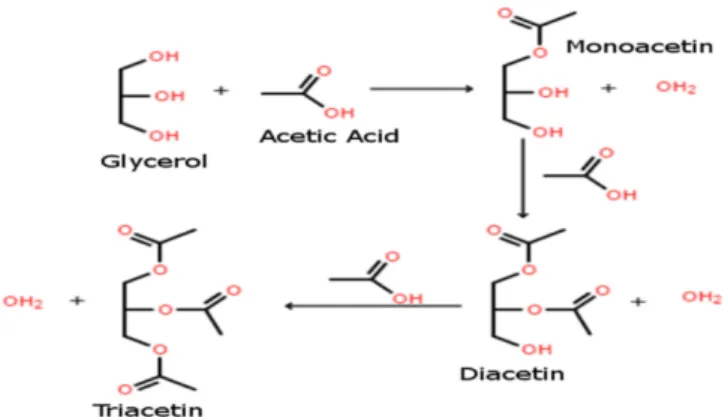
Mono-, di- and tri- esters called acetins are the products obtained.
High-value oxygenated fuel additives are obtained from this reac- tion. Acetins are employed as food additives, solvents, safety plas- ticizers, softening agents, biodegradable polyesters and fuel additives [11-14].
Using a solid catalyst in place of a homogeneous catalyst results in
several shortcomings, namely, excessive catalyst usage, corrosion of equipment, lack of recyclability, difficulties in catalyst separation, reduced product purity and environmental hazards can now be overcome. Different metal oxides such as TiO2, Al2O3, CeO2, SiO2, ZrO2, act as acid catalysts individually. Mixed oxides often show increased acidity and thermal stability than constituent single oxide.
Some important properties of a mixed oxide that ensure it is an ideal catalyst include low cost, high stability towards water, activity over a wide range of temperatures, high selectivity and activity, increased surface area and the ease of regeneration [15-17]. Literature on the acetins synthesis shows that attempts were made with ion exchanges, zeolites, heteropoly acids and mixed oxides are synthesized by the co-precipitation method [18- 22]. From the literature it is evident that the synthesis of acetins by esterification of glycerol using combus- tion synthesized mixed oxides is not reported. The solution combus- tion method has various advantages, such as less time and energy usage and easy process. The mixed oxide ceria-alumina is taken in the present work because of high reactive sites. CeO2-Al2O3 has cer- tain advantages over single oxides, such as stronger metal-support interactions, higher acidity compared to single oxides, and better resis- tance to sintering. There are sporadic attempts in reporting the kinet- ics of the esterification of glycerol [23]. The main objective of this work was to synthesize CeO2-Al2O3 by the combustion method and then sulfated to increase the acid site density on the surface of the catalyst. The sulfated cerium mixed oxide is used as a catalyst in the synthesis of acetins under varying temperatures, mole ratios and amounts of catalyst. The yield and selectivity of monoacetin, diacetin and triacetin are reported. Subsequently, based on the yield of products kinetic modeling was carried out for this reaction. The evaluated kinetic parameters (k1, k2 and k3) aid in the design and
†To whom correspondence should be addressed.
E-mail: [email protected]
This is an Open-Access article distributed under the terms of the Creative Com- mons Attribution Non-Commercial License (http://creativecommons.org/licenses/by- nc/3.0) which permits unrestricted non-commercial use, distribution, and reproduc- tion in any medium, provided the original work is properly cited.
scaling up of the reactors for the large-scale production of fuel additives.
1-1. Esterification of glycerol
The reaction of glycerol with acetic acid in the presence of an acid catalyst leads to the formation of acetins. The reaction follows a nor- mal esterification mechanism and gives the series products mono- acetin, diacetin and triacetin.
2. Materials and Methods
2-1. Chemicals
CeriumNitrate (Ce (NO3)3.6H2O), aluminum nitrate (Al (NO3)3.9H2O), urea, sulfuric acid, glycerol and acetic acid were analytical grade and obtained from SD Fine Chemical Ltd.
2-2. Catalyst preparation
The desired mixed oxide catalyst (CeO2-Al2O3) was synthesized by the combustion method. The requisite quantities of cerium nitrate (Ce (NO3)3.6H2O), aluminum nitrate (Al (NO3)3.9H2O) and the stoi- chiometric quantity of solid urea (H2N-CO-NH2) as fuel were dissolved in distilled water and placed in a beaker. The mixture’s composition was calculated on the basis of oxidizing valences of the oxidizer and the reducing valency of the fuel, i.e., metal nitrate to fuel valence ratio of 2.5. The aqueous solution containing redox mixture in a crucible was introduced into a muffle furnace which was preheated to 550oC.
The entire combustion process took about 20 minutes to produce the mixed oxide catalyst in open furnace. The synthesized catalyst was sulfated to introduce more active acid sites by adding 0.5 M sulfuric acid solution. The mixture of catalyst along with sulfuric acid was mechanically stirred for 1 hour at 300 rpm at room temperature. The sample was dried in a hot air oven at 120oC for 3 hours and calcined at 300oC for 2 hours.
2-3. Catalyst characterization
The XRD pattern of synthesized SO42–/CeO2-Al2O3 was recorded on a JDX-8030 XRD using copper Kα (0.15418nm) radiation source.
The intensity data were collected over a 2θ range of 7-95o with a step size of 0.02o. The counting time was 1o/min. FTIR analysis involved using a Bruker Alpha FTIR spectrophotometer. A Smart Sob 92/93
BET surface area analyzer was used for analyzing the surface area.
This is a single point surface area analyzer, and the analysis was car- ried out at a nitrogen partial pressure of 0.3. For SEM analysis, ESEM Quanta 200 instrument with tungsten based filament was used. Gold coating was carried out on the samples. The counts per second (CPS) were maintained above 600.The dead time was between 20-40 sec- onds.
2-4. Experimental Procedure for esterification of glycerol The efficacy of the catalyst was studied for the esterification of glycerol with acetic acid using a three-necked flask containing a magnetic stirrer and a reflux condenser to prevent evaporation of reactants under atmospheric pressure. The reaction mixture was allowed to reach the desired reaction temperature, and then charged into the round bottom flask with the catalyst. Samples were with- drawn periodically and centrifuged for 5min to separate the catalyst from liquid phase and cooled to below 5 oC to cease the reaction. The samples were further analyzed.
2-5. Analytical method
The obtained products were analyzed by gas chromatography (Agilent) with flame ionization detector (FID) equipped with capil- lary column (0.53 mm I.D and 30m length, Carbostable wax, Elite).
The periodically collected samples were analyzed with a gas chro- matograph. 0.5 ml of the sample was mixed with 50 ml of methanol.
0.5 µl of this solution was injected to the GC column that was main- tained at a column temperature of 100oC. The temperature was increased with a ramp input of 8oC/min until it reached 220oC.
Nitrogen was used as the carrier gas.
Yield (%) = × 100
Selectivity (%) = × 100
3. Results and Discussion
3-1. Catalyst characterization
XRD, FTIR, BET and SEM characterization was carried out for the catalyst and the results obtained are discussed below.
3-1-1. X-ray powder diffraction
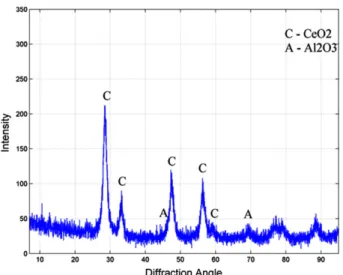
Fig. 1 shows the XRD pattern with sharp peaks reflecting the crys- talline form of CeO2- Al2O3. The major diffraction peaks were observed at 2θ values of 29.3, 31, 48.6 and 58 for CeO2 and Al2O3. The peaks obtained were in accordance with the JCPDS-01-075-0390 for the cerium-aluminum mixed oxide, confirming the formation of the CeO2-Al2O3 mixed oxide catalyst. The phase of the synthesized cat- alyst was identified to be of a fluorite structure using Profex soft- ware (Database of XRD patterns) as shown in Fig. 2. The peaks of synthesized catalyst coincide with green lines representing the fluo-
moles of product formed moles of glycerol feed
moles of desired product formed moles of total product formed
rite lines confirming the fluorite phase of the catalyst.
3-1-2. BET surface area
The results of BET surface area of the samples showed that the specific surface area of CeO2-Al2O3 was 9.5 m2/g and CeO2-Al2O3/ SO42- was 10.36 m2/g. The increase in surface area upon impregna- tion with sulfate ions was due to the formation of pores between the sulfate ions and the base catalyst.
3-1-3. Scanning Electron Microscopy
Scanning Electron Microscopy (SEM) provided further insights into the morphology of the cerium oxide-aluminum oxide particles.
Fig. 3a and 3b show the presence of particles of irregular morphol- ogy. Particles were of 10 µm size and some particles were of 0.2 mm size. The synthesized CeO2-Al2O3 material has porous surface which Fig. 1. X-ray diffraction pattern of CeO2-Al2O3 representing CeO2 and
Al2O3 peaks.
Fig. 2. X-ray diffraction pattern of CeO2-Al2O3 coinciding with the fluorite structure lines.
Fig. 3. SEM images of CeO2-Al2O3.
is caused by escaping gases during the synthesis of the catalyst.
3-1-4. Fourier-transform infrared spectroscopy
The FTIR spectra of CeO2-Al2O3 and CeO2-Al2O3/SO42- are shown in Fig. 4a and 4b. The presence of a peak at 497 cm-1 detects the presence of Ce-O, the peaks at 420 cm-1 and in between 500 and 450 cm-1 represent the presence of Al-O bond (Fig. 4b). The presence of a peak at 1111 cm-1 detects the presence of sulfate group (Fig. 4a).
3-2. Effect of process parameters
The synthesized sulfated CeO2-Al2O3 was used as the catalyst for carrying out the esterification of glycerol. Acetic acid was always taken in excess over glycerol to shift the equilibrium towards the for- mation of acetins. The effects of temperature, concentration of reac- tants (mole ratio) and a catalyst amount were studied for the reaction.
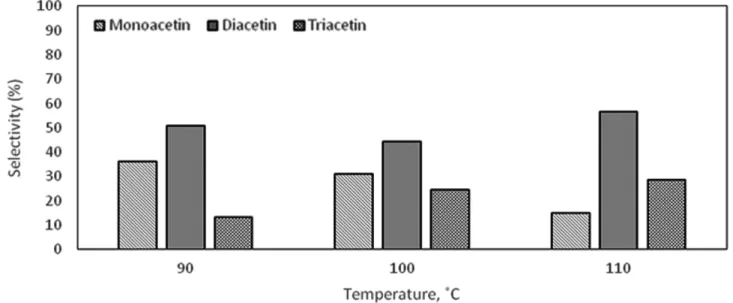
3-3. Influence of reaction temperature on yield of products The temperatures studied were 90oC, 100oC and 110oC for the esterification of glycerol with acetic acid for a mole ratio (acetic acid to glycerol) of 6:1 and 5 wt% of catalyst for 3 hours. From Fig. 5a, 5b and 5c it can be observed that due to the increase in the rate of reac- tion, the conversion of glycerol increased with temperature. The maximum conversion of glycerol obtained was 87.5% at 110oC and 25% yield of triacetin was obtained. From Fig. 6, the selectivity towards diacetin and triacetin is higher at 110 oC, whereas the selec- tivity of monoacetin has decreased.
3-4. Influence of mole ratio (acetic acid: glycerol) on yield of products
The mole ratio (acetic acid: glycerol) was varied from (3:1 to 9:1) for esterification of glycerol with acetic acid at reaction temperature Fig. 4. FTIR Spectra of CeO2-Al2O3 and CeO2-Al2O3/SO42.
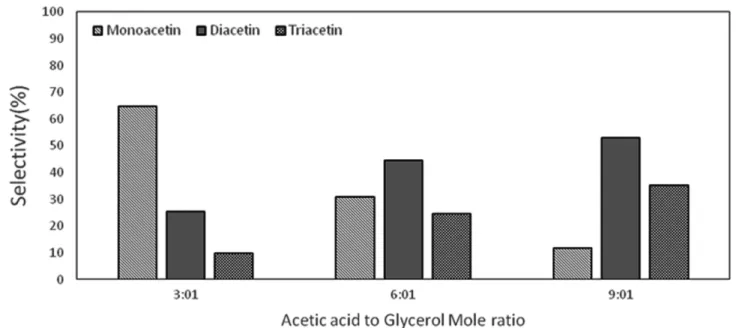
of 110oC and 5wt% of catalyst for 3 hours. Since esterification is a reversible reaction, the use of excess acetic acid shifts the equilib- rium towards the products. From Fig. 7a, 7b and 7c it can be observed that with an increase in the mole ratio of acetic acid from 3:1 to 9:1 the conversion of glycerol also increased due to excess concentra- tion of acetic acid. Along with the increase in conversion of glyc- erol, the yield of acetins also increased. The maximum conversion of 90.5% for glycerol and maximum yield of 32% for triacetin was
obtained at 110oC for 3 hours for 9:1 acetic acid: glycerol. Fig. 8 shows that the selectivity towards diacetin and triacetin is higher for 9:1 of acetic acid: glycerol. The selectivity towards monoacetin is high at 3:1.
3-5. Influence of catalyst loading on yield of products The catalyst weight percentage studied was 1 wt%, 3 wt% and 5 wt% on esterification of glycerol with acetic acid for mole ratio of Fig. 5. Effect of different temperature: (a) 90oC, (b) 100oC, (c) 110oC on the product distribution of glycerol esterification (catalyst loading=
5 wt% and Acetic acid: glycerol 6:1).
Fig. 6. Percentage selectivity of products for various reaction temperatures (catalyst loading= 5 wt% and Acetic acid: glycerol 6:1).
Fig. 7. Effect of different mole ratio of acetic acid: glycerol: (a) 3:1, (b) 6:1, (c) 9:1 on the product distribution of glycerol esterification (cat- alyst loading= 5 wt% and reaction temperature 110oC).
reactants (acetic acid : glycerol) 6:1 at reaction temperature of 110oC for 3 hours. Fig. 9a, 9b and 9c reflect the influence of catalyst load- ing on the products yield and glycerol conversion, and clearly indi-
cate that this is due to relative increase in the number of active sites.
The maximum conversion of 87.5% for glycerol and maximum yield of 25% for triacetin was obtained for 5wt% catalyst loading at Fig. 8. Percentage selectivity of products for different mole ratio after 3 hours (catalyst loading= 5 wt% and reaction temperature 110oC).
Fig. 9. Effect of different catalyst loading: (a) 1 wt%, (b) 3 wt%, (c) 5 wt% on the product distribution of glycerol esterification (molar ration acetic acid: glycerol 6:1 and reaction temperature 110oC).
Fig. 10. Percentage selectivity of products for various catalyst loading (reaction temperature 110oC and Acetic acid: glycerol 6:1).
110oC after 3 hours. Fig. 10 shows that the selectivity towards diace- tin and triacetin is higher for 5 wt%. The selectivity towards mono- acetin is high at 1 wt%.
3-6. Reaction Kinetics
The Langmuir-Hinshelwood kinetics model was used to express the rate law for glycerol esterification with acetic acid. The model assumes that there is a weak adsorption of both reactants and prod- ucts on the surface of catalyst with surface reaction being the rate determining step. It can be further justified that the resistance term of the LHHW model could be ignored [23].
Due to excess supply of acetic acid over glycerol, the glycerol esterification reaction drives in forward direction for products before equilibrium, and the backward reaction in each step can be neglected for developing the kinetics. Hence, the glycerol esterification can be represented as homogeneous irreversible first-order reactions in series.
k1 k2 k3
where G = glycerol, AA= acetic acid, M = monoacetin, D = diacetin and S = triacetin.
For a batch reactor under isothermal conditions, the above mecha- nism gives the following unsteady - state material. The reaction rate expression of different species can be written as:
Let Y=Ci/CGO i=G, M, D, S
Slope of the curve, -dYG/dt at each YG, is calculated. The value of k1 is determined using interpolation method.
Slope of the curve, -dYM/dt at each YG, is calculated. The value of k1 which is determined above is used and k2 is determined using interpolation method.
Slope of the curve -dYD/dt at each YD,is calculated. The value of k2 which is determined above is used and k3 is determined using interpolation method.
The rG, rM and rD are the reaction rates (mol/min·L) of species G, M and D; CG, CM and CD are the concentration (mol/L) of species G, M and D and t at any time in the reactor, respectively.
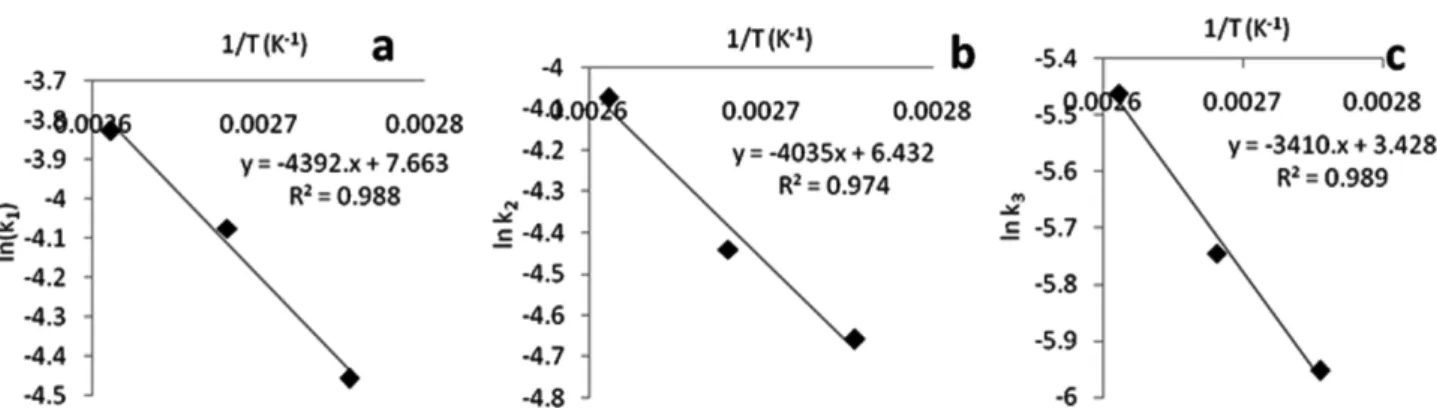
The rate constants were evaluated using an optimization method (MATLAB) at different temperatures. The temperature dependency of the rate constants can be expressed using the Arrhenius equation.
Considering the overall apparent rate constants (k1, k2 and k3), ki= kioe(-ΔE/RT)
or
ln(ki) = ln(kio) -
where i = 1, 2, 3 and kio is the frequency factor.
Plots of ln (ki) versus 1/T are shown in Fig. 11a, 11b and 11c, and the activation energies were determined from the slope of the graph.
The apparent rate constants (k1, k2 and k3) and activation energies (E1, E2 and E3) for acetic acid to glycerol mole ratio 6:1 and at 5 wt%
catalyst are represented as:
k1= exp(7.6639− ); E1= 36.52 kJ/mol; R2= 0.9888
k2= exp(6.4327− ); E2= 33.55 kJ/mol; R2= 0.9741
k3= exp(3.4284− ); E3= 28.35 kJ/mol; R2= 0.9891
3-7. Comparison of SO42-/CeO2-Al2O3 with reported catalyst for esterification of glycerol
The present catalyst SO42-/CeO2-Al2O3 was compared to that of the catalyst reported in literature. Among the reported catalyst Amberlyst -35 showed a higher glycerol conversion of 99% and tria- cetin selectivity of 25%, HZSM-5 achieved 30% glycerol conversion, K-10 attained 95% glycerol conversion with 5% triacetin selectivity at different reaction conditions. The SO42-/CeO2-Al2O3 attained 90.5%
for glycerol conversion, and selectivity of 32% for triacetin was obtained at 110oC for 3 hours for 9:1 acetic acid: glycerol.
G AA excess+ ( ) M D S→ → →
rG – –dCG
---dt k1CG
= =
rE
– dCM
---dt k1CG–k2CM
= =
rD – –dCD
---dt k2CM–k3CD
= =
ΔE RT---
4393.9 ---T 4035 ---T 3410.4 ---T
Fig. 11. Plot of (a) ln k1vs 1/T, (b) ln k2vs 1/T, (c) ln k3vs 1/T.
4. Conclusion
An ecofriendly catalytic process was developed for the synthesis of acetins from esterification of glycerol using CeO2-Al2O3/SO42-. The catalyst was characterized to understand its activity. The effect of yield and selectivity of products was checked under varied molar ratios of acetic acid to glycerol, temperature and amount of catalyst.
The reaction followed homogeneous pseudo first-order series reac- tion. The rate constants (k1, k2 and k3)as well as conforming activa- tion energy (E1, E2 and E3) were found.
Acknowledgments
The authors are thankful to KSCST for financial support and M. S.
Ramaiah Institute of Technology for providing the facilities. We thank Dr. Nagabhushan, Chemistry Deparment for his support and guidance.
References
1. Sravanthi, V., Archna, N. Indraja, S., Rao, D. S. and Spoorthi, S., “Catalytic Valorisation of Raw Glycerol Derived from Bio- diesel: A Review,” Biofuels (2016).
2. Luque, R. and Len, C., Continuous flow transformations of glyc- erol to valuable products: an overview. Sust. Chem. Processes (2014).
3. Diaz, L. and Borges, M. E., “Recent Developments on Hetero- geneous Catalysts for Biodiesel Production by Oil Esterification and Transesterification Reactions: A Review,” Renew Sust Energ Rev., 16(5), 2839-2849(2012).
4. Gui, M. M., Lee, K. T. and Bhatia, S., “Feasibility of Edible Oil vs Non Edible oil vs Waste Edible oil as Biodiesel Feedstock,”
Energy, 33(11), 1646-1653(2008).
5. Marchetti, J. M., Miguel, V. U. and Errazu, A. F., “Possible Methods for Biodiesel Production,” Renew Sust Energ Rev., 11(6), 1300-1311(2007).
6. Zhou, C. H., Beltramini, J. N., Fana, Y. X. and Lu, G. Q., “Chemo- selective Catalytic Conversion of Glycerol as a Biorenewable soure to Valuable Commodity Chemicals,” Chem. Soc. Rev., 3, 527-549 (2008).
7. Brian, H. and Pachauri, N., “Value - added Utilization of Crude Glycerol from Biodiesel Production : A Survey of Current Research Activities,” Paper presented at: American Society of Agricultural &
Biological Engineers Anuual International Meeting, Portland, Oregon, 9-12 ( 2006).
8. Gade, S. M., Munshi, M. K., Chherwalla, B. M., Rane, V. H. and Kelkar, A. A., “Synthesis of Glycidol from Glycerol and Dimeth- ylcarbonate Using Ionic Liquid as a Catalyst,” Catal Commun., 27, 184-188(2012).
9. Frusteri, F., Arena, F., Bonura, G., Cannilla, C., Spadaro, L. and Di, B. O., “Catalytic Etherification of Glycerol by Tert - butyl Alchol to Produce Oxygenated Additives for Diesel Fuels,” App
Cat A: Gen., 367, 77-83(2009).
10. Fernandez, Y., Arenillas, A., Diez MA, Pis, J. J, Menendez, J. A., Fernández, Y., Díez, M. A. and Menéndez, J. A., “Pyrolysis of Glycerol over Activated Carbons for Syngas production,” J. Anal.
Appl. Pyrol., 84, 124-150(2009).
11. Rahmat, N., Abdullah, A. Z. and Mohamed, A. R., “Recent Progress on Innovative and Potential Technologies for Glycerol Transformation Into Fuel Additives: A Critical Review,” Renew Sust Energ Rev., 14(3), 987-1000(2010).
12. Rao, P. V. and Appa, B. V., “Performance and Emmision Charac- teristics of Diesel Engine with COME -Triacetin Additive Blends as Fuel,” Int. J. Energy and Env., 3(4), 629-638(2012).
13. Mostashari, A., Karegar, M., Barzegar, M. and Mehdi, G., “Effi- cienct Synthesis of a- Monoglycerides via Solventless Condensa- tion of Fatty Acids with Glycerol Carbonate,” J. Amer Oil Chem.
Soc., 84(7), 681-685(2007).
14. Israel, E. W., “Recent Conceptual Advances in the Catalysis Science of Mixed Metal Oxide Catalytic Materials,” Cat Today, 100, 79- 94(2005).
15. Dal Bosco, S. M., Goncalves, M., Carvalho, W. A., Galhardo, T.
and Figueiredo, Flávia, C. A., “Sulfated Pillared Clay as Catalyst in Glycerol Esterification with Caprylic Acid,” Waste Biomass Valori., 7(5), 1-10(2016).
16. Lamas, D. G., Bacani, R., Martins, T. S. Fantini, M. C. and Fantini, M. C. A., “Structural Studoes of Mesoporous ZrO2-CeO2 and ZRO2-CeO2/SiO2 Mixed Oxides for Catalytic Applications,” J.
Alloys and Comp., 671, 396-402 (2016).
17. Reddy, P. S., Sudarsanam, P., Raju, G. and Reddy, B. M., “Selec- tive Acetylation of Glycerol over CeO2-M and Sulphated CeO2- M (M=ZO2 and Al2O3) Catalyst for Synthesis of Bioadditives,” J.
Chem. Sci. Technol., 2(3), 161-168(2013).
18. Balaraju, M., Nikhita, P., Lingaiah, N. Srilatha, K. and Sai, P. P.
S., “Acetylation of Glycerol to Synthesize Bioadditives over Nio- bic Acid Supported Tungstophosphoric Acid Catalysts,” Fuel Proc Tech., 91(2), 249-253(2010).
19. Raju, G., Reddy, P. S., Sudarsanam, P. and Reddy, B. M., “Syn- thesis of Bio-additives: Acetylation of Glycerol over Zirconia-based Solid Acid Catalysts,” Catal. Commun., 11(15), 1224-1228(2010).
20. Hameed, B. H. and Khayoon, M. S., “Acetylation of Glycerol to Biofuel Additives over Sulphated Activated Carbon Catalyst,”
Bioresource Technol., 102, 9229-9235(2011).
21. Sudarsanam, P., Mallesham, B. and Reddy, B. S., “Highly Prom- ising Sulphate Ion Promoted M-ZrO2 (M=Al2O3 and CeO2) Heterogeneous Solid Acids for Biodiesel - Derived Glycerol Esterification,” J. Chem. Sci. Technol., 2(3), 161-168(2013).
22. Swetha, S., Pandian, M., Anand, B. H. and Ganapati, V. S., “Glyc- erol Acetins: Fuel Additive Synthesis by Acetylation and Ester- ification of Glycerol Using Cesium Phosphotungstate Catalyst,”
RSC Advances, 5, 104354-104362(2015).
23. Limin, Zhoua., Tuan-Huy, Nguyenb., Adesoji A. Adesinab., “The Acetylation of Glycerol over Amberlyst-15: Kinetic and Product Distribution,” Fuel Processing Technology, 104, 310-318(2012).