663 Korean Chem. Eng. Res., 56(5), 663-678 (2018)
https://doi.org/10.9713/kcer.2018.56.5.663 PISSN 0304-128X, EISSN 2233-9558
Optical and Acoustic Properties of Binary Mixtures of Butanol Isomers as Oxygenates with Cyclohexane, Benzene and Toluene at 308.15 K
Sweety Verma*, Suman Gahlyan*, Manju Rani† and Sanjeev Maken*,†
Department of Chemical Engineering, Deenbandhu Chhotu Ram University of Science and Technology, Murthal-131 039, India
*Department of Chemistry, Deenbandhu Chhotu Ram University of Science and Technology, Murthal-131 039, India (Received 14 May 2018; Received in revised form 11 August 2018; accepted 31 August 2018)
Abstract − Refractive index and speeds of sound for the binary mixture of isomer of butanol (1) + cyclohexane, ben- zene and toluene (2) were measured at 308.15 K. The measured data were used to calculate deviation in refractive index Δn, ultrasonic speed Δu, isentropic compressibility KsE, available volume Va, excess intermolecular free length Lf and molecular association MA. All the derived properties were correlated with polynomial equation. Ultrasonic speed data were predicted using various empirical correlations like Nomoto, van Dael, impedance dependence and theoretically with Schaaff’s collision factor theory (CFT). Jacobson free length theory (FLT) was used to calculate Lf. The measured refractive index was also correlated with various mixing rules. The deviation in refractive index Δn and ultrasonic speed Δu was used to determine the intermolecular interactions.
Key words: Oxygenates, Hydrocarbon, Refractive index, Speed of sound, Molecular interactions
1. Introduction
Increasing global warming and extinction of fossil fuels is a great current issue. So researchers have shown much interest in the alter- native bio-fuels [1,2], which include biodiesel, bioalcohol, vegetable oil and other biomass sources. Bio-fuels are used as an oxygenated compound in motor fuel [3]. The oxygenates are oxygen-containing compounds such as ethers, alkanol and ester which are used as fuel additives. The oxygen present in these oxygenates helps in complete combustion of fuel. These are also good antiknocking agents with high octane number [4]. Oxygenates produced from renewable sources like alkanol (C3-C5) may have acceptable properties as gaso- line blend components and are considered as potential second gener- ation bio-fuel additives that can be produced by microbial fermentation of biomass (cellulose) [5,6].
Aromatic hydrocarbons are also constituent of motor fuel. However, due to the carcinogenic nature of benzene it needs to be replaced [7, 8] and toluene is a good candidate as it has similar property as ben- zene but is much less carcinogenic [9]. The aliphatic polar head in mono alcohol has affinity to interact with the delocalized π-electrons of benzene and toluene. Properties like acoustics, optics, transport, surface tension, etc. of these liquid mixtures are of great significance in chemical design and oxygenated fuel formulation [10,11]. Knowl- edge of the physical properties of binary mixtures is also important in understanding the behavior of mixed liquids [12,13]. The excess/
deviation in physical property is a beautiful tool to measure the devi- ation from ideality and also for understanding of intermolecular interactions in the liquid mixtures. These considerations prompted us to study the refractive index and ultrasonic speed of (A+B) mixtures of butanol isomers with cyclohexane, benzene and toluene at 308.15 K. In this sense, it is an interesting research problem to study the thermos-physical properties of oxygenate with hydrocarbons.
In continuation of our earlier work on the excess properties of oxy- genated fuel additives [14-31], we report the refractive index (nD) and ultrasonic speed (u) data for binary mixtures of butanol isomers with cyclohexane, benzene and toluene. We selected these mixtures because butanol is a second generation fuel additive and its interac- tions with hydrocarbons would be of great use in fuel formulation.
The measured data were used to calculate deviation in refractive index Δn, ultrasonic speed Δu, excess isentropic compressibility KsE, excess intermolecular free length LfE, available volume Va and molecular association MA. All the derived properties were correlated with polynomial equation. Ultrasonic speed data were predicted using various empirical correlations like Nomoto, van Dael, impedance dependence and theoretically with Schaaff’s collision factor theory (CFT) [32,33]. Jacobson free length theory (FLT) was applied to calculate LfE [34-36]. The measured refractive index was also cor- related with various mixing rules. The deviation in refractive index Δn and ultrasonic speed Δu was used to study the intermolecular interactions.
2. Experimental
Benzene and toluene (Merck) were treated with 15% H2SO4 in a separating funnel to remove thiophene until the yellow color of acid
†To whom correspondence should be addressed.
E-mail: [email protected]
This is an Open-Access article distributed under the terms of the Creative Com- mons Attribution Non-Commercial License (http://creativecommons.org/licenses/by- nc/3.0) which permits unrestricted non-commercial use, distribution, and reproduc- tion in any medium, provided the original work is properly cited.
became colorless [37,38]. The mixtures were kept undisturbed until two layers got separated; after separation in layer the acid was drained. For the neutralization of remaining acid, sodium bicarbon- ate solution was used. The chemicals were again washed with dis- tilled water and dried over fused CaCl2 for 24 h. After this, the chemicals were purified by fractional distillation and stored over molecular sieves (Merck). Cyclohexane (Merck 99%) was washed several times with a mixture of concentrated nitric acid and concen- trated sulfuric acid to nitrate any benzene that may have been pres- ent [39]. After repeated washing with NaHCO3 solution and distilled water, it was fractionally distilled over and dried over 0.3 nm molec- ular sieves (Merck) in an amber colored bottle for several days before use.
The butanol (Fluka Goldie) was stored over fused calcium oxide for absorption of water as impurity in alcohol and then distilled [37,38]. The purity of compound was confirmed by comparing experi- mentally measured density (ρ), u and nD with their respective litera- ture values shown in Table 1.
The u values were measured with interferometer (Mittal Enter- prises) with frequency generator of 2 MHz and at controlled tem- perature (308.15±0.01) K. The temperature was controlled by mercury- in-toluene regulator. The detailed procedure for measurement of u has been given earlier [50] and the data are reproducible within ±3%.
The nD values were measured with Abbe refractometer (OSAW, India) having an accuracy of (0.0001 units). The binary mixtures were made using a balance of precision ±0.1 mg (OHAUS, AR224CN) and the uncertainty in mole fraction was ± 1 × 10⁻⁴.
3. Results and Discussion
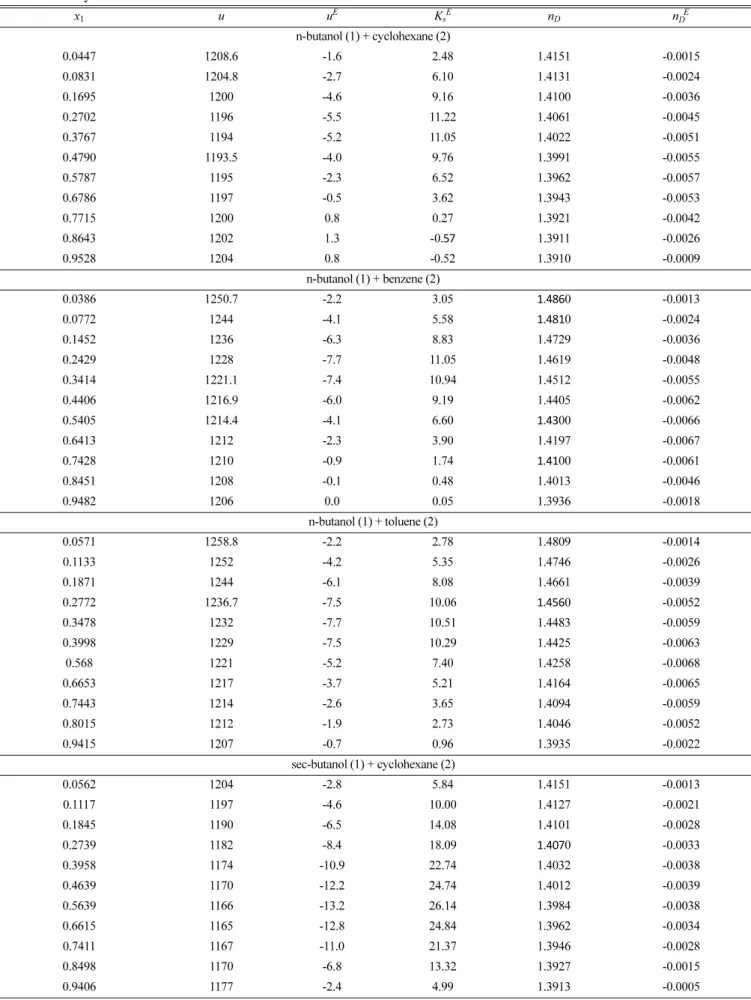
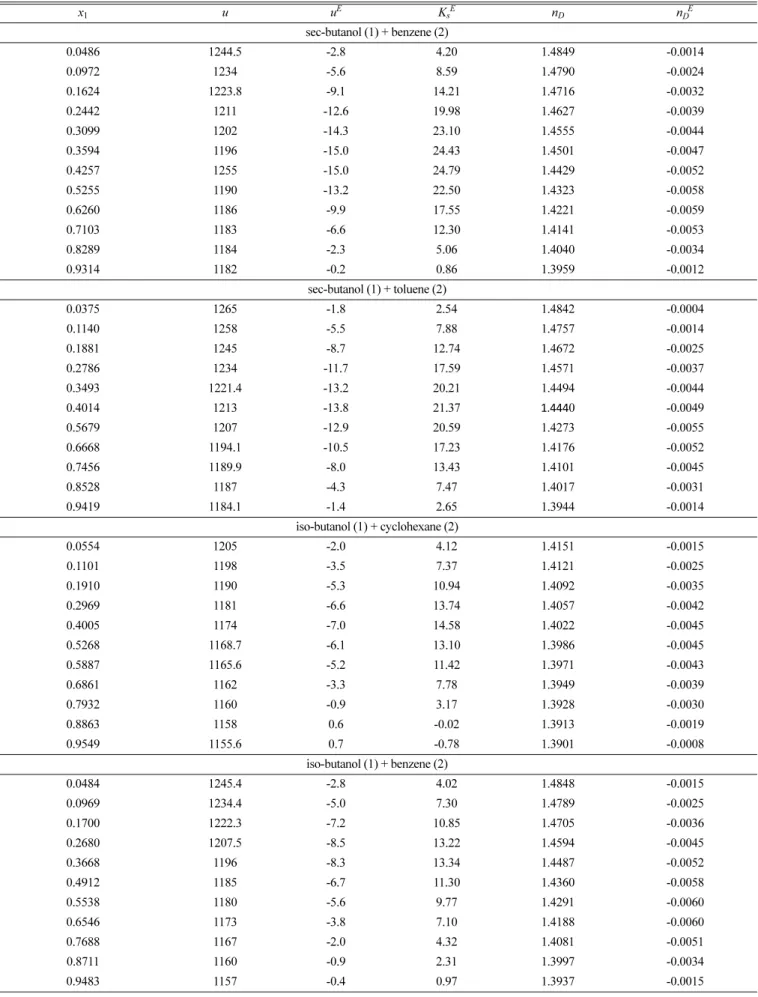
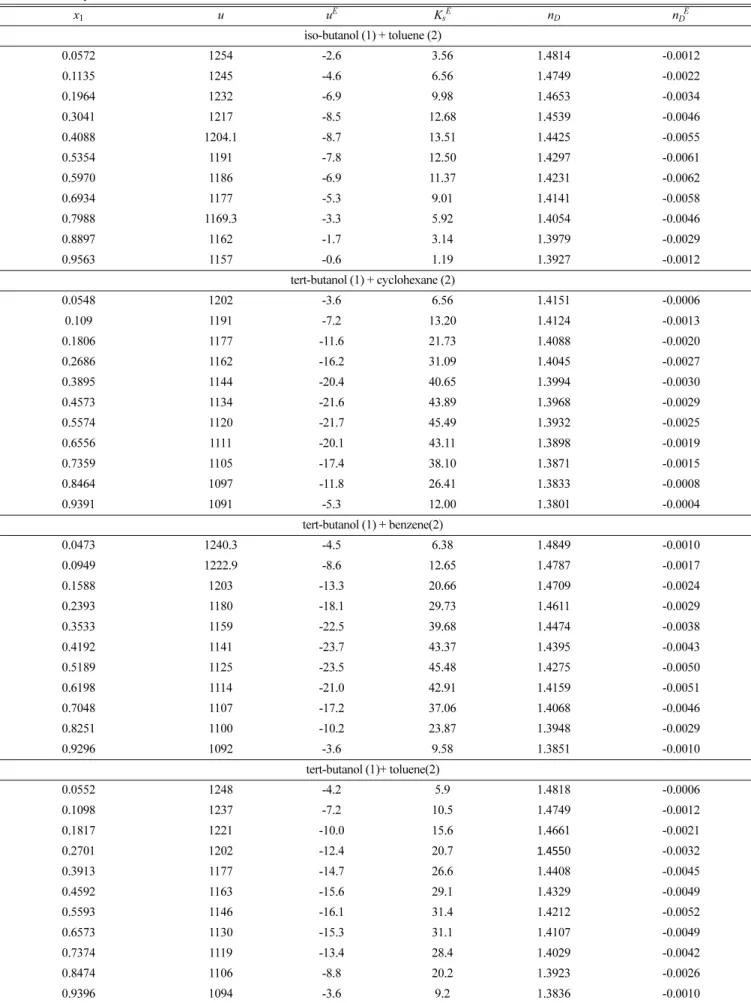
The properties like Δu and KsE shown in Table 2 and Figs. 1 and 2, were calculated from experimental values of u using Eqs. 1 and 2, respectively.
(1) (2) (3) Ksid was calculated from Equation [51] using αp [29][52] and Cp [29,53-55].
3-1. Ultrasonic speed
The u data were predicted using various empirical correlations like Nomoto, van Dael and impedance dependence and also theoretically predicted with Schaaff’s collision factor theory (CFT) at 308.15 K.
The quantitative as well as qualitative comparison of the estimated Δu u ρ( idKsid)
12 ---
–
= KsE=Ks–Ksid Ks=(u2ρ)–1
Table 1. Comparison of experimental values of refractive index, density and ultrasonic speed of pure liquids at 308.15 K with the corresponding literature values
Compound nD ρ/kg m-3 u/m s-1
Exptl. Literature Exptl. Literature Exptl. Literature
n-butanol 1.3902 1.3927[40] 798.60 798.25[41] 1205 1205.79[42]
sec-butanol 1.3901 1.3907[43] 794.45 793.72[41] 1180 1174.89[42]
iso-butanol 1.3899 1.3899[44] 789.69 789.66[41] 1154 1153.86[42]
tert-butanol 1.3780 1.3766[45] 770.20 770.39[41] 1090 1084.3[41]
cyclohexane 1.4180 1.4174[46] 762.50 762.46[47] 1212 1212[47]
benzene 1.4912 1.4910[48] 862.93 862.95[47] 1256 1260[49]
toluene 1.4882 1.4881[48] 852.88 852.85[47] 1265 1262[47]
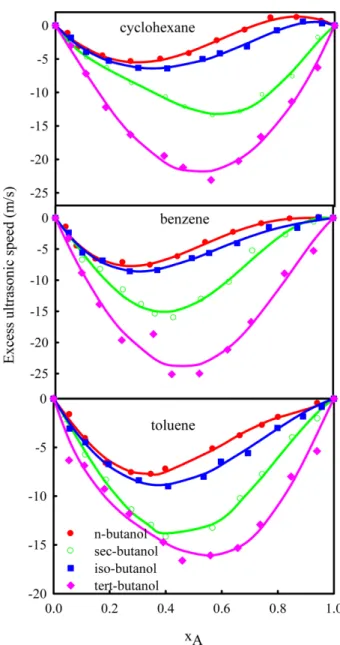
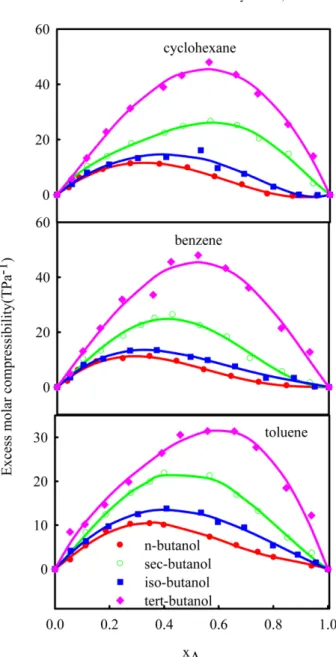
Fig. 1. Deviation in ultrasonic speed of butanol (A) +hydrocarbon (B) mixture as a function of mole fraction of butanol at 308.15 K.
Table 2. Speed of sound and excess speed of sound (m/s), excess molar isentropic compressibility, KsE (×10-12 Nm s-2), excess refractive index for binary mixtures
x1 u uE KsE nD nDE
n-butanol (1) + cyclohexane (2)
0.0447 1208.6 -1.6 2.48 1.4151 -0.0015
0.0831 1204.8 -2.7 6.10 1.4131 -0.0024
0.1695 1200 -4.6 9.16 1.4100 -0.0036
0.2702 1196 -5.5 11.22 1.4061 -0.0045
0.3767 1194 -5.2 11.05 1.4022 -0.0051
0.4790 1193.5 -4.0 9.76 1.3991 -0.0055
0.5787 1195 -2.3 6.52 1.3962 -0.0057
0.6786 1197 -0.5 3.62 1.3943 -0.0053
0.7715 1200 0.8 0.27 1.3921 -0.0042
0.8643 1202 1.3 -0.57 1.3911 -0.0026
0.9528 1204 0.8 -0.52 1.3910 -0.0009
n-butanol (1) + benzene (2)
0.0386 1250.7 -2.2 3.05 1.4860 -0.0013
0.0772 1244 -4.1 5.58 1.4810 -0.0024
0.1452 1236 -6.3 8.83 1.4729 -0.0036
0.2429 1228 -7.7 11.05 1.4619 -0.0048
0.3414 1221.1 -7.4 10.94 1.4512 -0.0055
0.4406 1216.9 -6.0 9.19 1.4405 -0.0062
0.5405 1214.4 -4.1 6.60 1.4300 -0.0066
0.6413 1212 -2.3 3.90 1.4197 -0.0067
0.7428 1210 -0.9 1.74 1.4100 -0.0061
0.8451 1208 -0.1 0.48 1.4013 -0.0046
0.9482 1206 0.0 0.05 1.3936 -0.0018
n-butanol (1) + toluene (2)
0.0571 1258.8 -2.2 2.78 1.4809 -0.0014
0.1133 1252 -4.2 5.35 1.4746 -0.0026
0.1871 1244 -6.1 8.08 1.4661 -0.0039
0.2772 1236.7 -7.5 10.06 1.4560 -0.0052
0.3478 1232 -7.7 10.51 1.4483 -0.0059
0.3998 1229 -7.5 10.29 1.4425 -0.0063
0.568 1221 -5.2 7.40 1.4258 -0.0068
0.6653 1217 -3.7 5.21 1.4164 -0.0065
0.7443 1214 -2.6 3.65 1.4094 -0.0059
0.8015 1212 -1.9 2.73 1.4046 -0.0052
0.9415 1207 -0.7 0.96 1.3935 -0.0022
sec-butanol (1) + cyclohexane (2)
0.0562 1204 -2.8 5.84 1.4151 -0.0013
0.1117 1197 -4.6 10.00 1.4127 -0.0021
0.1845 1190 -6.5 14.08 1.4101 -0.0028
0.2739 1182 -8.4 18.09 1.4070 -0.0033
0.3958 1174 -10.9 22.74 1.4032 -0.0038
0.4639 1170 -12.2 24.74 1.4012 -0.0039
0.5639 1166 -13.2 26.14 1.3984 -0.0038
0.6615 1165 -12.8 24.84 1.3962 -0.0034
0.7411 1167 -11.0 21.37 1.3946 -0.0028
0.8498 1170 -6.8 13.32 1.3927 -0.0015
0.9406 1177 -2.4 4.99 1.3913 -0.0005
Table 2. Speed of sound and excess speed of sound (m/s), excess molar isentropic compressibility, KsE (×10-12 Nm s-2), excess refractive index for binary mixtures
x1 u uE KsE nD nDE
sec-butanol (1) + benzene (2)
0.0486 1244.5 -2.8 4.20 1.4849 -0.0014
0.0972 1234 -5.6 8.59 1.4790 -0.0024
0.1624 1223.8 -9.1 14.21 1.4716 -0.0032
0.2442 1211 -12.6 19.98 1.4627 -0.0039
0.3099 1202 -14.3 23.10 1.4555 -0.0044
0.3594 1196 -15.0 24.43 1.4501 -0.0047
0.4257 1255 -15.0 24.79 1.4429 -0.0052
0.5255 1190 -13.2 22.50 1.4323 -0.0058
0.6260 1186 -9.9 17.55 1.4221 -0.0059
0.7103 1183 -6.6 12.30 1.4141 -0.0053
0.8289 1184 -2.3 5.06 1.4040 -0.0034
0.9314 1182 -0.2 0.86 1.3959 -0.0012
sec-butanol (1) + toluene (2)
0.0375 1265 -1.8 2.54 1.4842 -0.0004
0.1140 1258 -5.5 7.88 1.4757 -0.0014
0.1881 1245 -8.7 12.74 1.4672 -0.0025
0.2786 1234 -11.7 17.59 1.4571 -0.0037
0.3493 1221.4 -13.2 20.21 1.4494 -0.0044
0.4014 1213 -13.8 21.37 1.4440 -0.0049
0.5679 1207 -12.9 20.59 1.4273 -0.0055
0.6668 1194.1 -10.5 17.23 1.4176 -0.0052
0.7456 1189.9 -8.0 13.43 1.4101 -0.0045
0.8528 1187 -4.3 7.47 1.4017 -0.0031
0.9419 1184.1 -1.4 2.65 1.3944 -0.0014
iso-butanol (1) + cyclohexane (2)
0.0554 1205 -2.0 4.12 1.4151 -0.0015
0.1101 1198 -3.5 7.37 1.4121 -0.0025
0.1910 1190 -5.3 10.94 1.4092 -0.0035
0.2969 1181 -6.6 13.74 1.4057 -0.0042
0.4005 1174 -7.0 14.58 1.4022 -0.0045
0.5268 1168.7 -6.1 13.10 1.3986 -0.0045
0.5887 1165.6 -5.2 11.42 1.3971 -0.0043
0.6861 1162 -3.3 7.78 1.3949 -0.0039
0.7932 1160 -0.9 3.17 1.3928 -0.0030
0.8863 1158 0.6 -0.02 1.3913 -0.0019
0.9549 1155.6 0.7 -0.78 1.3901 -0.0008
iso-butanol (1) + benzene (2)
0.0484 1245.4 -2.8 4.02 1.4848 -0.0015
0.0969 1234.4 -5.0 7.30 1.4789 -0.0025
0.1700 1222.3 -7.2 10.85 1.4705 -0.0036
0.2680 1207.5 -8.5 13.22 1.4594 -0.0045
0.3668 1196 -8.3 13.34 1.4487 -0.0052
0.4912 1185 -6.7 11.30 1.4360 -0.0058
0.5538 1180 -5.6 9.77 1.4291 -0.0060
0.6546 1173 -3.8 7.10 1.4188 -0.0060
0.7688 1167 -2.0 4.32 1.4081 -0.0051
0.8711 1160 -0.9 2.31 1.3997 -0.0034
0.9483 1157 -0.4 0.97 1.3937 -0.0015
x1 u uE KsE nD nDE iso-butanol (1) + toluene (2)
0.0572 1254 -2.6 3.56 1.4814 -0.0012
0.1135 1245 -4.6 6.56 1.4749 -0.0022
0.1964 1232 -6.9 9.98 1.4653 -0.0034
0.3041 1217 -8.5 12.68 1.4539 -0.0046
0.4088 1204.1 -8.7 13.51 1.4425 -0.0055
0.5354 1191 -7.8 12.50 1.4297 -0.0061
0.5970 1186 -6.9 11.37 1.4231 -0.0062
0.6934 1177 -5.3 9.01 1.4141 -0.0058
0.7988 1169.3 -3.3 5.92 1.4054 -0.0046
0.8897 1162 -1.7 3.14 1.3979 -0.0029
0.9563 1157 -0.6 1.19 1.3927 -0.0012
tert-butanol (1) + cyclohexane (2)
0.0548 1202 -3.6 6.56 1.4151 -0.0006
0.109 1191 -7.2 13.20 1.4124 -0.0013
0.1806 1177 -11.6 21.73 1.4088 -0.0020
0.2686 1162 -16.2 31.09 1.4045 -0.0027
0.3895 1144 -20.4 40.65 1.3994 -0.0030
0.4573 1134 -21.6 43.89 1.3968 -0.0029
0.5574 1120 -21.7 45.49 1.3932 -0.0025
0.6556 1111 -20.1 43.11 1.3898 -0.0019
0.7359 1105 -17.4 38.10 1.3871 -0.0015
0.8464 1097 -11.8 26.41 1.3833 -0.0008
0.9391 1091 -5.3 12.00 1.3801 -0.0004
tert-butanol (1) + benzene(2)
0.0473 1240.3 -4.5 6.38 1.4849 -0.0010
0.0949 1222.9 -8.6 12.65 1.4787 -0.0017
0.1588 1203 -13.3 20.66 1.4709 -0.0024
0.2393 1180 -18.1 29.73 1.4611 -0.0029
0.3533 1159 -22.5 39.68 1.4474 -0.0038
0.4192 1141 -23.7 43.37 1.4395 -0.0043
0.5189 1125 -23.5 45.48 1.4275 -0.0050
0.6198 1114 -21.0 42.91 1.4159 -0.0051
0.7048 1107 -17.2 37.06 1.4068 -0.0046
0.8251 1100 -10.2 23.87 1.3948 -0.0029
0.9296 1092 -3.6 9.58 1.3851 -0.0010
tert-butanol (1)+ toluene(2)
0.0552 1248 -4.2 5.9 1.4818 -0.0006
0.1098 1237 -7.2 10.5 1.4749 -0.0012
0.1817 1221 -10.0 15.6 1.4661 -0.0021
0.2701 1202 -12.4 20.7 1.4550 -0.0032
0.3913 1177 -14.7 26.6 1.4408 -0.0045
0.4592 1163 -15.6 29.1 1.4329 -0.0049
0.5593 1146 -16.1 31.4 1.4212 -0.0052
0.6573 1130 -15.3 31.1 1.4107 -0.0049
0.7374 1119 -13.4 28.4 1.4029 -0.0042
0.8474 1106 -8.8 20.2 1.3923 -0.0026
0.9396 1094 -3.6 9.2 1.3836 -0.0010
Table 2. Speed of sound and excess speed of sound (m/s), excess molar isentropic compressibility, KsE (×10-12 Nm s-2), excess refractive index for binary mixtures
correlations values with experimental values is given in terms of standard deviation in Table 3 and Fig. 3 (a,b,c), respectively. Jacob- son free length theory (FLT) was used to calculate the LfE
.
3-1-1. Schaaffs’ collision factor theory (CFT) [32,33]
According to CFT,
(4)
where u∞ is 1600 ms-1 and b and S are the geometric volume and collision factor, respectively.
The actual geometric volume per mol of the liquids was com- puted as
(5)
and the value of collision factor S was calculated as
(6)
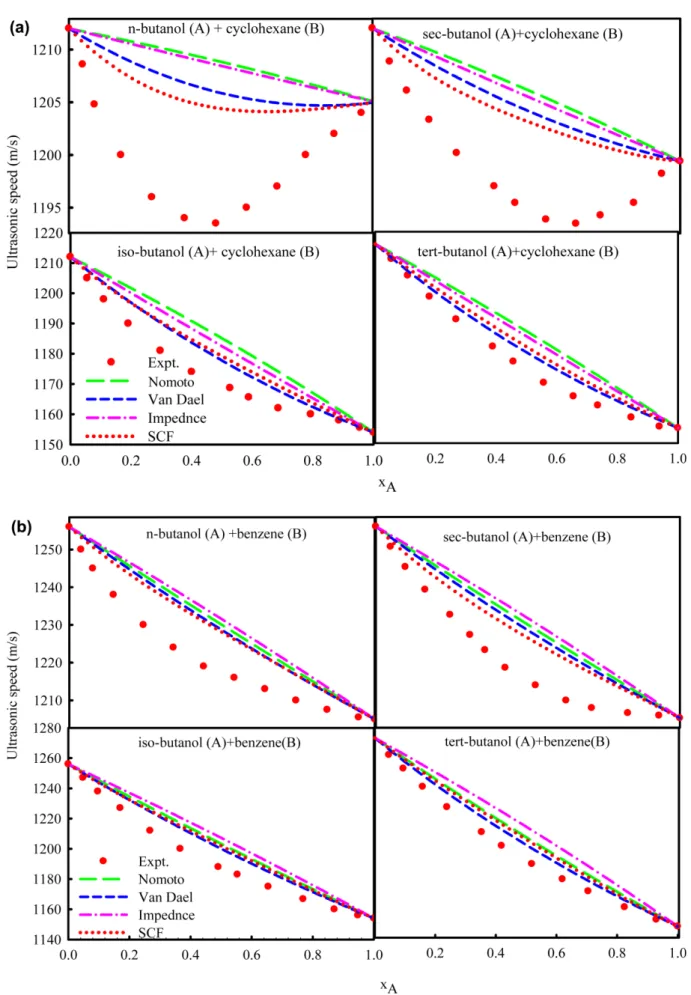
These theoretically calculated u values are compared with exper- imental values in Fig. 3, and quantitative comparison is given in terms of standard deviation in Table 4.
Among all correlations and theoretical approaches for u as from Fig. 3, the value predicted by van Dael relation is best for binary mixtures of tert-butanol (A) + benzene (B) and all butanol (A) + tolu- ene (B) systems. Schaaff’s collision factor theory (SCF) is good for n-butanol or sec-butanol (A) + cyclohexane (B) and all butanol (A) + benzene (B) systems. Nomoto and impedance relation deviation are larger than all other correlations for all systems, as can be seen from Table 4. So these correlations are not predicting the experimental data.
3-1-2. Jacobson free length theory [34-36]
This theory was used to calculate the LfE. The Lf for ideal solution was calculated using molar volume and surface area using following equation:
(7) (8) (9) umix u∞(x1S1+x2S2) x( 1b1+x2b2)
Vmix
---
=
b 4Πr3NA ---3
=
S uVT bu∞ ---
=
Lf 2Va ---Y
= Va=VT–Vo Y=(36ΠNAVo2)1/3 Fig. 2. Values of excess isentropic compressibility of butanol (A) +
hydrocarbon (B) mixture as a function of mole fraction of butanol.
Table 3. Standard deviations in ultrasonic velocity predicted by various correlations
Binary mixture Nomoto Van Deal Impedance CFT
n-butanol (1) + cyclohexane (2) 0.922 0.744 0.899 0.648
n-butanol (1)+ benzene(2) 0.966 0.885 1.052 0.831
n-butanol (1) + toluene (2) 0.872 0.163 0.810 0.681
sec-butanol (1) + cyclohexane (2) 1.872 1.548 1.769 1.356
sec-butanol (1) + benzene (2) 1.971 1.829 2.131 1.609
sec-butanol (1) + toluene (2) 1.594 0.577 1.526 1.172
iso-butanol (1) + cyclohexane (2) 1.007 0.551 0.845 0.618
iso-butanol (1) + benzene (2) 1.261 1.056 1.500 1.141
iso-butanol (1) +toluene (2) 1.125 0.171 1.069 0.798
tert-butanol (1) + cyclohexane (2) 1.726 0.786 1.497 1.035
tert-butanol (1) + benzene (2) 2.598 2.141 3.209 2.448
tert-butanol (1) + toluene (2) 1.599 0.337 1.702 1.062
Fig. 3. (a) Ultrasonic speed of butanol (A) + cyclohexane (B) as predicted by various correlations. (b). Ultrasonic speed of butanol (A) + ben- zene (B) as predicted by various correlations. (c) Ultrasonic speed of butanol (A) + toluene (B) as predicted by various correlations.
Fig. 3. (a) Ultrasonic speed of butanol (A) + cyclohexane (B) as predicted by various correlations. (b). Ultrasonic speed of butanol (A) + ben- zene (B) as predicted by various correlations. (c) Ultrasonic speed of butanol (A) + toluene (B) as predicted by various correlations.
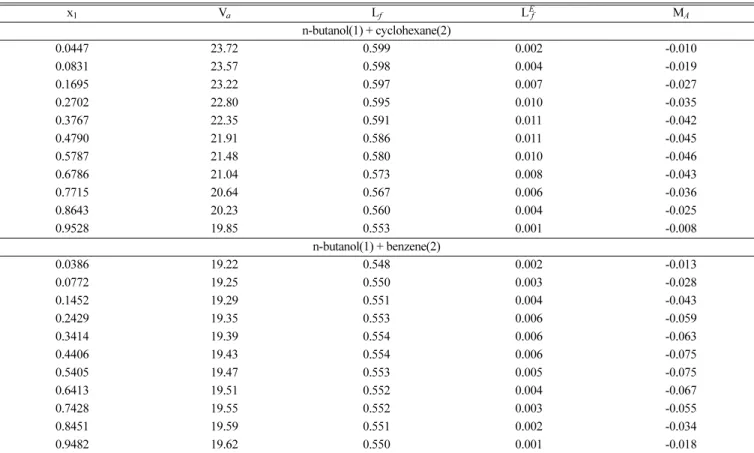
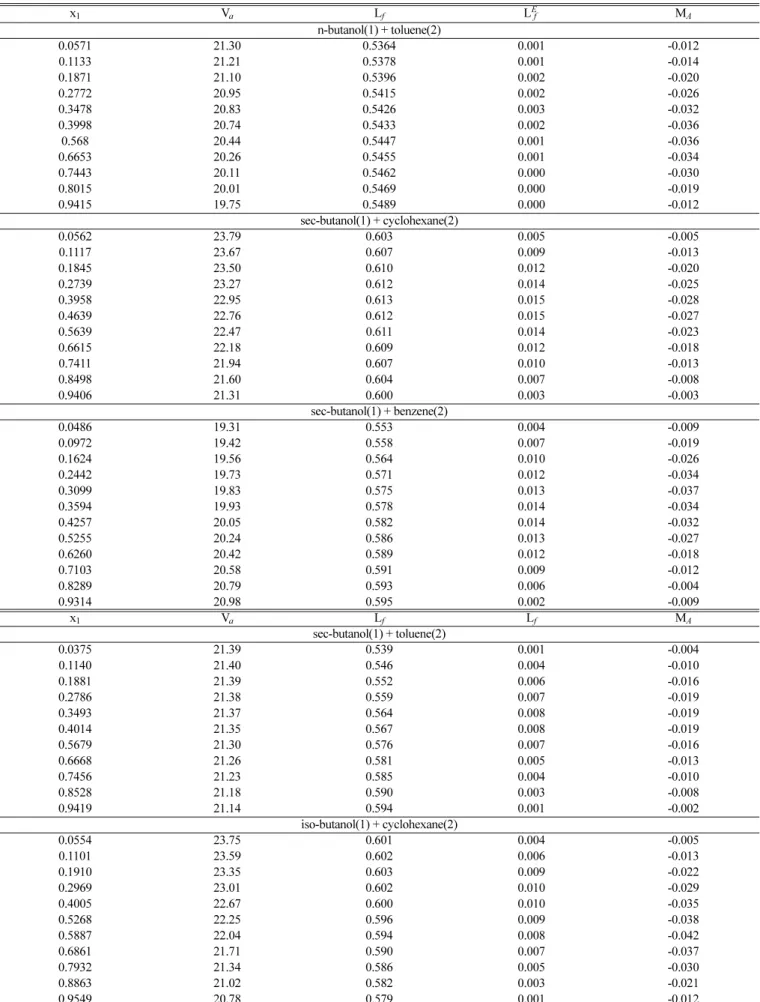
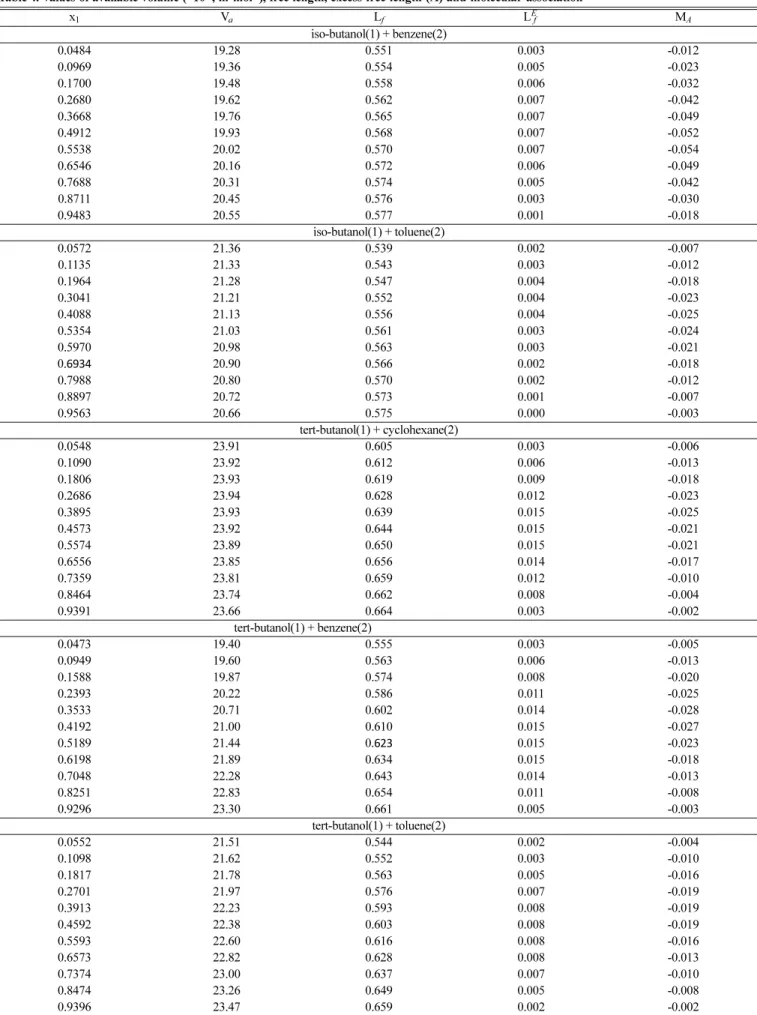
Table 4. Values of available volume (×10-6, m3mol-1), free length, excess free length (Å) and molecular association
x1 Va Lf LEf MA
n-butanol(1) + cyclohexane(2)
0.0447 23.72 0.599 0.002 -0.010
0.0831 23.57 0.598 0.004 -0.019
0.1695 23.22 0.597 0.007 -0.027
0.2702 22.80 0.595 0.010 -0.035
0.3767 22.35 0.591 0.011 -0.042
0.4790 21.91 0.586 0.011 -0.045
0.5787 21.48 0.580 0.010 -0.046
0.6786 21.04 0.573 0.008 -0.043
0.7715 20.64 0.567 0.006 -0.036
0.8643 20.23 0.560 0.004 -0.025
0.9528 19.85 0.553 0.001 -0.008
n-butanol(1) + benzene(2)
0.0386 19.22 0.548 0.002 -0.013
0.0772 19.25 0.550 0.003 -0.028
0.1452 19.29 0.551 0.004 -0.043
0.2429 19.35 0.553 0.006 -0.059
0.3414 19.39 0.554 0.006 -0.063
0.4406 19.43 0.554 0.006 -0.075
0.5405 19.47 0.553 0.005 -0.075
0.6413 19.51 0.552 0.004 -0.067
0.7428 19.55 0.552 0.003 -0.055
0.8451 19.59 0.551 0.002 -0.034
0.9482 19.62 0.550 0.001 -0.018
Table 4. Values of available volume (×10-6, m3mol-1), free length, excess free length (Å) and molecular association
x1 Va Lf LEf MA
n-butanol(1) + toluene(2)
0.0571 21.30 0.5364 0.001 -0.012
0.1133 21.21 0.5378 0.001 -0.014
0.1871 21.10 0.5396 0.002 -0.020
0.2772 20.95 0.5415 0.002 -0.026
0.3478 20.83 0.5426 0.003 -0.032
0.3998 20.74 0.5433 0.002 -0.036
0.568 20.44 0.5447 0.001 -0.036
0.6653 20.26 0.5455 0.001 -0.034
0.7443 20.11 0.5462 0.000 -0.030
0.8015 20.01 0.5469 0.000 -0.019
0.9415 19.75 0.5489 0.000 -0.012
sec-butanol(1) + cyclohexane(2)
0.0562 23.79 0.603 0.005 -0.005
0.1117 23.67 0.607 0.009 -0.013
0.1845 23.50 0.610 0.012 -0.020
0.2739 23.27 0.612 0.014 -0.025
0.3958 22.95 0.613 0.015 -0.028
0.4639 22.76 0.612 0.015 -0.027
0.5639 22.47 0.611 0.014 -0.023
0.6615 22.18 0.609 0.012 -0.018
0.7411 21.94 0.607 0.010 -0.013
0.8498 21.60 0.604 0.007 -0.008
0.9406 21.31 0.600 0.003 -0.003
sec-butanol(1) + benzene(2)
0.0486 19.31 0.553 0.004 -0.009
0.0972 19.42 0.558 0.007 -0.019
0.1624 19.56 0.564 0.010 -0.026
0.2442 19.73 0.571 0.012 -0.034
0.3099 19.83 0.575 0.013 -0.037
0.3594 19.93 0.578 0.014 -0.034
0.4257 20.05 0.582 0.014 -0.032
0.5255 20.24 0.586 0.013 -0.027
0.6260 20.42 0.589 0.012 -0.018
0.7103 20.58 0.591 0.009 -0.012
0.8289 20.79 0.593 0.006 -0.004
0.9314 20.98 0.595 0.002 -0.009
x1 Va Lf Lf MA
sec-butanol(1) + toluene(2)
0.0375 21.39 0.539 0.001 -0.004
0.1140 21.40 0.546 0.004 -0.010
0.1881 21.39 0.552 0.006 -0.016
0.2786 21.38 0.559 0.007 -0.019
0.3493 21.37 0.564 0.008 -0.019
0.4014 21.35 0.567 0.008 -0.019
0.5679 21.30 0.576 0.007 -0.016
0.6668 21.26 0.581 0.005 -0.013
0.7456 21.23 0.585 0.004 -0.010
0.8528 21.18 0.590 0.003 -0.008
0.9419 21.14 0.594 0.001 -0.002
iso-butanol(1) + cyclohexane(2)
0.0554 23.75 0.601 0.004 -0.005
0.1101 23.59 0.602 0.006 -0.013
0.1910 23.35 0.603 0.009 -0.022
0.2969 23.01 0.602 0.010 -0.029
0.4005 22.67 0.600 0.010 -0.035
0.5268 22.25 0.596 0.009 -0.038
0.5887 22.04 0.594 0.008 -0.042
0.6861 21.71 0.590 0.007 -0.037
0.7932 21.34 0.586 0.005 -0.030
0.8863 21.02 0.582 0.003 -0.021
0.9549 20.78 0.579 0.001 -0.012
x1 Va Lf LEf MA iso-butanol(1) + benzene(2)
0.0484 19.28 0.551 0.003 -0.012
0.0969 19.36 0.554 0.005 -0.023
0.1700 19.48 0.558 0.006 -0.032
0.2680 19.62 0.562 0.007 -0.042
0.3668 19.76 0.565 0.007 -0.049
0.4912 19.93 0.568 0.007 -0.052
0.5538 20.02 0.570 0.007 -0.054
0.6546 20.16 0.572 0.006 -0.049
0.7688 20.31 0.574 0.005 -0.042
0.8711 20.45 0.576 0.003 -0.030
0.9483 20.55 0.577 0.001 -0.018
iso-butanol(1) + toluene(2)
0.0572 21.36 0.539 0.002 -0.007
0.1135 21.33 0.543 0.003 -0.012
0.1964 21.28 0.547 0.004 -0.018
0.3041 21.21 0.552 0.004 -0.023
0.4088 21.13 0.556 0.004 -0.025
0.5354 21.03 0.561 0.003 -0.024
0.5970 20.98 0.563 0.003 -0.021
0.6934 20.90 0.566 0.002 -0.018
0.7988 20.80 0.570 0.002 -0.012
0.8897 20.72 0.573 0.001 -0.007
0.9563 20.66 0.575 0.000 -0.003
tert-butanol(1) + cyclohexane(2)
0.0548 23.91 0.605 0.003 -0.006
0.1090 23.92 0.612 0.006 -0.013
0.1806 23.93 0.619 0.009 -0.018
0.2686 23.94 0.628 0.012 -0.023
0.3895 23.93 0.639 0.015 -0.025
0.4573 23.92 0.644 0.015 -0.021
0.5574 23.89 0.650 0.015 -0.021
0.6556 23.85 0.656 0.014 -0.017
0.7359 23.81 0.659 0.012 -0.010
0.8464 23.74 0.662 0.008 -0.004
0.9391 23.66 0.664 0.003 -0.002
tert-butanol(1) + benzene(2)
0.0473 19.40 0.555 0.003 -0.005
0.0949 19.60 0.563 0.006 -0.013
0.1588 19.87 0.574 0.008 -0.020
0.2393 20.22 0.586 0.011 -0.025
0.3533 20.71 0.602 0.014 -0.028
0.4192 21.00 0.610 0.015 -0.027
0.5189 21.44 0.623 0.015 -0.023
0.6198 21.89 0.634 0.015 -0.018
0.7048 22.28 0.643 0.014 -0.013
0.8251 22.83 0.654 0.011 -0.008
0.9296 23.30 0.661 0.005 -0.003
tert-butanol(1) + toluene(2)
0.0552 21.51 0.544 0.002 -0.004
0.1098 21.62 0.552 0.003 -0.010
0.1817 21.78 0.563 0.005 -0.016
0.2701 21.97 0.576 0.007 -0.019
0.3913 22.23 0.593 0.008 -0.019
0.4592 22.38 0.603 0.008 -0.019
0.5593 22.60 0.616 0.008 -0.016
0.6573 22.82 0.628 0.008 -0.013
0.7374 23.00 0.637 0.007 -0.010
0.8474 23.26 0.649 0.005 -0.008
0.9396 23.47 0.659 0.002 -0.002
Table 4. Values of available volume (×10-6, m3mol-1), free length, excess free length (Å) and molecular association
Each term in above equation has the usual meaning [34-36] and LfEof mixtures was calculated using Eq. (10):
(10)
where K, Jacobson constant, varies from 618 to 642 at tempera- ture 293.15 K to 313.15 K.
The LfE values were calculated as:
(11) The available volume calculated from Eq. (8) is shown in Fig. 4 for all respective mixtures. The LfEcalculated using Eq. (11) with mole fraction of component A of binary mixture is shown in Figs. 5.
The calculated values of LfEand Va are also given in Table 4.
Molecular association (MA) value has also been calculated as:
(12)
These values are given in Table 4 and Fig. 6. The variation of molecular association with composition gives a direct measure of the non-ideality of the binary mixture because of the intermolecular association of the two components. Its value becomes less negative as the strength of intermolecular interactions between the compo- nent molecules increases.
3-2. Refractive Index
The deviation in nD was calculated from Eq. (11), which is given in Table 2 and Fig. 7 along with experimental nD values for all binary mixtures. For the theoretical estimation of nD the Arago-Biot (A-B), Gladstone-Dale (G-D), Lorentz-Lorentz (L-L); Heller (H), Weiner (W), Newton (Nw), and Eyring-John (E-J) mixing rules were used.
All mixing rules are discussed in detail in our earlier paper [17]. The comparison between predicted values of all mixing rules and experi- mental values is very good. The quantitative comparison is given in terms of standard deviation and reported in Table 5.
Redlich-Kister equation was used to correlate the above calcu-
umix K
Lf mix( )ρmix
---1/2
=
XmE =Xm–x1X1o–x2X2o
MA umix
x1u1+x2u2 ---
⎝ ⎠
⎛ ⎞2–1
=
Fig. 4. Available volume of butanol (A) + hydrocarbon (B) mixture.
Fig. 5. Excess intermolecular free length of butanol (A) + hydrocar- bon (B) mixture as a function of mole fraction of butanol at 308.15 K.
lated excess or deviation in properties values:
(13) The standard deviation σ(XmE) along with An parameters of Eq.
(13) are reported in Table 6. The XmE(Xm= u, Ks, Lf and nD) values
calculated using Eq. (13) along with experimental values are shown in Figs. 1, 2, 5 and 7.
The Δu values for the present systems shown in Fig. 1 are nega- tive at all composition and vary as: n-butanol > iso butanol > sec- XmE x1(1 x– 1) An(2x1–1)(n 1– )
n 1=
∑
4=
Fig. 6. Molecular association of butanol (A) + hydrocarbon (B) mix- ture as a function of mole fraction of butanol at 308.15 K.
Fig. 7. Excess refractive index of butanol (A) + hydrocarbon (B) mix- ture as a function of mole fraction of butanol at 308.15 K.
Table 5. Value of standard deviations of calculated values of refractive index using various correlations
System AB GD LL Weiner Heller Newton Erying
n-butanol(1)+cyclohexane(2) 0.019 0.019 0.019 0.021 0.018 0.019 0.019
n-butanol(1)+benzene(2) 0.017 0.017 0.015 0.042 0.014 0.017 0.017
n-butanol(1)+toluene(2) 0.030 0.030 0.028 0.054 0.027 0.032 0.029
sec-butanol(1)+cyclohexane(2) 0.014 0.014 0.014 0.016 0.014 0.014 0.014
sec-butanol(1)+benzene(2) 0.014 0.014 0.012 0.040 0.011 0.017 0.013
sec-butanol(1)+toluene(2) 0.024 0.024 0.021 0.048 0.020 0.026 0.023
iso-butanol(1)+cyclohexane(2) 0.016 0.016 0.016 0.018 0.016 0.016 0.016
iso-butanol(1)+benzene(2) 0.015 0.015 0.012 0.039 0.011 0.017 0.013
iso-butanol(1)+toluene(2) 0.026 0.026 0.023 0.048 0.023 0.028 0.025
tert-butanol(1)+cyclohexane(2) 0.011 0.011 0.011 0.015 0.011 0.012 0.011
tert-butanol(1)+benzene(2) 0.008 0.008 0.005 0.040 0.004 0.011 0.007
tert-butanol(1)+toluene(2) 0.022 0.022 0.019 0.052 0.017 0.025 0.020
Table 6. Coefficient An of Redlich-Kister equation and standard deviations
System A1 A2 A3 A4 σ
n-butanol (1) + cyclohexane (2)
Δu/ms-1 -14.54 31.96 6.20 -1.51 0.314
ksE/TPa-1 35.51 -53.26 -9.14 4.34 0.466
LfE/Å 0.042 -0.015 0.001 0.000 0.000
Δn -0.022 -0.005 -0.005 0.016 0.000
n-butanol (1) + benzene (2)
Δu/ms-1 -19.73 38.24 -11.92 -6.12 0.436
ksE/TPa-1 30.79 -53.39 12.69 11.08 0.536
LfE/Å 0.021 -0.015 0.0077 -0.001 0.000
Δn -0.026 -0.009 -0.013 0.010 0.000
n-butanol (1) + toluene(2)
Δu/ms-1 -25.26 29.13 -2.34 -16.84 0.335
ksE/TPa-1 35.38 -38.59 -0.96 24.60 0.396
LfE/Å 0.008 -0.014 -0.002 0.009 0.000
Δn -0.027 -0.005 -0.007 -0.004 0.000
sec-butanol (1) + cyclohexane (2)
Δu/ms-1 -50.69 -24.68 3.76 37.61 0.521
ksE/TPa-1 101.99 35.03 -3.42 -59.84 0.823
LfE/Å 0.058 -0.019 0.023 -0.001 0.000
Δn -0.0155 0.0002 -0.0010 0.0113 0.000
sec-butanol (1) + benzene (2)
Δu/ms-1 -55.27 44.72 30.88 -14.17 1.032
ksE/TPa-1 93.52 -61.32 -53.45 19.77 1.450
LfE/Å 0.054 -0.021 0.004 -0.008 0.000
Δn -0.023 -0.010 -0.001 0.021 0.000
sec-butanol (1) + toluene (2)
Δu/ms-1 -55.13 16.92 20.96 -3.42 0.431
ksE/TPa-1 86.88 -17.27 -33.71 4.54 0.622
LfE/Å 0.029 -0.015 0.002 0.0033 0.000
Δn -0.022 -0.006 0.003 -0.003 0.000
iso-butanol (1) + cyclohexane (2)
Δu/ms-1 -25.76 19.73 18.36 12.92 0.881
ksE/TPa-1 54.55 -35.84 -28.77 -21.49 1.432
LfE/Å 0.037 -0.019 0.013 -0.005 0.000
Δn -0.018 0.001 -0.007 0.005 0.000
iso-butanol (1) + benzene (2)
Δu/ms-1 -26.03 34.01 -9.64 -5.70 0.508
ksE/TPa-1 44.41 -46.68 11.25 11.25 0.743
LfE/Å 0.027 -0.0118 0.020 -0.006 0.000
Δn -0.023 -0.008 -0.010 0.011 0.000
iso-butanol (1) + toluene (2)
Δu/ms-1 -32.62 19.92 1.32 -2.33 0.359
ksE/TPa-1 51.90 -22.96 -5.37 2.68 0.502
LfE/Å 0.014 -0.010 0.006 -0.006 0.000
Δn -0.024 -0.008 -0.003 0.006 0.017
tert-butanol (1) + cyclohexane (2)
Δu/ms-1 -87.52 -5.66 7.87 -9.61 0.877
ksE/TPa-1 180.20 38.08 -14.91 11.25 1.624
LfE/Å 0.062 0.002 -0.002 -0.007 0.000
Δn -0.011 0.008 0.002 -0.005 0.007
tert-butanol (1) + benzene (2)
Δu/ms-1 -94.94 18.54 23.48 9.48 1.989
ksE/TPa-1 181.69 14.46 -49.11 -17.98 3.235
LfE/Å 0.060 0.005 0.019 0.008 0.000
Δn -0.020 -0.011 0.002 0.020 0.000
tert-butanol (1) + toluene(2)
Δu/ms-1 -63.70 -12.86 -10.96 28.54 1.221
ksE/TPa-1 121.27 50.22 20.01 -28.06 1.825
LfE/Å 0.034 0.001 0.003 0.006 0.000
Δn -0.021 -0.007 0.008 0.003 0.013
butanol > tert-butanol. Negative Δu value indicates the specific inter- actions among unlike molecules. As expected, the values of Δu become more negative with the branching of alkyl group due to weak H-bonding, which leads to easy dissociation. Thus, the branched chain alcohols result in larger reduction of u from ideal values. Among binary mixture of butanol isomers with cyclohexane, benzene or tol- uene, the magnitude of Δu varies in the order: toluene > benzene >
cyclohexane (the ∆η values are negative for all of these systems). Δu for isomers of butanol (A) + cyclohexane (B) system was found neg- ative because cyclohexane is a non-polar liquid, and due to its cyclic structure it occupies more space and also causes rupture of hydrogen bond as well as dipole-dipole interaction of monomer and polymer of isomers of butanol or cohesive forces in cyclohexane [56]. While aromatic hydrocarbon, due to π-electron donor-acceptor specific interactions with butanol, the aromatic hydrocarbon breaks the hydro- gen bonds to large extent [57-59]. This leads to higher Δu values than that for cyclohexane. Toluene interacts with alcohols more strongly than the benzene due to presence of methyl group, which increases the electron density on the ring.
If the above assumptions for interaction of molecules are correct, then it should be reflected in KsE values for the binary systems. The KsE value depends on the interactional strength between unlike com- ponents and available volume of mixture. The greater is the avail- able volume, the greater will be the compressibility. Order of KsE shown in Fig. 2 for butanol (A) + hydrocarbon (B) is: n-butanol <
isobutanol < sec-butanol < tert-butanol.
Weak interactions between unlike molecules are responsible for positive deviation in KsE values. The greater is the available volume, the greater will be the compressibility. The Va values in Fig. 4 con- firm that tert-butanol has greater available volume in comparison to other butanol isomer, so KsE values are larger for tert-butanol sys- tem. The KsE values are more positive for cyclohexane in compari- son to toluene and benzene in all systems due to its non-polar nature and its structure, which leads to a positive contribution. The KsE val- ues for toluene are larger than benzene system with all butanol due to greater π-electron donor-acceptor specific interactions in compari- son to benzene. LfE is the distance between two adjacent molecules, which is dependent on the type of packing and extent of association in given liquids. Order for LfE is shown in Fig. 5, which is positive for all the systems. More compressibility means more available volume, which in turn leads to more intermolecular length. Thus, the order for LfE and Va again supports our earlier predictions about intermolecu- lar interactions in the binary mixtures.
As nD is a speed of light dependent property, the lower is the density, the greater is the speed of light, which leads to a decrease in refractive index. Hence, for tert-butanol the ∆n is largest while lowest for n-butanol.
The ∆n value for toluene is largest among all systems with hydrocarbon.
4. Conclusion
Refractive index and speeds of sound of cyclohexane, benzene
and toluene with butanol were measured over the whole composi- tion range at 308.15 K. From the measured data the deviation in refractive index Δn, ultrasonic speed Δu, isentropic compressibility KsE, available volume Va, excess intermolecular free length LfE and molecular association MA were calculated. Jacobson free length theory (FLT) was used to calculate LfE. The measured refractive index and ultrasonic speed properties were correlated using various empiri- cal relations. Van Dael relation is best for predicting the experimen- tal values for all systems. Toluene due to π-electron donor-acceptor specific interactions with butanol break the hydrogen bonds to large extent in comparison to benzene and cyclohexane.
Acknowledgment
Ms. Sweety Verma acknowledges TEQIP Phase 3, Government of India, for financial assistance.
References
1. Hajbabaei, M., Karavalakis, G., Johnson, K. C., Guthrie, J., Mitchell, A. and Durbin, T. D., “Impacts of Biodiesel Feedstock and Additives on Criteria Emissions from a Heavy-duty Engine,”
Fuel Process Technol., 126, 402-414(2014).
2. Kim, K. H., Choi, I. S., Kim, H. M., Wi, S. G. and Bae, H.-J.,
“Bioethanol Production from the Nutrient Stress-induced Microalga Chlorella Vulgaris by Enzymatic Hydrolysis and Immobilized Yeast Fermentation,” Bioresource Technol., 153, 47-54(2014).
3. Surisetty, V. R., Dalai, A. K. and Kozinski, J., “Alcohols as Alternative Fuels: An Overview,” Applied Catalysis A: General, 404, 1-11(2011).
4. Karabektas, M., Ergen, G. and Hosoz, M., “The Effects of Using Diethylether as Additive on the Performance and Emissions of a Diesel Engine Fuelled with CNG,” Fuel, 115, 855-860(2014).
5. Ezeji, T. C. and Blaschek, H. P., Butanol Production from Lig- nocellulosic Biomass, in: H. P. Blaschek, T. C. Ezeji, J. Sheffran (Eds.), Biofuels from Agricultural Wastes and Byproducts, Wiley- Blackwell, Oxford, UK (2010).
6. Luque, R., Menendez, J. A., Arenillas, A. and Cot, J., “Microwave- assisted Pyrolysis of Biomass Feedstocks: the Way Forward,”
Energy & Environl. Sci., 5, 5481-5488(2012).
7. Regulation 715/2007 of the European Parliament ad of the Council on type approval of motor vehicles with respect to emissions from light passenger and commercial vehicles (Euro 5 and Euro 6) (2007).
8. Directive 2009/30/EC of the European Parliament ad of the Council on the specification of petrol, diesel and gas-oil and intro- ducing a mechanism to monitor and reduce greenhouse gas emis- sions (2009).
9. Dees, C., Askari, M. and Henley, D., “Carcinogenic Potential of Benzene and Toluene When Evaluated Using Cyclin-dependent Kinase Activation and p53-DNA Binding,” Environ. Health Persp., 104, 1289-1292(1996).
10. Belda, R., Herraez, J. V. and Diez, O., “Rheological Study and Thermodynamic Analysis of the Binary System (water/ethanol):
Influence of Concentration,” Phys. Chem. Liq., 42, 467-479(2004).
11. Belda, R., Herraez, J. V. and Diez, O., “A Study of the Refractive
Index and Surface Tension Synergy of the Binary Water/Ethanol:
Influence of Concentration,” Phys. Chem. Liq., 43, 91-101(2005).
12. Adhikhari, A. B., Rahman, I. M. M., Uddin, M. A., Hasegawa, H. and Majid, M. A., “Volumetric Behavior of the Binary Mix- tures of Methyl Ethyl Ketone with n-Hexane, Cyclohexane, and Benzene at T = (303.15, 313.15, and 323.15) K,” J. Chem Eng.
Data, 54, 1138-1141(2009).
13. Al-Jimaz, A. S., Al-Kandary, J. A. and Abdul-Latif, A.-H.M.,
“Densities and Viscosities for Binary Mixtures of Phenetole with 1-pentanol, 1-hexanol, 1-heptanol, 1-octanol, 1-nonanol, and 1-deca- nol at Different Temperatures,” Fluid Phase Equilibri., 218, 247- 260(2004).
14. Gahlyan, S., Rani, M., Lee, I., Moon, I. and Maken, S., “Mea- surement and Correlation of Excess Molar Volumes for Mixtures of 1-propanol and Aromatic Hydrocarbons,” Korean J. Chem. Eng., 32, 168-177(2015).
15. Gahlyan, S., Rani, M. and Maken, S., “Excess Molar Volume of Binary Mixtures Containing an Oxygenate,” J. Mol. Liq., 199, 42-50(2014).
16. Gahlyan, S., Verma, S., Rani, M. and Maken, S., “Application of Flory-Treszczanowicz-Benson Model and Prigogine-Flory-Pat- terson Theory to Excess Molar Volumes of Isomers of Propanol with Cyclohexane or n-hexane,” Korean Chem. Eng. Res., 56(2018).
In press.
17. Gahlyan, S., Rani, M., Maken, S., Kwon, H., Tak, K. and Moon, I., “Modeling of Thermodynamic Properties of An Oxygenate +aromatic Hydrocarbon: Excess Molar Enthalpy,” J. Ind. Eng.
Chem., 23, 299-306(2015).
18. Gahlyan, S., Verma, S., Rani, M. and Maken, S., “Ultrasonic Speed and Isentropic Compressibility of 2-propanol with Hydrocarbons at 298.15 and 308.15 K,” Korean Chem Eng. Res., 55, 668-678(2017).
19. Gahlyan, S., Verma, S., Rani, M. and Maken, S., “Viscometric Studies of Molecular Interactions in Binary Mixtures of Forma- mide with Alkanol at 298.15 and 308.15 K,” Korean Chem Eng.
Res., 55, 520-529(2017).
20. Gahlyan, S., Verma, S., Rani, M. and Maken, S., “Volumetric Stud- ies of Isomers of Propanol and Butanol with n-decane: Flory- Treszczanowicz-Benson Model and Prigogine-Flory-Patterson Theory,” J. Mol. Liq., 244, 233-240(2017).
21. Gahlyan, S., Verma, S., Rani, M. and Maken, S., “Excess Molar Enthalpy of Oxygenate+hydrocarbon Mixtures: Application of Flory-Treszczanowicz-Benson Model and Graph Theoretical Approach,” J. Mol. Liq., 258, 142-146(2018).
22. Gahlyan, S., Verma, S., Rani, M. and Maken, S., “Viscometric and FTIR Studies of Molecular Interactions in 2-propanol+hydrocar- bons Mixtures at 298.15 and 308.15 K,” Korean J. Chem. Eng., 35(2018).
23. Gahlyan, S., Verma, S., Rani, M. and Maken, S., “Measurements and Modeling of Excess Molar Enthalpy of Binary Mixtures of Oxygenate and Hydrocarbons,” Asian J. Chem., 30, 731-735(2018).
24. Partibha, Kumar, K., Gahlyan, S., Rani, M. and Bhankar, V.,
“Measurement and Correlation of Thermodynamic Properties of Amine and Esters,” J. Mol. Liq., 259, 167-178(2018).
25. Rani, M., Agarwal, S., Lahot, P. and Maken, S., “Excess Molar Enthalpies of Binary Mixtures of Formamide with Butanol at 298.15 K: Application of Prigogine-Flory-Patterson Theory and Treszczanowicz-Benson Association Model,” J. Ind. Eng. Chem.,
19, 1715-1721(2013).
26. Rani, M., Gahlyan, S., Gaur, A. and Maken, S., “Ultrasonic Study on Molecular Interactions in Binary Mixtures of Formamide with 1-propanol or 2-propanol,” Chinese J. Chem Eng., 23, 689-698 (2015).
27. Kashyap, P., Rani, M., Gahlyan, S., Tiwari, D. P. and Maken, S.,
“Volumetric, Acoustic and Optical Properties of Binary Mixtures of 2-propanol with n-alkanes (C6-C10) from 293.15 K to 303.15 K,”
J. Mol. Liq., 268, 304-314(2018).
28. Rani, M. and Maken, S., “Topological Studies of Molecular Interac- tions of Formamide with Propanol and Butanol at 298.15 K,” J.
Ind. Eng. Chem., 18, 1694-1704(2012).
29. Gahlyan, S., Rani, M. and Maken, S., “Ultrasonic Speeds, Vis- cosities, Refractive Indices and FT-IR Spectroscopic Studies of an Oxygenate with Aliphatic and Aromatic Hydrocarbons at 298.15 K and 308.15 K,” J. Mol. Liq., 219, 1107-1123(2016).
30. Rani, M., Gahlyan, S., Om, H., Verma, N. and Maken, S., “Ultra- sonic Studies of Molecular Interactions in Binary Mixtures of Formamide with Some Isomers of Butanol at 298.15 K and 308.15 K,” J. Mol. Liq., 194, 100-109(2014).
31. Gahlyan, S., Verma, S., Rani, M. and Maken, S., “Transport Properties and Modeling of Viscosity for Binary Mixtures of Butanol Isomers + Hydrocarbons,” Arab. J. Sci.CI Eng., https://
doi.org/10.1007/s13369-018-3276-1R.
32. Schaaffs, W., Molekularakustik, Springer-Verlag, 1963.
33. Schaaffs, W., “Das Problem Der Theoretischen Bereehnung Der Schallgeschwindigkeit in Binaren Flussigkeitsmischungen,” Acus- tica, 33, 272-276(1975).
34. Jacobson, B., “Association Numbers in Liquid Systems from Intermolecular Free Length Relationships,” Acta. Chem. Scand., 9, 997-1008(1955).
35. Jacobson, B., “Ultrasonic Velocity in Liquids and Liquid Mix- tures,” J. Chem. Phys., 20, 927-928(1952).
36. Jacobson, B., “Intermolecular Free Lengths in the Liquid State. I.
Adiabaic and Isothermal Compressibilities,” Acta. Chem. Scand., 6, 1485-1498(1952).
37. Riddick, J. A., Bunger, W. B. and Sakano, T. K., “Organic Solvents.
Physical Properties and Methods of Purification,” 4th ed., Wiley, New York(1986).
38. Vogel, A. I., “A Text Book of Practical Organic Chemistry, 4th ed.,” ELBS Longman, London(1978).
39. Barta, L., Kooner, Z. S., Hepler, L. G., Roux-Desgranges, G. and Grolier, J. P. E., “Thermodynamics of Complex Formation in Chloroform + 1,4-dioxane,” Can. J. Chem., 67, 1225-1229(1989).
40. de Cominges, B. E., Piñeiro, M. M., Mosteiro, E., Mascato, E., Mato, M. M., Iglesias, T. P. and Legido, J. L., “'Temperature Depen- dence of Thermophysical Properties of Octane+1-butanol Sys- tem,” J. Therm. Anal. Calorim., 70, 217-227(2002).
41. Nain, A. K., Srivastava, T., Pandey, J. D. and Gopal, S., “Densities, Ultrasonic Speeds and Excess Properties of Binary Mixtures of Methyl Acrylate with 1-butanol, or 2-butanol, or 2-methyl-1-propa- nol, or 2-methyl-2-propanol at Temperatures from 288.15 to 318.15K,” J. Mol. Liq., 149, 9-17(2009).
42. Troncoso, J., Tovar, C. A., Cerdeiriña, C. A., Carballo, E. and Romaní, L., “'Temperature Dependence of Densities and Speeds of Sound of Nitromethane + Butanol Isomers in the Range (288.15−308.15) K,” J. Chem.& Eng. Data, 46, 312-316(2001).
43. Chandra Sekhar, M., Madhu Mohan, T., Vijaya Krishna, T., Venkate- sulu, A. and Siva Kumar, K., “Density, Refractive Index, Speed of Sound and Computational Studies of Intermolecular Interactions in Binary Mixtures of 2-Chloroaniline with Butanols (1-Buta- nol, 2-Butanol) at T = (303.15–318.15) K,” J. Sol.Chem, 44, 237- 263(2015).
44. Sastry, N. V. and Patel, S. R., “ Excess Volumes and Dielectric Properties for (methyl methacrylate + a branched alcohol) at T=
298.15 K and T = 308.15 K,” J. Chem. Thermodyn., 32, 1669- 1682(2000).
45. Kijevčanin, M. L., Radović, I. R., Djordjević, B. D., Tasić, A. Ž.
and Šerbanović, S. P., “Experimental Determination and Model- ing of Densities and Refractive Indices of the Binary Systems Alcohol+dicyclohexylamine at T = (288.15–323.15)K,” Thermo- chim Acta, 525, 114-128(2011).
46. Ghanadzadeh Gilani, A., Paktinat, N. and Moghadam, P. M.,
“'Relative Permittivity Data of Binary Mixtures Containing 2-buta- nol, 2-butanone, and cyclohexane,” J. Chem. Thermodyn., 43, 569- 575(2011).
47. George, J. and Sastry, N. V., “Densities, Excess Molar Volumes, Viscosities, Speeds of Sound, Excess Isentropic Compressibilities, and Relative Permittivities for CmH2m+1(OCH2CH2)nOH (m = 1 or 2 or 4 and n = 1) + benzene, + toluene, + (o-, m-, and p-) xylenes, + ethylbenzene, and + cyclohexane,” J. Chem. Eng. Data, 48, 977-989(2003).
48. Nayak, J. N., Aralaguppi, M. I. and Aminabhavi, T. M., “Density, Viscosity, Refractive Index, and Speed of Sound in the Binary Mixtures of Ethyl Chloroacetate with Aromatic Liquids at 298.15, 303.15, and 308.15 K,” J. Chem. Eng. Data, 47, 964-969(2002).
49. Sastry, N. V., Patel, M. C. and Patel, S. R., “Ultrasonic Behaviour of Methyl Methacrylate+hydrocarbon Mixtures at 298.15 and 308.15 K,” Fluid Phase Equilib, 155, 261-276(1999).
50. Nayak, J. N., Aralaguppi, M. I. and Aminabhavi, T. M., “Density, Viscosity, Refractive Index, and Speed of Sound for the Binary Mixtures of Ethyl Chloroacetate with n-alkanes (C6 to C12) at
(298.15, 303.15, and 308.15) K,” J. Chem.Eng. Data, 46, 891- 896(2001).
51. Kiyohara, O. and Benson, G. C., “Ultrasonic Speeds and Isentropic Compressibilities of n-alkanol + n-heptane Mixtures at 298.15 K,” J. ChemThermodyn., 11, 861-873(1979).
52. Troncoso, J., Carballo, E., Cerdeiriña, C. A., González, D. and Romaní, L., “Systematic Determination of Densities and Speeds of Sound of Nitroethane + isomers of Butanol in the Range (283.15−308.15) K,” J. Chem. Eng. Data, 45, 594-599(2000).
53. Sharma, V. K., Dua, R., Dimple and Jangra, S. K., “Heat Capac- ities of Binary and Ternary Mixtures Containing o-chlorotoluene, Cyclic Ether and Aromatic Hydrocarbons,” Fluid Phase Equilib., 378, 83-92(2014).
54. Troncoso, J. and Valencia, J. L., Souto-Caride, M., González-Sal- gado, D. and Peleteiro, J., “Thermodynamic Properties of Dodec- ane + 1-butanol and + 2-butanol Systems,” J. Chem Eng. Data, 49, 1789-1793(2004).
55. Páramo, R., Zouine, M. and Casanova, C., “New Batch Cells Adapted to Measure Saturated Heat Capacities of Liquids,” J.
Chem. Eng. Data, 47, 441-448(2002).
56. Oswal, S. L., Prajapati, K. D., Oswal, P., Ghael, N. Y. and Ijardar, S.P., “Viscosity of Binary Mixtures of 1-alkanol+cyclohexane, 2-alkanol+cyclohexane and 1-alkanol + methylcyclohexane at 303.15 K,” J. Mol. Liq., 116, 73-82(2005).
57. Bhardwaj, U., Maken, S. and Singh, K. C., “MExcess Volumes of 1-butanol, 2-butanol, 2-methylpropan-1-ol, and 2-methylpro- pan-2-ol with Xylenes at 308.15 K,” J. Chem. Eng. Data, 41, 1043- 1045 (1996).
58. Bhardwaj, U., Maken, S. and Singh, K. C., “Molar Excess Enthal- pies and Molar Excess Volumes of all Isomers of Butanol with Cyclohexane at 308.15 K in terms of an Associated Model with a Flory Contribution Term,” Indian J. Chem., 37A, 316-322(1998).
59. Bhardwaj, U., Maken, S. and Singh, K. C., “Excess Molar Vol- umes of (an isomer of butanol+ benzene or toluene) at the Tem- perature 308.15 K,” J. Chem. Thermodyn., 28, 1173-1177(1996).