2 성분계 {1,2-dichloropropane+2-(2-methoxyethoxy)ethanol 및 + 2-(2-ethoxyethoxy)ethanol} 에 대한 298.15 K 에서의
과잉몰엔탈피 및 과잉몰부피
김재원·김문갑† 국립상주대학교응용화학공학부
742-711 경북상주시가장동 386 (2005년 11월 22일접수, 2006년 6월 29일채택)
Excess Molar Enthalpies and Excess Molar Volumes for the Binary Mixtures {1,2-dichloropropane+2-(2-methoxyethoxy)ethanol, and
+2-(2-ethoxyethoxy)ethanol} at 298.15 K
Jaewon Kim and Moongab Kim†
School of Applied Chemical Engineering, Sangju National University, 386, Gajang-dong, Sangju 742-711, Korea (Received 22 November 2005; accepted 29 June 2006)
요 약
298.15 K 및 1 atm에서 2성분계 {1,2-dichloropropane+2-(2-methoxyethoxy)ethanol} 및 {1,2-dichloropropane+2-(2- ethoxyethoxy)ethanol}에대한과잉몰부피와과잉몰엔탈피를측정하였다. 과잉몰부피를측정하기위한밀도는 vibrating glass-tube 방식의 densimeter를이용하였고, 과잉몰엔탈피는 flow mixing 형의 isothermal microcalorimeter를이용하였 다. 측정한과잉몰부피및과잉몰엔탈피는조성과상관지어모두 S자형을나타내었다. 초기 2-(2-alkoxyethoxy)ethanol
의강한자체회합현상으로음의편차를나타내며, 할로겐화탄화수소분자의증가에따라 2-(2-alkoxyethoxy)ethanol 분 자간의수소결합을끊기위한에너지가상대적더많이필요함을보여주고있다. 실험으로부터얻어진 및
data는 Nelder-Mead의 simplex pattern search method를이용하여 Redlich-Kister 다항식에접합(fitting)하였고, Wilson, NRTL 및 UNIQUAC model을이용하여 data와조성과의상관관계를조사하였다.
Abstract −This paper reports experimental excess molar volumes using a digital vibrating-tube densimeter and excess molar enthalpies by means of an isothermal microcalorimeter with a flow mixing cell for the binary mixtures {1,2-dichloropropane + 2-(2-methoxyethoxy)ethanol} and {1,2-dichloropropane + 2-(2-ethoxyethoxy)ethanol} at 298.15 K under atmospheric pressure. All the and of the two binary mixtures showed S-shaped forms, being negative for poor and positive for rich 1,2-dichloropropane mole fractions. These show that the excess properties were shown to be neg- ative deviation from ideality due to the strong self-association effect among 2-(2-alkoxyethoxy)ethanol molecules at an early stage of mixing, a relatively high energy then is needed to break hydrogen bonds of 2-(2-alkoxyethoxy)ethanol with an increase ofhalogenated hydrocarbon molecular at high mole fraction of 1,2-dichloropropane. The values of excess molar properties( and ) were fitted by the Redlich-Kister equation using Nelder-Mead's simplex pattern search method. The Wilson, NRTL, and UNIQUAC models were used to correlate the values.
Key words: Excess Molar Volumes, Densimeter, Excess Molar Enthalpies, Isothermal Microcalorimeter, 1,2-Dichloropropane, 2-(2-methoxyethoxy)ethanol, 2-(2-ethoxyethoxy)ethanol, Hydrogen Bond, Redlich-Kister Equation, Wilson, NRTL, UNIQUAC Model
VmE HmE
HmE
VmE
HmE
VmE HmE
VmE HmE
HmE
1. 서 론
혼합물의열역학적특성치는분자간상호작용을이해하는데중
요한인자가되며과잉물성(excess property) 자료는공정설계에
유용한기초자료를제공한다. 또한, 여러공정에서의미반응혼합 물의자원회수, 분리및정제등에이용되고있다.
1,2-dichloropropane(이하 DCP)은레진, 왁스및고무등을용 해하기위한용제뿐만아니라페인트, 잉크, 접착제등의조성물
로이용되고있는물질이다. 더욱이최근산업현장에서는다른화 합물과혼합하여금속및비철금속등을탈지세척하기위한세정
†To whom correspondence should be addressed.
E-mail: [email protected]
Hmand Vmof{1,2-dichloropropane + 2-(2-alkoxyethoxy)ethanol} 445 제로 사용되고 있다[1]. 높은 용해력(solubility)을 가진 1,2-
dichloropropane을이용하여세정성및다양한피세정물과의호환
성을고려한광범위산업용세정제로사용하기위해서는단일물 질이가진부식성을방지해야하고, 반복사용및수명을연장하기 위한다양한기능을가진물질과의혼합사용이필수적이며, 혼합
과정에서는최종물질의안정성을보장하기위한열역학적물성
data가필요하다. 혼합물의물리적성질은세정공정의최적조건을 설정하는데중요하며, 그중과잉성질(excess property)은세정제 배합시성분간의물리·화학적성질의예측에중요한인자로서작 용하며, 보다안정성높은물질의배합이가능해진다.
현재과잉성질에대한연구는외국에서는 Ba os 등[2], Barbès 등[3], Tamura 등[4] 및 Pal과 Singh[5]에의해활발하게연구가이루어 지고있으며, 국내의경우는대부분과잉몰부피에관한내용이며
몇편의논문이발표[6-8]되어있다.
본연구는열역학적특성치인과잉성질에관한일련의연구[9-13]
로서 2성분계인 {1,2-dichloropropane + 2-(2-methoxyethoxy) ethanol}
및 {1,2-dichloropropane + 2-(2-ethoxyethoxy)ethanol}에대한과 잉몰부피(excess molar volume), 와 과잉몰엔탈피(excess molar enthalpy), 를 1 atm 및 298.15 K에서측정하였고, 그결과는
Redlich-Kister 다항식[14]에 Nelder-Mead’s simplex pattern search
method[15]를 사용하여 매개변수를 구하였다. 또한, Gibbs-
Helmholtz식을이용하여 Wilson, NRTL 및 UNIQUAC model[16-18]로
부터액상의조성(xi)과 data와의상관관계를조사하였다. 2. 실 험
2-1.시약
본연구에사용된 1,2-dichloropropane(이하 DCP)은 Fluka사의 제품으로 표시순도가 99.0% 이상이며 2-(2-methoxyethoxy) ethanol(이하 MEE)과 2-(2-ethoxyethoxy)ethanol(이하 EEE)은 Aldrich사의표시순도가각각 99.6%및 99%이상의특급시약으 로더이상정제하지않고그대로사용하였다. 단, 수분을제거하기 위해시료를분자체(molecular sieve, Aldrich, 4A, 3.2mm pellets)로
24시간이상처리한후 Karl Fischer titrator(Model 784 KFP Titrino, Switzerland)로수분함량을확인하였고, 초음파(ultrasonic wave, Model 8210, Branson Ultrasonics, U.S.A.)를이용해기체를제거 한후사용하였으며, 시료의출처, 표시순도및수분함량을요약
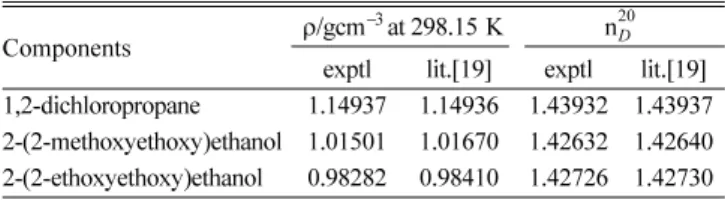
하여 Table 1에나타내었다. 각시료의순도를확인하기위하여밀
도및 굴절률(refractive index, Model RA-520, Kyoto Electronics, Japan)을측정하여문헌치와비교하였으며, 이를 Table 2에나타 내었다.
2-2.과잉몰부피,
과잉몰부피는정밀히측정된밀도로부터계산되어지며, 순수 성분및 2성분혼합물의 밀도는 자동시료주입장치(automatic
sample changer, model SP3, Anton Paar, Graz, Austria)가장착 된 밀도계(vibrating glass-tube densimeter, model DMA-58, Anton Paar, Graz, Austria)를사용하여측정하였고, 이장치의정 밀도는±5×10⁻⁶ gcm−3이다. 또한, 시료준비를위한질량측정은정
밀도가±1×10⁻⁵g인전자저울(model AT-201, Mettler Co., Switzerland)
을사용하였다. 과잉몰부피, 를구하기위한시료의준비및 절차에대한상세한기술은 Kim과 Kim[12]에나타나있다.
과잉몰부피, /cm3·mol−1는각조성의시료에대해측정된밀
도값을이용하여 (1)식으로부터계산되어진다.
(1)
여기서 xi는 i성분의몰분율이며, ρ및ρi는혼합물및 i성분의밀 도이고, Mi는 i성분의분자량이다.
2-3. 과잉몰엔탈피,
과잉몰엔탈피의측정은흐름혼합셀(flow mixing cell)이장착된 등온흐름열량계(isothermal microcalorimeter, model CSC-4400, Calorimetry Science Corporation, Utah, U.S.A)를이용하였으며,
장치의블록다이어그램을 Fig. 1에나타내었다. 이기기를구성
하고있는주요장치에관한상세한내용과 시료의전처리과정,
시료를 흐름혼합셀에 주입하기 위한 장치인두 대의 HPLC pump(Acuflow Series II, Fisher Scientific, U.S.A)을이용한실 험절차에관한자세한서술은 Kim과 Kim[12]에보고되어있다.
혼합티(mixing tee)에주입되는각성분의부피유속에따라열
적값(thermal power)이다르게나타나므로실험에앞서총주입
부피유속을결정해야한다. 총주입부피유속의결정방법은일반
적으로 2성분계의경우등몰(equimolar) 혼합물에서열적효과가
최대혹은최소치를나타내므로본장치의허용규격(±62,800µW)
에따라본실험에서의총주입부피유속은 0.5 ml·min−1로정하 여실험하였다. 정해진총주입부피유속에대한각시료간의부 피유속비(volumetric flow rate ratio)를미리정하여필요로하는 실험데이터수와측정조성을얻었다. 각시료의주입은 우선두
시료중시료(A)만총주입부피유속인 0.5 ml·min−1으로주입하 여열적값(thermal power)의변동이±30µW 내로안정하게유지 된후(보통 1~2시간정도소요됨) 성분(A)의기준선(baseline)의
n˜
VmE
HmE
HmE
VmE
VmE
VmE
VmE x1M1+x2M2
--- ρ x1M1
ρ1
--- x2M2
ρ2
--- – –
=
HmE
Table 1. Origins, stated purities, and moisture of the pure components
Components Origins stated purities moisture/vol%
1,2-dichloropropane Fluka Chemie AG >99.0% 0.005
2-(2-methoxyethoxy)ethanol Aldrich Chemical Co. >99.6% 0.010
2-(2-ethoxyethoxy)ethanol Aldrich Chemical Co. >99.0% 0.022
Table 2. Densities and refractive indices of the pure components and comparison with literature values
Components ρ/gcm−3 at 298.15 K
exptl lit.[19] exptl lit.[19]
1,2-dichloropropane 1.14937 1.14936 1.43932 1.43937 2-(2-methoxyethoxy)ethanol 1.01501 1.01670 1.42632 1.42640 2-(2-ethoxyethoxy)ethanol 0.98282 0.98410 1.42726 1.42730
nD20
값으로정하였다. 그다음성분(A)의주입부피유속을점차줄이
는동시에시료(B)의부피유속을 늘려시료 A와 B를미리정한
값에따라동시에주입시켜혼합물에대한혼합열(heat of mixing)
의열적값을얻게되며, 각혼합물시료의기준선의값(Φ/µW)은
(2)식에의해구하였다. 이때에도 peak의요동허용치(fluctuation tolerance)를 ±30µW 이내로하여안정될때까지시료를주입한 후데이터를얻었다. 혼합물에대한실험이종료된후시료(B)만 을총부피유속(0.5 ml·min−1)으로주입하여시료(B)에대한기준 선의값을정하였다.
(2)
여기서 는순수성분 1과 2의열속(heat flux/µW)이고, 은 성분 1, 2의부피유속(ml·min−1)이며, 는총부피유속(ml·min−1)
이다. 각주입유속에따른각혼합물의혼합티(mixing tee)에서의 조성은 (3)식으로계산하였다.
(3)
여기서 은 i성분의부피유속(ml·min−1), ρi는 i성분의밀도이며, Mi는 i성분의분자량이다. 최종적인과잉몰엔탈피는유속의조합에
따라얻어진열적값((2)식)과함께 (4)식의관계로부터얻어진다. (4)
여기서 는과잉몰엔탈피(Jmol−1)이며, 은각혼합물에대한 열속(heat flux, µW)이다.
열량계의 성능 및 실험 data의 건전성은 Sabbah 등[20] 및
Wadsö[21]가등온열량계의성능및재현성을검정하기위해 298.15K
에서흡열과정에대해서는 {n-hexane + cyclohexane}계와발열과 정인경우는 {water + ethanol}계를 2성분계에대한기준으로제시하 였는데, 본실험에앞서흡열과정에대해서는 Tanaka 등[22]과발 열과정인경우는 Chand와 Fenby[23] 및 Costigan 등[24]의실험
값과비교하였으며, 1.6%이내로잘일치하는결과를보여주었 다[12].
3. 결과 및 고찰
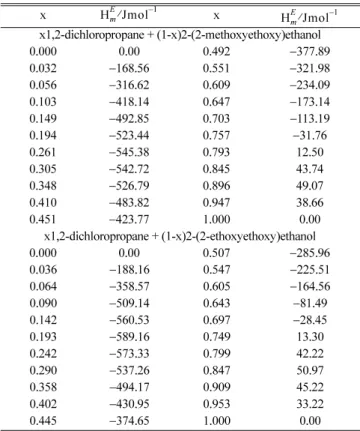
2성분계 {DCP + MEE} 및 {DCP + EEE}에 대해 1 atm, 298.15 K에서측정한 의결과는 Table 3 및 4와같으며, 는
Table 5에나타내었다. 또한, 측정한 및 를조성에대해
(5)식인 Redlich-Kister식으로곡선맞추기(fitting)를하였다.
Φ q·1υ·1
υ·T --- + q·2υ·2
υ·T ---
=
q·1,q·2 υ·1,υ·2
υ·T
xi
υ·iρi Mi
---
υ·1ρ1 M1
---
⎝ ⎠
⎛ ⎞ υ·2ρ2 M2
---
⎝ ⎠
⎛ ⎞
⎩ + ⎭
⎨ ⎬
⎧ ⎫
---
=
υ·i
HmE Φ q·
υ·1ρ1 M1
---
⎝ ⎠
⎛ ⎞ υ·2ρ2 M2
---
⎝ ⎠
⎛ ⎞
⎩ + ⎭
⎨ ⎬
⎧ ⎫
--- –
=
HmE q·
VmE HmE
VmE HmE
Fig. 1. Block diagram of isothermal microcalorimeter(Calorimetry Science Corporation, Utah, U.S.A).
Hmand Vmof{1,2-dichloropropane + 2-(2-alkoxyethoxy)ethanol} 447
(5) (5)식에서 은각각과잉몰부피 혹은과잉 몰엔탈피 이며, Ai는매개변수, x는 DCP의몰분율이다.
매개변수를구하기위한계산알고리즘은 Nelder-Mead’s simplex pattern search method[15]를이용하였으며, 표준편차(standard deviation),
σ와함께 Table 6 및 Table 7에나타내었다. 표준편차는 (6)식으 로계산하였다.
(6)
여기서 N은실험 data의수이며, r은파라미터의수이다. 또한, {DCP +
MEE} 및 {DCP + EEE}계에대한과잉몰부피및과잉몰엔탈피
에대한실험결과를조성과상관지어 Fig. 2과 Fig. 3에각각나
타내었으며, 그림에서곡선은 Redlich-Kister식의파라미터를이
용해계산된결과를나타낸것이다. Fig. 2와 3에서보는바와같
이과잉몰부피및과잉몰엔탈피는 2개의 2성분계모두 DCP의조성
에대해 S자형의양상을나타내고있다. 이는혼합초기인 2-(2-
QmE x 1 x( – ) Ai(1 2x– )i–1
i=1
∑n
=
QmE (VmE⁄cm3⋅mol–1)
HmE⁄Jmol–1
( )
σ {QmE(exptl) Q– mE(calcd)}2⁄(N r– )
i 1=
∑N
12
= ---
Table 3. Experimental densities and excess molar volumes for binary mixture of {x1,2-dichloropropane + (1-x)2-(2-methoxy- ethoxy) ethanol} at 298.15 K
x ρ/gcm−3
0.000 1.0150 0.0000
0.068 1.0230 −0.0372
0.131 1.0306 −0.0654
0.195 1.0384 −0.0884
0.255 1.0457 −0.1029
0.312 1.0529 −0.1129
0.370 1.0602 −0.1179
0.424 1.0671 −0.1155
0.479 1.0742 −0.1079
0.528 1.0807 −0.0977
0.578 1.0873 −0.0835
0.626 1.0938 −0.0666
0.672 1.1001 −0.0473
0.717 1.1064 −0.0286
0.761 1.1125 −0.0043
0.802 1.1185 0.0103
0.846 1.1248 0.0288
0.885 1.1308 0.0418
0.924 1.1366 0.0495
0.940 1.1392 0.0508
0.949 1.1407 0.0489
0.957 1.1419 0.0488
0.963 1.1429 0.0473
0.978 1.1453 0.0423
0.983 1.1462 0.0384
0.989 1.1472 0.0355
0.993 1.1479 0.0310
1.000 1.1494 0.0000
VmE
VmE⁄cm3mol–1
Table 4. Experimental densities and excess molar volumes for binary mixture of {x1,2-dichloropropane + (1-x)2-(2-ethoxy-ethoxy)- ethanol} at 298.15 K
x ρ/gcm−3
0.000 0.9828 0.0000
0.079 0.9931 −0.0666
0.153 1.0028 −0.1130
0.223 1.0125 −0.1456
0.290 1.0220 −0.1691
0.350 1.0309 −0.1785
0.412 1.0402 −0.1798
0.467 1.0488 −0.1725
0.519 1.0571 −0.1594
0.571 1.0656 −0.1417
0.619 1.0738 −0.1182
0.664 1.0816 −0.0932
0.709 1.0895 −0.0675
0.751 1.0973 −0.0397
0.791 1.1049 −0.0137
0.829 1.1122 0.0081
0.867 1.1197 0.0300
0.902 1.1270 0.0457
0.936 1.1342 0.0538
0.945 1.1363 0.0564
0.956 1.1387 0.0547
0.965 1.1407 0.0528
0.968 1.1414 0.0521
0.974 1.1429 0.0512
0.985 1.1453 0.0462
0.993 1.1472 0.0408
1.000 1.1494 0.0000
Table 5. Experimental excess molar enthalpies, for binary mixtures of {x1,2-dichloropropane + (1-x)2-(2-methoxyethoxy) ethanol}
and {x1,2-dichloropropane + (1-x)2-(2-ethoxyethoxy) ethanol}
at 298.15 K
x x
x1,2-dichloropropane + (1-x)2-(2-methoxyethoxy)ethanol
0.000 0.00 0.492 −377.89
0.032 −168.56 0.551 −321.98 0.056 −316.62 0.609 −234.09 0.103 −418.14 0.647 −173.14 0.149 −492.85 0.703 −113.19
0.194 −523.44 0.757 −31.76
0.261 −545.38 0.793 12.50
0.305 −542.72 0.845 43.74
0.348 −526.79 0.896 49.07
0.410 −483.82 0.947 38.66
0.451 −423.77 1.000 0.00
x1,2-dichloropropane + (1-x)2-(2-ethoxyethoxy)ethanol
0.000 0.00 0.507 −285.96
0.036 −188.16 0.547 −225.51 0.064 −358.57 0.605 −164.56
0.090 −509.14 0.643 −81.49
0.142 −560.53 0.697 −28.45
0.193 −589.16 0.749 13.30
0.242 −573.33 0.799 42.22
0.290 −537.26 0.847 50.97
0.358 −494.17 0.909 45.22
0.402 −430.95 0.953 33.22
0.445 −374.65 1.000 0.00
VmE
VmE⁄cm3mol–1
HmE
HmE⁄Jmol–1 HmE⁄Jmol–1
alkoxyethoxy)ethanol의조성이풍부한영역에서는 2-(2-alkoxyethoxy) ethanol 분자간(H-O)에 chemical effect인 수소결합(hydrogen bond)에의한강한자체회합현상(association)에따라과잉몰엔탈피 의경우음(negative)의비이상성(nonideality, 즉 exothermic effect)
을보이고있고, 과잉몰부피의경우회합에따른분자간인력에
의해분자간의거리가줄어듦에따라혼합부피의 감소가동반되 고있음을알수있다. 또한, 차츰 halogenated hydrocarbon인 DCP
의조성이증가함에따라 2-(2-alkoxyethoxy)ethanol의조성이감소
하면서 2-(2-alkoxyethoxy)ethanol 분자간에형성되어있던수소결합 이 파괴되면서 과잉몰엔탈피의 경우 양(positive)의 비이상성
(endothermic effect)을나타내고있고, 과잉몰부피의경우도마찬가 지로수소결합의깨어짐으로인한분자간상호작용(intermolecular
interaction)이약해짐에따라혼합부피가증가하는양상을나타내고
있다. 이는 Pal과 Singh[5] 및 Prausnitz 등[25]의실험결과및이론과
Table 6. Adjustable parameters A i and standard deviations σ for least-squares representations of and for binary mixture of {1,2-dichloropropane(1) + 2-(2-methoxyethoxy)ethanol(2)} at 298.15 K
A1 −0.4351 −0.4019 −0.4098 −1475.22 −1527.44 −1526.47
A2 −0.2844 −0.3406 −0.5153 −2355.01 −2365.51 −2452.50
A3 −0.6261 −0.0517 −0.2105 −−644.83 282.93 268.16
A4 −0.7892 −0.5955 −0.6483 −1451.18 −1387.78 −757.11
A5 1.0005 −0.6715 −1670.84 −1633.69
A6 −1.5546 −807.80
σ 0.0110 0.0088 −0.0074 16.72 11.65 11.59
Table 7. Adjustable parameters Ai and standard deviations σ for least-squares representations of and for binary mixture of {1,2-dichloropropane(1) + 2-(2-ethoxyethoxy)ethanol(2)} at 298.15 K
A1 −0.6815 −0.6409 −0.6533 −1131.41 −1183.39 −1183.55
A2 −0.3574 −0.4439 −0.6557 −2811.84 −2827.34 −2798.50
A3 0.7456 0.0273 0.2749 −1798.72 −872.55 −867.31
A4 −1.0222 −0.7373 0.7997 −1447.49 −1372.76 −1579.36
A5 1.2759 0.7760 −1644.03 −1656.49
A6 −1.9598 260.20
0.0133 0.0104 0.0084 22.44 19.47 20.04
VmE⁄cm3mol–1 HmE⁄Jmol–1
VmE⁄cm3mol–1 HmE⁄Jmol–1
VmE⁄cm3mol–1 HmE⁄Jmol–1
VmE⁄cm3mol–1 HmE⁄Jmol–1
Fig. 2. Excess molar volumes for binary mixture of {x1,2-dichlo- ropropane + (1-x)2-(2-methoxyethoxy)ethanol}; ■, and {x1,2- dichloropropane+(1-x)2-(2-ethoxyethoxy)ethanol}; ●, at 298.15K:
−, Redlich-kister model using parameters listed in Table 6 and 7.
VmE Fig. 3. Excess molar enthalpies for binary mixture of {x1,2-
dichloropropane + (1-x)2-(2-methoxyethoxy)ethanol}; ■, and {x1,2-dichloropropane + (1-x)2-(2-ethoxyethoxy)ethanol}; ●, at 298.15 K: −, Redlich-Kister model using parameters listed in Table 6 and 7.
HmE
Hmand Vmof{1,2-dichloropropane + 2-(2-alkoxyethoxy)ethanol} 449 잘일치하고있다.
또한, 과잉몰엔탈피를열역학적모델과상관지어기액평형실험 에의하지않고 VLE를예측하기위해각모델에대한적용성을 조사하였다.
3-1.열역학적모델과의상관관계
Excess molar enthalpies, 를 Gibbs-Helmholtz식으로부터
GE와상관지어 (7)식과같이나타낼수있다.
(7) 3-1-1. Wilson식
(7)식의 molar excess Gibbs energy GE/RT항을열역학적특성 치의추산식인 Wilson식[16]으로 2성분계에대해나타내면 (8)식과 같다.
(8) (8)식을 (7)식에대입하여온도 T에대해편미분하여 를조 성의함수로나타내면 (9)식과같다.
(9)
여기서 이고, 는각성분의몰부피이다.
3-1-2. NRTL식
NRTL(nonrandom two liquid)식[17]의 GE/RT는 (10)식과같다. (10) (10)식을위와마찬가지로 (7)식에대입하여하여온도 T에대 해편미분하여 를조성의함수로나타내면 (11)식과같다.
(11)
여기서 이고, 이다. α12는
non-randomness parameter이다. 3-1-3. UNIQUAC식
상기와 같이 UNIQUAC식[18]의 GE는 combinatorial part와 residual part를합하여 (12)식와같으며, 각 part의 GE/RT는 (13)
식및 (14)와같다.
(12)
(13)
(14)
(13)식과 (14)를위와마찬가지로 (7)식에 대입하여정리하면
(15)식과같다.
(15)
여기서 이고, 이다.
상기 Wilson식의 λ12 및 λ21, NRTL식의 τ12, τ21 및 α12와
UNIQUAC식의 ∆u12 및∆u21를구하여표준편차와함께 Table 8
에나타내었으며, 파라미터를계산하기위한 계산 알고리즘은
Redlich-Kister식의경우와동일한 Nelder-Mead's simplex pattern search method를이용하였다. 각 model에대해조성에따른 값
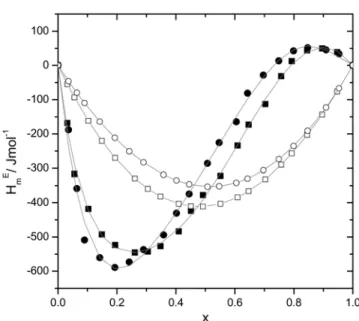
을실험값과의비교하여 Wilson식의경우는 Fig. 4에, NRTL식의 경우 Fig. 5 그리고 UNIQUAC식의경우는 Fig. 6에나타내었다. 그 림으로부터 NRTL식이조성과 간의상관관계를가장적절히 나타낼수있다는것을알수있었다.
4. 결 론
298.15 K 및 1 atm에서 2성분계 {DCP + MEE} 및 {DCP + EEE}에대한과잉몰부피와과잉몰엔탈피를측정하였다. 실험으로 부터얻어진 및 data는 Nelder-Mead의 simplex pattern search HmE
HmE RT2 ∂(GE⁄RT)
∂T ---
P x,
–
=
GE
RT---=–x1ln x( 1+Λ12x2)–x2ln x( 2+Λ21x1)
HmE
HmE x1x2 λ12Λ12
x1+Λ12x2
---+x---2λ+21ΛΛ2121x1
=
Λij VjL
VjL
---exp λij–λii ---RT
⎝– ⎠
⎛ ⎞
= ViL
GE
RT--- x1x2 τ21G21
x1+x2G21
--- τ12G12
x2+x1G12
--- +
=
HmE
HmE= RTx1x2
G12x1–x2(α12τ12–1) G12x1+x2
( )2
---G12τ12 G21x2–x1(α12τ21–1) G21x2+x1
( )2
---G21τ21
+
Gij (–α12τij) τij ∆gij
---RT
= exp ,
= ∆gij=gij–gjj
GE=GE(combinatorial)+GE(residual)
GE(combinatorial)
---RT
x1lnφx--- x11 2ln--- z2---qφx22 1x1lnθφ1
--- q1 2x2lnθφ2 ---2
⎝ + ⎠
⎛ ⎞
+ +
=
GE(residual)
---RT =–q1x1ln(θ1+θ2τ21)–q2x2ln(θ2+θ1τ12)
HmE q1x1τ21θ2∆u21
τ21θ2+θ1
--- q2x2τ12θ1∆u12
τ12θ1+θ2
--- +
=
τij exp ∆uij
---RT
⎝– ⎠
⎛ ⎞,∆uij = uij u– jj
= θ1 qixi qkxk
k
∑2
= ⁄
HmE
HmE
VmE HmE
Table 8. Adjustable parameters(λ12 and λ21, Wilson; τ12, τ21 and α12, NRTL; ∆u12 and ∆u21, UNIQUAC) used in Eqs. 9, 11 and 15 for correlating together with standard deviations, σ
Wilson NRTL UNIQUAC
λ12 λ21 σ τ12 τ21 α12 σ ∆u12 ∆u21 σ
{1,2-dichloropropane(1) + 2-(2-methoxyethoxy)ethanol(2)}
1499.18 −2184.39 156.2 1.590 4.457 0.790 23.9 −940.53 792.49 192.4
{1,2-dichloropropane(1) + 2-(2-ethoxyethoxy)ethanol(2)}
1574.33 −2289.02 196.9 0.973 6.284 0.535 15.6 −819.61 707.90 246.3
HmE
method를이용하여 Redlich-Kister 다항식에 접합(fitting)하였고, Wilson, NRTL 및 UNIQUAC model을이용하여 data와의
조성과의상관관계를조사하였다. 이상의결과로다음과같은결 론을얻었다.
(1) 과잉몰부피및과잉몰엔탈피는 2개의 2성분계모두 DCP의
조성에 대해 S-자형의양상을나타내었으며, 2-(2-alkoxyethoxy) ethanol의조성이풍부한영역에서는 2-(2-alkoxyethoxy)ethanol의 수소결합에 의한 강한회합현상에 따라 과잉몰엔탈피의경우
exothermic effect를보였고, 과잉몰부피의경우에도회합에따른
혼합부피의감소가일어났다. 또한, 차츰 halogenated hydrocarbon
인 DCP의조성이증가함에따라 2-(2-alkoxyethoxy)ethanol 분자 간에 형성되어있던수소결합의해리효과(dissociation effect)로 과잉몰엔탈피의경우 endothermic effect를나타내었으며, 과잉몰
부피의경우도마찬가지로수소결합의깨어짐으로인한분자간상 호작용(intermolecular interaction)이약해짐에따라혼합부피가증가하 는양상을보여주었다.
(2) Wilson, NRTL 및 UNIQUAC model을이용하여 data
와조성과의상관관계로부터각 model에대한매개변수를구했으며, fitting의적합성은 NRTL model이최적으로나타났다.
사용기호
Ai : Redlich-Kister adjustable parameters in the Eq. (5) Gij : NRTL parameter (=gij- gjj)
: excess molar enthalpies [Jmol1] Mi : molecular weight of component i
N : number of experimental data points in the Eq. (6) HmE
HmE
HmE
Fig. 5. Comparison between experimental and calculated by NRTL (eq. 11) using parameters listed in Table 8 for {x 1,2-dichloropropane + (1-x)2-(2-methoxyethoxy)ethanol} and {x 1,2-dichloro-propane + (1-x)2-(2-ethoxyethoxy)ethanol} at 298.15 K. ■ and □, 2-(2-methoxyethoxy)ethanol; ● and ○, 2-(2- ethoxyethoxy)ethanol. Closed and open points are for experi- mental and calculated values respectively. The solid curve for experimental values were drawn by eq. 5.
HmE HmE
Fig. 4. Comparison between experimental and calculated by Wilson(eq. 9) using parameters listed in Table 8 for {x1,2- dichloropropane + (1-x)2-(2-methoxyethoxy)ethanol} and {x 1,2-dichloropropane + (1-x)2-(2-ethoxyethoxy)ethanol} at 298.15 K. ■ and □, 2-(2-methoxyethoxy)ethanol; ● and ○, 2-(2- ethoxyethoxy)ethanol. Closed and open points are for experi- mental and calculated values respectively. The solid curve for experimental values were drawn by eq. 5.
HmE HmE Fig. 6. Comparison between experimental and calculated by UNIQUAC(eq. 15) using parameters listed in Table 8 for {x1,2-dichloropropane + (1-x)2-(2-methoxyethoxy)ethanol} and {x1,2-dichloropropane + (1-x)2-(2-ethoxyethoxy)ethanol} at 298.15 K. ■ and □, 2-(2-methoxyethoxy)ethanol; ● and ○, 2-(2- ethoxyethoxy)ethanol. Closed and open points are for experi- mental and calculated values respectively. The solid curve for experimental values were drawn by eq. 5.
HmE HmE
Hmand Vmof{1,2-dichloropropane + 2-(2-alkoxyethoxy)ethanol} 451
: refractive index at 293.15 K
q1, q2 : UNIQUAC area parameters of component i : heat flux [µW] of mixture and component i
: excess molar properties [ /Jmol1 or /cm3mol−1] in the Eq. (6)
r : number of adjustable parameters in the Eq. (6)
: total and volumetric flow rate [mlmin-1] of component xi : liquid phase mole fraction of component i
∆uij : UNIQUAC parameter
: liquid molar volume of component i [cm3mol-1] : excess molar volumes [cm3mol-1]
그리이스문자
α12 : NRTL non-randomness parameter
φi : UNIQUAC volume fraction of component i
Φ : baseline values [µW] in the Eq. (4) : Wilson parameters
θi : UNIQUAC area fraction of component i
: densities of binary mixture and component i [g·cm−3]
σ : standard deviation for [cm3mol−1] and [Jmol−1] in the Eq. (6)
τii : NRTL and UNIQUAC parameters
위첨자L : liquid phase
아래첨자1, 2, i, j : components calcd : calculated exptl : experimental lit : literature
m : mixture
참고문헌 1. http://daeyoungchemi.co.kr.
2. Ba os, I., Valero, J., Pérez, P., Gracia, M. and Gutiérrez Losa, C.,
“Excess Molar Volumes of Mixtures Containing 1,2-dichloropro- pane or 1,3-dichloropropane,”J. Chem. Thermodynamics, 22(5), 431-437(1990).
3. Barbés, B., Garca, I., González, J. A., Cobos, J. C. and Casanova, C.,
“Excess Properties of Mixtures of Some N-alkoxyethanols With Organic Solvents, Part 7. VE with Toluene at 298.15 K,”Thermo- chimica Acta, 257(1-2), 103-110(1995).
4. Tamura, K., Osaki, A., Murakami, S., Ohji, H., Ogawa, H., Lau- rent, B. and Grolier, J. -P. E., “Thermodynamic Properties of Binary Mixtures {an alkoxyethanol + n-octane}. Excess Molar Enthalp- ies and Excess Molar Heat Capacities at 298.15 K,” Fluid Phase Equilibria, 156(1-2), 137-147(1999).
5. Pal, A. and Singh, W., “Excess Molar Volumes and Excess Par- tial Molar Volumes of {xC6H5CH3+(1x)H(CH2)v(OCH2CH2)3 OH}
(v=1, 2, and 4) at the Temperature 298.15 K,” J. Chem. Thermo- dynamics, 28(7), 717-722(1996).
6. Park, S. J. and Gmehling, J, “Excess Molar Volumes at the 308.15 K for Constituent Binaries of n-decane, n-dodecane, 1-decanol and 1-dodecanol,”Korean J. of Chem. Eng., 12(2), 152-155(1995).
7. Bae, H. K. and Song, H. C., “Excess Molar Volume of Acetone, Water and Ethylene Glycol Mixture,”Korean J. of Chem. Eng.,
15(6), 615-618(1998).
8. Park, S. B., Kim, J. S. and Lee, H., “Excess Molar Enthalpies (Pro- pylene carbonate + an Alcohol),”J. Chem. Thermodynamics, 31, 1265-1271(1999).
9. Kim, M. G. and Lee, Y. S., “Excess Molar Volume and Enthalp- ies for 1,2-dichloropropane + 2-methoxyethanol) at the Temper- ature 298.15 K,”J. Kor. Soc. of Ind.,4(2), 193-198(2001).
10. Kim, M. G., Lee, Y. S. and Kim, Y. W., “Excess Molar Volumes and Excess Molar Enthalpies for {1,2-dichloropropane+2-ethoxy- ethanol} at T=298.15 K,” Proceedings of 2001 KIChE Fall Meet- ing, 7(2), 3619-3622(2001).
11. Kim, M. G. and Lee, Y. S., “Excess Molar Enthalpies for {1,2- dichloropropane+2-alkoxyethanol} at T=298.15 K,” Proceedings of 2002 KIChE Spring Meeting, 8(1), 849-852(2002).
12. Kim, Y. W. and Kim, M. G., “Excess Molar Enthalpies and Excess Molar Volumes of {1,2-dichloropropane + 1,3-dioxolane, and + 1,4- dioxane} at the Temperature 298.15 K,”Korean Chem. Eng. Res.,
42(4), 426-432(2004).
13. Kim, J. W., “Excess Molar Volumes and Excess Molar Enthalpies for Binary Mixtures of {1,2-dichloropropane + 2-(2-methoxy- ethoxy)ethanol, and + 2-(2-ethoxyethoxy)ethanol} at 298.15 K,”
M. S. Dissertation, Sangju National University, Sangju, Korea (2005).
14. Redlich, O. and Kister, A. T., “Algebraic Representation of Ther- modynamic Properties and the Classification of Solutions,”Ind.
Eng. Chem., 40, 345-348(1948).
15. Nelder, J. A. and Mead, R., “A Simplex Method for Function Minimization,”Comp. J., 7, 308-313(1965).
16. Wilson, G. M., “Vapor-Liquid Equilibrium. XI. A New Expres- sion for the Excess Free Energy of Mixing,”J. Am. Chem. Soc.,
86(2), 127-130(1964).
17. Renon, H. and Prausnitz, J. M., “Local Composition in Thermo- Dynamic Excess Functions for Liquid Mixtures,”AIChE J., 14, 135-144(1968).
18. Abrams, D. S. and Prausnitz, J. M., “Statistical Thermodynamics of Liquid Mixtures: A New Expression for the Excess Gibbs Energy of Partly or Completely Miscible Systems,”AIChE J., 21, 116-128 (1975).
19. Riddick, J. A., Bunger, W. S. and Sakano, T. K., Organic Solvents, Physical Properties and Methods of Purification, 4th ed., Wiley Interscience Publication, New York(1986).
20. Sabbah, R., Xu-wu, A., Chickos, J. S., Planas Leit o, M. L., Roux, M. V. and Torres, L. A., “Reference Materials for Calorimetry and Differential Thermal Analysis,”Thermochimica Acta, 331, 93- 204 (1999).
21. Wadsö, I., “Needs for Standards in Isothermal Microcalorime- ter,”Thermochimica Acta, 347, 73-77(2000).
22. Tanaka, R., D’arcy, P. J. and Benson, G. C., “Application of a Flow Microcalorimeter to Determine the Excess Enthalpies of Binary Mixtures of Non-electrolytes,”Thermochimica Acta, 11, 163-175 (1975).
nD20
qqi
QmE HmE VmE
υT,υi
uij–ujj
=
( )
ViL
VmE
Λii,λii–λii
ρ ρ, i
VmE HmE
n˜
a˜
23. Chand, A. and Fenby, D. B., “Enthalpy of Deuterium Exchange Reactions in Water + Ethanol and Methanol + Ethanol,”J. Chem.
Thermodynamics., 10, 997-1001(1978).
24. Costigan, M. J., Hodges, L. J., Marsh, K. N., Stokes, R. H. and Tuxford, C. W., “The Isothermal Displacement Calorimeter: Design
Modifications for Measuring Exothermic Enthalpies of Mixing,”
Aust. J. Chem., 33, 2103-2119(1980).
25. Prausnitz, J. M., Lichtenthaler, R. N. and de Azevedo, E., G., Molecular Thermodynamics of Fluid-Phase Equilibria, 3rd ed., Prentice-Hall, New Jersey(1999).