Journal of the Korean Chemical Society 2012, Vol. 56, No. 1
Printed in the Republic of Korea
http://dx.doi.org/10.5012/jkcs.2012.56.1.058
-58-
Solvent Extraction of Platinum (IV) with 4-(4-Ethoxybenzylideneamino)-5-methyl- 4H-1,2,4-triazole-3-thiol (EBIMTT) from Hydrochloric Acid Media
Uzma parveen K. Shaikh, Aashish O. Dhokte, Machhindra K. Lande, and Balasaheb R. Arbad* Department of Chemistry, Dr.Babasaheb Ambedkar Marathwada University, Aurangabad-431004 Maharashtra, India.
*E-mail: [email protected]
(Received July 4, 2011; Accepted December 16, 2011)
ABSTRACT. The solvent extraction of platinum (IV) metal from hydrochloric acid media using 4-(4-ethoxybenzylide- neamino)-5-methyl-4H-1,2,4-triazole-3-thiol (EBIMTT) in chloroform was studied as a function of several variables, such as reagent, acid and metal ion concentration, effect of various diluents, and diverse ions. The proposed method was further applied for the separation of platinum (IV) from binary mixtures, synthetic mixtures, alloys and commercially available samples.
Key words: Solvent extraction, Pt (IV), EBIMTT, Real samples
INTRODUCTION
Platinum is an extremely rare metal, occurring at a con- centration of only 0.005 ppm in the earth’s crust.1 The most common uses of platinum are in electronic indus- tries, in automotive exhaust-gas control converters and as a catalyst in petroleum and chemical processes. Due to its scarcity and importance there is need to recycle the plat- inum metal from secondary sources like electronic scrap, petrochemical catalysts, automotive catalysts.2
Usually, before the spectrophotometric determination of each metal, a separation is imperative and the separa- tion step definitely represents the most difficult problem of the analysis, especially in the case of trace amounts.
From this point of view, the solvent extraction technique holds a prominent position among separation techniques because of its speed, ease and selectivity. Liquid-liquid extraction procedures have proven very useful in the sep- aration of metal ions.
During the last three decades a variety of extractants have been proposed for the solvent extraction of platinum (VI), like Cyanex-923,3 Cyclic tetrathioethers,4 2-mer- captobenzothiazole,5 Organoaminophosphonate,6 Tri-n- butyl Phosphate,7 N,N-di-n-hexyl-Nbenzoylthiourea,8 N,N- Nonylthiourea,9 diethyl-N-benzoylthiourea,10 Bis (2-eth- ylhexyl),11 Dialkyl sulphoxide,12 N-octylaniline,13 tri-iso- octylamine.14
Sulphur containing ligands showed promising effects in the field of analytical chemistry for the separation and estimation of platinum group metals.15,16 As a soft acid, platinum has a great affinity for soft base ligand contain- ing sulfur. Hence, a new extractant has been synthesized
containing sulphur and nitrogen as donor atoms, 4-(4- ethoxybenzylideneamino)-5-methyl-4H-1,2,4-triazole-3- thiol (EBIMTT), and its effectiveness has been evaluated as an extractant for Pt(IV) from alloys, synthetic mixtures and real samples.
The important features of this method are that, it per- mits selective separation of Pt(IV) from other platinum group metals and base metals which are generally asso- ciated with it. It is free from interference from a large number of foreign ions, low reagent concentration is required and time needed for equilibration is short (about just 30 sec- onds). We report here the use of EBIMTT as an excellent extractant for Pt(IV) from hydrochloric acid medium.
EXPERIMENTAL
Instrumentation
A Jasco V-530 UV-Vis spectrophotometer with 1 cm quartz cells was used for absorbance measurement, pH measurements were carried out with an Elico digital pH meter model LI-120 (±0.01).
Reagents
Synthesis of extractant: Precursor, 3-ethyl-4-amino-5- mercapto-1,2,4-triazole was synthesized and recrystal- lized as reported by17,18 which was reacted with 0.02 mole of ethoxybenzaldehyde in 50 ml alcohol containing 3 drops of glacial acetic acid and was refluxed for 3-4 h.19 The product obtained was separated and recrystallized from hot ethanol as pale yellow shiny needles (m.p.171oC) Fig. 1.
1H-NMR spectra of synthesized extractant was recorded
2012, Vol. 56, No. 1
Solvent Extraction of Platinum (IV) with 4-(4-ethoxybenzylideneamino)-5-methyl-4H-1,2,4-triazole-3-thiol (EBIMTT) 59
in CDCl3. It shows following signals at. 2.12 (5H, s,-C2H5), 6.8 (2H, d, aromatic protons), 7.5 (2H, d, aromatic protons), 8.1(1H, s,-CH), 3.08 (1H, s, -SH). Mass spectral data of the ligand has been recorded and shows the molecular ion peak (M+) at m/z = 262.09 as indicated by the peaks cor- responding to their molecular masses. The FT-IR spec- trum of the free extractant shows C-H stretching at 2885 cm-1, -C=N stretching at 1600 cm-1 and 754 cm-1 for -C=S.
Solutions with a desired concentration of EBIMTT were prepared by dissolving appropriate amount of EBIMTT in chloroform. A stock solution of Pt(IV) was prepared by dissolving 1g of Platinum(IV) chloride hydrate (PtCl4) in analytical reagent hydrochloric acid (1M) diluted to 100 ml with double distilled water. The required concentration of this solution was prepared by further dilution. Other stan- dard solutions of different metal ions used to study the effect of foreign ions were prepared by dissolving weighed quantities of respective salts in distilled water or dilute hydrochloric acid. All the chemicals used were of ana- lytical grades. Double distilled water was invariably used throughout the measurements.
Recommended procedure
An aqueous solution containing 200µg Pt(IV) mixed with a sufficient quantity of hydrochloric acid and water were added to give final concentration of 1M with respect to hydrochloric acid in 25 ml. Then the pH of the solution was adjusted to 1.0 using dilute hydrochloric acid and sodium hydroxide. The solution was transferred into a 125 ml separating funnel and shaken with 10 ml of 0.1 M EBIMTT in chloroform for just 30 seconds. After equilibration, the mixture was allowed to separate and the metal was stripped from the organic phase with two 10 ml portions of water.
The extracts were evaporated to moist dryness. The res- idue was dissolved in 5 ml of conc. hydrochloric acid and 10 ml of 20% Sncl2 (stannous chloride) was added. The solu- tion was diluted to the mark with water. The absorbance of the resulted solution was measured at 403 nm.20 The con- centration of Pt(IV) was found from a calibration curve.
RESULT AND DISCUSSION
Effect of solvent: Among organic solvents (benzene, chloroform, acetone, carbon tetrachloride, nitrobenzene, isobutyl alcohol, 1-butanol, isobutyl methyl ketone, eth- anol, 1.4-dioxan and N, Ndimethylformamide) were exam- ined for the extraction of Pt(IV) with EBIMTT from hydrochloric acid media, chloroform medium extracts the complex effectively without third phase formation.
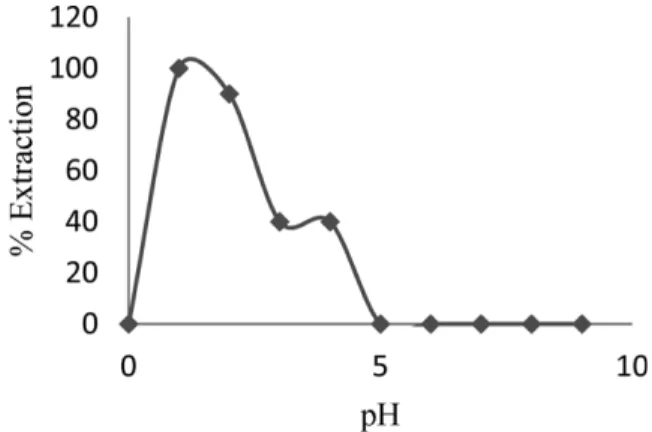
Extraction as a function of pH: Platinum (IV) was extracted in the pH range of 0.1-9 in the presence of 1 M hydrochloric acid. The quantitative extraction was obtained at pH range 1-2.The maximum absorption was observed at pH 1 (Fig. 2).
Effect of acids: Extraction of Platinum (IV) was car- ried out in different acid media like hydrochloric acid, sul- phuric acid, nitric acid, hydrochloric acid showed good extraction properties, while nitric acid forms emulsion at the time of extraction. Due to maximum extraction and better phase separation hydrochloric acid was found to be appropriate medium for extraction of Pt(IV) (Table 1).
Effect of reagent concentration: Different molar excess of EBIMTT were added to a fixed metal ion concentra- tion and the absorbances were measured according to the standard procedure.
It was observed that 0.06 M EBIMTT was sufficient for quantitative extraction of 200µg of Pt(IV), but in recom- mended procedure, 10 mL of 0.1 M EBIMTT in chloro- Fig. 1. Structure of 4-(4-ethoxybenzylideneamino)-5-methyl-4H-
1, 2, 4-triazole -3-thiol (EBIMTT).
Table 1. Extraction of Pt(IV) from different acid media with EBIMTT in chloroform
Acid media % Extraction
Hydrochloric acid 99
Nitric acid 20
Sulphuric acid 15
Fig. 2. Extraction of platinum (IV) with 0.1 M EBIMTT from hydrochloric acid medium as a function of pH.
60 Uzma parveen K. Shaikh, Aashish O. Dhokte, Machhindra K. Lande, and Balasaheb R. Arbad
Journal of the Korean Chemical Society
form was used to ensure the complete extraction of metal ion (Fig. 3).
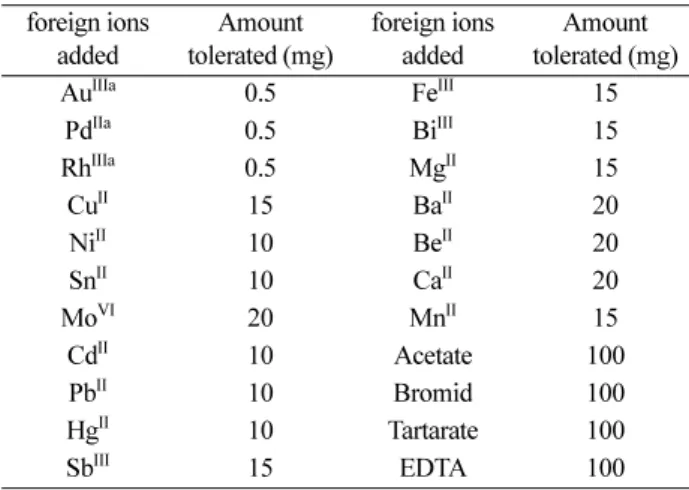
Effect of diverse ions: The effect of various diverse ions was tested, when platinum (IV) was extracted with EBIMTT in chloroform. The tolerance limit of individual diverse ions was determined with an error less than ±2%. It was observed that the method is free from interference from a large number of cations and anions (Table 2). The only species showing interference in the procedure were Pd(II), Rh(III) and Au(III). However, the interference of Pd(II) and Rh(III) was eliminated by masking with tartrate.
Effect of stripping agents: Platinum (IV) was stripped with different stripping agents such as mineral acids, bases, and salts after its extraction. The stripping of platinum (IV) was quantitative with water. The stripping was found to be incomplete with ammonia (60%), and sodium chlo- ride (40%), with hydrochloric acid (20%), whereas platinum (IV) was not stripped with sulphuric acid and sodium
hydroxide.
Effect of shaking time: The effect of time on extrac- tion of Pt(IV) was observed for a period of 5 sec. to 30 min.
The extraction was found quantitative in the period of 10- 35 seconds. Prolonged shaking has no adverse effect on the extraction, but to ensure the complete extraction 1 min equilibration time was selected.
Applications: The present method was successfully applied for the determination of Platinum (VI) in a series of synthetic mixtures of various compositions, and also in a number of real samples, e.g. several Certified Reference Materials (CRMs).
1) Binary separation of Pt(IV) from iron(III), cobalt(II), nickel(II) and copper(II): The method allowed separa- tion and determination of Pt(IV) from a binary mixture containing either iron(III), cobalt(II), nickel(II) and cop- per(II). In a typical experiment, solution containing 200µg of Pt (IV) was taken and known amounts of other metals were added. The separation of Pt (IV) from iron(III), cobalt(II), nickel(II) and copper(II) was accomplished with 0.1 mol/dm3 EBIMTT in chloroform at 1 mol/dm3 hydrochloric acid. Pt(IV) was estimated spectrophotometri- cally by stannous chloride method. The recovery of Pt(IV) and that added ions was 99.5% and results are reported in (Table 3).
2) Analysis of synthetic mixtures corresponding to alloy:
The method was applied for the analysis of synthetic mix- tures. Synthetic mixtures corresponding to alloys were pre- pared and analyzed for Pt(IV) content. Platinum (IV) was recovered quantitatively from hydrochloric medium by the proposed method. The method is selective and per- mits rapid separation and determination of micro amounts of Pt(IV). The average recovery of Pt(IV) was 99.5%
(Table 4).
3) Real sample analysis: EBIMTT also separates Pt(IV) from real samples like rhodium-platinum thermocouple wire, this platinum base alloy containing more than 10%
of iridium and rhodium. An aliquot of the real sample was prepared by the procedure given by Kolekar21 and Pt(IV) Fig. 3. Extraction of platinum (IV) at pH 1.0 from hydrochloric
acid medium as a function of EBIMTT concentration.
Table 2. Table of tolerance limit of foreign ions (diverse ions) on 200µg of Pt (IV) from hydrochloric acid with 0.1 M EBIMTT in chloroform
foreign ions added
Amount tolerated (mg)
foreign ions added
Amount tolerated (mg)
AuIIIa 0.5 FeIII 15
PdIIa 0.5 BiIII 15
RhIIIa 0.5 MgII 15
CuII 15 BaII 20
NiII 10 BeII 20
SnII 10 CaII 20
MoVI 20 MnII 15
CdII 10 Acetate 100
PbII 10 Bromid 100
HgII 10 Tartarate 100
SbIII 15 EDTA 100
aMasked with tartrate
Table 3. Binary separation of Pt (IV) from iron(III), cobalt(II), nickel(II) and copper(II)
Composition of metal ions (µg)
Recovery Pt(IV) (%)
Relative standard deviation (%) Pt(IV); 200, Fe(III); 15000 99.8 0.13 Pt(IV); 200, Co(II); 10000 99.4 0.10 Pt(IV); 200, Cu(II); 5000 99.6 0.15 Pt(IV); 200, Ni(II); 5000 99.6 0.15
*Average of six determination.
2012, Vol. 56, No. 1
Solvent Extraction of Platinum (IV) with 4-(4-ethoxybenzylideneamino)-5-methyl-4H-1,2,4-triazole-3-thiol (EBIMTT) 61
was determined using the procedure given above.The results of analysis are given in Table 5.
CONCLUSION
EBIMTT has been proved to be a sensitive and selec- tive spectrophotometric reagent for Pt(IV), it can be syn- thesized at low cost with high yield and in the best purity and recovered for reuse without loss of extraction effi- ciency. The proposed method is simple, reproducible and rapid. The important features of the method are, it permits selective separation and determination of Pt(IV) from other associated metals such as Cu(II), Co(II), Pt(IV), Ru(III), Fe(III), Pd(II), Ni(II), low reagent concentration is required for quantitative recovery of Pt(IV), shorter time of equilibration was needed, it is free from interfer- ence of a large number of foreign ions which are associ- ated with Pt(IV) in its natural occurrence and it is successfully applicable to the determination of Pt(IV) in analysis of binary, synthetic mixtures and real samples.
Acknowledgment. The authors are thankful to UGC New Delhi for providing financial assistance through MANF scheme and the Head, Department of Chemistry, Dr. Babasaheb Ambedkar Marathwada University, Auranga- bad, for providing necessary facilities.
REFERENCES
1. Murata, K. J. Symposium on Spectrocemical Analysis for Trace Elements: 1958; p 71.
2. Goralska, E.; Coll, M.T.; Fortuny, A.; Kedari, C.S.; Sas- tre, A.M. Solvent Extr. Ion Exch. 2007, 25, 65.
3. Duchea, S. N.; Dhadke, P. M. Sep. Sci. Tech. 2002, 37, 3011.
4. Keiitsu, S.; Ichiro T.; Yasuyo Y.; Satomi, M.; Akihiko, M.
Talanta 2000, 51, 913.
5. Diamantatos, A. Analytica Chimicu Acta 1973, 66, 147.
6. Keisuke, O.; Junji, N.; Seiji, H.; Kazuharu,Y.; Katsutoshi, I.;Yoshinari, B. Solvent Extr. Ion Exch 1997, 15, 115.
7. Faye, G. H.; Inman, W. Anal. Chem. 1963, 35, 8.
8. Vest, P.; Schuster, M.; Honig, K. Fres. J. Anal. Chem.
1991, 339, 142.
9. Uheida, A.; Zhang, Y.; Muhammed, M. Solvent Extr. Ion Exch. 2003, 21, 827.
10. Merdivan, M.; Aygun, R. S.; Kulcu, N. Annali di Chimica 2000, 90, 407.
11. Sherikar, A. V.; Phalke, P. N. Dhadke, P. M. Bull. Chem.
Soc. Jpn. 1997, 70, 805.
12. John, S. P.; Anna, C. du Preez, Solvent Extr. Ion Exch.
2002, 20, 359.
13. Lokhande, T. N.; Anuse, M. A.; Chavan, M. B. Talanta 1998, 47, 823.
14. Lee, J. Y.; Rajesh, K. J.; Kim, J. S.; Park, H. K.; Yoon, H.
S. J. Hazard Mater. 2009, 168, 424.
15. Vest, P.; Schuster, M.; Konig, K. H. Fres. J. Anal. Chem.
1989, 335, 759.
16. Inoue, K.; Koba, M.; Yoshizuka, K. Solvent Extr. Ion Exch.
1994, 12, 55.
17. Dhakha, K. S.; Mohan, J.; Chanda, V. K.; Pujari, H. K.
Ind. J. Chem. 1974, 12, 288.
18. Vidhate, K. N.; Lande, M. K.; Arbad, B. R. J. Ind. Chem.
Soc. 2008, 85, 536.
19. Shaikh, U. P.; Katkar, S. S.; Vidhate, K. N.; Lande, M. K.;
Arbad, B. R. J. Indian Chem. Soc. 2011, 88, 1.
20. Beamish, F. E.; Van Loon, J. C. Analysis of Noble Metals:
Overview and Selected Methods; Academic Press: London, 1977.
21. Kolekar, S. S.; Anuse, M. A. Talanta 2002, 58, 761.
Table 4. Analysis of synthetic mixtures corresponding to alloy
Alloy Composition (%) Platinum taken (µg) Platinum found (µg) Recovery* (%) R.S.D (%)
Platinurn-rhodium alloy 90Pt, 10Rh 200 199 99.5 0.09
Cooper’s pen metal 50Pt, 38Ag, 12Cu 200 199.8 99.9 0.06
Cooper’s gold 67-81Cu, 19-30Pt, 0-4Zn 200 199.8 99.9 0.06
Platinum substitute, electrical 68Au, 25Ag, 7.5Pt 200 199.8 99.9 0.06
Oakay alloy 20Pt, 10.5Pd, 60Ni, 9.5V 200 199.7 99.8 0.07
Solder alloy 10Pt, 30Pd, 60Au 200 199.8 99.9 0.06
Table 5. Analysis of real samples for platinum content
Sample Composition
(%)
Certified value of platinum
Amount of platinum(IV) found by proposed method
R.S.D (%)
Platinum-rhodium thermocouple wire 87Pt, 13Rh 87% 86.6% 0.30