ISSN 2234-3806 • eISSN 2234-3814
https://doi.org/10.3343/alm.2019.39.3.263
Dried Blood Spot Multiplexed Steroid Profiling Using Liquid Chromatography Tandem Mass Spectrometry in Korean Neonates
Rihwa Choi, M.D.1,2,3, Hyung-Doo Park , M.D., Ph.D.2,3, Hyeon Ju Oh, M.S.2, Kyounghoon Lee, M.D.2,3, Junghan Song, M.D., Ph.D.4, and Soo-Youn Lee , M.D., Ph.D.2,3
1Department of Laboratory Medicine, Green Cross Laboratories, Yongin, Korea; 2Department of Laboratory Medicine and Genetics, Samsung Medical Center, Seoul, Korea; 3Department of Laboratory Medicine and Genetics, Sungkyunkwan University School of Medicine, Seoul, Korea; 4Department of Laboratory Medicine, Seoul National University College of Medicine, Seoul National University Bundang Hospital, Seongnam, Korea
Background: Screening for congenital adrenal hyperplasia (CAH) using immunoassays for 17α-hydroxyprogesterone generates many false-positive results. We developed and vali- dated a liquid chromatography–tandem mass spectrometry (LC-MS/MS) assay for simul- taneous quantification of nine steroid hormones in dried blood spot (DBS) samples, and established reference intervals for these hormones.
Methods: We examined our method for linearity, precision, accuracy, extraction recovery, and matrix effects and determined the reference intervals of cortisol, 17α-hydroxyproges- terone, 11-deoxycortisol, 21-deoxycortisol, androstenedione, corticosterone, 11-deoxycor- ticosterone, testosterone, and progesterone in 1,146 DBS samples (from 272 preterm and 874 full-term neonates). Immunoassay and LC-MS/MS methods were compared for 17α-hydroxyprogesterone. Fourteen additional samples were tested to validate the clinical applicability of the LC-MS/MS method.
Results: The linearity range was 2.8–828.0 nmol/L for cortisol and 0.9–40.0 nmol/L for the other steroids (R2>0.99). Intra-day and inter-day precision CVs were 2.52–12.26% and 3.53–17.12%, respectively. Accuracy was 80.81–99.94%, and extraction recovery and matrix effects were 88.0–125.4% and 61.7–74.2%, respectively. There was a negative bias, with higher values measured by immunoassay compared with LC-MS/MS (r =0.8104, P <
0.0001). The LC-MS/MS method was successfully applied to the analysis of nine steroids in DBS for screening and diagnosis of CAH using the 14 additional samples.
Conclusions: Our method enables highly sensitive and specific assessment of nine steroids from DBS and is a promising tool for clinical analysis of CAH.
Key Words: 17α-hydroxyprogesterone, Steroid hormones, Congenital adrenal hyperplasia, reference intervals, LC-MS/MS, Dried blood spot
Received: June 10, 2018
Revision received: September 7, 2018 Accepted: December 17, 2018 Corresponding author:
Hyung-Doo Park, M.D.
https://orcid.org/0000-0003-1798-773X Department of Laboratory Medicine and Genetics, Samsung Medical Center, Sungkyunkwan University School of Medicine, 81 Irwon-ro, Gangnam-gu, Seoul 06351, Korea
Tel: +82-2-3410-0290 Fax: +82-2-3410-2719 E-mail: [email protected] Co-corresponding author:
Soo-Youn Lee, M.D.
https://orcid.org/0000-0001-7595-4042 Department of Laboratory Medicine and Genetics, Samsung Medical Center, Sungkyunkwan University School of Medicine, 81 Irwon-ro, Gangnam-gu, Seoul 06351, Korea
Tel: +82-2-3410-1834 Fax: +82-2-3410-2719 E-mail: [email protected]
© Korean Society for Laboratory Medicine This is an Open Access article distributed under the terms of the Creative Commons Attribution Non-Commercial License (http://creativecom- mons.org/licenses/by-nc/4.0) which permits unrestricted non-commercial use, distribution, and reproduction in any medium, provided the original work is properly cited.
INTRODUCTION
Serum steroid assays play an important role in the clinical evalu- ation of many common endocrine disorders [1]. Congenital adre- nal hyperplasia (CAH), the most common adrenal gland disorder
in infants and children, is a group of autosomal recessive disor- ders [2]. The 21-hydroxylase catalyzes hydroxylation of 17α-hydro- xyprogesterone to 11-deoxycortisol in the glucocorticoid pathway [1]. In particular, 21-hydroxylase deficiency is the cause of ap- proximately 95% of CAH cases [2]. Most neonatal screening pro-
2017-03-16 https://crossmark-cdn.crossref.org/widget/v2.0/logos/CROSSMARK_Color_square.svg
grams worldwide include the detection of CAH, and the standard test parameter is 17α-hydroxyprogesterone [3, 4].
Although immunoassays to evaluate 17α-hydroxyprogesterone are easy to handle, rapid, and highly sensitive, they have ques- tionable reliability because of a lack of specificity to CAH and matrix effects [5]. Conventional screening for CAH using immu- noassays for 17α-hydroxyprogesterone generates many false- positive results [3, 5], which not only upset parents and medical staff but also necessitate subsequent costly clinical and labora- tory analyses [3].
While the inclusion of extraction steps improves immunoassay specificity, all interfering molecules cannot be completely elimi- nated [5]. Several studies attribute the low specificity to cross- reactivity of antibodies with steroids other than 17α-hydroxypro- gesterone, such as steroid sulfates, 17α-hydroxypregnenolone, and 17α-hydroxypregnenolone sulfate [1, 3, 5]. Poor immuno- assay specificity is an issue, especially in preterm or stressed in- fants, who have high concentrations of delta-5 cross-reacting steroids [2]. Preterm neonates often have high concentrations of 17α-hydroxyprogesterone because of stress or delayed matu- ration of 11-hydroxylase [1], which can reduce diagnostic speci- ficity in screening for CAH by antibody-based methods, poten- tially resulting in false-positive diagnosis and generating demand for a second-tier confirmation test [2]. Using steroid profiling by liquid chromatography–tandem mass spectrometry (LC-MS/MS) in neonate screening for CAH yields fewer false-positive results because of its high analytical specificity and potential to quantify several compounds in a single run [2].
LC-MS/MS is the most accurate method currently available for measuring small molecules, and it can measure multiple steroid hormones simultaneously [6]. Steroid profiling with LC- MS/MS allows for evaluation of the status of enzymes involved in adrenal steroid biosynthetic pathways; thus, it is a better di- agnostic tool than the evaluation of a single steroid [6]. A spe- cific LC-MS/MS method with simultaneous detection of multiple steroids has been introduced to minimize unnecessary follow- up analyses [3, 6]. Although previous studies examined multiple steroid hormonal analyses using LC-MS/MS in Korea, they in- cluded limited numbers of steroids [6, 7] or did not evaluate clinical screening for CAH using patient samples [6]. Testoster- one and progesterone, steroid hormones useful for the screen- ing and diagnosis of CAH, have not been studied using dried blood spots (DBS) in Korean neonates [6, 7].
We developed and validated an LC-MS/MS method that ac- curately detects cortisol, 17α-hydroxyprogesterone, 11-deoxy- cortisol, 21-deoxycortisol, androstenedione, corticosterone,
11-deoxycorticosterone, testosterone, and progesterone in DBS, so as to be suitable for the screening and diagnosis of CAH in neonates. As the reference interval is not only method-specific [8] but also age-specific [9], we also determined age-specific reference intervals for the nine aforementioned steroids for healthy Korean neonates, including preterm neonates.
METHODS
Reagents, instruments, analytical conditions, and sample preparation
Samples were collected on DBS cards (Honeywell Burdick &
Jackson, Morristown, NJ, USA) between May 2013 and No- vember 2016 at Samsung Medical Center, Seoul, Korea. Re- agents, instruments, analytical conditions, and sample prepara- tion were as described previously [6, 8] with modifications for two more steroid hormones (testosterone and progesterone).
Quantitative analyses were conducted in multiple reaction moni- toring mode using an Agilent 6490 Triple Quadrupole Mass Spectrometer equipped with an Agilent 1260 Infinity HPLC sys- tem (Agilent Technologies, Santa Clara, CA, USA).
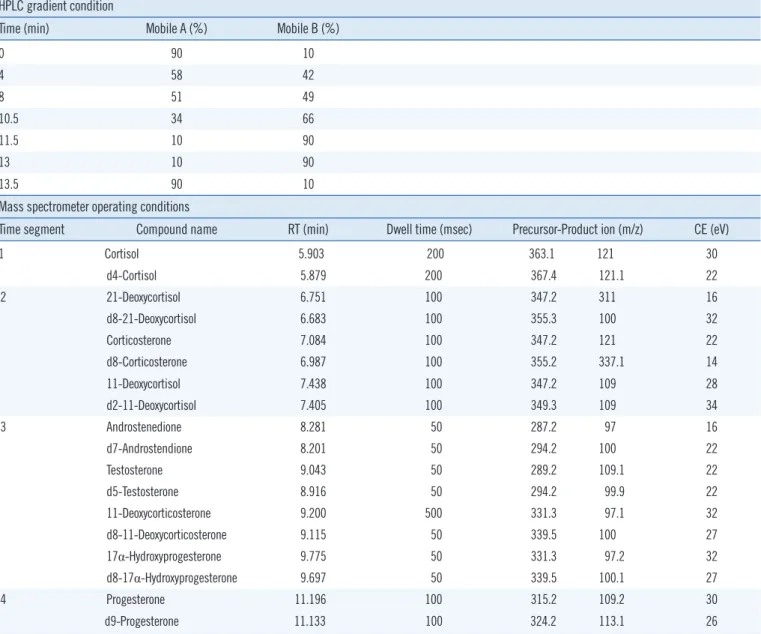
Operating conditions are shown in Table 1. To determine ref- erence intervals for the nine steroids in Korean subjects, the 1,146 DBS samples from neonates (272 from preterm and 874 from full-term neonates) were analyzed using the LC-MS/MS method, and the data were stratified by sex.
Assay performance characteristics
Assay performance characteristics, including assay range, lower limit of quantification (LLOQ), linearity, precision, accuracy, ex- traction recovery, and matrix effects were evaluated according to the updated guidelines and literature for MS/MS method vali- dation and neonate screening [2, 10-27]. Accuracy was addi- tionally assessed by participating in the second-tier Congenital Adrenal Hyperplasia Proficiency Testing Program (CAHPT), a proficiency test for immunoassay and LC–MS/MS methods pub- lished quarterly by the Newborn Screening Quality Assurance Program of the Centers for Disease Control and Prevention [4].
In total, 1,146 anonymized DBS samples submitted for routine clinical testing were used to compare 17α-hydroxyprogesterone concentrations determined by immunoassay (AutoDELFIA;
PerkinElmer, Waltham, MA, USA) and LC-MS/MS.
Reference intervals
Reference intervals were determined according to the CLSI guidelines [9] and compared with previously reported intervals
in the other populations [6, 8, 23-25, 27]. To validate the refer- ence intervals, we used additional anonymized samples from eight neonates without CAH (normal neonates), three full-term neonates with CAH (21-hydroxylase deficiency) whose 17α-hyd- roxyprogesterone was >18.2 nmol/L by immunoassay, two girls (4 and 14 years old) with CAH (21-hydroxylase deficiency), and a 3-year-old girl with congenital adrenal lipoid hyperplasia due to StAR mutation.
Statistical analyses
All data for steroid hormones with or without stratification by age and sex were not normally distributed. We used the Mann–Whit- ney U test to compare them. Reference inervals were estimated
as the central 95% (the 2.5th and 97.5th percentiles) of the dis- tribution of test results according to the CLSI guidelines [9].
P <0.05 was considered significant. Bland–Altman plots were created, and the nonparametric Passing–Bablock regression was conducted to compare the immunoassay and LC-MS/MS for 17α-hydroxyprogesterone, using MedCalc software for Win- dows, version 17.9.7 (MedCalc Software, Ostend, Belgium) [17].
Ethics
This study was conducted according to the Declaration of Hel- sinki, and all procedures involving human subjects were ap- proved by the Institutional Review Board of Samsung Medical Center (SMC 2012-08-058), Seoul, Korea.
Table 1. HPLC gradient conditions and mass spectrometer operating conditions HPLC gradient condition
Time (min) Mobile A (%) Mobile B (%)
0 90 10
4 58 42
8 51 49
10.5 34 66
11.5 10 90
13 10 90
13.5 90 10
Mass spectrometer operating conditions
Time segment Compound name RT (min) Dwell time (msec) Precursor-Product ion (m/z) CE (eV)
1 Cortisol 5.903 200 363.1 121 30
d4-Cortisol 5.879 200 367.4 121.1 22
2 21-Deoxycortisol 6.751 100 347.2 311 16
d8-21-Deoxycortisol 6.683 100 355.3 100 32
Corticosterone 7.084 100 347.2 121 22
d8-Corticosterone 6.987 100 355.2 337.1 14
11-Deoxycortisol 7.438 100 347.2 109 28
d2-11-Deoxycortisol 7.405 100 349.3 109 34
3 Androstenedione 8.281 50 287.2 97 16
d7-Androstendione 8.201 50 294.2 100 22
Testosterone 9.043 50 289.2 109.1 22
d5-Testosterone 8.916 50 294.2 99.9 22
11-Deoxycorticosterone 9.200 500 331.3 97.1 32
d8-11-Deoxycorticosterone 9.115 50 339.5 100 27
17α-Hydroxyprogesterone 9.775 50 331.3 97.2 32
d8-17α-Hydroxyprogesterone 9.697 50 339.5 100.1 27
4 Progesterone 11.196 100 315.2 109.2 30
d9-Progesterone 11.133 100 324.2 113.1 26
Abbreviations: RT, retention time; CE, collision energy.
RESULTS
Performance of LC-MS/MS for nine steroid hormones Analyses of steroid-free samples showed no interfering peaks at either steroid or internal standard retention times. The total run time for each sample was 16 minutes. There were linear corre- lations between steroid concentration and signal intensity for cortisol (2.8–828.0 nmol/L) as well as for the other steroids (0.9–
40.0 nmol/L; R2>0.99). In addition, steroid concentrations that were 10 times higher than the highest calibrator still complied with linearity [14, 24]. Intra-day precision and inter-day preci- sion CVs were 2.52–11.54% and 3.53–17.12%, respectively.
Accuracy was 80.81–99.94% (difference: 0.06–19.19%). High accuracy was assured by participating in CAHPT and having acceptable results for four quarters [4, 14]. Extraction recovery (the average percent of the target concentration recovered from DBS calibrators run as patient samples) was 64.3–74.2%, and the matrix effect was 88.0–125.4%.
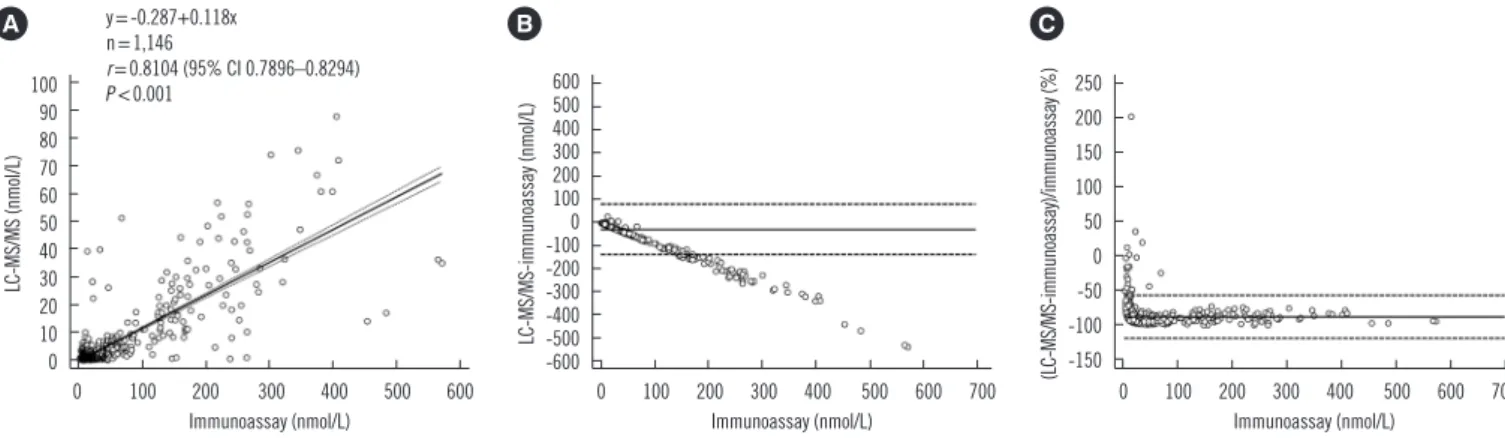
In the comparison between the LC-MS/MS method and im- munoassay for 17α-hydroxyprogesterone, the LLOQ of the im- munoassay for 17α-hydroxyprogesterone determination was 0.3 nmol/L. The correlation coefficient (r) was 0.8104 (95% CI:
0.7896–0.8294, P <0.0001), and there was a negative bias, with higher values measured by immunoassay than by LC-MS/
MS over the entire data range (Fig. 1).
Reference intervals and clinical application to 21-hydroxylase deficiency
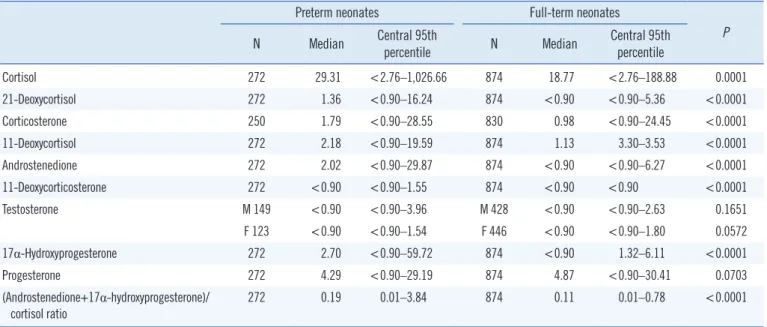
Reference intervals of all steroid hormones except testosterone and progesterone significantly differed between preterm and
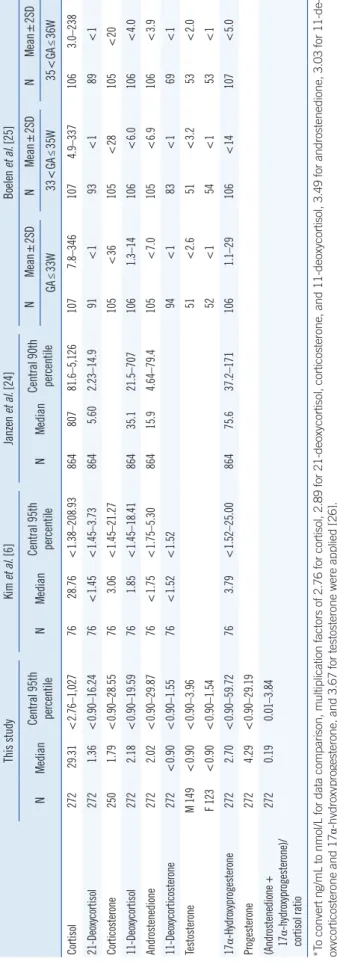
full-term neonates (Table 2, P <0.0001). Reference intervals and median values of the nine steroids determined in this study in comparison with those reported by other studies are pre- sented in Tables 3 and 4. Of the nine steroids, only testosterone concentrations differed significantly by sex. The LC-MS/MS method allowed reliable differentiation of samples from 21-hy- droxylase-deficient and unaffected neonates (Fig. 2). Of the two children with 21-hydroxylase deficiency, the 14-year-old girl was identified as screen positive for 21-hydroxylase deficiency with increased 17α-hydroxyprogesterone, 21-deoxycortisol, and an- drostenedione, and the 4-year-old girl was screen positive with only increased 17α-hydroxyprogesterone (her cortisol concen- tration was higher than the upper limit of the reference interval for full-term neonates). The ratio of androstenedione+17α-hyd- roxyprogesterone to cortisol of the children was not higher than the upper limit of the reference interval for either full-term neo- nates or preterm neonates. For the 3-year-old girl with congeni- tal adrenal lipoid hyperplasia caused by StAR mutation, the cor- tisol concentration was higher than the upper limit of the refer- ence interval for full-term neonates, whereas the other steroids were within the reference interval for full-term neonates.
DISCUSSION
We developed and validated an LC-MS/MS method for the si- multaneous quantification of nine steroids in DBS. In addition, we determined age-specific reference intervals of the nine ste- roids for Korean neonates (preterm and full-term). To the best of our knowledge, this is the first attempt to determine reference intervals for testosterone and progesterone concentrations in
Fig. 1. Comparison of LC–MS/MS and immunoassay. Correlation (A), absolute difference (B), and percent bias (C) between LC-MS/MS and immunoassay results for 17α-hydroxyprogesterone in 1,146 dried blood spots from Korean neonates. The solid line in (A) is the best-fit regression line and dashed lines in (A) represent 95% confidence interval. Solid lines in (B) and (C) represent average differences, and dashed lines in (B) and (C) represent limit of agreement.
Abbreviation: LC-MS/MS, liquid chromatography–tandem mass spectrometry.
100 90 80 70 60 50 40 30 20 10 0
0 100 200 300 400 500 600 Immunoassay (nmol/L)
LC-MS/MS (nmol/L)
y=-0.287+0.118x n=1,146
r=0.8104 (95% CI 0.7896–0.8294) P <0.001
A
600 500400 300 200100 0 -100-200 -300 -400-500 -600
0 100 200 300 400 500 600 700 Immunoassay (nmol/L)
LC-MS/MS-immunoassay (nmol/L)
B
250 200 150 100 50 0 -50 -100 -150
0 100 200 300 400 500 600 700 Immunoassay (nmol/L)
(LC-MS/MS-immunoassay)/immunoassay (%)
C
DBS samples from Korean neonates.
Intra-day precision and inter-day precision CVs were compa- rable with results in the literature and guidelines [2, 12, 13, 16, 22]. Accuracy was within the acceptable range for neonatal screening using MS/MS [2, 4, 12, 13, 16, 17, 22]. Extraction recovery and the matrix effect were comparable to the previous findings and existing guidelines for neonatal screening by MS/
MS [2, 11-13, 16, 17, 20-23]. In our study, the bias between
LC-MS/MS and immunoassay findings changed over the mea- surement interval in a linear fashion, and there was a negative bias, with higher values measured by immunoassay than LC- MS/MS over the entire range.
To avoid unnecessary tests, a sensitive and specific test, such as the LC-MS/MS method, is advantageous [1, 7]. Our method allows for simultaneous and rapid quantitation of nine steroids related to CAH with high specificity and without compromising Table 2. Reference intervals (nmol/L) for nine steroid hormones in dried blood spots from Korean preterm and full-term neonates
Preterm neonates Full-term neonates
N Median Central 95th P
percentile N Median Central 95th percentile
Cortisol 272 29.31 <2.76–1,026.66 874 18.77 <2.76–188.88 0.0001
21-Deoxycortisol 272 1.36 <0.90–16.24 874 <0.90 <0.90–5.36 <0.0001
Corticosterone 250 1.79 <0.90–28.55 830 0.98 <0.90–24.45 <0.0001
11-Deoxycortisol 272 2.18 <0.90–19.59 874 1.13 3.30–3.53 <0.0001
Androstenedione 272 2.02 <0.90–29.87 874 <0.90 <0.90–6.27 <0.0001
11-Deoxycorticosterone 272 <0.90 <0.90–1.55 874 <0.90 <0.90 <0.0001
Testosterone M 149 <0.90 <0.90–3.96 M 428 <0.90 <0.90–2.63 0.1651
F 123 <0.90 <0.90–1.54 F 446 <0.90 <0.90–1.80 0.0572
17α-Hydroxyprogesterone 272 2.70 <0.90–59.72 874 <0.90 1.32–6.11 <0.0001
Progesterone 272 4.29 <0.90–29.19 874 4.87 <0.90–30.41 0.0703
(Androstenedione+17α-hydroxyprogesterone)/
cortisol ratio 272 0.19 0.01–3.84 874 0.11 0.01–0.78 <0.0001
*P values were calculated using the Mann–Whitney U test for nonparametric data.
Fig. 2. Steroid profiles for 14 additional samples from neonates and children used to evaluate the clinical applicability of the LC-MS/MS method. Full-term neonates with 21-CAH (Δ) had distinctively low concentrations of cortisol, high concentrations of 21-deoxycortisol, 17α-hydroxyprogesterone, 11-deoxycorticosterone, and high values of (androstenedione+17α-hydroxyprogesterone)/cortisol ratio (A & B).
Other steroid hormone concentrations in full-term neonates with 21-CAH were variable (C). Two children with 21-CAH had high concentra- tions of cortisol and 17α-hydroxyprogesterone, progesterone, and androstenedione. Concentrations of other steroids were not distinctive.
One child with CALH had high concentration of cortisol and low concentrations of other steroids.
Abbreviations: CAH, congenital adrenal hyperplasia; 21-CAH, congenital adrenal hyperplasia caused by 21-hydroxylase deficiency; CALH, congenital adre- nal lipoid hyperplasia due to the StAR mutation; LC-MS/MS, liquid chromatography–tandem mass spectrometry.
250 200 150 100 50
0
Cortisol 21-
deoxycortisol 17α- hydroxy- progesterone
(androstenedione+
17α- hydroxyprogesterone)/
cortisol ratio
Concentration (nmol/L)
A
2.5 2.0 1.5 1.0 0.5 0
11-deoxycorticosterone Testosterone
Concentration (nmol/L)
B
20 15 10 5
0
deoxycortisol11-
Corticosterone Androstenedione Progesterone
Concentration (nmol/L)
C 2 preterm neonates without CAH
6 full-term neonates without CAH 3 full-term neonates with 21-CAH 2 girls with 21-CAH 1 girl with CALH
Table 3. Reference intervals (nmol/L) of nine steroid hormones in dried blood spots from Korean preterm neonates and comparisons with previous studies This studyKim et al. [6]Janzen et al. [24]Boelen et al. [25] NMedianCentral 95th percentileNMedianCentral 95th percentileNMedianCentral 90th percentileNMean±2SDNMean±2SDNMean±2SD GA≤33W33<GA≤35W35<GA≤36W Cortisol27229.31<2.76–1,0277628.76<1.38–208.9386480781.6–5,1261077.8–3461074.9–3371063.0–238 21-Deoxycortisol2721.36<0.90–16.2476<1.45<1.45–3.738645.602.23–14.991<193<189<1 Corticosterone2501.79<0.90–28.55763.06<1.45–21.27105<36105<28105<20 11-Deoxycortisol2722.18<0.90–19.59761.85<1.45–18.4186435.121.5–7071061.3–14106<6.0106<4.0 Androstenedione2722.02<0.90–29.8776<1.75<1.75–5.3086415.94.64–79.4105<7.0105<6.9106<3.9 11-Deoxycorticosterone272<0.90<0.90–1.5576<1.52<1.5294<183<169<1 TestosteroneM 149<0.90<0.90–3.9651<2.651<3.253<2.0 F 123<0.90<0.90–1.5452<154<153<1 17α-Hydroxyprogesterone2722.70<0.90–59.72763.79<1.52–25.0086475.637.2–1711061.1–29106<14107<5.0 Progesterone2724.29<0.90–29.19 (Androstenedione + 17α-hydroxyprogesterone)/ cortisol ratio
2720.190.01–3.84 *To convert ng/mL to nmol/L for data comparison, multiplication factors of 2.76 for cortisol, 2.89 for 21-deoxycortisol, corticosterone, and 11-deoxycortisol, 3.49 for androstenedione, 3.03 for 11-de- oxycorticosterone and 17α-hydroxyprogesterone, and 3.67 for testosterone were applied [26]. Abbreviations: GA, gestational age; W, week. Table 4. Reference intervals (nmol/L) of nine steroid hormones in dried blood spots from Korean full-term neonates and comparisons with previous studies This studyKim et al. [6]Magnisali et al. [8]Janzen et al. [23]Janzen et al. [24]Boelen et al. [25]Monostori et al. [27] NMedianCentral 95th percentileNMedianCentral 95th percentileNRef. intervalNRangeNMedianCentral 90th percentileNMean±2SDNMedian1-99th percentile (Neonates and children) Cortisol87418.77<2.76–188.887823.07<2.76–194.8
M 23 F 27
5.0–188.23 16.01–211.145143.9–339.272917614.7–6421283.9–1528134.84.6–423.7 21-deoxycortisol874<0.90<0. 90–5.3678<1.45<1.45–4.4250.00–2.17292.90<1–7.85101<181<5.0<5.0–5.9 Corticosterone8300.98<0.90–24.45781.73<1.45–15.4952.1–10.3128<12 11-Deoxycortisol8741.133.30–3.5378<1.45<1.45–3.70
M 23 F 27
<1.45–3.32 <1.45–3.1555.3–7.77296.301.48–23.3129<1.881<2.5<2.5 Androstenedione874<0.90<0.90–6.2778<1.75<1.75–2.51
M 23 F 27
<1.75–2.72 <1.75–2.3050.00–3.27295.801.10–17.8128<2.481<1.0<1.0–3.0 11-Deoxycorticosterone874<0.90<0.9078<1.52<1.5250.8–4.296<1 Testosterone
M 428 F 446
<0.90 <0.90<0.90–2.63 <0.90–1.8050.00–10.9
63 66
<1 <1
17α-Hydroxyprogesterone874<0.901.32–6.1178<1.52<1.52–4.51M 23<1.52–3.0354.7–8.172910.23.38–24.9128<2.5812.5<2.5–8.3 F 27<1.52–4.12 Progesterone8744.87<0.90–30.4150.00–11.0 (Androstenedione + 17α-hydroxyprogesterone)/ cortisol ratio
8740.110.01–0.7850<0.01–0.15810.040.01–0.43 *To convert ng/mL to nmol/L for data comparison, multiplication factors of 2.76 for cortisol, 2.89 for 21-deoxycortisol, corticosterone, and 11-deoxycortisol, 3.49 for androstenedione, 3.03 for 11-de- oxycorticosterone and 17α-hydroxyprogesterone, 3.18 for progesterone, and 3.67 for testosterone were applied [26]. Abbreviations: F, female; GA, gestational age; LLOQ, lower limit of quantification; M, male; W, week.
chromatographic resolution.
Differential diagnosis of CAH subtypes is possible by steroid profiling using the LC–MS/MS method [1]. In this method, diag- nosis of CAH depends on not only the absolute quantification of 17α-hydroxyprogesterone but also the ratio of multiple steroids to determine a positive result: 17α-hydroxyprogesterone (a di- rect substrate for 21-hydroxylase), cortisol (the final product of the adrenal enzyme’s action), and androstenedione (which sec- ondarily accumulates in 21-hydroxylase deficiency) [2]. Al- though the prevalence of CAH other than 21-hydroxylase defi- ciency is very low, and samples from patients with those dis- eases were not tested in this study, steroid profiling on the basis of ratios of multiple steroids, including precursor hormone and product hormones, used in this method has diagnostic strengths.
According to the CLSI guidelines [9], at least 120 samples for analysis are required to establish reference intervals. Some pre- vious studies on the development and application of mass spec- trometry for steroid profiling included less than 120 samples for establishing reference intervals [6, 8, 23, 25, 27]. Although the various reference intervals presented in these studies corre- sponded to different analytical conditions, they were quite simi- lar to the present ones, as shown in Tables 3 and 4 [6, 8, 23- 25, 27]. We included more than 120 samples for all nine ste- roids, especially testosterone and progesterone, which previous studies did not do [8, 25, 27].
Furthermore, we successfully demonstrated the clinical appli- cability of steroid profiling to differentiate between neonates with 21-hydroxylase deficiency and normal neonates. However, the reference interval was not established using samples from chil- dren to appropriately differentiate children with CAH from the normal ones. Considering that there was a 3-year-old girl with congenital adrenal lipoid hyperplasia due to StAR mutation whose cortisol concentration was higher than the upper limit of the reference interval for full-term neonates, whereas the other steroids were within the reference interval for full-term neonates, the reference interval of hormone analyses should be estab- lished separately for different age groups [6, 9].
The limitation of this study was the limited numbers of sam- ples for validation, because the prevalence of CAH is low [25].
Previous studies also included limited numbers of CAH patients for clinical application due to the low prevalence of CAH, but they reported successful clinical application of the methods in a manner similar to this study [2, 5, 7].
In conclusion, our method produced lower values for 17α- hydroxyprogesterone than an immunoassay, consistent with the relatively low analytical specificity of immunoassays compared
with LC-MS/MS. We also established reference intervals for nine steroid hormones in Korean neonates, which were comparable with those in other populations. Steroid profiling by LC–MS/MS highlights the utility of secondary diagnostic markers as a means of reducing false-positive results due to stress- or illness- induced transient elevation of 17α-hydroxyprogesterone. Thus, our sensitive, specific, and accurate steroid profiling method is suitable for routine neonatal screening for CAH.
Authors’ Disclosures of Potential Conflicts of Interest
The authors declare that they have no conflicts of interest.
Acknowledgements
This study was supported by a grant from the Korea Health Technology R&D Project, Ministry of Health & Welfare, Korea (A120030).
REFERENCES
1. Rauh M. Steroid measurement with LC-MS/MS in pediatric endocrinol- ogy. Mol Cell Endocrinol 2009;301:272-81.
2. Rossi C, Calton L, Hammond G, Brown HA, Wallace AM, Sacchetta P, et al. Serum steroid profiling for congenital adrenal hyperplasia using liquid chromatography-tandem mass spectrometry. Clin Chim Acta 2010;
411:222-8.
3. Janzen N, Sander S, Terhardt M, Steuerwald U, Peter M, Das AM, et al.
Rapid steroid hormone quantification for congenital adrenal hyperplasia (CAH) in dried blood spots using UPLC liquid chromatography-tandem mass spectrometry. Steroids 2011;76:1437-42.
4. Centers for Disease Control and Prevention. NSQAP: Newborn Screen- ing Quality Assurance Program. Laboratory Quality Assurance and Standardization Programs. https://www.cdc.gov/labstandards/nsqap.
html (Updated on Sep 2018).
5. Travers S, Martinerie L, Bouvattier C, Boileau P, Lombès M, Pussard E.
Multiplexed steroid profiling of gluco- and mineralocorticoids pathways using a liquid chromatography tandem mass spectrometry method. J Steroid Biochem Mol Biol 2017;165:202-11.
6. Kim B, Lee MN, Park HD, Kim JW, Chang YS, Park WS, et al. Dried blood spot testing for seven steroids using liquid chromatography-tan- dem mass spectrometry with reference interval determination in the Korean population. Ann Lab Med 2015;35:578-85.
7. Seo JY, Park HD, Kim JW, Oh HJ, Yang JS, Chang YS, et al. Steroid pro- filing for congenital adrenal hyperplasia by tandem mass spectrometry as a second-tier test reduces follow-up burdens in a tertiary care hospi- tal: a retrospective and prospective evaluation. J Perinat Med 2014;42:
121-7.
8. Magnisali P, Chalioti MB, Livadara T, Mataragas M, Paliatsiou S, Malamit- si-Puchner A, et al. Simultaneous quantification of 17α-OH progester- one, 11-deoxycortisol, Δ4-androstenedione, cortisol and cortisone in newborn blood spots using liquid chromatography-tandem mass spec-
trometry. J Chromatogr B Analyt Technol Biomed Life Sci 2011;
879:1565-72.
9. Horowitz GL, Altaie S, Boyd JC. Defining, establishing, and verifying ref- erence intervals in the clinical laboratory, approved guideline. EP28-A3.
3rd ed. Wayne, PA: Clinical and Laboratory Standards Institute. 2010.
10. International Conference on Harmonisation (ICH). ICH topic Q2 (R1) Validation of analytical procedures: text and methodology. Int Conf Har- mon 2005;1994:17.
11. Lacey JM, Minutti CZ, Magera MJ, Tauscher AL, Casetta B, McCann M, et al. Improved specificity of newborn screening for congenital adrenal hyperplasia by second-tier steroid profiling using tandem mass spec- trometry. Clin Chem 2004;50:621-5.
12. U.S. Department of Health and Human Services Food and Drug Ad- ministration Center for Drug Evaluation and Research (CDER). Bioana- lytical method validation guidance for industry 2018. https://www.fda.
gov/downloads/drugs/guidances/ucm070107.pdf (Updated on Sep 2018).
13. European Medicines Agency Committee for Medicinal Products for Hu- man Use (CHMP), 2011. Guideline on bioanalytical method validation.
http://www.ema.europa.eu/docs/en_GB/document_library/Scientific_
guideline/2011/08/WC500109686.pdf (Updated on Sep 2018).
14. CLSI. Evaluation of the linearity of quantitative measurement proce- dures: A statistical approach; approved guideline. CLSI document EP06A. Wayne, PA: Clinical and Laboratory Standards Institute; 2003.
15. CLSI. Spectrometry for androgen and estrogen measurements in se- rum. CLSI guideline C57. 1st ed. Wayne, PA: Clinical and Laboratory Standards Institute, 2015.
16. CLSI. Screening by tandem mass spectrometry. CLSI guideline NBS04.
2nd ed. Wayne, PA: Clinical and Laboratory Standards Institute; 2017.
17. CLSI. Measurement procedure comparison and bias estimation using patient samples. CLSI guideline EP09c. 3rd ed. Wayne, PA: Clinical and Laboratory Standards Institute. 2018.
18. Dietzen DJ, Bennett MJ, Lo SF, Grey VL, Jones PM. Dried blood spot reference intervals for steroids and amino acids in a neonatal cohort of
the National Children’s Study. Clin Chem 2016;62:1658-67.
19. Ministry of Food and Drug Safety. Republic of Korea. Guideline on Bio- analytical Method Validation 2013;12. http://www.nifds.go.kr/brd/m_15/
view.do?seq=7018 (Updated on Sep 2018).
20. Matuszewski BK, Constanzer ML, Chavez-Eng CM. Strategies for the assessment of matrix effect in quantitative bioanalytical methods based on HPLC-MS/MS. Anal Chem 2003;75:3019-30.
21. Hicks RA, Yee JK, Mao CS, Graham S, Kharrazi M, Lorey F, et al. Pre- cursor-to-product ratios reflect biochemical phenotype in congenital ad- renal hyperplasia. Metabolomics 2014;10:123-31.
22. IUPAC. IUPAC Compendium of Chemical Terminology (The “Gold Book”). version 2.3.3. 2014. http://goldbook.iupac.org/ (Updated on Nov 2018).
23. Janzen N, Sander S, Terhardt M, Peter M, Sander J. Fast and direct quantification of adrenal steroids by tandem mass spectrometry in se- rum and dried blood spots. J Chromatogr B Analyt Technol Biomed Life Sci 2008;861:117-22.
24. Janzen N, Peter M, Sander S, Steuerwald U, Terhardt M, Holtkamp U, et al. Newborn screening for congenital adrenal hyperplasia: additional steroid profile using liquid chromatography-tandem mass spectrometry.
J Clin Endocrinol Metab 2007;92:2581-9.
25. Boelen A, Ruiter AF, Claahsen-van der Grinten HL, Endert E, Acker- mans MT. Determination of a steroid profile in heel prick blood using LC-MS/MS. Bioanalysis 2016;8:375-84.
26. Fiet J, Le Bouc Y, Guéchot J, Hélin N, Maubert MA, Farabos D, et al. A liquid chromatography/tandem mass spectometry profile of 16 serum steroids, including 21-deoxycortisol and 21-deoxycorticosterone, for management of congenital adrenal hyperplasia. J Endocr Soc 2017;1:
186-201.
27. Monostori P, Szabó P, Marginean O, Bereczki C, Karg E. Concurrent confirmation and differential diagnosis of congenital adrenal hyperplasia from dried blood spots: application of a second-tier LC-MS/MS assay in a cross-border cooperation for newborn screening. Horm Res Paediatr 2015;84:311-8.