책임저자: 김대영, 경북 구미시 산동면 인덕리 55번지
730-739, 경운대학교 스포츠과학연구소 Tel: 054-479-1367, E-mail: [email protected] 접수: 2011년 5월 15일, 심사: 2011년 5월 15일 게재승인: 2011년 5월 20일
이 논문은 2010년 정부재원(교육과학기술부 인문사회연구역량강 화사업비)으로 한국연구재단의 지원을 받아 연구되었음(NRF-2010- 332-G00095).
트레드밀 운동이 당뇨유발 흰쥐의 기억력 장애에 미치는 영향
*경희대학교 의과대학 생리학교실, †경운대학교 스포츠과학연구소
정 선 영 *ㆍ서 진 희 *ㆍ성 윤 희 *ㆍ김 창 주 *ㆍ김 동 제
†
ㆍ김 대 영†
Effect of Treadmill Exercise on Memory Impairment in the Diabetic Rats
Sun-Young Jung*, Jin-Hee Seo*, Yun-Hee Sung*, Chang-Ju Kim*, Dong-Je Kim
†, Dae-Young Kim
†*Department of Physiology, College of Medicine, Kyung Hee University, Seoul, †Research Institute of Sport Science, Kyung Woon University, Gumi, Korea
Diabetes mellitus (DM) is a metabolic disorder, and this disease is associated with degeneration and functional disorder of the nervous system. In the present study, we investigated the effects of treadmill exercise on memory, cell proliferation, and expressions of brain-derived neurotrophic factor (BDNF) and insulin-like growth factor 1 (IGF-1) in the hippocampus of the diabetic rats.
Male Sprague-Dawley rats were used for this study. The animals were divided into four groups (n= 8 in each group): control group, exercise group, DM-induction group, DM-induction and exercise group. DM was induced by intraperitoneal injection of streptozotocin (50 mg/kg dissolved in 0.05 M citrate buffer, pH 4.5). The rats in the exercise groups were made to run on the treadmill for 30 min, five times a week for 6 weeks. For this study, step-down avoidance task, immunohistochemistry for 5-bromo-2'-deoxyuridine (BrdU), and western blot for BDNF and IGF-1 were performed. The present results showed that latency in the step-down avoidance task was decreased in the diabetic rats whereas treadmill exercise increased latency in the diabetic rats. Cell proliferation in the hippocampus was decreased in the diabetic rats, however treadmill exercise increased cell proliferation in the diabetic rats. The expressions of BDNF and IGF-1 protein in the hippocampus were decreased in the diabetic rats, in contrast, treadmill exercise increased the expressions of BDNF and IGF-1 in the diabetic rats. These results suggest that treadmill exercise may ameliorate DM-induced memory impairment by increasing cell proliferation through enhancing BDNF and IGF-1 expressions in the hippocampus. (Korean J Str Res 2011;19:175∼182)
Key Words: Dabetes mellitus, Treadmill exercise, Cell proliferation, Memory impairment, Hippocampus
서 론
당뇨병(diabetes mellitus, DM)은 전 세계적으로 2억 5천만 명 이상의 환자가 있으며, 매년 6백만명 정도의 증가 추이 를 보이고 있는 대표적인 만성질환이다(Cole et al., 2007). 당 뇨병은 중추신경계(central nervous system, CNS)의 변성 및 기능장애와도 매우 밀접한 관련이 있으며, 학습과 기억력
의 감소, 인지기능의 손상 및 혈관성 치매를 촉진하는 것 으로 알려져 있다(Beauquis et al., 2008; Biessels et al., 2008).
뇌의 해마(hippocampus) 영역은 학습과 기억을 담당하는 중 추로서 지속적인 신경세포 생성(neurogenesis)을 통해 인지 기능을 담당하기 때문에 다른 부위의 신경세포보다 대사 적 요구량이 높다(Choeiri et al., 2005). 이러한 이유로 당뇨 와 같은 만성 대사 장애 시 해마 신경세포의 활성, 특히 인 지기능이 매우 민감하게 영향을 받게 된다(Gispen et al., 2000).
최근 동물모델 연구에서 당뇨로 인한 인지기능의 감소 는 신경 전구세포 생성(neural progenitor proliferation)의 억제 에 의한 것으로 밝혀졌다(Zhang et al., 2008). 이러한 신경세 포생성의 조절에 중요한 역할을 하는 것은 해마에서 발현 되는 신경영양인자(neurotrophic factor)인 brain-derived neuro- trophic factor (BDNF)와 insulin-like growth factor 1 (IGF-1)이 다(Trejo et al., 2001; Achiron et al., 2008; Chan et al., 2008).
BDNF는 신경세포의 생성과 생존을 조절하는 중요한 단백 질로 기억의 형성과 형성된 기억을 장기기억으로 전환하 는데 필수적인 요소이다(Bekinschtein et al., 2008; Donovan et al., 2008). 또한 중추신경계에서 신경세포의 분화 및 증식 을 조절하며 성장 중인 신경세포의 기능을 유지하는데 밀 접하게 관여한다(Cotman et al., 2002). IGF-1은 성장호르몬 의 여러 가지 작용들을 매개하고 신경전구세포의 생존과 분화에 중요한 역할을 한다. IGF-1은 뇌에서 amyloid의 축 적을 예방할 뿐만 아니라 해마 신경세포의 보호 및 신경세 포 생성을 향상시키는 중요한 물질로 알려져 있다(Carro et al., 2001; Lichtenwalner et al., 2006). 당뇨에 의해 IGF-1와 같 은 신경영양 인자의 감소는 결과적으로 신경세포 생성의 억제와 인지기능의 저하를 유발하는 원인이 된다(Zhang et al., 2008).
당뇨로 인한 중추신경계 장애를 개선하기 위한 다양한 치료 방법이 시도되고 있다. 특히 비 약물적 치료의 방안 으로서 운동은 뇌 질환의 예방뿐만 아니라 뇌 기능을 향상 시키고, 당뇨성 신경병증(diabetic neuropathy)을 개선하는데 효과적인 방안으로 알려져 있다(Loimaala et al., 2003). 당뇨 병에서 신경세포 생성의 비율이 낮게 나타나지만, 규칙적 인 운동은 신경세포 생성과 시냅스 가소성(synaptic plasti- city)을 촉진하는 것으로 알려져 있다(Fontán-Lozano et al., 2007; Zhang et al., 2008). 특히 운동이 학습과 기억력을 담 당하는 해마 치상회(dentate gyrus)에 미치는 영향에 대한 여 러 연구가 수행되어 왔다(Lledo et al., 2006). Ding et al.(2006)
은 쥐를 대상으로 자발적인 달리기(voluntary running)가 세 포 생성과 생존을 증가시킨다고 보고하였고, Trejo et al.
(2001)도 트레드밀 운동이 IGF-1을 통하여 쥐의 해마 치상 회(dentate gyrus)에서 세포 생성을 증가시킨다고 하였다. 또 한 운동은 알츠하이머 질환(Alzheimer’s disease)이나 노화 쥐 에서도 인지능력과 신경세포 생성을 증가시키는 것으로 보고되었다(van Praag et al., 2005; Mirochnic et al., 2009).
운동이 해마에서 신경세포 생성을 촉진시키는 것으로 알려져 있으나, 아직까지 그 기전은 명확하게 밝혀지지 않 았으며, 특히 당뇨병에서 운동이 신경세포 생성을 증가시 킬 때 신경성장 인자인 BDNF와 IGF-1과의 관련성에 대해 서는 알려지지 않았다. 본 연구에서는 당뇨유발 흰쥐에서 트레드밀 운동이 기억력에 미치는 영향을 BDNF와 IGF-1 의 발현과 관련지어 신경세포 생성의 관점에서 살펴봄으 로써 당뇨 시 뇌기능에 미치는 운동의 효과를 규명하고자 한다.
재료 및 방법
1. 실험 동물
본 실험에 사용된 동물은 Sprague-Dawley계 8주령(254±
5.17 g) 수컷 흰쥐 32마리를 이용하였다. 실험기간 동안 모 든 쥐에게 물과 음식을 자유롭게 먹을 수 있도록 하였고, 실험환경은 온도 22±1oC, 습도 60±3%, 명암 12시간 light/
dark cycle의 자동조절을 유지하였다. 집단은 대조군(control group), 운동군(exercise group), 당뇨군(DM-induction group), 당뇨운동군(DM-induction and exercise group)으로 분류하였다 (각 군 n=8).
2. 당뇨유도 및 BrdU 투여방법
대조군은 생리식염수를 복강 주사하였고, 당뇨유발군은 streptozotocin (STZ; Sigma Chemical Co., St. Louis, MO, USA)을 50 mg/kg의 용량으로 10 mM citric buffer (pH 4.5) 용액에 용 해시킨 후 복강 주사하여 당뇨를 유도하였다. 당뇨 유발 확인은 STZ 주사 3일 후 혈당 측정 12시간 전에 먹이를 제 거하고, 꼬리정맥에서 50 μl 채혈하여 공복 혈당이 300 mg/dl 이상일 때 당뇨가 유발된 것으로 간주하였다. 신경세 포 생성을 확인하기 위하여 모든 쥐들에게 5-bromo-2’-deo- xyunridine (BrdU, Sigma Chemical Co., St. Louis, MO. USA)를 50 mg/kg의 용량으로 saline에 용해시킨 후, 쥐를 희생시키 기 이틀 전부터 하루 한번 총 2회에 걸쳐 트레드밀 운동 시
작 30분 전에 복강에 주사하였다.
3. 트레드밀 운동방법
운동군은 소형동물용 트레드밀에서 점증부하 운동을 실 시하였다. 운동군에 해당하는 모든 실험동물은 경사도 0o 에서 처음 5분간은 분당 3 m의 속도로, 다음 5분간은 분당 5 m의 속도로, 그리고 나머지 20분간 분당 8 m의 속도로 하루 30분씩 주 5회, 총 6주 동안 트레드밀 달리기를 실시 하였다. 흰쥐에서 위와 같은 트레드밀 달리기의 속도는 저 강도 운동에 해당되며 해마의 신경세포생성에 있어서 가 장 효과적인 강도로 보고된 바 있다(Kim YP et al., 2003).
4. 수동회피 검사(step-down avoidance task) Step-down avoidance task는 인지기능 중 기억 능력(memory capability)을 측정하기 위한 행동검사 중 하나이다. 실험동 물들에게 최초 7×25 cm platform (2.5 cm high)에서 2분간 안 정을 취하게 하였다. Platform 위에 놓인 쥐들이 평행하게 놓인 1 cm 간격의 스테인레스 막대기(42×25 cm)로 내려가 네 발이 모두 닿았을 때 흰쥐들에게 0.3 mA의 전기 자극을 2초간 주어 학습 시킨 뒤 2시간 후 동일한 검사를 실시하 였다. 두 번째 검사에서 흰쥐들이 platform에서 스테인레스 막대기로 내려올 때까지의 경과시간(latency time)을 측정하 였다. 네발이 모두 닿는 시간은 최대 300초까지 기록하였 고, 300초를 초과하는 시간은 모두 300초로 간주하여 기록 하였으며, 이와 같은 검사 방법과 과정은 Kim H et al.(2007) 의 선행연구에 따라 실시하였다.
5. 뇌 적출 및 조직처리
실험동물들은 Zoletile 50Ⓡ (10 mg/kg i.p.; Vibac Labora- tories, Carros, France)을 복강 내 주사하여 마취시킨 후 흉강 을 열고 좌심실을 통하여 50 mM 인산염 완충식염수(phos- phate buffer saline, PBS)를 주입하고, 이후 50 mM 인산 완충 액에 녹인 4% paraformaldehyde (PFA) 고정액을 관류하였다.
관류 고정 후 뇌를 적출한 다음 고정액에 담아서 4oC에서 12시간 후 고정을 실시하였다. 고정된 뇌 조직은 30%
sucrose 용액에서 2∼5일간 침적시킨 후 freezing microtome (Leica, Nussloch, Germany)를 이용하여 40 μm 두께의 연속 관상 절편을 제작하였다.
6. 면역조직화학검사
해마에서의 신경세포 생성을 정량화 하기위해 BrdU 면
역조직화학법을 시행하였다. 조직절편을 50 mM PBS로 세 척한 후 0.5% Triton X-100에 반응시켰다. Triton X-100을 세척한 후 65oC에서 50% formamide와 2×standard saline citra- te (SSC) 용액에서 2시간 반응시켰다. 반응 완료 후 2×SSC로 세척한 후 37oC에서 2 N HCl에 반응시켰다. 반응이 끝나면 바로 100 mM sodium borate, pH 8.5로 세척한 후 50 mM PBS 로 재세척하였다. 이 과정이 끝난 조직은 자유부유(free-flo- ating)법을 사용하여 면역조직화학 염색을 시행하였다. 항 체와 반응하기 전에 50 mM PBS에 10% horse serum과 1%
bovine serum albumin (BSA)를 함유한 차단용액으로 한 시간 동안 반응시켰다. BrdU 항체(Boehringer Mannheim, Germany) 를 50 mM PBS에 0.5% BSA와 0.5% sodium azide를 함유한 일차 항체 용액에 1 : 600의 비율로 희석한 후 24시간 동안 반응시켰다. 50 mM PBS로 세척한 후, biotinylated anti-mouse IgG를 50 mM PBS에 0.3% Triton X-100을 함유한 이차 항체 용액에 1 : 200의 비율로 희석한 후 1시간 동안 반응시켰다.
50 mM PBS로 세척한 후, HRP avidine-biotin complex (Vector Laboratories, Burlingame, CA, USA)에서 1시간 동안 반응시켰 다. 50 mM PBS로 세척한 후, 50 mM Tris 완충액에 과산화 수소와 3,3’-diaminobenzidine tetrahydrochloride (DAB)를 함유 하는 발색제로 발색반응을 실시한 다음 세척하였다. BrdU 항체로 면역조직반응을 시행한 조직을 neuronal nuclei (NeuN) 항체(Chemicon International, Temecula, CA, USA)로 1 : 2,000 으로 희석한 후 위와 같이 반응시켰다. 이 후 avidine-biotin complex에서 반응시키고, 발색이 완료된 조직은 탈수과정 을 거쳐 PermountⓇ (Fischer Scientific, Pittsburg, PA, USA)로 봉입하였다. BrdU 양성 세포수를 광학현미경(BX-51, Olym- pus, Tokyo, Japan)을 이용하여 관찰하여 해마 치상회 부위 의 과립세포층 단위면적(mm2) 당으로 정량적 분석을 실시 하였다.
7. 단백질 발현 측정
해마의 BDNF와 IGF-1의 단백질 발현을 측정하기 위해 western blotting 분석을 실시하였다. 적출된 해마를 1 x PBS 로 씻어낸 후에, 50 mM HEPES (pH 7.5), 150 mM NaCl, 10%
glycerol, 1% Triton X-100, 1.5 mM magnesium chloride hexahy- drate, 1 mM ethyleneglycol-bis-(β-aminoethyl ether)-N, N'-tetra- acetic acid (EGTA), 1 mM phenylmethylsulfonyl fluoride (PMSF), 2 μg/ml leupeptin, 1 μg/ml pepstatin, 1 mM sodium ortho vanadate와 100 mM sodium floride를 포함하고 있는 lysis buffer로 용해시킨 후, 단백질을 추출하고 원심 분리하여 그
Fig. 1. Effect of exercise on memory in the diabetic rats. (A) Control
group, (B) exercise group, (C) DM-induction group, (D) DM-induction and exercise group. The data are represented as the mean±SEM. ap<0.05 compared to the control group. bp<0.05 compared to the DM-induction group.Fig. 2. Effect of exercise on neurogenesis in the diabetic rats. (A) Control
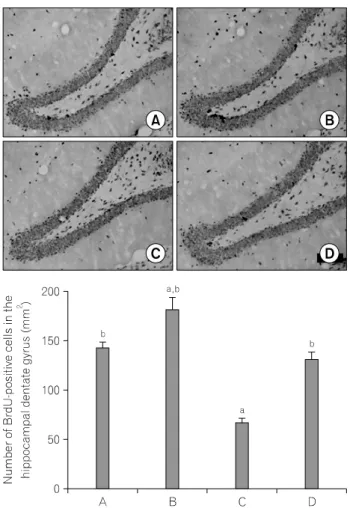
group, (B) exercise group, (C) DM-induction group, (D) DM-induction and exercise group. Upper panel: photomicrographs of BrdU-positive cells in the hippocampus. A scale bar represents 100 μm. Low panel: the mean number of BrdU-positive cells. The data are represented as the mean±SEM. ap<0.05 compared to the control group. bp<0.05 compared to the DM-induction group.상층액을 취하여 단백질을 정량하였다. 이와 같이 추출된 단백질을 SDS-polyacrylamide gels로 전기영동시킨 후, nitro- cellulose membrane (Schleicher & Schuell GmbH, Dassel, Ger- many)으로 전사시켰다. 이렇게 전사된 membrane을 blocking 한 후에, mouse β-actin antibody (1 : 1,000; Santa Cruz Bio- tech, Santa Cruz, CA, USA), rabbit BDNF antibody (1 : 1,000;
Santa Cruz Biotech), goat IGF-1 antibody (1 : 500; Santa Cruz Biotech)로 반응시켰다. 이후 BDNF의 2차 antibody로 anti-ra- bbit antibody (1 : 5,000; Santa Cruz Biotech), IGF-1은 anti-goat antibody (1 : 5,000; Santa Cruz Biotech)를 이용하였다. West- ern blotting의 결과는 enhanced chemiluminescence (ECL) detec- tion system (Amersham Pharmacia Biothech GmbH, Freiburg, Germany)을 이용하여 film 발색을 통해 확인하였다.
8. 자료처리
본 실험에서 측정된 결과들은 SPSS version 14.0 통계 프 로그램을 이용하여 각 항목에 대한 평균과 표준오차(stand- ard error mean, SEM)를 산출하였다. 각 집단 간 차이 검증은 일원변량분석(one-way ANOVA)을 이용하였으며, 사후검정 은 Duncan's post hoc test를 실시하였다. 유의수준은 p<0.05 로 설정하였다.
결 과
1. 운동이 당뇨유발 쥐의 기억력에 미치는 영향 인지기능 중 기억력을 검사하기 위하여 step-down avoi-
dance task를 실시하여 다음과 같은 latency time을 얻었다.
대조군이 271.83±10.09초, 운동군은 296.33±3.66초, 당뇨군 은 145.50±7.86초, 그리고 당뇨운동군은 260.00±19.14초를 나타내었다(Fig. 1). 본 실험의 결과, 당뇨유발 흰쥐의 기억 력이 대조군에 비하여 감소되었다. 트레드밀 운동은 당뇨 유발 흰쥐의 기억력을 증가시켰다. 트레드밀 운동은 정상 흰쥐에서도 기억력을 증가시켰으나 통계학적 유의성은 없 었다.
2. 운동이 당뇨유발 쥐의 해마 신경세포 생성에 미치 는 영향
해마 치상회부위의 BrdU 양성세포는 대조군이 143.71±
Fig. 3. Effect of exercise on BDNF level in the hippocampus. (A) Control
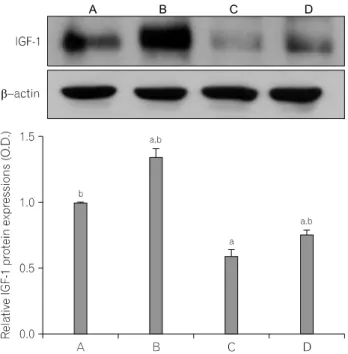
group, (B) exercise group, (C) DM-induction group, (D) DM-induction and exercise group. Upper panel: Representative expression of the protein level of BDNF and β-actin in the hippocampus. Low panel: Relative BDNF expression in the hippocampus. The data are represented as the mean±SEM. ap<0.05 compared to the control group. bp<0.05 compared to the DM-induction group. Molecular weights of BDNF=14 kDa, β-actin=42 kDa.Fig. 4. Effect of exercise on IGF-1 level in the hippocampus. (A) Control
group, (B) exercise group, (C) DM-induction group, (D) DM-induction and exercise group. Upper panel: Representative expression of the protein level of IGF-1 and β-actin in the hippocampus. Low panel: Relative IGF-1 expression in the hippocampus. Data are expressed as a percentage of control group. The data are represented as the mean±SEM. ap<0.05 compared to the control group. bp<0.05 compared to the DM-induction group. Molecular weights of IGF-1=17 kDa, β-actin=42 kDa.3.93개/mm2, 운동군은 182.58±11.98개/mm2, 당뇨군은 67.94±
4.57개/mm2, 그리고 당뇨운동군은 132.20±6.87개/mm2로 나 타났다(Fig. 2). 본 실험의 결과, 당뇨유발 흰쥐의 해마 치상 회에서 신경세포 생성이 억제되었다. 트레드밀 운동은 당 뇨유발 흰쥐에서 신경세포 생성을 증가시켰으며 정상흰쥐 에서도 신경세포 생성을 증가시켰다.
3. 운동이 당뇨유발 쥐의 해마 BDNF 발현에 미치는 영향
본 연구에서 해마의 BDNF 단백질 발현을 측정하기 위 해 western blotting으로 정량적 분석을 한 결과, 대조군에서 의 BDNF 발현을 1.00으로 하였을 때, 운동군이 1.17±0.45, 당뇨군은 0.62±0.06, 그리고 당뇨운동군은 0.71±0.03으로 나타났다(Fig. 3). 본 실험의 결과 당뇨유발 흰쥐의 해마에 서 BDNF 발현이 억제되었다. 트레드밀 운동은 당뇨유발 흰쥐의 BDNF 발현을 증가시켰으며 정상흰쥐에서도 BDNF 발현을 증가시켰다.
4. 운동이 당뇨유발 쥐의 해마 IGF-1 발현에 미치는 영향
본 연구에서 해마의 IGF-1 단백질 발현을 측정하기 위해 western blotting으로 정량적 분석을 한 결과, 대조군에서의 IGF-1 발현을 1.00으로 하였을 때, 운동군이 1.35±0.06, 당 뇨군은 0.59±0.05, 그리고 당뇨운동군은 0.76±0.03으로 나 타났다(Fig. 4). 본 실험의 결과, 당뇨유발 흰쥐의 해마에서 IGF-1의 발현이 억제되었다. 트레드밀 운동은 당뇨유발 흰 쥐의 IGF-1 발현을 증가시켰으며 정상흰쥐에서도 IGF-1 발 현을 증가시켰다.
고 찰
당뇨는 만성 염증과 산화스트레스를 유발하여 신경세포 사멸을 촉진하고, 신경세포 생성과 시냅스 가소성을 억제 하여 뇌 기능장애를 유발한다(MacLullich et al., 2008). 당뇨 병 동물모델의 경우 해마에서의 신경세포 생성이 억제되
고, 해마기능의 감퇴로 인하여 학습능력과 기억형성에 장 애를 유발하는 것으로 알려져 있다(Biessels et al., 1998;
Kamal et al., 2000).
본 연구에서는 당뇨로 인해 감소된 기억력에 운동의 효 과를 관찰하기 위하여 step-down avoidance task를 실시하였 다. 본 연구의 결과 기억력은 당뇨에 의해 유의하게 감소 하였고, 트레드밀 달리기에 의해 유의하게 증가하는 것으 로 나타났다. 이러한 결과는 당뇨로 인해 저하된 기억력이 트레드밀 달리기를 통하여 증가되었으며, 결과적으로 당 뇨환자에서 트레드밀 달리기에 의하여 학습된 기억을 보 다 오랫동안 유지할 수 있는 가능성을 보여주었다. 많은 임상 연구들에서 당뇨병 환자들의 기억력과 인지기능 손 상이 보고되었으며(Stewart et al., 1999; Ryan et al., 2000), 운 동은 퇴행성 뇌질환으로 유발되는 치매와 같은 인지기능 의 손상을 지연 혹은 개선하는데 효과가 있는 것으로 알려 져 있다(Laurin et al., 2001).
또한 운동은 당뇨로 인한 신경세포 생성의 억제를 경감 시켜, BrdU 양성 세포수를 증가시키는 것으로 보고되었다 (Lee HH et al., 2005; Beauquis et al., 2006; Chae CH et al., 2009). 본 연구에서도 선행연구와 마찬가지로 당뇨 유발에 의해 BrdU 양성 세포수가 유의하게 감소하였으며, 운동은 이러한 BrdU 양성 세포수의 감소를 억제하는데 효과적인 것으로 나타났다. 즉, 당뇨에 의하여 해마 치상회에서 신경 세포 생성이 감소되었으나 트레드밀 달리기에 의하여 신 경세포 생성이 증가되었다. 트레드밀 달리기의 신경세포 생성 작용은 정상 쥐에서도 나타났다. 이는 당뇨에 의해 신경세포 생성이 감소하며, 운동은 정상뿐만 아니라 당뇨 시에도 신경세포 생성을 증가시킴을 의미한다.
운동을 통한 신경세포 생성은 신경영양 인자를 매개로 하여 촉진되며, 그 중 대표적인 인자가 BDNF이다. BDNF 발현의 증가는 신경세포 생성을 향상시키며 생성된 신경 세포의 생존을 촉진시키고, 반대로 BDNF 발현의 결핍은 신경세포의 생성과 생존율을 감소시킨다(Chan et al., 2008).
BDNF는 신경의 성장과 분화를 유도하고 신경 손상 시 이 의 재생에 관여하며, 특히 운동이 신경계에 미치는 영향을 측정하는 지표로도 사용되고 있다(Cotman et al., 2002). 운동 으로 인한 BDNF 단백질 증가효과에 대해 Soya et al.(2007) 은 저강도 트레드밀 운동을 통해 흰쥐 해마의 BDNF mRNA와 BDNF 단백질 발현이 증가하였음을 보고하였다.
Aguiar et al.(2008)은 트레드밀 달리기를 통해 해마 BDNF 단백질을 70%까지 증가시켰다고 보고하였다. 또한 Wu et
al.(2008)은 5주간의 트레드밀 달리기가 BDNF의 증가를 통 해 신경세포의 생성과 생존을 향상시킨 것으로 보고하였 다. 본 연구에서 해마에서 BDNF 단백질 발현은 당뇨에 의 하여 유의하게 감소하였고, 트레드릴 달리기에 의해 유의 하게 증가하는 것으로 나타났다. 트레드밀 달리기의 BDNF 발현 증가 작용은 정상 쥐에서도 나타났다. 이는 당뇨에 의해 BDNF 단백질 발현이 감소하며, 운동은 정상에서뿐만 아니라 당뇨에서도 BDNF 단백질 발현을 증가시킴을 의미 한다.
BDNF의 발현에 영향을 미치는 중요한 요인으로 작용하 는 것 중 하나가 IGF-1이다(Carro et al., 2000). IGF-1은 간과 뇌 등의 여러 조직에서 생성되며(Holzenberger et al., 2003), 신경의 성장과 분화에 관여하고, 운동에 의하여 발현이 증 가한다(Markowska et al., 1998). 운동에 의해 증가된 IGF-1는 신경보호 작용을 나타내며 또한 BDNF의 발현을 촉진하는 것으로 알려져 있다(Carro et al., 2000). 그러나 당뇨와 같은 대사성 질환에서 운동이 뇌의 IGF-1에 미치는 영향은 아직 규명되지 않았다. Carro et al.(2001)은 외부적으로 IGF-1을 처치하였을 때, 신경보호 효과와 더불어 신경세포 생성을 촉진한다고 보고하였다. 설치류의 해마에서 IGF-1은 신경 세포 생성을 자극하는 것으로 알려져 있다(Anderson et al., 2002). 운동이 뇌에 미치는 많은 긍정적 효과들은 이러한 IGF-1과 같은 신경성장 인자들에 의해 매개되는 것으로 제 시되고 있다(Cotman et al., 2002). 즉 운동은 IGF-1을 증가시 켜 뇌 기능을 향상시키는 것으로 보고되었다(Trejo et al., 2001; Ma, 2008). 본 연구에서 해마 IGF-1 단백질 발현은 당 뇨군에서 유의하게 감소하였고, 트레드밀 달리기에 의하 여 유의하게 증가하는 것으로 나타났다. 트레드밀 달리기 의 IGF-1 발현 증가 작용은 정상 쥐에서도 나타났다. 이는 당뇨에 의해 IGF-1 단백질 발현이 감소하며, 운동은 정상 에서뿐만 아니라 당뇨에서도 IGF-1 단백질 발현을 증가시 킴을 의미한다.
본 연구의 결과 당뇨와 같은 대사성 질환에서 트레드밀 달리기는 IGF-1과 BDNF와 같은 신경영양 인자의 분비를 향상시킴으로서, 신경세포 생성을 증가시켜 당뇨에 의한 기억력의 감퇴를 경감시킨 것으로 알 수 있었다. 따라서 트레드밀 운동은 당뇨에 의하여 유발된 기억력 감퇴에 도 움이 되는 것으로 생각된다.
참 고 문 헌
Achiron A, Kalron A (2008) Physical activity: positive impact on brain plasticity. Harefuah 147:252-255.
Aguiar AS Jr, Speck AE, Prediger RD et al. (2008) Downhill training upregulates mice hippocampal and striatal brain-derived neurotrophic factor levels. J. Neural Transm. 115:1251-1255.
Anderson MF, Aberg MA, Nilsson M et al. (2002) Insulin-like growth factor-I and neurogenesis in the adult mammalian brain.
Brain Res. Dev. Brain Res. 134:115-122.
Beauquis J, Roig P, Homo-Delarche F et al. (2006) Reduced hippocampal neurogenesis and number of hilar neurones in streptozotocin-induced diabetic mice: reversion by antidepressant treatment. Eur. J. Neurosci. 23:1539-1546.
Beauquis J, Saravia F, Coulaud J et al. (2008) Prominently decreased hippocampal neurogenesis in a spontaneous model of type 1 diabetes, the nonobese diabetic mouse. Exp. Neurol. 210:359-367.
Bekinschtein P, Cammarota M, Katche C et al. (2008) BDNF is essential to promote persistence of long-term memory storage.
Proc. Nati. Acad Sci. USA. 105:2711-2716.
Biessels GJ, Deary IJ, Ryan CM (2008) Cognightion and diabetes: a lifespan perspective. Lancet Neurol. 7:184-190.
Biessels GJ, Kamal A, Urban IJ et al. (1998) Water maze learning and hippocampal synaptic plasticity in streptozotocin-diabetic rats: effects of insulin treatment. Brain Res. 27:125-135.
Carro E, Nunez A, Busiguina S et al. (2000) Circulating insulin-like growth factor I mediates effects of exercise on the brain. J.
Neurosci. 20:2926-2933.
Carro E, Trejo JL, Busiguina S et al. (2001) Circulating insulin-like growth factor I mediates the protective effects of physical exercise against brain insults of different etiology and anatomy.
J. Neurosci. 21:5678-5684.
Chae CH, Jung SL, An SH et al. (2009) Treadmill exercise improves cognitive function and facilitates nerve growth factor signaling by activating mitogen-activated protein kinase/ extracellular signal- regulated kinase1/2 in the streptozotocin-induced diabetic rat hippocampus. Neuroscience 29:1665-1673.
Chan JP, Cordeira J, Calderon GA et al. (2008) Depletion of central BDNF in mice impedes terminal differentiation of new granule neurons in the adult hippocampus. Mol. Cell. Neurosci. 39:372- 383.
Choeiri C, Staines W, Miki T et al. (2005) Glucose transporter plasticity during memory processing. Neuroscience 130:591-600.
Cole AR, Astell A, Green C et al. (2007) Molecular connexions between dementia and diabetes. Neurosci. Biobehav. Rev. 31:1046- 1063.
Cotman CW, Berchtold NC (2002) Exercise: a behavioral interven-
tion to enhance brain health and plasticity. Trends Neurosci.
25:295-301.
Ding Q, Vaynman S, Akhavan M et al. (2006) Insulin-like growth factor I interfaces with brain-derived neurotrophic factor-media- ted synaptic plasticity to modulate aspects of exercise-induced cognitive function. Neuroscience 140:823-833.
Donovan MH, Yamaguchi M, Eisch AJ (2008) Dynamic expression of TrkB receptor protein on proliferating and maturing cells in the adult mouse dentate gyrus. Hippocampus 18:435-439.
Fontán-Lozano A, Sáez-Cassanelli JL, Inda MC et al. (2007) Caloric restriction increases learning consolidation and facilitates synaptic plasticity through mechanisms dependent on NR2B subunits of the NMDA receptor. J. Neurosci. 19:10185-10195.
Gispen WH, Biessels GJ (2000) Cognition and synaptic plasticity in diabetes mellitus. Trends Neurosci. 23:542-549.
Holzenberger M, Dupont J, Ducos B et al. (2003) IGF-1 receptor regulates lifespan and resistance to oxidative stress in mice.
Nature 421:182-187.
Kamal A, Biessels GJ, Duis SE et al. (2000) Learning and hippocampal synaptic plasticity in streptozotocin-diabetic rats:
interaction of diabetes and ageing. Diabetologia 43:500-506.
Kim H, Lee SH, Kim SS et al. (2007) The influence of maternal treadmill running during pregnancy on short-term memory and hippocampal cell survival in rat pups. Int. J. Dev. Neurosci.
25:243-249.
Kim YP, Kim HB, Jang MH et al. (2003) Magnitude and time-de- pendence of the effect of treadmill exercise on cell proliferation in the dentate gyrus of rats. Int. J. Sports Med. 24:114-117.
Laurin DR, Verreault J, Lindsay K et al. (2001) Physical activity and risk of cognitive impairment and dementia in elderly persons.
Arch. Neurol. 58:498-504.
Lee HH, Shin MS, Kim YS et al. (2005) Early treadmill exercise decreases intrastriatal hemorrhage-induced neuronal cell death and increases cell proliferation in the dentate gyrus of strepto- zotocin-induced hyperglycemic rats. J. Diabetes Complications 19:
339-346.
Lichtenwalner RJ, Forbes ME, Sonntag WE et al. (2006) Adult-onset deficiency in growth hormone and insulin-like growth factor-I decreases survival of dentate granule neurons: insights into the regulation of adult hippocampal neurogenesis. J. Neurosci. Res.
83:199-210.
Lledo PM, Alonso M, Grubb MS (2006) Adult Neurogenesis and functional plasticity in neuronal circuits. Nat. Rev. Neurosci.
7:179-193.
Loimaala A Huikuri HV, Koobi T et al. (2003) Exercise training improves baroreflex sensitivity in type 2 diabetes. Diabetes 52:
1837-1842.
Ma Q (2008) Beneficial effects of moderate voluntary physical
= 국문초록 =
당뇨병은 대사성 질환으로 신경계의 퇴행 및 기능 이상을 유발한다. 본 연구의 목적은 당뇨유발 흰쥐에서 트레드밀 운동이 기억력과 신경세포 생성, 그리고 brain-derived neurotrophic factor (BDNF)와 insulin-like growth factor 1 (IGF-1) 단 백질 발현에 미치는 영향을 살펴보고자 하였다. 본 실험에 사용된 동물은 8주령 수컷 흰쥐 32마리를 이용하였다.
집단은 대조군, 운동군, 당뇨군, 당뇨운동군으로 구분하였으며, 집단별 8마리씩 배치하였다. 당뇨는 streptozotocin을 이용하여 유발하였으며, 운동군에 해당하는 실험동물은 경사도 0o에서 하루 30분씩 주 5회, 총 6주 동안 저강도 운동 을 실시하였다. 본 연구의 결과 당뇨유발 흰쥐의 해마에서 BDNF와 IGF-1의 발현이 감소되었고, 신경세포 생성이 억제되어 기억력의 장애를 나타내었다. 트레드밀 운동은 당뇨유발 흰쥐에서 BDNF와 IGF-1의 발현을 증가시켰고, 신경세포 생성이 향상되어 기억력의 장애가 감소되었다. 본 실험을 통하여 트레드밀 운동은 BDNF와 IGF-1의 발현 을 증가시켜 신경세포 생성을 향상시킴으로써 당뇨에 의한 기억력의 감퇴를 경감시킴을 알 수 있었다. 따라서 트레 드밀 운동은 당뇨에 의하여 유발된 기억력 감퇴에 도움이 되는 것으로 생각된다.
중심단어: 뇨병, 트레드밀 운동, 신경세포 생성, 기억장애, 해마