J Vet Sci 2016, 17(1), 97-102ㆍhttp://dx.doi.org/10.4142/jvs.2016.17.1.97 JVS
Received 16 Jan. 2015, Revised 2 Jul. 2015, Accepted 22 Aug. 2015
*Corresponding author: Tel: +82-2-450-3664; Fax: +82-2-446-9876; E-mail: [email protected]
†
Present address: Stem Cell Technology Center, CELNESS Co., Anyang 14048, Korea
Journal of Veterinary Scienceㆍⓒ 2016 The Korean Society of Veterinary Science. All Rights Reserved.
This is an Open Access article distributed under the terms of the Creative Commons Attribution Non-Commercial License (http://creativecommons.org/licenses/
pISSN 1229-845X eISSN 1976-555X
Expression of neurotrophic factors in injured spinal cord after transplantation of human-umbilical cord blood stem cells in rats
Hyo-jin Chung
1, Wook-hun Chung
1, Jae-Hoon Lee
2, Dai-Jung Chung
1, Wo-Jong Yang
1, A-Jin Lee
1, Chi-Bong Choi
1, Hwa-Seok Chang
1, Dae-Hyun Kim
1, Hyun Jung Suh
1, Dong-Hun Lee
5, Soo-Han Hwang
3,†, Sun Hee Do
4, Hwi-Yool Kim
1,*
Departments of
1Veterinary Surgery,
4Veterinary Clinical Pathology, and
5Avian Disease Laboratory, College of Veterinary Medicine, Konkuk University, Seoul 05029, Korea
2
Department of Veterinary Surgery, College of Veterinary Medicine, Gyeongsang National University, Jinju 52828, Korea
3
Seoul Cord Blood Bank, Histostem Co, Seoul 05372, Korea
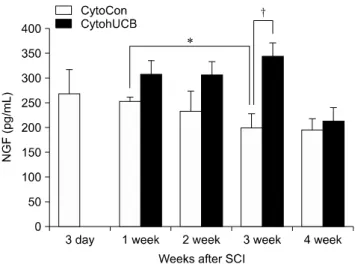
We induced percutaneous spinal cord injuries (SCI) using a balloon catheter in 45 rats and transplanted human umbilical cord blood derived mesenchymal stem cells (hUCB-MSCs) at the injury site. Locomotor function was significantly improved in hUCB-MSCs transplanted groups. Quantitative ELISA of extract from entire injured spinal cord showed increased expression of brain-derived neurotrophic factor (BDNF), nerve growth factor (NGF) and neurotrophin-3 (NT-3). Our results show that treatment of SCI with hUCB-MSCs can improve locomotor functions, and suggest that increased levels of BDNF, NGF and NT-3 in the injured spinal cord were the main therapeutic effect.
Keywords: brain-derived neurotrophic factor, nerve growth factor, neurotrophic factor, neurotrophin-3, spinal cord injury
Introduction
Traumatic spinal cord injuries (SCI), including compression and contusion, may show remaining axons in the periphery of the lesion, but they are non-functional due to demyelination.
Demyelination of axons is the result of the primary mechanical trauma, followed by secondary damage, which may include edema, ischemia, inflammation and excitotoxicity [3,18,32].
Although some spontaneous remyelination occurs, spontaneous regeneration of demyelinated axons is limited, and research regarding SCI focused primarily on promotion of axonal regrowth, remyelination and reduction of degenerative change [3,6,10,23,31]. Cell-based therapy has been considered to promote remyelination and functional recovery of SCI. Recent studies have included the use of transplanted oligodendrocyte precursor cells [15,16], bone marrow stromal cells [35], embryonic stem cells [24] and olfactory glial cells [13].
Human umbilical cord blood derived mesenchymal stem cells (hUCB-MSCs) are one of the attractive sources for cell transplantation in SCI. hUCB-MSCs are less mature than bone
marrow stems cells, and therefore less immunogenic [7].
Furthermore, hUCB-MSCs showed more proliferation potential associated with extended life span [7], raised less ethical problems and could be cryopreserved without a significant decline in viability [9].
In previous studies, hUCB-MSCs could be differentiated into various neural cells and showed improvement of locomotor function [5,19,20]. hUCB-MSCs secreted various cytokines that could be beneficial to SCI recovery, both in vitro and in vivo [3,6,9]. Moreover, Lee et al. [21] recently reported that hUCB-MSCs transplanted into dogs with SCI were able to facilitate Schwann cell-like myelination. Many studies have shown that tissue regeneration elicited by transplanted mesenchymal stem cells (MSCs) may not be the main source of functional recovery, since only a small proportion of MSCs appeared to differentiate into glial cells. Thus, increased production of neurotrophic factor following transplanted MSCs may be among the possible mechanisms of MSC-induced functional recovery [18,24,28].
In this study, we transplanted hUCB-derived MSCs into the