트레드밀 운동이 청소년기 흰쥐의 기억력과 해마 신경세포생성, BDNF, TrkB, 그리고 전뇌 콜린 세포에 미치는 영향
이 희 혁*
한남대학교 생활체육학과
Received January 16, 2009/Accepted February 23, 2009
Effects of Treadmill Exercise on Memory, Hippocampal Cell Proliferation, BDNF, TrkB, and Forebrain Cholinergic Cells in Adolescent Rats. Hee-Hyuk Lee*. Department of Sports Science, Hannam University, Daejeon 306-791, Korea - This study investigated the effects of treadmill exercise on memory ability, cell proliferation, BDNF, and TrkB in the hippocampus and forebrain cholinergic cells in adolescent rats. Male Sprague-Dawley rats (4 weeks old) were randomly assigned to the following two groups:
the sedentary group (n=10) and the exercise group (n=10). Rats in the exercise group were forced to run on a treadmill for 30 min, five times per week for 4 weeks. The latency of the step-through avoidance task was used in order to evaluate memory ability. Hippocampal brain-derived neurotrophic factor (BDNF) and tropomyosin-related kinase B (TrkB) expression were assessed by Western blotting.
Hippocampal cell proliferation and forebrain cholinergic cells were assessed by immunohistochemistry.
The present study showed that treadmill running during the adolescent period significantly improved memory capability, increased hippocampal cell proliferation, up-regulated hippocampal BDNF and TrkB expression, and enhanced the number of forebrain cholinergic cells. These results suggest that regular exercise during the adolescent period may enhance memory function.
Key words : Exercise, adolescent period, memory, cell proliferation, BDNF
*Corresponding author
*Tel:+82-42-629-7501, Fax:+82-42-629-8402
*E-mail : [email protected]
서 론
뇌의 전반적인 구조는 출산 전에 형성되고 뇌의 발달은 청소년기까지 지속된다[40]. 발달중인 뇌는 환경적 요인들에 상당히 민감하며, 인간을 포함한 다양한 동물에서 청소년기 가장 크게 영향 받는 뇌 영역은 인지능력에 중추적 역할을 담당하는 해마(hippocampus)로 알려져 있다[53]. 해마는 학 습과 기억의 형성과정에 관여하는 중요한 뇌 영역으로, 신경 의 발생기뿐만 아니라 성장 이후에도 신경세포가 지속적으 로 생성되는 특징을 지니고 있다[12]. 새로이 생성된 신경세 포는 축삭과 신경돌기 생성을 통해 기존의 해마신경회로에 새로운 시냅스를 형성함으로써 해마의 구조적 가소성에 바 탕이 된다[39]. 따라서 출생 후 신경세포 생성율은 해마기능 과 밀접히 관련되어 있어서 신경세포생성의 감소는 인지기 능의 손상을 수반하게 되는 반면에, 신경세포생성의 증가는 학습 및 기억 능력을 향상시키게 된다[43]. 이러한 해마 신경 세포의 생성율은 노화, 질병과 같은 내적요인 그리고 신체활 동과 같은 외적자극에 의해 영향을 받게 된다. 운동은 해마 신경전구세포의 증식유도를 통한 신경세포생성의 촉진과 생 존향상을 통해 해마 신경세포수를 증가시킬 수 있는 중요한 요소로 알려져 있다. van Praag 등[50]은 자발적인 휠 달리기
가 마우스의 해마 신경세포의 증식 및 생존을 향상시킴을 보 고하였고, Trejo 등[46]도 강제적인 트레드밀 달리기가 흰쥐 에서 해마 신경세포의 수를 증가시킴을 보고한 바 있다. 게 다가 Kronenberg 등[23]은 젊은 동물에서 운동이 노화로 인 한 신경세포생성의 감소를 억제시켰는데, 이것은 운동에 경 험이 없는 동물에 비해 신경세포생성율이 2배 이상 증가된 것이었다. 이러한 운동의 신경세포생성 촉진에 대한 기전이 명확히 밝혀지지 않았지만, 해마에서 발현되는 신경영양인 자들이 관여하는 것으로 제시되고 있다[1].
Brain-derived neurotrophic factor (BDNF)는 뇌의 다양한 영역에서 가장 풍부하게 발현되는 신경영양인자로 신경세포 의 성장, 발달 그리고 신경가소성에 중요한 물질이면서 신경 손상에 대한 저항을 높여 신경세포의 생존을 향상시킨다[33].
또한 다양한 학습과제에서 기억의 형성[26]과 형성된 기억을
장기기억으로 전환해 유지하는데 필수적이다[5]. 최근에는 해
마에서 발현되는 BDNF가 신경세포의 생성과 생존을 조절하
는 단백질로 보고되고 있다. 해마 BDNF 발현증가는 신경세포
생성과 생존을 향상시켰고[42], 외인성 BDNF의 해마 내 주입
도 유사한 효과를 유도했다[37]. 이러한 BDNF에 의한 신경세
포생성은 시냅스 전․후에서 tropomyosin-related kinase B
(TrkB) 수용체와의 작용을 통해 조절된다. 따라서 BDNF 혹은
BDNF 수용체인 TrkB의 감소는 각각 신경세포 생성, 분화, 그
리고 생존의 감소를 초래한다[8,11]. 유사하게 운동연구들에서
도 신경가소성의 향상기전으로 해마 BDNF와 TrkB 발현증가
를 통한 신경세포생성 증가가 제시되었다. Wu 등[54]은 5주간 의 트레드밀 달리기가 BDNF와 TrkB의 증가를 통해 신경세포 의 증식과 생존을 향상시킴을 관찰하였다. 하지만 BDNF 발현 이 손상된 동물에서 운동을 포함한 환경적 자극에 신경세포생 성이 관찰되지 않았고[41], TrkB가 결여된 형질전환 동물에서 도 운동의 BDNF 증가를 통한 신경세포생성 효과가 관찰되지 않았다[28]. 이처럼 해마의 BDNF-TrkB 신호체계가 운동으로 유도되는 신경세포생성 증가를 통해 인지기능을 향상시키는 데 밀접히 관련되어 있음을 알 수 있다.
콜린성 신경세포(cholinergic neurons)는 전뇌 기저부(basal forebrain)에 위치하여 다양한 뇌 영역에 축삭을 분포시켜 신 경전달물질인 아세틸콜린(acetylcholine, ACh)을 분비한다.
해마의 경우 구심성 신경경로의 대부분이 내측 중격의 콜린 신경세포와 연결되어 있기 때문에 중격으로부터의 구심성 정 보는 해마의 정상적인 기능을 조절하는 중요기전으로 알려져 있다[16]. 따라서 중격 콜린신경의 활성은 해마 BDNF 발현의 증가[29], 신경세포 생성[22]과 생존[20]을 향상시켰다. 반대로 콜린 신경의 손상은 BDNF 발현[7]과 신경세포 생성[9]을 감소 시켰다. 이것은 콜린 기능의 향상과 손상이 학습과 기억의 향 상과 손상을 각각 유발시킴을 의미한다. 운동과 관련된 연구 에서는 중격-해마축의 활성화[25], 해마 아세틸콜린 분비 증가 [36], 중격 손상 후 해마 BDNF 발현감소의 상쇄[6]가 보고된 바 있다. 또한 트레드밀 달리기가 콜린 신경세포수와 활성을 증가시켜 학습 및 기억력을 향상시킴이 관찰되었다[4]. 이처럼 운동으로 인한 콜린계의 향상이 해마 BDNF 발현과 신경세포 생성 증가와 관련되어 있음을 알 수 있다.
현재 규칙적인 신체활동이 뇌 기능 및 인지기능에 긍정적 효과를 지니고 있음이 많은 연구들에서 확인되고 있지만, 이 들 연구결과의 대부분이 성인, 노화, 뇌질환 등을 대상으로 한 운동의 효과에 한정되어 보고된 것이다. 일부 운동연구에 서 성장기 운동이 인지기능에 효과가 있음이 보고된 바 있지 만, 그 효과기전에 대한 연구는 아직 미흡한 실정이다. 이에 본 연구에서는 성장기 흰쥐를 대상으로 4주간의 트레드밀 운 동이 기억력과 해마 신경세포 생성, BDNF, TrkB, 그리고 중격 콜린신경세포에 미치는 효과를 조사하였다.
재료 및 방법
실험 동물
흰쥐의 청소년기는 출생 후 21일부터 60일까지로[43], 본 실험에서는 4주령의 Sprague-Dawley 수컷 흰쥐를 이용하였 다. 동물들은 3일간의 환경 적응 기간을 거치게 하였고, 4마리 당 한 개의 사육케이스(38×28×18 cm)에 넣고 항온(20±2
oC), 항습(60%)이 유지되며, 12시간 간격으로 낮과 밤을 교대시키 는 동일한 실험실 환경에서 사육되었다. 이들 흰쥐들은 대조 군(n=10)과 운동군(n=10)으로 분류되었다.
운동 프로토콜(protocol)
운동그룹의 동물들은 소형동물용 트레드밀에서 점증적인 부하를 이용하여 운동하도록 하였다. 점증부하 운동수행은 경 사도 0%에서 초기 5분간은 2 m/min 속도, 그 다음 5분간은 5 m/min 속도, 그리고 8 m/min 속도에서 20분간 총 30분 달리기를 하루 일회씩 주 5회로 4주간 실시되었다. 흰쥐에서 위와 같은 트레드밀 속도 및 경사도는 저강도 운동으로 분류 되며 해마의 신경세포생성에 있어서 가장 효과적인 강도로 보고된 바 있다[21]. 신경세포 생성의 면역조직화학법 검사를 위해 체중당 50 mg의 BrdU (Sigma Chemical Co., St. Louis, MO, USA)를 운동프로그램 시작 첫날 운동 시작 30분 전에 모든 그룹의 동물들에게 피하 주입하였다.
기억력 검사
기억력 검사를 위해 트레드밀 운동종료 3일 전부터 step-through passive avoidance 검사를 실시하였다. 이 장치 는 두 개의 방으로 구성되어있는데, 하나는 밝은 공간인 반면 에 나머지 하나는 어두운 공간이다. 어두운 공간의 방바닥에 전기충격을 가할 수 있는 강철 스테인레스가 설치되어 있다.
Acquisition trial에서 각각의 흰쥐를 밝은 공간의 방에 60초간 있게 한 다음에 밝은 공간의 방과 어두운 공간의 방을 막고 있는 문을 열어주었다. 그리고 흰쥐가 어두운 공간에 들어갈 때 가지의 시간(initial latency time)을 기록하였다. 흰쥐가 어 두운 방에 들어가자마자 문을 닫고 전기충격(75 V, 0.2 mA, 50 Hz)을 2초간 주었다. 그리고 5초가 지난 다음에 흰쥐를 꺼 내 사육장 케이스로 옮겼다. 72시간 후 acquisition trial과 동일 한 방식의 실험을 진행하였다. 이때 밝은 방에서 어두운 방으 로 들어가는 시간(retention latency time)을 기록하였다. 만약 기억력이 손상되지 않았다면 기억력이 손상된 흰쥐보다 전기 충격을 받게 되는 어두운 방으로 들어가는 시간이 길어진다.
뇌 적출 및 조직 처리
기억력검사 종료 24시간 후 실험동물들은 Zoletil 50
®(10 mg/kg)을 복강 내 주사를 통하여 마취시킨 후 흉강을 열고 좌심실을 통하여 50 mM 인산염 완충식염수(phosphate buffer saline, PBS)를 주입하고, 이 후 100 mM 인산 완충액에 녹인 4% paraformaldehyde (PFA) 고정액을 관류하였다. 관류 고정 후 뇌를 적출 한 다음 고정액에 담아서 4
oC에서 12시간 후 고정을 실시하였다. 고정된 뇌 조직은 30% sucrose 용액에서 2~5일간 침적시킨 후 Cryostat (American Optica, USA)를 이용하여 40 μm 두께의 연속관상 절편을 제작하였다.
면역조직화학 검사
해마 신경세포생성과 중격 콜린신경세포의 정량화를 위해
해당부위의 조직절편을 50 mM PBS로 세척한 후 0.5% Triton
X-100에 반응시켰다. Triton X-100을 세척한 후 65
oC에서 50%
formamide와 2× SSC 용액에서 2시간 반응시켰다. 반응 완료 후 2× SSC로 세척한 후 37
oC에서 2 N HCl에 반응시켰다. 반응 이 끝나면 바로 100 mM sodium borate, pH 8.5로 세척한 후 50 mM PBS로 다시 세척하였다. 이 과정이 끝난 조직은 자유 부유법을 사용하여 면역조직화학 염색을 시행하였다. 항체와 반응하기 전에 50 mM PBS에 10% horse serum과 1% Bovine serum albumin (BSA)를 함유한 차단용액으로 한 시간 동안 반응시켰다. 신경세포생성 확인을 위해 BrdU 항체 그리고 콜 린신경세포 확인을 위한 choline acetyltransferase (ChAT)를 각각 50 mM PBS에 0.5% BSA와 0.5% sodium azide를 함유한 일차 항체 용액(BrdU 1:600, ChAT 1:100)의 비율로 희석한 후 24시간 동안 반응시켰다. 50 mM PBS로 세척한 후, bio- tinylated anti-mouse IgG를 50 mM PBS에 0.3% Triton X-100 을 함유한 이차 항체용액에 1:200의 비율로 희석한 후 1시간 동안 반응시켰다. 50mM PBS로 세척한 후, HRP avidine-bio- tin complex (Vectastain-Elite
TMHRP ABC kit, Vector
Ⓡ, USA) 에서 1시간 동안 반응시켰다. 50 mM PBS로 세척한 후, 50 mM Tris 완충액에 과산화수소와 DAB를 함유하는 발색제로 발색반응을 실시한 다음 세척하였다. 각각의 항체들과 면역 반응이 일어난 세포들은 광학현미경을 이용하여 정량화 분석 을 실시하였다.
단백질 발현 측정
해마 BDNF와 TrkB 단백질 발현을 분석하기 위해 조직을 PBS로 washing 후 extraction buffer로 세포를 lysis시켰다. 10 분간 ice에 방치 후 4
oC에서 12,000× g로 15분간 원심 분리한 후 상청액을 새로운 tube에 옮겨 단백질을 정량 후 사용하였 다. 단백질의 정량은 Western blotting ECL kit (Amersham Co., England)를 사용하여, 분리된 단백질을 SDS-poly- acrylamide gel에서 전기 영동하였다. Sample과 4배의 sample buffer를 넣은 뒤 100
oC에서 1분간 heating 한 후 sample을 well에 넣은 뒤 100 V로 1시간 정도 run 시켰다. Coomassic blue로 5분간 gel을 stain 한 후 destaining solution으로 wash- ing 하고 electrophotesis된 gel을 membrane으로 이전하였다.
Blocking solution에서 천천히 흔들어서 세척한 후, 보합결합 을 위한 비닐주머니에 흡착지를 넣고 2-4시간 1차 항체와 결합 시키고 깨끗이 세척한 다음 이차항체-효소와 다시 1시간 동안 결합시킨 후, 발색용액을 넣고 film에 발색시켰다.
자료 처리
본 실험에서 얻은 자료는 SPSS (version 12.0) 통계프로그램 을 이용하여 처리하였다. 측정치는 평균 ± 표준편차로 표시하 고 집단간 차이 검정은 일원변량 분산분석(one-way ANOVA) 을 이용하였다. 유의차가 나타난 항목에 대한 사후검증은 Duncan의 방법을 이용하였다. 통계적 유의수준은 p<0.05로 정하였다.
결 과
운동이 기억력에 미치는 영향
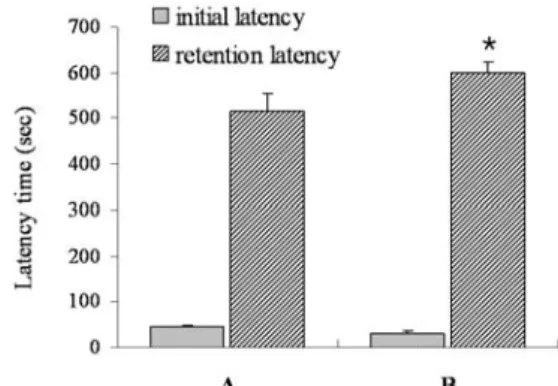
Step-through avoidance task의 latency time를 측정한 결과 initial latency는 대조군이 45.12±3.15 sec 그리고 운동군이 47.40±5.12 sec로 두 그룹 간 통계적으로 유의한 차이는 없었다 (Fig. 1). 3일 후 측정된 retention latency time에서는 대조군이 516.60±38.22 sec 그리고 운동군이 598.12±25.51 sec로 운동군 이 대조군에 비해 유의하게 증가되었다.
운동이 해마 신경세포생성에 미치는 영향
해마 치상회에서의 BrdU 양성세포수를 조사결과 대조군은
Fig. 1. Effect of exercise on the retention latency time of the passive avoidance task. The data are represented as the mean±SEM. *represents P<0.05 compared to the control group. (A) control group and (B) exercise group.
Fig. 2. Effect of exercise on cell proliferation in the hippocampus.
Upper: 5-Bromo-2’-deoxyuridine (BrdU)-positive cells. A scale bar represents 100 μm. Black dots indicate BrdU-pos- itive cells. Lower: The mean number of BrdU-positive cells. The data are represented as the mean±SEM. * repre- sents P<0.05 compared to the control group. (A) control group and (B) exercise group.
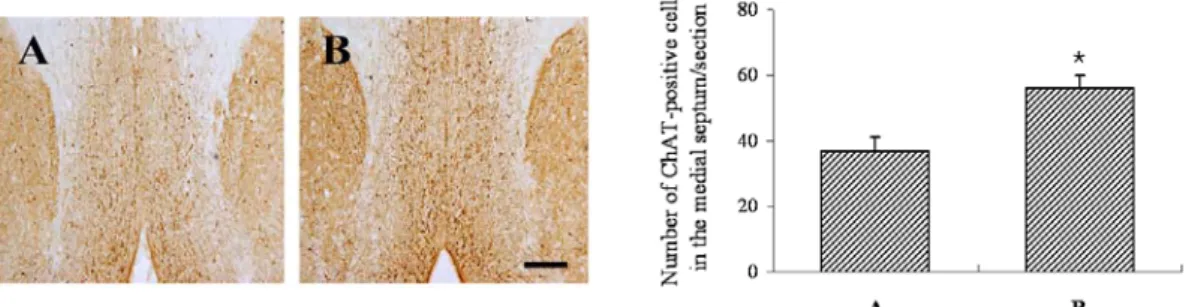
Fig. 3. Effect of exercise on the number of cholinergic neuron in the medial septum. Upper: choline acetyltransferase(ChAT)-positive cells. A scale bar represents 100 μm. Brown dots indicate ChAT-positive cells. Lower: The mean number of ChAT-positive cells. The data are represented as the mean±SEM. * represents P<0.05 compared to the control group. (A) control group and (B) exercise group.
Fig. 4. Effect of exercise on BDNF level in the hippocampus. Upper: Representative expressions of the protein level of BDNF and actin in the hippocampus. Lower: Relative BDNF expression in the hippocampus. Data are expressed as a percentage of control. Molecular weights of BDNF=15 kDa; Actin=42 kDa. * represents P<0.05 compared to the control group. (A) control group and (B) exercise group.
Fig. 5. Effect of exercise on TrkB level in the hippocampus. Upper: Representative expressions of the protein level of TrkB and actin in the hippocampus. Lower: Relative TrkB expression in the hippocampus. Data are expressed as a percentage of control. Molecular weights of TrkB=145 kDa; Actin=42 kDa. * represents P<0.05 compared to the control group. (A) control group and (B) exercise group.
45.24±8.51/mm
2그리고 운동군은 58.76±7.65/mm
2로 나타나 운동이 해마 신경세포생성을 유의하게 증가시킨 것으로 나타 났다(Fig. 2).
운동이 중격 콜린 뉴런수에 미치는 영향
중격에서 ChAT 양성세포수를 조사결과 대조군이 38.54±
6.80/section 그리고 운동군이 57.51±6.17/section로 나타나 운동이 콜린성 신경세포를 유의하게 증가시킨 것으로 나타 났다(Fig. 3).
운동이 해마 BDNF와 TrkB 발현에 미치는 효과
본 연구에서 해마 BDNF와 BDNF 수용체인 TrkB 단백질 발현을 Western blot 분석을 통한 정량적 분석결과 운동군의 BDNF와 TrkB 단백질 발현을 대조군의 BDNF 단백질 발현 량을 100으로 하여 백분율로 비교했을 때 BDNF는 2.1±
0.27% 그리고 TrkB는 1.41±0.14%로 나타났다(Fig. 4와 Fig.
5). 본 연구결과 운동이 해마 BDNF와 TrkB 단백질 발현을
모두 유의하게 증가시킨 것으로 나타났다.
고 찰
본 연구에서 성장기 운동이 기억력에 미치는 영향을 평가하 기 위해서 step-through passive avoidance 행동검사를 실시 하였다. 해마는 공간 학습과 기억에 핵심적인 역할을 담당하 기 때문에 동물에서 해마관련 행동검사는 방사형 미로(radial maze), 모리스 수중미로(morris water maze), 수동적 회피 (passive avodance)와 같은 공간성 학습으로 측정된다[52]. 이 중 수동적 회피검사는 공간성 기억력의 유지(spatial memory retention) 능력, 즉 장기기억을 평가하는데 타당한 지표로 이 용된다[17]. 이 검사에서 먼저 동물들은 어두운 방에 들어가면 전기충격을 받게 됨을 학습․기억하는 훈련을 받았다. 이 훈 련동안 어두운 방에 들어갈 때까지의 시간, 즉 initial latency 에서는 그룹 간 유의한 차이가 없었다. 이후 학습된 기억경험 의 유지능력을 알아보기 위해 3일 후 동일한 조건에서 수행된 latency 즉, retention latency의 시간은 훈련시 받은 전기충격 을 기억하는 능력과 비례하게 된다. 본 연구에서 retention la- tency를 측정한 결과 운동군이 대조군에 비해 유의하게 연장 된 것으로 나타나 인지기능의 향상을 관찰 하였다. 운동이 해 마에 의존하는 학습과 기억능력의 향상을 통해 인지수행력을 향상을 향상시킬 수 있음은 동물과 임상연구를 통해 잘 알려 져 있다. 성년기 동물에서 운동은 공간 학습기능을 향상시켰 고[3], 성장기 동물에서도 트레드밀 운동이 공간 기억 수행력 을 향상시켰다[27,47]. 게다가 규칙적인 운동참여는 치매와 같 은 퇴행성 뇌질환으로 유발되는 인지기능의 손상을 지연 혹은 개선하는데도 효과가 있다[19,24]. 이러한 인지기능의 향상은 해마 신경세포생성과 신경영양인자의 발현증가가 주원인으 로 알려져 있다[31].
본 연구에서 성장기 운동이 해마 신경세포생성에 미치는 효과를 조사한 결과 운동이 해마 신경세포생성을 유의하게 증가시키는 것으로 나타났다. 성숙한 동물에서 운동의 신경세 포생성 효과는 잘 알려져 있다. 최근 성장기 운동의 효과를 조사했던 연구에서도 저강도 트레드밀 달리기가 신경세포생 성을 유의하게 증가시켰고[30], 청소년기 규칙적인 유산소 운 동이 해마 신경세포의 밀도를 증가시켜 기억 수행력이 향상되 었음이 보고된 바 있다[47]. 해마에서 새로이 생성된 신경세포 는 환경적 자극에 반응해 인지기능, 특히 학습과 기억력을 향 상 시키며[43], 운동으로 증가된 해마 신경세포도 학습 및 기억 의 향상과 관련된 것으로 보고된 바 있다[51]. 또한 운동은 새 로이 생성된 신경세포의 생존율과 뉴런으로의 성숙율도 증가 시킨다. van Praag 등[49]은 마우스에서 BrdU 주입 후 4주간 의 달리기 운동 후 새로이 생성된 신경세포의 생존율(BrdU 양성세포수)이 비운동군에 비해 2배 높았다. 최근 Wu 등[54]
도 BrdU 주입 후 5주간의 달리기가 증식된 세포의 생존율을 50%(대조군 30%)까지 증가시켰고 생존한 세포에서 기능을 지 닌 성숙한 세포수는 대조군보다 2.5배 높아 운동이 신경세포
생성과 생존 그리고 성숙을 촉진시킴을 보고하였다. 흰쥐에서 새로이 생성된 신경세포의 약 절반정도만 생존하여 이동과 분화라는 성숙화 과정을 통해 해마형성체의 신경회로에 합병 되는데 약 4주가 걸린다[10]. 본 연구에서 BrdU 주입 후 4주간 의 운동 후 BrdU 양성세포수를 정량화한 결과 성장기 운동에 의한 신경세포생성 증가뿐만 아니라 증식된 세포가 기능을 지닌 성숙한 세포로 생존시키는데 효과가 있음을 보여주는 것이다. 이것은 성장기 흰쥐에서 운동으로 인한 해마 신경세 포생성의 증가가 본 연구에서 관찰된 기억력 향상에 도움이 된 것으로 생각된다.
BDNF와 BDNF 수용체인 TrkB의 신호전달체가 해마에서 분화와 성숙을 포함한 신경세포생성을 조정하게 된다[11,18].
BDNF 발현증가는 신경세포생성의 향상[34]과 생성된 신경세 포의 생존[42]을 촉진시켰던 반면에, BDNF의 결핍은 신경세 포생성과 생존율을 감소시켰다[8]. 연령증가에 따른 BDNF 발 현의 감소는 신경세포생성 손상에 원인으로 제시된바 있고 [32], 해마 신경세포증식이 세포사멸을 보상하지 못해 유발되 는 알쯔하이머형 치매환자의 경우에도 해마 BDNF 단백질이 70%까지 감소됨이 관찰되었다[35]. 게다가 BDNF의 선천성 결손증을 지닌 동물은 운동을 포함한 환경적 자극으로 인한 신경세포생성에 반응하지 못했다[41].
운동으로 인한 해마 BDNF와 TrkB 단백질 증가효과는 잘 알려져 있다. 자발적인 저강도 운동인 휠달리기가 해마 BDNF 와 TrkB 단백질 발현을 증가시켰다[6,38,51,54]. 강제적인 저강 도 트레드밀 달리기도 해마 BDNF 단백질을 70% 증가시켰다 [2]. 하지만, 최근 Soya 등[44]은 강도별 트레드밀 운동이 성숙 한 흰쥐 해마 BDNF mRNA와 단백질 발현에 미치는 효과를 조사한 결과 저강도 달리기만이 효과 있는 것으로 나타났고, 중정도 강도 이상에서는 혈중 젖산과 스트레스 호르몬인 글루 코코르티코이드의 축적으로 인해 BDNF 단백질이 오히려 감 소되는 것으로 보고하였다. 유사하게 성숙하지 않은 동물에서 도 저강도 트레드밀 운동에서만 BDNF 발현이 증가되었고, 고강도의 경우에는 오히려 BDNF 발현이 감소되었다[30]. 본 연구에서 성장기 저강도 트레드밀 달리기는 해마 BDNF와 TrkB 발현증가를 통한 BDNF- TrkB 신호전달체계의 향상이 신경세포생성 및 생존의 향상에 기여했음을 알 수 있다.
뇌의 콜린계는 해마 BDNF 발현의 조절에 관여해 cAMP response element binding protein (CREB)의 인산화, 즉 신호 전달을 활성화시킨다. 활성화된 CREB 신호체는 해마에서 신 경세포증식 및 생존을 향상시키는 것으로 알려져 있다[15]. 따 라서 해마와 연결된 콜린세포의 실험적 손상은 해마 BDNF 발현감소[13]와 신경세포생성과 생존을 감소시킨다[48]. 반대 로, 콜린에스터라제(cholinesterase) 억제로 유발된 콜린계 활 성은 해마 BDNF와 TrkB 발현[14]과 신경세포생성을 증가시 켰다[22]. 본 연구에서 운동은 중격 콜린세포수를 증가시켰다.
이것은 최근 운동이 콜린 세포수를 증가시켜 인지기능을 향상
시킴을 보고한 연구결과와 일치하는 것이다[4]. 게다가 Berchtold 등[7]은 운동에 의한 해마 BDNF 발현증가가 중격 콜린계의 활성증가로 유발됨을 관찰하였고, 또한 중격 손상으 로 인한 해마 BDNF 발현감소가 운동으로 상쇄됨을 보고하였 다. 이러한 연구들에 기초해 볼 때 본 연구에서 관찰된 BDNF 발현 증가와 신경세포생성 증가가 콜린세포의 활성화와 관련 되어 있음을 알 수 있다.
요 약
본 연구는 청소년기 흰쥐를 대상으로 4주간의 저강도 트레 드밀 운동이 기억력과 해마 신경세포생성, BDNF, Trkb, 중격 콜린세포에 미치는 효과를 조사하기 위하여 수행되었다. 먼저 운동이 기억력에 미치는 효과를 step-through avoidance에서 검사한 결과 운동을 실시했던 흰쥐의 retention latency가 대조 군에 비해 유의하게 증가되어 기억력 향상을 나타내었다. 이 후 기억력 향상기전으로 해마에서 신경세포증식과 BDNF 및 TrkB 단백질 발현을 정량화 한 결과에서도 운동군의 신경세포 생성율과 BDNF와 TrkB 단백질 발현 모두 대조군에 비해 유의 하게 증가된 것으로 나타났다. 게다가 운동을 통한 전뇌 콜린 세포 수의 증가가 해마 신경세포생성과 BDNF 발현 증가에 기여하는 것으로 나타났다. 이러한 결과는 청소년기 운동이 기억력 향상에 도움이 될 수 있음을 보여주는 것이다.
감사의 글
이 논문은 2008년도 한남대학교 학술연구조성비 지원에 의 하여 연구되었음
References
1. Achiron, A. and A. Kalron. 2008. Physical activity: positive impact on brain plasticity. Harefuah 147, 252-255.
2. Aguiar, A. S., A. E. Speck, R. D. Prediger, F. Kapczinski, and R. A. Pinho. 2008. Downhill training upregulates mice hippocampal and striatal brain-derived neurotrophic factor levels. J. Neural. Transm. 115, 1251-1255.
3. Anderson, B. J., D. N. Rapp, D. H. Baek, D. P. McCloskey, P. S. Coburn-Litvak, and J. K. Robinson. 2000. Exercise in- fluences spatial learning in the radial arm maze. Physiol.
Behav. 70, 425-429.
4. Ang, E. T., G. S. Dawe, P. T. Wong, S. Moochhala, and Y.
K. Ng. 2006. Alterations in spatial learning and memory after forced exercise. Brain Res. 1113, 186-193.
5. Bekinschtein, P., M. Cammarota, C. Katche, L. Slipczuk, J.
L. Rossato, A. Goldin, I. Izquierdo and J. H. Medina. 2008.
BDNF is essential to promote persistence of long-term mem- ory storage. Proc. Natl. Acad. Sci. 105, 2711-2716.
6. Berchtold, N. C., G. Chinn, M. Chou, J. P. Kesslak, and C.
W. Cotman. 2005. Exercise primes a molecular memory for brain-derived neurotrophic factor protein induction in the rat hippocampus. Neuroscience 133, 853-861.
7. Berchtold, N. C., J. P. Kesslak, and C. W. Cotman. 2002.
Hippocampal brain-derived neurotrophic factor gene regu- lation by exercise and the medial septum. J. Neurosci. Res.
68, 511-521.
8. Chan, J. P., J. Cordeira, G. A. Calderon, L. K. Iyer, and M.
Rios. 2008. Depletion of central BDNF in mice impedes ter- minal differentiation of new granule neurons in the adult hippocampus. Mol. Cell Neurosci. 39, 372-383.
9. Cooper-Kuhn, C. M., J. Winkler, and H. Kuhn. 2004.
Decreased neurogenesis after cholinergic forebrain lesion in the adult rat. J. Neurosci. Res. 77, 155-165.
10. Dayer, A. G., A. A. Ford, K. M. Cleaver, M. Yassaee, and H. A. Cameron. 2003. Short-term and long-term survival of new neurons in the rat dentate gyrus. J. Comp. Neurol.
460, 563-572.
11. Donovan, M. H., M. Yamaguchi, and A. J. Eisch. 2008.
Dynamic expression of TrkB receptor protein on proliferat- ing and maturing cells in the adult mouse dentate gyrus.
Hippocampus 18, 435-439.
12. Eriksson, P. S., E. Perfilieva, T. Bjork-Eriksson, A. M.
Alborn, C. Nordborg, D. A. Peterson, and F. H. Gage. 1998.
Neurogenesis in the adult human hippocampus. Nat. Med.
4, 1313-1317.
13. Ferencz, I., M. Kokaia, M. Keep, E. Elmér, M. Metsis, and Z. Kokaia. 1997. Effects of cholinergic denervation on seiz- ure development and neurotrophin messenger RNA regu- lation in rapid hippocampal kindling. Neuroscience 80, 389-399.
14. French, S. J., T. Humby, C. H. Horner, M. V. Sofroniew, and M. Rattray. 1999. Hippocampal neurotrophin and trk receptor mRNA levels are altered by local administration of nicotine, carbachol and pilocarpine. Brain Res. Mol. Brain.
Res. 67, 124-136.
15. Fujioka, T., A. Fujioka, and R. S. Duman. 2004. Activation of cAMP signaling facilitates the morphological maturation of newborn neurons in adult hippocampus. J. Neurosci. 24, 319-328.
16. Gold, P. E. 2003. Acetylcholine modulation of neural sys- tems involved in learning and memory. Neurobiol. Learn.
Mem. 80, 194-210.
17. Harrell, L. E., A. D. Peagler, and D. S. Parsons. 1987.
Passive-avoidance learning after medial septal lesions: effect of experience and the peripheral sympathetic nervous system. Exp. Neurol. 97, 542-554.
18. Hu, Y. and S. J. Russek. 2008. BDNF and the diseased nerv- ous system: a delicate balance between adaptive and patho- logical processes of gene regulation. J. Neurochem. 105, 1-17.
19. Jeong, I. G., J. H. Yoon, and H. H. Lee. 2008. Effects of Exercise Pre-conditioning on Memory and Cell Proliferation in the Hippocampus of the Rats with Streptozotocin-in- duced Alzheimer's disease. Journal of Life Science 18. 631-638.
20. Kaneko, N., H. Okano, and K. Sawamoto. 2006. Role of the cholinergic system in regulating survival of newborn neu-
rons in the adult mouse dentate gyrus and olfactory bulb.
Genes Cells 11, 1145-1159.
21. Kim, Y. P., H. B. Kim, M. H. Jang, B. V. Lim, Y. J. Kim, H. Kim, and C. J. Kim. 2003. Magnitude- and time-depend- ence of the effect of treadmill exercise on cell proliferation in the dentate gyrus of rats. Int. J. Sports Med. 24, 114-117.
22. Kotani, S., T. Yamauchi, T. Teramoto, and H. Ogura. 2006.
Pharmacological evidence of cholinergic involvement in adult hippocampal neurogenesis in rats. Neuroscience 142, 505-514.
23. Kronenberg, G., A. Bick-Sander, E. Bunk, C. Wolf, D.
Ehninger, and G. Kempermann. 2006. Physical exercise pre- vents age-related decline in precursor cell activity in the mouse dentate gyrus. Neurobiol. Aging 27, 1505-1513.
24. Laurin, D., R. Verreault, J. Lindsay, K. MacPherson, and K. Rockwood. 2001. Physical activity and risk of cognitive impairment and dementia in elderly persons. Arch. Neurol.
58, 498-504.
25. Lawson, V. H. and B. H. Bland. 1993. The role of the septo- hippocampal pathway in the regulation of hippocampal field activity and behavior: analysis by the intraseptal mi- croinfusion of carbachol, atropine, and procaine. Exp.
Neurol. 120, 132-144.
26. Lee, J. L., B. J. Everitt, and K. L. Thomas. 2004. Independent cellular processes for hippocampal memory consolidation and reconsolidation. Science 304, 839-843.
27. Lee, H. H., J. H. Yoon, and S. H. Kim. 2007. Effects of Treadmill Exercise on Memory and Hippocampal BDNF Expression in Streptozotocin-induced Diabetic Rats. Journal of Life Science 17, 1461-1471.
28. Li, Y., B. W. Luikart, S. Birnbaum, J. Chen, C. H. Kwon, S. G. Kernie, R. Bassel-Duby, and L. F. Parada. 2008. TrkB regulates hippocampal neurogenesis and governs sensi- tivity to antidepressive treatment. Neuron 59, 399-412.
29. Lindefors, N., P. Ernfors, T. Falkenberg, and H. Persson.
1992. Septal cholinergic afferents regulate expression of brain-derived neurotrophic factor and betanerve growth factor mRNA in rat hippocampus. Exp. Brain Res. 88, 78-90.
30. Lou, S. J., J. Y. Liu, H. Chang, and P. J. Chen. 2008.
Hippocampal neurogenesis and gene expression depend on exercise intensity in juvenile rats. Brain Res. 1210, 48-55.
31. Ma, Q. 2008. Beneficial effects of moderate voluntary phys- ical exercise and its biological mechanisms on brain health.
Neurosci. Bull. 24, 265-270.
32. Mattson, M. P., S. Maudsley, and B. Martin. 2004. BDNF and 5-HT: a dynamic duo in age-related neuronal plasticity and neurodegenerative disorders. Trends Neurosci. 27, 589-594.
33. Mizuno, M., K. Yamada, A. Olariu, H. Nawa, and T.
Nabeshima. 2000. Involvement of brain-derived neuro- trophic factor in spatial memory formation and main- tenance in a radial arm maze test in rats. J. Neurosci. 20, 7116-7121.
34. Morcuende, S., C. A. Gadd, M. Peters, A. Moss, E. A. Harris, A. Sheasby, A. S. Fisher, C. De Felipe, P. W. N. M. Rupniak, K. P. Giese, and S. P. Hunt. 2003. Increased neurogenesis
and brain-derived neurotrophic factor in neurokinin-1 re- ceptor gene knockout mice. Eur. J. Neurosci. 18, 1828-1836.
35. Murray, K. D., C. M. Gall, E. G. Jones, and P. J. Isackson.
1994. Differential regulation of brain-derived neurotrophic factor and type II calcium/calmodulin-dependent protein kinase messenger RNA expression in Alzheimer's disease.
Neuroscience 60, 37-48.
36. Nilsson, O. G., P. Kalen, E. Rosengren, and A. Bjorklund.
1990. Acetylcholine release in the rat hippocampus as stud- ied by microdialysis is dependent on axonal impulse flow and increases during behavioural activation. Neuroscience 36, 325-338.
37. Pinnock, S. B. and J. Herbert. 2008. Brain-derived neuro- tropic factor and neurogenesis in the adult rat dentate gy- rus: interactions with corticosterone. Eur. J. Neurosci. 27, 2493-2500.
38. Ploughman, M., S. Granter-Button, G. Chernenko, Z.
Attwood, B. A. Tucker, K. M. Mearow, and D. Corbett. 2007.
Exercise intensity influences the temporal profile of growth factors involved in neuronal plasticity following focal ischemia. Brain Res. 1150, 207-216.
39. Ramirez-Amaya, V., D. F. Marrone, F. H. Gage, P. F.
Worley, and C. A. Barnes. 2006. Integration of new neurons into functional neural networks. J. Neurosci. 26, 12237-12241.
40. Rice, D. and B. J. Stan. 2000. Critical periods of vulnerability for the developing nervous system: evidence from humans and animal models. Environ. Health Perspect. 108, 511-533.
41. Rossi, C., A. Angelucci, L. Costantin, C. Braschi, M.
Mazzantini, F. Babbini, M. E. Fabbri, L. Tessarollo, L.
Maffei, N. Berardi, and M. Caleo. 2006. Brain-derived neu- rotrophic factor (BDNF) is required for the enhancement of hippocampal neurogenesis following environmental enrichment. Eur. J. Neurosci. 24, 1850-1856.
42. Sairanen, M., G. Lucas, P. Ernfors, M. Castrén, and E.
Castrén. 2005. Brain-derived neurotrophic factor and anti- depressant drugs have different but coordinated effects on neuronal turnover, proliferation, and survival in the adult dentate gyrus. J. Neurosci. 25, 1089-1094.
43. Shors, T. J., G. Miesegaes, A. Beylin, M. Zhao, and T. G.
E. Rydel. 2001. Neurogenesis in the adult is involved in the formation of trace memories. Nature 410, 372-376.
44. Soya, H., T. Nakamura, C. C. Deocaris, A. Kimpara, M.
Iimura, T. Fujikawa, H. Chang, B. S. McEwen, and T.
Nishijima. 2007. BDNF induction with mild exercise in the rat hippocampus. Biochem. Biophys. Res. Commun. 358, 961-967.
45. Spear, L. P. 2000. The adolescent brain and age-related be- havioral manifestations. Neurosci. Biobehav. Rev. 24, 417-463.
46. Trejo, J. L., E. Carro, and I. Torres-Aleman. 2001. Circulating insulin-like growth factor I mediates exercise-induced in- creases in the number of new neurons in the adult hippocampus. J. Neurosci. 21, 1628-1634.
47. Uysal, N., K. Tugyan, B. M. Kayatekin, O. Acikgoz, H. A.
Bagriyanik, S. Gonenc, D. Ozdemir, I. Aksu, A. Topcu, and I. Semin. 2005. The effects of regular aerobic exercise in ado- lescent period on hippocampal neuron density, apoptosis
and spatial memory. Neurosci. Lett. 383, 241-245.
48. Van der Borght, K., J. Mulder, J. N. Keijser, B. J. Eggen, P.
G. Luiten, and E. A. Van der ZeeE. 2005. Input from the medial septum regulates adult hippocampal neurogenesis.
Brain Res. Bull. 67, 117-125.
49. van Praag, H., B. R. Christie, T. J. Sejnowski, and F. H. 1999.
Running enhances neurogenesis, learning, and long-term potentiation in mice. Proc. Natl. Acad. Sci. 96, 13427-13431.
50. van Praag, H., G. Kempermann, and F. H. Gage. 2004.
Running increases cell proliferation and neurogenesis in the adult mouse dentate gyrus. Nat. Neurosci. 2, 266-270.
51. Vaynman, S., Z. Ying, and F. Gomez-Pinilla. 2004. Exercise induces BDNF and synapsin I to specific hippocampal
subfields. J. Neurosci. Res. 76, 356-362.
52. Wagatsuma, H. and Y. Yamaguchi. 2007. Neural dynamics of the cognitive map in the hippocampus. Cogn. Neurodyn.
2, 119-141.
53. Wolfer, D. P. and H. P. Lipp. 1995. Evidence for physio- logical growth of hippocampal mossy fiber collaterals in the guinea pig during puberty and adulthood. Hippocampus 5, 329-340.
54. Wu, C. W., Y. T. Chang, L. Yu, H. I. Chen, C. J. Jen, S.
Y. Wu, C. P. Lo, and Y. M. Kuo. 2008. Exercise enhances the proliferation of neural stem cells and neurite growth and survival of neuronal progenitor cells in dentate gyrus of middle-aged mice. J. Appl. Physiol. 105, 1585-1594.